Truly Christian and Truly American Can Both Be True

I see a lot of journalists shocked that roughly a third of Americans believe that Christianity is a key to being “truly American,” according to a recent Pew poll. Compared to, say, Sweden, that’s a huge number.

Liberals don’t like to think that what makes someone “American” looks very much like what makes someone Christian.

Were you to look at the whole of a people and their history of giving, fighting for freedom and liberty around the world, accepting all comers who share those values (and many who don’t), governed under a principle of natural law derived from our Creator, you would see a Biblical template beneath it.

You would also see the people of the United States of America fitting that template. People who look through a purely political lens see Christianity as something to hide behind, masking motives like racism and xenophobia. Liberals have so rewritten history to fit their own narrative and philosophy that they can’t see a connection that expresses itself so naturally from many Americans who aren’t hung up on race identity politics.

I don’t think the people who answered the Pew survey were thinking, “Americans must be church-attending, white, Protestants.” I think they were thinking “what values make us American?”

The obvious things that tie people to a nationality — common language, customs and traditions — are shared by many countries (except, it seems, Sweden). Faith is where most countries differ on national identity. Greeks maintain the strongest ties to religion, and given the Greek Orthodox Church, that makes sense. Third on the list is the U.S., by far the largest, most pluralistic nation to tie faith closely to national identity.

But why? This is where the great philosophical divide, along with differing views of American history, is exposed.

Julie Zauzmer at the Washington Post suggested it might be related to political ideology and the particular brand of Christianity with which Americans associate.

One’s own religion also strongly affected the answers: Pew found that 57 percent of white evangelical Protestants thought it was very important to be Christian in order to be American, while 29 percent of white mainline Protestants, 27 percent of Catholics and just 9 percent of people unaffiliated with a faith felt the same way.

Kathryn Casteel at FiveThirtyEight posited that the attitudes regarding what makes one feel “American” strongly correlates with one’s support for, or opposition to, President Donald Trump.

There was also a partisan divide: Around 43 percent of Republicans surveyed by Pew felt that Christianity was an important part of being an American, versus 29 percent of Democrats and 26 percent of independents. Exit polls show Trump won 80 percent of white born-again and evangelical Christian voters and smaller majorities among all other denominations of Christianity.

Is a Christian-based view of America a racist view? Is it related to being a white, Anglo-Saxon, Protestant (WASP)?

Certainly a poll could be interpreted that way based on who answered which way. But Democrats, African Americans and Hispanic Americans believed that “sharing American customs and traditions were very important, and 70 percent of all Americans believed that speaking English was very important to national identity.

I submit that it’s not racist, nor is it ignorant to believe that Christianity is inimitably tied to Americanism.

American government is founded on the principle of natural law, which is derived from God as the creator and father of all moral law. Our rights in pluralistic America do not derive from the heredity of monarchs, or the consent of the State, or the majority opinion of its citizens. Our rights are inherent and granted by God.

Engraved on the Statue of Liberty, poet Emma Lazarus wrote “Here at our sea-washed, sunset gates shall stand a mighty woman with a torch, whose flame is the imprisoned lightning, and her name Mother of Exiles.” Some have cited these words as proof that those who seek to protect America are either not Christian, or those who claim Christianity cannot also claim America.

They have it wrong. Truly, they have it backwards.

It’s not that to be truly American, one must first be a Christian. It’s that if one is truly American, and understands true Christianity, looking in the mirror of “American” you find “Christian.” It’s not because of who we call ourselves, it’s because of what we do, what we believe and how we act toward others.

America truly is a Christian nation, because those who understand both correctly realize that one could not exist without the other. (For more from the author of “Truly Christian and Truly American Can Both Be True” please click HERE)

Follow Joe Miller on Twitter HERE and Facebook HERE.

From Campaign Finance to Regulations: Why Gorsuch Was the Perfect Pick for Trump

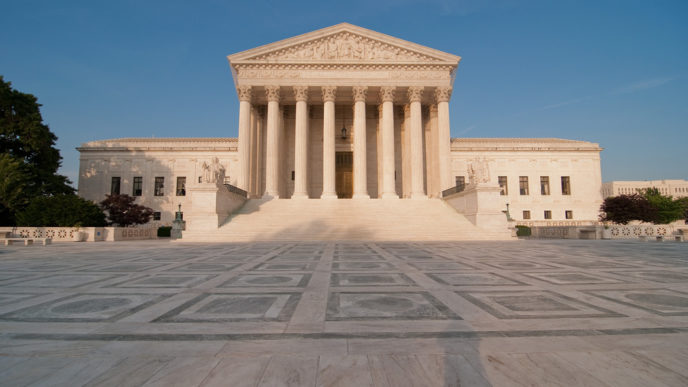
When President Donald Trump introduced his pick for the U.S. Supreme Court at the White House Tuesday night, he told the American people that he had kept his campaign promise “to select someone who respects our laws … and who loves our Constitution and someone who will interpret them as written.”

With the nomination of Tenth Circuit Judge Neil Gorsuch, Trump has indeed kept his word. Gorsuch’s record as a lawyer, judge, and legal intellectual demonstrates that he is indeed a constitutional textualist who believes, as he said in a 2016 speech on the passing of Justice Antonin Scalia at Case Western, that judges must:

apply the law as it is, focusing backward, not forward, and looking to text, structure and history to decide what a reasonable reader at the time of the events in question would have understood the law to be – not to decide cases based on their own moral convictions or the policy consequences they believe might serve society best.

Gorsuch confirmed that this is his view of the proper role of a judge when he spoke to the invited crowd of administration supporters at the White House, and said something that many liberals — including some who sit on our federal courts — disagree with:

in our legal order it is for Congress and not the courts to write new laws. It is the role of judges to apply, not alter, the work of the people’s representatives. A judge who likes every outcome he reaches is very likely a bad judge stretching for results he prefers rather than those the law demands.

Most importantly, Gorsuch has demonstrated that same approach in numerous opinions upholding basic rights in the Bill of Rights. In Riddle v. Hickenlooper, for example, he concurred in an opinion that tossed out a law setting different campaign contribution limits for major and minor party candidates. As he said, no one can dispute:

that the act of contributing to political campaigns implicates a ‘basic constitutional freedom,’ one lying ‘at the foundation of a free society’ and enjoying a significant relationship to the right to speak and associate — both expressly protected First Amendment activities.

This is very important because the Supreme Court has had a series of cases in recent years involving restrictions on campaign financing and speech that the liberal justices on the Court have refused to recognize as violating the First Amendment right to freely associate and engage in political activity. Justice Scalia was the needed fifth vote in these cases, such as Citizens United v. FEC, so it is vital that the new justice be someone like Gorsuch who has shown a firm commitment to upholding the First Amendment in the area of political speech and political activity.

In cases ranging from Hobby Lobby v. Burwell to Little Sisters of the Poor v. Burwell to Summum v. Pleasant Grove City, Gorsuch either joined majority opinions or filed dissents upholding the religious freedom rights of citizens under the First Amendment or the Religious Freedom Restoration Act, particularly their right to be protected from undue burdens imposed by the government that violate their religious beliefs. And that includes dissents criticizing the Supreme Court in American Atheists Inc. v. Davenport and Green v. Haskel County Board of Commissioners for creating a test that is far too likely to find supposedly impermissible endorsements of religion by the government when none was intended, resulting in religious adherents being prohibited from participating in public life.

Given the threat imposed to our liberty, our freedom, and our financial wellbeing by overregulation and unaccountable federal bureaucracies, the views that Gorsuch has expressed towards the administrative state are also needed on the Supreme Court. Last year in Gutierrez-Brizuela v. Lynch, he authored a concurring opinion in which he criticized the validity of the Supreme Court’s holding in Chevron v. NRDC.

That decision established a rule giving broad deference to decisions made by federal bureaucrats, rather than judges, when it comes to interpreting ambiguous laws. According to Gorsuch, this rule allows “executive bureaucracies to swallow huge amounts of core judicial and legislative power and concentrate federal power in a way that seems more than a little difficult to square with the Constitution of the framers’ design.”

Gorsuch summarily encapsulated the problems with the type of activist judges who think of themselves as super legislators in his speech at Case Western. As Gorsuch said, consider what happens when we allow a judge to act as a legislator:

Unconstrained by the bicameralism and presentment hurdles of Article I, the judge would need only his own vote, or those of just a few colleagues, to revise the law willy-nilly in accordance with his preferences and the task of legislating would become a relatively simply thing. Notice, too, how hard it would be to revise this so-easily-made judicial legislation to account for changes in the world or to fix mistakes. Unable to throw judges out of office in regular elections, you’d have to wait for them to die before you’d have any chance of change. And even then you’d find change difficult, for courts cannot so easily undo their errors given the weight they afford precedent. Notice finally how little voice the people would be left in a government where life-appointed judges are free to legislate alongside elected representatives. The very idea of self-government would seem to wither to the point of pointlessness.

That is exactly the kind of attitude against unrestrained judges who rewrite the law to suit their ideology that we need in a Supreme Court justice. Hopefully with the help of Justice Gorsuch, President Donald Trump and the new Congress will finally start to rein in the federal government and the administrative state and start to corral it back within the limits on its power that the Founders set out in the Constitution. (For more from the author of “From Campaign Finance to Regulations: Why Gorsuch Was the Perfect Pick for Trump” please click HERE)

Follow Joe Miller on Twitter HERE and Facebook HERE.
Democrats Have Run out of Ideas — Even Bad Ones

Just days into the Trump administration, the left’s narrative is clear. First, it was that Trump is an “illegitimate” president because he didn’t win the popular vote, claims about “voter fraud” notwithstanding.

Then the left tried name-calling. Unfit. Immoral. Crude. High-handed. Fascist. His supporters stuck with him when similar tactics were tried during the campaign.

Now the narrative has gone “racist,” that all-purpose word the left seems ready to attach to anyone for any reason. Egged on by their media allies, Democrats called the temporary halt on immigrants from seven Muslim-majority countries “racist” and referred to it as a travel “ban.” It was nothing of the kind and, according to a recent USA Today report, the Department of Homeland Security, as of Sunday night, said “all 109 travelers who were detained for additional screening under Trump’s order had their cases resolved.” DHS granted waivers to 392 legal permanent residents “after they underwent additional screening and allowed to enter the country.”

This action shouldn’t come as a surprise. It’s what Trump promised during the campaign.

It should also be noted, because the major media doesn’t, that the past six presidents have limited access or banned outright immigrants from certain parts of the world deemed dangerous, as they are allowed to do by the Immigration and Nationality Act of 1952. These include former President Obama, who couldn’t help himself and spoke out against the temporary delay. Trump’s action, as noted by Matt Vespa for townhall.com, “is based on a bill that Obama signed into law in December 2015.” At that time Obama restricted waivers from the same seven majority-Muslim countries — Iran, Iraq, Syria, Sudan, Somalia, Libya and Yemen — that President Trump did. (Read more from “Democrats Have Run out of Ideas — Even Bad Ones” HERE)

Follow Joe Miller on Twitter HERE and Facebook HERE.

With Gorsuch Pick and Sane Policy Towards Islamists, Trump Defends the Vulnerable

I’m delighted to admit it: I was wrong. I was one of those Christian conservatives who never came around to trusting Donald Trump. I didn’t endorse him, and almost couldn’t vote for him. At the last moment, as I stared at the ballot, thinking of Clinton’s track record of pro-abortion extremism and reckless disregard for religious minorities in the Middle East, I managed to pull the lever.

How glad I am that I did. As I learn more and more about Neil Gorsuch, I cannot wait for him to fill Justice Scalia’s chair on the U.S. Supreme Court. Tens of millions of pro-life Americans should today offer prayers of thanks, and publicly praise the President for such a solid, courageous choice. We must get on the phones and social media, pressing our senators to confirm Judge Gorsuch.

Iraqis in Refugee Camps Danced for Joy When Trump Took Office

But I’d already seen an excellent reason to be thankful that Donald Trump won. On his inauguration day, I wasn’t in Washington, D.C., but in Iraq — finishing up a tour of refugee camps on the borders of ISIS territory, for a documentary I’m producing.

If you thought that Republicans in D.C. were celebrating Trump’s entry into office, you should have seen the Iraqis in those camps. Muslims, Christians, and Yezedis alike were cheering and dancing together. (So, as I learned from my friends there, were Christians down in embattled South Sudan.)

If you want a grimly objective measuring stick of the impact Trump’s election had in this war-torn region: The sex slave traders of ISIS are afraid that their supply of Christian and Yezidi women will soon dry up, so the price of a sex-trafficked girl in Iraq shot up from $8,000 to $20,000. So I learned from a Yezidi family that is trying to ransom back a daughter.

I stopped to ask some of the refugees why they were excited about Trump’s victory. One after another answered me: Because he knows how evil ISIS really is, and he really will “eradicate” it. The Muslims in these camps despised ISIS, which drew support from a fanatical minority and funds from outside the country, then went on to brutalize and destroy their ancestral villages.

“Obama Slit Our Throats with Cotton.”

Obama, by contrast, dismissed ISIS as a “junior varsity” organization. In fact, as every Iraqi whom I spoke with about this told me, it was Obama’s policies that let ISIS become such a monstrous evil. Even those who’d opposed George Bush’s invasion in 2003 — including one of Saddam Hussein’s former generals, whom I interviewed — blamed Obama for making things much, much worse in Iraq by pulling U.S. troops out and leaving a power vacuum, which ISIS filled with blood, tyranny, and terror.

I met with dozens of people, and spoke as the only American at an interreligious conference. From military officers down to ordinary people in the camps, I kept hearing the same conspiracy theory. These people believed that Obama must have somehow wanted ISIS to win. One high-ranking soldier in a Kurdish peshmerga told me how his soldiers saw long lines of ISIS-owned oil tankers streaming into Turkey. They wanted to attack, but the American military advisor whom Obama had sent forbade them — and threatened them with U.S. airstrikes if they disobeyed him. Another officer told me that U.S. advisors had ordered his forces not to defend Mosul from ISIS. The phrase these people kept using, an Iraqi expression, was: “Obama slit our throats — with cotton.”

I pushed the questions further. Weren’t they worried that Trump’s “extreme vetting” of potential refugees from Iraq, Syria, and other troubled countries would keep them out of America? To this they had two answers. First, they simply laughed — and explained that it would be easy to determine which refugees hated ISIS, since all of them did. But more important than that, one after another insisted: “We don’t want to come to America. We want to go home to our towns. We want the U.S. to get ISIS out of the way so we can go back to living our lives, as we were before Obama let ISIS destroy them.”

“We Don’t Want to be Refugees in America.”

Didn’t it bother them that Donald Trump was suspicious of admitting refugees from countries with large jihadi movements? To that they answered again, “What makes you think that the whole world wants to come live in America? We want you to stop blundering in and destroying our countries. Help us stay safe here in the region, and hurry up and defeat the extremists so we can go home.” They mentioned more than ISIS here, noting that they also hoped that other radical Islamist groups such as al Nusra and al Qaeda could be defeated. And they were confident that Donald Trump would do that.

What made them so hopeful? The fact that Trump speaks in plain, honest language about defending America’s national interests — a natural, human concept that people around the world can understand and appreciate. Instead of the Kantian flim-flam of liberal internationalists, or the empty promises of neocon democracy-mongers, Trump talks about fighting America’s enemies and trying to help its friends. To Iraqis brutalized by high-minded Americans for the past 16 years, Trump’s bluntness has the ring of simple truth.

So let’s recap. We have elected a man who during a presidential debate cut through the euphemisms and graphically described a partial birth abortion. A man who sent his Vice President and campaign chair to address the March for Life, and who has chosen for the Supreme Court a judge who believes that the words of the Constitution mean exactly what they say. Trump also believes that his duty to protect his fellow citizens comes first — and that our extremist enemies who say that they want to destroy us also mean what they say, and that we should act to destroy them first, and keep their infiltrators out of our cities and suburbs.

President Trump’s loudest critics on the left mostly said nothing at all when Barack Obama allowed the Middle East to descend into brutal chaos, when ISIS ramped up its genocide and sex-trafficking enterprise, when millions of religious minorities were ethnically cleansed or killed. These same people helped cover for Planned Parenthood’s human organ trafficking. But now they are treating the president’s simple (if perhaps badly implemented) safety measures on immigration as a crime against humanity.

We should be very, very glad that these people lost the election, and aren’t running our country, picking our judges, or deciding the fate of the helpless in the refugee camps of Iraq. (For more from the author of “With Gorsuch Pick and Sane Policy Towards Islamists, Trump Defends the Vulnerable” please click HERE)

Follow Joe Miller on Twitter HERE and Facebook HERE.

Trump Should Rescind Obama’s Transgender Agenda and Protect Religious Liberty

The media was abuzz yesterday with rumors that President Donald Trump was preparing an executive order that would protect religious liberty in the aftermath of the redefinition of marriage.

Trump should issue such an executive order, and he should rescind former President Barack Obama’s executive actions on sexual orientation and gender identity that created many of these problems in the first place.

While a candidate, Trump promised to sign the First Amendment Defense Act into law. He needn’t simply wait for Congress. While legislation provides the best long-term protections, Trump can lawfully enact many of those protections through an executive order right now.

Such an order would instruct agencies of the federal government that they may not penalize certain individuals and institutions for acting on the conviction that marriage is the union of husband and wife.

Such an executive order, like the First Amendment Defense Act itself, should strike a careful balance as to whom and when these protections apply. Under the First Amendment Defense Act, protected entities include individuals, nonprofit charities and privately held businesses.

The act, however, would not apply to federal employees and contractors with respect to their job or contract duties. It does allow reasonable accommodation of federal employees’ religion, as under current law, but it makes clear that it does not relieve the federal government of its duty to provide government services, medical care or benefits to all who qualify — it must simply respect conscience in doing so.

Trump’s executive order should do the same.

An executive order on religious liberty should also include protections found in the Russell Amendment. This would prevent the federal government from discriminating against faith-based social service providers who maintain staffing policies that accord with their faith.

Religious charities shouldn’t have to give up their mission and identity simply because they partner with the government in serving the public.

In addition to proactively protecting the rights of Americans to hire for religious mission and to act on the conviction that marriage is the union of husband and wife, Trump should also rescind the various Obama executive actions that caused these problems.

A statement from the Trump administration notes that Trump was the “first ever GOP nominee to mention the LGBTQ community in his nomination acceptance speech, pledging then to protect the community from violence and oppression.”

Trump can and should protect all Americans from violence and oppression, but he should not go along with Obama’s policies of elevating “sexual orientation and gender identity” to a protected class.

The First Amendment Defense Act and similar religious liberty provisions oppress no one — they protect Americans from government-sponsored discrimination and coercion.

For example, in 2014, Obama issued an executive order barring “discrimination” on the basis of “sexual orientation and gender identity” in the private employment policies of federal contractors.

But according to liberals advocating such policies, “discrimination” on the basis of “sexual orientation” can be something as reasonable as an adoption agency preferring married moms and dads for orphans.

And “discrimination” on the basis of “gender identity” can be something as simple as having a bathroom policy based on biological sex, not gender identity.

Indeed, the Obama departments of Justice and Education instructed school districts throughout the country that they would interpret a 1972 law, Title IX, to require schools to allow students to use the bathroom, locker room and shower facility that accords with their self-declared “gender identity.”

They did this by saying the word “sex” would now mean “gender identity.”

Similarly, the Obama Department of Health and Human Services claimed a provision in Obamacare that forbids discrimination on the basis of “sex” means “gender identity” — and thus all health care plans have to cover sex reassignment therapies, and all relevant physicians have to perform them.

Parents and citizens across the country were astonished at this stunning overreach by Washington bureaucracy into local school bathroom policy and delicate medical decisions.

All of this can be undone right away. Trump can rescind Obama’s executive orders, and he can instruct his secretaries of education and health and human services and his attorney general to interpret the word “sex” as Congress intended it — as a biological reality, not as “gender identity.”

Trump can lawfully undo much of the damage that Obama caused, and he can provide immediate protections to all Americans through lawful executive orders.

Congress can then make these orders permanent by passing the First Amendment Defense Act, the Russell Amendment and the Civil Rights Uniformity Act (which specifies that the word “sex” in our civil rights laws does not mean “gender identity” unless Congress explicitly says so).

Whether it be harassing an order of nuns, forcing doctors to perform sex reassignment therapies, or preventing local schools from finding win-win compromise solutions that would respect all students’ bodily privacy, the Obama administration waged an aggressive and unnecessary culture war.

Because it has done so almost exclusively through executive action, a Trump administration can quickly undo this damage. And Congress can then ratify it permanently in law.

That’ll go a long way toward protecting peaceful coexistence, making American truly great again. (For more from the author of “Trump Should Rescind Obama’s Transgender Agenda and Protect Religious Liberty” please click HERE)

Follow Joe Miller on Twitter HERE and Facebook HERE.
5 Things Bothering Me About the Response to Trump’s Executive Order on Refugees

Have you ever seen America so ablaze with controversy? Protests in the streets; hysteria in the news rooms; chaos and weeping at the airports; cries for impeachment among political leaders — all because of President Trump’s executive order concerning refugees.

Some have openly called for the president’s murder, drawing swift rebuke from others (the original tweet pictured below from @indiaknight has since been deleted):

tweet-1

A well-educated Christian professor in Canada has dubbed Trump an antichrist:

A progressive Christian leader argues that supporting Trump and following Jesus are incompatible:

The leftwing media elite are indignant, with the New York Times branding Trump’s order a “cowardly and dangerous” act of “unrighteousness,” with a host of others echoing similar claims.

On the flip side, rightwing sites like Breitbart feature bold headlines declaring “Terror-Tied Group CAIR [The Council on American-Islamic Relations] Causing Chaos, Promoting Protests & Lawsuits as Trump Protects Nation.”

On Twitter, I asked my followers, “Is Trump’s executive order on the refugees fundamentally unChristian, or is it being misreported by the media?”

In response, 74 percent answered “misreported by the media,” 16 percent said it was “fundamentally anti-Christian,” and 10 percent chose “Other.”

How do we sort this out?

Wading Through the Confusion

In response to the national (actually, international) outcry, President Trump issued a statement Sunday afternoon, restating the rationale behind his order and defending its particulars. In the statement he emphasized that “America is a proud nation of immigrants and we will continue to show compassion to those fleeing oppression, but we will do so while protecting our own citizens and border.” And, he stated, “To be clear, this is not a Muslim ban, as the media is falsely reporting. This is not about religion — this is about terror and keeping our country safe.”

Others, far too numerous to cite here, have disputed his words, and the din on both sides is rising in intensity by the hour. So, rather than try to sort out all the controversies surrounding the executive order, let me share five things that are bothering me about the reaction to Trump’s order.

To be clear, though, we need to separate the executive order itself from the way it was executed, which led to even more chaos, including the momentary banning of green card holders returning to the States and even the alleged detention of a newborn and an 18-month old baby, both American citizens, at Chicago’s O’Hare airport. One can be upset over the initial implementation of the order while still defending the order itself.

Here, then, is what is sticking in my craw.

1.The Left’s Outrage Seems Driven by Hatred Toward Trump

First, I have a hard time believing that suddenly, across America, countless thousands of Americans are upset that Muslim refugees from seven countries will be temporarily banned from entering our country while “extreme vetting” measures are put in place.

Muslims make up about one percent of our population, and many of the Muslims who live here are not from the countries on Trump’s list. Yet suddenly, all across the nation, Americans are outraged that Muslims from countries like Libya and Yemen will be temporarily prohibited from immigrating here.

In my opinion, while some of the outrage is legitimate, much of it is more of an expression of hatred toward Trump than an expression of solidarity with, say, Somali refugees. As to the degree that Islamic groups like CAIR are behind some of the protests, others can decide.

2. Hypocritical Concern: What About Slaughtered Christians in the Middle East?

Second, this massive, loud, national expression of compassion for Muslim refugees strikes me as quite hypocritical when we remember that there have been very few words spoken about the decades-long genocide of Middle Eastern Christians at the hands of radical Muslims. As I tweeted out Saturday night, “Where were all the protests across America as millions of Christians overseas were being slaughtered or sold into slavery or exiled?”

Yet now, we Americans are in a state of frenzy because of the temporary halt on some refugees entering our country. Something is not lining up here.

3. There’s Nothing Wrong With Prioritizing Help for Our Christian Brethren

Third, I don’t understand why some Christian leaders are upset with putting a priority on resettling Christian refugees. (I suggested prioritizing Christian refugees back in November, 2015.) This is the right thing to do scripturally and legally, for at least three reasons.

1) Christians are called to do good to all people, but especially to fellow believers (see Galatian 6:10); so, we continue to help Muslim and other refugees, but as a majority Christian country, we prioritize Christian refugees.

2) Christian refugees really are “the least of these My brethren” in the classic words of Jesus in Matthew 25:31-46, being trapped as a tiny, persecuted minority in the midst of Islamic civil wars and surrounded by Islamic countries, with very few making it to our shores. Sadly, as I noted in 2015, “A friend of mine who pastors a large church in Tennessee traveled to Jordan and spoke with Christian refugees there. Their perception was that American Christians had completely abandoned them.”

3) Legally, the issue is not one of Islamophobia but rather, to quote the executive order directly, a call “to prioritize refugee claims made by individuals on the basis of religious-based persecution, provided that the religion of the individual is a minority religion in the individual’s country of nationality.” This could apply to groups like the Yazidis too, and rightly so. (See here for talk of Safe Zones in countries like Saudi Arabia aiming at helping Muslim refugees.)

4. There is No “Muslim Ban”

Fourth, I have no tolerance for the media’s hysteria and their use of inflammatory phrases like “the Muslim ban.” As David French explained on the National Review (note that French was a well-known Never Trumper):

You can read the entire executive order from start to finish, reread it, then read it again, and you will not find a Muslim ban. It’s not there. Nowhere. At its most draconian, it temporarily halts entry from jihadist regions. In other words, Trump’s executive order is a dramatic climb-down from his worst campaign rhetoric.

Again, French is hardly a defender of Trump, writing that “the ban is deeply problematic as applied to legal residents of the U.S. and to interpreters and other allies seeking refuge in the United States after demonstrated (and courageous) service to the United States.” But he is quite correct in labeling much of the media’s reporting of the order as “false, false, false.”

Similarly, Dan McLaughlin, also posting on the National Review, penned an article titled, “Refugee Madness: Trump Is Wrong, But His Liberal Critics Are Crazy,” stating that the anger at Trump’s new policy “is seriously misplaced.”

I would go as far as saying that some major media players are being downright irresponsible, engaging in the worst type of partisan politics, possibly even endangering lives in the process. I say that because the immigration crisis is volatile enough in itself, as is the presidency of Donald Trump, and some of the media’s irresponsible and inflammatory reporting could easily provoke acts of wanton violence.

5. Evangelicals: Stop Blindly Defending Trump

Fifth and finally, I don’t understand why evangelicals who voted for Trump feel the need to defend everything he does and even how he does it (and I am one who voted for him and who at times has defended him). Not only does this give further fuel to the fire of those critics who claim that we are hurting our Christian witness by supporting him, but it eliminates our high calling to be the president’s “loyal opposition” at times (a phrase used by biblical scholar Yochanan Muffs regarding Israel’s prophets). If we truly care for and support the president, we should demonstrate that by lovingly opposing him when we feel he has done wrong.

In this case, I’m not saying that he has acted wrongly (although, as is self-evident, the implementation of his order was terribly messy and unnecessarily confusing). I’m saying that we can’t simply have a gut level reaction of defending the president against all criticism, even if, in some (many?) cases, he is being unjustly accused.

Let’s put our faith before our politics, lest we make the mistake the religious right made in generations past and become an appendage of the Republican Party.

That said, if you know how to pray, now’s a good time to put those prayers to work. We desperately need God’s gracious intervention to heal our broken land. (For more from the author of “5 Things Bothering Me About the Response to Trump’s Executive Order on Refugees” please click HERE)

Follow Joe Miller on Twitter HERE and Facebook HERE.

It Took Just One Week for the NY Times to Blame Trump for ‘Deaths Around the World’

Polemic New York Times columnist Nicholas Kristof reached a new level of outrageous this week with “President Trump’s War on Women Begins,” claiming President Donald Trump will be responsible for “deaths around the globe” after reinstating the “Mexico City policy.” The policy, which prohibits federal tax dollars from going to international organizations that perform or support abortion services, is usually reinstated during Republican administrations.

Kristof believes that Trump upholding his pro-life campaign promises as president is either a deception or “the measure of his delusion.” Because, in Kristof’s mind, it’s logically impossible and inhumane to believe in the pro-life message otherwise. In the leftist columnist’s eyes, the reinstatement of the Mexico City policy is Trump’s “most horrific chicanery.”

Of all the faux pas and unsubstantiated statements from Trump, Nicholas Kristoff thinks that his move to ban taxpayer dollars from paying for the contraception and abortions for women overseas is the worst.

Why? Because we are “increasing the number of abortions and dying women,” and “the victims invariably are among the most voiceless, powerless people in the world.”

There are two problems with Kristoff’s thinking. First, it’s fallacious to think that it’s Americans’ obligation to fund abortion-supporting organization to prevent more, future/hypothetical abortions. Kristoff has written that he “find[s] abortion a difficult issue, because a fetus seems much more than a lump of tissue but considerably less than a human being. Most of us are deeply uncomfortable with abortion, especially in the third trimesters, but we still don’t equate it with murder.”

But many, many Americans do think abortion is morally wrong, because it’s the taking of a life. And even if a fetus doesn’t seem as human as a spry 25-year-old, that doesn’t mean a fetus doesn’t have all the trappings of a human being — it’s just in a particular stage of growth.

So is it just to take the tax dollars of the many Americans who morally object to fund overseas abortions? Especially when even a pro-abortion liberal like Kristof finds the morality of abortion “difficult”? Is it ever morally acceptable to knowingly aid in the killing of a human life in order to prevent an unknown and hypothetical? No.

Second, the voiceless victims Kristof thinks will be hardest hit by the Mexico City policy reinstatement are the women losing access to abortion services. But what about all the unborn children whose lives come to a brutal end in the womb? They are very literally voiceless victims. No mention of them, though, in Kristof’s polemic.

Kristof finishes his piece by calling on all the protesters at the Women’s March last weekend to keep marching, because “it’s about the lives of women and girls.”

Please, Nicholas Kristof, think about all the girls who never got the chance to live because they were murdered in the womb. (For more from the author of “It Took Just One Week for the NY Times to Blame Trump for ‘Deaths Around the World'” please click HERE)

Follow Joe Miller on Twitter HERE and Facebook HERE.

Are Trump Voters Heretics?

Stephen Mattson, writing last week in Sojourners Magazine, raised a passionate warning for white evangelicals, saying that while we sing worship songs about keeping “eyes above the waves,” we’ve elected a president who rejects refugees who have passed through those same waves. We’re “refusing shelter and opportunity to some of the world’s most helpless and oppressed people,” he adds.

Our hypocrisy is thick and rancid, says Mattson. Whereas Christ has called us to aid “the poor, oppressed, maligned, mistreated, sick, and those most in need of help,” conservative policies instead encourage “xenophobia, misogyny, racism, hatred, corruption and fear.”

And who did we just vote for? Blogger Zack Hunt notes that during the campaign, Trump declared his “personal motto is ‘eye for an eye.’” He admitted that he never asked for forgiveness, he “pathologically lied,” he spoke of his own daughter in a creepy way and he bragged about sexually assaulting women — among other un-Christ-like behavior.

Late in the primaries I wrote a little e-book entitled The Trump Bible: Why No Christian Should Vote for Donald Trump. (And echoed some of my arguments here.) After Clinton became the only alternative, I lacked the heart to promote that booklet. But I sympathize with my liberal brothers and sisters. Witnessing so many fellow Christians’ glee at Trump’s election must be, for them, like getting on a bus and finding your fellow passengers wearing prison uniforms and sporting tattoos of Las Vegas show girls. “What? Did I catch the right bus?”

But before our liberal brothers and sisters in Christ jump off the bus, let us try to understand one another better.

Not Most Christians’ First Choice

First, liberals should know that Donald Trump was not the first choice for most conservative Christians.

In the month before the election, I drove around the United States speaking about a book I had more heart to promote (Jesus is No Myth). Over and over again I heard, “I am deeply concerned about Trump’s character. But Hillary is just as dishonest and even more crooked. And I cannot support someone who willingly allows the deaths of unborn children.”

Christians on the left and the right agree it is a Christian’s duty to care for “the least of these.” Many feel this must begin with the unborn.

Christianity Isn’t Such a Failure After All

Second, there is reason to believe American Christianity has not utterly failed when it comes to following the example of Jesus.

In his book Who Really Cares, sociologist Arthur Brooks points out that devout American believers, left and right, tend to give about the same amount to charity, more than three times more than those who seldom attend religious services. Committed believers even give far more blood than nonbelievers. And Americans are vastly more personally forthcoming with funds than Europeans. So has American Christianity failed? Not at making Americans Christians among the most generous people in the world. (Tom Gilson gives examples from his own church, here — and I see evidence of the same in every church where I speak.)

Who Is Our Neighbor?

But what about refugees drowning beneath waves while we sing songs?

Right and Left do face one another across a deep philosophical divide. Our assumptions about economics, just warfare, and even human nature often seem starkly at odds. Yet our common agreed starting point should be “Love God with all your heart, soul, mind and strength, and love your neighbor as yourself.”

How does that apply, say, to Trump’s partial ban on immigrants from some Muslim countries?

Liberals may understandably reply:

“When asked ‘Who is my neighbor?’ Jesus told of a ‘Good Samaritan.’ He could have been talking about Syrian refugees! How dense can ‘Christians’ be not to see that nationalistic conservatives are the Pharisees who ‘pass by on the other side,’ voting for a man who denies entrance to needy and abused refugees!”

But a Trump supporter could respond with equal heat:

“Did the Good Samaritan take the mugging victim into his own home? What if he had a daughter, and this traveler had a bad reputation with women? Safe zones — which Senator McCain called for — would be a closer parallel to the inn. After all, not even the early Church allowed people who failed to share its values to join.

“And shouldn’t we also show compassion for blue collar workers whose jobs are put at risk, for women in England and Germany who have been abused by immigrants, or for the victims at the Boston Marathon? Peace and prosperity have been insured for the past 70 years by a strong America holding largely to Judeo-Christian values. That may change, if America accepts all Muslims who wish to come.”

Wisdom Regarding Islam

Loving Middle Eastern Muslims is certainly part of Jesus’ calling. But his first command also includes loving God with our minds. This means acting with wisdom as well as compassion. If we are to love Muslims, we must honestly recognize the nature of the ideology to which they subscribe.

Islam is an inherently aggressive belief system whose pretensions are as universal as those of communism. Islamic law prescribes death for those who convert out. As historian Bernard Lewis notes, Islam has never birthed movements for the liberation of women, slaves or unbelievers.

Building Fences Can Be an Act of Love

Love sometimes means building fences. A cell is a community of chemicals protected by a cell wall. An organ is a co-op of cells protected by a membrane. A body is a community of organs inside skin. Families and schools are protected by walls, locks and fences.

Nations also define themselves in part by rivers, mountains and Great Walls. Yes, love may emerge in rich ways at higher levels of organization, but the integrity of the community must also be guarded, by means of membrane, skin, skulls, brick, Homeland Security, the FBI.

I have welcomed foreigners to America, but in one case endangered loved ones in the process, through failing to understand how much culture and religion matter, especially in treatment of women. Nothing bad came of that error (involving a young Muslim man), thankfully, because our trust remained guarded.

Jesus said “Love God, love your neighbors as yourself.” He did not promise that understanding how best to do so would be easy, or that everyone would agree on the same solutions.

So let followers of Christ dialogue in humility, wisdom and genuine compassion. Let’s recognize the complexities of life. And let’s not indulge ourselves in any form of easy self-righteousness towards those with whom we disagree. (For more from the author of “Are Trump Voters Heretics?” please click HERE)

Follow Joe Miller on Twitter HERE and Facebook HERE.
The Media Play the Numbers Game, and Somehow Conservatives Always Lose

“This was the largest audience ever to witness an inauguration, period, both in person and around the globe,” Trump’s press spokesman said on Friday, a claim he repeated it on Saturday. “This was the largest audience to ever witness an inauguration — period,” Sean Spicer told a very skeptical press.

He based the estimate in part upon the number of people recorded riding D.C. public transit on Friday. He erroneously compared the total number of riders that day with half-day numbers from Obama’s inauguration.

Spicer retracted his statement later, but the mainstream media pounced on him for what was likely an honest mistake, and gleefully ran with their own misleading analysis of the numbers. Trump advisor Kellyanne Conway defended Spicer on Meet the Press, “You’re saying it’s a falsehood and Sean Spicer, our press secretary, gave alternative facts to that.” This just further incensed the media, with some outlets calling for Spicer to resign.

Why Does This Matter?

Why does this matter? Politicians and the press always fight about these things. It matters as an example of the larger problem: the vast attention the media places on favored events while ignoring others, in order to make the former appear more prominent than they really are.

So what about the inauguration crowd? Crowd size estimates were all over the board, in part because the U.S. Park Service no longer provides official numbers. The consensus seems to be there were about 900,000 people at Trump’s inauguration. An estimated 1.7 million attended Obama’s first inauguration, which the press was quick to point out.

But the press left out some important differences. Most important, millions watched the inauguration on TV and streaming media — probably millions in Russia alone.

Content delivery network Akamai reported that the inauguration was the largest, single live news event the company had ever hosted. It peaked at 8.7 Tbps (terabytes per second) during Trump’s speech. Obama’s first inauguration peaked at only 1.1 Tbps. In other words, about eight times more people watched Trump’s inauguration over streaming media than had watched Obama’s.

Media Tries to Make In-Person Attendance the Story

Instead of acknowledging the huge numbers that watched the inauguration over streaming media, the press honed in on the numbers of people who physically attended the event. Reporters jumped on Spicer’s mistake and tried to make that the story.

Media outlets also ran photos from earlier in the day, before the crowd was fullest. In these pictures, large stretches of white tarp stood out, exaggerating the effect of the empty spaces.

The media chose the worst comparison possible. Barack Obama’s first inauguration was the inauguration of the first black president. That was always going to draw a huge crowd. And Washington, D.C., is a heavily Democratic area. Trump drew just 4.1 percent of the vote in Washington D.C. and lost the surrounding states of Maryland and Virginia. How many Trump voters from Michigan or Missouri can get to the capital as easily as a Washington, D.C., Democrat can take the Metro?

Further, the media left out the fact that many people chose not to attend the inauguration for reasons that weren’t a factor at Obama’s first inauguration. Some stayed away to avoid the violent protesters, who increased the crowding and caused long security lines. May people reported not being able to get into the secure area at all thanks to protesters. Some chose not to attend because the weather, which was intermittent rain (the weather was clear for Obama’s first inauguration).

The Inauguration and the Women’s March

The first Obama inauguration wasn’t the only comparison the mainstream media made to try to make Trump look bad. Reporters claimed that the numbers for the Women’s March on Saturday, which reportedly attracted 500,000, surpassed the numbers at the inauguration.

That was clearly untrue. There were 250,000 official tickets issued for Trump’s inauguration, but another 650,000 people showed up to watch from the Mall. That’s 900,000, which is almost twice as many as 500,000.

Several factors inflated the attendence at the Women’s March. It benefited from all the liberals who had already made non-refundable flights and hotel reservations for the inauguration, expecting Hillary Clinton to win. It benefited from being in such a liberal area. And unlike the inauguration, which took place on a weekday, the Women’s March was on Saturday when most people were not working.

Furthermore, how many people watched the Women’s March from beginning to end? Did it grip people all over the country the way the inauguration gripped them?

Here’s one more revealing comparison. Newsbusters found that the Women’s March received 129 times more coverage than the annual March for Life, which also takes place on the Mall.

The pro-life rally has crowds of up to 650,000 (in 2013) and hundreds of thousands march every yer. Yet ABC, CBS and NBC devoted just 35 seconds to covering the 2016 March for Life, while spending an hour and 15 minutes this year on the Women’s March. (This year the mainstream media is finally covering the March. Maybe Trump pushed them?)

It Doesn’t Matter Anyway

It really doesn’t matter how many people watched or attended the inauguration. Conway summed it up best on Meet the Press, “I don’t think, ultimately, presidents are judged by crowd sizes at their inauguration. I think they’re judged by their accomplishments.”

More people may have attended Obama’s first inauguration, but he left office with one of the lowest average approval ratings of any post-World War II president, with his signature achievement, Obamacare, set to be dismantled. (For more from the author of “The Media Play the Numbers Game, and Somehow Conservatives Always Lose” please click HERE)

Follow Joe Miller on Twitter HERE and Facebook HERE.
Chief Justice Roy Moore’s Lonely Fight against Judicial Tyranny

[Editor’s note: if you want to help Roy Moore in his fight against judicial tyranny, radical gay activists, and agents of the Southern Poverty Law Center, please go HERE]

U.S. federal courts have aggressively attacked state sovereignty over the past several decades. Whether it was this week’s decision on Texas’s simple voter ID law, numerous recent orders trumping local laws with “transgender” rights, 2015’s radical homosexual marriage opinion, or even the more distant Roe v. Wade decision of 1973, States’ rights are in a full and prolonged retreat.

Why? No elected leaders seem interested in taking a real stand to push back against judicial tyranny. No one, that is, save Alabama’s Chief Justice Roy Moore.

Many remember Justice Moore as the “Ten Commandments Judge” who defied a federal judge’s order in 2003 to remove a massive granite replica of the commandments from the rotunda of Alabama’s judicial building. Elected Chief Justice by the citizens of Alabama two years before, Moore argued that the federal order was unlawful, infringing on his State’s sovereign rights. He also maintained that “to acknowledge God cannot be a violation of the Canons of Ethics. Without God there can be no ethics.” But Alabama’s Court of the Judiciary – composed mostly of lawyers – didn’t buy it and promptly removed the chief justice from office.

Fast forward to 2012. Roy Moore ran for Chief Justice once again and, much to the surprise of the media and political elites, first defeated the incumbent Republican in the primary and then went on to win the general election against a Democrat who had outspent him 6 to 1. The Establishment was mortified.

It wasn’t too long before Chief Justice Moore was embroiled in controversy again. This time, the catalyst was the US Supreme Court’s outrageous Obergefell decision which purportedly forced every State in the union to issue marriage licenses to homosexuals. Justice Moore felt this horrendously reasoned decision – literally based on feelings rather than any legal precedent – threatened the democratic fabric of the nation (prior to federal court action on marriage, most States had resoundingly rejected attacks on the institution of marriage. By the time of the Obergefell decision, only 11 States had voluntarily passed laws legalizing homosexual marriage).

Honoring his oaths to the US Constitution and Constitution of the State of Alabama, West Point graduate Roy Moore believed he was duty-bound to resist a decision that Justice Antonin Scalia disparaged as being equivalent to “the mystical aphorisms of the fortune cookie” and “lacking even a thin veneer of law.”

Perhaps in the most inflammatory language the US Supreme Court has ever seen from one of its own justices, Scalia also attacked the lawless decision for robbing “the People of the most important liberty they asserted in the Declaration of Independence and won in the Revolution of 1776: the freedom to govern themselves.

Chief Justice Moore agreed. Although he did not call for revolution, he did issue an order as the chief administrative officer of the Alabama courts to judicial officers responsible for marriage licenses explaining that the US Supreme Court’s Obergefell decision had not trumped state law. On the first page of this administrative order, Justice Moore quoted from prior decisions of the United States and Alabama Supreme Courts regarding marriage:

In 1885 the Supreme Court of the United States described marriage as “the union for life of one man and one woman in the holy estate of matrimony; the sure foundation of all that is stable and noble in our civilization; the best guaranty of that reverent morality which is the source of all beneficent progress in social and political improvement.” Murphy v. Ramsey, 114 U.S. 15, 45. The Alabama Supreme Court similarly stated that “‘[T]he relation of marriage is founded on the will of God, and the nature of man; and it is the foundation of all moral improvement, and all true happiness.'” Goodrich v. Goodrich, 44 Ala. 670, 675 (1870).

Justice Moore then cited recent federal appellate and district cases which recognized Obergefell did not directly invalidate state marriage laws in all 50 states. Given this precedence, and since Alabama was not a party to Obergefell, Chief Justice Moore ordered that “Alabama probate judges have a ministerial duty not to issue any marriage license contrary to the Alabama Sanctity of Marriage Amendment or the Alabama Marriage Protection Act.”

The left was incensed. David Cohen, president of the infamous hate group, the Southern Poverty Law Center (the same group whose follower attempted to slaughter Christians in an attack on the Family Research Council’s DC headquarters), made a complaint to Alabama’s Judicial Inquiry Commission. The Commission then tried to convince the State’s attorney general to draw up charges against Chief Justice Moore, but he refused. Unbelievably, the Commission then hired the Southern Poverty Law Center’s ex-director to draft charges against the Chief Justice. In a subsequent four-hour show trial, the lawyer-dominated “jury” then convicted Chief Justice Moore of violating the Canons of Judicial Ethics because of his response to the US Supreme Court’s Obergefell decision. He was suspended without pay until the end of his term of office.

Chief Justice Moore appealed this de facto termination of his judgeship. In support of his appeal, the United States Justice Foundation has filed briefing attacking the justice’s unlawful removal from office (USJF also came to the Chief Justice’s aid in an earlier 2015 case where he sued by a group of homosexuals). USJF noted in its brief that “no one can deny the revolutionary nature of the Obergefell decision” and that its lawlessness was revealed by the fact none of the five US Supreme Court justices who supported it “even bothered to respond to a single point expressed by any one of the four dissenters.”

Attacking the decision as “the product of a naked vote of the political will of a bare majority,” USJF went on to observe that marriage has always been viewed by the courts “as exclusively within the jurisdictions of the states.” The lack of legal justification for the decision was transparent in Justice Kennedy’s repeated statements that “new insights and societal understandings” supported striking down state laws on marriage. USJF noted that these statements proved that Justice Kennedy

knew that there was no original or textual basis for his decision in the U.S. Constitution; that he was not interpreting, but rather imposing his will on the U.S. Constitution; that in doing so he was elevating the power of the majority of U.S. Supreme Court justices above the text of the Constitution; that he was usurping the People’s right to govern themselves by setting out permanent rules in a written constitution; that he was usurping the People’s right to amend their Constitution pursuant to the provisions of Article V; … that he was instituting an era of the rule of man over the rule of law; … and that he was usurping the role of states — as well as the legislative function — to impose on them a new law of domestic relations.

In other words, this was no run-of-the-mill-decision that legal minds could reasonably disagree on. It was a tyrannical, unconstitutional grab for power likely unprecedented in Supreme Court jurisprudence. Given Chief Justice Moore’s courageous resistance to this lawlessness, he should have been championed – rather than terminated – as Alabama’s top judge.

With your help, USJF will continue to fight this battle on behalf of Roy Moore and will join in other fights critical to returning our institutions to the Rule of Law. Please partner with USJF by donating HERE. Your gifts are tax deductible.

Follow Joe Miller on Twitter HERE and Facebook HERE.