There Really Is Climate of Violence on Campuses

Time for our News Quiz! How many were arrested and punished in Berkeley among those who rioted, vandalized and violently beat a man with shovels, almost killing him, when the right-wing comedian Milo was to visit that campus?

Hint: The total was the same as the number of student militants menacingly brandishing automatic weapons who violently occupied Cornell’s Willard Straight Hall in 1969 in protest of Cornell’s “racist attitudes” and “irrelevant curriculum.”

Still not sure? Then here, at the risk of being too generous, is another hint. The number of violent actors arrested at Berkeley is the same as the number punished for their violent storming of the stage at the University of Wisconsin, Madison to prevent mild-mannered Ben Shapiro from speaking on the subject of decency, an event at which “Campus police watched but did nothing to stop the interruptions.” Violent students also blocked Shapiro from UCLA.

If you still don’t have it, the number you’re looking for is the usual count of those arrested, expelled or otherwise punished for their use of violence to further political causes at colleges and universities all across this fair country. It is a number fewer than the fingers on your right hand to the left of your thumb.

No more clues. Unless you find the answer too distasteful to admit, you have at least an inkling of this circular figure.

The Violent in Charge

Now that we have finished the first question, it is time for our … Political Science Quiz! Ready?

What do we call those people in a society who are licensed or allowed to use violence?

No hints this time. We call these the people in charge.

Since the violent are in charge, and since folks regularly use violence on college campuses as a means of politics — violence that just as regularly goes unpunished or is countenanced — we can therefore say that there is an officially approved climate of violence many campuses in the United States.

It really is this simple. Violent students (and professors) are in charge, have been in charge, and will continue to be in charge as long as they are allowed to use violence.

Violence in and around universities is so commonplace that its presence is thought natural and necessary. Pepper sprayings, calls for muscle, assaults of speakers calling for free speech (another Berkeley incident), a brawl and students rushing the stage, students occupying by force various campus offices.

These violent actions are not only in protest of freedom and traditional morality. Sometimes plain old-fashioned greed is the excuse. As when students violently burst into and occupied various buildings at University of California at Davis to whine that tuition should not increase.

There isn’t any point in continuing the examples. The reports of violent behavior and temper tantrums of campus denizens appear in the news as often as storm reports, ever since the 1960s. Everybody knows this to be true. Everybody expects it. And except for noting these incidents, as I am doing now, few do anything about them.

Don’t Call Them Snowflakes

The mistake is to label violent, fit-throwing students as they crowd into “safe spaces,” fill their diapers and demand to be changed, with being “snowflakes.” Those who do so, says Anthony Esolen in his new book Out of the Ashes, “are wrong in their diagnosis and inaccurate in their criticism.”

It is also something of a mistake to point at the students and laugh at them for being weaklings. The students hold the hammer, and they know it … in our world of inversions, power is granted to people who claim that they have no power and who resent the greatness of their own forebears. They do not seek “safety.” They seek to destroy. The strong man is bound and gagged, and the pistol is pointed at his head — the seat of reason itself.

On paper, at least, university presidents, deans and trustees are in charge. Almost none of these people, duly accepting their office and possessing the right to administer punishment and keep order, fulfill their duties to maintain order and keep the peace. Sometime these officials share the political goals of the violent on campus, and so excuse the violence.

But often those purportedly in charge do not want the grief associated with doing the right thing. If a president expelled a violent student, the national media would be against him, a large part of his faculty would be against him, the student body would be against him, even the trustees buckling under the weight of publicity would be against him. It is easier to look the other way or issue a non-binding We-Love-Tolerance-And-Repudiate-Violence missive. (For more from the author of “There Really Is Climate of Violence on Campuses” please click HERE)

Follow Joe Miller on Twitter HERE and Facebook HERE.

What Trump Can and Can’t Do to Make Changes to Civil Forfeiture

President Donald Trump’s comments on a procedure that allows law enforcement to seize property sparked much debate in the media and on the internet.

But for stakeholders who oppose the practice, called civil asset forfeiture, the president’s statements presented a learning experience for the country’s chief executive.

Trump’s comments came during a roundtable discussion with county sheriffs last week, where Jefferson County, Kentucky, Sheriff John Aubrey asked the president about efforts to curb law enforcement’s use of civil asset forfeiture.

The question sparked a brief discussion about the tool, which allows law enforcement to seize property and cash if they suspect it’s connected to criminal activity.

In the back-and-forth, Trump questioned why anyone would want to limit the police’s ability to take “a huge stash of drugs,” and ultimately told the sheriffs in attendance they were “encouraged” to take property through civil forfeiture.

The comments satisfied the law enforcement community, who believe that civil forfeiture is a critical tool to curb drug trafficking and money laundering.

“For over 30 years, the asset forfeiture program has allowed law enforcement to deprive criminals of both the proceeds and tools of crime,” Chuck Canterbury, national president of the Fraternal Order of Police, wrote in a December op-ed in The Daily Caller.

“The resources provided by the Equitable Sharing Program have allowed agencies to participate in joint task forces to thwart and deter serious criminal activity and terrorism, purchase equipment, provide training upgrade technology, engage their communities, and better protect their officers,” he continued. “It has been remarkably successful.”

But for civil forfeiture opponents who have been working with policymakers at the federal and state level, Trump’s comments demonstrated a “profound misunderstanding” of the issue, one that left open the door for some explanation from those who want reforms.

“We think if the president knew about the extent of forfeiture abuse across the country, his remarks would’ve been very different,” Darpana Sheth, a senior attorney at the Institute for Justice, told The Daily Signal.

The Institute for Justice, a public interest law firm, is part of a broad coalition of civil forfeiture opponents who believe the tool allows police to seize cash, cars, and property from people who are unaware of any wrongdoing and were never charged with a crime.

At the heart of the issue is the profit incentive opponents say civil forfeiture creates, since laws in half of the states and the federal government let police keep 100 percent of the proceeds from forfeited property.

And while some in law enforcement believe that efforts to reform civil forfeiture laws in the halls of Congress and in state legislatures are rooted in opposition to law enforcement, Sheth said that’s a misconception.

“Civil forfeiture warps law enforcement’s incentives and puts police officers in this untenable position of having to choose going after money rather than criminals,” she said. “They have to be revenue generators rather than fight crime. Once we have adequate reforms, it would free them to focus on fighting crime.”

Still, Trump’s comments left many unanswered questions, and the White House did not return requests for clarification on the president’s stance on the issue.

If Trump did want to put civil forfeiture “back in business,” as he told sheriffs last week, there are some changes he could make.

Movement in Congress

Each state and the federal government have different laws that dictate how local, state, and federal law enforcement agencies can seize and forfeit property using civil forfeiture.

At the federal level, there’s little Trump can do to change civil forfeiture laws without an act of Congress.

Even if lawmakers decided to move forward with reforms, the momentum is for tightening, not loosening, the statutes governing law enforcement’s ability to seize property, said Jason Snead, a policy analyst at The Heritage Foundation who has written extensively about civil forfeiture.

Last year, a bipartisan group of lawmakers in the House and Senate introduced the Due Process Act, which aimed to make it harder for law enforcement to take property from innocent Americans.

The bill stalled in Congress, but Snead said there’s still broad interest from Republicans and Democrats to pass civil forfeiture reform as part of a broader criminal justice reform package.

While President Barack Obama made criminal justice reform a priority of his administration, Trump’s comments injected uncertainty into the debate.

“We might see some movement in the upcoming Congress,” Snead told The Daily Signal. “But the question becomes, ‘What is the administration’s position and would they sign anything?’”

Aside from congressional action, the president and his Justice Department, led by Attorney General Jeff Sessions, do have latitude in the agency’s Equitable Sharing Program.

Under Equitable Sharing, local and state agencies participating in a joint investigation with the federal government can forfeit property under federal forfeiture laws, which are less stringent than those in some states.

The program also allows local and state agencies to keep up to 80 percent of the proceeds from forfeited property.

In 2015, the Justice Department, then led by Attorney General Eric Holder, made a significant change to Equitable Sharing.

The program allowed local and state law enforcement to seize property, which would then be “adopted” by federal agencies. Once the adoption occurred, the property was forfeited under federal law.

But Holder decided to implement a new policy prohibiting the federal government from “adopting” seizures, and today, local and state law enforcement agencies participating in Equitable Sharing have to be working alongside federal agencies to forfeit property under federal law.

That could all change, though, with Sessions in charge at the Justice Department, particularly if he decided to roll back Holder’s changes.

“We would be taking a step back to where we were in 2015,” Snead said.

While a senator from Alabama, Sessions opposed recent attempts to reform federal civil forfeiture laws.

And he said in the past that he was “very unhappy” with criticisms of how civil forfeiture is being used.

But Snead is holding out hope that both Sessions and Trump change their tune on the issue.

“We need to get in front of the president the actual facts on the ground, the extremely limited protections that are in place for property owners, and the fact that there is a financial incentive that can skew the policies and priorities,” he said.

Galvanized

While there is momentum for federal civil forfeiture reform coming from members of Congress, much of the action on the issue is taking place in the states.

Last year, a handful of states—including Florida, California, and Ohio—passed bills to tighten their civil forfeiture laws.

In total, 20 states and the District of Columbia have passed laws reforming civil forfeiture. In more than 12 states, the government must secure a conviction before forfeiting property.

“A lot of the power is in state legislator’s hands,” Snead said. “If they use that power wisely, they can make some dramatic steps.”

Already, state legislators in more than a dozen states like Illinois, Indiana, and Texas are considering legislation to require a criminal conviction before assets can be forfeited.

And Sheth said Trump’s comments likely provided state lawmakers with more motivation to push bills reforming state civil forfeiture laws across the finish line.

“People are galvanized by this,” she said. “These claims that you get that are unrebutted, that these are made up stories, the people who have experienced [civil forfeiture] or know about it know this clearly isn’t true. I think it sparks a kind of outrage.” (For more from the author of “What Trump Can and Can’t Do to Make Changes to Civil Forfeiture” please click HERE)

Follow Joe Miller on Twitter HERE and Facebook HERE.

Was Menachem Begin the Donald Trump of Israel?

George Orwell ‘s 1984 and Sinclair Lewis’s It Can’t Happen Here have returned to the bestseller lists, as readers prepare for totalitarian rule in America. Many liberals are filled with fear, and some grieve as though a close relative has died.

Lena Dunham, star of the HBO TV show, Girls, has returned with a slimmer figure. She told Howard Stern why on his radio show:

Donald Trump became president and I stopped being able to eat food. Everyone’s been asking like, ‘What have you been doing?’ And I’m like, ‘Try soul-crushing pain and devastation and hopelessness and you, too, will lose weight.’

Filled with despair, some liberals have convinced themselves that Donald Trump’s election is likely to lead to the end of American democracy.

This is odd.

After all, Trump’s first Supreme Court nominee, Neal Gorsuch, is a strict Constitutionalist. That choice is consistent with the seriousness Trump has shown in his first days in office about keeping his campaign promises, and foremost among these is appointing judges who want to hold back the government’s power and reach.

Nobody Panicked When Obama Abused His Power

Ironically, the recent administration which showed the least regard for the Constitution and the principle of limited government was that of Barack Obama. It was Obama, after all, who proposed a health care law that appeared to be a first step towards nationalization of medicine. Moreover, set within that plan were regulations, later overturned by the courts, which required religious organizations to provide their employees with free abortifacients. Even convents were to be compelled to give their novices stocks of drugs for killing fetuses.

The Obama administration further showed its disregard for the Constitution in its unwillingness to act against IRS agents who had targeted grassroots conservative organizations.

In addition, under Obama there was a broad expansion of domestic wiretapping, a wholesale growth of the national security state and increased use of targeted killings of foreigners — and even Americans abroad — who were suspected of involvement with terror cells.

Why, then, are liberals behaving so hysterically now?

All the “Best People” Think He’s a Thug

Perhaps a clue can be found in the Israel of 1977. In that year, Menachem Begin‘s conservative Likud party defeated Israel’s Labor party, making Begin the country’s prime minister. The response of most Israeli intellectuals was much like that of liberals in the United States today: a national media and upper-class meltdown.

Left-wing and center-left parties had dominated Israeli politics since the country’s founding in 1948. Although its management of the country’s economy was often ineffectual, the leftist “Alignment” had the backing of the nation’s powerful labor unions and nearly all of its leading intellectuals. Its popularity was particularly great among secular Jews and among European-descended Jews, the “Ashkenazim.” These groups also comprised most of the leaders of the country’s military.

Your Voters are Deplorable, with Tacky Accents

When it was declared on television in May 1977 that Begin’s Likud party had won the election, the announcer promptly termed it a “revolution,” and it is still often referred to in Israel as The Revolution (HaMahapakh). Intellectuals were shocked and repelled. This was embodied during a campaign event that proved pivotal to the election’s outcome. During a major Labor Party rally, a comedian named Dudu Topaz mocked Begin’s supporters for their accents. Since many were refugees expelled from North African countries like Morocco, they spoke with an accent that caused them to be called “chach chach.” The term referred to their difficulty pronouncing the Hebrew letter “ch.” It was a put-down meant to suggest that they were low-class and uneducated.

Begin responded by arranging a counter-rally just before the country went to the polls. Weakened by a recent heart attack, Begin arose before his followers as best he could and pointedly noted that Jews were one people, no matter if they were from Europe or the Middle East, poor or rich, and that they had to stand together as one in a world filled with enemies. The “chach chach” cheered him wildly and then went to vote. It was these working-class and less educated voters who decided the election for Begin. They liked his unabashed nationalism and his undoubted religious faith.

It was a shock to the Westernized, mostly agnostic intellectuals who had run the country for almost thirty years. They found Begin’s win almost incredible, and they regarded the man with open contempt. This hostility was so great that the country’s first prime minister, David Ben-Gurion, had reportedly refused to even speak Begin’s name.

A Mad Right-Winger has Seized Control of Our Country!

Begin was mocked for his belief in free-market economics, and he was accused of being a terrorist. The basis of the charge of terrorism was a bombing that men loyal to Begin had carried out against the King David Hotel in Jerusalem in 1946. Begin’s agents had called the hotel to warn all inside to leave the building before the bomb was to go off, and they had planned the attack at the request of men loyal to Begin’s rival, Ben-Gurion. Nonetheless, the attack led to 91 deaths, and blame had long been pinned on Begin for the lives lost.

Thus, with Begin’s election in 1977, it was easy for intellectuals to persuade themselves that they had been defeated in the election by a mad right-winger backed by uncouth people who took all their ideas from the Bible. Surely, they declared, Israel’s economy would be ruined, and war with Israel’s neighbors was likely.

What actually happened, however, was that Begin led Israel towards a formal peace treaty with Egypt, and, with lower taxes and less regulation, the nation started on its trek to its current status: a rich nation, that is among the world leaders in technology.

What’s Really at Stake: Loss of Status

In retrospect, it’s apparent that what the “smart” Israelis were really suffering from was a loss of social standing. They had always been the ones in charge. They were both literally and figuratively the authorities. Then, quite abruptly, they had been tossed aside and ignored by the little people. But those Bible-thumpers turned out to be the wise ones.

Is something similar happening in the U.S. forty years later? Time will tell. (For more from the author of “Was Menachem Begin the Donald Trump of Israel?” please click HERE)

Follow Joe Miller on Twitter HERE and Facebook HERE.

A Dishonest Rewriting of Democratic Racist History

The media is doing a terrible disservice to U.S. history, race relations, and the Democratic Party by dishonestly papering over the Democrats’ racist history. The Washington Post, in particular, engaged in this to make political hay and to criticize Sen. Ted Cruz.

The article began:

The day after Sen. Elizabeth Warren (D-Mass.) was rebuked while making a speech critical of Sen. Jeff Sessions (R-Ala.), Sen. Ted Cruz blasted Democrats, saying their party is the one rooted in racism.

“The Democrats are the party of the Ku Klux Klan,” Cruz (R-Tex.) said in an interview on Fox News on Wednesday. “You look at the most racist — you look at the Dixiecrats, they were Democrats who imposed segregation, imposed Jim Crow laws, who founded the Klan. The Klan was founded by a great many Democrats.”

Cruz isn’t the first Republican to associate Democrats with the Ku Klux Klan.
I’m going to stop there, and remind us all of some history.

A Dark Moment in Georgia

One of the darkest moments of Georgia history occurred on November 25, 1915. A local granite contractor, Sam Venable, was the owner of Stone Mountain, west of Atlanta. He joined a group of 40 men led by “Colonel” William J. Simmons, that included the speaker of the Georgia House, on a trek to the summit.

What happened there is a matter of historical record.

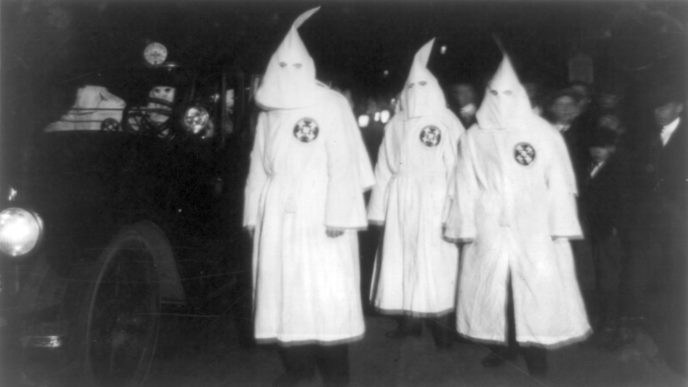
Under Simmons’ direction, the fifteen shivering men gathered stones to build a base for the cross of pine boards he had brought up earlier that day, and a crude altar upon which he laid an American flag, an open Bible, an unsheathed sword, and a canteen of water. They put on the bed-sheet robes and pointed mask caps and then gather around in a semi-circle as Simmons touched a match to the kerosene-soaked cross, the dancing light of the win-blown flames creating an eerie backdrop for the ceremony. With practiced oratory he then called forth the Invisible Empire from its slumber of nearly half a century.1

A week later, the silent film The Birth of a Nation opened in Atlanta. The film portrayed the Ku Klux Klan in a rather heroic light, and portrayed black men “as unintelligent and sexually aggressive towards white women.” Atlanta newspapers ran an announcement of “The World’s Greatest Secret, Social, Patriotic, Fraternal, Beneficiary Order” next to advertisements for the movie.

The Old South and the Democratic Party

In those days, the South was ruled by a single party: the Democratic Party. The first Republican governor of Georgia since 1872 was Sonny Perdue (now nominated as Secretary of Agriculture). The first GOP senator since 1873 was Mack Mattingly in 1981, and he served just one term.

There is no doubt that Democrats led the South during the height of the KKK’s popularity. Yet Kristine Guerra of The Washington Post treated it like a political football and punted. “Cruz isn’t the first Republican to associate Democrats with the Ku Klux Klan,” she wrote.

She then spent eight paragraphs responding to a 2013 remark by Virginia state Sen. Stephen Martin, who said the Democratic Party created the KKK, for which he later apologized and retracted. The entire piece was crafted to refute what Cruz said to Fox News, which is irrefutable. So Guerra dug to find something she could refute, and tied it to Cruz. If that’s not dishonest reporting, then dishonest reporting isn’t a “thing” anymore.

In her specious argument, she quoted Carole Emberton, “an associate professor of history at the University of Buffalo,” attributing the quote to PolitiFact. Possibly she was too lazy to get her own quote, so she just Googled it from another left-leaning media source. Guerra wrote that Emberton said party lines of the 1860s and 1870s “are not the party lines of today.”

Guerra added, “By the 1960s, the Democratic Party was becoming the party of the civil rights movement.” That line was not a quote from Emberton or anyone. It was the reporter misstating the facts, badly.

The Civil Rights Act of 1964, although supported by President Lyndon Johnson, was filibustered for 54 days, with South Carolina Democrat Strom Thurmond leading the opposition. That forced a bipartisan group of senators to introduce a substitute bill to gain enough votes for cloture. The filibuster continued, ultimately taking up 60 legislative days to overcome. Only eight southern Democrats voted for the bill in the House, and one in the Senate.

(To be fair, southern legislators of both parties voted against the legislation. But southern Democrats voted 107 against — in both houses — to Republicans’ 11.)

It is obvious that Democrats did not “become the party of the civil rights movement” by the 1960s.

The Press Must Acknowledge Democrats’ Ugly Racist History

After her major detour through rewritten history, Guerra finally returned to Cruz and the context of his remarks, which is Sen. Elizabeth Warren’s citing of 30-year-old accusations of racism against newly-confirmed Attorney General Jeff Sessions.

Guerra opposed the Senate’s decision to bar Warren from speaking after she violated Rule 19 by impugning another senator from the floor. Apparently, Democrats get a pass for 100 years of blatant and open racism, with some of those senators serving into the 2010s. But remarks made by the late Ted Kennedy and Coretta Scott King in the 1980s are to be held against Sessions.

How can our nation ever be expected to move past racial division when the press won’t acknowledge the Democrats’ ugly history, yet dishonestly smear Ted Cruz, and prop up Liz Warren? (For more from the author of “A Dishonest Rewriting of Democratic Racist History” please click HERE)

Follow Joe Miller on Twitter HERE and Facebook HERE.

We Hear You: From Obamacare to Affordability and Choice for Consumers

Dear Daily Signal: Thank you for Elizabeth Fender’s data-filled article on the Obamacare approval ratings over time. I appreciate your truthful reporting of the facts, and your citing the specific data and your sources (“Obamacare May Soon Be Over. Here’s What Americans Have Thought of the Law Since 2010”).

In addition to the reasons you cite for Obamacare’s low approval ratings (narrow networks, high and rising health care premiums), there are several others.

These include religious liberty violations: the contraceptives mandate on employers by the Department of Health and Human Services (source of two Supreme Court challenges and hundreds of lawsuits); abortion and Planned Parenthood funding; Independent Payment Advisory Board “death panels” (someone wouldn’t be able to use his own money to save his own life); and the government’s definition of “religious entity.” Last but not least is the Supreme Court ruling on gay marriage, which affects administration of health care benefits.

The Obamacare regulations seem to have completely ignored the serious comments advising the government to stop, slow down, make major changes. The contraceptives mandate and transgender mandate are huge mistakes, ignoring the science that shows that the premises upon which these mandates are based are faulty.

I am hopeful the Trump administration will work more collaboratively with key stakeholders in our health care system, including Catholic health care providers. The larger Judeo-Christian health care delivery system deserves to be treated as the large stakeholder that it is.

As the new administration moves into office and into power, we still can attempt to be peacemakers. We can honor the goal of the Affordable Care Act—to create a health care system that provides affordable care and expands access. This is a worthy goal.

People who have preexisting conditions need to have some form of health care insurance. Theoretically, there should not be an “uninsurable” person. These are some of the areas where insurance companies can focus to create new products and services. I believe they would respond appropriately. My experience with the industry supports the fact that they have far more goodness than they are given credit for.

We can honor one administration for their work as we move forward with the next administration’s agenda—as determined by the voters who put them there. —Kathleen Goryl

Making News Personal

Dear Daily Signal: I just read your piece about Obamacare and its effect on an owner of an International House of Pancakes franchise (“Obamacare a Factor in IHOP Owner’s Decision to Sell His 16 Restaurants”). Your mentioning Utica, New York, jumped out at me. I live just north of Utica in Remsen, home of Olympic luger Erin Hamlin.

I loved your piece because it made the news very personal. So much of the debate on health care is numbers about “millions of people covered.” This showed what happened to an employer who was trying to do right by his employees, not to a number of people.

Thank you for mentioning Utica. —Jane White

Sorting Out Plans to Replace Obamacare

Dear Daily Signal
: I think that there is merit to each of the Obamacare replacement plans, and lawmakers need to sort it out and commit to one (“A Look at 4 of the GOP’s Obamacare Replacement Plans”).

However, I have never favored health care support for grown people age 21 and up. Why should taxpayers support these adults and/or subsidize their parents who choose to do so? —David Cromer

Choosing Between Mortgage and Health Premiums

Dear Daily Signal: I’m writing about the repeal of Obamacare and its consequences (“What Happens for Consumers After Congress Repeals Obamacare”). My son is paying over $1,200 per month for a family health insurance plan, and he has lost his primary job.

His family can’t qualify for subsidies because they still make too much with part-time jobs. But they will have trouble between choosing to pay the mortgage or health premiums. He’s no congressman! —Susan Peed

Obamacare Doesn’t Protect Patients

Dear Daily Signal
: I know from personal experience that the Affordable Care and Patient Protection Act doesn’t contain enough to protect patients. Obamacare should have included where to file comments, suggestions, and complaints about your care. This would help pinpoint what and where the problems are. I find filing with the state to be useless.

My five-day nightmare stay at a hospital revealed what I consider serious problems. I had requested my hospital records three different times within a half-year, but the hospital claimed the records were not complete. After the two-year limitation to sue them, they finally gave me my “records.”

The records were not what I expected. There was no timeline of services provided, treatments, doctors’ assessments, medications, or the amounts. Being sued by the hospital for unpaid bills (some for services I didn’t request), I requested my records from the hospital lawyers. They sent me a list of the charges instead.

I was shocked at the number of drugs I was given—over 40, eight of which were for pain. I was given eight doses of morphine in a four-day period. All of those drugs and the amounts should have been in my records in a timeline, along with things like blood pressure and temperature checks.

Medical records in a timeline would help keep communications open between doctors and nurses, reduce unnecessary treatments and services, help keep the patient from being overmedicated, and give patients and health insurance companies better oversight. Do you know what’s in your medical records? —Gary Kujat

(For more from the author of “We Hear You: From Obamacare to Affordability and Choice for Consumers” please click HERE)

Follow Joe Miller on Twitter HERE and Facebook HERE.

Could Moderate Nationalism Save Us From Post-Christian “Americanism”?

As the president’s chief strategist Steve Bannon insists, the election of Donald Trump was a victory for “nationalism.” On that observers agree. But that’s where consensus ends. What exactly does that term mean? Is it something that should frighten us? Fill us with hope? Leave us ambivalent, neutral, or watchful? The answer to that crucial question depends both on what we mean by nationalism, and how its resurgence affects both domestic and foreign policy.

Thoughtful commentators on the right have been weighing in on this subject, especially lately. I’ll offer a round-up of their views in a moment. But first I would like to reiterate a distinction I offered here months ago, before it seemed even likely that Donald Trump would win the election. As I wrote then, there are two lodestars of loyalty among American conservatives, which can complement each other but also compete:

The Golden Egg: moral, civic and economic principles that could, in theory, be applied to any country on earth, and to any group of immigrants we admitted to America, however large. These principles are simply true for every human being, and we must insist on that fact. Instead of the left’s relativism and politics of group resentment, these principles offer conservatives an inclusive, persuasive program which should appeal to any voter of good will. You can find an excellent summary of America’s guiding principles right here at The Stream. Key among them are truths such as “Every human being has equal value and dignity,” and “Judeo-Christian religious faith guards our freedom.” If pursued consistently, these principles should always produce a more peaceful, prosperous, free country than would otherwise be possible.

And:

The Goose: real, existing, historically-founded facts that explain why these principles have worked here in America, while failing spectacularly when tried elsewhere — for instance in the Latin American republics that declared independence shortly after the 13 colonies did, wrote similar declarations and comparable constitutions, and degenerated into a 200-year cycle of dictatorships and chaos. The most important of these facts was the dominance of a tolerant, Anglo-Protestant culture grounded in some 800 years of English resistance to oppressive governments. Change this fact too radically or too quickly, and the principles we treasure will wither and die.

America as a Mere Abstraction

Back in 2003, when “Golden Egg” enthusiasts had almost completely captured the thinktanks, magazines, and other institutions of conservatism, I wrote a long “think piece” warning against the dangers of unmoored ideology that neglected the “Golden Goose,” called “America the Abstraction.” Jim Antle saw fit to reach back some 14 years and cite that piece yesterday in The Washington Examiner. (Antle’s piece is itself an excellent starting point for understanding today’s debate—I encourage all to read it.) As I wrote then:

If you are trying to boil down citizenship to its philosophically respectable components, and if ideology is all you are interested in, then it does not really matter where you were born. Or who your parents were. Or whom you love. Or the hymns you know by heart, the folk tales you treasure, the God you worship. None of these merely human matters measures up, ideologically speaking. None of them can be enshrined in a manifesto, or beamed across the world via Voice of America, or exported in music videos. They do not raise the GDP, or lower the interest rate, or increase our command of oil reserves. They cannot be harnessed to drive the engine of globalization. Therefore, to some people, these things do not matter. Such pieties can be harnessed in the run-up to a war, can form part of the Army recruitment ads and propaganda campaigns, and may even find their way into presidential speeches. But essentially there is no difference between a fourth-generation American and an Afghan refugee who just landed at JFK—so long as they both accept the same ideology.

How did we get to this pass? How did conservatism, which once centered on the fierce defense of tradition, religion, and particularism, turn into an ideology — that is, a philosophy in arms, a political system shorn of its ties to real people and places, slimmed down by dropping historical baggage, packaged for export on the global market of ideas? The simple answer is the Cold War. …

The post-war conservative movement labored mightily to craft … a version of Americanism that could be promoted internationally, which Europeans and Asians, Latins and Africans alike could adopt as an alternative to Marxism. …

Increasingly, America was defined according to the most expansive, abstract reading of the Declaration of Independence, combined with a version of market economics well-suited to the unrestricted “pursuit of happiness.” Anything that did not fit that formula tended to fall down the memory hole: the Anglo-Celtic roots of the Founding, the specifically Christian (mostly Protestant) identity of America, the very existence of the Confederacy, and the profoundly Western roots of our culture. …

To conservatives schooled in this mode of argument, restrictions on immigration are simply insane; anyone, anywhere who will sign on to the Declaration of Independence is already an American. Keeping him out makes no more sense than building a Berlin Wall to divide Manhattan’s East Side from its West. Embittered blacks, or religious conservatives, or leftists who do not accept the Cold War ideology of America are not real Americans. An ideological litmus test becomes the standard of citizenship. American foreign policy must cease to pursue the concrete interests of a concrete, national community and become the tool by which an abstract creed is imposed across the world — hindered only by the resistance of the benighted and bigoted, who are fated to end on the ash-heap of history.

A compatible view of these crucial issues comes from Rich Lowry and Ramesh Ponnuru of National Review, who write:

The outlines of a benign nationalism are not hard to discern. It includes loyalty to one’s country: a sense of belonging, allegiance, and gratitude to it. And this sense attaches to the country’s people and culture, not just to its political institutions and laws. Such nationalism includes solidarity with one’s countrymen, whose welfare comes before, albeit not to the complete exclusion of, that of foreigners. When this nationalism finds political expression, it supports a federal government that is jealous of its sovereignty, forthright and unapologetic about advancing its people’s interests, and mindful of the need for national cohesion.

Nationalism Can Be Dangerous

Jonah Goldberg, in the same magazine, respectfully differs, declaring his preference for the Golden Egg:

Our shrines are to patriots who upheld very specific American ideals. Our statues of soldiers commemorate heroes who died for something very different from what other warriors have fought and died for for millennia. Every one of them — immigrants included — took an oath to defend not just some soil but our Constitution and by extension the ideals of the Founding. Walk around any European hamlet or capital and you will find statues of men who fell in battle to protect their tribe from another tribe. That doesn’t necessarily diminish the nobility of their deaths or the glory of their valor, but it is quite simply a very different thing they were fighting for. …

[N]ationalism is healthy in small doses, but we must remember that all poisons are determined by the dose. Because nationalism is ultimately the fire of tribalism, having too much of it tends to melt away important distinctions, from the rule of law to the right to dissent to the sovereignty of the individual. This is why every example of unfettered nationalism run amok ends up looking very much like socialism run amok (and vice versa). The passionate populist desire for unity above all recognizes no abstract barriers to the general will.

Ben Shapiro warns, also at National Review:

Trump’s definition of nationalism is not the conservative definition of nationalism. Conservatives love America because we believe it is a nation founded on an idea. Our interests ought to prevail because our principles ought to prevail: limited government, individual liberty, God-given natural rights, localism in politics, religious freedom, freedom of speech and of the press, and so forth. If America ceased to believe those things or stand for them, we would not deserve to win. “Make America Great Again” would then ring hollow with the same blood-and-soil nationalistic violence of the Old World. If greatness is measured in utilitarian terms rather than ideological ones, nationalism is merely tribalism broadened, a way of valuing the collective over the individual.

America’s Founding Principles, De-Christianized, Can Be Poisonous

Of course, the critics of nationalism are right, up to a point. They correctly warn that an unreflective attachment to hearth and home, totem and tribe can quickly get out of control and erupt in the kind of ugliness we see around the world, which took its most infamous form in Hitler’s Germany.

But that’s not the only kind of danger. Countries bound together only by an abstract ideology can be very dangerous too — as we see not just from the Soviet Union and revolutionary France, but more recently in the empire created by ISIS, and the relentless drive for power of the Muslim Brotherhood.

Goldberg and Shapiro recognize this of course. They read their history, and know that ideologies can be dangerous. They just don’t seem to think that America’s can be. They don’t seem to see that American principles, while truer than most, can also be abused and applied to evil ends.

But isn’t that exactly what happened when our judicial elites declared that our Constitution enshrined the right to abortion? That central to our right of liberty is the right to make up the meaning of the universe exactly as we wish to? (See Casey v. Planned Parenthood.) That same-sex couples have the right to legally recognized marriage because of their human “dignity”?

You and I might rightly say that these are false inferences from our principles, but they are currently the official governing philosophy of the United States legal system. Stripped by judicial intellectuals of their tolerant, Protestant Christian context (the “originalist” reading of the Constitution that Justice Scalia insisted on), our founding principles can prove very dangerous indeed; they were fatal to almost 60 million unborn American children.

Our Founders were fallen men, and their ideas were not divinely revealed from heaven. The profound truths that did emerge in America’s founding were not some brilliant ideas that Enlightenment thinkers came up with and scribbled down. Instead, they emerged over centuries in a very specific context: the Christian soil of England, with its Saxon resistance to political authority and Protestant obsession with spiritual independence. That was the soil the Pilgrims and other English settlers carried over with them on their ships. Scrape it away, replace it with alien sand or secular gravel, and Liberty’s tree might wither. Or to go back to my first metaphor, the Goose might keel over and die. (For more from the author of “Could Moderate Nationalism Save Us From Post-Christian “Americanism”?” please click HERE)

Follow Joe Miller on Twitter HERE and Facebook HERE.

Time to Push Back Against Fake Judges Tearing Down the Constitutional Fabric of the Nation

Late yesterday, the three-judge motions panel of the Ninth Circuit, in a per curiam order, denied the federal government’s motion to stay the Temporary Restraining Order issued by a single district court judge from Washington State enjoining enforcement nationwide of President Trump’s Executive Order on immigration and refugees. Primarily in contention were two provisions of the Executive Order: (i) suspending for 90 days the entry of aliens from seven countries (Iraq, Iran, Libya, Somalia, Sudan, Syria, and Yemen) and (ii) suspending for 120 days the United States Refugee Admission Program.

Although the policy underlying the President’s Executive Order always is debatable in the public arena, the basic question before the Courts is whether the Executive Order is lawful — that is, does the President have statutory, and Constitutional, unreviewable authority to issue it. That issue was conveniently overlooked by the Courts, who, yet again, preferred to impose their own policy preferences under the guise of a judicial order.

Executive Order. Certainly, it would have been better crafted if the Executive Order had expressly excluded lawful permanent residents, rather than relying on a clarification issued by White House Counsel on that point. And it would have been better if the Executive Order had set out additional information about the threat of terrorism from the seven countries and refugees in general. However, those omissions did not make the exercise of presidential discretion reviewable by the federal court.

After all, as Justice Robert Jackson taught us in his concurring opinion in Youngstown Sheet and Tube Co. v. Sawyer, 343 U.S. 579 (1952): when a President acts pursuant to express Congressional authority, as here, his power is at its zenith. All that should have been required by the Court was the invocation of the statutory authority for the President’s actions giving him unbridled and unreviewable discretion. At that point, the Court’s role was done. It had no judicial authority to do what it did.

Oral Argument. The quality of advocacy for the United States has been challenged by many commentators — but we think that criticism misses the mark. The Justice Department attorney set out an argument that was fully sufficient to justify the President’s actions, and the Court certainly had before it all that it needed to decide the case properly. However, like many other modern federal judges who believe that they sit as super-legislators, these judges pressed government counsel to present to them the specific basis for the President’s decision, so that they could “rule” as to whether it was sufficient. Since the President made his decision after receiving information received from throughout the defense and intelligence communities, the court had no right to review his exercise of discretion.

Amicus Curiae Briefs. It was apparent that the lawyers developing the case for Washington and Minnesota, and their friends in the open borders community, were active in getting support from a variety of amici curiae technology companies as well as other States. In such cases, the advantage always goes to the party who is initiating the challenge. No Republican state Governor or Attorney General filed an amicus brief supporting the President. In fact, we filed one of only three amicus briefs supporting the President’s Executive Order, ours being filed on behalf of the United States Justice Foundation, Citizens United, Citizens United Foundation, English First Foundation, English First, Public Advocate of the United States, Gun Owners Foundation, Gun Owners of America, Conservative Legal Defense and Education Fund, U.S. Border Control Foundation, and Policy Analysis Center.

Our brief focused on two issues: the President’s statutory authority to suspend or even bar entry into the United States of any alien or group of aliens, demonstrating that his power has never been successfully challenged — and often has never been challenged at all. Secondly, our brief demonstrated the flaws in the vetting process for refugees, citing a report done by the Obama Department of Homeland Security. Neither of these matters were addressed even in passing by the panel.

Standing. Plaintiff States of Washington and Minneapolis claimed to have standing because they were acting parens patriae for its citizens — an approach that has been repeatedly rejected by federal Courts — and the panel declined to find standing on that basis.

The Plaintiff States also asserted a violation of the Establishment Clause, where the federal courts have virtually automatically found standing by any plaintiff making any accusation, but the panel declined to rely on that ground as well.

Rather, the panel relied on the “proprietary” interests of the States in that they operate state facilities such as universities which would be affected. According to the panel, however, the States have standing to contest the legality and constitutionality of the Trump order because their respective universities “have a mission of ‘global engagement’ and rely on … visiting students, scholars, and faculty to advance their educational goals,” and the Trump order interferes with their travel plans. In other word, the States are claiming, as a legal right, that its global educational policies override the nation’s interest in protecting her people from the threat of terrorism.

Truly, neither State brought a claim of its own, but only (at best) the claim of another. According to declarations filed by the States, two “visiting scholars” and “three prospective employees” — all of whom are subject to the Executive Order will not be able to come to Seattle, Washington. But do they have a legal claim to enter the country? There is nothing in the panel opinion indicating that they have anything but a unilateral expectation, not a right, to enter the United States. Thus, even those individuals do not have standing: they have suffered no legal injury.

Immigration Suspension. The 90-day suspension was made by the President pursuant to 8 U.S.C. Section 1182(f) which states:

“Whenever the President finds that the entry of any aliens, or any class of aliens, into the United States would be detrimental to the interests of the United States, he may by proclamation, and for such period as he shall deem necessary, suspend the entry of all aliens or any class of aliens as immigrants or nonimmigrants, or impose on the entry of aliens any restrictions that he deems appropriate.” [Emphasis added.]

Astonishingly, the panel opinion never even referenced this source of the President’s statutory authority.

Animus. One of the most dangerous “judge-empowering” doctrines that has snuck its way into Fake Constitutional Jurisprudence is the notion of animus. Made popular by Roemer v. Evans, 517 U.S. 620 (1996), this doctrine allows any federal judge to assert moral superiority to legislators, citizens who pass referenda, or even Presidents, and find that they had some “improper” motivation, which authorizes the court to substitute its pure judgment for the “hateful” judgment of legislators, voters, or executive branch officials.

Here, the panel presumed that President Trump was motivated by animus against Moslems, wholly ignoring the obvious fact that Islamic Terrorism is inexorably linked to Islam. And Islam is not just a religion, but also a political system — which denies the authority of a constitutional republic to establish laws that apply to all who reside in the country.

But the judges could have believed that Islam is a religion of peace, and it still should have upheld the Executive Order. The seven countries targeted by the ban had been previously identified as associated with a heightened risk of terrorism pursuant to 8 U.S.C. Section 1187(a)(12), and were thus already excluded from the visa waiver program because of international terrorists threats posed by those nations.

Nevertheless, Section c(g) of Trump’s Executive Order allowed for entry on a case-by-case basis. Although the panel questioned the efficacy of the White House Counsel’s clarification of the Executive Order that it did not apply to immigrants admitted with the privilege of residing permanently in the United States, that already was provided for by 8 U.S.C. Section 1101(a)(20).

The panel decision asserts that no aliens from the seven named countries have engaged in acts of terrorism — presumably based on the judge’s reading of the newspapers, and the fact that the Justice Department did not introduce into the record information that the Administration released publicly during the pendency of the litigation, about threats from individuals from those countries.

Refugee Suspension. The 120-day suspension in the refugee program was made pursuant to the President’s power to oversee that program under 8 U.S.C. Section 1157(a). The number of refugees that may enter the country is set by statute, and may not exceed 50,000, “unless the President ‘determines’ — before the beginning of the fiscal year, and only after ‘appropriate consultation’ with cabinet-level representatives of the President and members of the Committees on the Judiciary of the Senate and the House — that the proposed number of refugees is “justified by humanitarian concerns … or is otherwise in the national interest.” 8 U.S.C. Section 1157(d)-(e).

The District Court order included no careful analysis of either the EO or its statutory underpinning. The District Judge granted the plaintiff States request for a TRO on the generalized finding that the States were “likely” to prevail on the merits, that the EO was unlawful, providing no analysis or authority for that conclusion. Although we have seen orders denying relief with such cursory treatment of issues, we cannot recall reading an order imposing a TRO without a careful analysis.

Shifting Burden on Appeal. On appeal to the Ninth Circuit for a stay of that TRO, the burden shifted from the States having to demonstrate the likelihood of winning on the merits to the federal government having to prove that it was likely to prevail on the merits. To that end, the federal government submitted to the court of appeals the claim that, first of all, what President Trump had done was authorized by statute, and second, that the President’s actions did not violate the Constitution, as claimed by the Plaintiff States.

The threshold questions for the court should have been (i) whether President Trump’s action was authorized by Congress, and (ii) whether that the statutes conferred unreviewable authority to suspend the admission of any class of aliens and the ongoing screening refugee process. Yet it never addressed either issue.

Instead, the three-judge panel created a strawman by mischaracterizing the federal government’s claim to be that the President’s decisions about immigration policy, particularly when motivated by national security concerns, are “unreviewable” — even if those actions potentially contravene constitutional rights and procedure.” By posing this broad question, the panel lumped the President’s action to “suspend” for a limited period of time to protect the national interest, with “all executive exercises of immigration authority”:

“The present case … is not about the application of a specifically enumerated congressional policy to the particular facts presented in an individual visa application. Rather, the States are challenging the President’s promulgation of sweeping immigration policy.”

If that were truly the case, then one wonders whether the matter before the courts constitutes a “case” or “controversy” and within the power of the judiciary — or whether the States of Washington and Minnesota should take their beef to Congress.

Throughout the panel opinion, the court insists that it has jurisdiction to determine whether the constitutional rights of persons affected by the EO have been violated and that the federal government has failed to demonstrate that it will prevail against those claims.

First, the panel insists that “[t]he Government has not shown that the Executive Order provides what due process requires, such as notice and a hearing prior to restricting an individual’s ability to travel.” (Emphasis added.) But the panel utterly fails to acknowledge that the due process principles of notice and a hearing are not triggered unless and until the person demonstrates that his desire to travel into the United States is a “liberty or property” interest within the meaning of the due process guarantee. As Judge Gorton of the United States District Court for the District of Massachusetts has ruled in denying injunctive relief — there is “no constitutionally protected interest in either obtaining or continuing to possess a visa.” Indeed, as Judge Gorton also has observed, “a non-citizen has no ‘inherent property right in an immigrant visa.’” Thus, he concludes, such a person has no due process rights.

Second, the panel makes a similar mistake in assessing the likelihood of the federal government showing that the Executive Order unconstitutionally constitutes religious discrimination. The panel fails to lay down a predicate that “disfavoring Muslims” from seven named countries discriminates on the basis of religious faith — not nationality. With respect to the President’s power to exclude aliens, there is nothing unconstitutional about a law or ruling based upon a person’s nationality. Singling out seven predominantly Moslem nations, as the Executive Order does here, is a classic example of the use of a “Muslim ban” based on nationality, not on religious faith. However, even if the Executive Order barred entry to the country by alien Muslims as a class, we have been unable to find a single reported federal court decision under 8 U.S.C. Section 1182(f) which supports the proposition that such a determination would be impermissible under federal law.

Additionally, there is nothing in either the Establishment Clause, the Free Exercise Clause, or the equal protection guarantee that prohibits the special concern for Christians who are being persecuted in Moslem countries and, therefore, given special consideration in the nation’s refugee program. After all, religious persecution is one of the grounds upon which a person may be eligible for refugee status, and the Executive Order does not close the door to affording similar protection of people of different religious faiths.

From the time that the district judge entered his TRO to the day that the Ninth Circuit Motions Panel ruled, this conflict has sharply divided the country, eliciting emotional reactions galore — the most notable of which was President Trump referring to the district judge as a “so-called judge.” The President’s characterization may be crude, but it reflects the views of ordinary Americans who are fed up with a ruling class which thinks it knows better than anyone else how we should live our lives.

Follow Joe Miller on Twitter HERE and Facebook HERE.

Here’s a Preview of Where Transanity Is Leading Us

You had to know this was going to happen, and it did, in Scotland. An imprisoned man who identifies as a woman got transferred to a women’s prison, only to be transferred to a men’s prison because he was having sex with the female inmates. Welcome to the world of transanity.

The man in question, referred to in an article on the UK’s Metro only as Paris Green, was found guilty (along with two of his friends) of torturing and murdering another man, for which he was sentenced to at least 18 years in prison. A story on Breitbart gives his original name as Peter Laing, noting that this is not the first time he was accused of inappropriate conduct with female inmates.

Remarkably, in keeping with today’s ridiculous PC journalistic standards, the Metro article refers to Laing/Green in female terms only, with lines like this: “A transgender murderer has been moved from a women’s prison following claims she had sex with female inmates”; and, “She was jailed for 18 years” (my emphasis).

And then, the most telling line of all, from an anonymous source: “The women want sex and Paris is the only person who can give it to them.”

But of course, because Paris is Peter, a biological male, with male private parts and a male sex drive and a male attraction to women. In other words, as the only male inmate in a women’s prison, he’s the obvious (and only) choice for male-female inmate sex. Identifying as a female certainly has its perks.

Truly Transgender — Or Manipulator?

Not surprisingly, the sister of the man killed by Laing/Green questions the sincerity of his female identity, noting, “It’s costing the Prison Service a fortune moving him from jail to jail.” (She’s referring to the fact that this is the second time he’s been moved from a female prison for allegedly having sex with the female inmates. And remember: He has not yet had sex change surgery, so he remains a functionally biological male.)

The bereaved sister added, “The whole thing is a joke. We don’t believe he really wants a sex change. He’s just trying to manipulate the system and the tax payer is footing the bill.”

Of course, only God and Laing/Green know the truth about this. Is he genuinely confused about his gender identity, or is he cynically exploiting the system? In any case, let’s remember that it is transgender activists who constantly remind us that gender identity is different than sexual orientation.

In other words, while a gay man is attracted to other men, a man who identifies as a woman (referred to today as a transgender woman) need not be attracted to men. This means that while identifying as a woman, he is still attracted to women, hence Peter/Paris’s sexual activity with other women.

Naturally, transgender activists have an answer for this as well, telling us that a man who identifies as a woman but is attracted to women is actually a lesbian in a man’s body, in which case his true identity is as a lesbian. Is your head spinning yet?

Back to Reality

Coming back to reality, this unfortunate lesson from the Scottish prison system reminds us of an inconvenient truth that is often ignored in the debate about transgender access to bathrooms and locker rooms.

Let’s say that 16-year-old John identifies as a girl but is heterosexual, and he wants to play on the girls’ sports team and share their bathrooms, locker rooms, and shower stalls (a “right” for which the Obama administration fought vigorously). That means that John, who perhaps wants to be called Jane, will still be attracted to girls — the very ones he’ll be playing with and undressing with and showering with.

This doesn’t mean he’s a sexual predator. It just means that he’s a male teenager, naturally attracted to females, which is one reason why he’s supposed to use the boys’ bathroom, locker room, and shower stalls.

Yet to say this is to be transphobic and insensitive.

Similarly, let’s say that 30-year-old Charlie, who identifies as Charlene but remains a biological, heterosexual male, wants to change in the ladies’ locker room at the YMCA. This means that Charlie will be checking out the ladies there, since he’s heterosexual, and if the women complain to management that they feel uncomfortable, they will be branded troublemakers.

I’m aware, of course, that there are people who struggle deeply with gender identity issues, people who find themselves between a rock and a hard place when it comes to which bathroom or locker room to use, people who are doing their best to fit in and ignore the people looking at them as if they were some kind of freak.

As I’ve said many times before, I do not minimize their struggles and I long to see them find true and lasting wholeness. This recent report from Scotland, however, reminds us of the upside-down world in which we live, one where a biological, heterosexual male who identifies as a woman gets kicked out of a women’s prison for having sex with the female inmates and is still referred to as “she” throughout.

This societal madness must stop. There must surely be a better way. (For more from the author of “Here’s a Preview of Where Transanity Is Leading Us” please click HERE)

Follow Joe Miller on Twitter HERE and Facebook HERE.

Why Delaying Obamacare Repeal Is Hurting the American People

When President Donald Trump took office, repeal of Obamacare seemed like a guarantee—and then the timeline started slipping.

All the elements are in place: A Republican-controlled Congress and a Republican president, all elected after promising to repeal Obamacare. But once the celebration and ceremonies died away, Congress started to do what it does best. Nothing.

“Nothing” may be a bit strong given the historic levels of obstruction from Democrats in the Senate, but House Republicans have no such excuse. In fact, they even have a blueprint.

Last year, the House and Senate passed an Obamacare repeal using the budget reconciliation process. That measure was ultimately vetoed by then-President Barack Obama, but that same legislation can be reintroduced and sent to Trump’s desk to be signed into law.

There is no reason to delay. The slipping of the Obamacare repeal timeline is creating cascading problems for the American people.

Delaying Repeal Prolongs the Current Health Care Crisis

No one needs reminding that Obamacare takes away choice, erodes the value of health care, and puts additional burden on the pockets of the American taxpayer. The unsustainable nature of Obamacare is creating massive uncertainty and causing insurers to leave the marketplace, causing individual premiums to increase.

Additionally, once repeal is signed into law and real health care reforms begin moving forward, private insurers will need time to adjust to the new market. Continuing to delay repeal shortens the time insurers will be able to adjust and provide the best solution for the insured.

Most importantly, we don’t want Americans living under the current failing health care system any longer.

Obamacare is bad, and only getting worse. Average premiums are going up by 25 percent this year, deductibles are blowing past $10,000 for a family, and 70 percent of U.S. counties have no insurer choice, or a choice between only two insurers.

What good is a health care plan that you can’t choose and can’t afford to use? Congress must repeal it as soon as possible to put better health care choices back in the hands of the American people.

Delaying Repeal Hurts Public Support for Congress

Nearly every single congressional Republican campaigned on the promise to repeal Obamacare. The unfortunate consequence of the delay is that the American people are losing faith in the people whose job it is to represent them.

Recent Heritage Foundation research shows 72 percent of Americans will take the promises of Congress less seriously if they wait to fulfill their promise to repeal Obamacare. And 70 percent of Americans believe the longer Congress waits to fulfill their promises to repeal Obamacare, the less likely they will be successful.

There is no doubt that lawmakers will be held accountable to their promises.

Delaying Repeal Keeps the Focus Off Other Priorities

The surest way to repeal Obamacare is through the reconciliation process. However, that option has an expiration date. The reconciliation package is part of the budget process for fiscal year 2017 and it has to be completed before the fiscal year 2018 budget process begins.

In addition to creating a time crunch, the fight over when and how to repeal Obamacare is delaying action on other critical fights.

There is no doubt that Obamacare repeal is and should be the first priority, but Trump and congressional Republicans have made major promises to Americans that must also be considered.

Tax reform. Border security. Regulatory reform. Those priorities cannot move forward until Obamacare repeal is finalized.

What’s Next?

Republicans campaigned on repealing Obamacare in 2010, 2014, and 2016. Now it is time to step up to the plate and use the budget reconciliation process to deliver on those promises.

Congress needs to send a full repeal of Obamacare to the president for his signature. Americans cannot afford any further delays. (For more from the author of “Why Delaying Obamacare Repeal Is Hurting the American People” please click HERE)

Follow Joe Miller on Twitter HERE and Facebook HERE.

Please, Please Br’er Democrat, Don’t Throw Me Into That Filibuster Patch!

It might seem perverse to say so, but pro-lifers should welcome a Democratic filibuster of Trump Supreme Court nominee Neil Gorsuch. Here’s why:

The Democrats are wounded.

What’s left of the squishy GOP establishment is still in shock at Trump’s historic win.

The media are chasing a dozen different imaginary scandals as Steve Bannon’s apparent strategy of “flooding the zone” with bold initiatives seems to be working.

Every time President Trump lights a candle in the White House, the Left is throwing a tantrum and shouting “Reichstag fire!”

We have a nominee who is manifestly qualified, to fill the seat of a deceased, highly respected conservative.

A filibuster now would be so obviously partisan and absurd that it would be easy to justify trashing the filibuster forever.

And that is what we need to do, if we are serious about overturning Roe v. Wade, and removing the Supreme Court as a weapon of leftist rule by decree on every crucial social and Constitutional issue.

The Real Fight is the Next Supreme Court Opening

We conservatives are in a strong position now. In a year or two, when Ruth Bader Ginsburg or another justice finally retires, the balance of power will be different. And the stakes will be infinitely higher. The next SCOTUS nominee won’t just serve to restore the Court’s balance to what it was when it issued the outrageous pile of sophistries that was Obergefell v. Hodges. The next vote could tip it.

So next time, the Left will fight a justice like Gorsuch with the fury of a thousand suns, as the war chests of Planned Parenthood are flooded with money from George Soros and other pro-abortion philanthropists, from Warren Buffet to Bill Gates and beyond. Expect the United Nations and the European Union to issue statements. Because if abortion extremism — in all 50 states, for nine months of pregnancy, for any reason — falls in the United States, it’s in deep trouble all across the world. Expect every demon in Hell to weigh in with his opinion.

If the filibuster still exists when we have to fight that battle, count on a few squishy GOP senators (who don’t really want to overturn Roe v. Wade anyway, in their heart of hearts) to “reluctantly” side with the Democrats. And we’ll end up with some Republican version of Merrick Garland, or worse.

The Supreme Court is the Death Star of the Left

Unless President Trump betrays us, the next judge he chooses, if confirmed, will shift the balance on the Court, giving constitutionalists the votes to strike down a long series of badly decided, lawless precedents that have stymied us for decades, and left liberals free to keep “pushing the envelope” on one outrageous innovation after another. Essentially, up till now, when the left couldn’t win at the ballot box (as it couldn’t win in most states on same-sex “marriage”), it would call in the courts like a napalm strike on a Vietnamese village. Then we would be left helpless, and the left could get busy in its next assault on normalcy, private property, Western culture, or the family. Rinse and repeat.

You need to have been alive in 1980 to fully realize what a sick, miserable game of bait-and-switch we pro-lifers have been subjected to. That’s the year our triumphant, pro-life president — the first president to take such a stand, in the teeth of a pro-choice-led GOP — threw away his first SCOTUS nomination on the unknown quantity that was Sandra Day O’Connor, to keep a pointless campaign promise that some (doubtless pro-choice) consultant convinced him to make, to appoint a woman. Having swept the Senate that year, Reagan could have picked a really worthwhile woman of course — such as Phyllis Schlafly, a brilliant attorney who had just saved the Constitution from the indignity of the Equal Rights Amendment.

But no, we got a squish-center “moderate” Republican instead, and by the time the next opening came, we had lost the Senate — giving the Democrats the chance to rip off the veil of civility and smear Robert Bork. When pro-abortion Republicans-in-name-only such as Arlen Specter sided with the Democrats, Reagan lost that battle and was talked into appointing … Anthony Kennedy!

Yes, the man who would go on to write the infamous “Humpty-Dumpty” opinion on Casey v. Planned Parenthood, which said that it’s essential to American Constitutional freedom that we be able to pull our definitions of morality, meaning, life and the universe out of any bodily orifice. To appreciate how outrageous a betrayal that appointment turned out to be, imagine how Democrats would have reacted if one of Bill Clinton’s or Obama’s appointees issued a majority opinion against abortion, citing Thomas Aquinas on Natural Law.

Stop Nominating Useless Bench Warmers

The threat of the Democrats’ “Borking” a genuinely pro-life, Constitutional conservative nominee via filibuster — a non-Constitutional, purely procedural trick whereby a judge required 60 votes for confirmation instead of 51 — was enough, on those occasions and in the case of David Souter, to drive Republican presidents to waste the crucial choice of a Supreme Court nominee on someone entirely useless.

Oh, they may have issued a few opinions on antitrust law or … something that weren’t as bad as a Democrat’s pick would have been. But on the crucial issues on which our culture and law really turn, they let themselves be guided by the left-wing superstition of a “living Constitution.” What that actually boils down to is simply this: The Supreme Court will serve not to interpret what the words of the Constitution really mean, but instead will act as a perpetual, unelected and unaccountable Constitutional Convention — rewriting the core principles of our jurisprudence as five lawyers see fit, and imposing them on the voters by decree. Any SCOTUS appointee who won’t unmask that power grab, which vitiates democracy, is useless. We might as well nominate a mannequin.

Play to Win or Stop Pretending You’re Pro-Life

Meanwhile, right up till 2016, the Republicans in the Senate have been a supine, timid, sniveling pack of sycophants who would have confirmed a ham sandwich if President Obama had nominated it. Hence they exerted exactly zero moderating influence on the Democrats’ choices of justices. So the fight over the direction of the Supreme Court, and hence of the effective meaning of the U.S. Constitution, has been as rigged up till now as a Harlem Globetrotters game — where our team turned out and went through the motions, obeying a strict set of rules that the other side boldly ignored, since they were playing to win.

It’s time we did the same. And with Trump we have the chance, at last. Any “pro-life” senator who claims that the judicial filibuster is some hallowed legislative tradition essential to preserving the rights of the minority and defending our democratic system against extremism — fill in more high-school civics class boilerplate blather here — is in fact telling you something quite different. He is revealing that he’s not serious, that he doesn’t really want to stop five unelected liberals appointed for life from making all our important laws. He isn’t a pro-lifer or a conservative. He just plays one on TV — in campaign commercials every six years or so. (For more from the author of “Please, Please Br’er Democrat, Don’t Throw Me Into That Filibuster Patch!” please click HERE)

Follow Joe Miller on Twitter HERE and Facebook HERE.