My 2017 Resolutions for Minorities and Women

MTV has raised hackles across America with its new video that features Millennials engaged in social justice shaming of men whose ancestors came from Europe. Here’s that network’s contribution to the culture: 2017 Resolutions for White Guys.

In the spirit of the season, I’d like to offer my own proposed resolutions, aimed at Black Guys, Asian Women, Latino Teens, and Jewish Seniors. Oh yeah, and Native American Transsexuals (can’t leave them out). Because, as MTV’s video points out, “there’s a few things [I] think you could do a little bit better in 2017.” In fact, I have taken extensive notes on how each of these groups could improve their collective behavior and make America a nicer place to live, so here goes. …

Shut up. What are you, crazy?

Oh wait. Something tells me I won’t get away with that. But why not, exactly? Are we saying that all of the people in each of those groups I mentioned are perfect? That they couldn’t do just a little bit better, if they tried? Particularly when it comes to —

No wait, I can’t even say that. Which is really weird, I think. Because it’s perfectly acceptable for members of other groups to go off on what’s wrong with my group of people — not that I really think of myself first as a white man, come to think of it. But if they insist, I guess I could go ahead and do that. I could find a group of other white men, and together we could celebrate the whiteness and maleness of our culture, and insist that white male interests be respected and celebrated. …

No, on second thought, such a group wouldn’t be tolerated. It would end up on watchlists and get banned from college campuses, probably ruin my career if I got outed. In fact, I’ve learned that important authors such as Shakespeare — a white guy, by the way — are getting their pictures torn down at colleges, just because of their sex and the color of their skin. Again, that’s really odd to me, because that sounds a lot like the dictionary definitions of “racist” and “sexist.”

If Only Morality Had Some Kind of Rules …

It’s so hard, nowadays, to navigate ethical questions. It would help if there were something solid we could grab onto, like that thing … what was it …? It was a thing which some dead white guys a long time ago in Greece called … a “principle.” Yeah, that’s it! A “principle” which applied to every human being, regardless of his or her sex chromosomes, skin color, language or religion. If you had one of those things (think of it as a mental measuring tape) then you could make decisions about how to treat people, whether or not you knew their ethnic background — or even their sex, because that’s getting confusing nowadays, what with men wearing makeup in Vogue magazine and white women kinking their hair up so they can lead chapters of the NAACP.

Is that okay, by the way? Because I know it’s okay for men to identify as women, and vice-a-versa. But it’s not okay for a white guy to identify as a black guy, even though the physical differences between the ethnic groups are trivial, while the difference between men and women is what makes our species’ physical existence possible.

When the President Muslimsplains … is that okay?

I wish all of this were simpler, that somebody could explain to me clearly how we’re supposed to know what’s offensive and what’s acceptable. I mean, look at religion. We have a president who’s not a Muslim telling us what Islam does and doesn’t teach — and a bunch of Muslims all around the world, including clergy and professors, who say the exact opposite. And act on it, almost every day. But we’re supposed to listen to the president (who’s not a Muslim) and believe what he tells us. If we believe what the Muslims are saying and doing, then that makes us racist. Which is weird, because I thought Islam was a religion, not a race. But again, I’m not an expert, and I’m not even sure I’m allowed to talk about this at all. Because I’m just some white guy. And the president isn’t.

Maybe — and it’s just a theory, and if this offends I apologize, and please don’t tell my employer — there is an unspoken rule, which we’re just supposed to know about, but not discuss. Not a principle really, but more like an unwritten law. Yeah, I think I can suss it out based on that MTV video, plus all the news reports I’m reading from college campuses. I think it goes like this:

It is okay today to make fun of white people for being white, and men for being men, because back in the past white people were richer and more powerful than other people — especially in the countries which the white people had founded. Not so much in countries where people of other ethnic groups were completely in control, and ruling over smaller ethnic groups whenever they could. But that doesn’t count, because they weren’t white.

And the men dominated those countries, because they always dominate countries wherever they go, which is terrible and not at all something that just naturally happens. It must be part of a secret conspiracy that goes through every culture and all of recorded history, which was so effective that it erased all the evidence.

So because in some places other people a long time ago who were white and male were better off than the people who weren’t, it’s okay today to make fun of white men, to list their negative stereotypes and tell them to straighten them out. In fact, it’s so acceptable it’s even funny. So laugh at it, especially if you’re a white man, and maybe they’ll leave you alone.

But probably not. (For more from the author of “My 2017 Resolutions for Minorities and Women” please click HERE)

Follow Joe Miller on Twitter HERE and Facebook HERE.

Trump’s First 100 Days: What Blacks Should Hope For

In late October of this year, then candidate Trump gave a speech in Gettysburg, Pennsylvania, in which he outlined his plan for his first 100 days in office. It included three major areas of focus: cleaning up corruption in Washington, job creation and what many called a “law and order” agenda. The speech was reported on and then largely forgotten.

So what should black Americans be looking for in the first 100 days of a Trump presidency? I believe we should press for three major priorities, which are very compatible with what Trump has already put forth: a growing economy that creates jobs, education choice for all families, and criminal justice reform.

Growing Economy

It is absolutely vital that we look for jobs to be created by a growing economy, not just by insisting that individual corporations keep jobs in America or by diverting tax payer money into massive infrastructure spending. A potential problem with these strategies is that the initial boost from the jobs created or “saved” is quite modest while the long term drain on the productive part of the economy is large.

I believe that Mr. Trump will not repeat President Obama’s mistake in this arena. We all understand that spending $1 million to create five jobs that pay $50,000 is not a good deal. But somehow the “cost-per-job” factor gets lost as the numbers get larger. In fact in May 2012, the Congressional Budget Office estimated that Obama’s stimulus package — a job creation strategy similar to the current infrastructure spending proposal — may have cost up to $4.1 million per job.

Much more promising for overall economic health is the regulatory reform that Trump has also expressed support for. Regulations — including many associated with the Affordable Care Act — create huge barriers both to beginning new businesses and expanding existing ones. Over the past several years, thousands of new rules have been placed on businesses, hampering growth and costing (according to a Competitive Enterprise Institute estimate) nearly $2 trillion a year. Removing these would boost both productivity and employment.

Education Choice

Black Americans should also watch Trump’s first 100 days for a commitment to school choice. The selection of Betsy DeVos — a longtime school choice advocate — for Secretary of Education is an encouraging one, who opponents wasted no time criticizing. Critics typically recycle two tired arguments against allowing poorer parents the right to choose where their children are educated. The first is that school choice pulls money away from public schools. It does not. This accusation is at odds with actual public data that demonstrates per-pupil spending in public schools increases after school choice programs are implemented. (For example, per-pupil spending in Milwaukee public schools rose 58 percent in the years following the implementation of its voucher program.)

The second criticism is that most children will attend public schools, so all attention and energy must be focused on improving those schools. This argument ignores the fact that sometimes competition is the best incentive to make difficult reforms such as firing ineffective teachers and offering effective teachers the administrative support they need to do their jobs. During the campaign, Trump expressed support for vouchers and charter schools that provide life-changing alternatives for many black students trapped in chaotic, failing schools. African Americans should also encourage Trump to make good on his promises by taking concrete action.

Criminal Justice Reform

Although much of the press interpreted the selection of Jeff Sessions as Attorney General to be the death of any meaningful criminal justice reform, I think this is the best opportunity for President-elect Trump to shock some of his most vocal critics. The 115th Congress could easily choose to pass a version of the sentencing reform bill, which enjoyed widespread bipartisan support, but died in the Senate this year. If President Trump chose to sign it into law, it would send a powerful message that his administration can rise above petty politics and reduce the number of non-violent offenders in our already over-crowded prisons.

Although some see sentencing reform as opposed to Trump’s law and order platform, it actually enables law enforcement to focus on violent criminals, keeping everyone safer in the long run. While there are many complex challenges facing the country, progress in these three areas will go a long way toward improving the lives of blacks and ultimately all Americans. I am praying that Mr. Trump will continue to see the big picture and boldly take steps to help and heal the land. (For more from the author of “Trump’s First 100 Days: What Blacks Should Hope For” please click HERE)

Follow Joe Miller on Twitter HERE and Facebook HERE.

Standing up to Political Bullying Is What Voters Want

After a month of counting absentee and provisional ballots, exploring voter fraud, and recounting 90,000+ ballots in one of the progressive strongholds of the state that were turned in at 11:30 p.m. on election night, North Carolina Governor Pat McCrory conceded that he lost his re-election on Dec. 5.

McCrory lost his re-election by only 10,277 out of 4.7 million votes, or two-tenths of 1 percent. However, repeal of the H.B. 2 “bathroom bill” is not the lesson to be learned from the election.

The governor’s race in North Carolina had barely concluded before the Human Rights Campaign and other LGBT groups began taking credit for having unseated the one-term governor over his refusal to back down to their bullying.

The Human Rights Campaign engaged in an eight-month smear campaign against the state of North Carolina—with McCrory as the primary target—over the passage of North Carolina’s privacy law, which blocked a Charlotte city ordinance that would have allowed men into women’s bathrooms, showers, locker rooms, and other intimate facilities.

The Human Rights Campaign points to highly suspect internal polling as proof that this issue was his downfall, but the facts bear out a different conclusion. McCrory’s strong stance for privacy and safety and ensuring that local laws do not impose financial and legal liability on businesses actually helped him in his re-election bid, rather than hurting him.

So how does a governor who has presided over a massive economic comeback lose his re-election bid?

The most compelling evidence that the privacy law was not a deciding factor in the governor’s race is the fact that Lt. Gov. Dan Forest (who had championed the law) and the Republican majorities in the General Assembly (who crafted and passed the law) ended up winning re-election overwhelmingly.

Forest won 51.8 percent to 45.3 percent, a higher winning margin than President-elect Donald Trump, Sen. Richard Burr, or the Democrats who won the governor and attorney general races received. In fact, Forest brought in more total votes than either Trump or Gov.-elect Roy Cooper.

Republican state legislators, who had veto-proof majorities in both the House and Senate, retained those veto-proof majorities in both chambers, actually picking up a seat in the Senate and retaining the same number of seats in the House.

Rep. Dan Bishop, who championed the privacy law in the House, was elected to the Senate by almost 14 percentage points. If H.B. 2 were really a factor, it would have been a factor in these races as well as the governor’s race.

The truth is that voters in North Carolina were enthusiastic about re-electing those who preserved dignity, privacy, and safety by standing strong even in the face of bullying and extortion from the media, Fortune 500 companies, the NBA, and the NCAA.

The most measurable reason for McCrory’s downfall can be attributed to his refusal to scrap a toll road as the means for expansion of an interstate highway used heavily by commuters north of Charlotte.

The dispute arose over three years ago and peaked a year before the election, when four Republican state lawmakers called for the governor to kill the I-77 toll lanes and start over.

A Republican grassroots group threatened not to vote for McCrory in his re-election bid unless he scrapped the toll construction—and sure enough, those voters made good on their promise. Planned Parenthood was even caught red-handed posing as an anti-I-77 toll group.

A post-election comparison of votes from this highly Republican part of the state reveals that McCrory received 33,775 fewer votes in 2016 in these areas of the state than he did in 2012—enough to cost him the election.

To add further support to this argument, Republican Rep. John Bradford lives in the middle of this I-77 toll corridor, and he won his re-election race handily (56.5 percent to 43.5 percent), despite the fact that his opponent ran solely on her opposition to H.B. 2. Bradford won by a larger margin in 2016 than he did in 2012, another indicator that H.B. 2 was not what influenced his race or the governor’s race.

The toll road wasn’t McCrory’s only problem, unfortunately. For over three years leading up to the passage of North Carolina’s privacy law, McCrory was trailing in public opinion polls. In fact, in the 16 polls taken before the privacy law was passed, McCrory was trailing in nine of them.

Social conservatives were not enthusiastic about McCrory before H.B. 2 because of his veto of a previous religious liberty bill, his opposition to passing a Religious Freedom Restoration Act, and his threatened veto of a pro-life bill. McCrory himself admitted that he is not known for his support for social issues.

Only in the summer of this year did McCrory earn higher marks in the polls than his opponent, Cooper. It was then that the Republican base began to realize McCrory was standing strong on restroom and locker room privacy and safety, indicating that his handling of H.B. 2 and his determination not to give in to bullying, threats, and misrepresentations on the issue actually helped him gain ground with voters.

In addition, his handling of relief efforts for the destruction caused by Hurricane Matthew gave him a bump in public opinion polls right before the election.

Even the left-leaning group Public Policy Polling admits that McCrory’s approval right before the election (and post-H.B. 2) was the highest it’s been in over three years: “We’d found Pat McCrory with a negative approval rating every single month since July 2013 until now—45 percent of voters give him good marks to 43 percent who disapprove.”

The logical conclusion is that the negative trend for McCrory started long before North Carolina ever passed its privacy law, and his surprisingly strong stand in favor of H.B. 2 helped him gain enough support to run almost even with Cooper on Election Day.

But rising public opinion alone was not enough to help McCrory win, especially when he was being outspent by his opponent by almost $8 million.

Cooper raised $21.6 million to McCrory’s $13.75 million. That type of disparity between the candidates’ campaign budgets was destined to put McCrory at a disadvantage.

Republican insiders said that McCrory had not built his fundraising base outside of Charlotte, and that he was ill-prepared as a result. When money drives elections, not having it is critical.

The most damaging assault on McCrory’s re-election bid came from the “Blueprint for North Carolina” effort led by progressive groups to retake the state. They crafted a plan that directed their members to “eviscerate, mitigate, litigate, cogitate, and agitate,” and politically wound the state’s leadership, well before H.B. 2 became an issue.

One thing is for sure: Any claims that McCrory lost re-election because of North Carolina’s privacy law must be taken with a big grain of salt. The truth is that all politics is local, and McCrory’s refusal to act on conservative priorities such as the I-77 toll road and a larger progressive plan to target and take down the governor are to blame.

If anything, H.B. 2 helped the governor shore up the millions of North Carolinians who were skeptical about his commitment to religious freedom and conservative causes.

Although he narrowly lost the closest governor’s race in recent history, McCrory was right to stand on principle and not give in to the left’s bullying and attacks.

He may be leaving office, but North Carolina’s families and businesses will benefit from his bold stand for dignity, privacy, and safety, as well as his economic reforms, for years to come. (For more from the author of “Standing up to Political Bullying Is What Voters Want” please click HERE)

Follow Joe Miller on Twitter HERE and Facebook HERE.

NYT Hacks, Electoral College Edition: Hey, Let’s Blame EVERYTHING on Slavery

Modern leftists have a habit of blaming things they don’t like on slavery — like Harry Reid, D-Nev. (F, 2%) with opponents of Obamacare. Today’s lesson in “but slavery” is The New York Times on the Electoral College. The Times Editorial Board echoes the 2016 leftist narrative that the Electoral College was created to give “slave states” more power.

The notion is plainly not true, nor supported by the historical record. The Electoral College was designed to give smaller states, slave or not, a more equal say in the selection of the executive branch. It is a guardian against mob rule by pure democracy. It has worked well — remarkably so this year.

Here’s what the Times Editorial Board had to say:

The Electoral College, which is written into the Constitution, is more than just a vestige of the founding era; it is a living symbol of America’s original sin. When slavery was the law of the land, a direct popular vote would have disadvantaged the Southern states, with their large disenfranchised populations. Counting those men and women as three-fifths of a white person, as the Constitution originally did, gave the slave states more electoral votes.

There is so much wrong with this statement. It is hard to know where to begin. The first fact, ignored by the Times, is the vast majority of states were slave states at the time of the Constitution. Only five of the thirteen states — Vermont did not join the Union until 1791 — had fully or partially abolished slavery by law at the time of the Constitutional Convention. Those states were Connecticut, Massachusetts, New Hampshire, Pennsylvania, and Rhode Island. Of those states, only Massachusetts had abolished slavery completely. The other four enacted laws gradually abolishing slavery, and there were chattel slaves in those states until the 1800s.

Contrary to what the Times would have you believe, only one of the 13 states present at the Constitutional Convention was a true “free state.”

The abhorrent 3/5 provision had more to do with apportioning seats in the House of Representatives than the Electoral College.

The proposal for apportionment for the determination of each state’s number of seats in the House of Representatives became an issue when the Constitution was being drafted in 1787. Aside from being a complex system and method for calculating the population through the census and then establishing a number of seats for representation, the issue as to who was eligible to be counted for the population was a topic of controversy. However, it is no surprise that this agreement is known as the Three-Fifths Compromise, for the Constitution itself was born out of compromise between the Framers of the Constitution.

This fact doesn’t fit the leftist narrative stating, “Everything that is bad in the United States is because of slavery.” Which, of course, is a lazy argument. The Times Editorial Board further explains what they really want, which is the National Popular Vote initiative. By calling the Electoral College racist, they think they can get their way. How did that work for them this election?

Unfortunately for the Times, the real reason the Electoral College exists is the exact problem they have with it. The Electoral College was a solution to stop the country from devolving into a mobocracy. The founders studied history and realized that previous pure democracies descended into majority mob rule. That’s why the Electoral College is there. It was to give smaller states (remember all of the states but Massachusetts were slave states at the time) a more equal say in the government. It is the same reason why there is a U.S. Senate and not a unicameral legislature found in many Westminster parliamentary systems.

The Times asks:

Conservative opponents of a direct vote say it would give an unfair edge to large, heavily Democratic cities and states. But why should the votes of Americans in California or New York count for less than those in Idaho or Texas?

The answer is because we are a federal republic of semi-sovereign independent states. The federal government was never meant to supplant the state government as a primary governing body. It was envisioned to provide for the common defense and ease interstate commerce. It was, by and large, a mutual defense and free trade pact. People in different states, while all American, have different values. The Electoral College and the Senate ensure those values have a seat at the federal table.

In effect, the Electoral College is the furthest thing from racism. It is a most elegant solution for representing the rights of the minority. (For more from the author of “NYT Hacks, Electoral College Edition: Hey, Let’s Blame EVERYTHING on Slavery” please click HERE)

Follow Joe Miller on Twitter HERE and Facebook HERE.

Steal the Playbook: What Conservatives Lawmakers Should Learn from Open Borders Loons

In the fervent weeks leading up to the inauguration, Democrats are doing everything in their rapidly waning power to “Trump-proof” what parts of government they can before the president-elect takes office. While many of these actions are, as Alexander Hamilton would put it, “contrary to the tenor of the Constitution,” they offer an example (at least in spirit) conservative policymakers in red states ought to imitate in the months and years ahead.

In addition to President Obama stacking federal commissions with last-minute appointees (among them, a former attorney to a notable cop killer), cities across the United States are pondering and, in some cases, creating defense funds for illegal immigrants.

Local officials in Los Angeles city and county gave the go-ahead for a multi-million dollar defense fund to fight back against a president-elect who won with a strong border-security message.

“We’re trying to find a common solution to whatever threats the federal government throws our way,” City Council spokesman Fredy Ceja (D) told the LA Times. “We are telling the next administration and Congress: If you want to get them, you have to go through us,” said California Assembly speaker Anthony Rendon (D) earlier this month in Sacramento.

State officials are also planning to go toe to toe with a federal administration that doesn’t look like it will share the deep-blue state’s positions on the climate change issue.

“We’re ready to fight,” Gov. Jerry Brown (D) said at a meeting of the American Geophysical Union in San Francisco earlier this month.

Local officials in other major cities are also planning similar strategies on the immigration front. According to an Associated Press report, the city of Chicago is planning a $1.3 million defense fund, while New York City is “mulling” a similar public-private fund that would build on the city’s public defender program.

“We need to be able to be able to stand by people who are fearful,” Chicago Mayor, and former White House chief of staff, Rahm Emmanuel told his city council last week.

These efforts are directly in contradiction to the U.S. Constitution in both form and spirit. While the founders envisioned a robust federal system with clear delineations between state and federal power, one of the few jobs specifically given to Congress was that to control immigration and “establish an Uniform Rule of Naturalization.”

This should really be a no-brainer, folks. The states are united under the same national defense, currency, social safety net, etc., with permeable borders between them; it would make sense that decisions regarding how immigrants can join the body politic be decided at the top level.

In contrast, the Obama administration last week issued a rule in another 11th-hour power grab to prevent states from defunding Planned Parenthood. So, as Conservative Review’s Daniel Horowitz pointed out:

“The same liberals who champion sanctuary cities and suggest that Congress cannot force states to simply cooperate with federal immigration law — now believe that HHS can force states to fund a private organization under investigation for harvesting baby organs! Where are the sanctuaries for taxpayers who don’t want to fund murder?”

The truly frustrating thing here is less that Democrats are doing exactly what they should be expected to do (albeit unconstitutionally) in playing the part of the opposition. Rather, it is that these local officials have displayed the kind of fighting spirit that conservatives in red states have needed for decades — especially the past eight years.

Some will say that sort of thing and need is in the past; the tables have turned and the shoe is on the other foot – at least in regard to the White House. And there’s some truth to that. With Trump and company taking the helm of the federal leviathan, state and local government have a much better chance of reclaiming territory than they ever would have under Obama. But POTUS 44 was and is far from the only existential threat to the federal order.

Even if the president-elect turns out to be the most state-friendly president since Thomas Jefferson, the overreach committed on a daily basis by the federal judiciary will still be present. And America’s oligarchy of black-robed jurists will be waiting, gavel in hand, to undo conservative policies as they come — regardless of whether that was the framers’ intention.

Imagine for just a moment if state and local officials in the red states and counties were as adamant about fighting back against federal usurpations with the same fervor and unflinching orthodoxy that liberal politicians in California, New York, and Chicago are channeling against immigration enforcement.

Not only would it be good for their constituents and their sovereignty, but the “conservative” officials would also have the Constitution on their side. (For more from the author of “Steal the Playbook: What Conservatives Lawmakers Should Learn from Open Borders Loons” please click HERE)

Follow Joe Miller on Twitter HERE and Facebook HERE.

Facebook’s Crackdown on Fake News May Censor Conservative News

Facing criticism recently over the surge in fake news on Facebook, CEO Mark Zuckerberg announced a new plan to crack down on fake news stories appearing on the site. The social media giant will be asking users to report fake news stories by clicking a button next to the story. Zuckerberg said in a post on his page, “if many people report a story, then we’ll send it to third-party fact checking organizations.”

If the journalists at those sites, which include the Associated Press, deem it fake, “you’ll see a flag on the story saying it has been disputed, and that story may be less likely to show up in News Feed.” The flag cautions the user against sharing the story. Adam Mosseri, the Facebook VP of News Feed, added, “Once a story is flagged, it can’t be made into an ad and promoted, either.”

Facebook faced severe criticism last spring for cutting out conservative news from its Trending box. There is a real danger that left-leaning Facebook users will report conservative articles as fake, and journalists who lean to the left will affirm the reports.

Troubling Fact-Checking Sites

Mossieri said they will be using the list of fact-checking sites that are signatories of Poynter’s International Fact Checking Code of Principles.The Poynter organization is funded by left-wing billionaire George Soros and other organizations on the left. The sites included so far are the left-leaning Snopes, Politicker, The Associated Press and ABC News. No doubt more left-leaning sites will be added.

Conservatives have reason for concern. Snopes labeled as false the story that the death of DNC staffer Seth Rich was connected to the Clintons. However, the police had not yet issued a report, nor had the autopsy been released. How does Snopes know before the police complete their investigation that there is no connection?

Politifact declared the recent #Pizzagate controversy surrounding Hillary Clinton’s campaign manager John Podesta false, as did other left-leaning fact-checking sites. Some elements of the long, sordid story were accurate, but the sites didn’t bother to mention those.

Facebook has 1.8 billion members, who spend an average of 50 minutes a day on the site. If Facebook wishes to be fair, it should ensure that the fact checkers it uses are balanced between the right and the left.

Alternatively, there are plenty of other ways to deal with fake news, such as prominently showing the name of the news organization next to an article, or requiring users to opt in if they want to see posts from fake news sites. (For more from the author of “Facebook’s Crackdown on Fake News May Censor Conservative News” please click HERE)

Follow Joe Miller on Twitter HERE and Facebook HERE.

Guess Who’s Behind Facebook’s New ‘Fake News’ Detector?

As anyone active on the Internet is aware, there have been increasing calls for social media companies (Facebook, Twitter, etc.) to address the mostly manufactured crisis of “fake news” making its way onto people’s computer screens. The mainstream media, which finds itself increasingly viewed as untrustworthy by the American public, has latched on to the idea that the relatively free flow of ideas and opinions on the Internet actually poses a threat to our well-being.

As could be expected, political leaders jumped in early on this attack on independent media. In October, President Obama urged Americans to avoid independent news sources and stick with the mainstream, urging a kind of filter for information. He told an audience in Pittsburgh:

There has to be, I think, some sort of way in which we can sort through information that passes some basic truthiness tests and those that we have to discard. … The answer is obviously not censorship, but it’s creating places where people can say ‘this is reliable’ and I’m still able to argue safely about facts and what we should do about it.

Hillary Clinton, after losing the election, sounded even more bitter about non-mainstream media sources, warning the Senate about the, “epidemic of malicious fake news and false propaganda that flooded social media over the past year.”

To Hillary, it was personal: independent media could be deadly. Said the defeated candidate earlier this month:

This isn’t about politics or partisanship. Lives are at risk — lives of ordinary people just trying to go about their days to do their jobs, contribute to their communities. It’s a danger that must be addressed, and addressed quickly.

Lives are at risk! It was only a matter of time before some of these social media behemoths embraced the requests of the elites they most identify with. Yesterday, Facebook announced that it was going to employ a variety of “fact-checking” organizations to make sure no “fake news” made it onto people’s Facebook news feeds. So Facebook will be using Snopes, PolitiFact, Factcheck.org, ABC News, and the Associated Press, among others, to check its members’ postings and label them as “fake news” if these organizations determine them to be so.

One problem: these organizations themselves are among the biggest purveyors of real fake news! PolitiFact has a whole website dedicated to exposing the organization’s biases. The popular site Snopes is in fact run by a husband and wife out of their home in California. Neither have any background in research or investigative techniques — they just use Google to make their determinations. As for AP and ABC News — they are mainstream media outlets with no clean hands when it comes to propagating fake stories. In fact the Associated Press has a long history of coordinating with governments to produce fake news.

Political fact checking is not a science. On the contrary, more often than not it carries with it all the biases of any hyper-partisan organization.

Never fear. A group of selfless and unbiased philanthropists have stepped forward to offer millions of dollars to assist these “fact-checkers” in their efforts to ferret out and disappear anything they determine to be “fake news.” It seems rather curious, however, that these donors are all in fact in one way or other completely beholden to Hillary Clinton and the left-interventionists of the Democratic Party.

Who are they? George Soros, otherwise known as Hillary’s sugar daddy. EBay founder Pierre Omidyar who’s given more than $30 million to the Clintons and their charities. Google — “in like Flynn” for Hillary. The Bill and Melinda Gates Foundation. And the commie/neocon National Endowment for Democracy (which, as a government-funded entity, will be using our own money to censor news it deems harmful to us).

These are the people who will decide what you will see on Facebook. Are you happy to be thusly protected? (For more from the author of “Guess Who’s Behind Facebook’s New ‘Fake News’ Detector?” please click HERE)

Follow Joe Miller on Twitter HERE and Facebook HERE.
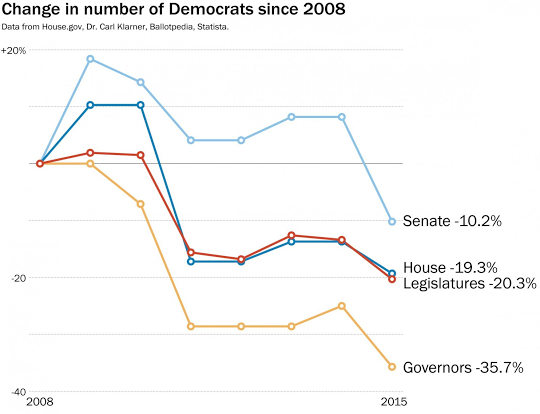
THE OBAMA LEGACY: Best Post-Election Graphic Yet

Philip Bump at The Washington Post accurately captions it “The decimation of the Democratic Party, visualized.”

As Dave Blount observes, “In 2008, the Democrat Party abandoned the last vestiges of moderation and threw itself behind the very personification of moonbattery, Barack Hussein Obama.”

While Democrats have thus far blamed James Comey, Julian Assange, Russian hackers, Fake News, and (presumably) George W. Bush for their crushing losses, there’s a much simpler explanation.

They nominated a thoroughly unlikeable, villainous harridan who pushed the party even further to the left thanks to the honorary President of Venezuela, Bernie Sanders, and President “I’ve Got a Pen and a Phone” Davis.

And while Democrats point to a popular vote victory for Hillary Clinton, that notion is also bogus:

161219-democrats-decimated

Let’s stipulate that California — even ignoring its massive population of illegal aliens — accounted for Hillary’s popular vote “victory”.

But let’s subtract out a few items from her popular vote total:

• There’s evidence of systematic Democrat vote fraud all over the country.

• There are also reputable estimates that millions of illegal aliens voted for Hillary Clinton in 2016.

• And Democrat efforts to undermine voter ID requirements, extend early voting periods, and make absentee ballots easier to obtain and forge have all contributed to the scam.

Subtract all of that Democrat criminality and it’s clear that Trump won the popular vote — and the electoral college — by a veritable landslide.

The evisceration of the Democrat Party is Obama’s real legacy. And no one tell Paul Krugman. He’s suffering from a bad case of walking butthurt. (For more from the author of “THE OBAMA LEGACY: Best Post-Election Graphic Yet” please click HERE)

Follow Joe Miller on Twitter HERE and Facebook HERE.

The Electoral College Chooses Trump. But Don’t Expect the Malcontents to Surrender

In the end, the malcontents failed to stump Donald Trump.

Despite a campaign drive from the Left, threats of violence and death against Republican electors, protests, and cheesy celebrity videos, Donald Trump was officially elected the 45th president of the United States Monday, earning the 270 Electoral College votes he needed, and then some.

The proceedings were not without its drama. In Wisconsin, for example, protesters interrupted the electors as they met in the state capitol.

“We’re all going to go to war and die because of you people!” one protester exclaimed, as Wisconsin’s 10 electors tallied their votes for President-elect Trump.

Cries of “shame” from the Left were not enough, as the electors kept their commitment to the voters in their respective states. In North Carolina, for instance, the electors blew past protesters singing a loud chorus of “God Bless America.”

Some raised concerns that Republican electors could defect and become “faithless” electors by refusing to vote for Donald Trump. Leading the effort was dissenting Republican, Christopher Suprun of Texas, who announced his refusal to vote for Trump in a recent op-ed in The New York Times and declared his intention to cast his ballot for Ohio Governor John Kasich. That effort proved fruitless.

Suprun was joined in dissent by a few Democrats who refused to cast their votes for Hillary Clinton. Per AJC.com, as of 3:49 p.m. ET “four Democratic voters in Washington chose not to vote for Hillary Clinton, becoming ‘faithless’ voters. Clinton took the other 8 votes in the state. Three Democratic electors have tried to be ‘faithless’ by not voting for Clinton. One in Maine, one in Minnesota and one in Colorado. Those votes were changed and registered for Clinton.”

One noteworthy Maine Democratic elector, David Bright, declared in a Facebook post that he would cast his ballot for Hillary Clinton’s primary rival, Sen. Bernie Sanders, D-Vt. (F, 17%). “I am not a Clinton elector, I am a Democratic elector. I do not represent Democrats all over the country, I represent the Democrats in Maine,” Bright wrote, explaining that if his vote could have helped Clinton win, he would have cast it for his party’s nominee.

“I see no likelihood of 38 Republican electors defecting from their party and casting their ballots for Secretary Clinton,” he explained.

Bright’s not-so-bright vote was invalidated.

The final tally will not be known until later today, with Hawaii’s electors casting their votes at 7 p.m. ET. Regardless of the final numbers, Donald Trump has definitively won. But don’t expect the Left to accept defeat.

As BuzzFeed News’ Chris Geidner declared today, “The battle over Monday’s electoral college vote is the beginning, not the end,” as a “larger campaign to undermine the legitimacy” of this free and fair election in the United States is “likely” to begin. The Democrats are preparing to use means outside of the Electoral College to deny Trump the presidency. From Geidner:

Assuming that effort fails to stop Trump, expect to start hearing about Title 3, Section 15 of the US Code and “objections” to the electoral vote results. An objection can be lodged in writing by two members of Congress: one each from the House and the Senate.

Although rare, this step is not unprecedented. In 2005, Sen. Barbara Boxer of California and Rep. Stephanie Tubbs Jones of Ohio filed such an objection, specifically to the counting of the votes of Ohio’s electors in the wake of allegations of voting irregularities. The objection was rejected within a few hours, with only 32 members of Congress — all but one from the House — voting against the counting of Ohio’s votes.

Should that fail, too, Democrats may challenge the constitutionality of Trump’s presidency under the Emoluments Clause of the Constitution, as Geidner explained:

Enter the Emoluments Clause — the constitutional provision referenced in the Eisen, Painter, and Tribe memo and elsewhere — which bars the president and other federal officials from accepting “any present, Emolument, Office, or Title, of any kind whatever, from any King, Prince, or foreign State.”

“While holding office, Mr. Trump will receive—by virtue of his continued interest in the Trump Organization and his stake in hundreds of other entities—a steady stream of monetary and other benefits from foreign powers and their agents,” the trio of scholars wrote. A handful of Democrats in the Senate already have made it clear they will not be dropping this as an issue.

And should that fail, Democrats may resort to accusing Donald Trump of treason. All this to say … do not expect the Left to roll over for President Trump the same way Republicans repeatedly caved for President Obama. (For more from the author of “The Electoral College Chooses Trump. But Don’t Expect the Malcontents to Surrender” please click HERE)

Follow Joe Miller on Twitter HERE and Facebook HERE.

Here’s the Tool Congress Can Use to Curtail Obama’s Regulation Legacy

Conservatives in Congress have a plan to undo a large number of regulations from the last few months of President Barack Obama’s time in office.

The recently imposed regulations include a new rule from the Department of Health and Human Services that protects federal funding for Planned Parenthood as well as regulations from the Department of Labor instituting paid sick leave for federal contractors.

Both of these new rules, along with a host of others, may be able to be undone with the help of the Congressional Review Act.

This law was passed in 1996 as part of the Small Business Regulatory Enforcement Fairness Act and then-Speaker Newt Gingrich’s Contract with America reform agenda.

Conservatives in Congress have a plan to undo a large number of regulations from the last few months of President Barack Obama’s time in office.

The recently imposed regulations include a new rule from the Department of Health and Human Services that protects federal funding for Planned Parenthood as well as regulations from the Department of Labor instituting paid sick leave for federal contractors.

Both of these new rules, along with a host of others, may be able to be undone with the help of the Congressional Review Act.

This law was passed in 1996 as part of the Small Business Regulatory Enforcement Fairness Act and then-Speaker Newt Gingrich’s Contract with America reform agenda.

According to the Congressional Research Service, the Congressional Review Act “is an oversight tool that Congress may use to overturn a rule issued by a federal agency.”

It requires agencies to update Congress on the rules they write and “provide Congress with a special set of procedures under which to consider legislation to overturn those rules”.

For a rule to be appealed under the Congressional Review Act, those disapproving of the rule must first present a report to the House, Senate, and comptroller general.

According to the Congressional Research Service, this report must contain “a copy of the rule; concise general statement relating to the rule, including whether it is a major rule; and the proposed effective date of the rule.”

Once this report is received, the House and Senate must pass a “joint resolution of disapproval” that would go to the president for approval or veto.

If vetoed by the president, Congress still has one more shot at the resolution by voting to overturn the veto with a two-thirds vote in each chamber.

So far, the Congressional Review Act has aided in the overturning of one rule.

The Hill reported that in 2001, Congress was able to successfully repeal a rule on workplace injuries that was issued by the Occupational Safety and Health Administration (OSHA). Since then, according to the Congressional Research Service, OSHA has not tried to reinstate a similar version of this workplace injuries rule.

James Gattuso, a senior research fellow who studies regulatory issues for The Heritage Foundation, said that the Congressional Review Act has not been successful in the past because of the administration in power.

“The problem that became apparent after the [Congressional Review Act] was adopted was that the president will almost never be in a situation where he wants to disapprove of regulations from his own agencies,” Gattuso told The Daily Signal in a phone interview.

Then-Republican President George W. Bush was the reason the Congressional Review Act succeeded in repealing the OSHA rule in 2001.

Gattuso said of the law’s potential success on a larger scale:

The Democratic president [has] adopted just slews of regulations all within the past few months. So all those new rules, there are dozens of them, are eligible to be reviewed under the [Congressional Review Act]. And, when they’re submitted to the president, they’ll be submitted to a Republican president who will have no hesitancy in signing a lot of these.

According to Gattuso, conservative lawmakers are likely to have more success with using the Congressional Review Act due to incoming President-elect Donald Trump.

Constitutionally, the president has to be involved in any legislative decision meant for his possible veto. The one example where that was not a barrier was in 2001, when there was a change of administrations and a Clinton administration rule was rescinded. Now, we have that same situation for really the first time since then that there is a new Republican president coming in with an outgoing Democratic president.

According to a report released by The Heritage Foundation’s Gattuso and Daren Bakst, the Congressional Review Act will be able to address regulations handed down by Obama dating back to June 3, 2016.

With Trump, Gattuso said he believes that lawmakers will have significant success in undoing “slews” of regulations that the Obama administration has set in place. He said that the Congressional Review Act is the “most powerful tool that Congress has … it is a powerful weapon.”

Rep. Mark Meadows, R-N.C., the recently elected chairman of the House Freedom Caucus, is spearheading the effort to address regulations put in place by the Obama administration through the utilization of the Congressional Review Act.

As part of this effort, the House Freedom Caucus has released a special report, “First 100 Days: Rules, Regulations, and Executive Orders to Examine, Revoke, and Issue” that outlines the regulations that conservative lawmakers are planning to take down with the help of the Congressional Review Act and a new presidential administration.

These include regulations present in the National School Lunch Program and
School Breakfast Program, the National Organic Program, and the Animal and Plant Health Inspection Services program.

In total, the report currently lists 228 rules that the House Freedom Caucus is looking to address.

“We expect it to get to 300 rules and regulations by the time that Jan. 20 rolls around,” Meadows said.

According to Meadows, the Congressional Review Act will not apply to all of the rules listed in the report, but instead will be a significant starting place.

“The Congressional Review Act will only apply to some of those, but the ones that it does apply to actually [have] a more far-reaching and lasting impact,” Meadows said.

Meadows said that the Congressional Review Act works best when used in concert with a conservative administration.

“It only works if you have a conservative in the White House or someone of the same party or it can be deployed as well, but it has to have a two-thirds majority … So, [the Congressional Review Act] is an exciting tool that is rarely used, but as we get prepared to use it on the overtime rule and hopefully a couple of others that have been a result of executive overreach, we’ll get to see it actually used perhaps for the first time in more than a decade,” Meadows said.

Not surprisingly, efforts are being made to enact more regulations before Trump takes office.

According to the Competitive Enterprise Institute, institutions such as the Environmental Protection Agency are trying to push through more restrictive policies before the presidential inauguration. The EPA is currently attempting to pass fuel economy standards before Trump’s inauguration in January.

However, Meadows said that due to his recent discussions with the Trump transition team, the president-elect’s administration is already aware of and planning to address the regulations imposed by the Obama administration.

“I will say this,” Meadows said. “Talking to some individuals with the Trump transition team, they are taking this extremely serious, and certainly will make it a priority so that excitement on behalf of Americans from coast to coast is well placed ‘cause I know that the Trump administration will have it as a high priority,” Meadows said. (For more from the author of “Here’s the Tool Congress Can Use to Curtail Obama’s Regulation Legacy” please click HERE)

Follow Joe Miller on Twitter HERE and Facebook HERE.