Shame Is Not a Hate Crime. Let’s Bring It Back in 2017

In our modern culture of political “correctness,” one of the easiest ways to silence criticism is to smear a person’s character by accusing them of “shaming.” The “sin” of shaming comes in many varieties: slut shaming, fat shaming, or body shaming, mom shaming, gender shaming, race shaming, victim shaming, etc., etc. All of these accusations, however, boil down to the single worst indictment of our day: intolerance.

There was once a time when shame played a vital role in civil society. It was a tool that incentivized good, moral behavior by creating social consequences for immoral behavior. Today — in America, at least — shame has not so much disappeared as it has been blacklisted.

Bad Santa

Consider the recent high-profile shaming incident of the young North Carolina boy who accused Santa of fat shaming.
Earlier this month, a family’s trip to go see Santa took a turn for the worse. After having his picture taken with the jolly old elf, 9-year-old Anthony Mayse of Forest City, N.C., says Santa told him to “lay off the hamburgers and French fries.”

“It affected me so bad that I was crying until I went to bed that night,” Anthony told the local News 13. “And I want to say to him, ‘You don’t want to disrespect a 9-year-old. Even though what shape and size you are, it doesn’t matter.'”

The story went viral, sparking international outrage and widespread calls for the fat-shaming Santa (real name: Earl Crowder) to be fired. He eventually resigned and apologized to the family, but the viral coverage of the incident sealed Crowder’s fate as “bad Santa.”

Was Earl Crowder wrong to tell 9-year-old Anthony Mayse to cut back on the junk food? Probably. But the problem in this case wasn’t so much what was said, as who said it. In general, random strangers shouldn’t try to parent other people’s kids. But this doesn’t take away from the fact that Anthony’s mother, Ashley Mayse, who is also considerably overweight, should be encouraging healthier eating habits for the sake of her son’s health.

“You do you”

Today, there are no longer social norms that aim to secure a degree of common morality and propriety in America. For example, there is no commonly held belief that gluttony is a sin … or even a health threat, for that matter. Because of this, we see social justice groups like Healthy at Every Size, which teaches that “obesity” is a term of oppression used to unjustly shame individuals who are simply “different.”

Our “you do you” culture has redefined “shame” to mean any comment or action that does not “validate” an individual. The only people deemed worthy of such judgement, the thinking goes, are the so-called bigots who hold permanent, transcendent values (e.g. conservatives and the religious).

A stranger telling an overweight kid that he should exercise some self-discipline is not OK, because the statement calls that child’s choices into question. But it’s fine — nay, just — to shame Christian (and only Christian) business owners who won’t service a gay wedding against their conscience. What’s the difference here? The business owners’ belief in traditional marriage implies that the gay couple’s lifestyle and decision to marry are misguided. And who are these business owners to judge what is right or wrong for other people?

Shame on who?

One could argue, as many do, that forcing Christian business owners to service a gay wedding violates their personal choice to honor biblical teaching. But as we’ve seen in the many court cases leading up to and following the Obergefell gay marriage decision, the judicial consensus has been that deeply held religious beliefs are secondary to political correctness and the personal choices of others. When relativism and autonomy rule the day, anything the smacks of objective moral judgement is marked as bigotry.

Shame was once an effective and extralegal way to maintain order in society. It didn’t outlaw certain decisions so much as it made those actions lose their appeal. Shame caused many young people to be weary of having children out of wedlock. It discouraged thoughtless and obnoxious behavior in public spaces like grocery stores, movie theaters, and restaurants. It discouraged people from overeating, and deterred spouses from cheating. Like real civil laws, shame was originally a tool used to preserve public health, safety, and morals.

When the act of discerning right from wrong, good from bad, healthy from unhealthy, becomes a matter of personal choice and feelings, the end result can only be chaos and confusion. Each person is free to make his or her own decisions in this country, but to assert that all choices are equally good, correct, or acceptable is to deny the societal benefits of right action. If the end result of shame is a happier, healthier, better-behaved society, perhaps we should stop treating it like a hate crime. (For more from the author of “Shame Is Not a Hate Crime. Let’s Bring It Back in 2017” please click HERE)

Follow Joe Miller on Twitter HERE and Facebook HERE.

4 Ways Congress Sought to Change or Scrap the Electoral College

On Monday, 538 presidential electors selected by voters on Nov. 8 will choose a president when the Electoral College votes in states across the country.

This year marks the fifth time in history the popular vote winner lost the presidency. The other elections were in 1824, 1876, 1888, and 2000.

Though Donald Trump won 306 electoral votes to Hillary Clinton’s 232, it may not be over yet. Several activist groups are demanding electors reject their state’s voters and cast a vote for someone other than Trump.

More than 50 of the 232 Democratic electors, and one Republican elector, have even asked for a national security briefing on the potential Russian hacking of the Democratic National Committee emails before casting a vote.

President Barack Obama opted against weighing in on what electors should do, but spoke during his Friday press conference more generally about the Electoral College. Obama said:

The Electoral College is a vestige of an earlier vision of how our federal government was going to work that put a lot of premium on states. It used to be that the Senate was not elected directly, it was just decided by state legislatures. It’s the same type of thinking that gives Wyoming two senators with about half a million people and California with 32 million get the same two. There are some structures in our political system that disadvantage Democrats. But the truth of the matter is, if we have a strong message, if we are speaking to the issues the American people care about, typically the popular vote and the Electoral College vote will align.

Congress has considered 850 separate proposals to amend the Constitution to change the way a president is elected, said Christine Blackerby, co-curator of the “Amending America” exhibit at the National Archives Museum.

Here is a look at a few of those efforts.

12th Amendment

The first major proposed change to the Electoral College was the only successful reform, coming in response to a glitch exposed in the 1800 election.

Presidential candidate Thomas Jefferson and his vice presidential running mate Aaron Burr got the same number of Electoral College votes, 73 each. The problem was, in those days, the second place finisher in a presidential race was the vice president. The House of Representatives voted 35 times before finally electing Jefferson president.

Congress passed the amendment on Dec. 9, 1803, and it was ratified on June 15, 1804, putting the president and vice president on a ticket for electors to choose.

Lottery President

In 1846, a proposal was floated in Congress to replace the Electoral College with a lottery system.

Under this proposal, each state would have its own election. The winners of each of those elections would then be chosen by lot in Washington. Balls with names of candidates would be placed in a bowl, similar to lottery drawings seen today on TV. The first name drawn would be president, the second name drawn would be the vice president, Blackerby explained.

The proposal, House Joint Resolution 8, introduced on Jan. 13, 1846, never came to a vote.

Still, the “Amending America” exhibit allows visitors to see the most popular person from each state based on Google searches, then entered into a random drawing, to see who could be president today if this system had been enacted.

Executive Committees

Although the biggest complaint against the Electoral College is typically that it’s undemocratic, the exhibit lists two occasions that Congress considered taking matters entirely out of voters’ hands.

In 1808, a constitutional amendment was introduced in Congress to scrap the Electoral College and replace it with a special committee of retired U.S. senators to choose the next president.

Congress introduced a similar proposal in 1860, just before the Civil War broke out. In this case, Congress and the executive branch would appoint a three-person committee that would choose the president every four years.

Direct Popular Vote

Of the hundreds of proposed changes to electing a president, a popular vote was far and away the most common. Similar bills have been introduced in nearly every session of Congress, but in most cases they were never debated nor acted upon.

The most recent examples where a popular vote proposal nearly passed were in 1969 and 1975, according to a Congressional Research Service report.

After the 1968 presidential election, third-party candidate George Wallace won 46 electoral votes. This prompted enough concern about third parties that Rep. Emanuel Celler, D-N.Y., proposed a resolution abolishing the Electoral College in favor of a popular election, in which the winner would have to win at least 40 percent of the vote. The resolution passed the House by a 338-70 vote, but it was blocked by a filibuster in the Senate.

After the close 1976 election, Sen. Birch Bayh, D-Ind., proposed a bill to amend the Constitution and switch to a direct popular vote. The bill failed by a close 51-48 vote

In other examples of action on the proposal to move to a popular vote, the House Judiciary Committee held hearings on the proposal in 1947, 1949, 1951, and 1969. The Senate subcommittee on constitutional amendments held hearings in 1948, 1953, 1955, 1961, 1963, 1966, 1967, and 1969. (For more from the author of “4 Ways Congress Sought to Change or Scrap the Electoral College” please click HERE)

Follow Joe Miller on Twitter HERE and Facebook HERE.

It’s Not Islamophobia to Recognize That Sharia Is Incompatible with the Constitution

The Washington Post is trying to pathologize as “Islamophobia” normal, human responses to the worldwide explosion of Islamic supremacism and jihad violence, including recent savage terrorist attacks in America by Muslims our government foolishly welcomed. In a recent column, William McCants tries to cast Donald Trump, Stephen Bannon, Newt Gingrich, Frank Gaffney, and anyone who agrees with them about the danger of Islamist radicalism as tinfoil-hat-wearing hatemongers or fools. That would have to include the scholars of the Claremont Institute, who issued this erudite warning of the grave threat posed to America by Islamist ideology and organizations — such as the many-tentacled Muslim Brotherhood.

No one knows the rules better than the Post: If you want to crush someone in America, link him somehow to racism, if only by some lame analogy. If you want to silence debate about your reasons for crushing him, suggest that he is frothing with hatred, to the point that his condition is a kind of moral disease. If anyone defends him, accuse that defender of that same disease and suggest that if he won’t throw his friend under the bus he could share his fate. Find out where he works, and look into getting him fired.

That’s how opinion is policed in America, where thanks to our Constitution elites don’t have the option of simply throwing dissenters in jail — as the Dutch establishment has jailed patriotic politician Geert Wilders, simply for opposing further Muslim immigration. That’s right, Wilders was sentenced to prison for making a policy argument. Fear not: Opinion polls suggest that he might be elected Prime Minister, at which point even EU minions would probably feel the need to let him out.

Or maybe not. The scorn which European elitists feel for mere citizens is so overpowering, that the Dutch might just leave Wilders to rot and annul the election — as EU satraps in Britain are trying to overturn the Brexit vote, and some Democrats are attempting to nullify the election of Donald Trump with wild charges of Russian “hacking.”

We can scent here the sniffy contempt that Clinton felt for “Deplorables,” which is shared by the Washington press corps. What’s funny is that this sense of superiority is absolutely groundless, built on wishful thinking and ignorance — in this case about what Islam really teaches and what it demands.

Communism was “pseudo-Islam.” The real thing is worse.

The brilliant economist and social philosopher Wilhelm Röpke — the very first professor fired by the Nazis for his ideas — once summed up Communism as a “pseudo-Islam.” A powerful insight: They are both creeds of conquest and domination. For a few generations, people were willing to lay down their lives for the sake of a future “socialist paradise,” but their fervor quickly faded. If you don’t believe in an afterlife, martyrdom is a pretty hard sell.

Islam, by contrast, from the very beginning offered rewards both in this life and the next one. Muhammad recruited warriors by promising them the three things which young men most crave: plunder, power, and pleasure. Those who followed him and his heirs would have Allah’s blessing in stealing loot from the unbeliever, subjugating him, and taking his wife or daughters as sex slaves. Here’s just one of the relevant verses from the Quran:

Quran (33:50) – “O Prophet! We have made lawful to thee thy wives to whom thou hast paid their dowers; and those (slaves) whom thy right hand possesses out of the prisoners of war whom Allah has assigned to thee”

As The Religion of Peace explains: “This is one of several personal-sounding verses ‘from Allah’ narrated by Muhammad — in this case allowing a virtually unlimited supply of sex partners. Other Muslims are restricted to four wives, but they may also have sex with any number of slaves, following the example of their prophet.” And of course if jihad warriors died in battle against the unbeliever, they would go straight to paradise and enjoy a harem in heaven.

Sharia is an ideology, aimed at world domination.

Islamic sharia law is intrinsically political, oriented toward imposing Islam by force if necessary upon every nation on earth, keeping non-Muslims in a servile state, and defending masculine “honor” by savagely policing women’s sexual behavior. In every Muslim-dominated country, sharia does just these things. And every orthodox Muslim must accept sharia — including all its provisions about warring against unbelievers, with the goal of converting, killing, or enslaving every last non-Muslim on earth.

Imagine if rules for burning witches or torturing heretics were mandated in the New Testament, and put into practice in virtually every Christian country on earth, to this very day. Picture evangelicals hounding and killing witches in Alabama, and Pope Francis burning a hundred heretics or so each year in the Vatican. Don’t you think that non-Christian countries would be cautious about admitting Christian immigrants? Not just Christians with actual ties to witch-hunters and inquisitors, but any Christian who wouldn’t clearly renounce such violent practices?

In the center of Sunni Islam, Saudi Arabia, which seeds lands around the world with shiny new mosques and handpicked radical imams, all the most violent practices of primitive Islam are still in effect—from polygamy to blasphemy flogging, from cutting off hands of thieves to executing ex-Muslims for “apostasy.” The Islamic pressure groups funded by Saudi money, such as the Council on American-Islamic Relations, have close links to sponsors of terrorist groups like Hamas, as a U.S. federal judge concluded in 2009.

Time to Change Our Immigration Laws

Given these facts, it is folly to pretend that sharia is compatible with the American experiment. It is not. We need a change to our immigration laws requiring that every potential immigrant renounce the use of force to compel or restrain religious freedom — with provisions for deporting any newcomer who later expresses support for sharia or anything like it. We can model such a law on the perfectly constitutional, decades-long ban on immigration for members of Communist parties.

None of the recent jihadi attackers, in Florida, California, or Ohio, had any provable connection with terrorist groups. The Boston Marathon bombers grew up here since early childhood. What did each of these terrorists have in common? They were simply orthodox Muslims, steeped in sharia — thus primed by their creed and culture to turn against their non-Muslim neighbors. All it took was some piece of bad news, a personal setback, or the right imam spouting on the right message board, to light the spark. It is not Islamophobic to recognize this fact, and to take measures to protect ourselves and our loved ones from it. It is Islamo-realism. (For more from the author of “It’s Not Islamophobia to Recognize That Sharia Is Incompatible with the Constitution” please click HERE)

Follow Joe Miller on Twitter HERE and Facebook HERE.

Cyberattacks Are a Major Security Threat. Here’s How to Deter Them.

Nearly two years ago, North Korea launched a cyberattack against Sony that nearly crippled the movie giant. The U.S. responded by imposing yet another round of feckless sanctions against the Hermit dynasty.

But ironically, if members of the North Korean army had landed in Los Angeles and blown up Sony’s studios with dynamite, they would actually have done less damage to the company—but there likely would have been a greater outcry in the U.S. for a more forceful response.

Cyberattacks are incredibly destructive, but because they are subtle, they often attract far less attention than overt attacks.

North Korea’s attack against Sony, along with a host of other state-sponsored cyberattacks, raises important questions for U.S. policymakers. How should we deter cyberattacks? And how should we respond when our deterrence fails?

Unlike the early days of the Cold War, we do not have a modern-day George Kennan (who wrote the strategically vital article “Sources of Soviet Conduct“) or a Paul Nitze (the primary author of the influential NSC-68) for the cyber age. Instead, we are left with the strategic equivalent of trying to pour old wine into new recyclable water bottles.

In order to develop a cyberdeterrence doctrine, we need to unpack what is necessary in order for deterrence to be successful—and how to respond when deterrence fails.

One of the most difficult hurdles to overcome is defining what constitutes a cyberattack. Several federal agencies disagree over what is, and is not, a cyberattack.

An informal consensus is contained in a report issued by RAND Corp. in 2009, which defined a cyberattack as “the deliberate disruption or corruption by one state of a system of interest to another state.” (Spying is not considered to be a cyberattack because it does not deny users access to a system, even though spying may be a prelude to an attack.)

At first glance, this is a reasonable definition. It doesn’t account, however, for one group of people: nonstate actors.

If a group such as the Islamic State, al-Qaeda, or Hezbollah were to disrupt the electrical grids in the United States or Israel, surely this would count as a cyberattack, would it not?

This brings us to the second problem: attribution—that is, correctly identifying where a cyberattack has come from.

It is fairly straightforward to determine who fired a gunshot or a rocket. However, when it comes to cyberattacks, attribution is a critical component of deterrence. Without attribution, we do not know who to retaliate against.

In the 2008 war between Russia and Georgia, hackers operating from Russian soil launched cyberattacks against Georgian installations. However, there was little evidence to directly tie then-Prime Minister Vladimir Putin’s Kremlin to the attacks.

While the attacks benefited Russia’s military efforts, there was no proof that Putin or then-President Dmitry Medvedev had hit the “enter” key—or created the code.

This lack of proof complicates efforts at the third problem: retaliation.

In order for deterrence to be credible, states not only have to be able to attribute attacks, they have to be able to retaliate. States may deter in one of two ways: deterrence by denial and deterrence by punishment.

We can think of deterrence by denial as erecting a large fence where cyberattacks would be deflected (or, building a wall that is so tall, enemies would not bother to attack it in the first place).

Deterrence by punishment, on the other hand, means retaliation. It is in essence saying to the enemy, “If you kill my mainframe, I’ll melt every one of your servers.”

These two options are not necessarily mutually exclusive. States can build cyberdefenses that protect against attacks by making the costs of attack exceed any of the benefits. States can also adopt retaliatory postures in response to attacks, provided they can determine who was responsible for an attack.

This leads us to the next issue: proportionality.

In his classic book “Strategies of Containment,” historian John Lewis Gaddis differentiated between two types of containment: symmetrical and asymmetrical.

Symmetrical containment emphasized maintaining the balance of power between the U.S. and the Soviet Union. It also suggested that if the Soviets attempted to breach our sphere of influence, we should respond proportionately.

This was the strategy adopted by the Truman, Kennedy, Johnson, and Carter administrations.

By contrast, asymmetrical containment suggested the U.S. climb the ladder of escalation in response to Soviet provocation.

In order to make Soviet expansion costly, the U.S. should push the Soviets behind the “Iron Curtain”—the term coined by Winston Churchill to describe the dividing line between the free states of Western Europe and the Soviet-dominated member nations of the Warsaw Pact. Presidents Ike Eisenhower, Richard Nixon, Gerald Ford, and Ronald Reagan all adopted this posture.

While retaliation against cyberattacks is necessary, whatever posture we adopt, the key question we need to ask ourselves is: “What next after retaliation?” Our hope, of course, is that with a symmetrical posture, our enemies will learn their lesson.

But, what if they don’t? What if they see a symmetrical posture as a sign of weakness, a lack of resolve, or a sign of low capabilities?

Similarly, the aim of an asymmetrical posture is to demonstrate our resolve while increasing the costs of cyberconflict for our opponents. But what if we are facing an opponent like Saddam Hussein, who lacked the ability to update his beliefs in the face of discrepant information, and any retaliation on our part is not taken seriously?

Or, what if we face a defensively motivated opponent whose intentions are not nefarious, but are driven by an interest in national security? Here, an asymmetric posture could lead to an unnecessary spiral of conflict.

Furthermore, we need to discuss whether our responses should be restricted to the cyber domain or include more conventional means of retaliation, such as economic sanctions or military strikes.

Some pundits and scholars have written of a “new” strategic triad: space, nuclear, and cyber. To be successful, it is necessary to develop a doctrine for cyberdeterrence that defines what a cyberattack is, how to attribute attacks from state-based and nonstate actors, and the appropriate degree of retaliation.

Before we develop a new cyber doctrine by the seat of our pants, it is worth allowing our cyber experts and decision-makers to take a breath and sift through the laborious conceptual work that is needed to make cyber-deterrence successful in the 20th century. (For more from the author of “Cyberattacks Are a Major Security Threat. Here’s How to Deter Them.” please click HERE)

Follow Joe Miller on Twitter HERE and Facebook HERE.

What Moved Voters? Pastors and Flocks Disagree

Even as Clinton dead-enders cycle through scapegoats and conspiracy theories in their drawn-out path to acceptance of the fact that they lost the 2016 election, statistician George Barna of the American Culture and Faith Institute is still trying to understand what influenced voters to rally behind Donald Trump, especially among America’s religious communities. If his data are correct and representative, they suggest that church leaders have a somewhat exaggerated view of their own influence over conservative Christian voters — who seem to be moved more by personalities appearing on right-leaning secular media.

Just a week after the election, Barna turned up some interesting data on who exactly swung votes among conservative Christians. Based on a survey of 3,000 voters who fit this broad profile, Barna found that these voters cited a range of media personalities, and a few conservative leaders. The leading influencers, according to Barna’s selection of voters, were:

Radio host Rush Limbaugh (cited by 19%)
TV host Sean Hannity (17%)
TV host Bill O’Reilly (14%)
Radio host Laura Ingraham (12%)
Family Research Council President Tony Perkins (11%)
Columnist Charles Krauthammer (9%)
Radio Host Tim Wildmon (6%)
TV host Megyn Kelly (5%)
Televangelist Pat Robertson (5%)
Columnist and TV analyst Todd Starnes (4%)
TV personality Eric Bolling (4%)
TV and radio host Glenn Beck (3%), and
Radio host Michael Savage (3%).

Bran noted that even conservative Christian voters are much more likely to be moved by “mainstream” figures who appear on Fox News and comparable venues than by identifiable church leaders.

What Pastors See Differently from Their Flocks

In a subsequent report released December 14, the American Culture and Faith Institute asked religious conservatives which institutions they believe are most influential among the general public. According to Barna’s latest report, Christian conservatives think that of the eight “non-media sources of influence evaluated, labor unions had the most impact of all. In total, three out of ten … said that labor unions had ‘a lot’ of impact on peoples’ voting decisions.”

The next three entities with high perceived impact, were President Obama (25%), church-distributed voter guides (24%), and Christian non-profits (23%). Ranked slightly below were Protestant churches and pastors (20%) public opinion polls (15%); celebrity endorsers (14%); and Catholic churches and priests (12%). Perhaps Barna’s most surprising finding was the significance of voter guides. He noted that “three out of four … said they relied on at least one voter guide to help them make voting decisions in the November election.”

A survey which the American Culture and Faith Institute conducted of theologically conservative pastors showed a gap between those pastors’ perception of their own influence, and the perception of voters. “Conservative pastors clearly had a higher opinion of their influence on the election than did the people they sought to influence,” Barna reports, explaining: “While the pastors tended to rate themselves at the top of the list, conservative voters placed them in the middle of the pack in terms of influence. Similarly… pastors were more likely to see significant influence from Catholic priests and churches” than voters reported.

The report continues: “Although Protestant churches and pastors ranked fifth in influence … those religious leaders and organizations placed at the top of the list according to the pastors themselves. One out of every five [conservative] pastors said such entities had ‘a lot of impact’ on voters.”

Of course, Barna’s report measures only perceptions — specifically, what Christian voters think motivated the general voter in the most recent election. It’s quite possible that such conservatives are as misinformed as their pastors. And of course, there is no way to measure the power of prayer, of initiatives such as Franklin Graham’s 50-state tour to energize Americans and beg for divine protection for our country. In the end, that might have been the most powerful force of all. (For more from the author of “What Moved Voters? Pastors and Flocks Disagree” please click HERE)

Follow Joe Miller on Twitter HERE and Facebook HERE.

Democrats Shouldn’t Blame Russia. They Should Blame Jill Stein

Blame Russia for Hillary’s losing White House bid? Try Jill Stein.

It wasn’t Vladimir Putin who picked up tens of thousands of votes in key battleground states that Clinton needed to win. Stein earned more votes than Clinton lost to Trump by in Michigan, Pennsylvania, and Wisconsin. Meaning, had most of those voters voted for Clinton, rather than Stein, Clinton could have won the election.

That’s not all, though. These three states — Michigan, Pennsylvania, and Wisconsin — also happen to be the three states where Stein sought recounts that Clinton supported. Recounts that validated Clinton’s loss.

The result of the Wisconsin recount announced last night showcases Clinton’s weaknesses far better than Putin ever could. The Wisconsin recount confirmed Trump’s win and awarded him an additional 131 votes.

That’s right. Clinton, by supporting Stein’s recount, actually helped Trump get more votes.

Meanwhile, Stein walks away with millions in unspent recount funds. Millions more than Stein ever raised for her presidential campaign.

What did Clinton get out of the recount? Nothing but another humiliation.

It’s mystifying Clinton would ever participate in such an exercise when you break it down.

First, Clinton gave money to Stein who, arguably, cost Clinton the election. Not only that. Clinton gave money to Stein to contest results in a state where Stein won only one percent of the vote. A state where Clinton’s own counsel said there was no evidence of tampering. A state that Clinton didn’t even bother to campaign in during the general election.

Who in Clinton world thought this was a good idea? What could have possibly been gained?

Maybe this is why the Democrats are so eager to blame Russia. It’s easier for them believe in fantasies of Putin’s evil election-rigging than believe Clinton’s presidential campaign could be so incompetent.

Putin didn’t dupe America. Stein sure is duping the Democrats, though. (For more from the author of “Democrats Shouldn’t Blame Russia. They Should Blame Jill Stein” please click HERE)

Follow Joe Miller on Twitter HERE and Facebook HERE.
Should Christian Leaders Stay out of Politics?

Is it dangerous for Christian leaders to mix politics and religion? Is that a confusion of their calling? Or is it important for Christian leaders to address all areas of life, including politics?

I have had to address this question myself, since I might be preaching in a church service one day, teaching in a Bible school the next, and then talking politics on the radio the next (or, sometimes, doing all three in one day). How should we conduct ourselves as religious leaders?

If Donald Trump as president keeps his word and successfully repeals the Johnson Amendment, which has greatly muzzled religious political speech, this question will become all the more relevant for Christian leaders in America.

What exactly is our role?

To Speak Out or To Not Speak Out

It so happened that on the same day, in response to the same article, some old friends expressed their disapproval of my commenting on political issues. One posted on Facebook, “I remain disappointed that you continue to focus on politics Mike. Your mandate is higher! God’s purpose for you and Christian leaders is [God’s] Kingdom not this world. Leave that to others!”

Another emailed, asking, “Are you sure you want to cross over to being a daily political commentator, rather than speak primarily to spiritual issues?”

Neither of these men are critics, and both wrote in friendly tones, but the thrust of their message was clear: To write political commentaries is to detract from my higher, spiritual calling.

I’m confident they would say this to other spiritual leaders as well.

In stark contrast, I hear from readers and listeners on a regular basis who thank me — sometimes with tears — for addressing moral, cultural, and political issues, in particular, for doing so as a follower of Jesus who uses the Bible as his grid.

One man posted on Facebook, that during the elections, “The only media voice I listened [to] for counsel was Dr. Brown.”

Another wrote:

Dr. Brown I am greatly appreciative that you are engaging the political arena. It’s seems that a fair amount of Christian leaders shy away from the political spectrum due to a fear of losing their audience. If we want to see change in this country, then we as Christians need to engage the political system. Encourage Christian leaders to run for office so that light can shine in the darkness of the corrupt leadership that this country has given over to itself.

Which perspective is right? Would Paul or Peter or John have gotten involved in the presidential elections? Would they have endorsed a candidate or advised a candidate or commented on the various party platforms? Would they have even voted?

Some point to Jesus’ comment in John 18 when He said to Pilate shortly before His crucifixion, “My kingdom is not of this world” (John 18:36). If it were of this world, He explained, then His servants would have been fighting for him not to be delivered up to His captors.

But in saying this, Jesus hardly meant that we should not be involved in the affairs of this world. After all, feeding the hungry and clothing the poor and educating our children and working our jobs are all “of this world.” Should we stop doing these things and simply go on a mountaintop to pray, waiting for the Lord’s return? (Of course, we’d soon have to figure out how to get food and where to sleep — all issues of this world.)

In reality, what Jesus was saying was this: “My kingship does not derive its authority from this world’s order of things. If it did, my men would have fought to keep me from being arrested by the Judeans. But my kingship does not come from here” (Jn. 18:36, CJB).

What about Philippians 3:20, where Paul wrote that “our citizenship is in heaven, and from it we await a Savior, the Lord Jesus Christ” (ESV)?

Interestingly, it was this same Paul who, at strategic times, invoked the fact that he was a citizen of Rome, assuring that he would receive better treatment than a common criminal (see, for example, Acts 16:35-39; 21:37-39).

His point in Philippians 3 had to do with those who lived with a fleshly, earthly carnality (see Philippians 3:18-19), and he was saying to his readers, “You are not like them! You are a heavenly people living in this world.”

In the same way, Peter wrote, “Dear friends, I warn you as ‘temporary residents and foreigners’ to keep away from worldly desires that wage war against your very souls” (1 Pet. 2:11, NLT).

It’s Not Our Eternal Home, But That Doesn’t Mean We Remain Silent

We are passing through this world, and it is not our eternal home, so we must not get entangled with worldly, carnal desires, which war against our souls. We should be above such things. But that doesn’t mean that we don’t fight against injustice or champion the cause of the needy, nor does it mean that we remain silent on important political and social issues.

After all, slavery was the paramount hot-button, deeply-divisive, political and social issue of the 19th century, yet it would have been very wrong for Christian leaders to remain silent on this, just as it’s very wrong for Christian leaders to remain silent on issues like abortion and homosexual activism today.

I can’t tell you how many times readers and listeners and viewers have talked with me after hearing me speak — again, often with tears in their eyes — thanking me for addressing the divisive cultural issues of the day. These are issues they live with every day — in their homes, in their schools, in their places of business, and they are frustrated when their pastors and teachers fail to give them spiritual guidance to help navigate these troubled waters.

And this is not just happening in the States. During my annual trip to India earlier this month, pastors in Mumbai specifically asked me to address LGBT issues, while in other international trips in the last few years, Christian leaders in the government have met with me privately (or publicly), asking for input on these same pressing social issues. They want to know what they can do as believers to make a positive impact on their society, and that includes the realm of politics and government.

Of course, we can get involved in politics in a partisan way, becoming appendages of a particular political party, which is a real mistake. And we can easily get caught up in a divisive, immature political spirit, which is quite destructive, or we can become obsessed with politics, which would distract us from our larger calling.

That’s one reason that, on my radio show, we devote certain days to theology and Bible study, while I spend much of my time teaching and preaching in churches and conferences — and not talking about politics.

But there’s nothing stopping us from walking in the Spirit, maintaining an eternal perspective, and constructively addressing the political realm. In fact, it behooves us to do so, as long as we don’t neglect our primary calling of preaching and teaching the Scriptures. The Church needs us to do it and the society needs us to do it.

I’m confident that I am not alone in sensing that it pleases God and helps His people when we, as ministry leaders, bring the Word of God to bear on every area of life, politics included.

Do you agree? (For more from the author of “Should Christian Leaders Stay out of Politics?” please click HERE)

Follow Joe Miller on Twitter HERE and Facebook HERE.

In Tillerson, Trump Nominates ‘Greatest Ally Liberals Have’ in the Cabinet, Says Christian Conservative Leader

“The ExxonMobil executive may be the greatest ally liberals have in the Cabinet for their abortion and LGBT agendas,” Christian conservative leader Tony Perkins said of Donald Trump’s nominee for Secretary of State, Rex Tillerson. He wrote on Monday before the nomination was officially made. He had been a strong Trump supporter during the election campaign.

Tillerson, the CEO of ExxonMobil, is “among the most accomplished business leaders and international deal makers in the world,” Trump said when nominating him. His career “is the embodiment of the American dream.”

The head of the Family Research Council noted in his Washington Update that Tillerson “not only led the charge to open the Boy Scouts to gay troop leaders but [his] company directly gives to Planned Parenthood.” Perkins continued:

FRC knows Tillerson all too well, having worked for years to put the brakes on his reckless agenda for a scouting organization that was already dealing with staggering numbers of sexual abuse cases. Unfortunately, the BSA, under Tillerson, ultimately caved to the pressure of the far-Left, irreparably splitting the Scouts and destroying a proud and honorable American tradition.

Tillerson served as president of the Boy Scouts from 2010 to 2011 and pushed for the acceptance of homosexual scouts and scoutmasters. However, when questioned by the Daily Caller, ExxonMobil said that it gave to Planned Parenthood through its employee matching gift and volunteer programs. The giving “does not reflect ExxonMobil’s philanthropic priorities or support for community causes.”

Support For the LBGT Agenda

Perkins also noted that while Tillerson led the ExxonMobile, its 2017 score on the homosexual lobby Human Rights Campaign’s Corporate Equality Index “skyrocketed to 87 percent.” (It’s actually a score of 85 out of 100.) It had been only 40 last year.

The company had perfect scores in practices like providing medical and “soft” benefits to homosexual partners and “non-discrimination standards” for its contractors and vendors. It got good scores in prohibiting “discrimination” against homosexual and transgender people and “positively” engaging the “external LGBT community.”

However, the HRC criticized Trump for his four nominees with “troubling anti-LGBTQ records.” They are Rex Perry (Energy), Tom Price (Health and Human Services), Ben Carson (HUD) and Jeff Sessions (Attorney General). It strongly opposes vice president-elect Mike Pence.

Perkins noted that under President Obama and Secretary of State Hillary Clinton, “the State Department lead the global parade for the slaughter of innocent unborn children and the intimidation of nations with natural views on marriage and sexuality.” He worried that Tillerson will continue their policies.

Whether Tillerson will press these issues as secretary of state is unknown, notes Religion News Service’s David Gibson. “He would be serving at the pleasure of a president who has vowed to enshrine the social conservative agenda in his policies,” Gibson writes. However, Perkins’ opposition may “augur an unexpectedly early end to the honeymoon with evangelical Christians — Perkins was one of Trump’s most vocal supporters on the religious right during the campaign.” (For more from the author of “In Tillerson, Trump Nominates ‘Greatest Ally Liberals Have’ in the Cabinet, Says Christian Conservative Leader” please click HERE)

Follow Joe Miller on Twitter HERE and Facebook HERE.
Do Boycotts Actually Work? Yes, but There’s a Right Way … And a Wrong Way

Advocates of government regulation of business frequently represent corporations as holding too much power. They have lots of money, and if their product is good, many loyal customers continue to feed their operations regardless of any moral or ethical violations.

Such people usually take a pessimistic view of the ability of consumers to regulate business via the threat of withholding their money. The implication is that people care more about low prices and convenience than they do about social causes, and that, therefore, businesses can get away with murder.

There is a certain amount of truth to this, in that in most cases, the cause du jour is only important to a small but vocal minority, while the rest of us are happy to continue shopping at our favorite stores. But if we don’t care enough about an issue to shop elsewhere, why should we care enough to impose government sanctions, paid for by all of our tax dollars whether we approve of the regulation or not?

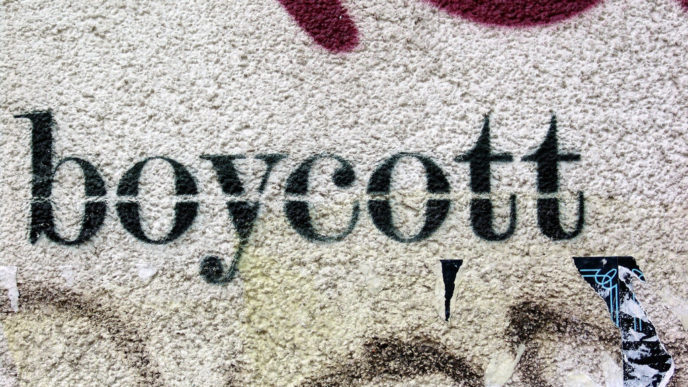
But let’s not be too hasty to dismiss the power of the boycott. Companies have shareholders to answer to, and bad publicity coupled with declining sales never sits well with stockholders whose chief concern is profit. This is far from a theoretical argument; there are plenty of examples of effective boycotts.

The most prominent example from this year is the boycott of Target for its announcement that transgendered shoppers are permitted to use any bathroom they choose. Social conservatives fear that this opens the door to predatory behavior and decided to withhold their business in protest of the policy.

The boycott has had a significant effect on business, reducing sales by 7.2 percent and costing the company $20 million. While Target has yet to reverse its transgender policy, the company has responded by installing larger bathrooms with more privacy in an effort to appease critics, proving that the boycott is working, at least to an extent.

Target is far from the only example. After Mozilla CEO Brendan Eich donated to a campaign to protect traditional marriage, a large Internet backlash resulted in his being removed from his position.

Similarly, the blogger and professional liar known as Food Babe succeeded in whipping up enough ill-informed outrage about an ingredient called carrageenan to convince a major producer of natural foods to stop using it.

There’s a lesson here that it matters what the customer base of a company looks like. Target is suffering because a large number of its customers hold traditional values. Mozilla primarily serves younger, more progressive users. And while companies that rely on the left-leaning, nutrition-focused demographic have to worry about bad publicity, other companies with more conservative customers were immune to the criticism about food additives.

The most striking example of this comes from addictive chicken purveyors Chick-fil-A, which drew outrage for a statement opposing gay marriage. But Chick-fil-A is located in primarily in the South and one of the few places that still closes on Sundays. Far from condemning the restaurant, the majority of Chick-fil-A’s customers redoubled their support, and the company actually saw an increase in sales as a result of the boycott.

The moral of the story is that boycotts work, but you have to know your target. You can’t get Whole Foods customers to boycott by claiming the company employs illegal immigrants, and you can’t get Cracker Barrel customers to boycott over the use of GMOs. It has to be something the existing customer base already cares about.

Consumers have a lot of power to influence corporate behavior if they are willing to use it. It’s worth remembering that no company, however large, can make you buy something you don’t want. And once people stop wanting their products, they will be forced to change or else face the prospect of bankruptcy. (For more from the author of “Do Boycotts Actually Work? Yes, but There’s a Right Way … And a Wrong Way” please click HERE)

Follow Joe Miller on Twitter HERE and Facebook HERE.
Trump Must Fire Swamp Monsters Comey, Koskinen, and Other Obama Holdovers Immediately!

“You’re Fired!”

If there was ever a president who has the mandate, public expectation, and personal style to drain out the bureaucratic swamp and fire every Obama holdover within the executive branch, it’s Donald Trump. He should exercise this mandate as liberally as he did on Celebrity Apprentice.

Tackling the “fourth branch of government”

Historically, even when Republicans win the White House, the various departments and agencies that actually run government serve as a collective fourth branch and a fifth column, countermanding any semblance of the conservative agenda. Democrat presidents never have these problems because the inherent ideological balance in most of these public policy fields is already oriented towards implementing the Left’s priories. And after eight years of Obama, every nook and cranny of the executive branch will be contaminated with hostile elements. Obama has left no stone unturned in orienting each department, agency, and office towards the execution of a cross-sectional portfolio of liberal priorities.

Trump must be the first GOP president to break the failed streak of Republican presidents to completely drain the swamp. To that end, he must immediately ask for the resignation of every agency head within the executive branch, including those agency heads that don’t automatically turn over with new administrations.

First and foremost, he should get rid of James Comey as FBI director and John Koskinen as IRS commissioner. Both of those individuals have clearly lost the public trust to serve in their positions. Democrats will try to claim that they are tenured in, pursuant to congressional statute, for 10 and five year terms respectively. However, those laws are only as strong as the president wants to make them because a president has plenary power over the personnel he chooses to run executive agencies. The same liberals who believe the executive and judicial branches could run rogue shot over Congress’ authority over broad public policy issues will now suddenly make the case that Congress can force a president to accept a particular individual to head an agency. They are dead wrong and Trump should challenge this assertion.

President controls executive personnel, Congress controls policy

While the legislature is clearly the dominant branch of government in terms of setting public policy and the federal budget, the president gets to determine who will serve in executive positions. To be clear, Congress can always eliminate an agency, completely regulate the scope of its jurisdiction, defund the agency or the office of the agency head, place reasonable qualification conditions on those who serve (e.g. requirement to obtain a security clearance), and, of course, refuse to confirm any presidential picks. But Congress does not have the authority to force the president to maintain any one individual as head of the agency so long as that agency still exists through statute.

The Supreme Court ruled long ago that because the president has the power to appoint [U.S. Const., art. II, §2, cl. 2] executive ministers and councils, he has the power to remove them. After all, if a president can, within reason, appoint anyone he desires to head an agencies, he certainly cannot be boxed in by Congress to only choose or maintain any particular individual. Again, the Senate is very powerful and can defund and abolish an office or refuse to confirm a presidential replacement if they are upset with him firing an FBI director or an IRS commissioner. But they lack the power to directly force a president to keep people like Comey and Koskinen.

Madison explained the distinction in separation of powers very clearly in a letter to Thomas Jefferson [see page 196]:

[Congressional tenure laws] overlook the important distinction between repealing or modifying the office and displacing the officer. The former is a legislative, the latter an Executive function; and even the former, if done with a view of re-establishing the office and letting in a new appointment, would be an indirect violation of the theory and policy of the Constitution.

Although it is widely believed, based on previous activist court decisions, that the president cannot fire commissioners of independent multi-body commissions (such as the Securities and Exchange Commission or Federal Trade Commission )[2] that engage in quasi-legislating and quasi-judicial functions, a president can definitely fire the FBI director and the IRS commissioner in middle of their tenures. As Andy McCarthy wrote in November, given that the FBI is an executive agency and part of the Justice Department, “the FBI director is subordinate to the attorney general in the chain-of-command,” and is therefore subject to termination by the chief executive.

What about the congressional statute creating a 10-year tenure?

“This is a preference, it is not binding on the president,” writes McCarthy. “Presumptively, after being confirmed, the FBI director is retained by subsequent presidents. If the president decides to make a change, however, the president is constitutionally authorized to remove the director and does not need cause — at least not legally.”

Indeed, Bill Clinton, at the recommendation of then-Attorney General Janet Reno, fired the sitting FBI Director, William Sessions, in 1993.

There is no reason the same logic shouldn’t apply for the IRS commissioner who serves under the secretary of treasury.

Additionally, Trump should fire Richard Cordray as the director of the Consumer Financial Protection Bureau (CFPB). The CFPB is an unaccountable agency created by Dodd-Frank and operates autonomously within the Federal Reserve. It is essentially the “death panel” of the financial sector, with control over bank accounts, mortgages, and student loans, and serves to limit the choices of consumers in financial markets, making it harder and more expensive to obtain credit. Ideally, Congress should abolish the CFPB, but until such repeal is signed into law, Trump must appoint a new director. The U.S. Court of Appeals for the District of Columbia has already ruled that the only way this agency can be constitutional is if it is under the executive stewardship of the president with its director being subject to removal by the president.

The same theory should apply to Mel Watts as director of the Federal Housing Finance Agency (FHFA). Although an independent agency, the FHFA completely oversees executive policy related to Fannie Mae and Freddie Mac — and by extension — the entire mortgage industry. Mel Watt, who was sworn in at the beginning of 2014 for a five-year term as director, is promoting the same affordable housing mandates that led to the original subprime mortgage crisis. Trump should immediately ask for his resignation.

Trump was elected president — despite his personal unpopularity — precisely because many people who don’t like him view him as the political Drano to clear out the federal sewer. The lesson from past administrations is that ALL of the agency heads must be fired and fired immediately. Once they are left in place initially, any subsequent decision to fire them is perceived as a scandal. But if Trump waltzes into the White House on January 20 and immediately tells all of Obama’s holdovers they are fired, it will resonate. That is exactly what people expect of The Donald. (For more from the author of “Trump Must Fire Swamp Monsters Comey, Koskinen, and Other Obama Holdovers Immediately!” please click HERE)

Follow Joe Miller on Twitter HERE and Facebook HERE.