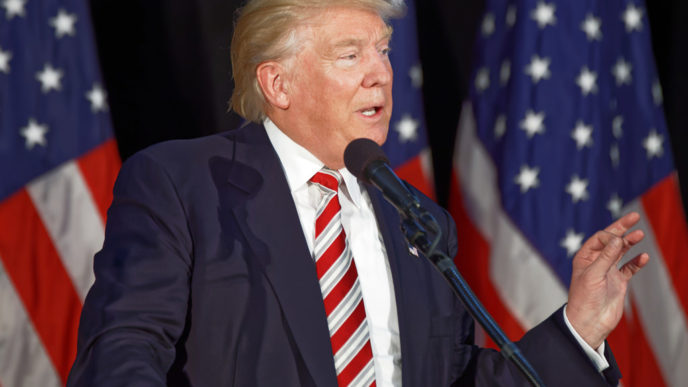
Handicapping the Trump Cabinet

There’s a lot of speculation out there, but here are my guesses for President Trump’s (doesn’t that phrase feel good?) cabinet.

Attorney General Rudy Giuliani
Secretary of State former Speaker of the House Newt Gingrich
DHS Secretary Gov. Chris Christie
Secretary of Defense Sen. Jeff Sessions
Department of the Interior former Alaska Gov. Sarah Palin
Secretary of Energy Harold Hamm
Surgeon General Ben Carson
National Security Adviser Lt. Gen. Michael Flynn
Chief of Staff Reince Priebus
Treasury Secretary Steven Mnuchin
Secretary of Agriculture former Georgia Gov. Sonny Perdue
Commerce Secretary Wilbur Ross
Secretary of Labor Victoria Lipnic
Secretary of Education William Evers
Veterans Affairs House retiring Veterans’ Affairs Chairman Jeff Miller
EPA Director Myron Ebell

Alright, you geniuses: what did I get wrong? (For more from the author of “Handicapping the Trump Cabinet” please click HERE)

Follow Joe Miller on Twitter HERE and Facebook HERE.

The Religious Vote and Why It Mattered

Pundits and pollsters long said the Christian demographic would be important to Donald Trump’s chances at the presidency, and exit polling results would appear to prove the Christian vote was critical to Donald Trump’s stunning win.

According to New York Times exit polling, 58 percent of Protestants or other non-Catholic Christians voted for Trump, while 52 percent of Catholics voted for him. Only 24 percent of Jewish voters cast a ballot for Trump, while 26 percent of those with no religious affiliation did the same.

White evangelicals showed up in a big way — at their highest margin since 2004. And fully 81 percent of white evangelical Christians voted for Trump. Black evangelicals seemed to prefer Clinton leading up to the election, but in the end, Clinton did not capture the majority of their votes, reported Christianity Today.

Of those who attend religious services, 56 percent of those attending weekly services voted for Trump, 49 percent of those attending services a few times monthly did the same, 47 percent of those who attended religious services a few times per year voted for Trump and 31 percent of those who never attended religious services voted for him.

Donald Trump’s Christian voters may have turned out largely due to his acknowledgement of the demographic while his opponent principally ignored them. Clinton only captured a fraction of what Obama did during his elections, reported Christianity Today, but Trump saw a strong base in the key states of Ohio, North Carolina and Florida.

Even Obama’s former faith adviser tweeted about Clinton’s disconnect with the white evangelicals:

Now that the election is behind the nation, plenty remains on the political horizon for Christians. Rev. Dr. Samuel Rodriguez, president of the National Hispanic Christian Leadership Conference, said the nation must put the divisiveness in the past and work together. “Instead of the agenda of the donkey or the elephant, Christians must be about the Lamb’s agenda,” Rodriguez said. He added:

Looking ahead, now is the time to rise up as people of faith and as an independent voice that holds political leaders on both sides of the aisle accountable to policies that don’t aim left or right, but toward righteousness and justice, for all. Chief of which remains our concern for religious liberty, the sanctity of life, immigration reform and racial unity. We pray for the safe keeping of our democracy as we transition to the new Donald Trump administration and we pray that God will continue to bless and prosper our nation in the coming months and years ahead.

David Jeremiah, founder of Turning Point and senior pastor of Shadow Mountain Community Church in California urged Christians to pray for the new administration and keep their eyes on their ultimate citizenship — heaven. He added:

“We commit to pray for the new Trump administration. We pray that God might have mercy on our nation and that our leaders might know and fear Him, for as the Scriptures say, blessed is the nation whose God is the Lord … Presidents come and go, but our God remains forever and he will be on his throne on November 9 as he was on November 8 and as he will be for all of eternity.”

(For more from the author of “The Religious Vote and Why It Mattered” please click HERE)

Follow Joe Miller on Twitter HERE and Facebook HERE.
How Republicans Can Start to Dismantle Obamacare With a Trump Presidency

The GOP’s long-discussed dreams of repealing Obamacare became closer to reality early Wednesday morning when Donald Trump was elected president.

Six years after President Barack Obama signed the Affordable Care Act into law and after more than 60 attempts to repeal it, Republicans now have a good chance to advance their own agenda.

While on the campaign trail, Trump repeatedly promised voters that he would repeal Obamacare if he was elected president and even called on congressional Republicans to call a “special session” to move forward with rolling back the law.

“Obamacare has to be replaced,” Trump said earlier this month during a stop in Pennsylvania. “And we will do it, and we will do it very, very quickly. It is a catastrophe.”

Now, following Trump’s defeat of Democratic presidential nominee Hillary Clinton, Republicans are laying the groundwork for dismantling the Affordable Care Act next year.

“I don’t think it’s going to be a sentence-per-sentence destruction of the bill, but I do think that substantial chunks of it are in really grave danger,” Seth Chandler, a visiting scholar at George Mason University’s Mercatus Center and a professor at the University of Houston Law Center, told The Daily Signal.

Republicans need 60 votes in the Senate to pass a bill repealing the health care law and would fall short of that threshold in the new Congress, where the GOP will hold at least 52 seats.

But GOP lawmakers are likely to use a budget tool called reconciliation—a procedure used in the Senate that allows a bill to pass with 51 votes—to roll back key provisions of Obamacare and avoid a Democratic filibuster.

The GOP-led House and Senate passed a budget resolution last year that included instructions to use reconciliation to repeal Obamacare and were ultimately successful in getting it to Obama’s desk, where it was vetoed.

The bill called for the repeal of the individual and employer mandates, Medicaid expansion, tax credits, medical device tax, and Cadillac tax. It also stripped the government of its authority to run the exchanges set up under the law and lessened the fine for failing to comply with the mandates to $0, which was needed to abide by Senate rules.

GOP leaders in the House and Senate haven’t committed to using reconciliation again next year to dismantle the Affordable Care Act, but House Speaker Paul Ryan said Wednesday the law is “collapsing under its own weight.”

“This Congress, this House majority, this Senate majority has already demonstrated and proven we’re able to pass legislation and put it on the president’s desk,” Ryan, R-Wis., said during a press conference. “Problem is, President Obama vetoed it. Now, we have a President Trump who has promised to fix this.”

Ryan’s counterpart in the Senate, Majority Leader Mitch McConnell, also said Wednesday that Obamacare’s repeal is a priority for the GOP-led Senate.

“It’s pretty high on our agenda as you know,” McConnell, R-Ky., said. “I would be shocked if we didn’t move forward and keep our commitment to the American people.”

As Congress considers and crafts a reconciliation bill rolling back key aspects of Obamacare, Trump can take steps on his own to “make the Affordable Care Act’s life miserable,” Chandler said.

The first thing the president-elect can do is end cost-sharing reductions, Chandler said, which are payments the federal government makes to insurance companies that provide silver-level plans to consumers.

“The Affordable Care Act is fragile enough that doing this one thing of refusing to pay the cost-sharing reduction payments will be enough to strike a mortal blow,” he said.

The House filed a lawsuit against the Obama administration in 2014 over the cost-sharing reductions on the grounds that the Department of Health and Human Services was using money that Congress never appropriated.

That lawsuit is currently weaving its way through the courts, but Chandler argued that Trump can stop cost-sharing reductions on his first day in office. Doing so would likely cause insurance companies to leave Obamacare’s exchanges and cancel policies, Chandler said.

Such action on the part of insurers would have a significant impact on consumers, but it could be used as a “starting point” for negotiations with congressional Democrats over a replacement for the health care law.

“Trump holds a very powerful card in his hand,” Chandler said.

In addition to ending cost-sharing reductions, Trump can also begin the rulemaking process to roll back several regulations implemented under Obamacare, including the contraception mandate and the essential benefits requirement.

The controversial contraception mandate, which was challenged before the Supreme Court this year, requires employers to provide their workers with health insurance plans that cover contraceptives and abortion-inducing drugs.

Under the essential benefits requirement, health insurance plans must cover a number of health care services, which include ambulatory patient services, emergency services, maternity and newborn care, and preventive and wellness services.

After Obamacare became law in 2010, Republicans pledged to repeal it while campaigning during the 2014 midterm and 2016 general elections but haven’t been successful.

Obamacare’s fourth open enrollment period began last week, and consumers have until Dec. 15 to purchase coverage that begins in January.

Though 20 million Americans gained health insurance coverage under Obamacare, many consumers have seen their premiums and deductibles increase over the last three years.

Monthly premiums for plans sold on Obamacare’s federal exchange next year will rise by an average of 25 percent, and consumers have fewer choices than they have had in the past.

Ryan and House Republicans rolled out the House GOP’s replacement plan for Obamacare in June, which starts with repealing the Affordable Care Act.

The plan, part of Ryan’s “A Better Way” agenda, maintains few of Obamacare’s provisions, such as a measure allowing those under the age of 26 to remain on their parents’ plans, but would also reform Medicaid and loosen regulations on health savings accounts.

Trump unveiled his own health care plan during the campaign, which includes measures to allow insurers to sell policies across state lines and to turn Medicaid into a state block grant program.

Republicans haven’t coalesced around one alternative to the health care law. But Sen. John Barrasso, R-Wyo., said Wednesday the GOP would ensure consumers have a “smooth transition” from the current health care system to a new one once Obamacare is repealed.

“People had significant disruption in their lives already,” Barrasso said. “We want a smooth transition—as smooth as possible. We’re moving away from Obamacare to patient-centered care and putting competition back in the system.” (For more from the author of “How Republicans Can Start to Dismantle Obamacare With a Trump Presidency” please click HERE)

Follow Joe Miller on Twitter HERE and Facebook HERE.
Make Religious Freedom Great Again

Donald Trump promised that he would make America great again. If he is to make good on that promise, he’ll need to start by robustly restoring our first freedom: the free exercise of religion.

Unfortunately, under President Barack Obama’s administration, it came in for attack as never before. Thankfully, many of those attacks can be rectified in the very first days of a Trump administration.

Trump should commit to protecting the free exercise of religion for all Americans of all faiths. In her concession speech, Hillary Clinton referred to the “freedom of worship”—piety limited to a synagogue, church, or mosque. But what the American founders protected was the right of all to live out their faith every day of the week in public and in private, provided they peacefully respect the rights of others.

The reduction of religious liberty to mere freedom of worship is a hallmark of the Obama years. Houses of worship, for example, were exempted from the Department of Health and Human Services Obamacare contraception and abortifacient mandate.

But religious schools, like Wheaton College, and religious charities and communities, such as the Little Sisters of the Poor, were merely “accommodated”—offered a different way to comply with the mandate while still violating their beliefs.

A Trump administration can fix this right away. Trump can instruct his secretary of Health and Human Services to provide robust religious liberty protections to the HHS mandate. And Congress can pass legislation, which Trump can sign, to repeal and replace Obamacare.

Likewise, the Obama administration has engaged in a series of executive actions—some of which were likely unlawful—to advance a radical transgender agenda. This, too, Trump can end.

For example, the Obama departments of Justice and Education have instructed school districts throughout the country that they are now interpreting a 1972 law, Title IX, to require schools to allow students to use the bathroom, locker room, and shower facility that accords with their self-declared “gender identity.” They did this by saying the word “sex” would now mean “gender identity.”

The Obama Department of Health and Human Services has done the same thing: claiming a provision in Obamacare that forbids discrimination on the basis of “sex” means “gender identity”—and thus all health care plans have to cover sex reassignment therapies, and all relevant physicians have to perform them.

Obama has also issued executive orders barring federal contractors and federal foreign aid recipients from engaging in what the government deems to be “discrimination” on the basis of “sexual orientation and gender identity”—where something as simple as saying biological males shouldn’t use female showers can count as “discrimination.”

All of this can be undone right away. Trump can rescind Obama’s executive orders, and he can instruct his secretaries of Education and Health and Human Services and his attorney general to interpret the word “sex” as Congress intended it—as a biological reality—not as “gender identity.”

Congress can then make these orders permanent by enacting the Russell Amendment, which protects freedom in religious staffing for religious institutions, and by passing the Civil Rights Uniformity Act, which specifies that the word “sex” in our civil rights laws does not mean “gender identity” unless Congress explicitly says so.

Trump should also make it clear that under his watch the federal government will never penalize any individual or institution because they believe and act on the belief that marriage is the union of husband and wife.

Trump can issue an executive order stating that when it comes to tax status, accreditation, licensing, government grants, and contracts, no entity of the federal government may penalize someone for acting on their conviction on man-woman marriage. To protect a future president from undoing this, Congress can pass, and Trump sign into law, the First Amendment Defense Act. Indeed, Trump promised to sign this bill into law during his campaign.

Whether it be harassing an order of nuns, forcing doctors to perform sex reassignment therapies, or preventing local schools from finding win-win compromise solutions that would respect all students’ bodily privacy, the Obama administration has waged an aggressive and unnecessary culture war.

Because it has done so almost exclusively through executive action, a Trump administration can quickly undo this damage. And Congress can then ratify it permanently in law. That’ll go a long way toward protecting peaceful coexistence, making American truly great again. (For more from the author of “Make Religious Freedom Great Again” please click HERE)

Follow Joe Miller on Twitter HERE and Facebook HERE.

4 Ways to Survive Election Day

As Election Day looms, many conservatives are struggling to be excited about this political cycle — in fact, many are dreading it. Still, it’s an important period in our nation’s history. Here’s how to navigate the next 24-48 hours without feeling crazy, depressed, or like you want to stick your head in the sand.

Vote

Given how awful both Trump and Clinton are, I really struggled this year with whether or not I was going to vote at all. But voting is a privilege — something not every citizen of every country shares (especially women). I’ve heard some people say, I don’t know anyone who has died for my right to vote. Perhaps not, but look at it this way: Our military sacrifices time, effort, money — and lives — to protect us from countries who’d like to take our freedoms away. Which right do you think our enemies would like to eradicate first? Voting is in the top five.

Read up on the candidates again — including the independent ones like Evan McMullin. Depending on where you live, figure out if your state is a “swing state,” and if you might deploy a strategy while voting. If you really, really can’t cast a vote due to your conscience — well that’s up to you. Remember: Be vigilant and report any suspicious activity at your polling place to police.

Oh, and if you feel comfortable and safe, bring your kids to vote: Tell them the differences between a democracy and a republic — remember, we live in the latter. If they’re older, explain to them how the Electoral College works. This is an important part of history; they’ll only get to see four times before they do it themselves. Lead the way; pave the path. It’s not a chore; it’s a privilege.

Do your thing

Now that you’ve voted, or perhaps you’re waiting for a lull later in the day, text your local friends and neighbors and tell them where you voted and gently nudge them to do the same. Then, go about your business, doing the thing you were put on this earth to do. Don’t sit around on social media wondering how many folks are voting. Plus, the results won’t be in for hours. The Founding Fathers didn’t lay the foundation for a republic — complete with voting rights — and that whole “life, liberty and the pursuit of happiness” thing for you to sit around worrying about who is going to be the next president.

I’ve got a great piece of art on one of my walls at home: “Dreams Don’t Work Unless You Do.” Cliche? Yes. Prosaic? Maybe. But, also, right. Whatever your dream is, beyond having a Republican, Democrat, or Independent for president, do a little bit of it today. This country still needs encouraging teachers, intelligent doctors, informed lawyers, proficient plumbers, creative architects, innovative designers, and good parents, (et al) as much as it needs a president who will do a good job too. Do your part in the American dream — especially before either nominees can get their foot in the door and do any more to try to yank it away.

Get with your family — then get informed

The most influential thing on your children won’t be their next president — it will be you. Get with your family, friends, whoever is in your circle of influence. Have a meal; Enjoy a glass of wine. Read aloud or listen to “Duck For President.” It’s adorable and will make them laugh and ease your mind. Tell them you love them — these are the moments children remember.

Now, and only now, check in with your preferred source of news. A few results from the East Coast might be rolling in, but remember, some of the swing spots — the purple areas — are more rural come in later. Plus, you’ve still got our West Coast friends who take a while (it seems). Go ahead, read the statistical analysis, start counting electoral votes, and if it makes you feel better, wonder how we got here all over again. (Not that this will matter much at this point, but it’s certainly a natural reaction.) The states to watch are Nevada, Colorado, Minnesota, Wisconsin, Ohio, Pennsylvania, Virginia, New Hampshire, North Carolina, and Florida.

Don’t panic

When the results have finally come in and the winner is basically declared, first, panic a little, if you’re the type to do so. If not, just roll your eyes, purse your lips, shrug, or — the worst — glare silently at the red and blue map on TV. Let all the thoughts run through your mind: I can’t believe it! How did we get here? This is absurd! How are we even a world superpower? Will we even be a world superpower come January? I miss Ronald Reagan! I’m moving to New Zealand! Or Canada! What am I going to tell my kids?

Then, collect yourself. You’re an adult after all. Be glad you live in a republic and not a democracy and that you even get to vote at all. Hope and pray that neither president is as awful as we have predicted. Ask yourself if you did everything you could to prevent what you’re seeing on television and if not, what you’ll do differently in 2020. Vow to do that, and more, especially at the local level starting Wednesday.

Then go to bed, with these things in mind, and this nugget from one of the best journalists of our time, the late Robert Novak: “Always love your country–but never trust your government!” (For more from the author of “4 Ways to Survive Election Day” please click HERE)

Follow Joe Miller on Twitter HERE and Facebook HERE.

What Can We Do to Indict Hillary Clinton, One of the Most Corrupt Politicians in History?

There is little doubt in the minds of the American public that Hillary Clinton probably broke a law. After all, she seems to have little reason to abide by it. In fact, she may be the first presidential candidate to be interviewed by the FBI as often as she is by the media.

More recently, the FBI has reopened the investigation into wrongdoing by Hillary and her aides after the FBI stumbled upon thousands of additional State Department emails that may have been improperly shared after investigating a separate incident involving disgraced former congressman (and estranged husband of Hillary’s closest aide, Huma Abedin) Anthony Weiner and his involvement with underage women.

Although the FBI has determined (perhaps politically) no wrongdoing by Clinton there either, it’s unlikely the illegal activity surrounding Hillary’s emails — and the fraudulent nature of the Clinton Foundation — will keep her off the radar of law enforcement.

Yet, if Hillary is elected as some polls suggest, the bigger question on the minds of so many Americans is what happens if Hillary did break the law? Can she be indicted? Can she go to jail? Can she pardon herself? To get answers, I sat down with one of the most informed individuals on such matters, Bruce Fein, constitutional scholar and former associate deputy attorney general under President Reagan.

Q & A with Bruce Fein

JG: Could “President Hillary Clinton” be indicted if law enforcement concludes she broke the law?

BF: This question was litigated during the Nixon/Watergate era. The courts concluded that a sitting president, unlike a member of Congress or a judge, could not be indicted. Since the president is the executive of an entire branch of the government, it would effectively shut that branch down. It would be in direct conflict with the Constitution.

However, like they did with President Nixon, Congress has the ability to impeach a president, and if they do so successfully, then the president can then be indicted.

That being said, it would be nearly impossible for the Justice Department to indict a president. Since the president has the authority to fire any individual in the executive branch without cause, any U.S. attorney willing to indict a President Hillary Clinton would immediately be fired. The case would never make it to a grand jury. A grand jury can’t indict an individual unless it is signed by the U.S. attorney. Even today, the secretive grand jury process is often ignored by the U.S. attorney’s office for much lesser political reasons. That is one reason the first action by any new president is to fire most of the U.S. attorneys and replace them with their own. When I was with Reagan, we fired most of the U.S. attorneys under President Carter.

JG: If President Clinton were indicted before the election, could she pardon herself as president?

BF: President Obama would never allow Clinton to be indicted. He wouldn’t risk destroying the Democratic Party over an indictment. Even then, Clinton’s indictment would simply be dismissed by the U.S. attorney’s office as soon as she became president.

JG: What are the steps to creating a special prosecutor?

BF: There are two ways:

One, is by congressional enactment, or an independent counsel statute — which Congress allowed to expire in 2000. That statute provided for three judges on the U.S. Court of Appeals here to appoint an independent counsel that runs their own criminal investigation using the FBI and traditional resources that don’t report to the attorney general in cases of clear conflict of interest where the target of the investigation is the president, the upper echelon of his cabinet, or head honchos within a party.

The independent counsels have the right to stay and investigate as long as they wish. Kenneth Star [who investigated President Bill Clinton] was an independent counsel, Congress appropriates money for them; they are the ones who decide to challenge executive privilege and that sort.

The other way to do this, assuming Clinton became president, is by regulation. This was done during Watergate. At that time, there was a vacancy at the attorney general’s office, so the Senate Judiciary Committee told the new nominee, Elliot Richardson, that he was not to be confirmed unless he agreed to various regulations. Those regulations required Richardson to establish a special prosecutor; it had to be Archibald Cox, and he had to have a special jurisdiction. Otherwise, you’re not going to be confirmed. So, he said ok.

That process could happen under a Clinton presidency, too.

JG: So, in Clinton’s case, it would really be up to Congress to establish a special prosecutor?

BF: Yes. Congress can establish a special prosecutor that can hold grand juries, report to the judicial branch, and even, be called before Congress to testify. They are just like the U.S. attorney’s office except they can’t be fired by the president.

JG: The special prosecutor can go after anyone around the president, but not presidents themselves since they are immune from indictment?

BF: No, the special prosecutor can certainly go after the president. Except, instead of indictment, any facts established in the investigation of the president can be used by the House of Representatives in an impeachment proceeding.

JG: Given your knowledge of impeachments, what do you think might happen to Clinton?

BF: Well, unless there is an independent counsel or special prosecutor, nothing is going to happen. It’s possible that some of the aides around Clinton get indicted. If there is a special prosecutor, I would imagine that would make its way to being considered by the House of Representatives.

Now, there is another argument some make about impeachment. Clinton could say that she broke the law as the secretary of State, but impeachable offenses are only actions undertaken while being president.

That argument would have to be voted on by the House, but I don’t think it’s a persuasive argument. Impeachment is like a preventive measure — it’s simply a statement that we just don’t trust this person with the reins of government, showing past behavior.

JG: Given your experience working on the impeachment proceedings against President Nixon, do you think Clinton’s actions warrant investigation by a special prosecutor if she becomes president?

BF: I don’t think the level and pervasiveness of wrongdoing that we expect of Clinton was on the level of Nixon. In part, she was secretary of State, but presidents can do everything, and President Nixon was doing everything. He was ordering the IRS to do stuff, breaking into offices, threatening the TV and radio licenses of media organizations if they were critical of him.

However, the most disturbing things about Clinton are that she placed herself above the law, very recklessly. She was secretary of State, and she had information that belonged to the government. The public confidence in the administration of justice is at its zenith at these highest levels. Moreover, we’re speaking about someone who was in the White House for eight years, has been through impeachment once with her husband, she was in the Senate for eight years, so she knows better. Yet she treated the whole thing with disdain.

When Alexander Hamilton was explaining what the nature of an impeachable offense was in Federalist Paper 65, he said it wasn’t necessarily a crime, but a crime against the Constitution — a crime against society because you shake confidence in justice and fairness. That is what Hillary Clinton has done.

JG: If you were to advise Congress on how to handle potential crimes committed by Hillary Clinton, if she became president, what would you tell them?

BF: I would suggest Congress immediately start having hearings on a proposed Article of Impeachment. It should be Congress that conducts the investigation. It’s their responsibility. The reason why Watergate worked is because Congress did their own investigation, and it was on TV, and the American people could see it.

All the grand jury stuff is secret. And one of the reasons why, in my judgement, the Bill Clinton impeachment failed is because all the really serious parts of the investigation were all secret. All the American people heard was Kenneth Star sitting and reading a piece of paper.

The House of Representatives has all the investigatory tools that the U.S. attorneys have: They can issue subpoenas, issue depositions; they can investigate it all in secret (via Executive Session) if they choose, they can issue immunity grants through the courts — and do all this investigation on their own that would allow them to come to their own conclusion whether to impeach Clinton or not.

JG: Do you think Clinton’s actions warrant Congress to take these steps?

BF: I’m not in favor of impeachment for the sake of impeachment. I’m in favor of impeachment in order to maintain the integrity of the principle of law. What persuades me to this conclusion isn’t to downplay the magnitude of the wrong. It’s that we do not give conclusive weight — but very strong presumptive weight — to the majority vote.

If she wins the election, we’ll need to have a very high threshold of wrongdoing to effectively overturn a popularly elected president — especially since these were acts committed before the American people voted, and when most of us knew what was going on but still elected her. (For more from the author of “What Can We Do to Indict Hillary Clinton, One of the Most Corrupt Politicians in History?” please click HERE)

Follow Joe Miller on Twitter HERE and Facebook HERE.

Was It a Sin to Vote for Lisa Murkowski?

I consider the killing of more than 50 million innocent children via abortion to be the moral crisis of this age.

It is a scourge on our supposedly enlightened society. It is a blight on our humanity. It has corrupted the soul of our nation. It has proven how little regard we have for our own legacy as a people, when we’re willing to so cavalierly dispose of our only renewable resources — our own children.

For these reasons I won’t vote for a candidate that isn’t pro-life — regardless of party or who their opponent is—- for dog catcher let alone a more meaningful office. For where someone stands on the life issue isn’t just a litmus test but a window to the soul. If someone is willing to compromise or worse on something as sacred as life, then they can’t be counted on to be stewards of our less sacred resources, either.

What then, if you believe as I do that abortion is the murder of an innocent child and an abominable violation against the designs of heaven, should you do when you walk into your polling place on Tuesday?

Randall Terry is the original founder of Operation Rescue, which is one of the pioneer organizations in the pro-life movement. And he doesn’t pull any punches. In fact, he has been driving a bus around the southeast to various campaign events for the last two weeks with this main message emblazoned across the side:

It is a sin to vote for Hillary.

Large pictures of aborted babies also cover the side of the bus, as does the command to “not play the whore with your vote. If you vote for Hillary, you share in the guilt of her sins. Do not raise the anger of God by helping Hillary shed innocent blood.”

I recently interviewed Terry, and he said that message is intended for the 55 percent of Catholics and 33 percent of evangelicals who “betrayed Jesus Christ” in the last election by voting for the pro-killing Barack Obama. Not only is that unacceptable, he says, but a preposterous moral equivocation that ultimately leads to a spiritual death sentence for the one making such a wicked compromise.

It doesn’t matter what else you think Hillary will accomplish as president if she promises to accelerate the baby killing. Imagine, as Terry says, that somebody asks you to give them a ride so that they can run some errands. First they ask you to go to the grocery store, then to the pharmacy, and last to the bank. And oh, by the way, the stop at the bank will include a hold up complete with an execution style murder.

That’s what you are an accomplice to, says Terry, if you vote for Hillary. The relative innocence of the other stops along the way, or the other political issues du jour, are non-sequiturs by comparison.

“There are some sins that are higher than others,” Terry said. “There is a hierarchy of evil. And Christians who keep voting in support of abortion have the brazen face of a harlot. They are committed to their path of sin. There is a motive skewing their ethical compass.”

So if one accepts the fundamentals of such a moral economy, then the question becomes what to do next. In Terry’s case, he is supporting Donald Trump, saying that “he says he will make it a crime to kill an unborn baby. He’s the only one (in the GOP primary) who has said that and I believe him, and I know that I believe Hillary is proven to be a maniacal supporter of abortion.”

Note that Trump almost immediately took back his claim that abortion should be considered a criminal offense, like he is prone to do on almost every position he’s taken throughout this campaign. But just as Hillary’s sins don’t absolve Trump from his, neither do his absolve hers. Hillary does little to hide her zeal for baby-killing, nor her admiration for macabre Planned Parenthood founder Margaret Sanger.

A pro-life leader I admire, Dr. Laurence White in Houston, has long said this about the infanticide holocaust we have permitted to occur on our watch:

The killing won’t stop until the church makes it stop, and not a moment sooner.

In his own, provocative way, Terry seems to be channeling a similar sentiment. “It is necessary for us to speak as harshly as God sometimes does in order to wake people up,” he adds.

This is on us when we affirmatively vote for those who enable and/or champion this rampage, which is why Terry believes it is a sin to vote for Hillary Clinton.

Whether or not you agree, I know this for sure. No matter who we vote for, if we have decided that Planned Parenthood’s freezer bags full of dismembered baby parts for sale are not really our concern, then we are doing it all wrong. (For more from the author of “Is It a Sin to Vote for Hillary Clinton?” please click HERE)

Follow Joe Miller on Twitter HERE and Facebook HERE.

All Politics Is Local: Why Down-Ballot Races Can Be Far More Important Than National

This weekend, do not neglect to research candidates for local office in your community. For in many ways, the people who serve in your local government will have more influence on your everyday life than those in the federal government.

That is the way our constitutional republic was designed.

In the minds of America’s founders, the powers of the federal government were intended to be limited, while the state and local governments were intended to bear the brunt of government work.

As James Madison, the father of the U.S. Constitution, explained in Federalist 45:

“The powers delegated by the proposed Constitution to the federal government, are few and defined. Those which are to remain in the State governments are numerous and indefinite.”

Essentially, the role of the federal government, as intended by the Founding Founders, was limited in scope to national security, international trade, the maintenance of peaceable relations between the states, and the power to lay taxes to pay for those responsibilities.

The real action of government was meant to take place at the local level. Madison continues: “The powers reserved to the several States will extend to all the objects which, in the ordinary course of affairs, concern the lives, liberties, and properties of the people, and the internal order, improvement, and prosperity of the State.”

This principle of separating the powers of the national and local governments, which we call federalism, is the key to having good and safe government. As Thomas Jefferson wrote:

[T]he way to have good and safe government, is not to trust it all to one, but to divide it among the many, distributing to every one exactly the functions he is competent to. Let the national government be entrusted with the defense of the nation, and its foreign and federal relations; the State governments with the civil rights, laws, police, and administration of what concerns the State generally; the counties with the local concerns of the counties, and each ward direct the interests within itself. It is by dividing and subdividing these republics from the great national one down through all its subordinations, until it ends in the administration of every man’s farm by himself; by placing under everyone what his own eye may superintend, that all will be done for the best.

The national government has unquestionably exceeded those bounds today. And while its all-encompassing power may seem to make state and local governments less relevant, there are important battles being fought in governors’ mansions, the state legislatures, and town halls of America.

On the issues conservatives care about, it has been state governments, not the federal government, where we have achieved some victories.

The federal government has refused to defund Planned Parenthood. Several states have taken action to do so, ending government aid to an organization that kills babies for profit.

In North Carolina, where most of the media attention is focused on the presidential race, Governor Pat McCrory (R) has held the line against the Left’s radical bathroom-bill demands. He is an extremely tight race with Democratic Attorney General Roy Cooper, who champions the Left’s radical gender-identity agenda.

Are your candidates for local and state office going to be willing to fight these fights?

Who is running for mayor in your town? City council? Supervisor? State senator, representative, or judge? Do you know the members of your local school board — those that make daily decisions about the welfare of your child? Are you aware of who runs your police department? Have they pledged to improve relations between the police and your community, for the safety and happiness of all?

If you don’t have the answer to these questions, take some time this weekend and educate yourself on the entirety of your ballot.

For the best government is that which governs closest to the people. And it is within your power as a voter to ensure that the government closest to you, in your community, is good government. (For more from the author of “All Politics Is Local: Why Down-Ballot Races Can Be Far More Important Than National” please click HERE)

Follow Joe Miller on Twitter HERE and Facebook HERE.
If Voting Is Sacred, Early Voting Must Go

Let’s work backward.

Less than a week before the election, the Wall Street Journal and Fox News’ Bret Baier reported that the Clinton Foundation has been under investigation for “pay-for-play” allegations for over a year — and that the Department of Justice may have been trying to monkey-wrench the effort.

Eleven days before the election, FBI Director James Comey announced that he was reopening the inquiry into Hillary Clinton’s emails. A few days before that, WikiLeaks dropped a bombshell of a hacked memo showing the full extent of “Clinton Inc.” — the tawdry, tacky and some would argue criminal web of for-profit, nonprofit and political entities that make up the Clinton empire. A couple weeks before that, NBC News released a tape of Donald Trump describing how he likes to sexually assault women. Since then, nearly a dozen women have come forward describing treatment that closely tracks the behavior Trump himself described in an unguarded moment.

Those are just the highlights.

Both candidates have also made controversial statements about their policies and philosophies. In the third debate, Clinton refused to support any limitations on even late-term abortions. She also claimed that the longtime gun ban in Washington, D.C., ruled unconstitutional by the Supreme Court in the Heller decision, was really just an effort to keep toddlers from getting their hands on guns.

And Trump? Well, let’s just say he’s said a lot of things.

And you know what else happened during all of this? People have been voting. A lot.

Early-voting start times vary by state and often by county. In Minnesota, people started casting ballots in September. In Ohio, voting began just five days after the Access Hollywood tape surfaced, three days after the second presidential debate and a week before the final debate. As of this writing, more than 22 million people have voted already. In all, an estimated 40 percent of voters will cast ballots before Election Day.

And that’s nuts.

Before you rush to the safety of the usual argument, let me admit that, of course, some early and absentee voting is necessary. Obviously, overseas military personnel and voters with certain disabilities should be accommodated. But defending their right to vote absentee is not a defense of mass-scale early voting.

The standard argument against widespread early voting is that it encourages many people to make their decisions without important information available to the voters who wait until Election Day. That’s really not debatable, so early-voting supporters concede the point and then say it just doesn’t matter. They note that the people most likely to cast early votes are committed partisans, immune to new facts and information. There’s surely some truth to that, but as the scale of early voting increases with each year, it must also be less and less true every year. Also, one might wonder why people who decry the rise of ideological polarization and partisanship are so eager to make it easier for hardcore partisans to vote.

Comey’s bombshell is a perfect illustration of how new facts can make a hash of things. Trump is imploring people who’ve already cast their votes for Clinton to remedy their “buyer’s remorse” and switch to Trump — which is legal in six states. The problem is worse in the primaries. Voters often cast early ballots for candidates who drop out before Election Day. That’s real voter suppression.

But my main problem with early voting is different. Every day we hear pious actors, activists and politicians talk about the solemn and sacred duty to vote, and yet everyone wants to make voting easier and more convenient. Many still dream of the most cockamamie idea of all: online voting, so we can make choosing presidents as easy as buying socks on Amazon.

This gets human nature exactly backward. Nothing truly important, never mind sacred and solemn, should be treated as a trivial convenience. Churches that ask more of the faithful do better at attracting and retaining congregants. The Marines get the best and most committed recruits because th1ey have higher standards. Elite schools demand more from students and get more as a result. No wonder one study found that early voting actually lowers turnout because it makes Election Day seem like a less special event.

Of course we shouldn’t put up any insurmountable obstacles to voting. But if we want citizens to value their vote, why are we constantly lowering the price? (For more from the author of “If Voting Is Sacred, Early Voting Must Go” please click HERE)

Follow Joe Miller on Twitter HERE and Facebook HERE.

What a Trump Win Would Mean

Sometimes it’s hard to know how history really played out.

Those who keep the record books usually have an agenda. Thus the Orwell maxim: “He who controls the past controls the future. He who controls the present controls the past.”

In an election year of deplorables, WikiLeaks, “Access Hollywood” hot mics, FBI investigations, another round of Obamacare failures, and party-wide disarray, it is a wonder how future generations will be made to understand the forces that have culminated in Trump v. Hillary.

Soon the partisan dust will settle, and everyone will again have a stake in manipulating the recent past, selectively remembering the mood of the nation. Before that day comes, let’s stipulate a few, true things.

Neither of these candidates is likable. Americans’ faith in their political leaders is at a record low, while the belief that we are, as a country, “on the wrong track,” soars higher and higher.

Considering these immutable conditions of the electorate, I would submit that most votes cast on November 8 will not be party or candidate driven. They will be votes of utter rejection. Rejection of the established order. Of all that the election cycle has revealed. Rejection of the very despair driving the rejection.

The most popular choice on the ballot will not be a specific candidate, but a sentiment. More than ever before, Americans have been made to realize how both parties are willingly failing them. This understanding informs how little they have come to expect from their political leaders. Even many of those who support Hillary Clinton consider her untrustworthy or blatantly corrupt. And further research continues to reveal what a misnomer “Trump supporter” actually is: These voters aren’t diehard Trumpians. They are desperately, bitterly opposed to everything Trump pledges to decimate. They hate that which he has sworn to defeat. They have bonded over mutual enemies: the vociferous Left, a sycophantic media, a spineless GOP, and a feckless president.

A masterfully plotted political thriller could not deliver a final chapter as layered and metaphorical as this election’s. How pitch-perfectly reflective of the mood driving the votes. The president’s defining, progressive achievement collapses underneath the weight of its own inept construction in the same week that the FBI finally realizes it has been had by an eminently indictable presidential candidate. You could not orchestrate a finale so in tune with vox populi. That both the Obamacare collapse and Director Comey’s reengagement are resuscitating Trump’s poll numbers lend a perfect symmetry to the rejection storyline. He is once again being saved by the interconnected ugliness of the powerbrokers and Americans’ inability to stare at them for another second.

If Trump wins, it will not be because he was successful. It will be because the rebellion used him as the cudgel to smash open the empire gates.

And yet the media continue to treat his supporters as anomalous racists and xenophobes to be disregarded the morning of November 9. The mainstream media lack the perspective to understand the motivating factors for close to half of the electorate. The fact that Hillary cannot outpace Trump by more than a few points at a time has nothing to do — they insist — with the culture of liberal orthodoxy dominating the mainstream. No one is surprised by the WikiLeaks uncovering of the collusion between camp Clinton and top news networks.

Surely, no one is dismayed by the media’s utter refusal to report on her triangulations, all the while morally outraged at Trump’s every tweet. No, the only feasible way to explain any support the GOP ticket has in 2016 is that those Americans simply haven’t listened to reason. It is this trademark, leftist condescension that so much of the country can no longer stand to marinate in.

“Make America Great Again” means little more than make it different. Most people called upon to interpret the slogan simply rail against the established order. And yet the utter question mark that is Donald Trump is, to many, preferable than the answer everyone already knows. The Clintons will do what the Clintons will do, and the media, apparently, will support, protect and extol them.

For history to dismiss a Trump win as the work of a reasonless mob of deplorables is to deprive future generations of a terrific lesson. Whenever a ruling class confirms the people’s worst fears — that they really do scratch one another’s backs, that they really are all in it for money, that they really can live by another set of rules — the people will turn to whatever alternative they have to protect themselves.

Should Trump win on Tuesday, against all odds and despite the opposition of the entire aristocracy, the American people will have sent a reminder to the establishment of corruption it desperately needed and ought not soon forget: You work for us. (For more from the author of “What a Trump Win Would Mean” please click HERE)

Follow Joe Miller on Twitter HERE and Facebook HERE.