Posts

How Obama’s Post-Presidency Could Affect Your State Legislature

During his final State of the Union address, President Barack Obama insisted that one means of ending the nation’s polarized political environment is changing how the states draw congressional and state legislative districts.

“If we want a better politics, it’s not enough just to change a congressman or change a senator or even change a president. We have to change the system to reflect our better selves,” Obama said. “I think we’ve got to end the practice of drawing our congressional districts so that politicians can pick their voters, and not the other way around. Let a bipartisan group do it.”

Obama apparently plans to devote much of his post-presidency to the cause of moving congressional and state legislative districts in Democrats’ favor.

Politico first reported that former Attorney General Eric Holder, an Obama appointee and friend, will be chairman of a new group called the National Democratic Redistricting Committee that was established in “close consultation” with the White House.

Elisabeth Pearson, executive director of the Democratic Governors Association, will be president of the organization.

The Democratic Legislative Campaign Committee, which focuses on raising money and campaigning for Democrats running for state legislatures, expects the new organization will align with its efforts to win back statehouses before the 2020 Census and subsequent redistricting, spokeswoman Carolyn Fiddler said.

“DLCC is thrilled that former Attorney General Holder and President Obama are engaging in this crucial effort,” Fiddler told The Daily Signal. “Redistricting and state legislative elections are vital to the future of the Democratic Party, and the president’s involvement will help drive that fact home to a broad audience.”

The new National Democratic Redistricting Committee is a “527,” a name derived from a section in the federal tax code, which means it is an organization dedicated to influencing policy or elections and may raise unlimited amounts of money from corporations and labor unions.

In a widely published statement last week, Holder seemed less concerned about better politics and more about partisanship when he said:

American voters deserve fair maps [of election districts] that represent our diverse communities—and we need a coordinated strategy to make that happen. This unprecedented new effort will ensure Democrats have a seat at the table to create fairer maps after 2020.

The White House didn’t respond to inquiries from The Daily Signal on the effort, nor did the Democratic Governors Association. Holder also did not respond to an inquiry left on his voicemail at Covington & Burling law firm, where he is a partner.

While the president seemed to rail against the practice of gerrymandering by calling for a bipartisan commission to redraw legislative districts, the National Democratic Redistricting Committee reportedly is focusing on state legislative and gubernatorial races, election-related litigation, and voter initiatives at the state level. The goal: Rebuild a bench of future Democratic candidates for state and national offices.

White House officials informally approved naming Holder, a close friend of Obama’s, to run the new organization, The Washington Post reported.

“Over the past eight years the president has seen firsthand Republicans pulled to the far right for fear of a primary challenge instead of trying to govern from the center,” White House spokesman Eric Schultz told the newspaper.

During Obama’s two terms as president, Democrats lost 69 seats in the House of Representatives. The president’s party also lost 913 state legislative seats. A total of 32 state legislative chambers flipped to Republicans during Obama’s two terms, according to the University of Virginia’s Center for Politics.

While some of these losses could be blamed on the way Republican-controlled state legislatures drew up maps for legislative districts, it can’t explain why Democrats lost 13 U.S. Senate seats and 11 governorships during statewide elections over Obama’s nearly eight years in office.

Obama’s backing of the organization after his presidency is drawing attention because, as The Washington Post reported, it “marks a rare, if not unprecedented, step in the modern era.”

Obama’s affiliation with the group is likely a means to rake in large donations, said J. Christian Adams, a former Justice Department lawyer and an expert on elections who was a critic of Holder’s actions as attorney general.

“This is about raising the dollars to swamp Republican efforts,” Adams, president of the Public Interest Legal Foundation, told The Daily Signal. “An ex-president will have access to almost limitless amounts of money to fuel efforts to manipulate the political system to advantage the left.”

Every 10 years after the Census, states complete redistricting for congressional and state legislative districts. States generally are free to conduct redistricting how they choose as long as it adheres to the “one man, one vote” principle laid out by the Supreme Court in 1962.

Democrats and Republicans have complained for years about state legislatures seeking to draw the lines of district maps so that the results are favorable to the dominant party’s interest.

The complaining party typically depends on who has the advantage in a particular state. The practice of drawing up such districts commonly is known as gerrymandering.

In response to complaints, 13 states established special commissions to draw state legislative boundaries, taking redistricting out of the hands of the legislature—similar to what Obama, in his State of the Union address, said a bipartisan group should do.

The 13 states are Alaska, Arizona, Arkansas, California, Colorado, Hawaii, Idaho, Missouri, Montana, New Jersey, Ohio, Pennsylvania, and Washington.

Seven of them—Arizona, California, Hawaii, Idaho, Montana, New Jersey, and Washington—have special commissions to determine congressional districts as well as state legislative districts.

However, such commissions haven’t always made the process less political, said Wendy Underhill, program director for the National Conference of State Legislatures. That’s because even nominally bipartisan commissions frequently have a party advantage.

“It’s not necessarily a given it will have a less political outcome just because you have a commission,” Underhill told The Daily Signal. “It depends on the rules and the makeup of the commission.”

In some of the 13 states, Arizona and California among them, the commissions are made up of nongovernment members and include an equal number of Republicans, Democrats, and independents.

In Ohio, where a commission will go into effect after 2020, the body will be made up of the governor, auditor, secretary of state, and four others appointed by majority and minority members of the general assembly.

In Arkansas, a board is made up of the state’s governor, attorney general, and secretary of state. Currently, all these officials are Republicans, so redistricting decisions likely would have a partisan tilt.

Even if each of the three elected Arkansas officials were not of the same party, a majority party likely would have a 2-1 advantage in determining the makeup of legislative districts. So, redistricting in Arkansas would not be void of politics. (For more from the author of “How Obama’s Post-Presidency Could Affect Your State Legislature” please click HERE)

Follow Joe Miller on Twitter HERE and Facebook HERE.

Fact-Checking 7 Claims in the President’s Speech on Obamacare

In a speech before Miami Dade College students in Miami, Florida, on Thursday, President Barack Obama spoke about some of the successes of the Affordable Care Act, as well as what he would like to see for the future of his signature health care law.

The president’s address came just weeks before the 2017 open enrollment period, which starts Nov. 1, and at a time when much of the news surrounding the health care law has focused on increasing premiums and decreasing options for consumers buying coverage on Obamacare’s exchanges.

During his speech, the president touted the uninsured rate, which is at its lowest in history, but also conceded that improvements can be made to the law.

The president called for the creation of a public option, or government-run plan that competes with private insurers, which he mentioned in the Journal of the American Medical Association in June.

“The Affordable Care Act has done what it was designed to do,” Obama said. “It gave us affordable health care.”

In the years since Obamacare’s implementation, GOP lawmakers have voted to repeal the health care law more than 60 times. Obama, referencing those attempts, called on Republicans to abandon those efforts and instead work with the next president to fix the law.

“Repeal is not the answer,” he said.

While the president outlined many of Obamacare’s accomplishments, The Daily Signal provided more context for some of Obama’s claims about the health care law.

1.) “Because of this law, because of Obamacare, another 20 million Americans know the financial security of health insurance.”

Though the uninsured rate has reached a historic low and 20 million Americans now have health insurance, the majority of those who enrolled in coverage under Obamacare qualified for Medicaid. The Affordable Care Act loosened the guidelines for Medicaid eligibility, and since the law was passed in 2009, 31 states and the District of Columbia have expanded the program.

In 2014, for example, 9.25 million consumers enrolled in coverage on the federal and state-run exchanges. However, 97 percent of those new enrollees, or 8.99 million people, enrolled in Medicaid.

Under Medicaid expansion, people making up to 138 percent of the federal poverty line, or about $16,390 for an individual, qualified for Medicaid.

2.) “States like Louisiana that just expanded Medicaid—you had a Republican governor replaced by a Democratic governor. He said, ‘I want that money.’ [He] expanded Medicaid and found not only does it insure more people, but it’s actually saved the state big money and makes people less dependent on expensive emergency room care.”

Despite the president’s claim, recent findings from a study published in the New England Journal of Medicine found that expanding Medicaid won’t stop patients from using emergency rooms for primary care.

The study, published Wednesday, examined patients in Oregon who were enrolled in Medicaid in 2008. Oregon expanded its Medicaid system that year for enrollees selected through a lottery system.

According to the study, visits to the emergency room remained high two years after those selected for the lottery were enrolled in Medicaid.

The study was first published in 2014, and that year, researchers found that those who enrolled in Medicaid through the state’s lottery increased emergency room visits by 40 percent over the first 15 months of enrollment.

With two more years of data between the 2014 and 2016 studies, researchers said Wednesday there was no sign of emergency room use dropping.

3.) “For most Americans, the Affordable Care Act, [Obamacare], has not affected your coverage except to make it stronger.”

Though the majority of Americans receive their health insurance coverage through their employers, consumers purchasing plans both on and off the exchange have seen their narrower networks, canceled policies, and increased deductibles and premiums.

Insurance companies have pointed to enrollees who are sicker and more expensive as one of the primary reasons for increased premiums. Additionally, health policy experts have said that insurers have been forced to narrow networks as a way to control premium increases.

4.) “Because the federal government pays for almost all of [Medicaid] expansion, you can’t use as an excuse that well, the state can’t afford it. Because the federal government is paying it.”

The federal government covered the cost of Medicaid expansion to states for its first three years, 2014 to 2017. During his speech, the president said the health care law provided states with an incentive to expand Medicaid at no cost to its taxpayers.

However, an August report from the Centers for Medicare and Medicaid Services Office of the Actuary found that the cost of Medicaid expansion for 2015 was $6,366 per person—49 percent higher than past estimates.

In its report, the Centers for Medicare and Medicaid Services said it expected the costs of expansion per person to decrease, but instead, costs increased.

Additionally, a 2015 report from the Foundation for Government Accountability, a Florida-based think tank, found that Medicaid expansion in Ohio ran $1.5 billion over budget during the program’s first 18 months. Budget officials in Kentucky estimated Medicaid expansion there would cost $1.8 billion more than expected during 2014 and 2015.

5.) “Most people today can find a plan for less than $75 a month at the HealthCare.gov marketplace when you include the tax credits that the government is giving you.”

Earlier this month, Department of Health and Human Services Secretary Sylvia Mathews Burwell said that consumers who purchase plans on the exchange and receive a subsidy may see monthly premiums of less than $75. The president echoed Burwell’s statement Thursday.

However, of the 17.3 million people who purchase plans sold in the individual market in 2015, 7.3 million received subsidies that lowered the cost of their health insurance. Another 10 million consumers did not qualify for financial assistance.

Those consumers, experts say, are going to be hit the hardest by premium increases. In Missouri, for example, one Kansas City resident will see his monthly premiums rise to $716 each month.

Additionally, an analysis from Standard & Poor’s found that enrollment in Obamacare’s exchanges is likely to decrease next year as consumers who don’t qualify for subsidies leave them. Roughly 85 percent of consumers on the exchange are eligible for financial assistance, but the rest won’t be shielded from premium increases.

6.) “The second issue has to do with the marketplaces. Although the marketplaces are working well in most of the states, there are some states where there’s still not enough competition between insurers.”

After Obamacare was passed in 2009, states were encouraged to build their own exchanges. Those that did not would be permitted to use the federal exchange, HealthCare.gov.

As of 2016, 13 states had their own marketplaces, while another 27 used the federal exchange. Another seven had state-partnership marketplaces, and four had federally supported marketplaces, according to the Kaiser Family Foundation.

Earlier this month, the federal government approved Kentucky’s request to switch from its own exchange, Kynect, to the federal exchange for the 2017 open enrollment period.

Last year, Oregon officials dissolved its state-run exchange, Cover Oregon.

Technical issues haven’t been the only problems with the exchanges, as insurers large and small have decided to pull out of them after losing money.

In five states, consumers who purchase coverage on the exchanges will have just one insurer to choose from. And in Tennessee, Insurance Commissioner Julie Mix McPeak warned in August, its exchange was “very near collapse.”

McPeak said she had to approve significant rate increases in the state in order to ensure consumers in Tennessee had options when purchasing coverage on the exchange.

Choice and competition among insurers has decreased not only as insurers have left the exchanges, but as the nonprofit consumer operated and oriented plans, or co-ops, have failed.

The health care law approved the creation of 23 co-ops, which were designed to provide consumers with more choice. However, in three years, 17 co-ops have collapsed.

7.) “In some states, the premium increases are manageable, 2 percent or 8 percent, some 20 percent. But we know there’s some states that may see premiums go up by 50 percent or more.”

Insurance commissioners have been mulling over insurers’ proposals for rates in 2017 over the last few months, with approved rates beginning to trickle out.

In at least eight states—Alabama, Georgia, Illinois, Minnesota, Nebraska, Oklahoma, Pennsylvania, and Tennessee—premiums will rise by an average of 30 percent.

Additionally, the cost of premiums for plans sold on the individual market will increase by an average of 25 percent.

Consumers in just one state so far, Vermont, will see premium increases below 10 percent. There, insurance rates will rise by an average of 5.5 percent. (For more from the author of “Fact-Checking 7 Claims in the President’s Speech on Obamacare” please click HERE)

Follow Joe Miller on Twitter HERE and Facebook HERE.

Judge Reaffirms Nationwide Ban on Obama Transgender School Bathroom Policy

A federal judge has stopped President Obama’s policy forcing public schools to allow boys in the girls’ locker room.

U.S. District Court Judge Reed O’Connor rejected the Obama administration’s request to lift an injunction against enforcement of the transgender bathroom policy put forth by the Department of Education.

In response to 13 state attorney generals, Judge O’Connor issued the nationwide injunction in August. The Justice Department requested the injunction at least be limited to the 13 objecting states, but O’Connor ruled late Tuesday against the Obama administration.

“It is clear from Supreme Court and Fifth Circuit precedent that this Court has the power to issue a nationwide injunction where appropriate. Both Title IX and Title VII rely on the consistent, uniform application of national standards in education and workplace policy,” O’Connor, a George W. Bush appointee, ruled. “A geographically-limited injunction would be ineffective.”

The Justice Department vowed to appeal to the Fifth Circuit Court in New Orleans if it did not prevail. (Read more from “Judge Reaffirms Nationwide Ban on Obama Transgender School Bathroom Policy” HERE)

Follow Joe Miller on Twitter HERE and Facebook HERE.

FISCAL SUICIDE: Is Obama Opening up the Federal Spending Floodgates to Get Hillary Elected?

During the last year of his reign of error, our beloved Nobel Peace Prize winner, Obama ran out of government accounting gimmicks to falsely proclaim Federal deficits have been falling. His legacy of debt accumulation will go down in history as the last dying gasps of a crumbling empire built upon Keynesian delusions, political corruption, and a Deep State establishment hellbent upon retaining power at the cost of global war and financial collapse.

The entirely fabricated government propaganda data point known as the Federal deficit skyrocketed by 34% in fiscal 2016 (Federal year is Oct. 1 to Sept. 30). The reported deficit in FY15 was a mere $438 billion. Obama and his brain dead minions had boasted about such a small deficit. The country has been in existence for 227 years and Obama had the balls to boast about “achieving” the 8th highest deficit in our history. Just for some context, the savior also led the country to the 1st, 2nd, 3rd, 4th, 5th, and 6th highest deficits in the country’s history. Bumbling Bush achieved the 7th highest in the glorious year of 2008.

The $149 billion surge in the reported deficit to $587 billion is a national disgrace and happened during a year in which we supposedly aren’t waging any real wars. Even with artificially suppressed interest rates, interest on the national debt went up by $30 billion. The Obamacare abortion has caused healthcare spending to soar, blowing a hole in the Federal budget. Remember Obama bloviating about Obamacare not adding one dime to the national debt? He was right. It’s adding trillions of dimes to the national debt. But, at least every family in America has gotten that promised $2,500 savings in their annual premiums. Right?

Another reason for the surge in the reported deficit is the little accounting trick the Obama administration has been playing for years. Fannie Mae and Freddie Mac are insolvent zombie Federal Agencies. With the suspension of mark to market accounting in March 2009, Wall Street banks and these bloated pig agencies were free to fraudulently value the mortgages on their balance sheets.

Poof!!! Wall Street bank profits miraculously recovered. Fannie and Freddie began reporting tens of billions in fake profits. They then pretended to pay these fake accounting profits to the Treasury, thereby “reducing” the reported deficits. Last year Fannie and Freddie ran out of fake profits and are now losing money again. And the establishment wonders why the peasants are revolting. (Read more from “FISCAL SUICIDE: Is Obama Opening up the Federal Spending Floodgates to Get Hillary Elected?” HERE)

Follow Joe Miller on Twitter HERE and Facebook HERE.

Cuban Dictatorship Governed More Severely During 2 Years of US Engagement

In the waning months of his presidency, President Barack Obama issued a directive he called “irreversible,” expanding transactions related to Cuban pharmaceuticals, increasing transportation, and greater commercial opportunities between the United States and the communist dictatorship.

Part of the expanded cooperation will include doing business with state-owned enterprises on property confiscated from Americans during the revolution, said Jason I. Problete, an attorney representing American families who saw their homes and businesses taken by the Cuban government.

“Access to U.S. markets is a privilege, not a right,” Problete told The Daily Signal in a phone interview. “The U.S. will be authorizing engaging with businesses stolen from Americans.”

Obama’s directive marks an expansion on his December 2014 move to normalize relations with Cuba. Notably, the directive will lift rules to make it easier to import Cuban cigars and rum by removing the monetary value restrictions on what people can bring to the U.S. when returning from Cuba.

Americans have made 5,913 certified claims against the Cuban government regarding confiscated property from the 5-decade-old revolution. Of those, about 5,000 are from families, while the rest are corporations that operated in Cuba, Problete said.

Taking steps to return property is one condition the United States placed on Cuba in order to lift the embargo. Other requirements include taking steps toward democracy and a free press. Critics complain that the Cuban government not only made no concessions, but has tightened its power grip since the Obama administration normalized relations.

“Almost two years after a policy should be enough to know what the behavior of the regime is going to be,” Cuban dissident leader Antonio Rodiles, who met with Obama in the Cuban capital of Havana this year, told The Daily Signal in a phone interview. “The Obama administration is moving ahead even though the regime has become more aggressive.”

On Friday, Obama touted his directive as building on the success.

“This directive takes a comprehensive and whole-of-government approach to promote engagement with the Cuban government and people, and make our opening to Cuba irreversible,” Obama said in a statement Friday. “These changes are representative of the progress I saw firsthand when I visited Havana to personally extend a hand of friendship to the Cuban people.”

It was during Obama’s visit in March to Cuba that the communist government made 498 politically motivated arrests, according to the Cuban Commission for Human Rights.

In the time since Obama and Cuban President Raul Castro agreed to normalize relations, the Cuban government made 8,616 politically motivated arrests in 2015, and 7,418 in the first six months of 2016, according to the human rights group. The Cuban government increased its violations of religious freedom “tenfold” according to Christian Solidarity Worldwide, with 2,300 violations in 2015, up from 220 in 2014.

“There is no such thing as dictator-down economics,” said Ana Quintana, policy analyst for Latin America and the Western Hemisphere at The Heritage Foundation.

“There is no evidence this will help the Cuban people. It will help the Cuban government and Communist Party elite.”

Treasury Secretary Jack Lew insisted the directive would be a benefit for bringing prosperity to Cubans.

“The Treasury Department has worked to break down economic barriers in areas such as travel, trade and commerce, banking, and telecommunications,” Lew said in a statement. “Today’s action builds on this progress by enabling more scientific collaboration, grants and scholarships, people-to-people contact, and private sector growth.”

Lew’s comments illustrate another problem in the upbeat scenario framed by the Obama administration, Quintana said.

“There is no such thing as a private sector in Cuba,” Quintana said. “If it isn’t state-owned, what you have is the black market. The Cuban government owns and operates the rum and the cigar manufacturing.”

Under the new directive, the Treasury Department will allow Americans and Cubans to engage in joint medical research. Certain Cuban-made pharmaceuticals will be imported into the United States.

The Treasury is also authorizing American companies to award grants and scholarships to Cuban nationals, while also allowing U.S. entities to spend money on Cuban infrastructure. New Commerce Department rules also lift numerous trade restrictions even though the Cuban embargo is still in place.

It would take an act of Congress to lift the Cuban embargo.

Rodiles said even if the 50-year-old embargo wasn’t deemed effective, the current policy is not a sufficient substitute.

“If the previous policy was not working, don’t just change the policy to something that is not gaining the results you are seeking,” Rodiles said. “There were no commitments made by the regime. They can still do whatever they want to do.” (For more from the author of “Cuban Dictatorship Governed More Severely During 2 Years of US Engagement” please click HERE)

Follow Joe Miller on Twitter HERE and Facebook HERE.

UNESCO, Which Obama Wants US to Fund, Calls Israel ‘Occupying Power’ and Rewrites Jewish History

Despite the fact that the membership of UNESCO brought this situation upon itself, the Obama administration has repeatedly asked Congress to change the law to allow the U.S. to renew funding, offering a number of highly dubious assertions on how U.S. interests were being undermined by the failure to provide funding.

Congress has rightly refused.

Part of this resistance is UNESCO’s history of controversial actions and anti-Israel bias, including approving a Palestinian request to add the Church of the Nativity in Bethlehem and the pilgrimage route to the Palestinian World Heritage list over the objections of the U.S. and Israel.

This week, UNESCO doubled down on its efforts to appease Palestinian complaints by adopting a resolution that condemns Israel on its policies regarding Jerusalem and deliberately downplays Jewish history with the Temple Mount and the Western Wall. Specifically, the resolution repeatedly refers to Israel as the “occupying power” and accuses Israel of a long list of offenses.

Although the resolution acknowledges that the Old City of Jerusalem is sacred to Christianity, Islam, and Judaism, it refers to the “Al-Aqsa Mosque/Al-Haram Al-Sharif” only as Muslim holy sites and ignores the historical and religious connections of these sites to the Jewish people.

Only six Western nations—Estonia, Germany, Lithuania, the Netherlands, the U.K., and the U.S.—voted against the resolution.

Israel has suspended all professional activities with the organization. As noted by Israeli Prime Minister Benjamin Netanyahu, “To say that Israel has no connection to the Temple Mount and the Western Wall is like saying that China has no connection to the Great Wall of China or that Egypt has no connection to the pyramids. By this absurd decision, UNESCO has lost what little legitimacy it had left.”

The U.S. should join Israel and cease its cooperation with UNESCO until the resolution is reversed.

Beyond UNESCO’s controversial decisions, the resistance to funding UNESCO in Congress is based on a bigger concern—that Palestinian membership in the U.N. and its specialized agencies prior to formal recognition of Israel by the Palestinians and a negotiated peace threatens U.S. and Israeli interests.

Additionally, allowing funding for UNESCO would encourage other U.N. organizations to similarly grant membership to the Palestinians. As noted by Reps. Ileana Ros-Lehtinen, R-Fla., and Brad Sherman, D-Calif., the funding prohibition is: “vital in successfully derailing attempts … to seek de facto recognition of a Palestinian state from the U.N. via the granting of membership to ‘Palestine’ in U.N. agencies, including UNESCO. … ”

Unfortunately, because the U.S. remains a member of UNESCO but is legally prohibited from providing funding, it is accumulating debts to the organization. This is not in our interests.

But changing the law to allow funding for UNESCO would undermine more significant U.S. interests by rewarding Palestinian efforts to avoid a negotiated peace with and recognition of Israel, accepting UNESCO’s support for that position, and encouraging other U.N. organizations to follow suit.

The next administration should act responsibly and withdraw the U.S. from UNESCO. (For more from the author of “UNESCO, Which Obama Wants US to Fund, Calls Israel ‘Occupying Power’ and Rewrites Jewish History” please click HERE)

Follow Joe Miller on Twitter HERE and Facebook HERE.

Obama Involves Our Military in Another Islamic Civil War

Forget about Syria; the new rage is Yemen.

Obama has finally found a way to get tough on Iran. He is attacking their proxy, the Houthi rebel group in Yemen. The only problem? These Shiite rebels are fighting Al Qaeda and other Sunni factions backed by Saudi Arabia. Is this the beginning of a new Sunni-Shiite dumpster fire into which Obama will send ground troops?

Over the past few days, the Houthi rebels launched two unsuccessful missile attacks on the USS Mason, a destroyer operating in international waters in the Mandeb Straight between Yemen and the horn of Africa. Late last night, according to the Pentagon’s press office, the U.S. Navy retaliated by launching Tomahawk cruise missile strikes against three Houthi radar installations. The Houthis control the western part of Yemen, abutting the key waterway between the Horn of Africa.

On the one hand, this sounds like news to celebrate. Obama is finally retaliating against Iran, at least in a very limited way, after an enemy faction attacked our Navy. This is especially significant as today is the 241st birthday of the Navy. The problem is this is the worst hill to die on as it relates to confronting Iran. Why should we side with Saudi Arabia and Al Qaeda in the Arabian Peninsula (AQAP) in this civil war? This is similar to the approach of attacking Assad because he is an Iranian ally, while helping ISIS and Al Qaeda in Syria. Why can’t we stay out of Islamic civil wars?

Contrast this action taken by the Navy against an Iranian proxy locked in a war with Al Qaeda to Obama’s scandalous indifference to Iranian aggression mano-a-mano with the U.S. Iran has been harassing U.S. ships operating in the Persian Gulf all year, including the time they actually seized a boat and humiliated the crew, a provocation that would have been an act of war in any other era. Instead of retaliating against Iran, Obama has made them his biggest ally and has continued to violate the terms of the nuclear agreement in their favor. Meanwhile, Obama continues to serve as the Shiite air force in Iraq where our military is giving air support to Iranian-backed militias being directed by Iranian Revolutionary Guard Corp (IRGC) Commander Qassem Soleimani.

Of all times to get tough with Iran, involving our military in the Yemeni civil war — which in itself is a creation of this administration’s support for the Muslim Brotherhood Arab Spring — is not one of them.

The only thing coherent about this administration’s Middle East policy is to involve the U.S. military in exactly wrong theaters while ignoring the real threats to our strategic interests. (For more from the author of “Obama Involves Our Military in Another Islamic Civil War” please click HERE)

Follow Joe Miller on Twitter HERE and Facebook HERE.
How Obama Political Aides Get Preference Over Veterans for Government Jobs

A disabled veteran didn’t get a job he sought in a federal agency, although he was qualified for the position and was supposed to receive preference. The job went instead to a political appointee of the Obama administration.

This was just one instance in which a nonpartisan government investigation found agencies didn’t follow the rules in hiring one-fourth of all the President Barack Obama political appointees who will be settled in career posts after a new president is sworn in Jan. 20.

One Senate committee chairman said the Obama administration’s failure to follow procedures is “troubling,” while another said the administration “should ensure fairness and competition” in filling jobs.

The disabled veteran applied for a job at the Federal Deposit Insurance Corporation.

That FDIC was supposed to get approval from the Office of Personnel Management, which oversees the federal workforce, before passing over the veteran in March 2010 in favor of the Obama appointee. The personnel agency has purview over “burrowing,” the term generally used to describe a political appointee moving to a career position in the civil service.

Noting that disabled veterans have preference for federal jobs under the law, the Office of Personnel Management in May 2011 flagged the case and “subsequently instructed FDIC to take several corrective actions,” according to a Government Accountability Office report.

Ultimately, however, the office approved the political appointee’s transition to the career job, the report says.

Although political appointees are allowed to make the transition to career federal jobs, under the law they are supposed to go through the same merit-based selection process as other applicants.

The GAO determined that federal agencies didn’t follow procedures to avoid favoritism in hiring a quarter of Obama’s political appointees for career positions. The report sampled the actions of 30 federal agencies in such “conversions” from Jan. 1, 2010, to Oct. 1, 2015.

“The practice of burrowing in threatens the integrity of the federal workforce, where employees need to be hired based on merit and not on partisan political beliefs,” Sen. Ron Johnson, R-Wis., chairman of the Homeland Security and Governmental Affairs Committee, said in a statement.

“I was particularly disappointed to see the Department of Homeland Security reporting the highest number of appointee-to-career employee conversions,” Johnson said. “It is critical that the administration take steps to ensure fairness and competition in federal service.”

Unlike political appointees, federal workers in the civil service system are hired through a merit system, are difficult to fire, and carry over in changes of administrations, Republican or Democrat.

In other cases, the GAO report says:

• The Department of Education in March 2011 “gave the political appointee an unfair advantage in the hiring process by manipulating the requirements of the career position to align with the employee’s background.”

• In April 2012, the Department of Health and Human Services hired a political appointee “who did not qualify” and “improperly” removed from consideration an applicant with a veterans preference.

• The Food and Drug Administration in December 2012 “applied an overly restrictive definition of specialized experience” that screened out two qualified applicants with veterans preference status before selecting a political appointee.

The GAO, reviewing the 30 federal agencies, found 69 individuals moved from political to career positions over the five years. These agencies did not always get the necessary final approval from the Office of Personnel Management, the report says:

Specifically, 14 of the 30 agencies reported numbers of political conversions to GAO that were different from the numbers that OPM reported to GAO. In most cases, the differences in the two data submissions were off by one conversion except at two agencies—the departments of Homeland Security and Commerce—where they were off by six and two conversions, respectively.

Six Cabinet-level departments and another agency accounted for almost half of the conversions of political appointees to civil service jobs, according to the report. Homeland Security had nine, Justice had seven, Defense and Treasury had five each, and Health and Human Services and the FDIC had four each.

The GAO report continues:

Of the agencies that implemented political conversions during the review period, eight agencies implemented 17 conversions without receiving prior approval from the Office of Personnel Management (OPM) as required by OPM policy. OPM completed post-appointment reviews for 13 of these 17 political conversions, approving nine and denying four.

It took the Office of Personnel Management about one year to identify conversions it should have reviewed, the report says.

Occasionally, an OPM spokeswoman said, agencies move political appointees into career posts without first submitting the change to the personnel agency for review. These transitions can slip past the proper review process.

“Each year, some cases are not submitted to OPM for pre-appointment review,” the spokeswoman told The Daily Signal in an email, adding:

We usually identify those cases when we run quarterly reports on appointments meeting the criteria for our review. We compare the list of appointments to those cases we reviewed. When we find an appointment we did not review, we notify the employing agency that they must submit the case file to us for a post-appointment review. In other cases, the agencies identify their own error and submit the case to us post-appointment.

The FDIC has not responded to phone and email inquiries from The Daily Signal regarding the specific case of the disabled veteran who was denied a job later given to a political appointee.

The findings should raise concerns about political cronyism, said Sen. John Thune, R-S.D., chairman of the Commerce, Science, and Transportation Committee.

“One of the reasons the federal government has laws on merit-based hiring is to prevent cronyism and political favoritism,” Thune said in a statement. “GAO’s finding that the Obama administration hasn’t consistently followed these rules is troubling.”

In some cases when the Office of Personnel Management determined an agency didn’t follow the rules, it reopened a hiring decision for other applicants, according to the GAO report. In other cases, the personnel office referred the matter for investigation by the U.S. Office of Special Counsel, an independent investigative agency that primarily safeguards the merit system and government whistleblowers.

The Daily Signal has sought comment from the Office of Personnel Management, which said it would be forthcoming.

About 3,200 political appointees are among the 2.69 million nonmilitary employees of the executive branch. Of those 3,200, 158 were Bill Clinton appointees and 135 were George W. Bush appointees, according to a Congressional Research Service report.

A similar GAO report in June 2010 reviewed conversions to civil service jobs that occurred from May 2005 to May 2009—most of which came under the second term of the Bush administration. It also found lapses in adhering to policy.

Democrats raised significant concerns about conversions in 2008, the final year of the Bush administration, which saw about 26.

In 1883, Congress passed the Pendleton Civil Service Reform Act to stop raw political appointments, known as the spoils system, from filling all federal government jobs. The law introduced the merit system to hiring practices and made numerous positions untouchable once filled.

Civil service law has been updated several times, but the basics remain the same. The law requires that most federal employees be hired based on skills, knowledge, and ability. The law prohibits favoritism.

Samuel Schumach, press secretary for the Office of Personnel Management, previously told The Daily Signal the agency doesn’t have a way to determine how many Obama political appointees have or will apply for civil service employment. But summarizing the process, he said in an email:

If an agency selects a current or former political appointee (in the last five years), the agency is required to seek Office of Personnel Management review and approval prior to appointing them. [The Office of Personnel Management] will review the hiring action to ensure it is free from political influence and meets merit system principles. If we cannot conclude the action is free from political influence and meets merit system principles, we will deny the request to appoint the individual and may refer the matter to the Office of Special Counsel for further investigation.

The GAO report found that officials did not follow the procedure described by Schumach in one-fourth of the cases reviewed.

Separately, the House Oversight and Government Reform Committee has asked 23 executive agencies to account for the number of political appointees seeking career government jobs.

“Hiring decisions must be free from political interference, legitimate, and justified,” Oversight Chairman Jason Chaffetz, R-Utah, said in a statement. “OPM should fully embrace GAO’s recommendation for a more stringent process to verify all conversions are appropriate. Fair and open competition is central to the integrity of a merit-based federal workforce.” (For more from the author of “How Obama Political Aides Get Preference Over Veterans for Government Jobs” please click HERE)

Follow Joe Miller on Twitter HERE and Facebook HERE.
Obama Mocks ‘Demon’ Talk by Sniffing Himself

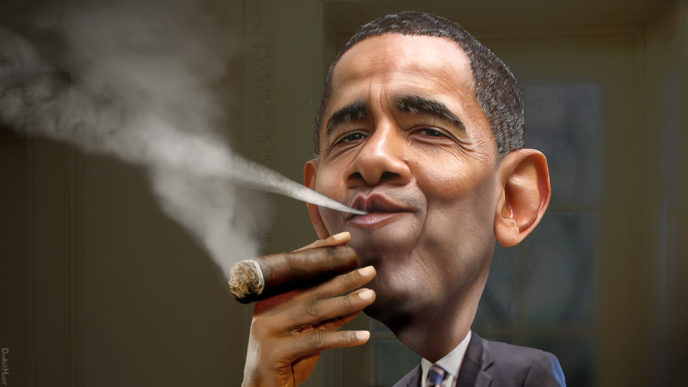
President Obama on Tuesday mocked conservative radio host Alex Jones for accusing him and Hillary Clinton of being demons.

“I was reading the other day there’s a guy on the radio who apparently – [Donald] Trump’s on his show frequently – who said me and Hillary demons,” he told listeners at a rally for Clinton in Greensboro, N.C.

“[Jones] said we smell like sulfur,” Obama added, pausing to smell himself as the audience cheered and whistled. “Ain’t that something?”

Obama burst into laughter before criticizing remarks like Jones’ for undermining the harmony between Americans.

“Democracy does not work if you just say stuff like that. Apparently there are people who believe that stuff. I mean, c’mon people.” (Read more from “Obama Mocks ‘Demon’ Talk by Sniffing Himself” HERE)

Follow Joe Miller on Twitter HERE and Facebook HERE.
Obama Administration Wants to Use Taxpayer Money to Settle Health Insurer Lawsuits. Here’s How a Republican Would Stop It.

Republican Rep. Chris Stewart of Utah has mounted a campaign urging House Speaker Paul Ryan to initiate a lawsuit against the Obama administration over the potential use of a fund the Treasury Department oversees to pay federal legal claims to settle with insurance companies suing the government.

Stewart is circulating a letter to his Republican colleagues that would push Ryan to intervene to prevent the Obama administration from using the Judgment Fund, an indefinite appropriation created by Congress, to pay billions to insurers who are suing over Obamacare’s risk corridor program.

So far, at least 10 members have signed on to his letter to Ryan.

“Such an egregious misuse of taxpayer funds is not only a violation of the law but also represents an institutional challenge to the legislative branch, and should be met with the fullest opposition from the House of Representatives,” the letter states. “If such a payment is not met with a challenge from Congress, there is no limit to any administration’s ability to decide which of its priorities it funds.”

AshLee Strong, spokeswoman for Ryan, said they are looking at options.

“By passing the [Sen. Marco] Rubio amendment, Congress has been clear that no taxpayer dollars are to go to failing insurance companies under Obamacare,” she said in an email to The Daily Signal.

Insurance companies filed lawsuits against the Department of Health and Human Services earlier this year over the risk corridor program, which was written into the Affordable Care Act and designed to provide insurers with stability during the first few years of the law’s implementation.

Under the risk corridor program, insurers that had excess profits paid into a fund operated by the federal government. Those that incurred excess losses received money from the fund.

Because many insurers experienced significant losses during the 2014 benefit year, insurance companies received just 12.6 percent of the payments they expected to receive from the risk corridor program and are now arguing they’re entitled to the remaining money.

The Obama administration has signaled it is open to discussing settlements with those companies, and if it decided to do so, it would tap into the Judgment Fund to pay out billions of dollars to insurers.

“They hoped this thing would slide under the radar and no one would notice,” Stewart told The Daily Signal. “The Judgment Fund has been abused in the past, but never anything like this, for heaven’s sake. It was a few $10 million a year that the Judgment Fund was paying out, not something more than $1 billion, which is what this administration is inviting the insurers to do: Sue us, and we’ll settle. We’ll settle before we leave office.”

“It’s crony capitalism at its worst,” he continued.

In his letter, Stewart urges Ryan to “initiate a civil action” on behalf of the lower chamber in federal court. Authority to do so, the letter states, would be granted under a House resolution passed in 2014.

That resolution authorized the cost-sharing reductions lawsuit filed against the Obama administration.

Because the House resolution approved the initiation of or intervention in any civil action “with respect to implementation of any provision” of Obamacare, legal experts told The Daily Signal in March that it gives Congress the authority to intervene in the risk corridor case.

Stewart said he prefers lawmakers find a “legislative fix” to prevent the Obama administration from using the Judgment Fund to settle with insurers in the risk corridor lawsuits when they return from an extended recess in November.

However, he views legal action as a “backstop” and said the White House has already found ways to ignore legislation passed by Congress regarding the risk corridor program.

“We thought we dealt with this legislatively already, and the language is very, very clear on this,” he said. “The administration continues to find creative ways to circumvent obvious legislative language.”

Late last month, the Justice Department filed motions to dismiss lawsuits filed by two insurers—Moda Health Plan and Blue Cross and Blue Shield of North Carolina—on the grounds that there is no deadline by which risk corridor payments must be paid.

This contradicts statements from the Centers for Medicare and Medicaid Services and its top officials, which have said the government would explore the option to settle.

In addition to Stewart’s letter, which was first sent to GOP lawmakers Thursday, Republicans in both chambers have expressed concern about use of the Judgment Fund in additional letters to Sylvia Mathews Burwell, secretary of the Department of Health and Human Services; Andy Slavitt, acting administrator for the Centers for Medicare and Medicaid Services; and Loretta Lynch, U.S. attorney general.

More than 40 House members, Stewart included, sent Burwell a letter late last month warning that any attempt to settle with insurance companies through the Judgment Fund “will be met with the strictest scrutiny” from Congress.

Republican Sens. John Barrasso of Wyoming, Mike Lee of Utah, Marco Rubio of Florida, and Ben Sasse of Nebraska sent a separate letter to Burwell, Slavitt and Lynch asking for additional information on whether the Obama administration plans to settle with insurers.

Before working at the Centers for Medicare and Medicaid Services, Slavitt worked for OptumInsight/QSSI, the sister company of UnitedHealthcare and a subsidiary of UnitedHealth Group.

UnitedHealthcare is the nation’s largest insurance company, and Slavitt received an ethics waiver from the White House in 2014 that allowed him to begin working on matters involving his former employer immediately.

Slavitt’s history with UnitedHealth Group is raising questions for Stewart.

“He shouldn’t be sitting in a position to make this decision,” Stewart said of Slavitt. “That’s an example of why my Republican colleagues and I hope others are going to be interested in this.”

“Once [Republicans are] aware of what CMS is recommending, that the administration is trying to sue and settle and do it very quickly with an enormous amount of money, when the obvious conflict between the person who’s advocating this and his own personal interest in the industry that he worked with, we’re going to have a lot of interest,” he continued.

Slavitt’s predecessor at the Centers for Medicare and Medicaid Services, Marilyn Tavenner, left the Obama administration to lead America’s Health Insurance Plans, a trade group that represents insurance companies.

Stewart called the revolving door of administration officials to and from the insurance industry an example of crony capitalism.

“We’re seeing it here,” he said of the risk corridor lawsuit, “but it’s not the first time that we’ve seen it. The Affordable Care Act is rife with examples of this, and they do it at the expense of the American taxpayer.”

Insurance companies filed lawsuits earlier this year after learning they would receive a fraction of the money requested from the risk corridor program.

The shortfall in risk corridor payments was the result of an amendment added to 2015 and 2016 government spending bills prohibiting the administration from using taxpayer dollars to fund the payments requested by insurers through the program.

Because of those restrictions, insurance companies participating in Obamacare’s exchanges received a collective $2.5 billion less than originally anticipated. Many smaller insurers, including several of 23 consumer operated and oriented plans, or co-ops, closed their doors because of the lower-than-expected risk corridor payments.

After three separate insurers filed lawsuits, congressional Republicans began to issue warnings about the Obama administration using the Judgment Fund to settle with insurance companies.

Settling with insurers would provide the White House with a way to give insurers their full risk corridor payments, effectively circumventing Congress. (For more from the author of “Obama Administration Wants to Use Taxpayer Money to Settle Health Insurer Lawsuits. Here’s How a Republican Would Stop It.” please click HERE)

Follow Joe Miller on Twitter HERE and Facebook HERE.