Posts

Inside China’s Massive Tariff-Dodging Scheme That Kills Its Competition

In 2016, the U.S.-China trade war forced Beijing to negotiate. Tariffs crippled Chinese factories, major U.S. retailers like Walmart and Costco halted orders, and container shipments stalled. China conceded. But in 2025, when the U.S. imposed a 145 percent tariff expecting similar results, Beijing didn’t flinch. There was no panic, no economic distress, no concessions. Why? Because China had a secret card this time.

Over the past decade, China has built a decentralized export machine: more than 1 million cross-border e-commerce companies shipping directly to U.S. consumers via platforms like Amazon, Temu, and Shein. This army bypasses traditional retail channels, pays no income taxes, evades tariffs, and undercuts American businesses. Here’s how they do it — and why tariffs alone can’t stop them.

How They Game the System

Unlike in 2016, Chinese sellers no longer rely on U.S. retailers’ purchase orders. They ship container loads of goods directly to consumers, systematically undervaluing them on customs declarations.

Chinese e-commerce companies exploit U.S. customs through sophisticated tactics centered on non-resident importer (NRI) structures and delivered duty paid (DDP) clearance. These methods, often facilitated by logistics firms and customs brokers, shield sellers’ identities and minimize duties.

Here’s how it works: Brokers register NRI entities and post bonds for Chinese sellers, clearing goods and delivering them to Amazon fulfillment warehouses. They declare low container values to avoid scrutiny and sometimes misclassify goods as other items to secure a lower tariff rate. Many brokers are Amazon-affiliated (SPN, Send, Ship Track). Platforms like AMZ123.com list hundreds of such providers. Large sellers register multiple NRIs, splitting shipments among them. If one NRI is flagged, only that bond is lost — a minor business expense. (Read more from “Inside China’s Massive Tariff-Dodging Scheme That Kills Its Competition” HERE)

Cardinal Tarnished by Secret Chinese Pact Emerges as Front-Runner for Pope

An Italian cardinal once tainted by a secret deal with China over the appointment of Catholic bishops has emerged as the favorite to be elected pope.

Pietro Parolin, 70, is a seasoned diplomat who served under Pope Francis as secretary of state – effectively the prime minister of the Vatican City State.

The odds of him being elected as the successor to the late pope when 133 cardinals enter the Sistine Chapel on Wednesday at the start of the conclave are now at 9/4, according to British bookmaker William Hill. . .

Catholics in China are split into two camps – those who are members of an underground church that is loyal to Rome and the pope, and those who belong to a state-sanctioned church that refuses to accept the authority of the pontiff.

Under the deal, struck in 2018 and since renewed several times, Chinese officials were given some input into bishops who are appointed by the Vatican. Critics said the agreement sold out those Catholics who are loyal to Rome and represented a capitulation to Beijing. (Read more from “Cardinal Tarnished by Secret Chinese Pact Emerges as Front-Runner for Pope” HERE)

‘What the Machine Uprising Might Look Like’: Video Shows Robot ‘Going Berserk’

A video has appeared online of a malfunction of a robot at a China factory.

“Malfunction,” however, might not be the most accurate term.

“This is what the machine uprising might look like: a video is going viral online showing a robot going berserk during testing,” explained NEXTA, a large Eastern European media concern, which posted the video.

One response on social media tried to explain it away: “Clearly unbalanced, then tried using algorithms to rebalance, but the algorithms were not tuned which led to wild oscillations, furthering the imbalance. This is ‘not’ an “attack.”

That might not be reassuring to two workers, near the robot when it powered up, who then jumped out of reach of the flaying robot arms, then circled around to try to stabilize the stand to which robot was attached.

The robot has become so violent it was moving the stand across the floor. (Read more from “‘What the Machine Uprising Might Look Like’: Video Shows Robot ‘Going Berserk’” HERE)

Tough-Talking China Could Be Opening the Door to Tariff Talks

China may be warming to the possibility of holding talks with the U.S. on tariffs, following a statement from the Chinese Commerce Ministry on Friday.

“The U.S. has recently taken the initiative on many occasions to convey information to China through relevant parties, saying it hopes to talk with China,” the ministry statement translated by Reuters said, adding that Beijing was “evaluating this.”

What observers are calling a “shift in tone” may present an off ramp for the world’s two largest economies to avoid an ongoing trade war that has impacted markets worldwide.

However, the ministry also warned that “attempting to use talks as a pretext to engage in coercion and extortion would not work.”

President Donald Trump’s decision to single Beijing out for import duties of 145 percent comes at a particularly difficult time for China, which is struggling with deflation due to sluggish economic growth and a prolonged property crisis, analysts say. (Read more from “Tough-Talking China Could Be Opening the Door to Tariff Talks” HERE)

Chinese Official Reportedly Seeking Talks With Trump on Fentanyl Ingredients Amid Trade War

A top Chinese government official is asking what the Trump administration wants the communist nation to do about chemicals used to make fentanyl amid an ongoing trade war between the world’s two largest economies.

Wang Xiaohong, China’s minister of public security, has been making inquiries about what Trump wants China to do about the fentanyl issue over the last few days, The Wall Street Journal reported Friday.

Chinese companies produce precursors, large quantities of chemicals that eventually flow to Mexican drug cartels, which then make fentanyl and smuggle it into the United States.

Beijing could possibly have Wang meet with senior Trump administration officials in a neutral country, the newspaper reported.

Trump has tried to persuade China, Mexico and Canada to do more to combat the flow of fentanyl into the U.S. (Read more from “Chinese Official Reportedly Seeking Talks With Trump on Fentanyl Ingredients Amid Trade War” HERE)

China Makes Stunning Accusation About Which Country Should Be Blamed for COVID Outbreak

China pointed its finger at the United States for originating COVID-19 on Wednesday, claiming America was attempting to “shift the blame” after President Trump declared the deadly disease was leaked from a Wuhan lab.

The communist regime argued that “substantial evidence” suggested that COVID might have come from the US earlier than the outbreak in China while insisting the lab leak theory was “extremely unlikely” in a white paper.

“The US government, instead of facing squarely its failure in response to Covid-19 and reflecting on its shortcomings, has tried to shift the blame and divert people’s attention by shamelessly politicizing SARS-CoV-2 origins tracing,” Chinese officials complained.

The report also claimed COVID-19 was circulating around the US earlier than it was officially determined.

The Chinese accusations come after the White House revamped its COVID-19 information earlier this month to push out the assertion that COVID-19 leaked out of a lab in the Wuhan Institute of Virology. (Read more from “China Makes Stunning Accusation About Which Country Should Be Blamed for COVID Outbreak” HERE)

Amazon Hides Origin Of Chinese Knockoffs While Considering Tariff Labels

For a while on Tuesday, it sounded like Amazon planned to list tariff “import charges” for its products, so shoppers could see a connection between the Trump administration and price increases. If Amazon did that, the administration would consider it a “hostile and political” move, White House Press Secretary Karoline Leavitt said on Tuesday morning while speaking with reporters. But the import charge did not play well, and by midday Amazon had distanced itself from the idea.

“The team that runs our ultra low cost Amazon Haul store considered the idea of listing import charges on certain products. This was never approved and is not going to happen.” An Amazon media wrangler pointed The Federalist to this statement and answered no other questions.

But there were other questions. For example, why does Amazon sometimes conceal the country of origin for its products? And will the company make it easier for consumers to find the country of origin?

Everything is made somewhere, but Amazon only sometimes lists the country of origin for shoppers using a computer, and apparently not at all on the phone app.

When the country of origin is missing, Amazon usually names the manufacturer. (Read more from “Amazon Hides Origin Of Chinese Knockoffs While Considering Tariff Labels” HERE)

Photo credit: Flickr

Chinese National Accused of Voting in U.S. Election Skips Hearing, Prompting Bench Warrant

A Chinese national accused of voting in the 2024 election in Michigan now faces a bench warrant after he failed to attend a hearing last week.

Haoxiang Gao, a 20-year-old Chinese national with a green card, was supposed to show up for a hearing in district court on Thursday but never appeared, prompting Judge J. Cedric Simpson to issue a bench warrant for his arrest. Simpson decided to issue the bench warrant after conferring with Gao’s lawyer, K. Orlando Simón.

Gao’s legal ordeal began back on October 27 at the University of Michigan, where he apparently registered to vote and cast a ballot on the same day. He used his UM student ID card to prove local residency, Michigan Enjoyer learned after submitting several public information requests about the incident.

He must have had some misgivings about his actions because he then called the Ann Arbor clerk’s office, inquiring about whether green-card holders were eligible to vote. When the staff member explained that green-card holders were ineligible to vote, Gao allegedly claimed he knew of someone who had voted using their green card at the University of Michigan Museum of Art.

Gao then called the clerk’s office back 20 minutes later and admitted that he was the person who had voted and that he had “lied on the forms and attested to being a U.S. citizen,” according to an email from Ann Arbor clerk Jacqueline Beaudry. (Read more from “Chinese National Accused of Voting in U.S. Election Skips Hearing, Prompting Bench Warrant” HERE)

Photo credit: Flickr

Treasury Secretary Reveals ‘Interaction’ With Chinese Counterpart Amid Trade War

On Sunday, Treasury Secretary Scott Bessent revealed that he interacted with his Chinese counterpart this past week, a contact that comes as the United States and China are engaged in a trade war.

Beijing has denied there were trade talks with the United States, but President Donald Trump insisted to reporters that there were meetings with China.

On ABC’s “This Week,” Bessent told anchor Martha Raddatz, “This was IMF World Bank week in D.C., as you know, and I had interaction with my Chinese counterpart, but it was more on traditional things like financial stability, global economic early warnings.”

The United States has increased tariffs on China to 145% in bid to stop what the Trump administration says are unfair trade practices. China responded by raising tariffs on U.S. goods to 125%.

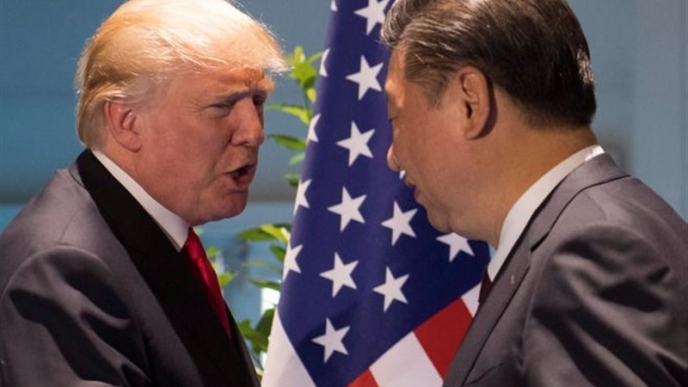
Trump indicated last week that tensions could be easing, saying the tariffs against China come down “substantially” — but not to “zero.” He also said that he has spoken “many times” with Chinese President Xi Jinping, although he did not clarify if those discussions happened after escalating tariffs. (Read more from “Treasury Secretary Reveals ‘Interaction’ With Chinese Counterpart Amid Trade War” HERE)

Trump Signals Step Back On China Tariffs, Says They’ll ‘Come Down Substantially’

President Donald Trump signaled Tuesday evening from the Oval Office that the U.S. will ease tariffs on China, saying they’ll “come down substantially” but won’t be eliminated entirely.

On April 2, Trump announced reciprocal tariffs on several countries, with higher rates for nations like China due to their own trade barriers against the U.S. When asked Tuesday about the tariffs against the foreign country, Trump said that the 145% hit would not last forever.

“It’ll come down substantially, but it won’t be zero. It used to be zero,” Trump said. “We were just destroyed. China was taking us for a ride and just not going to — it’s not going to happen. We’re going to be very good to China. I have a great relationship with President Xi, but they would make billions and billions and billions of dollars a year, and they were building a military out of the United States on what they made.”

By April 10, the White House said that Trump’s announced 125% tariff would actually total 145% on all Chinese imports, according to The New York Times. The administration said the 125% would be added on top of a previously announced 20% tariff already in place on goods from China, the outlet reported.

“So that won’t happen. But they’re going to do very well, and I think they’re going to be happy, and I think we’re going to live together very happily and ideally work together. So I think it’s going to work out very well, but, no, it’s at 145%. It will not be anywhere near that number,” Trump said. (Read more from “Trump Signals Step Back On China Tariffs, Says They’ll ‘Come Down Substantially’” HERE)

Photo credit: Gage Skidmore via Flickr