Posts

Here’s How the Trumps Plan to Spend Christmas

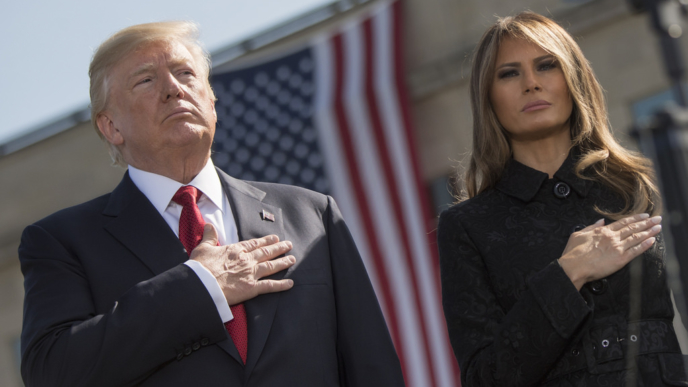
Because of the government shutdown that is looming, President Donald Trump plans to stay in Washington, D.C. First Lady Melania Trump is returning from Florida so the family can be together on Christmas.

“Due to the shutdown, President Trump will remain in Washington, D.C. and the First Lady will return from Florida so they can spend Christmas together,” White House press secretary Sarah Sanders said in a statement on Saturday. . .

(Read more from “Here’s How the Trumps Plan to Spend Christmas” HERE)

Follow Joe Miller on Twitter HERE and Facebook HERE.

Christmas Review: The Promises Trump and Republicans Kept — and the Ones They Didn’t

Which campaign promises did President Donald Trump deliver for conservatives before Christmas 2018? At the end of 2017, the Republican majority and the president delivered on some of their promises, but failed to keep most of them. In 2018, sadly, Republicans lost control of the House of Representatives after spending the last year of their majority failing to do what they said they would do.

Let’s review the unfinished promises from 2017 and see what was kept:

1. Full repeal of Obamacare

Republicans did not fully repeal Obamacare in 2018, as was promised in 2010 and every election thereafter. After reducing the individual mandate tax penalty to zero in the 2017 tax bill, the Republican Congress did not act on health insurance reform, putting the burden on the Trump administration to enact changes to the law by executive order.

President Trump worked with Sen. Rand Paul, R-Ky., to develop regulations to expand access to association health plans, offering cheaper insurance plans for small businesses and collectives of people who band together to purchase health insurance. The administration also expanded the length of time Americans are permitted to purchase cheaper short-term health insurance plans to three years. However, these executive branch workarounds are not permanent solutions and can be reversed by a future Democratic president.

Several lawsuits have moved forward against Obamacare, and in December, a Texas federal judge declared the entire law unconstitutional based on the Republicans’ change to the individual mandate. That ruling is likely to be challenged, however, giving the Roberts Supreme Court another opportunity to save Obamacare next year.

President Trump and the Republicans have not kept their promise to fully repeal Obamacare yet.

2. Border security and the wall

President Trump’s border wall has not been fully funded by Congress, though parts of it were constructed in 2018. In a March spending bill, Congress authorized $641 million to be spent to build 33 miles of physical barriers in Southern Texas’ Rio Grande Valley. Construction there will begin in February.

Congress also appropriated $292 million to the Department of Homeland Security to replace pre-existing “ineffective” fencing in Southern California, New Mexico, and western parts of Texas. But the Republican majority in Congress did not fund the full $25 billion requested by President Trump, unable to overcome Democratic opposition in the Senate.

There is an ongoing debate as the year ends over attaching $5 billion as a down payment for the wall in a spending bill needed to pass Congress by midnight tonight to keep the government fully open. President Trump says he will not sign a bill without wall funding, and Democrats refuse to vote for wall funding. The unfunded parts of government are likely to shut down, and Congress will need to negotiate wall funding in 2019 to open them back up.

For now, the wall is not built or fully funded.

3. Repeal Dodd-Frank

In June 2017, the House of Representatives voted to repeal the “Obamacare of financial markets” along party lines. The U.S. Senate killed the House bill, and Congress went back to the drawing board. In May 2018, Congress passed and President Trump signed a bipartisan agreement to roll back parts of the law, but it was not fully repealed.

Most disappointing, the unconstitutional Consumer Financial Protection Bureau was not eliminated. This is a promise half-kept and unlikely to be revisited in Trump’s first term.

4. Nominate a pro-life justice to the Supreme Court

President Trump kept this promise with the nomination of Justice Gorsuch in 2017, but in 2018 he had another opportunity to keep it by appointing a second pro-life justice. He chose Justice Brett Kavanaugh. The court with Kavanaugh has not yet taken up an abortion case, but it did reject one. Justice Kavanaugh cast the deciding vote to reject a case dealing with state funding for Planned Parenthood. Justice Neil Gorsuch, Trump’s 2017 appointee, voted in favor of hearing the case.

Does that mean Trump failed to nominate a pro-life justice in Kavanaugh? It’s still too early to tell, but that decision by the court was a troubling sign.

5. Pain-capable abortion ban

In January, the United States Senate voted to end debate and advance a federal ban on abortions after 20 weeks of gestation, the point at which scientists believe an unborn baby can feel pain. The vote failed to reach the 60-vote threshold to overcome obstruction from Democrats, and Sens. Susan Collins, R-Maine, and Lisa Murkowski, R-Alaska, voted to block the bill as well.

Had Sen. Mitch McConnell, R-Ky., invoked the two-speech rule to overcome Democratic obstruction, the bill would have passed Congress and have been sent to President Donald Trump’s desk for his signature.

6. Defund Planned Parenthood

Planned Parenthood was not defunded in 2018, and in fact, congressional Republicans say they will give up attempts to defund the nation’s largest abortion provider in 2019 now that the Democrats have control of the House of Representatives. This is the most disappointing broken promise from Republicans under President Trump.

7. First Amendment Defense Act

A federal version of laws designed to protect religious liberty by preventing the government from penalizing Americans for affirming that marriage is only the union between a man and a woman was introduced by Sen. Mike Lee, R-Utah, in the Senate and by Rep. Raul Labrador, R-Idaho, in the House.

The president supports this legislation. “If Congress considers the First Amendment Defense Act a priority, then I will do all I can to make sure it comes to my desk for signatures and enactment,” Trump wrote in a letter in 2016.

Congress still hasn’t moved on it and likely won’t pass it with Democrats in control of the House.

8. Fixing the Fed

Congress did not pass or even vote on legislation to audit the Federal Reserve in 2018, despite efforts from Sen. Rand Paul, R-Ky., to push the issue. And despite President Donald Trump’s campaign preference for auditing the Fed and abandoning fiat currency for a gold standard, he has not championed the issue as president.

9. Tax reform

In 2017, President Trump signed a tax reform plan that, while short of a fundamental restructuring of the American tax system, gave most Americans a solid tax cut and gave American businesses a huge competitive edge. In 2018, the House of Representatives voted to make the tax cuts permanent. The Senate has not yet considered that legislation.

10. Scrap Obama’s unconstitutional executive orders (DACA to start)

In 2017 President Trump canceled Obama’s unconstitutional amnesty, but since then federal courts have undone Trump’s executive action. It is Congress’ responsibility to pass immigration reform that will undo Obama’s damage to the Constitution and put the courts in their place. Republicans must rein in the courts to keep this promise.

11. Repeal the EPA “Waters of the United States” rule

The Trump administration began the formal process of repealing this tyrannical regulation permitting the government to seize control of puddles last year, and earlier this year the EPA rule was suspended. Sens. Mike Lee, R-Utah, and Rand Paul, R-Ky., lead an effort to permanently repeal the rule in June, but their bill was defeated in the Senate.

Trump’s administration is working to replace the rule, but a future Democratic president may be able to bring it back unless Congress ends it permanently.

12. National right to carry

President Trump was a strong advocate for the Second Amendment on the campaign trail. As president, he has not yet pushed for Congress to pass legislation guaranteeing concealed carry reciprocity nationwide.

Instead, Trump’s administration is advancing a sweeping gun control regulation to ban bump stocks, a gun accessory that uses recoil energy from semi-automatic rifles to increase the firearms’ rate of fire. Contrary to popular belief and lies from gun control advocates, bump stocks do not turn rifles into machine guns. Sean Davis, writing for The Federalist, warns that the Trump administration’s gun control effort “could eventually be used as a basis for a presidential administration unilaterally banning and confiscating all semi-automatic weapons.”

President Trump is not only breaking his promise to protect and advance the Second Amendment, his administration is working to undermine it.

In the remaining two years of Trump’s presidency, Democrats will control the House of Representatives, and President Trump and the Republican majority in the Senate will need to fight harder than ever to keep these promises ahead of the 2020 election. Conservatives must keep pressuring Congress and the president to fulfill their pledges to the American people. (For more from the author of “Christmas Review: The Promises Trump and Republicans Kept — and the Ones They Didn’t” please click HERE)

Follow Joe Miller on Twitter HERE and Facebook HERE.

James Mattis Hit the Trump Administration With Unexpected News But Trump Hits Back

By Townhall. President Trump announced Thursday afternoon Secretary of Defense James Mattis will be leaving his position at the beginning of next year.

The move comes less than 24-hours after President Trump announced U.S. troops will be leaving Syria, a decision Mattis, along with a number of other military leaders, strongly disagrees with.

(Read more from “James Mattis Just Hit the Trump Administration With Unexpected News” HERE)

____________________________________________

In Characteristic Fashion, Trump Hits Back After Mattis’ Resignation

By Quint Forgey. President Donald Trump claimed Saturday he gave outgoing Defense Secretary James Mattis “a second chance” after the retired Marine general was ousted from military leadership under the Obama administration.

“When President Obama ingloriously fired Jim Mattis, I gave him a second chance. Some thought I shouldn’t, I thought I should,” Trump tweeted Saturday evening.

Former President Barack Obama fired Mattis as head of U.S. Central Command in 2013 in large part because of Mattis’ increasingly hawkish posture toward Iran.

. . .Trump wrote that he made sure Mattis was better equipped and more empowered in his role leading the Pentagon since January 2017.

“Interesting relationship-but I also gave all of the resources that he never really had. Allies are very important-but not when they take advantage of U.S.,” Trump tweeted. (Read more about how Trump reacted to Mattis’ unexpected news HERE)
____________________________________________

US Defense Secretary James Mattis left a stark message for his successor in his resignation letter: Wake up and smell the threat

By Business Insider. US Defense Secretary James Mattis announced his resignation from the Trump administration on Thursday, setting in motion the end of what has been a tumultuous tenure working with President Donald Trump.

In his resignation letter, Mattis told Trump, without saying his name, that the president has a “right to have a Secretary of Defense whose views are better aligned” with his own. . .

But it was the outgoing defense secretary’s warning about the shifting nature of great-power relations he hopes his successor will study closely. . .

“I believe we must be resolute and unambiguous to those countries whose strategic interests are increasingly at odds with our own,” Mattis wrote in his resignation letter.

“It is clear that China and Russia, for example, want to shape a world consistent with their authoritarian model — gaining veto authority over other nations’ economic, diplomatic and security decisions — to promote their own interests at the expense of their neighbours, America and our allies.” (Read more from “US Defense Secretary James Mattis left a stark message for his successor in his resignation letter: Wake up and smell the threat” HERE)

Follow Joe Miller on Twitter HERE and Facebook HERE.

Trump Doesn’t Need 60 Senate Votes to Fix the Border and Short-Circuit a Shutdown

Last night, Chuck Schumer said at a press conference, “The Trump temper tantrum will shut down the government, but it will not get him his wall.” The truth is that if McConnell would actually lead and enforce the rules of the Senate, this decision wouldn’t be Schumer’s to make.

Thankfully, the president and the Freedom Caucus finally decided to stand up to the establishment and discovered the facts that Trump has a veto pen and that Republicans still control the House. The president threatened a veto of the open-borders budget, and as I’ve long predicted, the House dutifully passed a budget bill with $5.7 billion for the wall. It would have been nice if this had been done weeks ago, and it would be helpful if they included fixes to the asylum loopholes, courts, and sanctuaries as well, but I’ll take this.

Don’t we need 60 votes to pass this, you might ask? The answer is very simple. If McConnell and his colleagues actually used the Senate rules and fought for our sovereignty with the same vigor with which they fight for Supreme Court justices, the border wall could prevail.

There is a big misconception that it takes 60 votes to pass anything in the Senate. That is not true. The reality is that the majority party controls the “chair,” aka presiding officer, and the majority gets to rule on motions with simple majority votes. A bill can also be passed with a simple majority, eventually. Where the 60-vote threshold comes into play is only if Democrats choose to hold the floor and continuously engage in debate. To shut off debate without any tedious brinkmanship, yes, it takes 60 votes (or procedural unanimous consent) to proceed to the bill. However, given that this is the end of the line for GOP trifecta control, there is no greater issue than border security, and Democrats will be made to look like the ultimate obstructionists on behalf of illegal aliens and drug cartels, isn’t it worth it to finally force them to engage in a talking filibuster until they relent?

Here’s how it works.

Senators don’t need unanimous consent to bring up a bill. The lack of unanimous consent or 60 votes doesn’t table a bill. It’s just that opposing senators in the minority can request to be recognized and continuously hold the floor. In recent years, majority parties have never made the minority do that. Sometimes it makes sense to pre-emptively achieve an agreement because the majority just can’t afford to chew up endless days on debate of a single issue. But sometimes there are issues worth fighting for. Either way, this is the end of the line for the 115th Congress.

How do you get Democrats to stop talking? This is where Senate Rule XIX, “the two-speech rule,” comes into play. The rule explicitly prohibits individual senators from speaking “more than twice upon any one question in debate on the same legislative day.” Given that Republicans preside over the chair and control the floor, they can refuse to officially adjourn, opting only to recess temporarily, and keep the Senate in the same legislative day indefinitely. This will ensure that even the Democrats who are willing and able to speak for a long time will eventually be forced to relent.

This never happens and is never enforced, because Republicans never force Democrats to hold the floor in the first place and McConnell simply won’t bring up legislation without a unanimous consent agreement or without 60 votes to ultimately shut off debate. But if he forced the minority to hold the floor and enforced Rule XIX, Democrats would exhaust themselves very quickly. This is a strategy laid out by James Wallner, an expert on Senate procedure who is currently completing a manuscript on the history of the Senate.

Wallner points out that Democrats do have the ability to challenge rulings of the chair and bring up points of order or call for quorum calls as means of prolonging their floor time, but Republicans can dispense with their motions with 51 votes. Eventually, Democrats would run out of steam and exhaust their two speeches per member. This would theoretically take several days or weeks, but it all depends on the determination of each side. If Republicans keep them in session day and night and over the weekends and make them hold the floor, Democrats would eventually run out of options to block a majority vote to proceed with the border wall funding continuing resolution.

This strategy is even stronger in optics than in the raw technicalities. Actually forcing Democrats to publicly hold the floor in such a dramatic and unusual way, particularly on a government funding bill, will make the Democrat speech-givers look like utter fools and obstructionists during Christmas. It’s always conservatives who look bad on funding fights, because Republicans and Trump always pre-emptively surrendered. They never bothered to pass a good bill and dare Democrats to block it. This time, however, they finally passed a good budget bill out of the House. If McConnell would bring it up on the Senate floor and rigorously demand its passage with the president ready to sign it – while Democrats are virtue-signaling like clowns for hours on end in front of the cameras – the optics would be terrible for Democrats.

A committed Republican Party could use control of the chair to grind down Democrats even more while also exposing their radicalism. The chair could enforce a germaneness rule against senators bringing up extraneous matter to the question currently before the Senate, in this case, the House budget bill. Wallner explains the utility of such an approach as follows:

They would be prohibited from using their floor time during the first three hours of session to discuss unrelated issues. On a point of order, the Chair may call the filibustering Senator to order and force the member to take his or her seat. At that point, the member will have thus used one of his or her two speeches. While the Chair’s ruling is subject to appeal, the appeal can be tabled by a simple majority vote.

I would add, in the context of this debate, that forcing them to stay on topic would make Democrats stand before the American people and demonstrate that they are engaging in a Christmas filibuster on behalf of people invading our country with violence.

Wallner, in his strategy originally designed to confirm nominees, lists several other ways the majority can speed up the expending of each minority member’s two-speech allotment.

The bottom line is that with control of the chair, 51 votes, and sheer conviction (and coffee), a majority party can assert its will, especially with the pressure of a minority filibuster causing a government shutdown. This is how the civil rights bills passed. Republicans with convictions should recognize that having sovereign borders is the civil rights issue for all Americans, rooted in the entire social compact underpinning our federal government.

But the operative condition here is “conviction.” Republicans officially control the chair and have 51 votes, but they lack conviction. In reality, this is not a 60-vote problem; it’s a 51-vote problem. Conservatives have nowhere close to even 51 votes, and that includes leaders like McConnell. They couldn’t care less about our sovereignty and safety. McConnell was busy attacking Trump last night over the resignation of Secretary Mattis rather than pounding Schumer over the border and challenging him to a Senate procedural duel.

President Trump could embarrass McConnell by sending Vice President Pence to preside over the Senate, which is his constitutional right. He can have an allied senator get the ball rolling by calling up the bill instead of McConnell. Trump must remember that his entire presidency is on the line. This is his moment. He must use the bully pulpit and every constitutional tool at his disposal to finally force a national debate over the integrity of our own borders. (For more from the author of “Trump Doesn’t Need 60 Senate Votes to Fix the Border and Short-Circuit a Shutdown” please click HERE)

Follow Joe Miller on Twitter HERE and Facebook HERE.

Trump Orders Major Military Withdrawal From Afghanistan

By The Washington Post. President Trump has directed the Pentagon to come up with a plan to withdraw nearly half of the more than 14,000 troops deployed to Afghanistan, U.S. officials said Thursday, a move that many of Trump’s senior advisers and military officials have warned will plunge the country further into chaos.

The order comes on the heels of Trump’s announcement that he will be withdrawing all 2,000 U.S. troops from Syria, a surprise decision that the president made against the counsel of his top advisers and without warning any of the allies who have fought alongside American forces in the battle there against the Islamic State.

The Afghanistan directive also comes as the United States attempts to negotiate a peace deal with the Taliban, potentially undercutting leverage that American diplomats have. It marks a significant departure from Trump’s August 2017 decision to slightly increase the number of U.S. troops there and keep them in place with conditions on the ground dictating withdrawal. (Read more from “Trump Orders Major Military Withdrawal From Afghanistan” HERE)

_____________________________________________

Trump Has Ordered More Than 7,000 US Troops to Leave Afghanistan, Cutting Troops Levels in Half

By Business Insider. President Donald Trump has ordered the immediate withdrawal of more than 7,000 US troops from Afghanistan, according to multiple reports, citing defense officials.

In what appears to be the first major step toward ending America’s involvement in a war fought for nearly two decades, the president has decided to cut the US military presence in Afghanistan in half, The Wall Street Journal reported. There are currently roughly 14,000 American service members in the war-torn country.

News of the withdrawal comes just one day after Trump declared victory over ISIS and announced the withdrawal of US troops from Syria, a move that reportedly drove the president’s secretary of defense to resign from his position Thursday.

“I think it shows how serious the president is about wanting to come out of conflicts,” one senior U.S. official told TheWSJ. “I think he wants to see viable options about how to bring conflicts to a close.”

Another official told The New York Times that the Afghan forces, which have suffered unbelievably high casualties, need to learn to stand on their own, something senior military leaders have suggested they may not yet be ready to do. (Read more from “Trump Has Ordered More Than 7,000 US Troops to Leave Afghanistan, Cutting Troops Levels in Half” HERE)

Follow Joe Miller on Twitter HERE and Facebook HERE.

Trump Will Not Sign Spending Bill Without Wall Funding, After Conservatives Fought

Speaker of the House Paul Ryan, R-Wisc., said Thursday President Trump has told lawmakers he will not sign the Senate continuing resolution without border wall funding.

House conservatives have led the fight to help Trump keep his promise and fight for a wall.

Chairman of the House Freedom Caucus Mark Meadows, R-N.C., said Thursday that now is the time to fight for President Donald Trump’s border wall, even if that means shutting down the government.

Speaking on Fox News, Meadows said that the American people believe that President Trump is receiving “bad advice” to sign a continuing resolution to fund the government through February without funding the wall. He urged Trump to veto any spending bill that doesn’t fund the wall.

“They know that he’s promised not once, not twice, but three different times that he would get border wall funding, and here we are about to punt,” Meadows said. “And I would argue it’s not a punt. A punt actually helps improve the field advantage. This is a fumble, and we need to make sure that the president stays firm.”

Meadows said that Congress failed in the first two years of Trump’s presidency to keep Republican promises on border security and the wall. He added that House conservatives want to vote on a bill appropriating $5 billion for the down payment on a border wall, but that House leadership has not moved on passing wall funding out of the House.

He dismissed concerns over a government shutdown, noting that the vast majority of the government’s essential functions will remain operational.

“If we’re not going to fight now, when are we going to fight?” Meadows said. “Are we suggesting that when the Democrats have control in February that somehow our position is going to improve? There’s no one in the West Wing that believes that. There’s no one on main street that believes that, and quite frankly now is the time to fight.” (Read more from “Trump Will Not Sign Spending Bill Without Wall Funding, After Conservatives Fought” HERE)

Follow Joe Miller on Twitter HERE and Facebook HERE.

House Approves Spending Bill With Border Wall Funding

The House of Representatives approved a spending bill Thursday that includes $5.7 billion to build President Trump’s proposed wall on the U.S.-Mexico border. It passed by a vote of 217-185, with no Democratic “yeas.” The legislation now heads to the Senate.

Among those who voted for the bill were the members of the conservative House Freedom Caucus.

“Republicans in Congress have continually told the American people that we would fight for wall funding, and today the House of Representatives took its first step toward fulfilling that promise,” the group said in a statement after the vote. “The Senate must follow our lead. It’s time we do what we said and work with President Trump and the American people to secure our borders.”

The Freedom Caucus introduced an amendment Wednesday night and gave a series of impassioned speeches about how the president had a duty to keep his promise to the American people. To have border security, the likes of Rep. Jim Jordan (R-OH) said, they had to fund the wall. He called it “common sense.” . . .

Considering Chuck Schumer and Nancy Pelosi already insisted, in front of cameras at the White House last week, they are not paying for the border wall, we seem to be heading toward a partial government shutdown. The deadline is Friday.

(Read more from “House Approves Spending Bill With Border Wall Funding” HERE)

Follow Joe Miller on Twitter HERE and Facebook HERE.

Why President Trump Is Right To Consider Pardoning Green Beret Matthew Golsteyn

All too predictably, The New York Times is hyperbolically criticizing President Donald Trump for saying that he would review the case of Maj. Matthew L. Golsteyn, a Green Beret accused of killing an Afghan man in 2010. The New York Times called Trump “impulsive” and accused him of exercising “undue command influence.” But Golsteyn’s case is exactly the situation for which the presidential pardon must be considered. . .

Golsteyn’s involvement in the man’s murder first came to light when he interviewed for a job at the CIA. As part of his application, he was asked to identify any illegal acts or indiscretions in which he may have participated. His confession led to an investigation resulting in withholding Golsteyn’s employment with the CIA, but without charges being brought against him. . .

But then there’s the rule of law, above which none of us can be placed. Golsteyn was given specific orders. He is part of the greatest fighting force in the world, a fighting force whose greatness proceeds from its soldiers’ discipline, adherence to the rule of law, and respect for the chain of command. It is not up to Golsteyn to decide who lives and who dies. No man should have that kind of unfettered authority. He is a soldier, and his job is to follow orders, to carry out his mission faithfully, and to support and defend the Constitution of the United States and, by extension, its laws.

According to the information available, Golsteyn broke the law then made the unforced error of brazenly bringing attention to that fact through a national television broadcast. Unquestionably, there is much more evidence to be uncovered, some of it potentially exculpatory, but if the facts stand as they are, and if there is nothing more of substance to consider, Golsteyn’s choice stood outside of the boundaries of the law, and he must be held to account.

But there are times when the law is too harsh; times when society’s punishment is either illogical or inappropriate for the circumstances. Under these conditions, an escape clause must be configured. Alexander Hamilton said it best, as he so often does, in The Federalist Number 74, “The criminal code of every country partakes so much of necessary severity, that without an easy access to exceptions in favor of unfortunate guilt, justice would wear a countenance too sanguinary and cruel.” (Read more from “Why President Trump Is Right To Consider Pardoning Green Beret Matthew Golsteyn” HERE)

Follow Joe Miller on Twitter HERE and Facebook HERE.

White House Going Wobbly on Border Wall Shutdown? Trump Needs to Keep His Promise

Tuesday morning on Fox News, White House press secretary Sarah Sanders gave President Donald Trump a way to save face should he cave to Democrats on funding for a border wall.

Democrats have so far refused the president’s demands for $5 billion in wall funding, a compromise from the $25 billion needed to complete construction of wall on the southern border. Congress must pass a spending bill by midnight Friday to keep the government fully operational and Democrats have only agreed to fund $1.6 billion as part of a continuing resolution to keep spending at current levels.

Sanders suggested that if Congress refuses to appropriate the full $5 billion, the president can look elsewhere for those funds and sign a bill that will keep the government open.

“We have other ways that we can get to that $5 billion that we will work with Congress if they will make sure that we get a bill passed that provides not just the funding for the wall, but there is a piece of legislation that’s been pushed around that Democrats voted 26-5 out of committee that provides roughly $26 billion in border security, including $1.6 billion for the wall,” Sanders said. “That’s something that we would be able to support as long as we can couple that with other funding resources that help us get to the $5 billion.”

She did not get specific about those “funding resources.” In truth, the administration’s ability to move money around is limited without congressional approval, which Trump will be hard pressed to receive once the Democrats assume control of the House of Representatives.

Yet Sanders said the president is committed to border security and does not want to shut the government down.

“We don’t want to shut down the government, we want to shut down the border from illegal immigration, from drugs coming into this country, and make sure we know who’s coming and why they’re coming, and that’s what the president is focused on,” Sanders added later.

That statement contradicts President Trump, who last week proclaimed he would be “proud” to shut down the government for border security. But Senate Majority Leader Mitch McConnell, R-Ky., and other Republican leaders have been urging the president to avoid a government shutdown. Possibly, Trump is acquiescing to the demands of Republican congressional leaders.

Here’s the deal: If Trump signs a spending bill without the full downpayment on wall funding to avoid a government shutdown, he breaks repeated promises to fight for border security but he’ll blame the failure on Democrats and claim his administration is working around Congress. Going this route likely means no wall funding before the 202o election. If Trump keeps his promise, the government will shut down this weekend and Republicans and Democrats will continue negotiations as the media hysterically reports on the government being “shut down” while in reality less than 10% of the government stops working.

To score a win Trump and the GOP need to make a unified argument for border security. Trump should deliver an address to the nation on the hundreds of thousands of criminal convictions of illegal immigrants made in FY2018 and on the illicit drug crisis fueled by international drug cartels taking advantage of our weak borders. Trump ought to demonstrate how a wall works and how Democrats are threatening public safety by refusing to fund the wall. Trump should follow through with the shutdown threat and spend every single day of the shutdown single-mindedly hammering the Democrats until they either give in or keep the government closed indefinitely.

Short of this strategy, what exactly will change in the next two years? A Democratic House will not approve wall funding, or any other of Trump’s priorities. If the case is made to the American people that Republicans should be in control of the House again and Trump is reelected with a GOP majority in 2020, how will anything be different from the past two years of GOP control with no wall funding? Trump has repeatedly given in to demands from Congress to keep the government open and so far he has nothing to show for it. Enough is enough.

If Trump wants the wall, it’s shutdown or bust. If he’s unwilling to fight, he should tell the American people he can’t win and let them find someone else who will. (For more from the author of “White House Going Wobbly on Border Wall Shutdown? Trump Needs to Keep His Promise” please click HERE)

Follow Joe Miller on Twitter HERE and Facebook HERE.

GOP Operatives Reveal How Key States Feel About Trump 2020

President Trump’s re-election campaign has yet to place staff in key states, with some Republicans anxious that the plodding pace of hiring for 2020 could squander the advantages of incumbency.

Republican operatives in a half-dozen states critical to Trump and Vice President Mike Pence winning a second term say they have seen few signs of life from the re-election campaign. With the eventual Democratic nominee sure to be mired in a competitive and possibly lengthy primary, some GOP insiders fret that Trump-Pence could miss an opportunity to enter the general election better organized and more prepared to compete.

“We just came through a tough general election here in Pennsylvania and there hasn’t been a lot of focus on 2020 yet. There’s clearly some concern,” said Charlie Gerow, a veteran Republican consultant in a state crucial to Trump’s fortunes. “It’s going to be difficult for President Trump to repeat here, but it’s clearly doable. To beat the odds, as he did in 2016, the campaign will have to have a strong ground game.” . . .

“In my thirty years of working in presidential campaigns, I have never seen a more unified, robust campaign operation than what we established in 2018, which has positioned us to deploy a winning team in 2019 and 2020,” Michael Glassner, CEO of the Trump-Pence campaign, said in a statement provided to the Washington Examiner. “As impressive as our victory was in 2016, we are currently light years ahead in structure and operations today than we were then.”

Trump declared for re-election and started raising money for 2020 earlier than many predecessors. His campaign hired senior staff in the middle of the 2018 cycle and began charting a path to re-election. Despite growing concern at the grassroots, Republicans directly familiar with campaign planning say they aren’t unhappy with the rate of progress, dismissing the nail-biters as needlessly, and unreasonably, impatient. (Read more from “GOP Operatives Reveal How Key States Feel About Trump 2020” HERE)

Follow Joe Miller on Twitter HERE and Facebook HERE.