Posts

Trump’s Budget Puts Medicaid on a Path to Long-Needed Reform

Medicaid, the huge government health program for the poor and the indigent, is broken.

Both the Trump administration’s recent budget submission and the House-passed American Health Care Act, designed to partially repeal and replace Obamacare, propose Medicaid fixes.

Dubious assumptions burden the Trump budget proposal, and the House health care reform bill labors under some serious deficiencies. Both are correct, however, in resetting the general direction on Medicaid policy.

Medicaid is beset by two serious problems.

The first is a fiscal problem. Medicaid is an “open-ended” federal entitlement, and thus it contributes, like other major federal entitlements, to deficits and dangerous levels of national debt.

As the Congressional Budget Office has described current Medicaid financing:

All federal reimbursement for medical services is open-ended, meaning that if a state spends more because enrollment increases or costs per enrollee rise, additional federal payments are automatically generated.

America can no longer afford automatic federal entitlement spending. This is a bipartisan conclusion.

In 2008, for example, a politically diverse group of senior analysts and economists, in “Taking Back Our Fiscal Future,” concluded:

The first step toward establishing budget responsibility is to reform the budget decision process so that the major drivers of escalating deficits—Social Security, Medicare, and Medicaid—are no longer on autopilot.

The signatories included top analysts from The Heritage Foundation, American Enterprise Institute, Brookings Institution, Progressive Policy Institute, New America Foundation, and Urban Institute.

These analysts issue a further recommendation:

Congress and the president enact explicit long-term budgets for Medicare, Medicaid, and Social Security that are sustainable, set limits on automatic spending growth, and reduce the relatively favorable budgetary treatment of these programs compared with other types of expenditures.

Both the Trump budget proposal and the House health care reform bill are taking a first big step in that direction: capping the annual growth in Medicaid spending. This is a fundamental and fiscally responsible decision. Medicaid should no longer be an “open-ended” entitlement.

The second Medicaid problem is its programmatic performance.

Medicaid serves the poor and the indigent—mostly poor women and children, the disabled, and the poor elderly, including nursing home care as part of its long-term care supports and services.

The program is not doing a good job. Compared to the privately insured, based on various studies, Medicaid patients have less access to care, longer hospital stays, and higher mortality rates.

This is not surprising since Medicaid pays doctors about 66 percent of what Medicare pays, and Medicare already pays doctors about 20 percent below private market rates.

Medicaid is not delivering the value commensurate with its rising cost. The best way to secure value—better care at lower costs—is to encourage competition based on personal choice and control over the dollars and decisions.

Obviously, such a market-based model is not appropriate for all Medicaid beneficiaries. A block grant approach, with ample state flexibility to manage care in their interest, may be the best option.

For able-bodied persons, however, Congress and the administration should go beyond block grants and create a new Medicaid option, harnessing the market forces of choice and competition.

This can best be done through a defined contribution (a “premium support”) to competing private health plans and providers that able-bodied Medicaid beneficiaries choose.

With broader networks of doctors and other medical professionals, such a policy would offer Medicaid beneficiaries superior coverage and better access to care than they have today. That kind of change would be transformational. (For more from the author of “Trump’s Budget Puts Medicaid on a Path to Long-Needed Reform” please click HERE)

Follow Joe Miller on Twitter HERE and Facebook HERE.

Pope Gives Trump a Copy of His Global Warming Encyclical

Pope Francis gave President Donald Trump a copy of his encyclical that refers to Earth as an “immense pile of filth” and calls for phasing out fossil fuels to fight global warming.

Francis gifted Trump with his 2015 letter “Laudato Si” during their half-hour meeting Wednesday, Bloomberg reported. The Pope intended for his gift to bolster calls for Trump to not withdraw the U.S. from the Paris climate agreement.

Trump promised to withdraw from the Paris Agreement on the campaign trail, but European leaders — and some in his own White House — are urging the U.S. president to stick with it. Leaders of G7 countries are expected to lobby Trump on the issue when they meet him in Italy this week.

Francis says he would not “proselytize” during his meeting with Trump, but at least one Bishop believed that the pontiff could “convert” Trump on the issue of global warming.

“They will come to an agreement, since the president claims to be a Christian, and so he will listen to him,” Bishop Marcelo Sánchez Sorondo, the chair of the Pontifical Academies of Science and Social Sciences, said ahead of the meeting. (Read more from “Pope Gives Trump a Copy of His Global Warming Encyclical” HERE)

Follow Joe Miller on Twitter HERE and Facebook HERE.

Congress Must Embrace These 5 Principles to Create a More Responsible Budget

With this week’s release of President Donald Trump’s fiscal year 2018 budget, the congressional appropriations season is officially underway.

Although discretionary appropriations only account for one-third of the federal budget, they are critical in reducing the size and role of the government and provide an opportunity to make a down payment towards the national debt.

Since it was mere weeks ago that fiscal year 2017 appropriations were finalized, it is hard to be optimistic about the prospects for 2018.

Nevertheless, Congress should look to the following principles as it begins its important work on the budget:

1. Stick to the Budget Control Act Caps

The Budget Control Act was passed in 2011 with the intention of reducing total spending by more than $2 trillion and controlling the growth of federal programs. To do so, it adopted discretionary caps for defense and nondefense categories, enforced by automatic cuts (called sequestration), as well as a mandatory spending sequestration.

While the law has been moderately successful in controlling discretionary spending, Congress has undermined its effectiveness by amending the spending caps each year of their existence.

In 2013, implementation of the sequester was delayed for several months as part of the fiscal cliff deal and for 2014-2017 the caps were raised again, first by the Bipartisan Budget Act of 2013 and later by the Obama-Boehner budget deal.

With total discretionary funding set to decrease by $6 billion in 2018, there is likely to be a desire from some in Congress to pass another budget deal that raises the spending caps.

Congress must resist this urge to spend more and should pursue prudent cuts, or stick to the current levels, at the very least. The president’s budget proposes a total discretionary spending level of $1.1 billion, in line with the Budget Control Act caps. This is the maximum level of funding that Congress should support in 2018.

2. Break the Spending Firewall and Fully Fund Defense

As part of the Budget Control Act, discretionary spending was arbitrarily divided into defense and nondefense categories. Providing for national defense is the primary responsibility envisioned by the Founding Fathers when they established our government.

Trump’s budget calls for abandoning the defense and nondefense categories, instead raising defense spending by $54 billion and offsetting that increase with cuts to domestic programs. That’s the fiscally responsible way to properly prioritize among competing demands for taxpayer dollars.

The increase proposed by the resident is the minimum needed to begin rebuilding a stronger military. According to the Heritage Foundation director of the Center for National Defense, “This increase on its own is insufficient to begin the rebuilding. It simply represents an ‘on-ramp’ to rebuilding.”

The Budget Control Act cap on defense spending has been a detriment to our national security and must be abandoned. Congress should adopt the level of funding needed to fully equip our military against growing threats worldwide.

These increases should be offset by the reduction or elimination of inefficient domestic programs that limit individual and economic freedom and that have usurped functions that are better left to the private sector, and states and localities.

3. Return to Regular Order

The last time that Congress passed all 12 annual appropriations bills prior to the start of the fiscal year was 1996. Instead, lawmakers continue to rely on continuing resolutions and massive omnibus spending bills. This is not an effective way to govern and it does a disservice to taxpayers.

With the president’s budget delayed more than three months and Congress not expected to release its own budgets until at least mid-June, Congress is already way behind schedule.

Regardless of the late start, Congress should look to pass as many appropriations bills as possible, starting with Department of Defense appropriations, through regular order. Following the congressional budget process facilitates a higher level of debate and increased oversight and accountability over federal government programs and agencies.

4. Stop Providing Appropriations for Unauthorized Purposes

In fiscal year 2016, Congress provided more than $310 billion in appropriations to unauthorized agencies and programs. Authorizing programs is a key component of Congress’ oversight responsibility. It provides an opportunity to examine and prioritize the activities that receive taxpayer dollars carefully. Lack of oversight has contributed to increased spending and rising debt levels.

Congress should immediately stop providing unauthorized appropriations and return accountability to the budget process.

5. Seize the Opportunity for reform.

Congress must use the fiscal year 2018 appropriations process as an opportunity to reassert its commitment to control spending. Congress should reject any attempt to increase the overall discretionary spending level.

Defense should be the highest priority and needed increases should be fully offset with cuts to nondefense programs. With republicans in control of the White House and Congress, there is no better time than now to pursue a conservative budget.

The Heritage Foundation’s “Blueprint for Balance” lays out more than 100 discretionary policy options that could be implemented in 2018, saving taxpayers $87 billion in 2018 alone.

Continuing the failed policies and spending addiction of the past few years is not the answer. (For more from the author of “Congress Must Embrace These 5 Principles to Create a More Responsible Budget” please click HERE)

Follow Joe Miller on Twitter HERE and Facebook HERE.

Anti-Trump Leaks Are Against the Law. So Where’s the Investigation?

A lot of people even in the White House are leaking stories to hurt Donald Trump. Are they committing felonies? If the information they give to the media affects national security, then yes.

Disclosing classified information relating to U.S. or foreign communications intelligence activities is a felony. The leaker can go to prison for 10 years and be fined as well.

It May Still Be a Felony

But even if it doesn’t rise to that level, it may still be a felony. Federal employees can’t reveal confidential information to the press without permission. It’s considered theft to convey “any record, voucher, money, or thing of value of the United States or of any department or agency thereof.” It carries the same stiff penalty. Additionally, federal employees are generally subject to nondisclosure agreements.

Every presidential administration leaks. Sometimes the leakers rightly expose wrongful behavior. Many are protected by whistleblower laws. Look at Watergate.

What’s different now is the scope. The Washington Post ran an article on President Trump firing FBI Director James Comey based on “the private accounts of more than 30 officials at the White House, the Justice Department, the FBI and on Capitol Hill, as well as Trump confidants and other senior Republicans.”

Conservative writer Jonah Goldberg talked to reporters who say the leaks are in part due to the lack of experience of many working at the White House.

That may explain a few of the leaks. But for the most part, they seem “coordinated and timed” to hurt Trump. That’s what the administration believes. The Trump campaign sent an email to supporters entitled “SABOTAGE,” condemning the leaks. And in a tweet, the president complained that he’d been asking the FBI and others to investigate the leaks, apparently without success.

Some of the leaks may not even be leaks, but made-up stories to make the president look bad. Making false statements in the course of a federal investigation is a felony. Trump has tweeted that he believes the leaks rise to the level of crimes.

The Most Important Leaks

What are the most important leaks? First, the leaks after Trump fired FBI director James Comey. Some aides told the media that Trump did it to stop the FBI’s probe into the Trump campaign’s possible collusion with the Russians to influence the presidential election.

As a result, Congress stepped up its own probe into Trump, and pressure mounted to appoint an independent investigator. Trump agreed to appoint former FBI Director Robert Mueller for this task last week.

The second example is the leaks saying Trump had provided highly classified information about ISIS to the Russian foreign minister and ambassador to the U.S. The leaker gave the story to The Washington Post. He said it put an intelligence source at risk.

Yet that is merely the leaker’s opinion. Besides, Trump’s national security adviser H.R. McMaster (quoted in the story) said that he was in the meeting and Trump said nothing that wasn’t already public. “At no time were any intelligence sources or methods discussed and no military operations were disclosed that were not already known publicly,” he said.

Dina Powell, a deputy national security adviser, who was also at the meeting, said, “This story is false. The president only discussed the common threats that both countries faced.” Secretary of State Rex Tillerson explained, “During that exchange the nature of specific threats were discussed, but they did not discuss sources, methods or military operations.”

Trump defended his conversation on Twitter, “As President I wanted to share with Russia (at an openly scheduled W.H. meeting) I have the absolute right to do, facts pertaining to terrorism and airline flight safety.”

So, do you trust the leaker — who probably dislikes Trump and has an agenda to make the president look bad. Or do you trust Trump and the top-level officials around him who were at the meeting?

The New York Times confirmed that Israel was the source of the information. That means that if the leaker was correct about the seriousness of the information, he (or she) may have put national security at risk by revealing it.

Leaks About Michael Flynn

Former acting Attorney General Sally Yates is suspected of leaking classified information to the press regarding former National Security Advisor Michael Flynn lying to Vice President Mike Pence about talking to the Russian ambassador.

Again, releasing this information could jeopardize U.S.-Russian relations. If Russia believes its private conversations are going to be made public, it may be less willing to cooperate with the U.S.

Lack of Outrage Over Leaks

There hasn’t been much outrage over the leaks. Instead, the mainstream media, Congress and the FBI are focusing on the substance of the leaks. Concern is directed at whether Trump did anything wrong. So far, there has been no evidence Trump has. The leaks are compared to Watergate — but no evidence of Trump’s wrongdoing has emerged. Each new leak accuses the president of a different type of crime but nothing sticks.

The mainstream media seems so intent on taking Trump down that they risk running information that may be classified and harmful. While the laws against leaking don’t generally apply to journalists, journalists can be prosecuted for failing to reveal the source of the leak. Judith Miller spent 85 days in jail for refusing to divulge the source of the Valerie Plame leak, Scooter Libby. “They shouldn’t be allowed to use sources unless they use somebody’s name,” Trump said during a speech in February. “Let their name be put out there.”

There are three separate probes of Trump — by Congress, the FBI and the newly appointed special investigator Mueller. Shouldn’t there be at least one probe into the likely criminal leaks? (For more from the author of “Anti-Trump Leaks Are Against the Law. So Where’s the Investigation?” please click HERE)

Follow Joe Miller on Twitter HERE and Facebook HERE.
Trump Says He Didn’t Mention Israel in Meeting With Russians

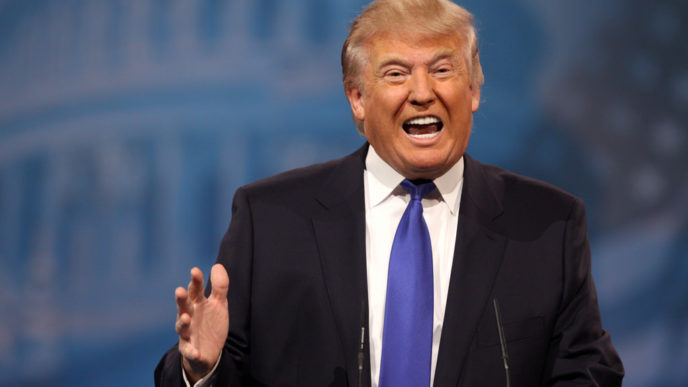
President Donald Trump on Monday defended himself against allegations he divulged classified information in a recent meeting with Russian diplomats, saying alongside Israeli Prime Minister Benjamin Netanyahu that he never identified Israel in his Oval Office conversation.

At the end of his appearance with Netanyahu, Trump said that he “never mentioned the word or the name Israel” in his conversation with Russia’s foreign minister and ambassador. “So you have another story wrong,” he said.

Various reports, quoting anonymous officials, have said Trump did share classified information with Russian diplomats about the threat posed by the Islamic State group, and several have said that information came from Israeli intelligence. But news accounts have not accused Trump of naming Israel as a source of the information. (Read more from “Trump Says He Didn’t Mention Israel in Meeting With Russians” HERE)

Follow Joe Miller on Twitter HERE and Facebook HERE.
Here’s What’s in Trump’s ‘Taxpayers First’ Federal Budget

The Trump administration will respect taxpayers, balance the budget, return the country to 3 percent economic growth, and push a parental leave requirement in its fiscal plan to be released Tuesday, said Office of Management and Budget Director Mick Mulvaney.

Mulvaney called it a “taxpayers first budget.”

“This budget was written through the eyes of the people paying for the budget, not through the eyes of who is getting paid,” Mulvaney told reporters Monday during an off-camera briefing at the White House.

Mulavney elaborated that budget writers went line-by-line through the budget to see what programs had a success rate and what programs didn’t.

The White House released a general outline of the plan Monday, before the full plan is released on Tuesday. The budget includes $3.6 trillion in spending cuts over 10 years, which the White House says is the most proposed by any president.

The administration’s first budget is being released while President Donald Trump is out of the country, taking stops in the Middle East and Europe.

Much of the budget policies are tied to creating 3 percent growth, or are contingent on achieving that goal. A key example is balancing a budget in 10 years, which relies on the growth goal.

“It is not unprecedented, but is below the average since the founding of the country and since World War II,” Mulvaney said. “You will never balance the budget with 1.9 percent growth.”

The growth rate could be a very optimistic assumption for balancing the budget in 10 years, said Romina Boccia, deputy director of the Thomas A. Roe Institute for Economic Policy Studies at The Heritage Foundation. Last week, she said the budget numbers are worth comparing to other estimates, such as the Congressional Budget Office.

The fiscal plan presumes the passages of both the American Health Care Act—to replace Obamacare—and of Trump’s tax reform proposal. It also includes increases in defense and border security spending—including $2.6 billion for a border wall and other border infrastructure.

The administration projects that by 2027, when the budget balances, publicly held debt will drop to 60 percent of gross domestic product. This would be the lowest level since 2010, when the Obama administration’s first budget took effect. That’s down from 77 percent of GDP. The plan further projects the national debt to continue falling.

The Trump administration’s plan puts forth a new path for welfare reforms, which Mulvaney characterized as a method to encourage the “dignity of work,” and also another way to move people out of poverty and into the workforce.

“We believe social safety net programs will help us get to 3 percent growth, because people won’t be afraid that if they take a gamble and fail, they’ll be wiped out,” Mulvaney said.

He said the reforms are simply to determine if everyone in the social programs should be on the programs.

The 10-year plan will “tighten eligibility and encourage work” for recipients of food stamps. It will limit the earned income tax credit and child tax credit to only those legally eligible to work in the United States.

The food stamp reforms are projected to save $193 billion over the next decade. Reforms to Temporary Assistance for Needy Families, or TANF, are projected to save $21 billion over 10 years and EITC and child tax credit changes will save $40 billion over 10 years, according to the budget projection. The budget outline further proposes to reform Medicaid to give states more flexibility through federal block grants.

There is a reason to be skeptical of whether work requirements—such as in Medicaid, food stamps, or housing—will have a significant budgetary impact, said Michael Tanner, a senior fellow with the libertarian Cato Institute.

“I do not think it’s a terrible thing, but savings will be really incremental,” Tanner told The Daily Signal. “I also think all the wailing and gnashing of teeth we’ll hear on the other side is too much. This will affect few people.”

“Look at TANF, which has fairly strong work requirements,” Tanner said. “Only 42 percent [of recipients] are working, with a fairly generous definition of working—job training or college. There are so many exemptions.”

He added that welfare programs shouldn’t be reformed to save money, but because they are not working.

Mulvaney said this is the first time a presidential budget proposed a fully-paid-for paid family leave proposal through building on the unemployment insurance system as a base, and allowing states to establish paid parental leave programs.

“This goes to the matter of 3 percent growth,” Mulvaney said, because more parents will feel comfortable about going back to work without fear.

Tanner said not so fast, citing laws in California, and in Europe, where laws have had the opposite effect.

“There is no such thing as a free lunch,” Tanner said. “If a business has to pay for two workers to support one, it becomes more expensive to hire women. In Britain and other European countries that have these laws, it drove down the number of women in the workforce.” (For more from the author of “Here’s What’s in Trump’s ‘Taxpayers First’ Federal Budget” please click HERE)

Follow Joe Miller on Twitter HERE and Facebook HERE.

Undeniable Proof That America Has Gone Mad

In case you’ve been sleeping under a rock the last few years, here’s a newsflash: America has gone totally mad.

To be clear, I don’t mean that all Americans are off their rocker. I mean that right is now wrong, the abnormal is now normal, and what was once was unthinkable is now celebrated.

Head-scratching Headlines

Think I’m exaggerating? Then consider some recent headlines.

Time magazine, September 12, 2016: “My Brother’s Pregnancy and the Making of a New American Family.”

This article was written by a woman who was describing her brother’s pregnancy — in other words, her sister’s pregnancy. The twist being that her sister now identifies as her brother.

Pink News, September 4, 2016: “This photo of a trans dad breastfeeding his son tells a great story of love and acceptance.”

This refers to the same story and features the same, heartbreaking picture of what appears to be a man (with a scruffy beard and chest hair) nursing a baby. Somehow, this man has women’s breasts. This is not a “great story.” It’s a tragic story. It’s something to be mourned, not celebrated.

Lifesite News, May 19, 2017: “Breastfeeding organization welcomes transgender ‘nursing men’.”

As the article explains, “A venerable breastfeeding advocacy group is floating the notion that men can nurse children.

“Nursing is not just for moms anymore, reports a blog post from the National Catholic Register this week about a policy statement from La Leche League International (LLLI).

“‘As the cultural understanding of gender has expanded, it is now recognized that some men are able to breastfeed,’ the organization also stated.”

Note those words carefully once more: “nursing men” and “some men are able to breastfeed.”

The Chronicle of Higher Education, May 16, 2017: “Tampons in Men’s Rooms? It’s Just a Small Part of ‘Menstrual Equity,’ Campus Activists Say.”

Says the article, “Over the past year, several colleges have improved access to menstrual products on their campuses, including in some men’s and gender-neutral restrooms. That last detail has prompted some conservative websites to take note.

“The American Conservative mockingly headlined its report ‘Social Justice Washrooms,’ from ‘tomorrow’s generation of American elites.’ Commenters on Breitbart’s report on the trend called it ‘academic insanity,’ pointing out that ‘men do not menstruate.’”

But these campus ideologues are committed to their cause, which is part of the growing “free the tampon movement.” This is “an effort to make college more fair for students who menstruate, a concept for which Jennifer Weiss-Wolf coined the phrase ‘menstrual equity.’

According to Lance Floto, vice-president of the student association at the University of Rochester, “We have smaller baskets in men’s rest­rooms, but the reason we do that is because there are some men on the campus who menstruate and so it’s just the whole idea of inclusion and making sure that nobody’s left out — it’s a very easy thing.”

Let me remind you that these quotes are not from a satirical website and that the “menstrual equity, free the tampon” movement really exists.

Coupled with this on our campuses is the “pronoun of your choice” movement, which I’ve documented elsewhere. (For the record, these pronouns include: they/them/their/themselves; tey/tem/ter/temself ;ey/em/eir/emself; e/em/eir/emself; thon/thon/thons/thonself; fae/faer/faers/faerself; vae/vaer/vaers/vaerself; ae/aer/aers/aerself; ne/nym/nis/nymself; ne/nem/nir/nemself; xe/xem/xyr/xemself; xe/xim/xis/ximself; xie/xem/xyr/xemself; ze(or zie)/zir/zirs/zirself; zhe/zhir/zhirs/zhirself; ze/hir/hirs/hirself; sie/sier/siers/sierself; zed/zed/zeds/zedself; zed/zed/zeir/zedself; ce/cir/cirs/cirself; co/cos/cos/coself; ve/vis/vir/verself; jee/jem/jeir/jemself; lee/lim/lis/limself; kye/kyr/kyne/kyrself; per/per/pers/perself; hu/hum/hus/humself; bun/bun/buns/bunself; it/it/its/itself.)

And let’s not forget the Obama Justice Department policy. It threatened schools that would not allow boys who identified as girls to share the girls’ bathrooms, locker rooms, and shower stalls. What kind of social experiment is this?

Perhaps this one article from Everyday Feminism (with video) shows just how mad our nation has gone. (Thankfully, the responses to the video are mostly negative. That’s a glimmer of hope, at least for the moment.) The article is written by Riley J. Dennis, “a polyamorous, atheist, gender non-binary trans woman with a passion for fiction writing, feminism, and technology.” It’s titled, “Can Having Genital Preferences for Dating Mean You’re Anti-Trans?” In other words, if, as a man, you prefer to date or marry a woman who has female genitalia rather than male genitalia, does that mean you’re “anti-trans”?

The article asks: “Is it cissexist, or anti-trans, to say that you wouldn’t date a woman who has a penis?” The answer? Well, it’s “more complicated than you might think.”

Complicated? Really? We have lost our collective mind!

England is not far behind. This headline announces, “First British man to get pregnant has been bombarded with abuse and threats since revealing he is due to give birth.”

I’m truly sorry that this woman is suffering such abuse and getting ugly threats. I’m also sorry that she wants to be both the mother and father of her child.

Speaking of children, have you heard about the latest? It’s drag queens reading stories to little kids. Major media headlines celebrate it. “Drag Queen Story Hour Puts the Rainbow in Reading” says The New York Times. “Early reading just got a lot more glamorous” says the Smithsonian. And Circa tells us, “Drag Queens Are Reading Books to Help Fight Gender Stereotypes”

And who knows what’s coming next? Who can even imagine?

Three Possible Outcomes

As a God-fearing follower of Jesus, I can see three possible outcomes for the near future:

1. Jesus comes back before we completely self-destruct

2. We completely self-destruct.

3. We have a great (and rude) awakening that saves us from self-destruction.

While I long for the Lord’s return, I also work and pray for a great awakening. We should all pray that the Holy Spirit will transform the people I mention above. If not, it will be a rocky ride. (For more from the author of “Undeniable Proof That America Has Gone Mad” please click HERE)

Follow Joe Miller on Twitter HERE and Facebook HERE.

The Significance of Trump’s Historic Address to Muslim Leaders

President Trump’s speech before 50 Muslim leaders in Saudi Arabia did not break new ground in terms of America’s Middle Eastern policy. However, it was highly significant for at least four reasons.

First, Trump mentioned “terror” or “terrorism” 30 times. In stark contrast, during President Obama’s (in)famous speech Cairo speech in 2009, he did not mention terrorism at all. More importantly, President Trump spoke directly of “the crisis of Islamist extremism and the Islamist terror groups it inspires.”

To fight against this, Trump urged, “means standing together against the murder of innocent Muslims, the oppression of women, the persecution of Jews, and the slaughter of Christians.”

And remember: Trump said this in the heart of Islamic holy land, Saudi Arabia.

The president called on these Muslim leaders to “drive out” the terrorists from “your places of worship . . . your communities . . . your holy land, and this earth.”

Yes, these terrorists are currently in some of your mosques, and you need to drive them out.

To say that, in that setting, required chutzpah.

Trump also announced the founding of a new Global Center for Combating Extremist Ideology, located in the heart of the Islamic World. “This groundbreaking new center represents a clear declaration that Muslim-majority countries must take the lead in combating radicalization.”

It’s about time that Muslim leaders were urged to combat this deadly ideology.

Calling Out Iran

Second, Trump identified Iran as the enemy, linking Iran directly and repeatedly to Islamic terrorism.

He called it “the government that gives terrorists … safe harbor, financial backing, and the social standing needed for recruitment.”

He labeled it “a regime that is responsible for so much instability in the region.”

He stated, “From Lebanon to Iraq to Yemen, Iran funds, arms, and trains terrorists, militias, and other extremist groups that spread destruction and chaos across the region. For decades, Iran has fueled the fires of sectarian conflict and terror.”

He said, “It is a government that speaks openly of mass murder, vowing the destruction of Israel, death to America, and ruin for many leaders and nations in this room.”

This had to sting Iran. And this had to be unprecedented for an American president speaking in such a setting. (Note also that some of the Muslim leaders there presumably want to see Israel destroyed,. Still, Trump spoke of this as evil.) Elsewhere, Trump mentioned Shias and Sunnis together. So he was stating that his issue with was terrorism, not Islamic sectarianism.

Not surprisingly, CNN offered an article critical of Trump’s speech. Tehran University professor Hamed Mousavi said, “It will be met with deep skepticism in the Muslim world because Trump has been hostile and offensive to Muslims — with his Muslim travel ban, for example. All they’ve seen so far from Donald Trump is a lot of hostility.”

What else should we have expected from an Iranian professor? His country was just slammed as a major agent of terror by the President of the United States before dozens of Muslim leaders. Should we have expected him to greet Trump’s words warmly?

Professor Mousavi also spoke against our new arms deal with the Saudis. He did raise a legitimate point regarding our inability to combat Wahabism, the fundamentalist expression of Islam that dominates Saudi Arabia and has helped spurn radical Islamic terrorism. But his critical comments should be expected, since Saudi Arabia and Iran are arch-enemies.

CNN provided no context to Mousavi’s critique, which must now be read with a big grain of salt.

Note also that Trump never proposed a generic “Muslim travel ban” (as claimed by the professor). That was the exaggeration of a hostile media and Trump’s political opponents.

Hamas and Hezbollah = ISIS and Al-Qaeda

Third, the president put Hamas and Hezbollah in the same category as ISIS and Al-Qaeda. This means that opposition to Israel is not a justification for terrorism. He said, “The true toll of ISIS, Al Qaeda, Hezbollah, Hamas, and so many others, must be counted not only in the number of dead. It must also be counted in generations of vanished dreams.”

The significance of this was not missed by a Lebanese professor, who, CNN reports, “pointed out that Trump equated Hezbollah, a Lebanese political and military group made up mostly of Shia Muslims, with ISIS and al Qaeda. Hezbollah was conceived in the early 1980s primarily to fight against Israeli occupation in southern Lebanon.”

The professor, Karam Makdisi, claimed this was irresponsible on several levels. “With Israeli rhetoric increasing against Lebanon, this does not bode well. The Lebanese will not put much stock in yet another grand speech, but they will keep an eye out for Trump’s position towards Israel’s threats against Lebanon, and any shift in US policy towards Syria.”

I’m sure that Prof. Makdisi was not the only Muslim intellectual who got Trump’s point loudly and clearly. To paraphrase: “You may call Hamas and Hezbollah freedom fighters against the Israeli occupation. We call them terrorists.”

The Sick Theology of Martyrdom by Murder

Fourth, Trump rejected the theology of martyrdom by suicide bombing: “Terrorists do not worship God, they worship death.”

He said, “This is not a battle between different faiths, different sects, or different civilizations. This is a battle between barbaric criminals who seek to obliterate human life, and decent people of all religions who seek to protect it. This is a battle between Good and Evil.”

Trump also made clear that the victims of this terror are primarily Muslims. He said that “the deadliest toll has been exacted on the innocent people of Arab, Muslim and Middle Eastern nations. They have borne the brunt of the killings and the worst of the destruction in this wave of fanatical violence. Some estimates hold that more than 95 percent of the victims of terrorism are themselves Muslim.”

Somehow, another critic cited by CNN missed this emphatic statement.

Former Jordanian Justice Minister Ibrahim Aljazy said, “Referencing ‘Islamic’ terrorist organizations only will not be appreciated by the vast majority of people in the region when other forces are carrying out acts of aggression, especially as Arabs and Muslims are the prime victims of these organizations.”

Did Mr. Aljazy not hear Trump’s words?

Perhaps CNN needs to vet its Trump-critics more carefully. At the least, they should have qualified some of the quotes. But again, is anyone surprised?

Standing on Holy Islamic Ground

Turning back to President Trump, we can certainly debate his policies, actions, and words at home. (I am not Trump’s defender-in-chief. Not anywhere near it.)

We can question the propriety of the massive arms deal with Saudi Arabia. (Will this be used to finance terror? Will it lead to more bloodshed in the region? Is this good for Israel too?)

But we should not question the landmark nature of Trump’s speech, which also referenced the oppression of women and called on these Muslim nations to lead the way in repatriating Muslim refugees.

In short, an American president stood on holy Islamic ground and called on 50 Islamic leaders to fight against Islamic terrorism. This is highly significant. (For more from the author of “The Significance of Trump’s Historic Address to Muslim Leaders” please click HERE)

Follow Joe Miller on Twitter HERE and Facebook HERE.
Roger Ailes, Donald Trump and Spiritual Warfare

Last weekend Donald Trump spoke at Liberty University, which is the largest Christian university in the world. Not long after that, he found himself facing the greatest crisis he’s faced since entering the election. I do not think this is a coincidence. I think that there are forces in play in our world that are not from our world. Powers, principalities, dominions. They are forces of accusation and expulsion. They play us, and they play for keeps.

Spiritual Attacks Don’t Absolve Responsibility

I think the attacks on Fox News are part of this pattern of spiritual warfare as well.

Now, when I say things like that, hard core Fox and Trump supporters want to stand up and yell, “Amen!” as if I’m blaming their problems on the devil. If that’s your reaction, then you are misunderstanding me. Spiritual warfare may involve an attack of the dark forces, but it almost always involves a failure on the part of those who are attacked. The Accuser is clever: he attacks where his targets are weak. He enters where he is permitted to enter.

I argued in my masters-level thesis that the spiritual warfare against Adam and his wife was successful because of the first failure of Adam in the Garden of Eden: Adam allowed the serpent into the garden in the first place. Adam failed to protect his wife from an act of spiritual warfare. The eating of the forbidden fruit was the result of earlier failure to protect and defend. The serpent should not ever have been in the garden!

It seems fairly clear that Fox’s top management, like Adam before, failed to protect “the woman” from predation. Fox rode culture war outrage about the War on Christmas … picked fights about coffee cups … built its market dominance on outrage about Bill Clinton’s pattern of sexual harassment — and most of that was delivered by pretty girls in very short cocktail dresses.

Like the DNC, Fox learned to avert its gaze away from sexual dissolution and abuse because the predator was a “winner.” Many Trump apologists did the same.

Is Fox a victim of spiritual warfare? Yes, I think it is. But that fact does not absolve Fox from responsibility. Adam and his bride were the victims of spiritual warfare from the serpent, but that did not absolve them of responsibility.

‘He Who Guards His Lips Guards His Life’

I see the same with Donald Trump. He could have spent his life learning to grow as a leader. Not a deal-maker, not a “winner,” but a leader. He could have mastered the book of Proverbs. My friend James Robison said (almost prophetically) before Trump’s latest scandal, that he wished Trump would Tweet Proverbs rather than his usual zingers. I think that James is right to focus on Proverbs.

During the election when Christians would tell me how much they like Trump because ‘He speaks his mind,” I would ask them if they’d ever read the Book of Proverbs. “He who guards his lips guards his life.” Trump is often the very opposite of the wise son in Proverbs. Speaking your mind is the habit of fools.

It is precisely this character flaw which has now left him open to assault. He is unable to guard his tongue. His long history of blurting things out has now come back to haunt him. For many early Trump supporters his lack of verbal discipline was refreshing, even cathartic. He was their primal scream. This was true for many evangelical Christians, which tells me that the state of Biblical ignorance among evangelicals in this nation is at crisis levels.

Now, I have friends — good friends — who endorsed Trump. I gave them no grief then, or now. I understand that he was the less bad of the two viable candidates. They knew his problems, admitted them, and cast an unenthusiastic vote for him.

I’m not talking about people like that. I’m talking about Christian leaders who helped him win the primary. I’m also talking about Christian leaders who had spent years banging on about Clinton’s sexual harassment, about the “death of outrage” and how “if his wife can’t trust him, how can America?” and “character matters,” who then were mute about Trump and O’Reilly’s history of predation.

In the Face of Spiritual Attack, Repent

Evangelical Christianity has become deeply intertwined with both Trump and Fox. That means we have pulled God’s name and His honor into this mess. Did we think He would just stand by and let these institutions, which cynically used His name and His people for wealth and power, continue to sully Him and us?

What’s the answer? Repent. I’m not talking about caving in to the forces of leftism: I’m talking about depriving them of ammunition. The Trump Administration needs to adopt a culture of wisdom, of verbal self-control, of humility.

Our conservative institutions need to repent of Don Draper conservatism, give women the respect and protection conservatism and Christianity demand. We need to repent of celebrity idolatry and stop defending the indefensible.

Repentance is a strong defense against spiritual warfare. I think it’s St. Theresa who said that you cannot be accused of that which you have already confessed to and repented of. (For more from the author of “Roger Ailes, Donald Trump and Spiritual Warfare” please click HERE)

Follow Joe Miller on Twitter HERE and Facebook HERE.

The Major Entitlement Overhaul That Could Be Part of Trump’s Budget

President Donald Trump’s budget proposal, to be rolled out Tuesday, likely will include Medicaid reform. But with several approaches having been floated, definitive answers will have to wait until the White House releases the fiscal plan.

During his Senate confirmation hearings in January, Health and Human Services Secretary Tom Price said he would look at changes to Medicaid, the federal-state health insurance program for the poor.

Medicaid covers about 70 million low-income Americans. Thirty-one states and the District of Columbia expanded eligibility for Medicaid under Obamacare.

When serving as House Budget Committee chairman as a congressman from Georgia, Price advocated giving Medicaid funds to states in block grants as a way of providing more flexibility.

“Block grants would save the federal government money, but would shift that cost to the states,” Marc Goldwein, senior vice president for the Committee for a Responsible Federal Budget, a bipartisan research group in Washington, told The Daily Signal. “When a state has more skin in the game, will it be more cost-effective? Yes. But perhaps not enough to deal with the new expense.”

Another solution, Goldwein said, is to cap “provider taxes,” which states impose on health care providers. He said states use the tax to get more money from the federal government without losing revenue. The federal government prevents states from taxing health providers more than 6 percent.

He said most states make deals with hospitals to increase Medicaid payments in exchange for taxing the hospital by the same amount, then go to the federal government presenting a need for a larger subsidy based on the larger payment from the state to the hospitals.

“If you phased [the state provider taxes on hospitals] out to 0 percent, it would save $100 billion” on Medicaid, Goldwein said. “If you cut to 5.5 percent, it would save about $10 billion.”

Fiscal hawks long have argued that the federal government’s main entitlement programs—Social Security, Medicare, and Medicaid—are the key drivers of the national debt and deficit spending.

In March, four Republican governors—John Kasich of Ohio, Rick Snyder of Michigan, Brian Sandoval of Nevada, and Asa Hutchinson of Arkansas—touted their own proposal to reform Medicaid.

In a letter to Congress, the four governors said any reform should have work requirements, allow options on eligibility and what drugs are covered, and continue to allow the Medicaid expansion that occurred under Obamacare.

A better solution would be for the government to provide premium supports to encourage people to move on to private health insurance plans, said Robert Moffitt, senior fellow for health policy at The Heritage Foundation.

“Able-bodied Medicaid recipients, we’re not talking about someone who is disabled or in a nursing home, could receive a defined premium support to be mainstreamed into private insurance,” Moffit told The Daily Signal.

This would accomplish two things—reducing spending and helping patients, he said:

This Medicaid population would then have access to more doctors, since most doctors take private insurance and fewer are taking Medicaid. This population is also relative younger, which usually has a positive impact on the insurance pool. That could drive down cost for the rest of the American population.

Government data found 11.5 million able-bodied adults were on Medicaid.

In their recently passed American Health Care Act, House Republicans adopted a Heritage Foundation policy proposal that would change Medicaid to a per capita cap on funding for states that would be limited to medical inflation plus 1 percent.

Medicaid recipients’ access to doctors has become more limited, according to a study last year that found 1 in 3 available physicians don’t see Medicaid patients.

The White House Office of Management and Budget did not respond to email inquiries Friday from The Daily Signal about whether, and which, Medicaid reforms would be part of the budget proposal.

“I assume the reform will probably be tied to the House Budget Committee, and would propose to block-grant Medicaid, as the House Republican budget has proposed for years,” Chris Edwards, director of tax policy studies at the Cato Institute, told The Daily Signal.

Edwards said he also anticipates the Trump administration will go after waste, fraud, and abuse for all entitlements, including Social Security and Medicare. Doing so could save tens of billions of dollars, but still make only a little dent in budget deficits or the debt.

A report by the Committee for a Responsible Federal Budget, released Friday, dismissed tackling waste as a long-term solution. The report by the private group says:

Importantly, there is no way to make Social Security, Medicare, and Medicaid even close to sustainable simply by reducing fraud. However, broadly defined program integrity—for example, reducing excessive provider payments and using competition or negotiation to get better prices in Medicare, restricting the ability of states to inflate their federal match in Medicaid, or encouraging and helping workers with disabilities return to work in Social Security—can represent a starting point for entitlement reform. Still, it would be impossible to fix Social Security and Medicare solely through program integrity—even using a broad definition—and, ultimately, tough choices will need to be made to bring the costs of these programs under control.

Of the three main entitlements, Medicaid is the most sustainable, Moffit said.

“You can’t get control of federal debt and deficits unless you address Social Security and Medicare,” Moffit said. “Otherwise, it’s just not going to happen.” (For more from the author of “The Major Entitlement Overhaul That Could Be Part of Trump’s Budget” please click HERE)

Follow Joe Miller on Twitter HERE and Facebook HERE.