President Trump announced a decision on DACA will be Tuesday. Will this finally begin the “Big Ugly” confrontation? Possibly, but one thing is certain, right now he’s probing.
CTH is not a seer of Donald Trump, and anyone who would claim they are should be necessarily dismissed. President Donald Trump is the only entity who knows specifically what he’s going to do in the moments leading up to what he’s going to do; no-one else. However, that said, CTH does have a pretty good sense of what evaluation processes Trump takes prior to action. There are indications Tuesday might be the day.
There is one political enterprise within Washington DC and national politics. There is only one enterprise. That enterprise is the UniParty. There is only one political party in Washington DC, with two internal caucuses – Republicans and Democrats.
The “Big Ugly” is the moment when President Trump decides to rip the masks off the remnants of the Republican wing of the UniParty within Washington DC. In many ways the “Big Ugly” is the elimination of the Republican party, and the beginning of an era when a second party, a MAGA party, actually enters the blood stream of U.S. politics and stands against the UniParty.
The confrontation is inevitable. It has been inevitable since the entire GOPe apparatus, including every single GOPe candidate within the 2016 Republican primary, stood up against Donald J Trump. Candidate Donald Trump held an entirely different series of campaign platform issues the Republican apparatus abhors. That’s why he won, and they didn’t. (Read more from “DACA Timing – President Trump Is Probing, Testing, Gauging, Timing for ‘the Big Ugly'” HERE)
https://joemiller.us/wp-content/uploads/8567821732_de2efb1399_b-1.jpg6831024kfranceshttps://joemiller.us/wp-content/uploads/logotext.pngkfrances2017-09-02 01:01:072017-09-02 01:01:07DACA Timing – President Trump Is Probing, Testing, Gauging, Timing for ‘the Big Ugly’
Breitbart News Editor-in-Chief Alex Marlow spoke to journalist Mike Cernovich on Breitbart News Daily this morning discussing the Trump presidency, Jared Kushner and Ivanka Trump’s influence, and the possibility of President Trump being held under “house arrest.”
Mike Cernovich appeared on Breitbart News Daily today to speak to Breitbart Editor-in-Chief Alex Marlow about issues surrounding the Trump Presidency. Cernovich has a running series of posts called ” Dispatches from Trumpland” that were at the center of their discussion. “There’s some pretty explosive stuff in your report,” said Alex Marlow referencing Cernovich’s recent Trump Dispatches, “and so I just wanted to unpack some of it with you, the first place where it starts in your dispatch is that Trump is on house arrest and you cite John Bolton who people thought was under consideration for National Security Advisor, for Secretary of State who can’t even have access to the President right now and this is a pretty big departure from campaign trail Trump.”
“Exactly, so I’d heard from people that Trump is on house arrest,” replied Mike Cernovich, “I thought ‘oh c’mon, the President of the United States, that’s the weirdest thing I’ve ever heard’, but I kept digging into it and I kept hearing the same thing over and over again and then, of course, John Bolton wrote his column for National Review and he’s begging people to retweet it, he said ‘this is the only way the President is gonna see it,’ and I’ll say Alex, I don’t really understand, how can Trump not see who he wants to see? This is something I don’t really fully comprehend within the White House. I have talked to a lot of people, it’s a very weird situation.”
Marlow agreed, “it is a very weird situation, and this is something that I’m afraid is systemic of something that’s happening inside, people that listen to the show know that I’m not a huge ‘Javanka’ fan,” referencing Jared Kushner and Ivanka Trump, “and I’m just seeing the numbers here Mike and the people inside the White House, you’ve got Kushner, you’ve got Ivanka Trump, Gary Cohn, Dinah Powell, H.R. McMaster, who I know you were really the first person to call him out as a big threat to the MAGA agenda. And it’s just overwhelming and now with no Bannon and with no Gorka, just where is the President getting information that can tie him, connect him to his own base?” (Read more from “Trump Under House Arrest?” HERE)
https://joemiller.us/wp-content/uploads/5440385457_52d372e1d0_b-2.jpg6831024Joe Millerhttps://joemiller.us/wp-content/uploads/logotext.pngJoe Miller2017-08-30 21:19:462017-09-02 11:28:26Trump Under House Arrest?
With all sorts of disarray in the Republican Party and little progress in advancing its agenda, conservative powerhouse Rush Limbaugh is now wondering if President Donald Trump will run for re-election as a member of the GOP or create his own political party, perhaps known as the Trump Party.
Limbaugh says it’s more than obvious Republican leaders in Congress are not interested in helping Trump’s objectives . . .
“He’s sitting up there, and he’s not an idiot. He can see that the Republican Party is his primary obstacle,” said Limbaugh. “He knows this. It’s not the Democrats. The Democrats are doing what they would be expected to do.”
“What’s unexpected is for them to be joined by Republicans. So what does he do? Does he remain a Republican? Does he go independent? Does he come up with a Trump Party?”
“Does he run as a Republican or does he say, ‘This party isn’t going to exist. This party is killing itself. This party is eating itself. This party is committing suicide. I’m not gonna be a part of it.’?” (Read more from “Trump ‘May Not Run’ Again as Republican” HERE)
https://joemiller.us/wp-content/uploads/24949307320_d0d8b05827_b-1-1.jpg6831024Joe Millerhttps://joemiller.us/wp-content/uploads/logotext.pngJoe Miller2017-08-30 19:16:182017-08-30 19:16:18Trump ‘May Not Run’ Again as Republican
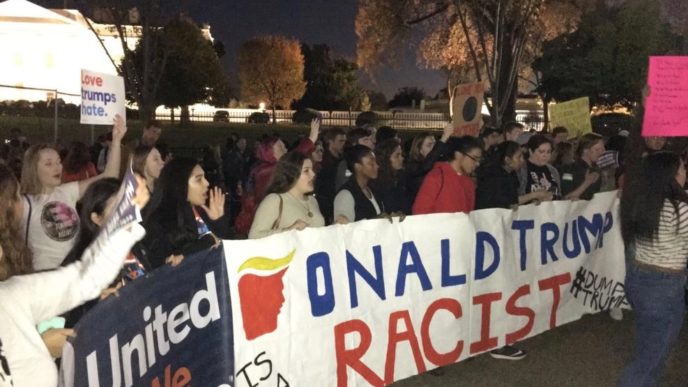
The protester seen getting hit in the groin by a pepper ball following President Donald Trump’s Aug. 22 rally in Phoenix has been criminally charged.
Police arrested Joshua Cobin, 29, that night and he was charged with three felony counts of aggravated assault against police and a misdemeanor count of unlawful assembly.
Following an outbreak of violence, police repeatedly called on the protesters, including Cobin, to disperse before firing tear gas, pepper balls, and rubber bullets into the crowd, KTVK reported.
According to court documents, police stated that Cobin tried to kick a smoking canister back at police, and then picked it up and threw it at them.
Later he picked up a second canister and threw it at police.
The Scottsdale, Arizona, resident disputed the charges.
“I don’t equate kicking or putting back tear gas canisters as attacking police. I never attacked a police officer,” Cobin said.
“That was not an unlawful assembly and that I had every right to be there. And that tear gas was in the way of myself and every other peacefully assembled protesters being there,” he added.
The Phoenix Police Department stated that Cobin admitted to the charges.
“He has posted images and admissions to his crime on social and local media outlets,” Phoenix police spokesman Sgt. Jonathan Howard wrote in an email announcing the arrest.
“Thanks for all the kind words, what a crazy night last night! My hand feels a lot better..and for EVERYONE who asked, my nuts are fine lol, the cops missed by a few inches so I have a nasty baseball size bruise there,” Cobin wrote in a Facebook post. (For more the author of “Trump Protester Hit in Groin by Gas Round Faces Criminal Charges” please click HERE)
https://joemiller.us/wp-content/uploads/Anti-Trump_protest_in_Washington_D.C._3-2.jpg740987Joe Millerhttps://joemiller.us/wp-content/uploads/logotext.pngJoe Miller2017-08-29 19:18:372017-08-30 17:29:11Trump Protester Hit in Groin by Gas Round Faces Criminal Charges
GOP leaders seeking a way out of their September logjam are talking about tying a disaster aid bill for Hurricane Harvey to a larger measure funding the government and raising the nation’s borrowing limit.
Including the disaster aid would almost certainly win some Republican votes for the package, which will otherwise be unpopular with GOP lawmakers who oppose a “clean” debt ceiling hike and would like to impose restrictions on government spending.
But the move risks a confrontation with President Trump, who is demanding that the end-of-month bill include $1.6 billion in funding for his southern border wall.
Trump has repeatedly suggested he is willing to shut down the government to win funding for his wall, an outcome GOP leaders want to avoid just more than a year ahead of midterm elections where they will be defending majorities in the House and Senate.
Trump on Monday vowed to win quick disaster relief funding for Harvey’s victims, but he suggested that he saw the aid package and the wall as separate issues. (Read more from “GOP Risks Spending Confrontation With Trump” HERE)
. . .The whole disaster is probably just karma for those Republicans who voted for President Trump in 2016.
At least that’s what a former assistant professor at the University of Tampa claimed in a tweet that stunned the Twittersphere Sunday.
The assistant professor, Kenneth L. Storey, posted a tweet suggesting Texans deserved Hurricane Harvey devastation for voting for Republicans such as President Trump.
And now Storey is out of a job.
Storey, who taught sociology and had worked at the university since 2011, posted the following tweet Sunday before later deleting it: “I don’t believe in instant Karma but this kinda feels like it for Texas. Hopefully this will help them realize the GOP doesn’t care about them.” (Read more from “Professor Says ‘Trump-Lovin’ Texas Deserved Hurricane” HERE)
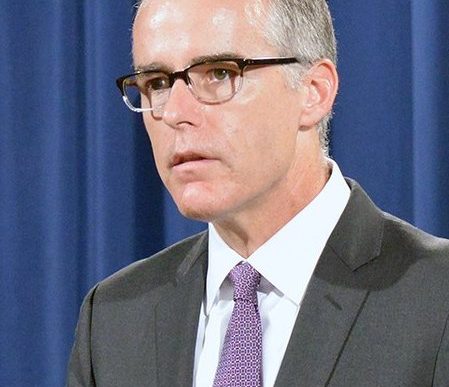
Politically compromised deputy FBI director Andrew McCabe continues to run an investigation into the Trump campaign’s alleged “collusion” with Russia, bureau sources familiar with the probe say – even though it overlaps with the special counsel’s investigation, and even though McCabe, whose wife is a Democrat activist, is under investigation for political conflicts of interest.
As the subject of no fewer than three separate investigations of his own, McCabe is operating under a growing ethical cloud, critics inside the bureau complain.
Yet, “He is still running that investigation,” an FBI source said. “He didn’t recuse himself from the Hillary Clinton case, and he won’t recuse himself from the Russian matter.”
President Trump has questioned McCabe’s objectivity and called on Attorney General Jeff Sessions to remove him, because he “got $700,000 for his wife’s political run from Hillary Clinton and her representatives.”
Trump’s recent tweet referred to financial and political connections McCabe had to the Clinton machine last year via Democratic Virginia Gov. Terry McAuliffe, a longtime Clinton operative. A PAC tied to McAuliffe and the Democratic Party of Virginia together pumped $675,288 into Jill McCabe’s campaign for a state senate seat, while the FBI was investigating Clinton for mishandling classified information and possible espionage at the State Department. (Read more from “Hillary-Linked G-Man Still Investigating Trump” HERE)
As Hurricane Harvey bore down on the Texas coat Friday night, President Donald Trump‘s news hurricane struck as well, leading to condemnation from Democrats but praise form Fox News panelists.
On Friday night, Trump announce the pardon of former Sheriff Joe Arpaio, made official his ban on transgender recruits in the military, and parted ways with aide Sebastian Gorka, whose exit was part of a general housecleaning that has been taking place since the arrival of White House Chief of Staff John Kelly.
Senate Minority leader Chuck Schumer expressed outrage at the timing.
“As millions of people in TX and LA are prepping for the hurricane, the President is using the cover of the storm to pardon a man who violated a court’s order to stop discriminating against Latinos and ban courageous transgender men and women from serving our nation’s Armed Forces,” he posted on Twitter. “So sad, so weak.”
On the Fox News show The Five, co-host Juan Williams pondered the “politically explosive” actions, wondering whether Trump was “trying to distract from something else.”
But host Ed Henry read a text he received from a Trump adviser.
“Who says the president doesn’t know what he’s doing? He pardons Arpaio and bans transgenders in the military in the middle of a hurricane,” Henry read.
“That sounds to me like people around this president get what they’re doing,” Henry said. “This is a news dump. There’s no other way of saying it.”
“Technically, I kinda admire it,” said Dana Perino, who was White House press secretary under former President George W. Bush.
“The president is doing this on purpose,” said co-host Kimberly Guilfoyle. “We knew he was going to do with Sheriff Joe Arpaio, he said it the other night during the rally in Arizona, so he’s gonna give his followers what he’s promised them … and you have North Korea going on, you’ve got Venezuela sanctions, you’ve got all of these things at once.”
“It’s seems to me like it was a good strategy, you know politically, to do this on a Friday night in the middle of Harvey,” she continued.
Henry chimed in to say this “has been one of the great fears” heard from Democrats that Trump knows what he’s doing as he gets “very effective at overturning Obama regulations, rules and all of the rest.”
Alex Conant, a Republican strategist and former aide to Sen. Marco Rubio, R-Fla., said that it was an unorthodox move by an unorthodox president.
“It was very risky because if the hurricane is as bad as the experts were predicting then he’s opening himself up to a lot of potential criticism,” he said. “But very little that Trump does surprises me any longer. He’s proven to be very unpredictable and to not act within the norms of other politicians.”
Conant also admitted that Trump may have timed it just right.
“The president has great political instincts — he can read the temperature of the public better than almost anyone else,” he explained. “He is very well aware that his base is shrinking and in a way that explains almost everything he’s done over the last month.”
In its reporting on the blizzard of news, The Washington Post said the presence of Gen. John Kelly as Trump’s new chief of staff should be factored into the equation
“Kelly is really strong right now,” said a source described by The Post as a Republican close to the White House. “He gives his best advice but he wasn’t going to stop the Sheriff Joe thing.
“Everything else was textbook — what a really good chief of staff would do: Dump a whole bunch of stuff when there’s a hurricane coming.” (For more from the author of “Trump Accused of Using Hurricane Harvey as Distraction” please click HERE)
https://joemiller.us/wp-content/uploads/20724485306_cd92ecfab1_b-1-1.jpg6831024Joe Millerhttps://joemiller.us/wp-content/uploads/logotext.pngJoe Miller2017-08-28 19:59:552017-08-28 19:59:55Trump Accused of Using Hurricane Harvey as Distraction
The ongoing controversy about the federal government’s role in managing land may soon come to a head.
Earlier this month, in accord with a presidential executive order issued in April, Interior Secretary Ryan Zinke delivered recommendations to the president on national monument lands that are being reviewed by his department.
Details about the report—whether lands should be reduced, and if so, which ones—are expected from the White House in the coming days.
The highly anticipated report has stirred a great deal of angst this summer, particularly among environmental activists who are convinced the Interior’s review is an unprecedented ploy to sell off or sully federal lands.
For example, luxury outdoor retailer Patagonia argued the following in its first ever television ad: “Public lands have never been more threatened than right now because you have a few self-serving politicians who want to sell them off and make money.”
Beautiful scenes of the Grand Tetons, Yosemite, and Zion pan across the screen as the company urges viewers to defend these lands and hold Zinke accountable.
The Patagonia commercial and much of the conversation this summer have been muddled with hyperbole and misinformation. It’s worth taking a step back to understand the issue.
Who’s Involved
In April, President Donald Trump requested that Zinke review all presidential national monument designations or expansions since 1996. In particular, Trump requested review of designations of areas over 100,000 acres and/or those that were “made without adequate public outreach and coordination” to determine if revisions were necessary.
Other presidents have reviewed and altered national monuments—among them Presidents William Howard Taft, Woodrow Wilson, Calvin Coolidge, Harry Truman, and Ike Eisenhower.
What’s at Issue
The subject of Interior’s report is presidential use of the Antiquities Act of 1906. The law allows presidents to unilaterally designate federal lands as “historic landmarks, historic and prehistoric structures, and other objects of historic or scientific interest.” These designations change how land is managed and who has access to it.
Trump is considering the need to reduce the size of, or altogether eliminate, some of these monuments.
Contrary to what the Patagonia commercial and many others would imply, reducing the size of a national monument or even rescinding its status does not open up the federal land to be overrun by oil interests or clear cut by the foresting industry.
Federal lands are managed by a web of laws determining who can do what and when. For example, at least nine other laws also address artifact preservation on federal lands.
The Lands in Question
Perhaps where environmental groups most mislead the public is in explaining which lands are being reviewed. National monuments are distinct from other land designations like national parks, which are created by Congress.
Zinke’s review covered 27 national monuments, mostly in the western United States, though some are located in New England and in offshore federal waters. In other words, this debate has nothing to do with the Grand Tetons, Yosemite, or Zion—all of which are national parks.
It’s also worth keeping in mind that the federal government owns hundreds of millions of acres in America. To put that in perspective, that’s about the same size as all of Western Europe.
Why Trump’s Upcoming Decision Matters
The reason this 110-year-old law has become so contentious is complicated.
In part, it has to do with past presidents abusing the purpose of the law. The Antiquities Act directs the president to protect artifacts on federal lands according to the “smallest area compatible with proper care and management of the objects to be protected.”
However, in recent history the Antiquities Act has instead been used to pull vast swathes of land out of use.
President Barack Obama in particular used this power aggressively. The Sutherland Institute reports that 66 percent of all national monument acreage was designated so under the Obama administration, and 25 percent under President George W. Bush.
It also has to do with ensuring quality management of lands. It is no secret that the Department of Interior is facing $15.4 billion in maintenance backlogs, and $11.9 billion of that is in the National Park Service alone.
Holly Fretwell of the Property and Environment Research Center reports that “[o]nly 40 percent of park historic structures are considered to be in “good” or better condition and they need continual maintenance to remain that way.”
The “why” also has to do with who should get the most say in decision-making.
The Patagonia ad encourages people to oppose changes to national monuments because “this [land] belongs to all the people in America—it’s our heritage.” But this glosses over decades and generations’ worth of contentious debate about who “our” refers to.
Does it refer to fly fishermen, hunters, hikers, and bikers as Patagonia would have its customers believe? Does it refer to the Native Americans and locals who are directly impacted by federal land management decisions, but who have little say in the matter?
Are American natural resource industries to be excluded from the collective “our”?
If Congress doesn’t like what the Trump administration is doing, it ought to act to clarify the law. Zinke rightly noted that “the executive power under the Act is not a substitute for a lack of congressional action on protective land designations.”
At the very least, Congress ought to amend the law to give states more say in the matter.
Land management decision-making has been contentious for decades. Shifting more control from Washington to those with direct knowledge of the land in question and a clear stake in the outcome of decisions would be a step in the right direction. (For more from the author of “Why Trump’s Upcoming Decision on Federal Lands Matters” please click HERE)
President Donald Trump is angry with Republican leaders because of a proposal floating around Capitol Hill that undercuts his legislative agenda and provides major concessions to Democrats, two conservative strategists with more than 40 years of Hill experience told The Daily Caller News Foundation.
Senate Majority Leader Mitch McConnell and House Speaker Paul Ryan are planning to pass legislation that would raise the debt ceiling and fully fund Obamacare subsidies through the 2018 election cycle, a source within the administration told TheDCNF. Leadership is also preparing to pass a short-term spending bill — a continuing resolution — that would fund the government through mid-December, include no appropriations for Trump’s border wall, and continue funding to Planned Parenthood, the conservative strategists told TheDCNF.
The administration announced in late August that it wants lawmakers to pass a “clean” debt ceiling increase, meaning a piece of legislation that raises the debt limit with no additional measures attached.
Ryan is counting on Democrats in the House to get the proposal passed — a risky strategy as leadership does not typically get the minority party to raise the debt limit, the conservative strategists told TheDCNF. (Read more from “Here’s the Real Reason Trump Is Angry With McConnell and Ryan” HERE)
https://joemiller.us/wp-content/uploads/8567872816_972101b2b6_b-2.jpg6831024Joe Millerhttps://joemiller.us/wp-content/uploads/logotext.pngJoe Miller2017-08-26 00:52:502017-08-26 23:06:46Here’s the Real Reason Trump Is Angry With McConnell and Ryan