FBI Director Christopher Wray said Thursday that he has not witnessed President Trump or the White House attempting to influence the ongoing investigation into Russian meddling in the presidential campaign.
“I can say very confidently that I have not detected any whiff of interference with that investigation,” Wray said during a speech at an event hosted by the Intelligence and National Security Alliance in Washington, D.C.
Wray was confirmed as FBI director last month. He replaced James Comey, who Trump fired on May 9. Trump’s firing of Comey has generated allegations that he attempted to quash the investigation into possible collusion between the Trump campaign and Russian government. (Read more from “This Comment by the FBI Chief Will Probably Get No Media Attention” HERE)
https://joemiller.us/wp-content/uploads/1280px-Flag_of_the_United_States_Federal_Bureau_of_Investigation.svg-2.png7681280Joe Millerhttps://joemiller.us/wp-content/uploads/logotext.pngJoe Miller2017-09-07 20:07:002017-09-09 20:19:24This Comment by the FBI Chief Will Probably Get No Media Attention
When the FBI launched an investigation into former National Security Adviser Michael Flynn, one of the bureau’s top former counterterrorism agents believed that FBI Deputy Director Andrew McCabe would have to recuse himself from the investigation.
Former Supervisory Special Agent Robyn Gritz was one of the bureau’s top intelligence analysts and terrorism experts but resigned from the bureau five years ago after she said she was harassed and her career was blocked by top FBI management. She filed a formal sexual discrimination complaint against the bureau in 2013 and it was Flynn, among many others, who publicly came to her aide . . .
A 16-year veteran with outstanding work performance reviews and accomplishments, Gritz alleges McCabe, along with other senior management, made it impossible for her to do her job and obstructed her ability to move up the ranks.
She eventually filed an Equal Employment Opportunity Complaint [EEOC] in 2013 for sexual discrimination and a hostile work environment against McCabe and other superiors. In 2012 she received the only negative review in her career with the FBI, and it was conducted by the same supervisor she had named in her EEOC.
She told Circa, current senior level management, including McCabe, created a “cancer like” bureaucracy striking fear into FBI agents and causing others to resign. She eventually resigned herself, but her case is still pending. (Read more from “A Former FBI Agent Battling Deputy Director McCabe Said There Is a ‘Cancer’ Inside the FBI” HERE)
https://joemiller.us/wp-content/uploads/4505842946_52b2b8b6df_z.jpg426640Joe Millerhttps://joemiller.us/wp-content/uploads/logotext.pngJoe Miller2017-09-01 02:07:562017-09-01 02:07:56A Former FBI Agent Battling Deputy Director McCabe Said There Is a ‘Cancer’ Inside the FBI
The FBI rejected a request Monday from a lawyer seeking information relating to former Secretary of State Hillary Clinton’s emails, as the bureau claimed there was a supposed lack of public interest to justify the release.
The lawyer, Ty Clevenger, said he has made mutliple attempts to have Clinton and several of her personal lawyers disbarred for the manner in which they handled classified information on Clinton’s private email server during her time as secretary of state.
FBI records management section chief David M. Hardy wrote a letter to Clevenger Monday, claiming he has not shown the public is committed to the issue surrounding Clinton’s emails.
“You have not sufficiently demonstrated that the public’s interest in disclosure outweighs personal privacy interests of the subject,” the letter said.
“It is incumbent upon the requester to provide documentation regarding the public’s interest in the operations and activities of the government before records can be processed pursuant to the FOIA,” Hardy added.
The decision by Clinton, the 2016 Democratic nominee for president, to send and receive classified information through her private email server was a top issue during the 2016 presidential election.
Then-FBI Director James Comey announced in July 2016 that he would not recommend charges against Clinton, even though he said what she did was “extremely careless.”
Comey questioned Clinton’s judgment, indicated she gave misleading statements surrounding her use of the private email server and suggested it was possible hostile foreign governments had at some point been able to access her email account.
The FBI indicated it is common practice to only release records if the subject of the inquiry consents to their release or is deceased, or if public interest in the matter supersedes privacy issues.
Clevenger told The Washington Times it was unclear why the bureau felt the public has lost interest in Clinton’s email scandal.
Clevenger said he cited the fact that House Republicans recently requested an investigation into whether Clinton perjured herself during testimony before Congress regarding her email scandal.
“I’m just stunned. This is exactly what I would have expected had Mrs. Clinton won the election, but she didn’t. It looks like the Obama administration is still running the FBI,” Clevenger said.
“How can a story receive national news coverage and not be a matter of public interest? If this is the new standard, then there’s no such thing as a public interest exception,” he added. (For more from the author of “FBI Won’t Release Clinton’s Documents Due to Lack of Public Interest” please click HERE)
https://joemiller.us/wp-content/uploads/25861802472_250182a6b6_b-2.jpg6831024Joe Millerhttps://joemiller.us/wp-content/uploads/logotext.pngJoe Miller2017-08-29 19:10:052017-08-29 19:10:05FBI Won’t Release Clinton’s Documents Due to Lack of Public Interest
A former federal investigator enlists his son to infiltrate a Muslim front in the nation’s capital that had routinely collaborated with the White House and federal law-enforcement agencies as a “civil rights” group.
The daring undercover operation results in the capture of 12,000 pages of incriminating internal documents along with audio and video recordings, attracting the interest of the FBI and congressional investigators.
The evidence is compiled in one volume that draws the praise of a member of Congress who declares: “Now we have proof – from the secret documents that this investigative team has uncovered, coupled with the ones recently declassified by the FBI – that [radical Islamic] agents living among us have a plan in place, and they are successfully carrying out that subversive plan.”
But the Muslim front group, funded by wealthy Saudi donors and other foreign sources, files a lawsuit against the investigators, charging its “reputation” was damaged. Lacking any grounds to rebut the overwhelming evidence that it actually is a Muslim Brotherhood front, the group amends it complaint then prolongs the case through frivolous motions until finally, after eight years, a trial is set to be scheduled.
While it might sound like a Hollywood script, it’s the true story of a WND Books co-author and his son who have been sued by the Washington, D.C.-based Council on American-Islamic Relations in a case that has moved to a trial likely to begin this fall in the nation’s capital. (Read more from “Trial to Expose Radical Islamic Agents Embedded in U.S.” HERE)
https://joemiller.us/wp-content/uploads/us-capitol-1273914_960_720.jpg720960Joe Millerhttps://joemiller.us/wp-content/uploads/logotext.pngJoe Miller2017-08-22 22:39:252017-08-22 22:39:25Trial to Expose Radical Islamic Agents Embedded in U.S.
It’s become a near-weekly occurrence. Somewhere in some state, the FBI will announce that they’ve foiled yet another terrorist plot and saved lives. However, as the data shows, the majority of these cases involve psychologically diminished patsies who’ve been entirely groomed, armed, and entrapped by FBI agents. Simply put, the FBI manufactures terror threats and then takes credit for stopping them.
While many of these cases have garnered attention and been exposed in the alternative media, a recent case out of Oklahoma sets a new low for FBI and exposes how insidious these plots can be.
Through the hundreds of ‘foiled terror plots’ the FBI has ‘busted’ over the years, many of them have been focused on people of Middle Eastern descent or people associated with ISIS or Al Qaeda. This time, in the case of Jerry Drake Varnell, the 23-year-old diagnosed schizophrenic, accused of attempting to bomb a bank, the FBI fomented terror from a right wing dialogue.
In a June meeting with the agent, according to FBI documents, Varnell described himself as a believer in “Three Percenter” ideology, a right wing group claiming to be committed to standing against and exposing corruption and injustice.
According to federal documents, Varnell drove what he believed was a stolen van containing a 1,000-pound ammonium nitrate bomb on Saturday morning to blow up an Oklahoma City bank. Vile, indeed.
However, if we backtrack just a bit, to when the FBI began grooming their would-be right wing militia terrorist, the vileness comes directly from the government.
“The FBI knew he was schizophrenic,” Varnell’s parents declared on Wednesday in an open letter bravely published by NewsOK.
Underneath his condition, he is a sweet-hearted person and we are extremely shocked that this event has happened. However, what truly has us flabbergasted is the fact that the FBI knew he was schizophrenic. The State of Oklahoma found him mentally incompetent and we, his parents have legal guardianship over him by the Court. These documents are sealed from the public, which is why no news media outlet has been able to obtain them. The FBI clearly knew that he was schizophrenic because they have gathered every ounce of information on him.
Yet they knowingly continued to groom him, despite the clear immoral implications.
When they began grooming him, according to the family, the FBI knew that Varnell was declared mentally unfit to live by himself and that he was a paranoid schizophrenic. Without their criminal informant and the FBI tactics playing mind games with this vulnerable man, the idea of him committing an act of terror would have likely never materialized.
What the public should be looking at is the fact that the FBI gave our son the means to make this happen. He has no job, no money, no vehicle, and no driver’s license, due to the fact that he is schizophrenic and we; his parents do everything we can possible to keep him safe and functional….. He has suffered through countless serious full-blown schizophrenic delusional episodes and he has been put in numerous mental hospitals since he was 16 years old. The FBI came and picked him up from our home, they gave him a vehicle, gave him a fake bomb, and every means to make this happen none of which he had access to on his own.
The parents noted that during the setup they suspected something was going on and Jerry’s father told the informant to stay away from their son. However, according to the parents, the informant “continued to sneak onto our residence. The FBI paid him to continue this operation and I believe they have cleared his criminal record.”
Because they knew Varnell had severe mental disabilities, the FBI should have had stopped their plans to do this and immediately sought an option of hospitalization. However, they pressed on.
The FBI should have filed conspiracy on our son and had him committed to a mental institution. They should not have aided and abetted a paranoid schizophrenic to commit this act. There are many more facts that I will not make public that will support my son and the disturbing acts made by the FBI.
I realize that many will say my son could have found another person to commit this act. Yet, any person that has access to the materials and the state of mind necessary to bomb a building would not have any need for a schizophrenic who has no resources to contribute.
Clifford and Melonie Varnell, Jerry’s parents make a powerful point. No one — other than the FBI — would’ve attempted to get a schizophrenic man with nothing to contribute to do their bidding as it would most likely be a futile effort — unless you are the FBI looking for an easy patsy to keep fear alive.
David Steele, a 20-year Marine Corps intelligence officer, the second-highest-ranking civilian in the U.S. Marine Corps Intelligence, and former CIA clandestine services case officer, had this to say about these most unscrupulous operations:
Most terrorists are false flag terrorists, or are created by our own security services. In the United States, every single terrorist incident we have had has been a false flag, or has been an informant pushed on by the FBI. In fact, we now have citizens taking out restraining orders against FBI informants that are trying to incite terrorism. We’ve become a lunatic asylum.
Indeed, we’ve become a lunatic asylum.
(For more from the author of “Parents Catch FBI in Plot to Force Mentally Ill Son to Be a Right Wing Terrorist” please click HERE)
https://joemiller.us/wp-content/uploads/1280px-Flag_of_the_United_States_Federal_Bureau_of_Investigation.svg-1.png7681280Joe Millerhttps://joemiller.us/wp-content/uploads/logotext.pngJoe Miller2017-08-18 00:09:272017-08-20 00:22:39Parents Catch FBI in Plot to Force Mentally Ill Son to Be a Right Wing Terrorist
One of the FBI officials recently brought onto the Trump-Russia investigation being conducted by Special Counsel Robert Mueller has left the team, according to a new report.
ABC News is reporting that Peter Strzok left the position for unknown reasons. He is now working in the FBI’s human resources department. It is unclear why the move was made.
CNN reported last month that Mueller had picked Strzok to manage the ever-expanding investigation into possible collusion between members of the Trump campaign and Russian government.
The probe has expanded to include possibly illegal business activities involving former Trump campaign chairman Paul Manafort and former national security adviser Michael Flynn. (Read more from “Why Did One of Mueller’s Investigators Leave the Trump-Russia Probe?” HERE)
https://joemiller.us/wp-content/uploads/Robert_S._Mueller_official_portrait.jpg18951500Joe Millerhttps://joemiller.us/wp-content/uploads/logotext.pngJoe Miller2017-08-16 14:57:242017-08-20 01:03:04Why Did One of Mueller’s Investigators Leave the Trump-Russia Probe?
Former FBI Director James Comey’s actions in leaking to the media his own memos about meetings with President Donald Trump were not in keeping with how the Department of Justice operates, Deputy Attorney General Rod Rosenstein said Wednesday.
During a Fox News interview, Rosenstein said he would not directly address Comey’s actions. However, he was forthright when asked by Martha MacCallum on The Story whether he would ever consider it proper for an FBI director to leak notes to the media regarding a meeting with a president.
“As a general proposition, you have to understand the Department of Justice. We take confidentiality seriously, so when we have memoranda about our ongoing matters, we have an obligation to keep that confidential,” Rosenstein said.
Rosenstein also said the principle of confidentiality is basic to the work of the Department of Justice.
“I think it is quite clear,” he said. “It’s what we were taught, all of us prosecutors and agents.”
During the interview, he also defended hiring special counsel Robert Mueller to investigate collusion between the Trump campaign and Russia, something Trump has denied for months.
“I’ve got to explain that I made the decision to appoint Director Mueller based upon his reputation. He had an excellent reputation. Really bipartisan support for his integrity. That’s why I made that decision,” Rosenstein said. “But I can assure you that if there were conflicts that arose because of Director Mueller or anybody employed by Director Mueller, we have a process within the department to take care of that.”
Rosenstein said Mueller’s probe should be judged once it completes its work.
“The Department of Justice, we judge by results, and so my view about that is, we’ll see if they do the right thing,” Rosenstein said.
Comey said he believed the memos he wrote were his to do with as he pleased, but the FBI has indicated it has a different view. Four of the seven memos Comey wrote contained classified information, the FBI has told Congress.
FBI policy forbids an agent from sharing classified information without prior written permission, and all records created during official duties are government property.
Columbia University professor Daniel Richman, a Comey friend who leaked part of one memo to The New York Times, has said no rules were broken.
“No memos were given to the press, and no memos were classified at the time I received them,” Richman said, adding that the physical memo was never shared, only its “substance.” (For more from the author of “Comey Went Outside FBI Protocol With Leaks” please click HERE)
“Chris Wray is extremely intelligent, very principled, very hardworking,” said a former colleague of President Donald Trump’s FBI director nominee in an interview with The Daily Signal.
John Malcom, The Heritage Foundation’s vice president of the Institute for Constitutional Government and Wray’s former colleague, said Wray is a good fit for the job.
I will be nominating Christopher A. Wray, a man of impeccable credentials, to be the new Director of the FBI. Details to follow.
Wray and Malcolm worked together in the Department of Justice’s Criminal Division in the early 2000s.
“I have known Chris Wray for a very long time. … He was my boss … for about nine months in 2003 to early 2004. But I’ve known Chris Wray since the mid-nineties,” Malcolm told The Daily Signal.
Wray began working for the Department of Justice in 2001 and eventually served as an associate deputy attorney general, principal associate deputy attorney general, and assistant attorney general of the Criminal Division.
Malcom said Wray was a “protege” of Larry Thompson, the then-deputy attorney general, at the Department of Justice. When the then-head of the Criminal Division, Michael Chertoff, left in 2003, Wray became head of the Criminal Division where Malcolm was the deputy assistant attorney general. Malcolm said he remained one of Wray’s deputies until Malcolm left the DOJ in March 2004.
“I’m quite confident [Chris Wray] realizes that the FBI is the nation’s chief law enforcement office … I have no doubt he will approach this new job, once he is confirmed, in a thoroughly professional, nonpartisan manner,” Malcolm said.
Malcolm said he was confident in Wray’s abilities to head the FBI.
“He will be a dedicated, fair-minded FBI director,” Malcolm said.
Wray currently works at the law firm King & Spalding and chairs its special matters and government investigations practice group. This group “represents companies, audit and special committees, and individuals in a variety of white-collar criminal and regulatory enforcement matters, parallel civil litigation, and internal corporate investigations,” according to the firm’s website.
The website also says that Wray was “integral” to the DOJ’s response to the terrorist attacks of 9/11 and received “the department’s highest award for public service and leadership.”
He previously clerked for former Judge J. Michael Luttig, who was “a prominent conservative on the 4th U.S. Circuit Court of Appeals,” according to Politico. He graduated from Yale in 1989 and from Yale Law School in 1992. (For more from the author of “What a Former Colleague Thinks About Chris Wray Becoming FBI Director” please click HERE)
https://joemiller.us/wp-content/uploads/3416310475_3e0625b8e4_b-2.jpg7681024Joe Millerhttps://joemiller.us/wp-content/uploads/logotext.pngJoe Miller2017-07-11 21:41:402017-07-11 21:41:40What a Former Colleague Thinks About Chris Wray Becoming FBI Director
Restoring Liberty Editor’s note: The story below is not particularly surprising. Just look at the feds’ use of informants in other cases.
In Alaska, we have the 2011-2012 Schaeffer Cox case where Cox was constantly egged on to criminal acts – even threatened – by the exact same informant (Bill Fulton) who handcuffed a reporter at one of Joe Miller’s town halls in 2010. That was the incident that the national press suggested cost the election (in reality, it turned out to be massive voter fraud, as we discovered in subsequent ballot reviews). By the FBI’s own admission, that same informant was debriefed by the agency after the handcuffing incident.
Do you think this level of entrapment really accomplishes any legitimate public service? Should folk like Samy be locked up for decades after falling prey to such federal schemes? Why do you think feds are doing this?
It’s become a near-weekly occurrence. Somewhere in some state, the FBI will announce that they’ve foiled yet another terrorist plot and saved lives. However, as the data shows, the majority of these cases involve psychologically diminished patsies who’ve been entirely groomed, armed, and entrapped by FBI agents. Simply put, the FBI manufactures terror threats and then takes credit for stopping them.
But what happens when they take it too far? What happens if the FBI actually tells someone to conduct a mass shooting? Well, in Milwaukee, WI, we are seeing this unfold first hand.
A little over two years ago, Samy Mohamed Hamzeh, 25, found himself in the midst of an FBI sting. Little did he know that he was being groomed for terrorism by the same government who claims to fight terrorism.
Hamzeh was born in the U.S. but lived much of his childhood in Jordan before moving to Milwaukee when he was 19. For four years, Hamzeh lived an entirely normal life, until one day, he was contacted by people who wanted to radicalize him and give him weapons.
The group, entirely controlled by the FBI was plotting to shoot up the Humphrey Scottish Rite Masonic Center during an event.
In February of 2016, the FBI announced they had foiled a terror plot by a man who was planning to kill at least 30 people to “defend Islam.” Americans cheered, and everyone felt safer — the FBI had saved us from extremists once again.
For months, two corrupt FBI informants goaded Hamzeh into obtaining weapons. According to his attorneys, hundreds of hours of recorded conversations show the FBI pressed Hamzeh into getting these weapons and eventually began pushing him to carry out a mass shooting.
Despite the intense peer pressure from people pretending that they were mass murderers, Hamzeh resisted. He didn’t even want the guns. Now, his attorneys have filed a motion to get him released on bond because they say he’s been set up.
The informants, the motion states, “frequently lobbied Hamzeh to get a machine gun despite his repeated protests that all he wanted was a legal handgun to protect himself.”
In spite of the FBI claiming Hamzeh was going to carry out a mass shooting — they were attempting to force him to do — the recordings, according to his attorneys, show he resisted and adamantly refused to ever participate in violence.
Even after the FBI announced their foiled terror plot, they were unable to charge Hamzeh with anything other than possessing a machine gun and a silencer. And even these items had been essentially shoved into his lap by the FBI.
As the Journal-Sentinel reports, a psychiatrist who evaluated Hamzeh in jail concluded he does not fit a profile of someone who would kill strangers and “has a strong moral code with a very prominent conscience and empathy.”
“There is also no evidence that Hamzeh ever made any plans or was doing anything other than making empty boasts to express his resentment about Israel or to gain attention,” reads their brief in support of the bond motion.
Hamzeh has now been in jail for a year and a half because the FBI tried to make him carry out a mass shooting that he didn’t want to do. And, he could be there much longer as each of the charges for the weapons — that he also did not want — carry 10 years a piece.
If Hamzeh never had any intention of carrying out a terror attack and the weapons were forced on him by the FBI, why on Earth would this be on the news and touted as some foiled plot?
Well, the answer to that is simple.
Former FBI assistant director Thomas Fuentes actually reveals the answer as he defends the tactics used by the FBI to set up poverty-stricken men by offering them large sums of money and weapons to commit crimes.
After he defended the FBI’s role in bribing poor, mentally diminished people to get them to commit crimes, he let out a bombshell statement, confirming what many of us already know.
“If you’re submitting budget proposals for a law enforcement agency, for an intelligence agency, you’re not going to submit the proposal that ‘We won the war on terror and everything’s great,’ cause the first thing that’s gonna happen is your budget’s gonna be cut in half,” states Fuentes. “You know, it’s my opposite of Jesse Jackson’s ‘Keep Hope Alive’—it’s ‘Keep Fear Alive.’ Keep it alive.”
There you have it. The FBI puts Americans in danger by grooming otherwise entirely innocent people into doing harm — so they can keep fear alive.
But what would’ve happened if Hamzeh would’ve actually carried out this shooting that the FBI was trying to force on him? Would the FBI still claim they had informants attempting to groom him? Would they admit to forcing him to accept weapons?
David Steele, a 20-year Marine Corps intelligence officer, the second-highest-ranking civilian in the U.S. Marine Corps Intelligence, and former CIA clandestine services case officer, had this to say about these most unscrupulous operations:
Most terrorists are false flag terrorists, or are created by our own security services. In the United States, every single terrorist incident we have had has been a false flag, or has been an informant pushed on by the FBI. In fact, we now have citizens taking out restraining orders against FBI informants that are trying to incite terrorism. We’ve become a lunatic asylum.
Indeed, we’ve become a lunatic asylum.
(For more from the author of “Recordings Reveal FBI Gave Man a Rifle, Urged Him to Carry out Mass Shooting to ‘Defend Islam'” please click HERE)
https://joemiller.us/wp-content/uploads/Flag_of_the_Federal_Bureau_of_Investigation-1-1.png12002000Joe Millerhttps://joemiller.us/wp-content/uploads/logotext.pngJoe Miller2017-07-07 00:10:392017-07-08 21:12:51Recordings Reveal FBI Gave Man a Rifle, Urged Him to Carry out Mass Shooting to ‘Defend Islam’
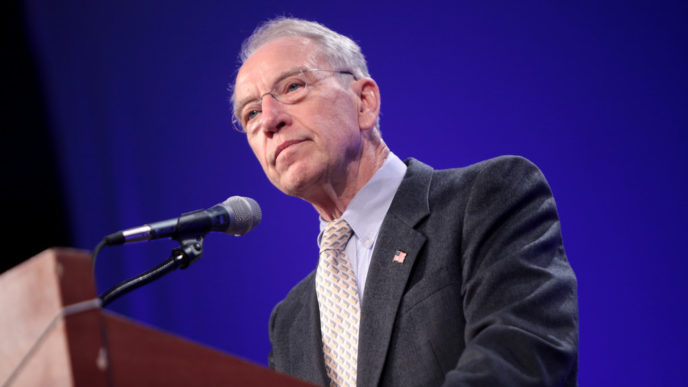
Senate Judiciary Chairman Chuck Grassley fired off a letter to Deputy Attorney General Rod Rosenstein Wednesday questioning numerous probes into acting FBI Director Andrew McCabe and asking whether investigators have found any political conflicts from these inquiries.
In his letter to Rosenstein, Grassley reminded him that he already asked about McCabe’s apparent conflict of interests due to his close relationship with Democratic Virginia Gov. Terry McAuliffe, among other issues, and then pointed out that McCabe appears to be the focus of three separate pending investigations.
“First, the Department of Justice Office of Inspector General is examining his failure to recuse himself from the Clinton investigation due to his political relationship with McAuliffe. Second, the Office of Special Counsel (OSC) is investigating allegations that he violated the Hatch Act by engaging in political campaign activities,” Grassley wrote.
“Third, he is also reportedly the subject of a pending Equal Employment Opportunity (EEO) complaint by a female FBI agent for sex discrimination, who alleges she was targeted for retaliation because of her complaint,” he added.
Chairman Grassley cited a new report by Circa News that says former Trump National Security Adviser Lt. Gen. Michael Flynn was the subject of retaliation from the FBI for supporting the female FBI agent through an official letter during the case. (Read more from “Grassley Demands Answers on Acting FBI Director’s ‘Apparent’ Conflicts of Interest” HERE)