Posts

Warning Signs Flash As America’s Oil Reserves Bleed For Iran War

Just when you thought gas prices could not get any higher, the real oil crisis is beginning to brew underground in America’s key oil reserve.

The U.S. Strategic Petroleum Reserve (SPR) is intended to maintain a stockpile of crude oil for periods of wartime or economic instability. The Iran War has pushed the U.S. to drain the SPR, which is now reaching critical levels, U.S. Energy Information Administration (EIA) data shows.

The price of oil has surged past $100 per barrel as Houthi rebels have begun attacking ships in the Red Sea, Reuters reported, putting even more pressure on an already-constrained oil market.

Some analysts argue that the amount of usable oil in the SPR is much smaller than the official EIA numbers suggest.

The SPR has been drained by nearly 25% over the last 17 weeks, according to the EIA data, declining from 415.4 million barrels on March 20, 2026, to 311.4 million barrels on July 17, 2026. (Read more from “Warning Signs Flash As America’s Oil Reserves Bleed For Iran War” HERE)

US Beefs up Military Might in Middle East as Trump says He’s Weighing ‘Massive Attack’ on Iran

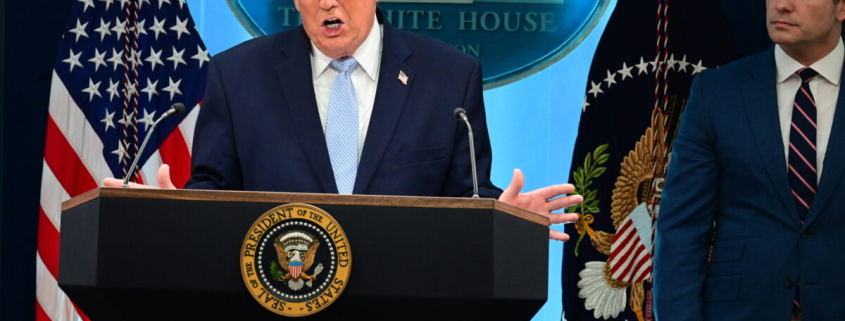
President Trump said he is weighing a “massive attack” on Iran — as the Pentagon floods the Middle East with elite troops, fighter jets and combat medics, vowing to avenge the deaths of four US troops in less than a week.

“I am considering a massive attack. Bigger than anything we have ever had before. I am close to making a decision. We are fully prepared for it,” the president told Israel’s Channel 12 on Thursday.

He added that the Jewish state would join the US in the operation “in two minutes” if he asked, but clarified that “we don’t need anybody” to launch the potential escalation.

“Relations with [Israeli Prime Minister] Bibi [Netanyahu] are very good,” he said. “I will meet with him if he is in town [for Sen. Lindsey Graham’s funeral next week.]”

His remarks come as the US military has surged special operations forces into the Middle East and repositioned fighter squadrons across the region, according to flight tracking data, after four US troops were killed over the past week. (Read more from “US Beefs up Military Might in Middle East as Trump says He’s Weighing ‘Massive Attack’ on Iran” HERE)

Resumption of Iran War Pushes Average Gas Price over $4

. . .With the resumption of the war with Iran, gas has returned to a national average of $4 a gallon this week. Gas prices had started coming down after the U.S. and Iran agreed to a peace deal, which brought stability to the market. Then, as everyone with an IQ over 70 expected, that all fell apart as Iran continued to violate the agreement. Nevertheless, we did have a few weeks of gas prices coming down.

“The price is a national average, meaning drivers in some states have been paying well over $4 a gallon for a while now, while others pay less. Prices vary between states due to factors ranging from nearby supply to differing tax rates,” reports the far-left Associated Press. “People around the world are also dealing with high gas prices as a result of the war.”

We are less than four months out from the November 3 midterm elections. Hopefully, Trump can mop this up pretty quickly with a lasting victory against the jihadist mullahs in Iran and get those prices down. Voters don’t like the war. Voters hate high gas prices. Still, if the victory against Iran is decisive in the minds of voters, they could come around to approve Trump’s decision in hindsight.

But it must be a decisive victory, a victory where 1) everyone knows for sure that the war really is over and 2) the Strait of Hormuz is open and free. (Read more from “Resumption of Iran War Pushes Average Gas Price over $4” HERE)

US Launches New Wave of Strikes Against Iran for Ninth Straight Night; CENTCOM Announces 3 US Service Member Deaths in Jordan, Iraq

U.S. Central Command (CENTCOM) launched another round of strikes against Iran on Sunday, extending its military campaign into a ninth straight night.

“CENTCOM began conducting a new wave of strikes against Iran at 7 p.m. ET today for the ninth consecutive night,” the command said in a post shared on X. . .

President Donald Trump said Sunday that the U.S. military campaign against Iran is focused on ensuring Tehran has no path to obtaining a nuclear missile.

“We were doing a little job and stopping them from having a certain capability,” Trump told reporters at Joint Base Andrews.

“Now we’re just ending it, so it’s really not the same thing. What we’re doing now is we’re ending any chance that they can have a nuclear missile,” he added. . .

President Donald Trump on Sunday paid tribute to U.S. service members killed in recent attacks linked to Iran, saying American forces launched another round of strikes “in honor” of them.

At Joint Base Andrews, Trump also said the service members had sacrificed their lives to prevent Iran from obtaining a nuclear weapon.

“Well, we feel very badly. But you know, those great people, those great patriots were out there fighting so that Iran could not have a nuclear weapon,” Trump said.

“Iran has been very, very badly damaged. They’ve lost everything almost militarily. They’ve got very little left,” he added. (Read more from “US Launches New Wave of Strikes Against Iran for Ninth Straight Night; CENTCOM Announces 3 US Service Member Deaths in Jordan, Iraq” HERE)

The US Military Just Emptied A Third Of Its Deepest Missile Magazine Into Iran — And The Pentagon’s Own Wargames Say The Next War Empties It In Days

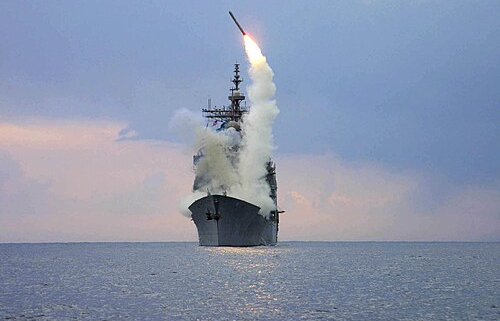
The U.S. Military’s Tomahawk Crisis: How Many Are Left, What the Iran War Used, and What a China War Would Take: As of July 17, 2026, the United States has fired well over 1,000 Tomahawk cruise missiles at Iran, the largest expenditure of the weapon in history, and with the ceasefire declared dead on July 8, the meter is running again. Roughly 2,000 to 3,000 missiles are estimated to remain, against a production line that has built about 90 a year. The sharper question is the one the war has forced into the open: whether the magazine that just emptied into Iran could sustain the conflict it exists to deter, against China or Russia. The honest answer, drawn from the Pentagon’s own wargames, is unsettling.

Nearly five months into America’s war with Iran, one of the conflict’s most consequential numbers has nothing to do with targets destroyed. It is the count of Tomahawk cruise missiles expended, because that count has collided with three facts the defense establishment has known for years and hoped not to test at once: the inventory is finite and smaller than most people assume, the production line is a trickle, and the wars planners most worry about, in the Western Pacific, would demand these weapons at rates the stockpile cannot meet. With the ceasefire declared over on July 8 and CENTCOM striking dozens of coastal air-defense, naval, and logistics targets in the days since, the expenditure is climbing again. Here is the full picture as of July 17: what is left, what has been used, and what the next war would take.

Start with the honest caveat: the Pentagon classifies its exact munitions inventories, so every figure here is an estimate, and the estimates have converged downward as the war has gone on. Before the conflict, open-source assessments of the total stockpile put the total at 4,000 or more Tomahawks, while the cautious estimates were closer to 3,100. The credible current numbers are lower and cluster tightly. The Center for Strategic and International Studies estimated this spring that the U.S. still had around 3,000 Tomahawks, and the Stimson Center’s Kelly Grieco put the figure at about 3,100, summarizing the pattern bluntly: America keeps recognizing it lacks long-range strike capacity, keeps trying to build stockpiles, and, in her words, “we keep depleting them.” Reconcile those estimates against the more than 1,000 missiles fired, and the arsenal remaining today most likely sits somewhere between roughly 2,000 and the high 2,000s, a spread whose very width tells you how little Washington discloses. Whatever the true number, it is spread across Navy destroyers, cruisers, and attack submarines, the four converted Ohio-class guided-missile submarines that carry up to 154 apiece, and new Army and Marine ground launchers.

The expenditure has been historic by every measure. U.S. warships fired roughly 400 Tomahawks in the first 71 hours of Operation Epic Fury alone, principally to smash Iran’s air defenses and command nodes. By the end of the first month, the total passed 850, which made this, by a wide margin, the largest Tomahawk campaign ever conducted, more than Operation Desert Fox’s 325 and Desert Storm’s 288 combined. Firing continued to the April 8 ceasefire, and CSIS’s munitions review, citing updated Wall Street Journal reporting, put the figure at more than 1,000 Tomahawks expended. The same review tracked parallel drawdowns across the rest of the precision magazine, including heavy use of Patriot and THAAD interceptors against Iranian barrages and large expenditures of air-launched JASSM cruise missiles. Since the ceasefire collapsed this month, strikes have resumed, and no updated official count exists; the only precise statement available as of July 17 is that the true number now exceeds 1,000 by an undisclosed and growing margin. (Read more from “The US Military Just Emptied A Third Of Its Deepest Missile Magazine Into Iran — And The Pentagon’s Own Wargames Say The Next War Empties It In Days” HERE)

Two U.S. Service Members in Jordan Killed in Iranian Attack, U.S. Says

(Editor’s note: the actual number of US service members killed is actually three, according to troops in Jordan)

The U.S. military said on Saturday two of its personnel were killed in Jordan and another was missing after an Iranian attack, while Iran’s supreme leader said Washington would pay for “seeking to incite war” after a seventh straight night of U.S. strikes.

The U.S. and Iran have intensified attacks since an interim ceasefire deal signed a month ago fell apart last week, raising the possibility of a return to all-out war.

U.S. Central Command said the deaths of the two U.S. personnel occurred on Friday. It said a third U.S. service member was missing in action.

On Saturday Iran, responding to U.S. attacks on bridges, power facilities and other infrastructure, appeared to target Saudi Arabia as well as other U.S. Gulf allies and Jordan.

In a written statement carried by the official social media accounts of Iran’s supreme leader and Iranian state media, Mojtaba Khamenei said repeated U.S. breaches of the interim deal had shown that President Donald Trump’s signature was “utterly worthless and devoid of credibility.” (Read more from “Two U.S. Service Members in Jordan Killed in Iranian Attack, U.S. Says” HERE)

Iran Reportedly Enlisting Insurgent Group To Cripple Crucial Flow Of Commerce If US Escalates Attacks

Iran has reportedly said it will enlist the help of a terrorist group to further constrain global shipping if the U.S. military attacks Iranian energy infrastructure.

Iran has instructed Yemen’s Houthi rebels to prepare to close the Bab el-Mandeb Strait if the United States attacks Iranian power infrastructure, Reuters reported, citing Iranian and regional sources familiar with the communications. The report came as the U.S. military escalated its operations with repeated airstrikes on critical infrastructure, including highways, bridges and energy sites, according to the Associated Press (AP) and Reuters.

The Islamic Republic’s leadership already sent the request to the Yemeni Houthis, Reuters reported, citing two senior Iranian ‌sources and a regional source who spoke anonymously.

President Donald Trump threatened to attack Iranian energy infrastructure, according to an interview with Fox News’s Trey Yingst. It remains unclear if this is the reason the Iranians issued the request to the Houthis.

“I’ll save the energy targets for last, but ultimately we’ll hit energy targets,” Trump said.

(Read more from “Iran Reportedly Enlisting Insurgent Group To Cripple Crucial Flow Of Commerce If US Escalates Attacks” HERE)

Iran Puts Trump in a Coffin on Huge Billboard in Tehran

The Iranian regime on Wednesday unveiled a massive billboard in Tehran, curved around the side of a building, that depicts President Donald Trump lying dead in a coffin.

Trump’s image on the billboard is disheveled and bloated, with straight, rigid legs and feet pointing straight up, suggesting rigor mortis has set in.

The billboard is also scrawled with graffiti-style messages, mostly written in Farsi, although “We Kill Trump” is clearly visible in English. The “blackboard” area of the billboard appears to be a homage to the billboard upon which farewell messages to the late Ayatollah Ali Khamenei were scrawled during his funeral last week.

Another message on the billboard said “In memory of Minab’s children,” a reference to the Iranian city where a U.S. airstrike on February 28 is believed to have struck an elementary school.

These death threats loom over Islamic Revolution Square, also known as Enqelab Square, which is one of the busiest intersections in the capital city of Tehran. The regime often uses the square to stage rallies and demonstrations, recently including the early stages of the week-long funeral for Khamenei. (Read more from “Iran Puts Trump in a Coffin on Huge Billboard in Tehran” HERE)

US Military Unleashes Another Round of Attacks on Iran for the Third Consecutive Night

President Trump ordered another wave of airstrikes against Iran Monday, marking the third consecutive night the US military has battered regime targets.

“We’re hitting them very heavy tonight, as you know,” the president told reporters in the Oval Office shortly after US Central Command announced the strikes.

“We have tremendous amounts of ammunition. We have numbers that we haven’t had in years, and we’re hitting them very hard and it’ll continue, and we’ll see what happens. But we’re knocking out all of their offensive capability, and we’re controlling the straits.”

CENTCOM announced Monday’s strikes in a statement posted to X.

“At 4:45 p.m. ET today, US Central Command began launching the third consecutive night of strikes against Iran, at the Commander in Chief’s direction,” read a statement released by the combatant command.

“These strikes will continue imposing a heavy cost on Iranian forces and degrade their ability to attack innocent civilians and commercial shipping in the Strait of Hormuz,” CENTCOM added. (Read more from “US Military Unleashes Another Round of Attacks on Iran for the Third Consecutive Night” HERE)

CENTCOM Sends 20 US Warships — and Two Aircraft Carriers —toward Iran after Trump Threatens to Reinstate Naval Blockade

The US is redirecting an armada of warships — including two aircraft carriers – toward Iran as President Trump threatens to reinstate the blockade on Iranian ports.

Maritime trackers on Friday spotted the USS Abraham Lincoln and USS George H.W. Bush entering the Gulf of Oman — a move experts in military planning say would be necessary to re-establish the blockade that crippled the Iranian economy.

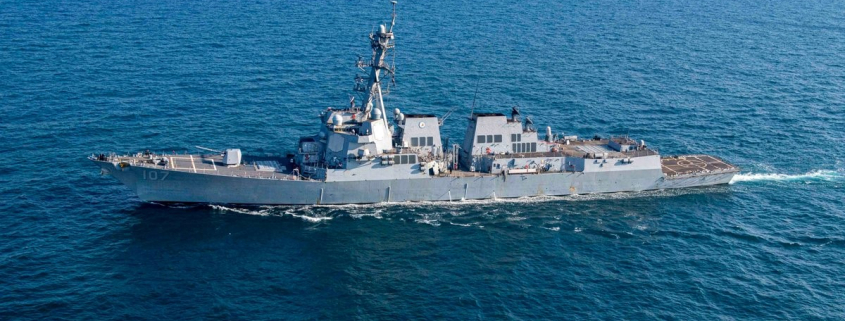
“More than 20 US Navy warships are patrolling waters across the Middle East as CENTCOM forces continue promoting regional security and stability,” US Central Command posted to X this week.

Asked about restarting the blockade that choked off supplies to Tehran, CENTCOM declined to comment on “operational updates.”

The aircraft carriers were spotted within Iran’s missile range, raising their risk level, according to the trackers. (Read more from “CENTCOM Sends 20 US Warships — and Two Aircraft Carriers —toward Iran after Trump Threatens to Reinstate Naval Blockade” HERE)