Posts

‘They Probably Gonna Fake Alien Invasion’: 9th NASA Scientist’s Mysterious Death adds to a Pattern Raising Eyebrows

The National Aeronautics and Space Administration, better known as NASA, has been in the news a lot lately. The Artemis II mission finally took man back to the moon for the first time in over 50 years. But recent reports of NASA scientists either dying or vanishing, all within a span of three years, have made people more interested in what the agency has been working on behind closed doors.

According to the Daily Mail, Michael David Hicks was the first to die. Hicks’ cause of death was never announced, and there’s no public record of an autopsy. That alone caused considerable controversy with internet conspiracy theorists such as Candace Owens — but more on that later.

Hicks worked as a research scientist at NASA’s Jet Propulsion Laboratory. He was a veteran at the agency, having been there from 1998 to 2022 — just one year before he died under unclear circumstances. He’s reportedly one of the nine people connected to the agency, with intimate knowledge of America’s space or nuclear programs, to have died.

NASA is usually viewed as a unifying institution in the country. Scientists who work there are aware of this role and have often resisted making their political leanings public, even when things aren’t going well. What makes the situation more mysterious is that there are at least three other scientists with close ties to Hicks who worked on NASA missions with him and later went missing. That includes Monica Reza, the new Director of the Materials Processing Group at JPL, who vanished without a trace in June 2025. . .

A graphic compiling the missing persons and deaths has since circulated on X, and people have had wildly varying reactions. One user wrote, “They probably gonna fake alien invasion to establish one world government as a so-called earth defense force.” Another suggested, “Almost like the amount of deaths and suicides related to the Epstein circle.” Candace Owens tied it back to moon-landing conspiracy theories, ominously writing, “Gus Grissom might have a clue” about what could be happening.

(Read more from “‘They Probably Gonna Fake Alien Invasion’: 9th NASA Scientist’s Mysterious Death adds to a Pattern Raising Eyebrows” HERE)

NASA’s Moon Mission is a Massive Media Failure, Inexplicably Feeds Conspiracy Theories

. . . NASA’s team of geniuses has been unable to find a way to send any decent cameras on the Artemis II mission. Or if they did, they weren’t used. The Astronauts had their iPhones with them, which was a good idea, so presumably they could have just pointed them out the window and then tweeted the result. If they did that, NASA chose not to highlight most of their pictures. You won’t see many astronaut selfies going viral.

Instead of an endless stream of cool videos and photos of our planet as Orion left, NASA has released THREE photos that their crew took of the Earth. . .

NASA will now mumble excuses about why they can’t get any good pictures, and then throw in some technical jargon about why the mission was important to science despite how boring it looked. They’ll say it matters because it sets up future missions. Doubtless, those missions will also be unable to do basic photography and social media marketing. . . 

Later space footage of [Artemis II] separating was grainy and hard to make out. By the way, when SpaceX has done launches like this, their videos of the rocket are always pristine and beautiful. You see it all. Somehow, despite billions in tax dollars, that’s not something that can be accomplished by NASA.

When the mission arrived at the moon a few days later, we watched the flyby live feed, which largely consisted of two women sitting in front of the camera spinning word salad and occasionally explaining why we can’t see anything. When Orion came around the dark side of the moon and returned to contact with Earth, we still saw nothing. While looking at nothing, we had to sit through a crew member reading a boring, grandiose, pre-prepared speech. (Read more from “NASA’s Moon Mission is a Massive Media Failure, Inexplicably Feeds Conspiracy Theories” HERE)

NASA’s Artemis II Launches On Mission Aiming To Go Further Than Man Has Gone Before

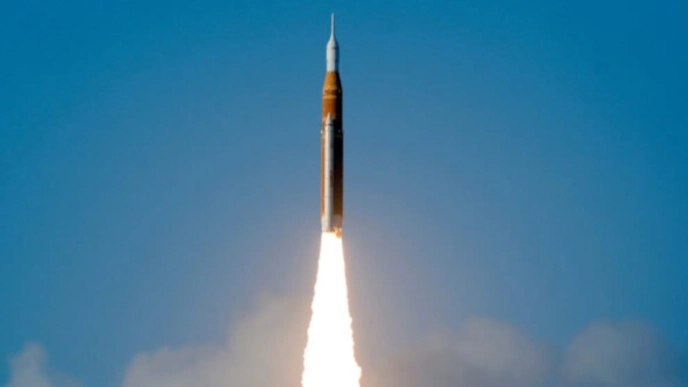
NASA’s Artemis II mission launched at 6:35 p.m. on April 1 from the Kennedy Space Center on Merritt Island, Florida.

The rocket and Orion spacecraft launched after the 10-minute hold was extended according to the National Aeronautics and Space Administration’s (NASA) live update page. Engineers looked into a sensor on the “launch abort system’s attitude control motor battery” that was “believed to be an instrumentation issue” that would not influence take-off, according to the space agency. A unanimous “go” was later given under the direction of Artemis II Launch Director Charlie Blackwell-Thompson.

The twin solid boosters had separated as of 6:37 p.m. and the jettison fairings that enclose the launch abort system and the service module as of 6:38 p.m., NASA said. The Space Launch System’s (SLS) main cut off was completed by 6:43 p.m. and the core stage separated from the Orion spacecraft as well as the interim cryogenic propulsion stage. The space agency said the Artemis II has begun upper-stage operations. (Read more from “NASA’s Artemis II Launches On Mission Aiming To Go Further Than Man Has Gone Before” HERE)

NASA Telescope Unveils Remarkable Never-Before-Seen Views Of Our Galaxy

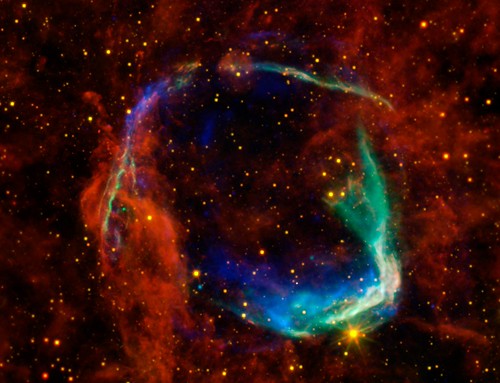
NASA’s James Webb Space Telescope (JWST) has revealed stunning, unprecedented details of the Red Spider Nebula using its Near-Infrared Camera (NIRCam).

This new image, for the first time, fully reveals the Red Spider Nebula’s outstretched lobes — the dramatic structures that create the spider’s “legs” — according to NASA.

Launched in 2021 as the successor to the Hubble Space Telescope, the James Webb Space Telescope is now the planet’s premier space science observatory, capable of detecting infrared radiation across the universe.

In the James Webb image, the sprawling lobes appear in striking blue tones, traced by the glow of light from H₂ molecules — pairs of hydrogen atoms that are bonded.

“These lobes are shown to be closed, bubble-like structures that each extend about 3 light-years,” notes NASA, and that gas streaming outward from the nebula’s core has filled vast bubbles throughout thousands of years. (Read more from “NASA Telescope Unveils Remarkable Never-Before-Seen Views Of Our Galaxy” HERE)

Photo credit: Flickr

Lesbos in Space: Alleged Victim of ‘First Crime in Space’ Admits She Lied About NASA Astronaut Ex-Wife

Summer Heather Worden, the ex-wife of NASA astronaut Anne McClain, pleaded guilty to lying to law enforcement after she previously accused McClain of committing the first crime in outer space.

Worden, a former U.S. Air Force intelligence officer, entered her guilty plea on Nov. 13, the U.S. District Attorney’s Office, Southern District of Texas announced on Tuesday, Nov. 18.

Worden, 50, a resident of Sedgwick County, Kan., claimed McClain guessed the password for her bank account and “illegally accessed” it while she was in the International Space Station in July 2019, federal prosecutors say.

“However, Worden had actually opened the account in April 2018. Both parties had accessed it until January 2019 when Worden changed the credentials. The investigation revealed Worden had granted her spouse access to her bank records from at least 2015, including her login credentials,” the release from the DA’s office continued.

McClain, 46, and Worden were married from 2014 to 2019. McClain, 46, a West Point graduate who served in Iraq, joined NASA in 2013, The New York Times reports. She most recently served as commander of NASA’s SpaceX Crew-10 mission, which began in March, and saw her return to Earth in August, according to the outlet. (Read more from “Lesbos in Space: Alleged Victim of ‘First Crime in Space’ Admits She Lied About NASA Astronaut Ex-Wife” HERE)

Photo credit: Flickr

Harvard Scientist Accuses NASA of ‘Hiding’ Critical Evidence About Manhattan-Sized Comet 3I/ATLAS

. . .Scientist Avi Loeb has accused NASA of withholding critical information about 3I/ATLAS — the Manhattan-sized interstellar comet which he’s postulated could have extraterrestrial origins. The Harvard astrophysicist made these allegations during a recent appearance on “The Joe Rogan Experience.”

Loeb was discussing how the intergalactic object seemed to defy comet behavior, describing how the jet-like emission pointed toward the sun and not away, like it is standard, and that he didn’t “see any cometary tail here.”

That’s when he dropped the so-called NASA bombshell. “Amazingly, the best image was obtained on Oct. 2, 2025, when 3I/ATLAS came within 30 million kilometers of Mars,” the scientist said.

He declared that said image was snapped by NASA’s HiRISE camera aboard the Mars Reconnaissance Orbiter, but that the image “was never released.”

“I wrote to the principal investigator of HiRISE, asking, ‘Can I get the data? I’m a scientist,’” claimed Loeb, who said that he received “no response.” (Read more from “Harvard Scientist Accuses NASA of ‘Hiding’ Critical Evidence About Manhattan-Sized Comet 3I/ATLAS” HERE)

Photo credit: Flickr

NASA Launches Global Defense Probe as ‘Manhattan-Size’ Comet Raises Alarm

NASA and its international partners are ramping up planetary defenses after a mysterious Manhattan-sized comet began behaving in ways that have scientists scratching their heads — and, in some cases, raising the possibility of something not entirely natural.

The cosmic object, known as Comet 3I/ATLAS, was first spotted on July 1 and has since exhibited a string of bizarre behaviors that prompted the International Asteroid Warning Network (IAWN) — a NASA-coordinated global coalition — to officially list it as a potential threat.

While there’s no immediate cause for panic, experts say the comet’s strange composition, trajectory, and emissions have forced them to treat it seriously.

3I/ATLAS, roughly the size of Manhattan Island, stunned astronomers when it was found emitting a rare alloy — nickel tetracarbonyl — at a rate of 4 grams per second, without any detectable iron. That compound, scientists note, has only ever been observed in human manufacturing, not in nature.

The comet also displayed an anti-tail, meaning that instead of trailing particles away from the sun, it was releasing jets pointed directly toward it — a highly unusual and unexplained phenomenon.

Adding to the mystery, researchers have detected non-gravitational acceleration and an anomalous orbital path that will carry the object close to Jupiter, Venus, and Mars before it slingshots near Earth’s neighborhood.

In response, NASA and IAWN have launched what they’re calling a “comet campaign”, scheduled from November 27 through January 27, aimed at refining detection and response techniques for potentially hazardous interstellar objects.

“To prepare for the campaign, we will hold a workshop on techniques to correctly measure comet astrometry,” IAWN said in a statement, referring to precision tracking methods used to calculate orbital movement and rotation.

Although officials have described the initiative as a “test of improved astrometry methods,” some astronomers and sky watchers have expressed concern that 3I/ATLAS simply isn’t behaving like a typical comet.

Among those intrigued by 3I/ATLAS is Harvard astrophysicist Avi Loeb, who has previously suggested that some interstellar objects may be artificial in origin. Loeb noted that the comet’s chemical emissions and acceleration patterns could point to an engineered probe rather than a random rock.

In a recent blog post, Loeb speculated that the object’s upcoming close approach to the sun — followed by a rapid change in trajectory — might indicate an intentional gravitational slingshot maneuver, similar to how spacecraft use planetary gravity to alter their speed and direction.

“If 3I/ATLAS is a massive mothership, it will likely continue along its original gravitational path and ultimately exit the Solar System,” Loeb wrote.

Photo credit: Flickr

NASA’s Curiosity Rover Captures ‘Coral’ Rock on Mars, Hinting at Ancient Water

NASA’s Curiosity rover has uncovered yet another fascinating clue about Mars’ watery past — a small, coral-like rock that may offer more evidence that the Red Planet once supported conditions for life.

The rock, about 1 inch (2.5 centimeters) wide and light in color, was discovered in the Gale Crater, a massive impact basin that has been a focal point of Curiosity’s decade-long mission. Captured by the rover’s Remote Micro Imager, the object bears an uncanny resemblance to coral found on Earth.

While striking, this isn’t the first time Curiosity has spotted such formations. According to NASA, these unusual shapes were created billions of years ago when liquid water still flowed across Mars. Water carried dissolved minerals into cracks in the rock, and as it evaporated, those minerals hardened into distinctive patterns. This process, common on Earth, has also produced other spectacular Martian features — including a flower-shaped rock captured in earlier missions.

“These findings remind us that Mars was once a planet of rivers, lakes, and possibly oceans,” NASA explained. “Although its surface water disappeared long ago, the minerals left behind tell a clear story of a world that was once much wetter.”

This summer, Curiosity also documented another intriguing geological phenomenon in the Gale Crater — intricate ridge networks nicknamed “spiderwebs” due to their insect-like patterns. These structures, like the coral rock, formed when water persisted underground even as the surface dried. Over time, Martian winds eroded the softer rock, revealing the hardened mineral ridges we see today.

“The images and data being collected are already raising new questions about how the Martian surface evolved over billions of years,” NASA said. “Remarkably, even as Mars transitioned into the cold desert we know now, water continued to shape its landscape beneath the surface.”

Photo credit: Flickr

NASA Discovery Linked to Jesus Crucifixion ‘Reveals Exact Day He Died’

A discovery by NASA may confirm the Biblical account of Jesus’ crucifixion, according to researchers from Oxford University.

The Bible states that the sun turning into darkness and the moon into blood, which some scholars believe referenced events following Christ’s death.

NASA’s models, which trace the positions of the Earth, moon, and sun through history, show a lunar eclipse occurred on Friday, April 3, 33AD — the year traditionally linked to Jesus’ death.

The cosmic event would have been visible in Jerusalem shortly after sunset, and the position of the moon would have given it a reddish hue.

The Biblical historians believe the lunar eclipse identified by NASA was the same written about in the Bible.

The NASA discovery was made in the 1990s, but is now going viral on TikTok as today is known among Christians as the day Jesus was crucified. (Read more from “NASA Discovery Linked to Jesus Crucifixion ‘Reveals Exact Day He Died’” HERE)

Astronauts Recount the Harrowing Moment Boeing’s Starliner Almost Doomed Them

In a candid interview, NASA astronauts Butch Wilmore and Suni Williams shared their experiences during the Boeing Starliner’s first crewed flight which left them stranded in space for nine months. According to Wilmore, thruster failures almost doomed the pair to a fate far worse than an extended stay aboard the International Space Station.

The inaugural crewed mission of Boeing’s Starliner spacecraft to the International Space Station (ISS) in June 2024 was marked by a series of thruster failures that left NASA astronauts Butch Wilmore and Suni Williams in a precarious position. In a recent interview, the astronauts provided a detailed account of the harrowing events that transpired during the flight, which left them stranded in space until they were rescued by Donald Trump and Elon Musk. The interview reveals that the astronauts came far closer to a catastrophic failure and subsequent death in orbit than was previously known.

The June 2024 launch of Boeing’s Starliner Crew Flight Test, carrying NASA astronauts Butch Wilmore and Suni Williams, appeared to go smoothly at first. “Oh man, the launch was awesome,” Williams said. “Both of us looked at each other like, ‘Wow, this is going just perfectly.’”

However, as the Starliner approached the ISS for docking, a series of thruster failures put the mission and the lives of the astronauts in jeopardy. Wilmore, who had to take manual control of the vehicle, expressed his concern about the situation, stating, “I don’t know that we can come back to Earth at that point. I don’t know if we can. And matter of fact, I’m thinking we probably can’t.”

The loss of thrusters violated the mission’s flight rules, which dictated that the crew should abort the docking attempt and return to Earth. However, with the uncertainty surrounding Starliner’s ability to safely deorbit and reenter Earth’s atmosphere, the astronauts and Mission Control faced a difficult decision. (Read more from “Astronauts Recount the Harrowing Moment Boeing’s Starliner Almost Doomed Them” HERE)