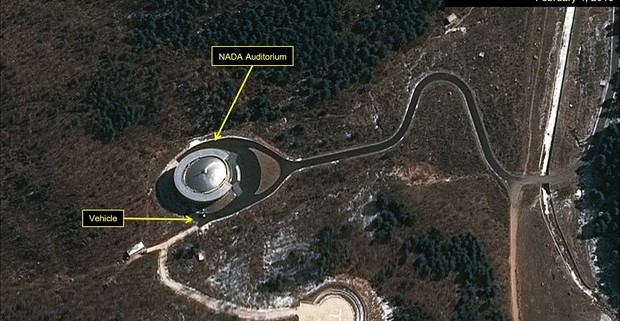
Photo Credit: Reuters (Editor’s note: see UPDATE below) By Reuters. Satellite images taken this week of North Korea’s Sohae rocket launch site show apparent fueling activity seen in the past one to two weeks before a rocket launch, a US think tank said on Friday.
North Korea has told UN agencies it will launch a rocket carrying what it called an earth observation satellite some time between 8 and 25 February, triggering international opposition from governments that see it as a long-range missile test.
Commercial satellite images from Wednesday and Thursday show the arrival of tanker trucks at the launch pad, said Washington-based 38 North, a North Korea-monitoring project. It said the presence of the trucks likely indicated the filling of tanks within bunkers at the site rather than a rocket itself.
“In the past, such activity has occurred one to two weeks prior to a launch event and would be consistent with North Korea’s announced launch window,” the report said.
A US defense official said on Thursday activity detected at the site was consistent with a launch in the time frame given by Pyongyang. On Friday, a US government source said US intelligence agencies believed North Korea could be ready by the US Super Bowl kickoff on Sunday, which will be Monday Korea time. (Read more from “North Korea May Be Ready to Launch a Rocket by Super Bowl Kickoff” HERE)
______________________________
North Korea: Long Range Missile Launch Successful
By Ralph Ellis, K.J. Kwon and Tiffany Ap. North Korea has successfully launched a satellite into space, its state-run TV said, an action immediately condemned by the United States as “destabilizing and provocative.”
Carrier rocket Kwangmyongsong blasted off from the Sohae Space Center at 9 a.m Sunday local time, state news agency KCNA said.
The Kwangmyongsong-4 satellite entered orbit nine minutes and 46 seconds after the liftoff, an operation “great leader Kim Jong Un personally ordered and directed,” the TV announcer said.
Though North Korea said the launch was for scientific and “peaceful purposes” — adding it plans to launch more satellites — it was viewed by other nations, such as Japan and South Korea, as a front for a ballistic missile test, especially coming on the heels of North Korea’s purported hydrogen bomb test last month. (Read more from this story HERE)
https://joemiller.us/wp-content/uploads/2200.jpg372620Joe Millerhttps://joemiller.us/wp-content/uploads/logotext.pngJoe Miller2016-02-06 00:57:472016-04-11 10:52:59North Korea May Be Ready to Launch a Rocket by Super Bowl Kickoff
North Korea may be preparing to launch a long-range missile as soon as in a week, Japan’s Kyodo news agency has reported, citing an unnamed Japanese government official.
The official cited signs of possible preparations for a missile launch based on analysis of satellite imagery.
North Korea conducted its fourth nuclear test on Jan 6., which is expected to result in fresh sanctions at the United Nations.
Earlier on Wednesday, John Kerry, the US secretary of state, said that a nuclear-armed North Korea poses an “overt threat, a declared threat to the world”.
Washington is pushing for a strong United Nations response to the North’s latest atomic blast – which Pyongyang said was a miniaturised hydrogen bomb, a claim largely dismissed by experts – with enhanced sanctions. (Read more from “North Korea ‘Preparing Long-Range Missile Launch Next Week'” HERE)
North Korea’s fourth nuclear test may be its most consequential, but the world is limited in how far it can escalate its response.
Though the Obama administration disputed North Korea’s assertion that it had tested a hydrogen bomb, which would be the most powerful nuclear weapon the country has ever tested, the act violated international treaties, showing that measures to rein in Pyongyang have failed.
Still, unless North Korea’s powerful backer, China, agrees to change course and strengthen sanctions in a way that hampers Pyongyang’s economy and brings the regime near collapse, nuclear experts say the the country’s young leader, Kim Jong-un, will remain undeterred.
“Basically North Korea is committed to developing a nuclear weapons program and we don’t have the policy tools to convince them or force them to give it up,” said Gary Samore, President Barack Obama’s former chief adviser on nuclear policy.
“If you look at the tools available and the magnitude of the problem, it can’t be resolved as long as the North Korean regime survives,” Samore continued in an interview with The Daily Signal.
“The best we can do is slow down and delay program, and I think we have done that.”
Bruce Klinger of the Heritage Foundation, who served as the CIA’s deputy division chief for Korea analysis, argues the Obama administration is not “fully implementing” U.S. laws against North Korea.
“Obama has said North Korea is the most heavily sanctioned country in the world, and there’s not much more we can do, but that’s not true,” Klinger told The Daily Signal. “We are not making the pain strong enough for North Korea to change policy. This administration has had a policy of timid incrementalism. But under existing U.S. law there are things we can do, because we have done them to other countries.”
Samore said Obama’s strategy to confront North Korea has been similar to past presidents, whose diplomatic overtures were frustrated by a regime that ignores international pressure, while the most powerful potential partner in that effort, China, has proved unwilling to take major action.
“What’s remarkable is how consistent U.S. policy has been over last three presidents, and how consistently it has failed,” said Samore, who also worked on nuclear issues in the Clinton and Reagan administrations. “We are really limited in what we can do as long as China has fundamentally different national interests.”
China, as a member of the United Nations Security Council, has veto power over any resolution put forth by that body, and is especially influential in the context of North Korea because it is Pyongyang’s largest trading partner and economic provider.
In the past, China and Russia have objected to potential United Nations measures that could threaten the North Korean regime’s survival, such as sanctions targeting financial transactions with the country, or sales of commodities like coal.
“For the Chinese, as much as they are uncomfortable with the North Korean nuclear program, their bigger fear is a collapse of the regime, and unification under a government friendly to the U.S,” Samore said. “That would weaken China’s geopolitical position. North Korea may not be much of an ally to China, but it’s better for them than the Korean peninsula being dominated by a government friendly to the U.S.”
After meeting Wednesday, the Security Council vowed to “begin to work immediately” on a resolution imposing additional measures against North Korea, and the American ambassador to the United Nations, Samantha Power, called for a “tough, comprehensive and credible package of new sanctions.”
The Security Council has adopted four major resolutions since 2006 sanctioning North Korea for continuing to develop its nuclear weapons program and calling on Pyongyang to dismantle it.
But Samore said existing measures specifically target North Korea’s nuclear and missile programs and don’t strongly impact the country’s basic economy.
“If you look at the last resolution [from March 2013], there are bans on the sale of certain commodities to North Korea because of their potential use for nuclear activity, and a ban on financial transfers that people believe could support the nuclear program,” Samore said. “But these are all targeted sanctions, so they are not important in influencing the overall economy. The big question is whether the Chinese would be willing to consider sanctions beyond targeted sanctions. I’d be delighted if this last test would be enough to persuade Beijing to go a bit further, but we haven’t seen much evidence of that.”
House Speaker Paul Ryan, R-Wis., on Thursday said Congress would not wait to take action of its own, with plans next week for a sanctions vote against North Korea that will likely receive bipartisan support.
Outside of actions related to sanctions, South Korea is talking with the U.S. about deploying American strategic weapons on the Korean peninsula, according to Reuters.
South Korea also said it will restart propaganda broadcasts into North Korea, Reuters reported.
Bruce W. Bennett, a defense analyst at the RAND Corporation focused on Northeast Asian military issues, said the U.S. is wise to consider nontraditional measures such as these.
“Part of the problem is we usually focus on economic responses with some form of sanctions,” Bennett said. “But North Korea is largely isolated from the international marketplace and has not been affected much by U.N. actions. I think we have to ask if economic sanctions are the right approach. If we could also put political pressure on North Korea, that might change their incentives.”
If North Korea doesn’t change, the stakes are significant.
North Korea is different than Iran, another nuclear threat, in that Pyongyang already has a small arsenal of nuclear weapons, while Tehran only has ambitions to do so.
Some nuclear experts say North Korea could have more than 20 weapons by the end of this year.
While Samore says North Korea is “years away” from being able to deliver its nuclear arsenal into a weapon that could hit the U.S., Pyongyang has medium-range missiles that threaten allies South Korea and Japan sooner.
“This particular test, this is the fourth one, so it’s hard to get too excited,” Samore said. “But the overall trend is North Korea is seeking to develop the nuclear weapons ability to attack us. There are no questions that is the objective.” (For more from the author of “Why China Is the Biggest Deterrent to Stopping North Korea’s Nuclear Program” please click HERE)
https://joemiller.us/wp-content/uploads/logotext.png00Joe Millerhttps://joemiller.us/wp-content/uploads/logotext.pngJoe Miller2016-01-08 00:18:392016-04-11 10:54:07Why China Is the Biggest Deterrent to Stopping North Korea’s Nuclear Program
By Greg Botelho and Euan McKirdy. The U.N. Security Council is set to implement “significant” punitive measures after North Korea’s nuclear test Wednesday and will begin working on a new resolution “immediately,” a statement released by Security Council President Elbio Rosselli says.
After Wednesday’s meeting, the council, which includes China, Russia and the United States, together condemned the test as a “clear violation of (past) resolutions … and of the nonproliferation regime.”
Along with “strongly condemning” the test, members of the council determined to create a resolution that acts on previous promises to further curb the reclusive state’s ability to further its nuclear weapons program.
The 15-member U.N. Security Council held a closed-door meeting Wednesday geared to preventing Pyongyang from getting more nuclear weapons and punishing it for the test earlier that day.
Past U.N. measures included arms, nonproliferation and luxury good embargoes, a freeze on overseas financial assets and a travel ban. None of them have so far stopped North Korea from continuing its nuclear program. (Read more from “U.N. Taking Drastic Measures After North Korea Claims to Test Hydrogen Bomb” HERE)
_____________________________
North Korea: We Tested an ‘H-Bomb’
By Gordon G. Chang. Chilling announcement raises huge concerns over nuclear proliferation and proves that Kim Jong Un doesn’t care what Obama and the rest of the world think about his militant regime.
North Korea today claimed it has joined the world’s first rank of nuclear nations by successfully conducting a hydrogen bomb test at 10 a.m. Pyongyang time.
If the claim is true, the Kim Jong Un regime has made far more progress in developing nuclear weapons than believed. Even if the boast is false, the detonation is a dangerous signal.
The test, which triggered international earthquake detection systems, will plunge the region into a diplomatic crisis and intensifies concerns about nuclear proliferation to Iran. (Read more from “North Korea: We Tested an ‘H-Bomb'” HERE)
https://joemiller.us/wp-content/uploads/logotext.png00Joe Millerhttps://joemiller.us/wp-content/uploads/logotext.pngJoe Miller2016-01-07 00:06:372016-04-11 10:54:08U.N. Taking Drastic Measures After North Korea Claims to Test Hydrogen Bomb
North Korea announced Wednesday that its most senior official in charge of inter-Korean relations died in a car accident.
Kim Yang-gon was head of the United Front Department of the ruling Korea Workers’ Party, a member of the North Korean Central Committee and alternate member of the Politburo. He had most recently negotiated with senior South Korean officials in August to defuse a crisis caused by a North Korean incursion into the demilitarized zone and exchange of artillery fire.
Kim Yang-gon’s demise raises suspicions that he was killed by the regime, particularly since several other officials over the years have suffered a similar end. But prior to his death, there were no indications that Kim was distrusted or in danger of being purged.
In addition to the August 2015 negotiations, he had also participated in a senior delegation that made a surprise visit to South Korea in Oct. 2014. He had recently escorted North Korean leader Kim Jong-un on inspection tours to military and civilian sites, suggesting that he remained a trusted aide.
His frequency of accompanying the leader had increased under Kim Jong-un’s reign as compared with the era of Kim Jong-il.
Parsing natural deaths from a forced demise among the senior leadership of North Korea is always difficult, particularly nowadays, given Kim Jong-un’s extensive purging.
Kim Yang-gon’s death in a car accident might be interpreted as paying the ultimate price for the collapse of the inter-Korean mini-détente following the August agreement.
However, the official announcement of Kim’s death described him as Kim Jong-un’s “closest comrade-in-arms and steadfast revolutionary comrade” who had made “dedicated” efforts to achieve Korean unification.
The North Korean leader attended the funeral, expressing “bitter grief” and bemoaning the loss of his “his faithful helper whom nobody can replace,” suggesting an accidental rather than planned death. That said, other North Korean elites may now be more wary of getting into their cars.
Suggestions by some pundits that Kim’s death will hinder inter-Korean dialogue are a red herring, since Pyongyang had already spiked Seoul’s latest attempts at engaging the regime. While the August agreement had led to more reunions of Korean families separated since the Korean War, subsequent senior-level dialogue collapsed in early December over the inability to reach consensus even on an agenda.
During those meetings, North Korean representatives insisted on discussing only the resumption of the Kumgangsan tourist venture, a special region in North Korea for South Korean tourists, which has been a cash cow for the regime.
South Korea called for standardizing family reunions and addressing North Korean denuclearization. Pyongyang subsequently declared that “prospects of North-South relations became even bleaker.”
It is unknown who will succeed Kim Yang-gon, and his replacement may not be announced until the convening of the 7th Congress of the Korea Workers’ Party in May 2016.
But North Korea has repeatedly demonstrated that it rejects implementing the political and economic reforms necessary to justify a principled South Korean engagement strategy. Nor will the regime moderate its aggressive foreign policy to refrain even from threats of nuclear incineration and highly insulting diatribes against President Park Geun-hye. (For more from the author of “Was This Top North Korean Official Assassinated?” please click HERE)
https://joemiller.us/wp-content/uploads/logotext.png00Joe Millerhttps://joemiller.us/wp-content/uploads/logotext.pngJoe Miller2016-01-03 23:26:282016-04-11 10:54:17Was This Top North Korean Official Assassinated?
North Korean leader Kim Jong Un on Thursday appeared to say his country has developed a hydrogen bomb, a step up from the less powerful atomic bomb, but the United States and outside experts were skeptical.
Kim made the comments as he toured the Phyongchon Revolutionary Site, which marks the feats of his father who died in 2011 and his grandfather, state founder and eternal president, Kim Il Sung, the official KCNA news agency said.
The work of Kim Il Sung “turned the DPRK into a powerful nuclear weapons state ready to detonate a self-reliant A-bomb and H-bomb to reliably defend its sovereignty and the dignity of the nation,” KCNA quoted Kim Jong Un as saying. . . A hydrogen bomb, also known as a thermonuclear bomb, uses more advanced technology to produce a significantly more powerful blast than an atomic bomb. (Read more from “North Korea Nows Says It Has a Hydrogen Bomb” HERE)
https://joemiller.us/wp-content/uploads/logotext.png00Joe Millerhttps://joemiller.us/wp-content/uploads/logotext.pngJoe Miller2015-12-11 00:14:502016-04-11 10:55:15North Korea Now Says It Has a Hydrogen Bomb
The Iran nuclear deal does not prohibit Iran country from outsourcing its nuclear arms research to North Korea, which has vowed this week to produce more nuclear bomb fuel, experts are saying.
“We have to make sure that we’re doing whatever we can to uncover anything,” CIA Director John Brennan told reporters on Tuesday, reports The Washington Times.
“I’m not saying that something is afoot at all — what I’m saying is that we need to be attuned to all of the potential pathways to acquiring different types of [weapons of mass destruction] capabilities.”
The deal will free between $100 billion to $150 billion in Iranian assets, which could be used to pay other rogue countries, like North Korea, to carry out the research operations that the agreement prohibits in Iran itself, said Michael Rubin, an analyst for the American Enterprise Institute.
“[Secretary of State John] Kerry and crew left a loophole a mile wide when they effectively allowed Iran to conduct all the illicit work it wants outside of Iran, in countries like North Korea or perhaps Sudan,” Rubin said. (Read more from “CIA Director Worried Iran Might Outsource Nuke Program to North Korea” HERE)
https://joemiller.us/wp-content/uploads/logotext.png00Joe Millerhttps://joemiller.us/wp-content/uploads/logotext.pngJoe Miller2015-09-16 23:55:032015-09-16 23:55:03CIA Director Worried Iran Might Outsource Nuke Program to North Korea
The US has warned North Korea to refrain from “irresponsible provocation” after the communist state said its main nuclear facility had resumed normal operations.
The reactor at Yongbyon has been the source of plutonium for North Korea’s nuclear weapons programme.
The White House said North Korea should “focus instead on fulfilling its international obligations”.
The reactor was shut down in 2007 as part of a disarmament-for-aid deal.
But Pyongyang vowed to restart it in 2013, following its third nuclear test and amid high regional tensions. (Read more from “US Warns North Korea Over Nuclear Plant ‘Provocation'” HERE)
https://joemiller.us/wp-content/uploads/logotext.png00Joe Millerhttps://joemiller.us/wp-content/uploads/logotext.pngJoe Miller2015-09-15 23:48:562015-09-15 23:48:56US Warns North Korea Over Nuclear Plant ‘Provocation’
He’s a fairly young man, wearing an ill-fitting suit. His thin neck is pronounced, giving way to an equally thin face and frame. We’re meeting over a meal of sushi, something he specifically requested because it’s rare for those trapped in North Korea.
For his safety, I’ll limit descriptions of this defector. We’ve agreed that I can say he worked among the elites in Pyongyang. He is by far, the most recent defector I’ve ever interviewed; he’s only been in the free world for a year . . .
He stresses that revealing much more than these few details could endanger his family, still trapped in the Hermit Kingdom. He also fears North Korea could manage to hunt him down in his new life. But he’s talking to me to get a message to the West out.
He believes that among North Korea’s dictators, the dynasty of Kim Il Sung, Kim Jong Il and now Kim Jong Un, “It is Kim Jong Un’s regime that is the most unstable. And it is going to be the shortest” . . .
“There is no collapse of North Korea while Kim Jong Un is alive. We can only expect the opening or reform of North Korea when Kim Jong Un is removed by an external power. North Korea will not collapse as long as Kim Jong Un lives.” (Read more from “North Korean Defector: Kim Jong Un’s Days Are Numbered” HERE)
https://joemiller.us/wp-content/uploads/logotext.png00Joe Millerhttps://joemiller.us/wp-content/uploads/logotext.pngJoe Miller2015-09-07 23:18:372015-09-07 23:18:37North Korean Defector: Kim Jong Un’s Days Are Numbered
By Lim Chang-Won. South and North Korea traded artillery fire across their heavily militarised border on Thursday, in a rare exchange that left no casualties but pushed already elevated cross-border tensions to dangerously high levels.
North Korea followed up with an ultimatum sent via military hotline that gave the South 48 hours to dismantle loudspeakers blasting propaganda messages across the border or face further military action . . .
Direct exchanges of fire across the inter-Korean land border are extremely rare, mainly, analysts say, because both sides recognise the risk for a sudden and potentially disastrous escalation between two countries that technically remain at war.
Thursday’s incident came amid heightened tensions following mine blasts that maimed two members of a South Korean border patrol earlier this month and the launch this week of a major South Korea-US military exercise that infuriated Pyongyang.
In a detailed press briefing later in the day, the South’s defence ministry said the nuclear-armed North initially fired a single artillery round over the border shortly before 4:00pm (0700 GMT). (Read more from “North and South Korea Trade Artillery Fire as Tensions Soar” HERE)
Rival Koreas Trade Artillery, Rocket Fire at Border
By Hyung-Jin Kim. South Korea fired dozens of shells Thursday at rival North Korea after the North lobbed a single rocket round at a South Korean town near the world’s most heavily armed border, the South’s Defense Ministry said.
The Defense Ministry said in a statement that its artillery shells landed at the place where North Korea had fired its rocket. There were no other immediate details from the military and no reports of injuries. It appeared that North Korea did not respond to South Korea’s returned fire.
North Korea had previously threatened to attack South Korean loudspeakers that have been broadcasting, for the first time in 11 years, anti-Pyongyang propaganda messages across their shared border. Pyongyang also restarted its own loudspeakers aimed at the South.
About 80 residents in the South Korean town where the shell fell, Yeoncheon, were evacuated to underground bunkers, and authorities urged other residents to evacuate, a Yeoncheon official said, requesting anonymity because he wasn’t authorized to speak to the media.
In the nearby border city of Paju, residents were asked to stay home. On Baeknyeong Island near the Koreas’ disputed western sea boundary — the scene of several bloody skirmishes in recent years — residents in villages near a site where South Korea operates one of its loudspeakers were also evacuated, according to island officials. (Read more from this story HERE)
North Korea Declares “Quasi-State of War” Today on South
Photo Credit: CNN
By Stars and Stripes. North Korean leader Kim Jong Un declared his front-line troops in a “quasi-state of war” Friday and ordered them to prepare for battle against South Korea in response to an exchange of artillery fire on the border the day before. . .
Tensions on the Korean peninsula ratcheted up after two South Korean soldiers were maimed on Aug. 4 by land mines planted along the Demilitarized Zone. A U.N. Command investigation determined the mines had been planted by the North along a known South Korean patrol route. Pyongyang has denied involvement.
In response to the attack, South Korea resumed anti-Pyongyang broadcasts through loudspeakers along the border, and the North retaliated with its own broadcasts. North Korea demanded the broadcasts end by Friday evening.
On Thursday North Korea fired an artillery round into Yeoncheon near the DMZ. The South responded by firing dozens of shells at the point of origin of the North’s round, according to the Ministry of National Defense statements reported by Yonhap News.
While the two Koreas have traded fire several times in recent years, this marked the most serious incident since the North’s sinking of the Cheonan warship in 2010, killing 46 sailors, and its shelling of the Yeonpyeong island later that year that left four dead. (Read more from this story HERE)
https://joemiller.us/wp-content/uploads/logotext.png00Joe Millerhttps://joemiller.us/wp-content/uploads/logotext.pngJoe Miller2015-08-21 23:34:542015-08-21 23:34:54North and South Korea Trade Artillery Fire as Tensions Soar