Posts

Rand Paul in Pain With Every Breath

The average person takes 20,000 breaths a day. Since November 3, my husband, Rand Paul, has not taken a single one without pain. He has not had a single night’s sleep uninterrupted by long periods of difficult breathing or excruciating coughing.

As his wife, I have been distraught over seeing him suffer like this. There have been several nights where I had my hand on my phone ready to call 911 when his breathing became so labored it was terrifying.

Despite this, he refused to give in to the pain and was determined to fly back to Washington last week to do his job. As we walked through the airport returning from D.C., he was shivering with a 102.5 fever, and the next morning his internist diagnosed pneumonia in his damaged lung.

It is incredibly hurtful that some news outlets have victimized Rand a second time as he struggles to recover, delighting in hateful headlines like “Not A Perfect Neighbor,” and concocting theories about an “ongoing dispute,” based on nothing more than speculation from an attention-seeking person with no knowledge of anything to do with us. (Read more from “Rand Paul in Pain With Every Breath” HERE)

Follow Joe Miller on Twitter HERE and Facebook HERE.

Rand Paul: Neighbor’s Attack Wasn’t About Landscaping

Kentucky Sen. Rand Paul spoke out on Monday for the first time since being attacked by his neighbor 10 days ago, saying in an interview that there’s “no justification” for the attack.

Paul’s socialist neighbor, Rene Boucher, tackled Paul from behind while he was mowing his lawn, leaving Paul with six broken ribs. Boucher has said the attack was over a “trivial matter.”

“From my perspective, I’m not really too concerned about what someone’s motive is,” Paul told the Washington Examiner. “I’m just concerned that I was attacked from the back and somebody broke six of my ribs and gave me a damaged lung where at least for now I have trouble speaking and breathing and now I’ve hurt for 10 days.”

“There is no motive that would justify hitting somebody from behind and breaking their ribs and damaging their lungs, so no, there is no justification for something like that,” he added.

Paul also knocked down media reports that the attack was the culmination of a landscaping feud between the two neighbors, telling the Examiner that he hadn’t spoken to Boucher in 10 years. “My first encounter was basically being hit in the back,” he said. “We’ve never had words over anything, we’ve never had a dispute or discussion or word.” (Read more from “Rand Paul: Neighbor’s Attack Wasn’t About Landscaping” HERE)

Follow Joe Miller on Twitter HERE and Facebook HERE.

Left-Winger Who Attacked Rand Paul Offers a Sketchy Motive

The socialist man who assaulted Kentucky Sen. Rand Paul on Friday — leaving Paul with five broken ribs — released a statement through his lawyer insisting the assault had “nothing to do” with politics.

Rene Boucher, a 59-year-old retired anesthesiologist, who lives next door to Paul, faces charges of fourth-degree assault for tackling the senator as he mowed his lawn. Paul suffered lung contusions as a result of the broken ribs, his office said. Boucher was ordered to remain 1,000 feet away from Paul and his family, except while in his house, as a condition for bail, according to a copy of the citation reviewed by The Daily Caller.

Paul’s neighbors said the assault was the result of a landscaping dispute, the New York Times reported. “They just couldn’t get along. I think it had very little to do with Democrat or Republican politics,” neighbor Jim Skaggs told the NYT. “I think it was a neighbor-to-neighbor thing. They just both had strong opinions, and a little different ones about what property rights mean.”

“The unfortunate occurrence of November 3rd has absolutely nothing to do with either’s politics or political agendas,” Matthew Baker, Boucher’s attorney, said in a statement released to Fox News. “It was a very regrettable dispute between two neighbors over a matter that most people would regard as trivial.”

Baker said that he hopes Paul and Boucher “get back to being neighbors as soon as possible.” (Read more from “Left-Winger Who Attacked Rand Paul Offers a Sketchy Motive” HERE)

Follow Joe Miller on Twitter HERE and Facebook HERE.
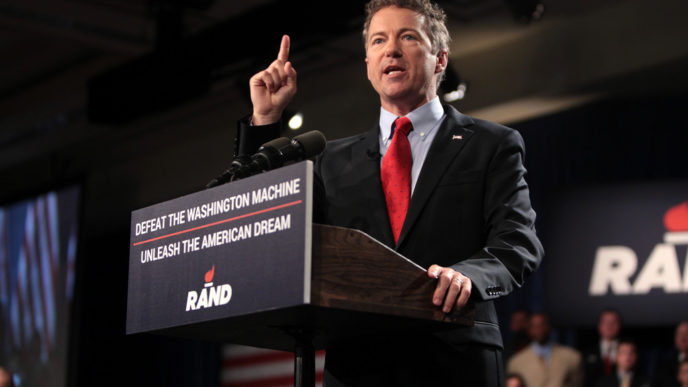
Man Charged With Assaulting Rand Paul

U.S. Sen. Rand Paul has five rib fractures and lung contusions as a result of an apparent assault Friday by a neighbor at Paul’s home in Bowling Green, a spokesman for Kentucky’s junior senator said Sunday.

Senior adviser Doug Stafford said Paul’s injuries cause pain that could persist for weeks, perhaps even months, but that the Republican plans to return to the U.S. Senate soon.

“Senator Paul has five rib fractures including 3 displaced fractures,” Stafford said in a statement emailed to the Daily News by Paul’s staff. “This type of injury is caused by high velocity severe force. It is not clear exactly how soon he will return to work, as the pain is considerable as is the difficulty in getting around, including flying.”

Rene Boucher, 59, a Bowling Green doctor, was arrested Friday and charged with fourth-degree assault after an incident at Paul’s home in the gated Rivergreen community just east of Bowling Green.

Boucher, 582 Rivergreen Lane, was released Saturday night from the Warren County Regional Jail on a $7,500 bond, according to online jail records. (Read more from “Man Charged With Assaulting Rand Paul” HERE)

Follow Joe Miller on Twitter HERE and Facebook HERE.
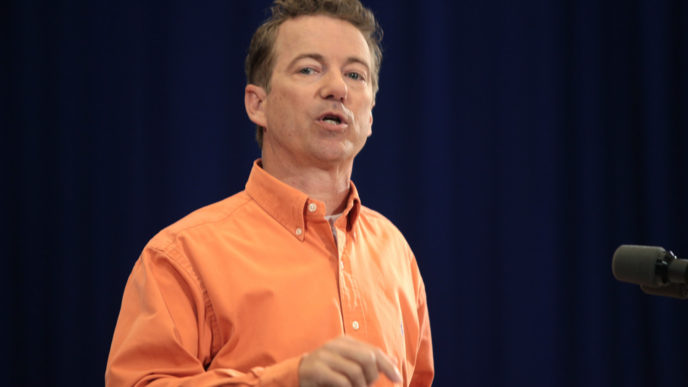
Rand Paul Is Going to War With His Own Party

Restoring Liberty Editor’s note: Rand Paul is calling out the RINO hypocrites (about 95% of the GOP) for refusing to actually support repeal of Obamacare. He points out that the despicable GOP bill contains many of the exact same Obamacare provisions that Republicans have always screamed about (during their election cycles, of course).

What Senator Paul is pointing out is something that most of us are already aware of: the GOP does not represent our interests. They, along with the Democrats, represent the interests of their Establishment handlers (aka, “the elites”).

Do you think this is why the American political experiment may be entering its twilight? If 80% of Republicans were elected on a platform of repealing Obamacare, but virtually none of them actually work to do so, doesn’t that justify a lack of confidence in our elected leaders?

___________________________________________________

Sen. Rand Paul has not been quiet about his displeasure with the Republican healthcare bill as it was written, saying many times that he can’t vote for it unless it looks more like an actual repeal of Obamacare.

Paul has derided Republicans for dropping the essence of their previous “repeal and replace” mantra for another big government approach, which promises an infusion of more federal money into the healthcare system.

Now that Paul has voiced support for separating the repeal effort from the replace effort into two different bills, he has distinguished himself even further from the rest of his caucus as one of the few remaining small government, pro-liberty Republicans.

Commenting on the current bill, he said, “We have nearly $200 billion in insurance bailouts. Does anybody remember us complaining that Obamacare had insurance bailouts?” (Read more from “Rand Paul Is Going to War With His Own Party” HERE)

Follow Joe Miller on Twitter HERE and Facebook HERE.

‘Professor’ Rand Paul?

Senator Rand Paul, R-KY., former presidential candidate, ophthalmologist, and conservatarian firebrand is fulfilling a dream – teaching English to college students.

Jackson Richman of Red Alert Politics reports “Professor Rand Paul” will teach a course titled “Dystopian Visions” during the fall 2017 semester at George Washington University. The course will focus on dystopian literature and what it can teach about the nature of too-powerful government.

Sen. Paul has previously discussed his desire to teach, saying “I think dystopian novels are a discussion of politics, and sort of what happens if you let a government accumulate too much power.”

The class will be an elective held bi-weekly at 8 AM.

“When Senator Paul’s office approached us about coming to campus to teach this course, we agreed that his unique voice as a sitting senator would provide an engaging backdrop for our students,” Ben Vinson, the dean of GWU’s Columbian College of Arts and Sciences, said. “Because of our connections and location in the heart of the nation’s capital, we will continue to welcome prominent contributors to the global dialogue to come to campus to engage our students.”

Eager students have maxed out the available seats in the class. It’s safe to say this will be one college campus where a conservative speaker is welcome. (For more from the author of “‘Professor’ Rand Paul?” please click HERE)

Follow Joe Miller on Twitter HERE and Facebook HERE.

FINALLY! Sen. Rand Paul Offers Worthy Obamacare Alternative GOP Can Get Behind

Sen. Rand Paul, R-Ky. (A, 92%) has been nothing if not vocal about his belief that a new set of health care reforms should be voted on at the same time as a repeal of Obamacare. This week, Sen. Paul has revealed his proposal to replace Obamacare, by introducing S. 222, the Obamacare Replacement Act.

His bill is obviously designed to work in tandem with the partial repeal that was passed by Congress last year, in that it sweeps away the parts of Obamacare that the other bill leaves behind, particularly the regulations. While the bill being passed via the budget reconciliation process repeals only the taxation and spending portions of Obamacare, if Paul’s plan were advanced at the same time, the two bills would add to up to a fairly complete repeal of Obama’s health care takeover.

More so than other GOP proposals for life after Obamacare, Paul’s plan focuses much of its effort on removing barriers to competition in the health insurance market that existed well before 2010. First and foremost, it puts individuals on an equal footing with employers with respect to tax treatment for health insurance costs. He does this by allowing the full tax deductibility of health insurance premiums. He allows the deductions to apply not only to income taxes, but also to payroll taxes, meaning that even lower-income individuals benefit.

In addition, a tax credit of up to $5,000 per individual is allowed for contributions to a health savings account. This allows employers to make the choice whether to continue directly purchasing insurance to offer to employees or simply to contribute an equivalent sum to an employee’s health savings account.

HSAs are then greatly expanded to allow individuals to use their funds for many products and services that are currently not allowed, including health insurance itself as well as over-the-counter medications, physical fitness programs, and nutritional supplements.

Another major drawback of the individual insurance market has been that larger companies are able purchase health insurance in bulk and thus reduce the cost per plan. Paul’s plan creates the framework for individuals and small businesses to be able to easily band together into a larger purchasing pool. While Obamacare attempted to do this for small businesses with its SHOP program, the law increased premiums and regulated the market so much across the board that it hasn’t worked well. This new framework leaves wide open space for innovation in health insurance pools.

One consistent talking point for health care reformers on the Right has been allowing health insurance to be sold across state lines. Specifics of how to accomplish in a way that doesn’t violate federalism have generally been in short supply, but Paul’s plan appears to do a pretty good job of squaring that circle. It allows insurers from one state to offer their products in other states while acknowledging certain constraints imposed by secondary states.

Allowing cross-state sales further boosts insurance pools by increasing the ability to pool together by trade or organizational ties, rather than just by geography. Unions and other professional associations have had some ability to do this through association health plans for years, but Paul’s plan greatly loosens the restrictions on these plans.

Of all the new problems created by Obamacare, the Medicaid expansion is the most difficult to deal with politically. Although Medicaid generally provides poor quality coverage and Medicaid enrollees are rejected by a huge (and increasing) percentage of physicians, millions of Americans have now been brought into the program via Obamacare. Paul’s plan addresses the Medicaid issue in a way that would benefit both states and the covered individuals regardless of whether or not the expansion is fully repealed in the accompanying reconciliation bill.

He does this by granting states the ability to change how they deliver coverage under Medicaid. Previously, states have had to request a waiver from the Department of Health and Human Services to get permission to experiment with better ways to administer their Medicaid programs. Paul’s bill eliminates the need to request the waivers, allowing states to follow in the steps of states like Florida, where reforms carried out under waivers have been very successful in improving the quality of care that Medicaid provides.

Overall, Sen. Paul’s plan focuses reform where it ought to be — breaking down barriers in the marketplace and allowing innovation and competition to increase access to affordable health care. From a free market perspective, it stands head and shoulders above any other plan yet offered to reform health care in the wake of Obamacare’s repeal. (For more from the author of “FINALLY! Sen. Rand Paul Offers Worthy Obamacare Alternative GOP Can Get Behind” please click HERE)

Follow Joe Miller on Twitter HERE and Facebook HERE.

Rand Paul’s Smack down of Bernie Sanders’ Anti-American Rhetoric Is Frickin’ Fantastic

In his questioning of Rep. Tom Price, R-Ga. (D, 62%) Wednesday at the Health, Education, Labor, and Pension (HELP) Committee confirmation hearing, Sen. Bernie Sanders, I-Vt. (F, 17%) asked the HHS nominee if he thought health care is a “right of all Americans whether they’re rich or they’re poor?”

“We’re a compassionate society,” Price began his reply before Sanders cut him off, stating, “No, we’re not a compassionate society in terms of our relationship to poor and working people. Our record is worse than virtually any other country on earth. We have the highest rate of childhood poverty than any other major country on earth and half of our senior, older workers have nothing set aside for retirement. So I don’t think compared to other countries we are particularly compassionate.”

When it was Sen. Rand Paul’s, R-Ky. (A, 92%) turn to question Rep. Price, a former practicing physician, he centered his comments on rebutting Sen. Sanders:

“It’s also been insinuated that America is this horrible, rotten place, and that we don’t have compassion. And by extension, the physicians don’t. As you worked as an emergency room physician or as you worked, did you always agree that as part of your engagement with a hospital to treat all, regardless of whether they had the ability to pay?” questioned Sen. Paul, a trained ophthalmologist who has completed medical missions since taking office.

Price answered that, “It’s one of the things we pride ourselves on, and that is anybody that showed up in need of care was provided that care. And that was true not only in our residency but in our private orthopedic practice as well.”

Paul continued: “It’s interesting that those who say we have no compassion, you know, extol the virtues of socialism. And you look at a country like Venezuela, with great resources and an utter disaster where people can’t eat, devolving into violence. I think it’s important that we do have a debate ultimately in our country between socialism and communism and America and capitalism.

“One of things that’s extraordinary about our country is that just two years ago, in 2014, we gave away $400 billion privately. Not the government — individually, through churches and charities. We’re an incredibly compassionate society and I think often this was misplaced in sort of the wonky numbers … within healthcare. How much we do help each other — not only do we help each other in our country, I bet you half of the physicians in my community in Bowling Green have gone on international trips and done international charity work.

“And all that is lost in saying that we’re this heartless, terrible country. I would just argue the opposite. I think the greatness of our country and the greatness of the compassion of our country, we give away most of the gross domestic product of most of these socialized countries around the world.”

Sen. Rand Paul’s smackdown of Sanders’ empty, predictable rhetoric on capitalism and America was an immediate hit on social media.

No word yet on how Bernie Sanders is nursing his wounds. (For more from the author of “Rand Paul’s Smack down of Bernie Sanders’ Anti-American Rhetoric Is Frickin’ Fantastic” please click HERE)

Follow Joe Miller on Twitter HERE and Facebook HERE.

Rand Paul Proves That Repealing Obamacare and Balancing the Budget Work Together Just Fine

Sen. Rand Paul, R-Ky. (A, 92%) has been stealing the Senate’s thunder of late, coming out in opposition to the budget proposal that is supposed to lay the groundwork for a quick repeal of Obamacare.

So what’s up with Rand? Is he just showboating, placing perfection before finally achieving a long-sought conservative goal?
Or is Sen. Paul crazy like a fox by pointing out that the rush to repeal Obamacare need not require an abandonment of basic fiscal restraint?

The line coming from the GOP leadership in Congress is that the budget resolution that sets the framework for repealing Obamacare has to move quickly. There’s no time for monkeying around with current spending levels in this budget, they say, because it would cause unneeded distractions and controversies over what spending to cut and where. The battle to address the federal government’s massive spending and unsustainable deficit trajectory will happen later this spring, in the budget for fiscal year 2018.

(n.b., Remember that the budget Congress is working with is actually from last year, since they never completed the appropriations process for fiscal year 2017. This gives them the chance to pass a budget resolution for the rest of the fiscal year, through October 2017, and then start over on schedule with a second budget for FY 2018 this spring.)

But what Sen. Paul points out is that maintaining the current spending trajectory, even in a budget plan that sets up repealing Obamacare, means Republicans voted for a framework that increases the national debt by more than $9 trillion over the next 10 years. All while simultaneously advancing an Obamacare repeal plan that neither fully repeals the law right away nor proposes its replacement.

Agree or disagree with Paul’s approach, he’s got some real points here. And then he delivers the coup de grace to the leadership’s arguments by wrangling a vote on a substitute budget that actually balances.

Sen. Paul’s alternative proposal would have balanced the budget by 2024 while still setting the stage for Obamacare’s repeal. Most importantly, it didn’t lay out a specific blueprint for how the budget cuts would be realized to achieve that goal, instead setting target numbers for the individual committees in Congress to decide what to cut and how.

In other words, he did what leadership insisted it couldn’t do because there was no time. And yet only 13 Republicans joined Sen. Paul in his amendment to accomplish both Obamacare repeal and budget sanity.

The Republican deal-with-the-debt-later tactic would be more understandable if there were any reasonable standard of trust that conservatives could deal with. But after years under Obama — of Republicans promising that they would fight for balanced budgets “later” — the trust that later will ever come has been eroded.

And with Sen. Paul proving how easy a basic balanced budget proposal is procedurally, there’s simply no excuse to let there be any separation between balanced budgets and Obamacare repeal. (For more from the author of “Rand Paul Proves That Repealing Obamacare and Balancing the Budget Work Together Just Fine” please click HERE)

Follow Joe Miller on Twitter HERE and Facebook HERE.

Rand Paul Has a Novel Idea: Let’s Kill Obamacare and Try Freedom

Congress is going to vote on Obamacare. Senate Majority Leader Mitch McConnell, R-Ky. (40%) has promised that an Obamacare repeal resolution will be the first item on the Senate’s agenda, but there is some disagreement among Republicans as to what the replacement for President Obama’s failed health care reform law should be.

Sen. McConnell’s fellow Kentuckian, Sen. Rand Paul, R-Ky. (A, 92%) suggests “freedom.”

In an op-ed written for Rare, Sen. Paul suggested it would be “wise” for the GOP to immediately vote on a replacement health insurance reform law, guided by four principles.

1. The freedom to choose inexpensive insurance free of government dictates.

2. The freedom to save unlimited amounts in a health savings account.

3. The freedom to buy insurance across state lines.

4. The freedom for all individuals to join together in voluntary associations to gain the leverage of being part of a large insurance pool.

Rand Paul’s guidelines come as other Republicans in Congress have begun to back away from full ACA repeal, to some form of partial repeal and a replacement plan that keeps parts of Obamacare.

“It’s a partial repeal first of all, it’s not a total repeal,” Sen. David Perdue, R-Ga. (C, 75%) told reporters in late November. “Let’s get that out of the way. It’s a partial repeal, and I think there are pieces of it in there that have to stay in place for awhile and that is what we are going to be working on.”

Sen. John Cornyn, R-Texas (F, 42%) floated a “three-year transition” period to delay the effective repeal of Obamacare while lawmakers develop a replacement plan. One of those plans in development, authored by Sen. Bill Cassidy, R-La. (F, 47%) and Rep. Pete Sessions, R-Texas (F, 57%), “does not purport to repeal the [Affordable Care Act],” in the words of Health Affairs contributing editor Timothy Jost.

Sen. Paul warns that anything less than a full repeal will end in disaster:

My fear is that if you leave part of Obamacare in place (the dictate that insurance companies must sell insurance to individuals with pre-existing conditions) then you will see an acceleration of adverse selection and ultimately mass bankruptcy of the healthcare insurance industry.

Don’t misunderstand me. We should repeal Obamacare, but partial repeal will only accelerate the current chaos and may eventually lead to calls for a taxpayer bailout of insurance companies.

And he is joined by other conservatives in Congress.

Senator Mike Lee, R-Utah (A, 100%) and Rep. Mark Walker R-N.C. (C, 75%) wrote, in a joint op-ed, that President-elect Trump’s administration and the new Congress must not “fumble” full repeal. “We can’t afford to just squeak by with the bare minimum, while preserving many of Obamacare’s most burdensome and intrusive provisions,” they wrote.

Freedom Caucus Chairman Rep. Mark Meadows (A, 94%) has unequivocally stated Obamacare “should be repealed and replaced, and all of that should be done in the 115th Congress,” and “not left to a future Congress to deal with.”

And, of course, Senator Ted Cruz, R-Texas (A, 97%) has made his position on Obamacare abundantly clear:

“Principled opponents of Obamacare rejected it because we reject the use of state force to mandate that we buy a commercial good from a private seller. Pragmatic opponents want to keep the feel good aspects of Obamacare while cleaving the individual mandate that forces people to buy insurance,” Paul writes.

Will the principled conservatives in Congress be enough to dissuade GOP leadership’s partial-repeal agenda? Sen. Paul’s conclusion is pessimistic.

“Partial repeal of Obamacare will likely win the day,” he predicts. “But when the insurance companies come to Washington crying for a bailout don’t say that no one warned of this preventable disaster.” (For more from the author of “Rand Paul Has a Novel Idea: Let’s Kill Obamacare and Try Freedom” please click HERE)

Follow Joe Miller on Twitter HERE and Facebook HERE.