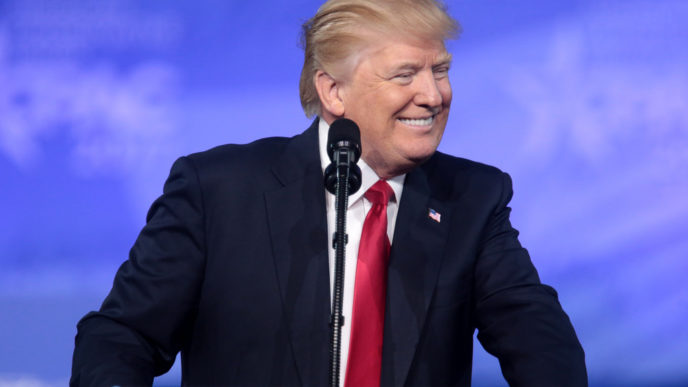
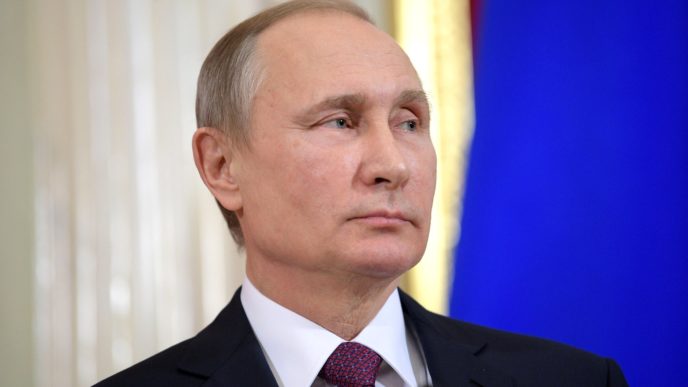
Higher-ups at CNN are cracking down after another botched story regarding President Trump and Russia.
The network retracted and deleted a story late last week that claimed Anthony Scaramucci, who served on Trump’s transition team, was under FBI investigation for a meeting he had with a Russian executive. That story, which was based off of one unnamed congressional source, was false.
“No one should publish any content involving Russia without coming to me and Jason,” CNNMoney executive editor Rich Barbieri said in an email obtained by BuzzFeed. “This applies to social, video, editorial, and MoneyStream. No exceptions.” The “Jason” referred to in the email is a vice president at CNN, according to BuzzFeed. (Read more from “Report: CNN Imposing New Rules on Russia Coverage After Another Botched Story” HERE)
https://joemiller.us/wp-content/uploads/389753335_da844ed5dc_b.jpg6871024Joe Millerhttps://joemiller.us/wp-content/uploads/logotext.pngJoe Miller2017-06-25 23:40:422017-06-25 23:40:42Report: CNN Imposing New Rules on Russia Coverage After Another Botched Story
Russians hacked or attempted to hack into election systems in 21 states, Department of Homeland Security officials confirmed to a Senate panel Wednesday, but stressed this didn’t affect any election outcomes.
However, federal officials would not disclose which states were victims of hacking attempts, other than Arizona and Illinois, which were revealed last year to have been attacked. State election officials, later testifying to the same panel, wanted more information from the federal government. Also, a top FBI official told the panel Russia has interfered in U.S. elections since the Cold War.
“We determined that internet-connected election-related networks in 21 states were potentially targeted by Russian government cyber actors. It is important to note that none of these systems were involved in vote tallying,” Samuel Liles, acting director of the cyber division for the DHS Office of Intelligence and Analysis, told the Senate Select Committee on Intelligence.
This was the latest in a series of Senate hearings regarding the continuing investigation into Russian interference into the 2016 presidential election. Former FBI Director James Comey and Attorney General Jeff Sessions both testified to the committee this month regarding the Russian probe.
“This vast majority of activity we’ve observed was indicative of simple scanning for vulnerabilities and analogous to someone walking down the street to see if you were home,” Liles said. “A small number of systems were unsuccessfully exploited as though someone rattled the door knob but was unable to get in, so to speak. Finally, a small number of the networks were successfully exploited. They made it through the door.”
During the hearing, the committee’s top Democrat, Sen. Mark Warner of Virginia, doggedly pressed the DHS and FBI and, if they were aware, state officials, to notify the public which states were targeted.
“I think there is a public obligation to disclose, again, not to relitigate 2016 but to make sure that we are prepared to for 2017, where I have state elections in my state this year, and 2018,” Warner said. “There are some in the political process that believe this whole Russian incursion into our elections is a witch hunt and fake news. I could very easily see some local elected official saying this is not a problem, this is not a bother.”
Liles returned to the point that Americans can have faith in the election, despite the cyber intrusions.
“Multiple checks and redundancies in U.S. election infrastructures, including diversity of systems, noninternet-connected voting machines, pre-election testing, and processes for media, campaign, and election officials to check, audit, and validate the results, all of these made it likely that cyber manipulation of the U.S. election system intended to change the outcome of the national election would be detected,” Liles said.
However, Alex Halderman, a professor of computer science and engineering at the University of Michigan, contended U.S. election equipment is “vulnerable to sabotage” that “could change votes.”
“We’ve found ways for hackers to sabotage machines and steal votes. These capabilities are certainly within reach for America’s enemies,” Halderman told senators.
He said he and his team spent 10 years researching cyber vulnerabilities of election equipment. The professor said:
Some say that the fact that voting machines aren’t directly connected to the internet makes them secure. But, unfortunately, this is not true. Voting machines are not as distant from the internet as they may seem. Before every election, they need to be programmed with races and candidates. That programming is created on a desktop computer, then transferred to voting machines. If Russia infiltrated these election management computers, it could have spread a vote-stealing attack to a vast number of machines. I don’t know how far Russia got or whether they managed to interfere with equipment on Election Day.
Sen. Roy Blunt, R-Mo., a member of the select committee, noted during the hearing the importance of preventing any manipulation of tallying votes.
“I would think that if you could get into the vote tallying system and you did want to impact the outcome of an election, obviously the vote tallying system is the place to do that,” Blunt said.
Blunt said he doesn’t want the federal government to take over elections, but does hope the DHS should “give advice to state and local election officials to be sure that that vote tallying system is protected at a level above other systems.”
Jeanette Manfra, the acting director of the DHS national protection and programs directorate, insisted vote counting has a greater level of protection.
“What we can assess is that those vote tallying systems, whether it was the machines at a kiosk that a voter uses at a polling station or the systems that are used to tally votes were very difficult to access and particularly to access them remotely and then given the level of observation for vote tallying at every level of the process that adds into that we would have identified issues there, and there were no identified issues,” Manfra said.
Bill Priestap, the FBI’s assistant director of the Counterintelligence Division, said Russia “has for years conducted influence operations targeting our elections.” Though he said it was not equal to the interference in 2016.
Sen. Dianne Feinstein, D-Calif., seemed surprised Russia had interfered before and pressed him on details.
“The scale and the aggressiveness of the effort in my opinion made this one different,” Priestap told the senator. “Again, it’s because of the electronic infrastructure the internet, what have you today, that allowed Russia to do things that in the past they weren’t able to do.”
Citing previous intelligence reports, Priestap said Russia’s goal was to attempt to create discord and delegitimize the election. Citing those same reports, he said the interference was intended to harm Democrat Hillary Clinton and help then-Republican candidate Donald Trump.
Feinstein asked if Russians have ever taken sides in previous efforts. Priestap answered affirmatively, but couldn’t provide an immediate example.
“Yes, ma’am, they have. I’m sorry, I can’t think of an example off the top of my head, but all the way through the Cold War up to our most recent election, in my opinion they have tried to influence all of our elections since then,” Priestap said. “This is a common practice.”
One occurrence came ahead of the 1984 presidential race. A letter to then-Soviet General Secretary Yuri Andropov, dated May 14, 1983, KGB head Viktor Chebrikov explained that then-Sen. Ted Kennedy, D-Mass., was eager to “counter the militaristic policies” of President Ronald Reagan, and to undermine his prospects for re-election in 1984.
The National Association of Secretaries of State oppose the Department of Homeland Security designating election equipment as critical infrastructure, said Connie Lawson, the group’s president-elect and Indiana secretary of state.
“Threat sharing has been touted as a key justification for the designation,” Lawson told the senators. “Yet, nearly six months later, no secretary of state is currently authorized to receive classified threat information from our intelligence agencies. From information gaps to knowledge gaps that aren’t being addressed, this process threatens to erode public confidence in the election process as much any foreign cyber threat.”
The “critical infrastructure” designation puts locally-run elections under the same category as national defense, highways, the power grid, the food and water supply, and communications systems. The federal government can step in to protect these fronts in case of an emergency under the post-9/11 designation.
“It’s also shredding the rights that the states hold to determine their own election procedures, subject to the acts of Congress,” Lawson continued.
She added: “If I have one major request for you today—other than rescinding the critical infrastructure designation for elections—it is to help election officials get access to classified information sharing. We need this information to defend state elections from foreign interference and respond to threats.” (For more from the author of “Homeland Security: Russia Targeted 21 States in 2016, Changed No Votes” please click HERE)
https://joemiller.us/wp-content/uploads/Flag_of_the_United_States_Department_of_Homeland_Security.svg_-1.png12002000Joe Millerhttps://joemiller.us/wp-content/uploads/logotext.pngJoe Miller2017-06-21 20:14:072017-06-21 20:14:07Homeland Security: Russia Targeted 21 States in 2016, Changed No Votes
On the afternoon of June 18, the world changed. The U.S. Air Force shot down a bomber of the Syrian air force controlled by Bashir Assad. The reason for this action was plain and simple. This bomber attacked American allies in Syria: the Syrian Democratic Forces (SDF)—an alliance of Kurds, Christians, and non-jihadist Arabs. The U.S. did what every good ally should do and tried to stop the attack. First the Americans demanded withdrawal. When no response came, this bomber was shot down in order to stop any senseless killing of SDF forces. In response Russia now threatens to shoot down U.S. jets that happen to enter the Russian sphere of influence over Syria.
This is happening while the SDF is taking the first ring of quarters of Raqqa, the ‘capital’ of ISIS. The liberation of Raqqa started June 6 and is progressing. It is quite obvious that attacking the SDF at the end of the day only helps ISIS.
The U.S. and Russia Fight for Dominance of Post-ISIS Syria
At first sight the downing of this Syrian jet is a very simple situation: The US defends its ally on the ground. If that is true, why then is Russia threatening to shoot down U.S. fighting jets? That is because something else is equally true: All players involved are now starting to look to a new map of post-ISIS Syria. And the U.S. wants to stop Iran from dominating either Syria or Iraq.
We can see that the Syrian army has (finally) made some serious progress against ISIS. Assad’s goal is probably not to defeat ISIS as such. More likely he wants to capture oilfields try to block the U.S-backed SDF. Assad wants to distract the SDF and keep its forces busy. Why? Because Assad wants his forces to beat them to the strategic site called Deir Ezzor.
The strategic importance of Deir Ezzor has totally been ignored until now. This ISIS stronghold controls the road from Teheran, Iran, across Iraq and Syria to the Mediterranean Sea and Iran’s enemy, Israel. Iran wants to control this road, so it can funnel weapons to its terrorist allies in Lebanon and the West Bank, which target Israel. The U.S. wants to prevent that, for obvious reasons.
The race to Deir Ezzor has suddenly become a high-stakes game. None of the players is at this point ready to take that area from ISIS. The Assad forces are stretched out and still a long way away. Iranian proxies are on the Iraqi side of the Iraq/Syria border, but this is a relative small force with a lot of other forces around it. The SDF meanwhile is busy in Raqqa and has no spare forces left to march to Deir Ezzor.
How Can We Block Iran?
The big question is what the US can do to block Iran. The answer is actually quite simple. The US has to deepen its commitment to the whole SDF. It must offer weapons to every element in that army. The sad truth is that the US still does not provide the Syriac Military Council (the Christian wing of SDF) any arms or ammo. These brave Christians are fighting ISIS in Raqqa as you read this. But they have to scrape their equipment together and ask others for help. Even the Arab and Kurdish parts of the SDF, which the U.S. does supply, are still under-equipped.
The U.S. still does not tap into the full potential of the SDF. although it is standing ready. For example the Syriac Military Council has more men and women trained than they can arm and this is also true for Kurdish and Arab forces in the SDF. More and better equipment can help to build an army that will act much faster in Raqqa and stand ready much sooner to win the race to Deir Ezzor. That would protect Israel and Iraq from Iran’s terrorist allies. To stabilize northern Syria, the U.S. would be wise to much more humanitarian aid and support rebuilding.
Arm Syria’s Christians
Much is at stake and President Trump can once more make a major difference. This time not only for the peoples in the Federation of Northern Syria but also for Israel.
One thing is clear. We are now definitively looking at a new map of Syria. Turkey is no longer able to block America’s policies. The U.S. has a clear, democratic, religiously tolerant ally: The SDF. America needs to build its ally up. There are now several small US military airbases in northern Syria, built to last rather years than months. The U.S. has realized that the SDF and the Federation of Northern Syria are there to stay. A return to the old, centralized and dictatorial Syria is out of the question. A new decentralized or even divided Syria is in the cards.
Don’t mourn the end of a brutal, centralized Syria. Its demise means that freedom has come to the heart of the Middle East. The task of the U.S. should be to make sure that all religious minorities, including Christians, are treated fairly. (For more from the author of “Why Russia Might Shoot Down American Planes in Syria” please click HERE)
https://joemiller.us/wp-content/uploads/Syrian_civil_war_April_15.png21072502Joe Millerhttps://joemiller.us/wp-content/uploads/logotext.pngJoe Miller2017-06-20 21:50:202017-06-20 21:50:20Why Russia Might Shoot Down American Planes in Syria
Ukrainian President Petro Poroshenko said the United States has been a “co-sponsor of this story of success” in helping his country fight for freedom against Russian aggression, as he sat with President Donald Trump in the Oval Office Tuesday.
Trump and national security adviser H.R. McMaster had a “drop-in” of a White House late morning meeting between Poroshenko and Vice President Mike Pence.
Ahead of the meeting, the Treasury Department announced sanctions against 38 individuals and organizations that U.S. authorities determined had helped Russia in its annexation of the Crimean Peninsula.
“We’re really fighting for freedom and democracy,” Poroshenko said in front of reporters in the Oval Office after the private meeting, according to the press pool report.
The Ukrainian leader talked about U.S. support for security and defense of his country of 45 million people.
“I’m absolutely confident that today is a story of success and I’m proud to have you, Mr. President, and the United States as the co-sponsor of this story of success,” he said.
Critics have accused Trump of being overly sympathetic with Russian President Vladimir Putin’s regime and slow to denounce the invasion. Trump has said he wants Russia’s help in combatting the Islamic State, a Sunni terrorist group.
Trump spoke broadly during his comments with Poroshenko.
“It’s a great honor to be with President Poroshenko of the Ukraine, a place that we’ve all been very much involved in and we’ve been seeing it and everybody’s been reading about it,” Trump said. “And we’ve had some very, very good discussions. It’s going to continue throughout the day and I think a lot of progress has been made.”
The official White House readout of the meeting said Trump and Poroshenko “discussed support for the peaceful resolution to the conflict in eastern Ukraine and President Poroshenko’s reform agenda and anti-corruption efforts.”
Regarding the new sanctions, Treasury Secretary Steven Mnuchin was more direct.
“These designations will maintain pressure on Russia to work toward a diplomatic solution,” Mnuchin said in a statement. “This administration is committed to a diplomatic process that guarantees Ukrainian sovereignty, and there should be no sanctions relief until Russia meets its obligations under the Minsk agreements.”
In 2014, Russia invaded the Crimean Peninsula, and working with pro-Russian separatist militias in Ukraine, annexed the region. The conflict began after Kremlin-backed Ukrainian President Viktor Yanukovych was rejected by the public. The conflict has led to more than 10,000 deaths, 23,000 wounded, and 1.8 million displaced.
During the public appearance, Trump also addressed the death of American Otto Warmbier, who was imprisoned in North Korea. Warmbier died Monday shortly after returning home in a coma. Trump seemed to lay some blame on the Obama administration for not resolving the matter sooner.
“It’s a disgrace what happened to Otto. It’s a total disgrace what happened to Otto. It should never, ever be allowed to happen,” Trump said. “And frankly, if he were brought home sooner, I think the results would have been a lot different. He should have brought home that same day. The results would have been a lot different. What happened to Otto is a disgrace.” (For more from the author of “Ukrainian President Credits US Help in Defense Against Russia” please click HERE)
https://joemiller.us/wp-content/uploads/kKJyGCSfn5MICkyBvVtFN5IZZZmVn5Lq.jpeg580940Joe Millerhttps://joemiller.us/wp-content/uploads/logotext.pngJoe Miller2017-06-20 20:50:202017-06-20 20:50:20Ukrainian President Credits US Help in Defense Against Russia
The Russian defense ministry claims to have killed Islamic State leader Abu Bakr al-Baghdadi in a May 28 airstrike in Raqqa, Syria.
Russian forces in Syria launched the airstrike after receiving intelligence that ISIS leaders were planning a meeting in the outskirts of Raqqa.
“According to the information that is being verified through various channels, ISIS leader Abu Bakr al-Baghdadi also attended the meeting and was killed in the airstrike,” the ministry said in a statement Friday, according to the Associated Press.
In addition to several senior ISIS leaders, Russia estimates around 30 field commanders and 300 personal guards were killed in the strike.
The ministry claims it informed the U.S. of the airstrike in advance. Air Force Col. John Dorrian, the spokesman of the U.S.-led coalition, said he could not confirm the Russian report of Baghdadi’s death. (Read more from “Russia Claims It Killed ISIS Leader Baghdadi in Airstrike” HERE)
A Russian fighter jet last week intercepted a formation of 11 NATO aircraft, including U.S. bombers, as they flew within international airspace over the Baltic Sea as part of a military exercise.
This correspondent for The Daily Signal was onboard a U.S. Air Force KC-135 aerial refueling tanker, part of the formation June 9, and witnessed the intercept by the Russian Su-27 fighter jet.
“It’s a game,” Air Force Lt. Col. Kristofer Padilla, commander of 52nd Operations Group Detachment 1, tells The Daily Signal afterward. “They [the Russians] broke no rules.”
Watch the video:
On this day, NATO warplanes join for an extraordinary aerial formation, comprising two U.S. Air Force B-1B bombers, one USAF B-52H bomber, two German Eurofighter Typhoon fighters, two Polish F-16 fighters, two U.S. Air Force F-16s, and a U.S. Navy P-8 surveillance aircraft.
The aerial refueling tanker, which flies in front of and above the rest of the formation, carries The Daily Signal’s correspondent and other members of the media.
The event is part of an annual NATO maritime exercise in the Baltic Sea called BALTOPS, running from June 1 to 16.
The exercise dates to 1972. But with Russia’s 2014 invasion of Ukraine, and heightened tensions across Eastern Europe between NATO and Russia, the exercise is now more than just a chance for NATO forces to practice operating together in the high-stress environment of simulated combat.
Today, BALTOPS is a signal to NATO’s eastern members that the alliance is committed to their defense. It’s also a message of deterrence to Moscow, underscoring that military aggression against a NATO member could lead to war.
The New Normal
The NATO formation comes together while it orbits on a refueling track over the Baltic Sea within international airspace. Then, unannounced, a Russian Su-27 Flanker fighter merges to intercept the NATO aircraft.
Out of the rear refueling boom operators station, with a window facing down and behind the aircraft, this correspondent observes as the Russian fighter jet, painted in light blue camouflage, approaches.
The Russian fighter moves in from the front right side, merging to intercept within a few hundred meters laterally and at the same altitude as two U.S. Air Force B-1B bombers—approximately what the Air Force calls tactical formation.
The Russian warplane cuts laterally across the formation from right to left, briefly trailing a U.S. B-52 bomber. The NATO formation does not modify due to its unanticipated presence. After a few minutes, the Russian Su-27 breaks off and the formation continues as planned.
U.S. pilots and their commanders downplay the Russian intercept, underscoring that it was not provocative and that U.S. and NATO aircraft never were in danger.
In an email to The Daily Signal, a U.S. military spokesman confirms the Su-27 had its transponder switched on, so the aircraft could be identified.
“We were flying with our allies in the Baltic Sea and we were intercepted by Russian fighters as expected,” writes Lt. James Fisher, an Air Force public affairs officer who was on the KC-135 flight to observe the Russian intercept.
“It was in international airspace and has been characterized as safe and routine,” Fisher says of the intercept. “It was all handled very professionally.”
Still, the sight of a Russian fighter jet merging alongside a pair of B-1B bombers and then cutting across the tail of a B-52 bomber is extraordinary, underscoring the new normal of NATO-Russian military encounters in the region.
The Western alliance is engaged in a delicate, peacetime back and forth with Russia, in which both sides are prone to see routine military operations and exercises by the other camp as provocative acts of brinkmanship, or regional power plays.
‘We Expect Intercepts’
Russia’s air activities over the Baltic Sea have been more aggressive since 2014, the year it invaded Crimea and launched a proxy war in eastern Ukraine. Resultantly, NATO has stepped up its air policing mission in the region, doubling the number of warplanes tagged to patrol the Baltic skies from four to eight in 2014.
“In 2014 and 2015, the number of NATO Air Policing flights over the Baltic and Black Sea areas increased significantly due to increased Russian air activities,” according to the 2016 NATO Secretary General’s Annual Report.
Russian warplanes now routinely intercept NATO warplanes and ships in the Baltic Sea. U.S Air Force personnel say that as long as Russian jets abide by international norms of air safety, they are free to do what they want within international airspace.
“We expect intercepts to happen,” Fisher, the Air Force public affairs officer says. “We act as professional airmen when they do. … There are a number of intercepts that take place on a regular basis. The vast majority are conducted in a safe manner.”
Russian state media and U.S. Air Force personnel portrayed the June 9 intercept in sharply contrasting ways.
Kremlin officials and Russian state-controlled media painted the intercept as an instance of Russia’s standing up to NATO aggression.
“The fact that NATO forces are converging near Russia’s borders and carrying out military exercises supported by strategic bombers from the USA capable of carrying nuclear weapons hardly helps de-escalate tensions in Europe,” Russian Foreign Ministry official Mikhail Ulyanov said, according to Sputnik, a Russian news agency.
For their part, U.S. pilots dismiss this intercept as a normal part of flying in international airspace.
“We’re professional fighter pilots; that’s not something that would be a distraction, or would require any focus to prep. That’s kind of normal ops for us,” Lt. Col. Benjamin Freeborn, commander of the 510th Fighter Squadron, says.
The 510th is an F-16 squadron based in Aviano, Italy, which deployed here to Krzesiny Air Base, Poland, to support BALTOPS and Saber Strike, a concurrent NATO exercise in the region.
“Everything we’ve seen in the exercise so far has been safe and professional,” Freeborn says.
Assurance and Deterrence
BALTOPS is an annual multinational, maritime-focused exercise. This year, 14 countries participate. The exercise involves 4,000 shipboard personnel, 50 ships and submarines, and more than 50 aircraft.
Like other military exercises in Eastern Europe involving NATO and its partners, the simulated enemy forces confronted by NATO in BALTOPS are not specifically labeled as Russian.
The simulated enemy aircraft, called aggressors, are considered to be near-peers—a hypothetical military adversary with technology and training on par with the U.S. and its allies.
The BALTOPS aggressors are, for the most part, simulating Russian military aircraft.
“It’s not focused in any cardinal direction or against any specific adversary,” Freeborn, the F-16 squadron commander, says.
The U.S. has no permanent Air Force bases in Poland. Yet, different units rotate throughout the country in a noncontinuous cycle, and U.S. pilots are embedded within the Polish Air Force as instructors and advisers.
Detachment 1, from the 52nd Operations Group, which is commanded from Spangdahlem Air Base, Germany, is the first U.S. permanent operational military unit in Poland.
Beginning in 2012, the detachment supports four annual U.S. aircraft rotations into Poland, two each of F-16 fighters and C-130 Hercules planes.
Most U.S. pilots are too narrowly focused on their day-to-day mission to gauge the overall effect of their presence on how allies feel about U.S. security guarantees–or on deterring Russia.
Yet, at the back of their minds is the realization that every mission flown is not just about learning or perfecting a combat skill. Every sortie is also a diplomatic statement.
“Success for me is our unit getting to exercise our multirole airpower that we train to with our NATO partners, and hopefully that contributes to some sort of long-term stability, independence, and prosperity in the region,” Freeborn says.
Ambassadors
There is another, deeper, layer to exercises such as BALTOPS, and it involves more than just ironing out logistics or developing common tactics.
A level of human-to-human trust develops when working side by side with other countries’ militaries in the high-stress environment of simulated combat.
“It takes time to build that trust,” Staff Sgt. Marcus Mathews, an F-16 crew chief with the 510th Fighter Squadron, tells The Daily Signal. “By week two, you start to feel things out. It’s a beautiful thing. It’s not about us, it’s about the whole NATO alliance.”
“We’re ambassadors of our nation,” Mathews says.
Mathews is from Killeen, Texas. He speaks in a measured clip and says “sir” a lot when talking to this correspondent. Walking among the 510th Squadron’s F-16 fighters lined up on the Polish ramp, he is upbeat and full of pride about his job.
Much of the media attention in an exercise such as BALTOPS focuses on the aircraft and the pilots—especially with B-1B and B-52 bombers in the mix.
However, some of the most important lessons learned, and the hardest work done, happens on the steaming hot tarmac of airfield ramps such as here at Krzesiny Air Base. That’s where Mathews and other crew chiefs work day and night to keep jets flying.
Transplanting the squadron’s maintenance infrastructure from Aviano Air Base in Italy up to Poland requires maintainers like Mathews to start from scratch in many ways.
Even the simplest things–where to get fuel, where to throw out the trash–can be headaches at an unfamiliar base. Then there’s the language barrier with Polish counterparts.
Those minutiae of day-to-day operations are some of the biggest hurdles to sort out in peacetime exercises.
“No matter where we’re at, our job doesn’t change,” Mathews says. “Every time a jet goes up, there’s a life in that seat that we’re responsible for. I never forget that.”
Deploying to an unfamiliar airfield is a challenge for pilots, too.
Freeborn says that flying daily simulated combat operations out of a new base, with unfamiliar airspace and local procedures, takes pilots out of their comfort zones and better simulates the real world complications that come from rapidly deploying away from home station to respond to a crisis.
“They have to adapt their normal habit patterns to an unfamiliar setting,” Freeborn says.
Enduring Bonds
BALTOPS is a peacetime military exercise occurring above the actual location where a conflict could break out. It comprises frequent aerial run-ins with NATO’s most likely adversary, Russia.
It’s not an exercise held over a desolate desert range in Nevada, or a swath of empty terrain in Alaska. NATO forces are not simulating, in some distant place, the battlefield over which they could fight the next air war. They’re at it. And the enemy is watching their every move.
As a result, this exercise is more than a chance to rehearse combat operations. It’s also a dry run of the logistics operation necessary to move U.S. military assets to the Baltic region.
“Even the simple things are difficult,” Freeborn, the F-16 commander, says.
Another novelty of the exercise for the Air Force is the battlespace.
Air Force pilots typically spend less time training to operate in the maritime environment than their Navy counterparts. Yet, as part of NATO’s air policing responsibilities in the Baltics and the Arctic to counter the Russian threat, many Air Force missions occur over the water.
BALTOPS is a chance to hone skills supporting maritime operations, which only can be simulated at other Air Force training sites.
“In day-to-day training we don’t have access to that level of joint assets,” Freeborn says, adding:
At least for us in the 510th, that’s an absolutely unique experience for us to actually get to physically work with the naval component of our joint team.
Certainly working with the physical assets and not having to simulate something is great. Both with the Army, the Marines, the Navy … those are just usually fake voices on the radio.
Team Players
The U.S. trains to go to war with its allies.
“I’m conditioned to operate and think as a coalition,” Padilla, an F-16 pilot based in Poland with Detachment 1, says. “At a minimum, to be joint minded. And to be humble and gracious enough to know we are not the big bear in the room.”
Poland, a former Warsaw Pact member state, joined NATO in 1999. Today, the U.S. F-16 pilots hold their Polish counterparts in high regard for the rapid transition they’ve made from a post-Soviet military into a valuable NATO asset.
“It’s remarkable what they’ve done in such a short amount of time,” Padilla says. “They’re motivated.”
On the ramp here at Krzesiny Air Base, Soviet-era Russian fighter jets that the Polish Air Force operated as part of the Warsaw Pact are lined up beside a U.S.-made F-16 fighter—the Polish Air Force’s modern workhorse, which it began flying in 2006.
Every so often, on this day, U.S. and Polish F-16s roar overhead.
On the ramp beside the old Russian fighter jets, Padilla, a seasoned American fighter pilot for whom jet noise is a humdrum part of his workday routine, can’t help but look up.
“What’s the modern day Warsaw Pact?” Padilla says. “There is none. But NATO endures.” (For more from the author of “Watch as Russian Fighter Jet Intercepts US Bombers Over Baltic Sea During NATO Exercise” please click HERE)
https://joemiller.us/wp-content/uploads/military-aircraft-568641_960_720.jpg643960Joe Millerhttps://joemiller.us/wp-content/uploads/logotext.pngJoe Miller2017-06-16 23:11:452017-06-16 23:11:45Watch as Russian Fighter Jet Intercepts US Bombers Over Baltic Sea During NATO Exercise
Attorney General Jeff Sessions is preparing to face former Senate colleagues over his role in the controversy around ties between the Trump campaign and Russia, part of an escalating investigation into possible Russian meddling in the 2016 elections.
Sessions is scheduled to testify Tuesday before the Senate Intelligence committee and is due for sharp questioning. It is not yet known whether the hearing will be public or closed. . .
Fellow Republicans, meanwhile, pressed President Donald Trump to come clean about whether he has tapes of private conversations with fired FBI Director James Comey and provide them to Congress if he does — or possibly face a subpoena. It was the latest fallout from riveting testimony from Comey last week of undue pressure from Trump, which drew an angry response from the president on Friday that Comey was lying. (Read more from “Sessions to Testify as Republicans Push for Tapes” HERE)
https://joemiller.us/wp-content/uploads/Senate_Judiciary_Committee_Chairman_Sen._Jeff_Sessions_R-AL_makes_opening_remarks_to_a_panel_of_Department_of_Homeland_Securit.jpg29074296Joe Millerhttps://joemiller.us/wp-content/uploads/logotext.pngJoe Miller2017-06-12 22:38:192017-06-13 03:20:45Sessions to Testify as Republicans Push for Tapes
What ousted FBI Director James Comey tells Congress could set the tone for what his predecessor, now the special counsel investigating Russian interference in the 2016 election, looks into.
But, barring any new bombshells when Comey testifies Thursday before the Senate Intelligence Committee, legal experts identify a few directions the case could go under Robert Mueller’s direction if evidence emerges of collusion between Russia and the Trump campaign.
Mueller’s probe could lead to “obstruction of justice charges and possibly form the basis for impeachment,” said Nick Akerman, who served on the teams of two special prosecutors, Archibald Cox and Leon Jaworski, during the Watergate investigation.
But Ron Hosko, a former assistant director for the FBI assigned to its Criminal Investigative Division, said he doubts it will go quite that far.
“I don’t see today individual transactions forming a broader criminal conspiracy, which is what Democrats want to see, evidence of knowing agreement,” Hosko, who served under both Mueller and Comey, told The Daily Signal.
“Comparisons to Watergate are way over the top,” Hosko added.
However, Akerman and Hosko agree that certain evidence, if uncovered, could lead to charges against people who work or worked for President Donald Trump, either during the campaign or in the administration.
One chief criticism of the congressional investigations before the Justice Department tapped Mueller is the lack of evidence of collusion between the Trump campaign and Russia to weaken Hillary Clinton politically or put Trump in the White House.
Commentators on both the right and the left also question what the underlying crime would be. Even some Democrats have said there is no evidence so far of a crime.
The landscape covered by Mueller’s probe includes the actions of former national security adviser Michael Flynn, the emails connected with Clinton’s campaign, and any communication between Trump campaign or transition officials and the Russians.
Here are six laws and potential charges that legal experts say could be brought:
1.) Logan Act
The “heart of the investigation” would be whether Flynn or anyone else violated the Logan Act, said Robert Ray, the independent counsel who completed an investigation of President Bill Clinton.
The law, dating to 1798, prevents unauthorized citizens from negotiating with foreign governments that are at odds with the United States.
“Between the election and inauguration, if someone was making promises about foreign policy, whether it’s the president himself or someone working for the president, it could be a crime,” said Ray, now in private practice.
This would require evidence of actual promises, deals, or negotiations.
2.) Cyber Intrusion
According to federal officials, Russia apparently hacked the emails of the Democratic National Committee or the emails of John Podesta, Clinton’s campaign chairman, correspondence that ended up on the WikiLeaks site.
If evidence emerges that Trump campaign workers were involved in assisting the Russians, it could tie them to a violation of a statute called Fraud and Related Activity in Connection with Computers, legal experts said.
“This could be a cyber intrusion violation,” said Hosko, now president of the Law Enforcement Legal Defense Fund. “There are laws against aiding and abetting hacking.”
3.) Espionage Act
The Espionage Act may apply on two fronts: anonymous government employees’ leaking classified information to damage Trump, or Trump’s talking to Russian officials during a much-publicized Oval Office meeting.
The FBI recently arrested 25-year-old National Security Agency contractor Reality Winner and charged her with illegally mailing intelligence information about Russian interference with the election to a news organization.
Considering other aspects of the probe seem to lack actual evidence, leaks by government employees might be the most direct route to prosecution, said Hans von Spakovsky, a senior legal fellow at The Heritage Foundation.
“Leaks of classified material is a federal crime,” von Spakovsky, a former Justice Department lawyer, told The Daily Signal, adding:
But so far in the so-called collusion investigation, there is no evidence of any violation of any federal law that I know of. Similarly, the big to-do over Kushner talking to the Russian ambassador—that is perfectly legitimate and not any violation of federal law. Mueller can certainly investigate leaks.
The Heritage legal expert was referring to Jared Kushner, Trump’s son-in-law and one of his top White House aides.
In May, the Trump administration fended off press reports about Trump’s Oval Office meeting with Russian Foreign Minister Sergei Lavrov and Russian Ambassador Sergey Kislyak, in which sources claimed Trump disclosed intelligence about the Islamic State and aviation safety issues.
A procedure exists for presidents to declassify information, Akerman said, and this action could be prosecutable.
“It could have been a plot beforehand, [such as] ‘I’ll tell you in the light of day and then no one will think I’m in cahoots with you guys,’” said Akerman, now in private practice.
Others point out that the president has the power to decide what is and isn’t classified.
4.) Obstruction of Justice
Comey, during his testimony on Capitol Hill, reportedly will not accuse Trump of trying to obstruct the FBI’s investigation of Flynn.
A Comey memo reportedly noted that after dinner at the White House, Trump told him in a February meeting: “I hope you can see your way clear to letting this go, to letting Flynn go.”
It would be tough to make Trump’s stating this in a meeting with Comey the basis of an obstruction charge, Hosko said. But it could give Mueller reason to seek all records of communications or behind-the-scenes actions by Trump regarding the FBI’s Flynn probe.
“The president could have been expressing his wishful thinking to Comey,” Hosko said. “If his true intent was to decapitate an investigation, it would be a more troubling issue.”
Under a “unitary executive” view of the law, it would be difficult to charge a president for seeking to shut down an investigation within the executive branch, Ray said.
“It might be constitutional grounds for impeachment, but it’s not obstruction of justice,” he told The Daily Signal.
5.) Foreign Agent Registration Act
Rep. Elijah Cummings, D-Md., the top Democrat on the House Oversight and Government Affairs Committee, has argued that Flynn, a retired Army general, lied on his national security disclosure forms about past work with Russia.
Flynn allegedly worked for entities with ties to Russian and Turkish governments without disclosing the information, as required under the Foreign Agent Registration Act.
Trump ousted Flynn, a campaign adviser, as his national security adviser after three weeks because Flynn had one or more interactions with the Russian ambassador before Trump’s inauguration and then misinformed Vice President Mike Pence about it.
This could be a serious offense, Ray said.
“There could be a charge of making false statements with regard to vetting and financial disclosure forms,” Ray said.
Akerman agreed.
“When you get a security clearance, they instill the fear of God in you to be honest and provide information about contacts; that’s not something you just forget,” Akerman told The Daily Signal.
6.) Campaign Finance Law
The investigation could uncover a campaign finance scandal, wrote Bob Bauer, former White House counsel for President Barack Obama.
“The law prohibits foreign nationals from providing ‘anything of value … in connection with’ an election,” Bauer wrote. “The hacking of the Podesta emails, which were then transmitted to WikiLeaks for posting, clearly had value, and its connection to the election is not disputed.”
Such an in-kind contribution case is “theoretically possible, but would be difficult to prove,” Ray said.
Hosko agreed.
“There is no hint of any Russian money being involved. Trump’s campaign was largely self-funded,” the former assistant FBI director said. “You did have peripheral players such as Michael Flynn, [former Trump campaign manager] Paul Manafort, and [informal Trump adviser] Roger Stone, who supposedly made money from Russians. But you would have to prove that money ended up in the campaign.” (For more from the author of “6 Crimes Special Counsel Might Pursue in Trump-Russia Probe” please click HERE)
President Donald Trump on Monday defended himself against allegations he divulged classified information in a recent meeting with Russian diplomats, saying alongside Israeli Prime Minister Benjamin Netanyahu that he never identified Israel in his Oval Office conversation.
At the end of his appearance with Netanyahu, Trump said that he “never mentioned the word or the name Israel” in his conversation with Russia’s foreign minister and ambassador. “So you have another story wrong,” he said.
Various reports, quoting anonymous officials, have said Trump did share classified information with Russian diplomats about the threat posed by the Islamic State group, and several have said that information came from Israeli intelligence. But news accounts have not accused Trump of naming Israel as a source of the information. (Read more from “Trump Says He Didn’t Mention Israel in Meeting With Russians” HERE)
https://joemiller.us/wp-content/uploads/Q2JdQ6JPBACFpECedQjbi2L3dU0forPv.jpg580940Joe Millerhttps://joemiller.us/wp-content/uploads/logotext.pngJoe Miller2017-05-22 23:41:422017-05-22 23:41:42Trump Says He Didn’t Mention Israel in Meeting With Russians
The Justice Department on Wednesday appointed former FBI Director Robert Mueller as a special counsel to oversee a federal investigation into potential coordination between Russia and Donald Trump’s campaign during the 2016 presidential election.
The appointment gives Mueller, who led the FBI through the Sept. 11 terrorist attacks and served under presidential administrations of both parties, sweeping powers to investigate whether Trump campaign associates colluded with the Kremlin to influence the outcome in his behalf, as well as the authority to prosecute any crimes uncovered during the probe. The broad mandate, beyond any specific Trump-Russia connection, also covers “any matters that arose or may arise directly from the investigation.”
JUST IN: President Trump releases statement on appointment of special counsel in Russia investigation pic.twitter.com/DTDRztOSFr
Deputy Attorney General Rod Rosenstein, facing scathing criticism for authoring a memo that preceded the firing last week of James Comey as FBI Director, said in a statement that Mueller’s appointment was “necessary in order for the American people to have full confidence in the outcome.” (Read more from “Former FBI Director Mueller Named to Lead Trump-Russia Probe” HERE)
https://joemiller.us/wp-content/uploads/Donald_Trump_Rally_Dallas.jpg8481280Joe Millerhttps://joemiller.us/wp-content/uploads/logotext.pngJoe Miller2017-05-17 16:29:042017-05-17 16:29:04Former FBI Director Mueller Named to Lead Trump-Russia Probe