Posts

McMaster on WaPo Claim Trump Gave Russians Highly Classified Info: ‘I Was in the Room, It Didn’t Happen’

The Washington Post ran a story late this afternoon claiming Donald Trump, in his meeting with Russian Foreign Minister and Ambassador, disclosed highly classified information, including information that could reveal sources and methods.

Despite the length of the story, the allegations of substance are all in this single paragraph:

Trump went on to discuss aspects of the threat that the United States learned only through the espionage capabilities of a key partner. He did not reveal the specific intelligence-gathering method, but he described how the Islamic State was pursuing elements of a specific plot and how much harm such an attack could cause under varying circumstances. Most alarmingly, officials said, Trump revealed the city in the Islamic State’s territory where the U.S. intelligence partner detected the threat.

From that, WaPo argues:

The identification of the location was seen as particularly problematic, officials said, because Russia could use that detail to help identify the U.S. ally or intelligence capability involved. Officials said the capability could be useful for other purposes, possibly providing intelligence on Russia’s presence in Syria. Moscow would be keenly interested in identifying that source and perhaps disrupting it.

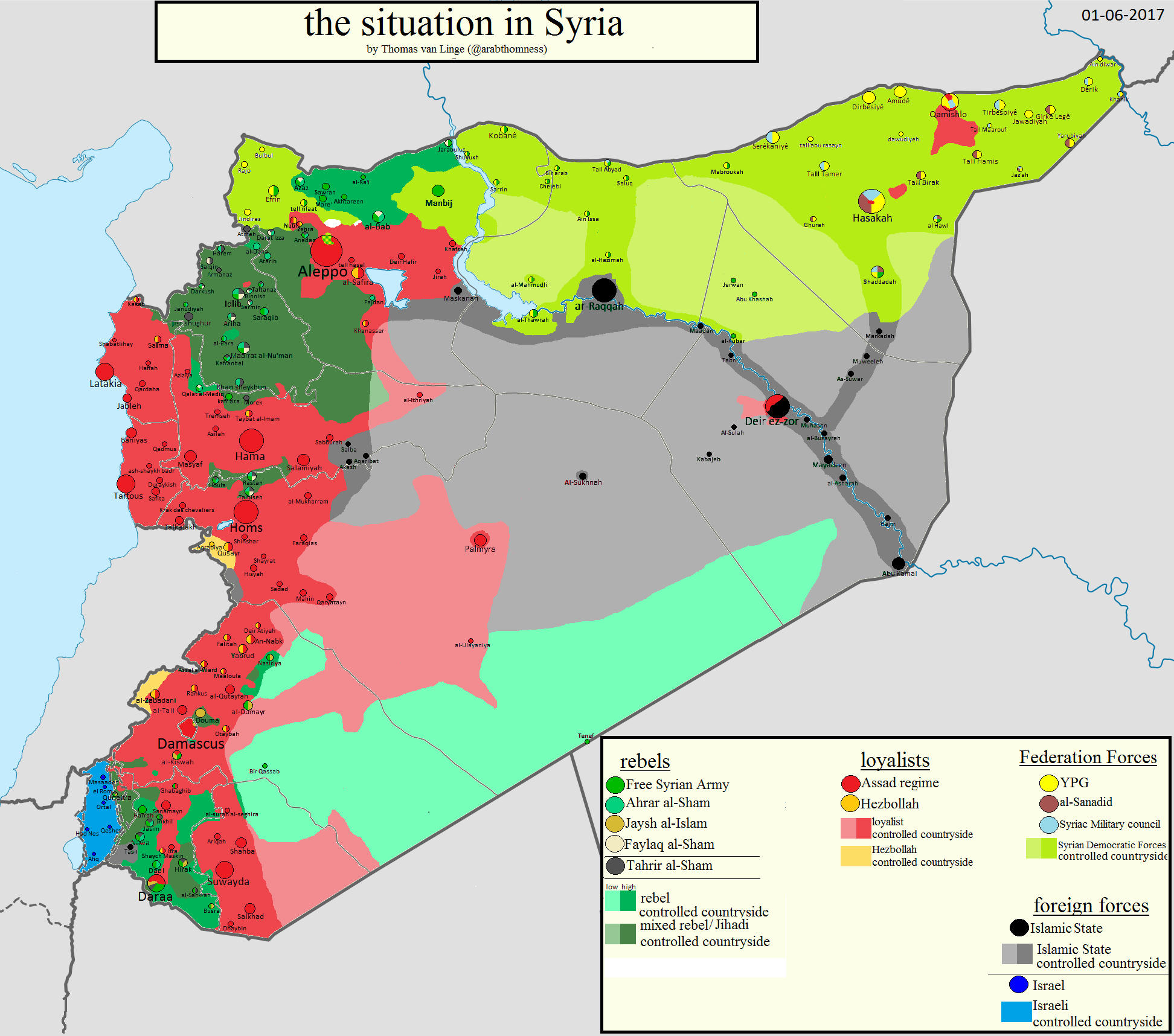
Russia and the United States both regard the Islamic State as an enemy and share limited information about terrorist threats. But the two nations have competing agendas in Syria, where Moscow has deployed military assets and personnel to support President Bashar al-Assad.

(Read more from “McMaster on WaPo Claim Trump Gave Russians Highly Classified Info: ‘I Was in the Room, It Didn’t Happen'” HERE)

Follow Joe Miller on Twitter HERE and Facebook HERE.

Paris and Washington Send a Message to Moscow: No Sanctions Relief Until Russian Troops Leave Ukraine

The Kremlin’s gambit to secure sanctions relief by redrawing the political landscapes in Europe and the United States has, so far, been a failure.

In 2014, the U.S. and the European Union levied punitive economic sanctions on Moscow for its invasion of Ukraine’s Crimean Peninsula and subsequent proxy war in eastern Ukraine. New presidential leadership in Washington and Paris have both made clear this year that the sanctions will stay in place until the Kremlin fulfills its commitments in implementing the Ukraine cease-fire, known as the Minsk II agreements.

Those commitments include the withdrawal of all Russian troops from Ukrainian territory, the return of Ukrainian control over its border with Russia in the Donbas, and unhindered access for international monitors in the conflict area.

“We will not submit to Russia or Mr. Putin’s values, as they are not the same values as ours,” French President-elect Emmanuel Macron said during the campaign, referring to Russian President Vladimir Putin.

Macron, a 39-year-old pro-European centrist, was elected president in a May 7 landslide over his pro-Russian, anti-EU rival, Marine Le Pen. Macron is set to enter office on Sunday.

Meanwhile, U.S. Secretary of State Rex Tillerson pressed for the full implementation of the Minsk agreements during a Wednesday meeting in Washington with Russian Foreign Minister Sergei Lavrov.

“Sanctions on Russia will remain in place until Moscow reverses the actions that triggered them,” U.S. State Department spokeswoman Heather Nauert said in a statement following the meeting.

Consequently, there will be no workaround for the Kremlin to avoid fulfilling its Minsk II commitments. And, so far, neither the EU nor the U.S. has been willing to make concessions about Ukraine for tighter cooperation with Russia in combatting the Islamic State terror group in Syria.

“The [Trump] administration should be wary of getting distracted by Russia and [Bashar] Assad in Syria at the expense of countering Russia’s continued aggression in Europe,” Daniel Kochis, policy analyst in European affairs at The Heritage Foundation, told The Daily Signal.

Setback

Macron’s victory over Le Pen in the May 7 French presidential election was widely perceived to be a setback to Putin’s efforts to influence Europe’s political future through a hybrid campaign of propaganda and cyberattacks.

Macron’s opponent, Le Pen, represented the pro-Russia, anti-EU National Front party.

In November 2014, according to French news reports, the National Front received a 9 million euro ($9.8 million) loan from the Russian-owned First Czech-Russian Bank, part of a larger 40 million euro request.

During the 2017 campaign, Le Pen said she would lift sanctions on Moscow. She praised Putin, criticized U.S. policy regarding Ukraine and Russia, and traveled to Moscow to meet with the Russian leader on March 24.

“Regarding Ukraine, we behave like American lackeys,” Le Pen told the Polish news site Do Rzeczy. “The aim of the Americans is to start a war in Europe to push NATO to the Russian border.”

“I will not accept to have my behavior dictated by Mr. Putin, and that is the difference with Mrs. Le Pen,” Macron said during the campaign.

In the last two days of the campaign, Macron’s campaign said it had been the target of a massive computer hack that dumped internal campaign emails online. Multiple independent investigations cited in news reports claimed the hackers had ties to Russian military intelligence. Moscow denied it was involved.

Without conclusively pinning the Macron campaign hack on Russia, U.S. National Security Agency Director Michael Rogers told Congress on Tuesday that the spy agency had warned French authorities about the threat of a Russian cyberattack before the election.

“If you take a look at the French election … we had become aware of Russian activity,” Rogers told the Senate Armed Services Committee. “We had talked to our French counterparts prior to the public announcements of the events publicly attributed this past weekend and gave them a heads-up: ‘Look, we’re watching the Russians, we’re seeing them penetrate some of your infrastructure.’”

On May 8, the day after the French election, Putin made a conciliatory overture to Macron, urging Franco-Russian cooperation on shared security challenges such as combatting terrorism.

“The citizens of France have trusted you with leading the country at a difficult time for Europe and the whole world community,” Putin told Macron in a telegram, according to Russian news reports.

“The growth in threats of terrorism and militant extremism is accompanied by an escalation of local conflicts and the destabilization of whole regions,” Putin said in the message. “In these conditions it is especially important to overcome mutual mistrust and unite efforts to ensure international stability and security.”

Across the Pond

In Washington, the election of President Donald Trump has not resulted in any significant change in U.S. policy regarding sanctions on Moscow.

On Wednesday, Trump met with Lavrov, Russia’s foreign minister, as well as Ukraine’s foreign minister, Pavlo Klimkin, in the Oval Office during separate appointments.

Trump subsequently published pictures of his meetings with both Klimkin and Lavrov on Facebook, along with the message: “Yesterday, on the same day – I had meetings with Russian Foreign Minister Sergei Lavrov and the FM of Ukraine, Pavlo Klimkin. #LetsMakePeace!”

“The United States is ready to be further involved in making Russia implement Minsk agreements,” Klimkin said following the meeting with Trump, according to Ukrainian news reports.

Klimkin also suggested the U.S. might join the Minsk II negotiations, known as the Normandy format, which currently comprises leaders from Ukraine, Russia, Germany, and France.

Meanwhile, on Tuesday—one day before Lavrov’s Oval Office meeting with Trump—a Russian fighter jet flew within 20 feet of a U.S. Navy reconnaissance aircraft over the Black Sea, NBC News reported Friday.

Speaking to reporters in Moscow on Friday, Russian presidential aide Yuri Ushakov blamed the current tensions between Russia and the U.S. on Trump’s predecessor, former President Barack Obama.

“Naturally, we do not expect that all problems—and there are quite a few of them—will be resolved overnight, because Obama and his team have left the gravest legacy on the Russian track and clearing away these obstructions will be extremely difficult,” Ushakov said, according to the Russian news agency TASS.

“Russia is open for dialogue with the United States in various spheres, including Syria and any other areas where our interests meet or can meet,” Ushakov said.

A History of Violence

Russia’s failure to achieve sanctions relief has not had a cooling effect on the Ukraine war. Overall, the conflict is stuck in a cyclical pattern of waxing and waning violence.

On May 7, the same day that French voters went to the polls to choose their next president, combined Russian-separatist forces fired more than 150 mortars at Ukrainian positions throughout the war zone, according to Ukrainian military officials.

On that day, one Ukrainian soldier was killed in combat; another soldier died in a military hospital due to wounds from a sniper shot on April 30. During the preceding week, four Ukrainian soldiers were killed due to enemy fire, and 40 were wounded.

Ukrainian military forces are engaged in a three-year-old proxy war with Russia in the Donbas, Ukraine’s embattled southeastern territory on the Russian border.

Along a 250-mile-long front line, Ukrainian troops are entrenched within a network of trenches and fortified fighting positions. Across no man’s land, they face a combined force of about 35,000 pro-Russian separatists and approximately 5,000 Russian regulars, according to Ukrainian and NATO intelligence estimates.

Artillery and rocket attacks, tank shots, and small arms gunfights are still daily occurrences. As are casualties, both military and civilian, on opposite sides of the conflict. At some places, no man’s land is only a few hundred meters wide—close enough for the enemy camps to hear each other talking.

The Minsk II cease-fire prohibits the use of heavy weapons above certain calibers within prescribed buffer zones around the front lines. The cease-fire also prohibits both sides from taking new ground or using airpower.

However, the war never ended. About one-third of the war’s 10,000 deaths have occurred since Minsk II went into effect in February 2015.

The international organization tasked with monitoring the cease-fire, the Organization for Security and Cooperation in Europe, or OSCE, has suspended operations in the war zone after an American paramedic attached to one of its patrols was killed in a landmine blast on April 23 in separatist-controlled territory.

The paramedic, 36-year-old Joseph Stone, was the first OSCE patrol member killed while on duty in eastern Ukraine.

“The restrictions have reduced the geographical scope of our patrols and have entailed a grounding of our mid-range unmanned aerial vehicles,” Alexander Hug, principal deputy chief monitor of the OSCE Special Monitoring Mission to Ukraine, said during a press briefing in Kyiv.

“All of which means we are unable to monitor and report on facts, including violations, to the extent that we usually do,” Hug said. “The OSCE SMM imposed these restrictions in order to protect our unarmed civilian monitors.”

On Thursday, combined Russian-separatist forces attacked Ukrainian units 28 times, using mortars, small arms, grenade launchers, and heavy armor, Ukrainian Ministry of Defense spokesman Col. Andriy Lysenko told reporters in Kyiv on Friday.

Lysenko said two Ukrainian soldiers were killed and six were wounded during Thursday’s attacks.

“We assess that Moscow’s strategic objectives in Ukraine, maintaining long-term influence over Kyiv and frustrating Ukraine’s attempts to integrate into Western institutions, will remain unchanged in 2017,” Director of U.S. National Intelligence Daniel R. Coats told the U.S. Senate Select Committee on Intelligence during a Thursday hearing.

“Russia largely controls the level of violence, which it uses to exert pressure on Kyiv and the negotiating process,” Coats said. (For more from “Paris and Washington Send a Message to Moscow: No Sanctions Relief Until Russian Troops Leave Ukraine” please click HERE)

Follow Joe Miller on Twitter HERE and Facebook HERE.
The Russia Investigation: A Scandal About Smoke

The cliche about the Russia investigation is that there’s a lot of smoke. And with the firing of FBI Director James Comey, President Donald Trump rolled a military-grade smoke grenade into the room.

There were many legitimate reasons to fire Comey, who repeatedly went outside Department of Justice guidelines to comment on the investigation of Hillary Clinton during last year’s presidential campaign. Annoyance with his handling of the Russia investigation isn’t one of them.

The firing has stoked charges of a cover-up and again raised the questions, Why, if Trump has nothing to hide, does he act so guilty? Why, if there’s no fire, is there always so much smoke?

But so far, the scandal is nothing but smoke: We get hints of what might be, pending further revelations, serious misconduct, always augmented by Trump’s defensive bluster. It’s all highly suspect, yet it’s hard to see what exactly will constitute the grave underlying offense.

The most plausible of these suspicions, that the Trump campaign colluded with the Russians, has never made much sense on the face of it. The Russians hacked Democratic National Committee and Clinton campaign emails and walked across the street to hand them over to WikiLeaks for dissemination. Why would any coordination with the Trump campaign be necessary? (Read more from “The Russia Investigation: A Scandal About Smoke” HERE)

Follow Joe Miller on Twitter HERE and Facebook HERE.

US May Send Patriot Missile to Lithuania Amid Moscow Threat

U.S. defense officials said a long-range Patriot missile battery may be deployed to the Baltic region later this year as part of a military exercise. The move, if finalized, would be temporary but signal staunch U.S. backing for Baltic nations concerned about the threat from Russia.

U.S. Defense Secretary Jim Mattis on Wednesday declined to confirm the specific deployment, but said, “We are here in a purely defensive stance. Everyone knows this is not an offensive capability. For anyone who says otherwise, I would just say I have too much respect for the Russian army to think that they actually believe there’s any offensive capability.”

At a news conference with Lithuania President Dalia Grybauskaite, Mattis said the U.S. “will deploy only defensive systems to make certain that sovereignty is respected. The specific systems that we bring are those that we determine necessary.” (Read more from “US May Send Patriot Missile to Lithuania Amid Moscow Threat” HERE)

Follow Joe Miller on Twitter HERE and Facebook HERE.

Veteran Justice Department Officials Weigh Need for Special Prosecutor in Russia Probe

President Donald Trump’s firing of FBI Director James Comey gave more fodder to Democrats, many of whom were already calling for a special prosecutor to investigate Russian interference in the 2016 presidential election.

Matthew Whitaker, a former U.S. attorney for the Southern District of Iowa, is unsure this case measures up to past cases involving special prosecutors.

“Usually, there is some intractable conflict where the Justice Department is unable to do its job,” Whitaker, now the executive director for the Foundation for Accountability and Civic Trust, a watchdog group, told The Daily Signal.

“It’s not so much about the level of evidence or the sensibilities of the case,” he continued. “It’s about the confidence in the system.”

In the past, administrations have named special prosecutors that could conduct an investigation independent of the Justice Department, which is part of the executive branch. This is usually the case when there is consensus that the Justice Department cannot objectively investigate a matter, or can’t assure public trust that the probe was done without bias.

Under President Bill Clinton, an independent counsel was named to investigate the Whitewater matter, which eventually led to the investigation of the Monica Lewinsky scandal. After President George W. Bush took office, and the independent counsel statute had expired, the administration named a special prosecutor to investigate the alleged leak of a CIA operative’s name.

Whitaker said Deputy Attorney General Rod Rosenstein is highly respected. Rosenstein, who recommended to Trump that Comey be fired, will ultimately oversee any Justice Department probe into the Trump campaign and Russia because Attorney General Jeff Sessions has recused himself from any investigation that could relate to the 2016 election.

However, Nick Akerman, a former Watergate prosecutor who worked for special prosecutors Archibald Cox and Leon Jaworski, believes this case is ripe for an independent view.

“This is a classic example for the need of a special prosecutor,” Akerman, who later became the U.S. attorney for the Southern District of New York, told The Daily Signal. “It’s extremely serious when there is Russian interference in an election and the possibility that one of the candidates was in cahoots with the Russians.”

Democrats and critics of the Trump administration allege that the firing came as a result of Comey stating the FBI is investigating potential Russian ties to the Trump campaign.

White House deputy press secretary Sarah Huckabee Sanders told reporters Wednesday that every investigation that was going on Monday is going on today.

“There is no evidence of collusion between the Trump campaign and Russia,” Sanders told reporters.

While Sanders said the administration welcomes the investigation, she said a special prosecutor isn’t necessary because the House, the Senate, and the Justice Department are all separately investigating the matter.

When Trump met with former Secretary of State Henry Kissinger at the White House, a reporter asked, “Why did you fire Director Comey?”

Trump responded: “He wasn’t doing a good job. Very simply. He was not doing a good job.”

He was also asked if this affected his meeting Wednesday at the White House with Russian Foreign Minister Sergey Lavrov. He answered, “Not at all.”

During the press briefing, a reporter asked a question about Trump meeting with Kissinger and a Russian official at a time when Democrats are talking about Russian ties and making President Richard Nixon comparisons. Sanders said the two meetings were planned well in advance.

Previous administrations, including independent counsel Ken Starr during the Clinton administration and special prosecutor Patrick Fitzgerald during the George W. Bush administration, expanded their investigations beyond the original topic of inquiry.

Both former federal prosecutors say that doesn’t have to be the case.

“The more narrow, the better,” Akerman said. “The scope of this shouldn’t expand beyond possible collusion between the Trump campaign and the Russian government.”

Whitaker said past precedents demonstrate why an administration would be concerned about naming a special prosecutor to any case.

“The investigations can go far afield if the prosecutor is outside the regular chain of command, so, that’s viewed as a risky proposition,” Whitaker said. “But the investigation can be narrowly focused.”

This isn’t a matter that needs an independent investigation if the FBI has the proper resources to look into the matter, said Ron Hosko, a former FBI assistant director.

“What would make me feel better is knowing that the FBI will get every tool they need to explore the scope of Russian interference,” Hosko, now the president of the Law Enforcement Legal Defense Fund, told The Daily Signal. “I think Congress is a pile of politics and hypocrisy and is incapable of investigating this.” (For more from the author of “Veteran Justice Department Officials Weigh Need for Special Prosecutor in Russia Probe” please click HERE)

Follow Joe Miller on Twitter HERE and Facebook HERE.

Russian Bombers, Fighter Jets Fly Near Alaska, Prompting Air Force Escort

Two Russian Bear bombers — escorted for the first time by a pair of Su-35 “Flanker” fighter jets — entered Alaska’s Air Defense Zone on Wednesday night, U.S. officials told Fox News.

The Russian formation was intercepted by a pair of U.S. Air Force F-22 stealth fighter jets that were already flying a patrol about 50 miles southwest of Chariot, Alaska. A NORAD spokesperson told Fox News the intercept began at 9 p.m. ET on Wednesday and a defense source said it also occurred into Thursday.

It was the first time the U.S. Air Force has seen advanced Russian Su-35 fighter jets escort Russian Cold War-era bombers near Alaska.

The Russian fighter jets were unarmed and remained in international airspace, officials said.

Late last month, Russian bombers flew near Alaska over four consecutive days for the first time since 2014. (Read more from “Russian Bombers, Fighter Jets Fly Near Alaska, Prompting Air Force Escort” HERE)

Follow Joe Miller on Twitter HERE and Facebook HERE.

CIA Confirmed Russians’ Role in Shooting of Pope John Paul II, Reagan Biographer Writes

Contrary to what “pragmatists” in U.S. government agencies concluded, top officials with the Soviet Union were behind the 1981 assassination attempt on Pope John Paul II, a biographer of Ronald Reagan told The Daily Signal in an exclusive interview.

Paul Kengor, a Grove City College political science professor and author, has acquired what he calls never-before-seen information about the Reagan administration’s “supersecret investigation” into the shooting and wounding of the pope.

The information details the role of the Soviet GRU, the Russians’ brutal foreign military intelligence unit, and KGB spy agency head Yuri Andropov in the attempt on John Paul II’s life, Kengor said.

President Reagan and his CIA chief, William Casey, had suspected from the outset that the Soviets had a hand in the shooting of John Paul II on May 13, 1981, in St. Peter’s Square in Rome, he said.

But their suspicions weren’t confirmed until after Casey organized his own secret probe spearheaded by two female researchers, according to Kengor’s just-released book, A Pope and a President: John Paul II, Ronald Reagan, and the Extraordinary Untold Story of the 20th Century.

“Their suspicions ran completely contrary to the establishmentarians in the institutional CIA, at the State Department, and among the White House pragmatists,” Kengor told The Daily Signal. “That being the reality, Casey, I learned, actually ordered a truly supersecret investigation into the shooting, researched by two impressive women in their 30s and 40s, known only to a handful of agency people.”

A Turk named Mehmet Ali Agca, 23, fired four bullets from a handgun at John Paul II, two of which struck him, as the pontiff entered the square. An Italian court eventually sentenced Agca, an escaped murderer, to life in prison. John Paul later forgave Agca, and Prime Minister Carlo Ciampi pardoned him at the pope’s request, deporting him to Turkey in 2000.

The final report of the Casey-ordered investigation never was released, and Kengor says he is not sure where it is. The author did suggest that someone in the Trump administration, including perhaps the president, could ask that the report be released.

Kengor said he believes he may have learned the names of the two female CIA employees. He emailed one, he said, but did not receive a response.

One source told the college professor that the report was “the most secretive thing I’ve ever seen,” Kengor said, declining to name the source.

“We had to practically remove the eyeballs of those who read it,” the source told him. “That report was the blockbuster of the 20th century.”

But even without the actual report in hand, Kengor said, he learned its major findings.

“I did get the results of the investigation, the background, the thinking of Reagan and Casey,” he said in an email to The Daily Signal. “I even pinpointed the date/time that I believe Casey briefed Reagan on the conclusions: May 16, 1985, 11:02-11:17 a.m. I have the president’s daily schedule from that day.”

Both Reagan, who died in 2004, and John Paul II, who died in 2005, decided it would be best not to disclose the findings at the time, Kengor said.

The pope was concerned about starting World War III and “shrewdly figured that people would rightly blame Moscow anyway,” he said.

Reagan was asked several times about a possible Soviet role in the shooting, but was “very careful not to say what was truly on his mind,” Kengor said. “This is an impressive act of diplomacy by Reagan.”

Putin and the Missing Report

So why hasn’t the report of the “supersecret investigation” been released?

Kengor has one possible explanation.

“The current head of Russia, Vladimir Putin, was in the KGB at this exact time,” he said, adding:

But I have to be very clear, I doubt very much that Putin knew anything or was involved. He wasn’t high-ranking enough. This was, as William Safire put it, ‘the crime of the century,’ and a tiny few Russian officials were permitted to know. It was actually the GRU that organized the assassination attempt.

That was the big finding in the Casey investigation, given that everyone else had been looking for, but couldn’t find, KGB fingerprints. That said, the GRU organized the shooting with Yuri Andropov’s direct order, blessing, and enthusiasm at the KGB. Andropov, as head of the KGB, was Vladimir Putin’s boss.

Since coming to power in 2000, Putin has been a “major protector of the GRU and KGB,” Kengor said. “Maybe that’s why this Cold War report still hasn’t been disclosed by Washington. Maybe Washington has heretofore feared offending Putin and hurting U.S.-Russian relations.”

“I wonder,” he added, “if our new president would have any such fears?” (For more from the author of “CIA Confirmed Russians’ Role in Shooting of Pope John Paul II, Reagan Biographer Writes” please click HERE)

Follow Joe Miller on Twitter HERE and Facebook HERE.

Russian Rallies Urge Putin Not to Run Again; Dozens Arrested

Under the slogan “I’m fed up,” demonstrators urging Vladimir Putin not to run for a fourth term rallied in cities across Russia on Saturday. Dozens were arrested in St. Petersburg and elsewhere.

The centerpiece rally in Moscow went peacefully, despite being unsanctioned by authorities. Several hundred people rallied in a park then moved to the nearby presidential administration building to present letters telling Putin to stand down from running in 2018.

But in St. Petersburg, Associated Press journalists saw dozens arrested. The OVD-Info group that monitors political repression relayed reports of more arrests in several cities, including 20 in Tula and 14 in Kemerovo. (Read more from “Russian Rallies Urge Putin Not to Run Again; Dozens Arrested” HERE)

Follow Joe Miller on Twitter HERE and Facebook HERE.
Zuckerberg Might Just Make Russia’s 25-Year-Old Spy Dreams a Reality

Facebook CEO Mark Zuckerberg said Tuesday during an annual conference his tech company is developing a futuristic new technology, a concept the Russians may have tried to bring to fruition decades ago.

“Some of the work that we’re doing in Building 8, even further out beyond augmented reality, … includes work around direct brain interfaces that are going to eventually, one day, let you communicate using only your mind,” Zuckerberg said, admitting, though, that such “stuff is really far out.” Building 8 is Facebook’s innovation research department.

Zuckerberg’s presentation primarily focused on a preliminary augmented reality platform, showing the audience that users of its technology may soon be able to overlay a virtual world on top of the physical one. He used Pokémon Go as an example, a mobile game that places digital fictional creatures on top of the real scenery around a player.

Eventually, the “direct brain interface” (or DBI) will be embedded on their augmented reality platform, meaning communicating will potentially only require the brain . . .

Dr. Igor Smirnov, a Russian scientist at the Moscow Medical Academy, conducted substantial amounts of research on a field of human behavior he called “psychoecology.” He eventually developed an acoustic mind control device, which was claimed to be most effective for treating drug and alcohol addiction. (Read more from “Zuckerberg Might Just Make Russia’s 25-Year-Old Spy Dreams a Reality” HERE)

Follow Joe Miller on Twitter HERE and Facebook HERE.

Russian Bombers Spotted off Alaskan Coast Twice in 24 Hours

Two Russian TU-95 Bear bombers were spotted flying about 41 miles off the coast of Alaska on Tuesday, just hours after two US F-22 fighter jets intercepted the same type of Russian aircraft in the area.

An E-3 surveillance aircraft was scrambled in response to the second sighting of Russian bombers off the Alaskan coast in 24 hours, a US defense official told CNN.

It is unclear if these were the same planes that were intercepted by the F-22s on Monday, but defense officials told CNN that it was a separate violation.

On Tuesday, the two Russian TU-95 Bear bombers once again flew into the Alaskan Air Defense and Identification Zone, according to two US defense officials. The closest the bombers came was 36 nautical miles off the mainland Alaskan coast, and they flew 745 nautical miles southwest of Anchorage. (Read more from “Russian Bombers Spotted off Alaskan Coast Twice in 24 Hours” HERE)

Follow Joe Miller on Twitter HERE and Facebook HERE.