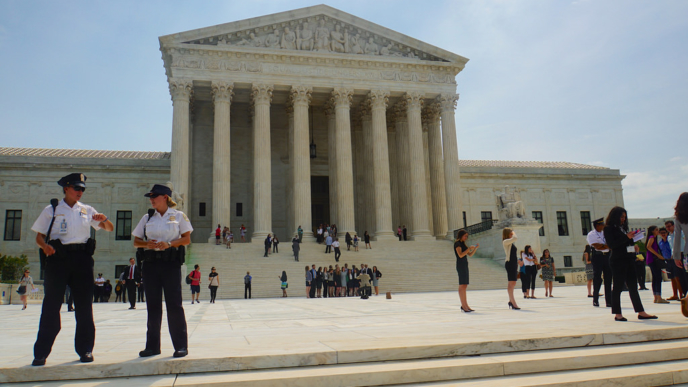
Day two of the Brett Kavanaugh hearings were once again riddled with theatrics. Guy will have a more in-depth analysis later, but let’s discuss Sen. Cory Booker’s nonsense stand to release documents supposedly relating to racial profiling that were deemed confidential. He called it his Spartacus moment. Give me a break—it was more 2020 posturing. He didn’t violate a Senate rule by doing this, which comes with the risk of expulsion from the body, though he said he was willing to do so for the sake of the republic. There are not enough eyes to roll on this one. This set off more Democrats whining and complaining about document releases and transparency when, again, everyone knows they’re not going to support this man. They’ve already made up their minds, which is why the Senate GOP shouldn’t entertain their nonsense motions on this front. This clown show over documents lasted nearly an hour (via Fox News):
New Jersey Sen. Cory Booker injected chaos into Judge Brett Kavanaugh’s Supreme Court confirmation hearing Thursday by releasing confidential Kavanaugh emails with the backing of fellow Democrats in possible violation of Senate rules, calling it an act of “civil disobedience” and drawing condemnation from the Republicans on the committee. . .
After announcing plans to do so, Booker released 12 pages of emails — which had been marked “committee confidential” — online for the public to read. The emails included internal post-9/11 discussions surrounding issues of racial profiling.
. . .
I've said it before and I'll say it again: I will happily work with any of my colleagues from across the aisle to go through the necessary steps and processes to try and get specific classified documents released to the public. #Kavanaugh#SCOTUS
In the end, it was cleared prior to its release by the Bush team and the committee, so nice acting job there, Cory. Also, the big bombshell in those documents only showed that Brett Kavanaugh is reasonable, mainstream, and against racial profiling after the 9/11 terror attacks. The documents were from his time in the Bush administration, which has become a focal point for Democrats since they know there are scores of documents, immaterial ones, whose review could delay the whole process.
So the documents that Cory Booker violated committee rules to release shows that Kavanaugh rejected the use of race or national origin in airport security screening and law enforcement generally in the immediate aftermath of 9/11 https://t.co/aNIkqWeN01pic.twitter.com/bhyBG17uz2
https://joemiller.us/wp-content/uploads/28318497819_7b7566c0ab_b.jpg5761024Joe Millerhttps://joemiller.us/wp-content/uploads/logotext.pngJoe Miller2018-09-06 18:30:072018-09-06 18:27:38Senator Thought He Had a Kavanaugh Bombshell. It Was a Total Dud.
If you tuned in on day one of the Supreme Court confirmation hearing for Judge Brett Kavanaugh Tuesday, you watched Democrats do everything possible to attack his legal record. Worse, they smeared his character, integrity and repeatedly made a number of false accusations.
Putting the distraction, grandstanding and protests aside, there’s a lot of inconvenient facts the far left — including Democrat Senators Cory Booker and Kamala Harris — don’t want Americans to know about Judge Brett Kavanaugh. . .
“I’ve been very aggressive about hiring the best and understanding that the best include women,” Kavanaugh said during testimony Wednesday. “A majority of my clerks have been women. Twenty-five. Twenty-one of them have gone on the clerk at the Supreme Court. They’re an awesome group. If confirmed to the Supreme Court, I will continue to do this.” . .
“I am here today with another of my judicial heroes … my mom. Fifty years ago this week, in September 1968, my mom was 26 and I was three. That week, my mom started as a public-school teacher at McKinley Tech High School here in Washington, D.C. 1968 was a difficult time for race relations in our city and our country,” Kavanaugh said. . .
“His intellect is unquestioned. His judgement is highly regarded. And I can personally attest to his character and integrity as a colleague,” [Condoleezza] Rice testified Tuesday as a character witness.
“Here's the Brett Kavanaugh that I know. He is hard-working. He has a sense of humor. He seeks truth in facts.” -Former Secretary of State, Condoleezza Rice pic.twitter.com/oEyJEHrdHr
https://joemiller.us/wp-content/uploads/Judge_Brett_Michael_Kavanaugh-2.jpg333465Joe Millerhttps://joemiller.us/wp-content/uploads/logotext.pngJoe Miller2018-09-06 03:26:202018-09-06 03:23:16Here’s What the Left Doesn’t Want America to Know About Brett Kavanaugh
In light of yesterday’s conviction of former Trump campaign manager Paul Manafort and lawyer Michael Cohen’s guilty plea, Democrats are losing their minds.
A number of Democratic Senators cancelled their meetings with Supreme Court nominee Brett Kavanaugh today, citing President Trump’s ties to Manafort and Cohen as the reason why. Then, Senate Minority Leader Chuck Schumer took things a step further a declared Kavanaugh’s nomination should be halted indefinetely.
Judge Kavanaugh’s refusal to say a POTUS must comply w a duly issued subpoena & Mr Cohen’s implication of POTUS in a federal crime make the danger of Kavanaugh's nomination to the SCOTUS abundantly clear.
It's a game changer & Chairman Grassley should delay confirmation hearings
At this moment in our nation's history, the Senate should not confirm a man to the bench who believes presidents are virtually beyond accountability, even in criminal cases; that they are essentially above the law and only Congress can check a president's power. #WhatsAtStake
https://joemiller.us/wp-content/uploads/37890313915_1767807d66_b-2.jpg5761024Joe Millerhttps://joemiller.us/wp-content/uploads/logotext.pngJoe Miller2018-08-22 23:09:582018-08-22 23:07:41It’s Getting Dumber: Chuck Schumer Desperately Tries to Block Judge Kavanaugh Because of Michael Cohen
Senate Judiciary Committee Chairman Chuck Grassley has officially released the dates for Judge Brett Kavanaugh’s confirmation hearing to become the next justice on the U.S. Supreme Court.
The hearing will begin on Tuesday, September 4 and is expected to span three or four days. Opening statements will be made on the first day, with questioning starting on Wednesday, September 5.
“As I said after his nomination, Judge Kavanaugh is one of the most respected jurists in the country and one of the most qualified nominees ever to be considered by the Senate for a seat on our highest court. My team has already reviewed every page of the over 4,800 pages of judicial opinions Judge Kavanaugh wrote, over 6,400 pages of opinions he joined, more than 125,000 pages of records produced from his White House legal service, and over 17,000 pages in response to the most comprehensive questionnaire ever submitted to a nominee,” Grassley released in a statement. “He’s a mainstream judge. He has a record of judicial independence and applying the law as it is written. He’s met with dozens of senators who have nothing but positive things to say. At this current pace, we have plenty of time to review the rest of emails and other records that we will receive from President Bush and the National Archives. It’s time for the American people to hear directly from Judge Kavanaugh at his public hearing.” (Read more from “It’s Official: The Date for Judge Kavanaugh’s Supreme Court Hearing Has Been Set” HERE)
https://joemiller.us/wp-content/uploads/Mike_Rounds_and_Brett_Kavanaugh.jpg7231041Joe Millerhttps://joemiller.us/wp-content/uploads/logotext.pngJoe Miller2018-08-10 18:23:422018-08-10 18:22:01It’s Official: The Date for Judge Kavanaugh’s Supreme Court Hearing Has Been Set
Great Scott! Judge Brett Kavanaugh said he would like to deliver the final nail in the coffin to the Morrison decision, which spoke to the constitutionality of an independent counsel. Some have argued it’s unconstitutional, as it increases the power of the judiciary over the executive branch. Judge Kavanagh, President Trump’s nominee for the Supreme Court, made these remarks at an American Enterprise Institute event in 2016 (via NBC News):
Two years before President Donald Trump nominated him to a seat on the Supreme Court, federal appeals courts Judge Brett Kavanaugh said he believes the legal precedent that allows for independent counsels to investigate government officials for federal crimes should be overturned.
Asked at a conservative event in 2016 to name a case that he believed should be overturned, Kavanaugh named Morrison v. Olson, a Supreme Court ruling upholding a 1978 law that creates a system for independent counsels to investigate and potentially prosecute government officials for federal crimes. The law had five-year sunset provisions and was allowed to expire in 1999, according to the Congressional Research Service.
Trump is under federal investigation and is trying to appoint his own judge to put him above the law.
Kavanaugh was asked in 2016 to name any precedent he’d like to overturn. He chose the ruling upholding independent counsels and promised to "put the final nail in.” Watch: pic.twitter.com/WCQV6ulz4i
You can see the script now from the Left, right? Fix bayonets! They’re coming charging, except the Morrison opinion was apparently a crappy legal decision that’s mostly been discarded. The act from which this issue arose—the Independent Counsel Act—was allowed to expire in 1999 (via Weekly Standard):
The law was challenged as a violation of the separation of powers. The Rehnquist majority dealt with the law’s appointment and removal provisions before turning to the separation of powers. Scalia said the majority’s approach to the case was “backwards” and instead began his opinion with a discussion of separation of powers that drew upon The Federalist. Scalia wrote that the principle “is the absolutely central guarantee of a just government” and that “without a secure structure of separated powers, our Bill of Rights would be worthless.”
(Read more from “The Democrats’ Second Attempt to Hurl a Bomb at Trump’s SCOTUS Nominee Exploded in Their Faces” HERE)
https://joemiller.us/wp-content/uploads/19123918176_1e85504a3e_b.jpg5801024Joe Millerhttps://joemiller.us/wp-content/uploads/logotext.pngJoe Miller2018-07-19 21:26:112018-07-19 21:24:32The Democrats’ Second Attempt to Hurl a Bomb at Trump’s SCOTUS Nominee Exploded in Their Faces
When you’re going to be a hack, you might as well be a shameless hack. Liberals are humiliating themselves over President Trump’s latest Supreme Court nomination, trafficking in insane conspiracy theories, and launching bogus, half-cocked (“extreme distortion”) attacks, as part of a frenzied “kitchen sink” approach. They’ll grasp at any straw to oppose Brett Kavanaugh’s confirmation, even as some key red state Senate Democrats are taking pains to avoid talking about the issue. The Associated Press describes the cacophony of resistance and discord:
Chuck Schumer, the Senate Democratic leader, says it’s all about health care. Sen. Richard Blumenthal, D-Conn., worries about the impact on the special counsel investigation. And Sen. Kamala Harris, D-Calif., sees an assault that could set women’s rights back decades. There’s so much for Democrats to dislike about Brett Kavanaugh, President Donald Trump’s Supreme Court pick. And that may be the problem. In the hours after the Republican president tapped the conservative jurist, Democrats struggled to unify behind a clear and coherent message to combat the nomination, which could shift the court to the right for decades. They’re energized, outraged and ready to fight. But what, exactly, is their argument to voters?…It’s an all-too-familiar political challenge for Democrats, who’ve left voters confused in the Trump era about what the party stands for beyond simply opposing the president. And in this case, the muddled messaging threatens to dampen a new surge of voter enthusiasm just a few months before [the] midterm elections.
As for Schumer’s new talking point that the Supreme Court fight is all about…healthcare, or something, it’s a line so unserious that even the Senate’s most moderate Republican couldn’t help but dismiss it with a rhetorical eyeroll:
“I’ve noticed they seem to have switched from a focus on Roe to health care, in an attempt, I assume, to unify their caucus,” Susan Collins says of Senate Democrats.
She adds health care is important to her, and notes conservatives were unhappy with prior Kavanaugh ACA rulings
Someone should inform Schumer that the Supreme Court doesn’t craft healthcare policy. While they’re at it, they should tell Schumer that one of the few Kavanaugh rulings that some conservatives are upset over involved, um, Obamacare. So it’s a stupid point on two levels. Sen. Collins also went on to say that Kavanaugh is obviously qualified for the job and reinforced the so-called ‘Ginsburg standard’ — pioneered by leftist icon Ruth Bader Ginsburg — under which Supreme Court nominees decline to discuss specific issues or cases that could come before them on the bench (though, as a former top ACLU attorney, she was willing to talk about abortion):
Collins, asked about asking nominee about Roe: “It is the height of irony that it was Justice Ginsburg who was the one who first said: ‘no hints […] no forecasts’ on how she would vote. “
Collins adds: Biden told Ginsburg she didn’t have to answer those kinds of questions.
. . .It’s also Democrats’ worst nightmare. If you thought they were freaking out this week over Justice Anthony Kennedy‘s retirement announcement, imagine how they’d react to the Utah senator [Mike Lee] joining the High Court. . .
President Donald Trump has asked his advisers about nominating Lee to replace Kennedy, according to a Bloomberg News report Thursday that cited “three people familiar with the matter.”
Lee’s rock-solid voting record has earned him perfect 100 percent scores from Conservative Review and the Heritage Foundation. In addition, he has the highest lifetime score from the American Conservative Union at 99.43 percent.
The senator also has a strong background in the law. He has served as a federal court clerk, assistant U.S. attorney and general counsel for Utah’s governor, in addition to his private practice work specializing in appellate and Supreme Court litigation. . .
“I think he would be extraordinary,” [Ted] Cruz said of his friend. “If you look back at Republican nominations to the Court, Democrats have batted almost 1.000. Just about every nominee they’ve put up there has voted the way they wanted on just about every single issue. Republicans at best bat .500. About half of the nominees Republican presidents have put on the Court have turned into train wrecks — have turned into liberal activists.
The president's list of candidates for the Supreme Court is outstanding. That said, I would strongly encourage him to select Sen. Mike Lee. There's no doubt at all that he'd be absolutely faithful to the Constitution. And this is a life-time appointment, after all.
https://joemiller.us/wp-content/uploads/Panorama_of_United_States_Supreme_Court_Building_at_Dusk-3.jpg19523788Joe Millerhttps://joemiller.us/wp-content/uploads/logotext.pngJoe Miller2018-06-29 22:56:342018-06-30 20:50:59Trump Just Added the Worst Possible Name for Dems to SCOTUS List
The Supreme Court has just issued what could become a landmark ruling against gun rights advocates.
The case, Stephen Voisine vs. The United States, “involves two plaintiffs who were convicted of misdemeanor domestic violence crimes and were subsequently denied their rights to own a firearm, although no one was seriously injured during the commission of the crimes. The case seeks to answer the question, what kind of domestic abuse does one have to be convicted of in order to have constitutionally protected gun rights taken away?” wrote Western Journalism in February.
According to the SCOTUS ruling, even texting while driving can fall under the crimes resulting in a person’s forfeiture of their rights to own a firearm.
WAIT, WHAT?!? Texting and driving can now STOP you from getting a gun?
The SCOTUS concluded individuals convicted of “reckless domestic assault,” a misdemeanor, can now have their gun rights revoked and receive a lifetime ban on ownership of firearms.
States like Connecticut have already passed laws banning individuals from gun ownership who have been convicted of one crime of domestic assault.
The ruling passed with a 6-2 vote, with Justice Elena Kagan writing the opinion of the court. “In sum, Congress’s definition of a ‘misdemeanor crime of violence’ contains no exclusion for convictions based on reckless behavior. A person who assaults another recklessly ‘use[s]’ force, no less than one who carries out that same action knowingly or intentionally.”
Justice Thomas offered the dissenting opinion. He argued that a person who texts while driving could “lose his right to bear arms forever if his wife or child suffers the slightest injury from the crash.”
Thomas wrote, “And while it may be true that such incidents are rarely prosecuted, this decision leaves the right to keep and bear arms up to the discretion of federal, state and local prosecutors.”
Those who may have recently been convicted of the crime, or received a conviction years, or even decades ago, may now be in jeopardy of losing their right to own a weapon, and conceivably, having their weapons confiscated. (For more from the author of “Gun Rights SCOTUS Ruling Has Far Reaching Implications” please click HERE)
https://joemiller.us/wp-content/uploads/5394773690_f78b4db535_b.jpg1024682Joe Millerhttps://joemiller.us/wp-content/uploads/logotext.pngJoe Miller2016-06-28 03:21:252016-07-03 03:47:11Horrendous SCOTUS Ruling Deprives Average Citizens of Gun Rights for Minor Offenses
If a state has a law defining marriage as between a man and woman — as has been the case since the dawn of civilization — apparently it is discriminatory and in violation of the 14th Amendment. Yet, a state CAN pass a law blatantly discriminating against whites in order to admit lower performing minorities in pursuit of diversity. That is the outcome of today’s 4-3 decision (Justice Kagan recused herself) in Fisher v. University of Texas at Austin, authored by Justice Anthony Kennedy, the same author of the gay marriage decision.
We live in a society where the 14th Amendment has been flipped on its head to violate natural law and mandate even on private individuals and employees accommodation for gay marriage and transgenderism, ideals that never existed when the Constitution was written or the 14th Amendment was adopted. Anything short of that is deemed as discriminatory in the eyes of the legal profession. The most basic common sense policies are deemed in violation of the Equal Protection Clause if they don’t favor a particular class of individuals that are in vogue with the legal profession. Yet, when it came time to call a strike on a true case of state-sanctioned racial discrimination, the same justices had no problem ignoring the 14th Amendment.
The case deals with an admissions policy at the University of Texas (UT) system’s flagship school in Austin. From 1997 to 2004, the University attempted to boost its diversity statistics through a quantitative “Top Ten Percent” system, which meant that every student in Texas in the top ten percent of their graduating high school class was granted automatic admission. This meant that even students at underperforming schools would be admitted, even if they wouldn’t have made the cut previously, so long as they did better than 90 percent of their own graduating class. They were admitted even if they performed below those in the lower tier of better performing schools. Abigail Fisher, a white woman who was denied admission to the school even though she would have met the qualifications under the true color-blind fair system, sued the university for violating the Equal Protection Clause of the 14th Amendment.
After being sent back from the Supreme Court to the lower courts in 2013 to analyze the law under a standard of strict scrutiny, the 5th Circuit Court of Appeals upheld UT’s policy. Today, Justices Kennedy, Sotomayor, Ginsburg and Breyer affirmed the 5th Circuit. Thus, even with Scalia on the Court, a 4-4 split would have resulted in a win for the Left, but it would not have created a precedent (to the extent one believes courts have such power over social issues) emboldening state race-conscious affirmative action policies. Alas, this is the first major case where Scalia’s absence is felt.
Writing for the dissenting members, which also included Chief Justice Roberts and Justice Clarence Thomas, Justice Alito cut through the clutter:
What is at stake is whether university administrators may justify systematic racial discrimination simply by asserting that such discrimination is necessary to achieve “the educational benefits of diversity,” without explaining — much less proving — why the discrimination is needed or how the discriminatory plan is well crafted to serve its objectives. Even though UT has never provided any coherent explanation for its asserted need to discriminate on the basis of race, and even though UT’s position relies on a series of unsupported and noxious racial assumptions, the majority concludes that UT has met its heavy burden. This conclusion is remarkable—and remarkably wrong.
And as always, Justice Thomas sums up the originalist truth in one paragraph in a separate dissent:
I write separately to reaffirm that “a State’s use of race in higher education admissions decisions is categorically prohibited by the Equal Protection Clause.” Fisher v. University of Tex. at Austin, 570 U. S. ___, ___ (2013) (THOMAS, J., concurring) (slip op., at 1). “The Constitution abhors classifications based on race because every time the government places citizens on racial registers and makes race relevant to the provision of burdens or benefits, it demeans us all.” Id., at ___ (slip op., at 2) (internal quotation marks omitted). That constitutional imperative does not change in the face of a “faddish theor[y]” that racial discrimination may produce “educational benefits.” Id., at ___, ___ (slip op., at 5, 13). The Court was wrong to hold otherwise in Grutter v. Bollinger, 539 U. S. 306, 343 (2003). I would overrule Grutter and reverse the Fifth Circuit’s judgment.
The Fourteenth Amendment, which was designed to grant existing liberties and property rights to freed slaves, and in the words of its drafters established “no new right” and declared no new principle,[1] has been used as a garbage can to trash the Constitution by creating super rights and privileges for favored classes under the guise of equality. Yet, when a state actually flagrantly violates the true ideals of equality based on race, the court has no problem upholding it.
Raise your hand if you believe these four liberal justices would have upheld a state university’s admission scheme to collegiate basketball if they allowed lower performing students in high school basketball programs form predominantly white schools to take slots away from higher-performing black students in predominantly African American schools? This is all outcomes-based jurisprudence.
As I warn in my upcoming book, the courts have contorted fundamental rights in the most grotesque ways imaginable. What’s in the Constitution is taken out of it and what’s absent is enshrined as a fundamental liberty interest. With each decision, they create a precedent from which to build further deviations from the Constitution. If we fail to strip the courts of their power as the sole and final arbiter of all social and political questions, this precedent will metastasize to encourage discrimination in all ways imaginable, so long as the “right” people benefit from the policy. (For more from the author of “SCOTUS: Here’s a License to Discriminate… on Behalf of the RIGHT People” please click HERE)
https://joemiller.us/wp-content/uploads/SCOTUS_Marriage_Equality_2015_58149_18578505644.jpg12212799Joe Millerhttps://joemiller.us/wp-content/uploads/logotext.pngJoe Miller2016-06-23 23:14:352016-06-23 23:14:35SCOTUS: Here’s a License to Discriminate… on Behalf of the RIGHT People
Photo Credit: Washington Times In a 6-3 decision, the Supreme Court handed President Barack Obama his second major win on his signature health care law, upholding nationwide tax subsidies for millions of Americans.
Chief Justice John Roberts, again siding with the court’s liberal wing, said in the majority opinion that Obamacare allows for residents of states that did not set up their own insurance exchanges to still receive subsidies to pay for their health coverage.
“Congress passed the Affordable Care Act to improve health insurance markets, not to destroy them,” Roberts wrote.
Section 1311 of the Patient Protection and Affordable Care Act says customers should receive subsidies through an exchange “established by a state,” leaving the Supreme Court to decide how literal those words are: whether tax credits are restricted to customers in state-run exchanges, or if the federally run marketplace counts as well.
The plaintiffs had contended that the legislative language clearly means that tax subsidies to buy health insurance may only be available to states that established their own health exchanges, excluding residents in 37 states that didn’t set up an Obamcare marketplace, while the Obama administration argued the language broadly meant that all exchanges were eligible for federal tax subsidies. (Read more from “Chief Justice Roberts Leads Court Toward Tyranny in SCOTUScare Decision” HERE)
Words no longer have meaning if an Exchange that is not established by a State is “established by the State.” It is hard to come up with a clearer way to limit tax credits to state Exchanges than to use the words “established by the State.” And it is hard to come up with a reason to include the words “by the State” other than the purpose of limiting credits to state Exchanges. “[T]he plain, obvious, and rational meaning of a statute is always to be preferred to any curious, narrow, hidden sense that nothing but the exigency of a hard case and the ingenuity and study of an acute and powerful intellect would discover.” Lynch v. Alworth-Stephens Co., 267 U. S. 364, 370 (1925) (internal quotation marks omitted). Under all the usual rules of interpretation, in short, the Government should lose this case. But normal rules of interpretation seem always to yield to the overriding principle of the present Court: The Affordable Care Act must be saved.
…
Today’s interpretation is not merely unnatural; it is unheard of. Who would ever have dreamt that “Exchange established by the State” means “Exchange established by the State or the Federal Government”?
…
Making matters worse, the reader of the whole Act will come across a number of provisions beyond §36B that refer to the establishment of Exchanges by States. Adopting the Court’s interpretation means nullifying the term “by the State” not just once, but again and again throughout the Act. . . It is bad enough for a court to cross out “by the State” once. But seven times?
…
The Court claims that the Act must equate federal and state establishment of Exchanges . . . Pure applesauce. Imagine that a university sends around a bulletin reminding every professor to take the “interests of graduate students” into account when setting office hours, but that some professors teach only undergraduates. Would anybody reason that the bulletin implicitly presupposes that every professor has “graduate students,” so that “graduate students” must really mean “graduate or undergraduate students”? Surely not. Just as one naturally reads instructions about graduate students to be inapplicable to the extent a particular professor has no such students, so too would one naturally read instructions about qualified individuals to be inapplicable to the extent a particular Exchange has no such individuals.
…
The Court has not come close to presenting the compelling contextual case necessary to justify departing from the ordinary meaning of the terms of the law. Quite the contrary, context only underscores the outlandishness of the Court’s interpretation. Reading the Act as a whole leaves no doubt about the matter: “Exchange established by the State” means what it looks like it means. . .For its next defense of the indefensible, the Court turns to the Affordable Care Act’s design and purposes. . .
…
The Court’s decision reflects the philosophy that judges should endure whatever interpretive distortions it takes in order to correct a supposed flaw in the statutory machinery. That philosophy ignores the American people’s decision to give Congress “[a]ll legislative Powers” enumerated in the Constitution. Art. I, §1. They made Congress, not this Court, responsible for both making laws and mending them. This Court holds only the judicial power—the power to pronounce the law as Congress has enacted it. We lack the prerogative to repair laws that do not work out in practice, just as the people lack the ability to throw us out of office if they dislike the solutions we concoct. We must always remember, therefore, that “[o]ur task is to apply the text, not to improve upon it.” Pavelic & LeFlore v. Marvel Entertainment Group, Div. of Cadence Industries Corp., 493 U. S. 120, 126 (1989).
…
Even less defensible, if possible, is the Court’s claim that its interpretive approach is justified because this Act “does not reflect the type of care and deliberation that one might expect of such significant legislation.” Ante, at 14–15. It is not our place to judge the quality of the care and deliberation that went into this or any other law. A law enacted by voice vote with no deliberation whatever is fully as binding upon us as one enacted after years of study, months of committee hearings, and weeks of debate. Much less is it our place to make everything come out right when Congress does not do its job properly. It is up to Congress to design its laws with care, and it is up to the people to hold them to account if they fail to carry out that responsibility.
…
Having transformed two major parts of the law, the Court today has turned its attention to a third. The Act that Congress passed makes tax credits available only on an “Exchange established by the State.” This Court, however, concludes that this limitation would prevent the rest of the Act from working as well as hoped. So it rewrites the law to make tax credits available everywhere. We should start calling this law SCOTUScare.
Perhaps the Patient Protection and Affordable Care Act will attain the enduring status of the Social Security Act or the Taft-Hartley Act; perhaps not. But this Court’s two decisions on the Act will surely be remembered through the years. The somersaults of statutory interpretation they have performed (“penalty” means tax, “further [Medicaid] payments to the State” means only incremental Medicaid payments to the State, “established by the State” means not established by the State) will be cited by litigants endlessly, to the confusion of honest jurisprudence. And the cases will publish forever the discouraging truth that the Supreme Court of the United States favors some laws over others, and is prepared to do whatever it takes to uphold and assist its favorites.
I dissent.
https://joemiller.us/wp-content/uploads/logotext.png00Joe Millerhttps://joemiller.us/wp-content/uploads/logotext.pngJoe Miller2015-06-26 03:35:242016-04-11 10:59:36Chief Justice Roberts Moves Court Closer to Tyranny with SCOTUScare Decision: Laws No Longer Mean What They Say