Posts

Trust The Gender Science, Says SCOTUS Justice Who Doesn’t Know What A Woman Is

There are many things that D-list Broadway actress and Supreme Court Justice Ketanji Brown Jackson does not understand, as she will be the first to tell you. The latest item on that list, she revealed on Tuesday, is the First Amendment.

After her eight colleagues struck down Colorado’s ban on the use of talk therapy to help children overcome gender confusion, Jackson wrote a 35-page dissent — longer than the majority and concurring opinions combined — and reportedly forced everyone in the courtroom to listen as she read all 35 pages of it from the bench.

“To properly evaluate the First Amendment claim at issue in this case, one must first understand the impetus for Colorado’s regulation, what that law requires, and the nature of the speech it implicates,” she writes.

Jackson clearly does not.

Led by Justice Neil Gorsuch, the majority found that Colorado violated the speech rights of counselors like Kaley Chiles by banning them from providing talk therapy to patients who ask for help overcoming gender dysphoria and other sex-based confusion. (Read more from “Trust The Gender Science, Says SCOTUS Justice Who Doesn’t Know What A Woman Is” HERE)

Supreme Court Nukes Nationwide Injunctions Against Trump’s Birthright Citizenship Order

On Friday, the U.S. Supreme Court declared rogue lower courts’ universal injunctions against President Donald Trump’s birthright citizenship order to be unlawful.

“[F]ederal courts do not exercise general oversight of the Executive Branch; they resolve cases and controversies consistent with the authority Congress has given them. When a court concludes that the Executive Branch has acted unlawfully, the answer is not for the court to exceed its power, too,” Associate Justice Amy Coney Barrett wrote.

The final decision was 6-3, with Chief Justice John Roberts and Associate Justices Clarence Thomas, Samuel Alito, Neil Gorsuch, and Brett Kavanaugh joining Barrett in the majority. Associate Justices Sonia Sotomayor, Elena Kagan, and Ketanji Brown Jackson dissented.

Known as Trump v. CASA, Inc., the matter before the high court centers around the issuance of nationwide injunctions on President Trump’s executive order seeking to end so-called “birthright citizenship.” That is a concept in which any individual born on American soil is automatically granted U.S. citizenship under the 14th Amendment, irrespective of whether that individual’s parents are legally permitted to be in the U.S.

Following a series of injunctions blocking the order’s implementation among lower courts, the Trump administration appealed to SCOTUS, asking the high court to “‘restrict the scope’ of multiple preliminary injunctions that ‘purpor[t] to cover every person * * * in the country,’” and limit “those injunctions to parties actually within the courts’ power.” The case and Friday’s decision do not, however, determine the merits of Trump’s birthright citizenship order. (Read more from “Supreme Court Nukes Nationwide Injunctions Against Trump’s Birthright Citizenship Order” HERE)

Photo credit: Flickr

Supreme Court Deals Blow to Deep State Control in Ruling Against EPA

The U.S. Supreme Court took a major step in helping dismantle the federal government’s stranglehold on public policy on Wednesday. In an 8-0 decision, the court ruled that the Environmental Protection Agency (EPA) could not defend itself against a lawsuit from Oklahoma and Utah in its rubber-stamp home court, the D.C. Circuit.

The case arose from the EPA’s 2023 decision to deny the state implementation plans (SIP) submitted by 21 states in order to comply with the 2015 “good neighbor” revision to the Clean Air Act, which “mandates states to prevent their emissions from substantially affecting the air quality of neighboring states.” However, the facts of this case are essentially a secondary point, because the thrust of the Supreme Court appeal has to do with the venue at which the case can be heard.

The EPA wanted it to be heard in the D.C. Circuit, while Oklahoma and Utah, two states suing the EPA over the denial of their SIPs, want it to be heard in the 10th Circuit — their regional court. While the EPA has argued that the case should be heard in D.C. because the implementation plans are being requested by all 50 states, Oklahoma and Utah believe their local circumstances are much better heard by their own federal courts.

In this case, the EPA did individual state reviews “on their own merits,” but then denied the SIPs of certain states in one “omnibus” Federal Register rule in order to artificially shoehorn it into the D.C. Circuit to claim that such publication makes the denials a national action.

Justice Clarence Thomas, who authored the opinion, recognized that merely publishing those denials together does not constitute a national action that might warrant review in the D.C. Circuit, but rather that each denial is a matter between the individual state and the EPA. It should therefore be challenged regionally. (Read more from “Supreme Court Deals Blow to Deep State Control in Ruling Against EPA” HERE)

Photo credit: Flickr

Supreme Court Signals Support for Allowing Nation’s First Public Religious Charter School

Amajority of U.S. Supreme Court justices signaled their support for allowing the establishment of the country’s first public religious charter school on Wednesday.

The matter first came to fruition in fall 2023, when the Oklahoma Statewide Charter School Board entered into a contract with St. Isidore of Seville Catholic Virtual School. According to The Federalist Society, the agreement made the latter the “first religious public virtual charter school in the nation.”

This prompted Oklahoma Attorney General Gentner Drummond, a Republican, to sue the Statewide Charter School Board in the state Supreme Court, in which he alleged that the board’s sponsorship of St. Isidore is “unlawful” because “Oklahoma’s Constitution disallows sectarian control of its public schools and the support of sectarian practices — indirect or otherwise.” The Sooner State’s high court agreed with Drummond, nullifying the contract on the grounds that it violated the Oklahoma Constitution and the U.S. Constitution’s establishment clause.

The Trump Justice Department filed an amicus brief with SCOTUS in support of the school last month. U.S. Solicitor General John Sauer represented the administration during oral arguments before the high court on Wednesday.

St. Isidore is seeking the votes of at least five justices to overturn the Oklahoma Supreme Court’s decision — an objective made more difficult by Associate Justice Amy Coney Barrett’s recusal from the case. Should the justices deadlock in a 4-4 vote, the Oklahoma high court’s ruling would stand. (Read more from “Supreme Court Signals Support for Allowing Nation’s First Public Religious Charter School” HERE)

‘Tough Case To Argue’: SCOTUS Poised To Back Parental Opt-Out For LGBT Content In School

A majority of Supreme Court justices on Tuesday appeared to be in favor of backing parents’ rights to opt their children out of explicit LGBT content in schools during oral arguments in a Maryland religious liberty case.

The case, Mahmoud v. Taylor, revolved around Muslim, Christian, and Jewish parents from Montgomery County, Maryland. The county school board would not allow these parents to remove their elementary school children from portions of class actively advocating for things like gay marriage, trans-identifying children, pride parades, and the idea that a child can change his “gender identity” at any given moment.

Attorneys for the county board are claiming the purpose of the instruction was to simply engender “inclusivity,” and that the children who were being exposed to the material, ranging from pre-kindergarten to sixth grade, were only being shown that gay “marriages” exist. But that narrative was swiftly cut down by questioning from Justice Samuel Alito to parents’ attorney Eric Baxter, senior counsel at the Becket Fund for Religious Liberty.

“It has a clear moral message,” Alito said of Uncle Bobby’s Wedding, one of the books in question, which the justice said he has read. “And it may be a good message. It’s just a message that a lot of religious people disagree with. … I don’t think anybody can read that and say, ‘Well, this is just telling children that there are occasions when men marry other men.’”

Alito pointed out that while every character in the book was excited and supporting the gay wedding, the only character “who has reservations about it,” a little girl named Chloe, was quickly corrected for her wrong thought and told she should have zero reservations at all. (Read more from “‘Tough Case To Argue’: SCOTUS Poised To Back Parental Opt-Out For LGBT Content In School” HERE)

If The Supreme Court Is Going To Ignore The Constitution, Trump Should Ignore The Supreme Court

The Supreme Court’s shocking decision on Wednesday to allow a D.C. district court judge to order the Trump administration to disburse $2 billion in federal grant money is a major blow to the separation of powers undergirding our constitutional system of government.

But the thing about separation of powers is that they stand or fall together. All three branches of our government — legislative, executive, and judicial — have to respect the Constitution’s clear separation of powers. If one of them doesn’t, there’s no reason that the others should.

Put another way, if the Supreme Court can simply disregard the Executive branch’s constitutional authority and allow it to be usurped by an inferior federal court, which is what happened, then there’s no reason the Executive branch under Trump should pay any attention to what the Supreme Court says in this case, because it’s trying to assert an authority it simply doesn’t have.

So here’s what happened. As part of an administration-wide effort to crack down on fraudulent and wasteful federal spending, President Trump ordered a review of all federal grants, and also ordered that payments on all grants should be paused while the review is ongoing. Some of those grant recipients sued, and in a 5-4 decision handed down Wednesday, the Supreme Court denied a request by the Trump administration to vacate a recent ruling by D.C. District Court Judge Amir Ali (a Biden appointee) that ordered the State Department and United States Agency for International Development (USAID) to disburse about $2 billion in federal grants to nongovernmental groups for “work already completed.”

In mid-February, Ali had issued a temporary restraining order that prohibited the Trump administration from pausing the disbursement of funds, arguing that the respondents were likely to succeed in showing the government violated the Administrative Procedures Act. After issuing this restraining order, Ali apparently grew frustrated by the slow pace of the disbursement of funds and on Feb. 25 issued a second order requiring the government to pay out about $2 billion in grant funds within 36 hours. (Read more from “If The Supreme Court Is Going To Ignore The Constitution, Trump Should Ignore The Supreme Court” HERE)

SCOTUS to Reconsider Hearing Case Alleging Biden, Harris, Lawmakers Ignored 2020 Fraud, Broke Oaths

The Supreme Court is set to reconsider whether to hear a lawsuit alleging President Biden, Vice President Kamala Harris, former Vice President Mike Pence, 291 House members, and 94 senators violated their oaths of office by refusing to investigate evidence of fraud in the 2020 election before certifying Biden as the victor on Jan. 6, 2021, allowing for Biden and Harris to be “fraudulently” inaugurated.

The plaintiff, Raland J. Brunson, seeks the defendants’ removal from office for violating their oaths.

After the Supreme Court declined on Jan. 9 to hear Brunson’s lawsuit, he filed a petition for reconsideration on Jan. 23. On Feb. 1, the court scheduled the private conference for reconsidering the petition on Friday, when four of the nine justices must vote to grant the case a hearing for it to move forward.

Brunson, who is representing himself in the case, originally filed the lawsuit, Brunson v. Alma S. Adams, et al, on June 21, 2021 in Utah’s 2nd District Court. In August 2021, the case was moved from the state court to the U.S. District Court in Utah. After that court ruled against Brunson in February 2022, he appealed to the U.S. 10th Circuit Court of Appeals.

Before a decision was rendered by the 10th Circuit, Brunson realized he could bypass the appeals court and go straight to the Supreme Court by invoking the high court’s Rule 11. Under the rule, a case pending before the appeals court may bypass that court’s decision and go to the Supreme Court if it “is of such imperative public importance as to justify deviation from normal appellate practice and to require immediate determination in this Court.” The Supreme Court received Brunson’s petition in September 2022. (Read more from “SCOTUS to Reconsider Hearing Case Alleging Biden, Harris, Lawmakers Ignored 2020 Fraud, Broke Oaths” HERE)

Photo credit: Flickr

Delete Facebook, Delete Twitter, Follow Restoring Liberty and Joe Miller at gab HERE.

Liberal Supreme Court Justice Announces His Last Day

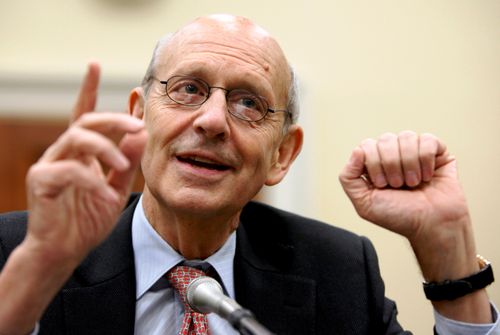
Outgoing Supreme Court Justice Stephen Breyer, who announced his retirement earlier this year after a leak and heavy pressure from leftist organization Demand Justice, will official depart the bench on Thursday, June 30 at noon.

“This past January, I wrote to inform you of my intent to retire from regular active service as an Associate Justice of the Supreme Court of the United States, upon the Court rising for its summer recess. You have nominated and the United States Senate has confirmed the Honorable Ketanji Brown Jackson to succeed me in the office, and I understand that she is prepared to take the prescribed oaths to begin her service as the 116th member of this Court,” Breyer wrote in a letter to President Joe Biden Wednesday. (Read more from “Liberal Supreme Court Justice Announces His Last Day” HERE)

Delete Facebook, Delete Twitter, Follow Restoring Liberty and Joe Miller at gab HERE.

Hollywood Hate: ‘Satanic’ SCOTUS Seeking to ‘Traffic Babies’

Republicans will “traffic babies” for financial gain in the event the Supreme Court overturns Roe v. Wade, according to left-wing Hollywood actress Rosanna Arquette, who deemed conservative Supreme Court justices in favor of overturning the landmark abortion case a “satanic force.”

“No, it’s not hysterical or alarmist,” Arquette wrote in a Saturday tweet. “They will traffic babies that many women can’t afford to keep.”

The 62-year-old Pulp Fiction actress went on to highlight the broad financial market tied to international organ trafficking.

“There is a huge money making market world wide for babies and behind that is organ trafficking,” she added, before labeling the majority of Supreme Court justices “officially the satanic force.”

(Read more from “Hollywood Hate: ‘Satanic’ SCOTUS Seeking to ‘Traffic Babies’” HERE)

Delete Facebook, Delete Twitter, Follow Restoring Liberty and Joe Miller at gab HERE.

Justice Thomas: SCOTUS Refusal to Hear Pennsylvania Election Cases Is ‘Inexplicable’

. . .In his dissent Justice Thomas argued mass mail-in voting, which was conducted in Pennsylvania for the first time ahead of the 2020 presidential election in November, combined with election rules being rewritten last minute, makes the process prone to fraud and mistrust.

“The Constitution gives to each state legislature authority to determine the ‘Manner’ of federal elections…Yet both before and after the 2020 election, nonlegislative officials in various States took it upon themselves to set the rules instead. As a result, we received an unusually high number of petitions and emer- gency applications contesting those changes. The petitions here present a clear example. The Pennsylvania Legislature established an unambiguous deadline for receiving mail-in ballots: 8 p.m. on election day,” Thomas wrote. “Dissatisfied, the Pennsylvania Supreme Court extended that deadline by three days. The court also ordered officials to count ballots received by the new deadline even if there was no evi- dence—such as a postmark—that the ballots were mailed by election day. That decision to rewrite the rules seems to have affected too few ballots to change the outcome of any federal election. But that may not be the case in the future. These cases provide us with an ideal opportunity to address just what authority nonlegislative officials have to set elec- tion rules, and to do so well before the next election cycle. The refusal to do so is inexplicable.”

(Read more from “Justice Thomas: SCOTUS Refusal to Hear Pennsylvania Election Cases Is ‘Inexplicable'” HERE)

Delete Facebook, Delete Twitter, Follow Restoring Liberty and Joe Miller at gab HERE and MeWe HERE