Posts

Here’s What Trump Told Reporters to Expect With His SCOTUS Pick

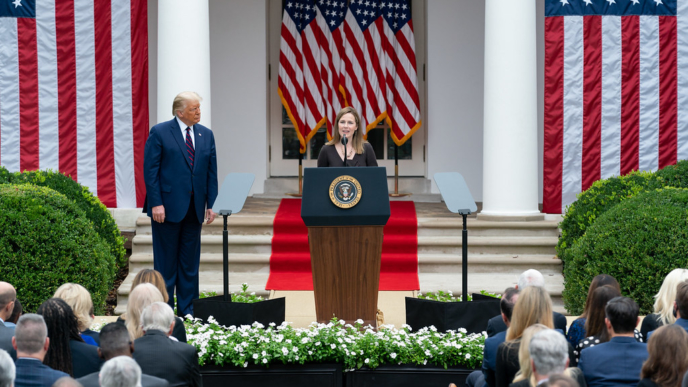
On Saturday, President Trump talked to reporters about his Supreme Court nominee, saying the nominee will likely be a woman.

In agreement with Senate Majority Leader Mitch McConnell (R-KY), President Trump said he may pick a nominee to go before the Senate as early as this coming week.

“I agree with the statement put out by Mitch McConnell,” the president said before departing for a campaign rally in Fayetteville, North Carolina, Saturday afternoon. “I agree with it, actually, 100 percent. I put out a very similar statement as you saw. So I think we’re going to start the process extremely soon, and we’ll have a nominee very soon.” . . .

“I could see most likely it would be a woman,” Trump told reporters. “Yeah, I think I could say that. … if somebody were to ask me now, I would say that a woman would be in first place. The choice of a woman I would say would certainly be appropriate.” (Read more from “Here’s What Trump Told Reporters to Expect With His SCOTUS Pick” HERE)

Follow Joe Miller on Twitter HERE and Facebook HERE

Ruth Bader Ginsburg Dead at 87

By NPR. Justice Ruth Bader Ginsburg, the demure firebrand who in her 80s became a legal, cultural and feminist icon, died Friday. The Supreme Court announced her death, saying the cause was complications from metastatic cancer of the pancreas.

The court, in a statement, said Ginsburg died at her home in Washington, D.C., surrounded by family. She was 87. . .

Inside the court, not only is the leader of the liberal wing gone, but with the court about to open a new term, the chief justice no longer holds the controlling vote in closely contested cases.

Though Roberts has a consistently conservative record in most cases, he has split from fellow conservatives in a few important ones this year, casting his vote with liberals, for instance, to protect at least temporarily the so-called DREAMers from deportation by the Trump administration, to uphold a major abortion precedent and to uphold bans on large church gatherings during the coronavirus pandemic. But with Ginsburg gone, there is no clear court majority for those outcomes. (Read more from “Ruth Bader Ginsburg Dead at 87” HERE)

______________________________________________________

Trump reacts to Ruth Bader Ginsburg’s death, says justice ‘led an amazing life’

By Fox News. President Trump on Friday called late Supreme Court Justice Ruth Bader Ginsburg “an amazing woman who led an amazing life” and said he was “sad” to learn of her passing, but didn’t say anything about plans for nominating a replacement.

The president, on the tarmac after finishing a rally in Minnesota Friday night, had just learned that Ginsburg, 87, had died from complications surrounding metastatic pancreas cancer.

“Wow, I didn’t know that,” Trump told reporters. “She led an amazing life. Whether you agree or not, she was an amazing woman who led an amazing life.”

He added: “Sad to hear that.”

The president didn’t discuss any plans for nominating a replacement. But just earlier, during the Minnesota rally, the president vowed to “nominate judges and justices who will interpret the Constitution as written,” and called the Supreme Court “so important.” (Read more from “Trump reacts to Ruth Bader Ginsburg’s death, says justice ‘led an amazing life’” HERE)

Follow Joe Miller on Twitter HERE and Facebook HERE
NO MORE BETRAYALS: Senator Just Set the Standard for Conservative Supreme Court Justices

Social conservatives are done being taken for granted by the GOP: That’s the message Sen. Josh Hawley shot across the party and administration’s bow Sunday, setting a brave and admirable standard for Christian legislators that is sure to pit him against powerful Washington Republicans and Democrats.

“I will vote only for those Supreme Court nominees who have explicitly acknowledged that Roe v. Wade is wrongly decided.” Hawley told The Washington Post. “By explicitly acknowledged, I mean on the record and before they were nominated.”

“I don’t want private assurances from candidates. I don’t want to hear about their personal views, one way or another. I’m not looking for forecasts about how they may vote in the future or predictions. I don’t want any of that. I want to see on the record, as part of their record, that they have acknowledged in some forum that Roe v. Wade, as a legal matter, is wrongly decided.”

The junior senator from Missouri is a member of the powerful Senate Judiciary Committee, through which any of President Donald Trump’s potential future nominees to the Supreme Court must pass before being brought to the floor for a vote. Conservative judges have been a major point for this administration, beginning during the campaign when, working closely with The Federalist Society and The Heritage Foundation, Trump released a list of who he would nominate, exciting then-skeptical conservatives.

Since then, conservatives have been routinely disappointed by Republican-nominated justices, quietly complaining about the GOP and the powerful, conservative Federalist Society’s tendency to focus on justices who have established records of conservative and libertarian business and government rulings, but no firmly established record of rulings that protect either marriage or the lives of the unborn. (Read more from “NO MORE BETRAYALS: Senator Just Set the Standard for Conservative Supreme Court Justices” HERE)

Follow Joe Miller on Twitter HERE and Facebook HERE
Justice John Roberts Votes Against the Constitution Again, Turns Away Church’s COVID Challenge

The US Supreme Court on Friday denied a petition from a church in Nevada that argued a policy limiting in-person church attendance to 50 during the coronavirus pandemic violated the Constitution. . .

The church argued that the state policy treated church services differently from other large gatherings including casinos, gyms and restaurants. . .

Although the court’s order was unsigned, Justices Samuel Alito, Clarence Thomas, Brett Kavanaugh and Neil Gorsuch dissented, meaning that Chief Justice John Roberts provided the necessary fifth vote by joining the liberals on the bench.

The order marks the second time Roberts has voted to reject a request from a church amid the pandemic.

In May, he sided with the liberals in a 5-4 order against a church in California that was challenging limitations on the number of people who could attend services. (Read more from “Justice John Roberts Votes Against the Constitution Again, Turns Away Church’s COVID Challenge” HERE)

Follow Joe Miller on Twitter HERE and Facebook HERE

Supreme Court Transgender Decision Leads to Religious Liberty Legal Battle

A transgender man last week filed a lawsuit against a Catholic-run hospital in Maryland, citing in his complaint June’s landmark Supreme Court decision on transgender rights, fulfilling conservative fears that the ruling would usher in a legal war.

The suit, filed on behalf of Jesse Hammons by the American Civil Liberties Union, alleges that St. Joseph Medical Center, a Catholic-run hospital within the University of Maryland Medical System, violated the First and Fourteenth Amendments by refusing to perform a surgery necessary to Hammons’s transition from woman to man. The suit uses Justice Neil Gorsuch’s majority opinion in Bostock v. Clayton County to buttress its argument, namely, that refusing services to transgender people is a form of discrimination on the basis of sex.

When Bostock was decided in June, many social conservatives predicted that it would have dire implications for women’s sports leagues, single-sex dorms on college campuses, and general religious liberty exceptions to nondiscrimination laws granted to faith-based institutions. . .

Anderson pointed to his own work on transgender activists’ clashes with religious institutions and said that the ACLU’s argument holds no water, since “good hospitals remove diseased organs, not healthy ones. Regardless of ‘identity.’”

The ACLU’s argument rests on two points. The first is that St. Joseph’s, which, until UMMS acquired it in 2012, was owned by the Catholic Church, violates the First Amendment’s establishment clause by operating according to Catholic teaching. The second is that the hospital violated the equal protection clause of the Fourteenth Amendment because it would have performed the procedure, a hysterectomy, if Hammons, a biological woman, needed it for reasons other than gender dysphoria. (Read more from “Supreme Court Transgender Decision Leads to Religious Liberty Legal Battle” HERE)

Follow Joe Miller on Twitter HERE and Facebook HERE

Electors Must Vote for Their State’s Preferred Candidate, Supreme Court Rules

The Supreme Court unanimously ruled Monday that states can require members of the Electoral College to vote for the same presidential candidate as their respective state.

The ruling puts an end to the occasional so-called faithless electors, who vote for a candidate different than that of the state they are representing. Though many states already have laws in place that require electors to vote for the winner of their state’s popular vote, electors have at times failed to do so.

“Today, we consider whether a State may also penalize an elector for breaking his pledge and voting for someone other than the presidential candidate who won his State’s popular vote. We hold that a State may do so,” Justice Elena Kagan wrote in the court’s majority opinion for the case Chiafalo v. Washington.

Though rare, as few as 10 faithless electors could have changed the outcomes of five of the previous 58 presidential elections, The New York Times reported. . .

In 2019, the Washington State Supreme Court upheld $1,000 fines on electors who had voted for Colin Powell instead of Hillary Clinton, saying that the Constitution allowed for states to insist that their electors vote according to their respective popular votes, according to The New York Times. The electors appealed to the Supreme Court after the decision, setting the foundation for the Monday decision on Chiafalo v. Washington. (Read more from “Electors Must Vote for Their State’s Preferred Candidate, Supreme Court Rules” HERE)

Follow Joe Miller on Twitter HERE and Facebook HERE

Supreme Court Hands Huge Victory to Families on School Choice

In a 5-4 decision Tuesday, the Supreme Court held that families have a right to seek the best educational opportunities for their children, by preventing states from blocking the participation of religiously affiliated schools in state school choice programs.

In Espinoza v. Montana Department of Revenue, the court ruled that the application of a “no-aid” provision in Montana’s Constitution violated the Free Exercise Clause of the First Amendment of the U.S. Constitution, since it barred state tax credit scholarships from being used at private religious schools.

In a huge win for families, the high court held that states cannot apply the no-aid provision to discriminate against religious schools by excluding them from private school choice programs.

In 2002, the court’s ruling in Zelman v. Simmons-Harris held that the Establishment Clause of the U.S. Constitution did not block parents from choosing schools that are the best fit for their children, including religious schools.

Tuesday’s decision in Espinoza removed the largest state constitutional obstacle by holding that so-called Blaine Amendments cannot be used to deny choice to parents.

Under the U.S. Constitution, states no longer may prevent parents from choosing religious schools if they are participating in a school choice program.

“A state need not subsidize private education. But once a State decides to do so, it cannot disqualify some private schools simply because they are religious,” Chief Justice John Roberts wrote in the opinion of the court in Espinoza.

This decision struck a blow to the notoriously anti-Catholic Blaine Amendment in Montana’s Constitution that sanctioned explicit discrimination against religious schools in funding. Montana’s discrimination hurt families who have a wide variety of values and preferences when it comes to their children’s education.

As the Supreme Court had previously noted, Blaine Amendments have an “ignoble” history. The amendments are named after Sen. James G. Blaine of Maine, who in 1875 sought a federal constitutional prohibition of aid to “sectarian” schools.

“Consideration of the amendment arose at a time of pervasive hostility to the Catholic Church and to Catholics in general, and it was an open secret that sectarian was code for Catholic,” Justice Clarence Thomas wrote in the court’s Mitchell v. Helms decision in 2000.

As Jarrett Stepman and one of us, Lindsey Burke, wrote previously in the Journal of School Choice:

Catholics sought to establish their own schools, and proposed that funding should follow, as it had to the common school (proto-public schools).

Supporters of the common school movement perceived a threat to its mission in such proposals. … Against this backdrop, Blaine [Amendments] sought to prevent aid to Catholic schooling as part of a wider reaction to increased Catholic immigration.

Blaine’s effort to amend the U.S. Constitution failed in 1875, but his effort still served as a major impediment to school choice, continuing to thwart modern-day school choice programs in the 21st century.

That’s because 37 states went on to adopt similar amendments, sometimes referred to as “baby Blaine Amendments.” Prior to today’s ruling, in states such as Montana, many of these state Blaine Amendments and similar “compelled support” clauses restricted or outright prohibited the use of taxpayer funds at private religious schools.

This timeline shows when states adopted Blaine Amendments and similar “compelled support” clauses.

The Supreme Court made it clear Tuesday that the Free Exercise Clause of the Constitution prohibits discrimination against religious schools on the basis of their religious status—a status that provides families with more education options that best meet the needs of their children.

The high court said that if states create a publicly available benefit, such as a scholarship program, they must allow religious schools to participate. The states that have Blaine Amendments in place are now prohibited from excluding religious school options.

In Mitchell v. Helms, Thomas wrote of Blaine Amendments: “This doctrine, born of bigotry, should be buried now.” On Tuesday, the Supreme Court’s decision in Espinoza took us one step closer to achieving that goal.

Now is the time for states to cast aside these 19th-century rules rooted in prejudice that unfairly punish religious families, students, and schools. The Constitution requires states to provide a level playing field for religious and secular education.

The legal impediment to school choice programs is now gone, and it’s up to state legislatures to move forward advancing education choice.

The court made it clear that policymakers across the country now have the power to enact robust school choice programs. They should do just that. (For more from the author of “Supreme Court Hands Huge Victory to Families on School Choice” please click HERE)

Follow Joe Miller on Twitter HERE and Facebook HERE

John Roberts Screws Protectors of Life Again, Strikes Down Louisiana’s Abortion Law

The Supreme Court on Monday struck down a Louisiana abortion law, handing a win to abortion rights advocates who feared the conservative court would break with past rulings to rein in protections that emerged from the landmark decision in Roe v. Wade.

The justices voted 5-4 to invalidate Louisiana’s admitting-privilege law in the first major abortion ruling of the Trump era, which came after the court struck down a nearly identical Texas restriction four years ago.

The ruling, which underscored the razor-thin voting margin over abortion rights, with Chief Justice John Roberts joining the court’s four liberals, is likely to make future Supreme Court decisions over a woman’s right to terminate an unwanted pregnancy an even more pressing issue in the coming presidential election.

The decision is also the clearest indication yet that the court, which now tilts more conservative with the addition of President Trump’s two nominees, is pursuing a more restrained approach than many abortion rights advocates feared.

In a concurring opinion, Roberts said his vote was guided by deference to prior rulings, particularly the court’s 2016 decision in Whole Woman’s Health v. Hellerstedt, which struck down a nearly identical Texas law. (Read more from “John Roberts Screws Protectors of Life Again, Strikes Down Louisiana’s Abortion Law” HERE)

Follow Joe Miller on Twitter HERE and Facebook HERE

Colorado Supreme Court Upholds Gun Magazine Law

. . .The Colorado Supreme Court issued it’s ruling Monday morning, ending the seven-year challenge by Loveland-based Rocky Mountain Gun Owners.

In 2013, one year after the Aurora Theater Shooting, Colorado’s democratic-controlled legislature passed a number of gun reform bills, including House Bill 13-1224, which banned the sale and transfer of magazines that hold more than 15 rounds of ammunition. Then-Gov. John Hickenlooper signed the bill into law, which took effect July 1, 2013.

Rocky Mountain Gun Owners sued in state court, saying it violated the right to bear arms under Colorado’s Constitution. Because of that, Monday’s ruling is final and cannot be appealed to the United States Supreme Court.

. . .”We hold that HB 1224 is a reasonable exercise of the police power that has neither the purpose nor effect of nullifying the right to bear arms in self-defense encompassed by article II, section 13 of the Colorado Constitution,” the 7-0 ruling concluded.

Rocky Mountain Gun Owners sued in state court, saying it violated the right to bear arms under Colorado’s Constitution. Because of that, Monday’s ruling is final and cannot be appealed to the United States Supreme Court. (Read more from “Supreme Court Upholds Gun Magazine Law” HERE)

Follow Joe Miller on Twitter HERE and Facebook HERE

Woman Turns to Supreme Court to Get Her Guns Back

In 2013, Lori Rodriguez called San Jose police to her home because her husband was having a mental health crisis and making violent threats. Seven years later, she is petitioning the Supreme Court to force the city to return her guns.

“It’s not right. I shouldn’t have to do this to get back what’s mine,” Rodriguez told the Washington Free Beacon. “They violated several of my constitutional rights.”

Rodriguez claims police ordered her to open the couple’s gun safe so they could seize all of the weapons in the home after her husband was detained for making threats that the city says included “shooting up schools.” Cops seized not only her husband’s weapons but also the guns that were personally registered to Rodriguez. The city has repeatedly rebuffed her requests to return her property.

The suit is now the sole case with Second Amendment implications remaining before the Court after the justices rejected 10 other gun-rights cases on June 15. Rodriguez’s legal challenge comes as the federal government and a number of states debate “red flag” bills that would allow authorities to deny gun rights to citizens. It has the potential to clarify the extent to which the Second Amendment protects individuals from seizures of firearms.

San Jose city attorney Richard Doyle did not respond to a request for comment. The city defended its actions, saying that authorities were within their rights to confiscate the guns, calling Rodriguez’s claim “borderline frivolous.” (Read more from “Woman Turns to Supreme Court to Get Her Guns Back” HERE)

Follow Joe Miller on Twitter HERE and Facebook HERE