Posts

Senators Promise to Block Potential Clinton Supreme Court Nominees

Two U.S. senators say they plan to oppose Hillary Clinton’s Supreme Court nominees should she win the presidency.

In the past week, both Sen. John McCain, R-Ariz., and Sen. Mike Lee, R-Utah, have indicated they would continue to block confirmation of a Supreme Court nominee next year.

According to CNN, McCain said in a radio interview that he believes the Republican Party will take a united stand to block Clinton’s nominees.

“I promise you that we will be united against any Supreme Court nominee that Hillary Clinton, if she were president, would put up,” McCain said. “I promise you … ”

According to The Hill, since making this statement on Monday, Rachael Dean, a spokeswoman for McCain, has softened the senator’s claim. She said McCain “will, of course, thoroughly examine the record of any Supreme Court nominee put before the Senate and vote for or against that individual based on their qualifications as he has done throughout his career.”

Lee said that he will oppose potential Supreme Court nominees put forward by Clinton.

“Make no mistake: As a former law clerk … I don’t believe there would be a real substantive distinction, a real noticeable difference between the voting pattern of a justice who would be appointed by a President Hillary Clinton … and Merrick Garland,” Lee said to reporters. “I just don’t think there is much, if any, difference.”

Garland is the chief judge of the U.S. Court of Appeals for the D.C. Circuit. He was nominated by President Barack Obama to replace the late Justice Antonin Scalia, who died in February. Garland has yet to be confirmed by the Senate.

Carrie Severino, chief counsel and policy director of the Judicial Crisis Network, a conservative judicial organization, said she is heartened by the fact that Lee and McCain are committed to doing all they can to support nominees whose only agenda is to uphold the Constitution.

“I am very impressed with the stance that the senators are taking,” Severino told The Daily Signal in a phone interview. “They are taking seriously their oath to uphold the Constitution. It is exciting to see them taking their job seriously.”

Severino said it is refreshing to see these senators take the initiative to do what they can to ensure that conservative values will be considered in the Supreme Court nominee process.

In contrast, Marge Baker, executive vice president of People For the American Way, an organization “dedicated to making the promise of America real for every American,” said the statements from Lee and McCain are inappropriate. Baker said in an email to The Daily Signal:

These new statements make clear that Republicans’ blockade of Merrick Garland was never about principle and always about partisanship. With almost a year left in the president’s term when the Supreme Court vacancy first opened up, Republicans said, “let the voters decide” (ignoring the fact that the voters had in fact elected Obama in 2012 for a full four-year term). Now that it’s looking more likely that the voters will elect Hillary Clinton, they’re coming up with new reasons to justify their unconstitutional blockade. Republicans’ refusal to do their job and give fair consideration to a nominee shows a real contempt for the Constitution.

Rather than seeing the opposition of Lee and McCain as “contempt for the Constitution,” Severino said she believes that Clinton is being inconsistent with the way she has been discussing her potential nominees, as Clinton was quite vocal in her opposition to President George W. Bush’s Supreme Court nominees. (For more from the author of “Senators Promise to Block Potential Clinton Supreme Court Nominees” please click HERE)

Follow Joe Miller on Twitter HERE and Facebook HERE.

If Hillary Packs the Supreme Court, Democracy Is Dead. We Should Give It a Decent Burial.

If you want a young person to have a hopeful, patriotic view of the U.S. government, you probably shouldn’t set his first trip to Washington, D.C. on the anniversary of Roe v. Wade. As I wrote back in 2008:

The first time I ever saw our nation’s capital was on the March for Life, way back in high school on a bus the Knights of Columbus rented to take us down there. Those vast, wedding cake buildings that represent the authority of the U.S. government, adorned with flags, bronze statues, bas-reliefs and grand inscriptions… it all seemed such a miserable sham. Those structures built out of butter cream looked to me like whited sepulchers. The Supreme Court on whose steps we stood seemed a structure built of bones, and the city a fortress defending a vast and soulless regime of death. And so it stands today.

When that essay appeared, the question of unborn children’s rights was still a live one, resting on the faithfulness of Republican presidents. Today, if the upcoming election hands the White House to Hillary Clinton, and if Senate Republicans fail to fight her doggedly like wildcats on every Supreme Court appointment, the issue is dead and gone. It goes in the medical waste dumpster along with the Court’s 58 million victims.

A Clinton court menaces the rest of us who escaped the womb intact. Chief Justice Mark Tushnet (or his chemical equivalent) would indeed treat Christians and conservatives as “losers in the culture war” who deserve no more consideration than defeated Japanese or Germans — as the Harvard Law professor and plausible SCOTUS appointee wrote back in March.

The left already uses the Supreme Court as a permanent Constitutional Convention, in which five progressives use the battered text of our founding document like the letters in a ransom note — clipping and pasting as they like, to yield the meaning they want. A Clinton court would switch from scissors to a shredder.

Our Constitutional right to spend our own money and time to influence elections — imagine that! I thought the First Amendment was just for flag-burning and porn! — hangs by a thread, on the decision in Citizens United which Hillary has pledged to overturn. So does the future of free journalism, if you remember the left’s dogged attempts to imprison the likes of David Daleiden and James O’Keefe.

Our basic human right, marked out in the Second Amendment, to defend ourselves by owning private firearms is dangling dangerously on a similar narrow vote on the Court, in another decision Clinton opposes.

Our religious freedom is already in Clinton’s gunsights. She never admits our “free exercise of religion,” but only “freedom of worship,” in language crafted by the Organization of the Islamic Conference to cover the narrow privilege that Orthodox monks have, a few times a week, to offer quiet services in places like Istanbul — though they’d face jail time if they criticized Islam. Combine this with Obama administration threats to church groups’ tax exemptions, California’s attacks on Christian colleges, Hillary’s demand that Christians’ “beliefs must be changed” to accommodate abortion and the Clinton campaign’s attempt to blow up the “medieval dictatorship” that is the Catholic church, and you know exactly what to expect:

The rights of orthodox churches and believers will be pared down relentlessly, while churches that cooperate with progressivism will rake in federal contracts — until we really do have something like the two-tier Chinese system: in Column A will be the approved “patriotic” churches, and in Column B the faithfully Christian ones, which the state persecutes at will.

We Face Rule by Decree, Like Natives in a Colony

Keep in mind that we’re not facing a Democratic president who will pass evil or foolish laws on any of these subjects. No, we face someone who will appoint lifelong judges who will rule us by decree. None of these issues — unborn life, free speech, gun rights, or religious liberty — will be settled by the Congress and the Executive via the democratic process, in a law subject to repeal. They will be carved in stone by the god-like fingers of five philosopher kings, hoisted far out of reach of mere peons like you and me. For our lifetimes, and perhaps for our children’s, they will be dogmas enshrined on altars. Democracy will be dead.

What will we tell our kids once that has happened? When we have to inform them that their Christian school has been taxed into bankruptcy and is closing; that we cannot protect them from home invasions by coddled illegal immigrants; that the faith we are sharing with them is condemned by their own government; that there are certain subjects on which they are not even free to speak — how will we explain that? Or the fact that they can’t even vote on it? It’s a conversation you might need to have very soon, so it’s time to start thinking about which words you’ll use.

When I was young, democracy still seemed vital. At age 11, I became a pro-life activist, ringing doorbells and collecting signatures for the Right-to-Life Party candidate for New York City mayor — radio host Barry Farber. No he didn’t win, but he out-polled the liberal, pro-choice Republican Roy Goodman, coming in second. Taking part in that action sparked my faith that in America, the people could have a voice. It set me on track to a lifetime of activism — volunteering for pro-life Senate candidates and later for Ronald Reagan, then to editorship of the pro-life, conservative paper at Yale, and finally, to The Stream.

If I had a child in the America ruled by Hillary’s appointees, would I encourage him to emulate my actions? It might not even be fair. It would surely damage his future, as being a baptized Christian used to haunt Soviet citizens as a black mark throughout their lives.

In fact, I think we will have to teach resistance. We aren’t called to give the next generation “success tips” but the Truth — as my Irish Catholic mother passed along to me when I was only eight. Again, from 2008:

I cannot forget the actual day in 1973, when Harry Blackmun (moved to change his mind on the subject by a Rockefeller Foundation report on U.S. “overpopulation”) issued the farrago of logical fallacies [Roe v. Wade] which still makes [first-year] law students blush. I saw something about it on the news. Only eight years old, I needed the story explained to me, and asked my mother. She tried her best:

“Well, the government just decided that if a woman is going to have a baby, and she doesn’t want one, now she doesn’t have to.”

“So what can she do?”

“Now she can go to a doctor, and he’ll take out the baby.”

“Won’t it be alive?”

“No. The doctor will make sure it’s dead.”

“They’re allowed to do that?”

“Yes, John. Now they are.”

“In America? Really?”

It’s a question I still ask myself.

(For more from the author of “If Hillary Packs the Supreme Court, Democracy Is Dead. We Should Give It a Decent Burial.” please click HERE)

Follow Joe Miller on Twitter HERE and Facebook HERE.

What’s at Stake in the Next Supreme Court Term

The next Supreme Court term is beginning Oct. 3—and there’s plenty of contentious issues on the docket for the eight justices to rule on.

“The cases this term may be hard-pressed to match the excitement and media flurry that accompanied highly anticipated rulings in recent years, such as cases involving same-sex marriage, immigration, abortion, and President [Barack] Obama’s signature health care law,” The Heritage Foundation’s Elizabeth Slattery, a legal fellow, and Tiffany Bates, a legal research associate, wrote.

“But the upcoming term has the potential to become an important year for property rights, the separation of powers, and copyright law.”

At an event at The Heritage Foundation on Tuesday, Paul Clement, a former solicitor general of the United States, said, “It is a very interesting time at the court.”

“That doesn’t automatically translate into interesting cases,” he added.

The 2016-17 Supreme Court term begins on Oct. 3. Justices agree to hear about 1 percent, or roughly 70 cases, out of approximately 7,000 petitions for review they receive each year, according to Heritage research. Already the court has agreed to hear arguments for 31 cases and oral arguments are set for 19 cases in October and November.

“It’s certainly right that the court seems to be reluctant to add cases to their docket that they think in advance may well divide them four to four,” Clement said.

Here are three key cases the Supreme Court will hear in its next term.

1. Murr v. Wisconsin

This case is about four siblings who own two adjacent waterfront properties. Their parents built a cabin on the first lot after obtaining the parcels separately in the 1960s. The siblings, decades later, looked into developing or selling the second lot and found that zoning regulations prevented them from doing so and that the state considered both lots to be one property.

“As it turns out under state law not only can they not sell the one parcel, but they are not even allowed now to develop the other parcel, which it seems to me about the most extreme regulatory scheme you can devise,” Carter Phillips, a former assistant to the solicitor general, said at the Heritage event.

Clement and and Phillips have each argued more than 80 before the Supreme Court.

Phillips said this case seems “unbelievably unfair” and that sometimes the government goes too far in its “regulatory scheme.”

The case has not been scheduled for oral argument.

2. Trinity Lutheran Church of Columbia, Inc. v. Pauley

Supreme Court cases sometimes come from the “most unlikely government programs,” Clement said, describing another case, this one involving church and state. The case involves Trinity Lutheran Church and a Missouri scrap tire program.

“When you buy new tires in the state of Missouri … you pay a small tax and that goes into a fund. What that fund helps do is take used tires and instead of having them fill up landfills where they create all sorts of problems, those get sort of shredded and treated and then they get used to make playgrounds for children safer,” Clement said.

In Trinity Lutheran Church of Columbia, Inc. v. Pauley, one of the likely highlights for the term, Trinity Lutheran Church in Missouri applied for a state-funded grant to install a rubber playground surface for the church’s daycare and preschool. The state denied its application on the basis that it was a religious institution.

Oral argument for the case have not been scheduled, but Clement said this is a “very important case.”

“This is perhaps the best example of a case that the court is taking a really long time to schedule for oral argument,” Clement said. “This case was granted in the same sitting where a number of cases were granted last year and scheduled and argued and decided already.”

Clement predicted there could be a closely divided court on this case.

“It does seem like the most logical inference is this is a case where the court is going to take its time scheduling this in the hopes that they might have nine justices to decide the case,” he said.

3. National Labor Relations Board v. SW General, Inc.

Another case this term concerns the president’s power to fill vacancies in government roles. Under the Constitution, the Senate must provide “advice and consent” before the president can appoint officers.

However, the president can nominate “acting” officers to high-level federal offices before the Senate has acted, although federal law limits the length of time such officers can serve and who can be appointed.

The case National Labor Relations Board v. SW General, Inc. challenges “the service of the National Labor Relations Board’s (NLRB) Acting General Counsel Lafe Solomon, who was responsible for prosecuting unfair labor practices,” according to Heritage’s research.

Heritage’s Slattery and Bates wrote:

President Obama appointed Solomon as Acting General Counsel in 2010 and also nominated him for the permanent post in 2011. This issue came up in the course of an unfair labor practice charge against SW General, Inc., a company that provides emergency medical services to hospitals; the company asserted that Solomon was serving in violation of the [Federal Vacancies Reform Act].

The case is scheduled for oral argument on Nov. 7. According to Slattery and Bates, “the outcome of this case could have broad and long-reaching effects for the separation of powers and on federal agencies’ actions if their high-level officials were appointed in violation of” the Federal Vacancies Reform Act.

Additional cases that could come up for review by the Supreme Court, according to Heritage research, could be about the Washington Redskins’ trademark, another Obamacare challenge, and the issue of schools’ bathroom policies for transgender students. (For more from the author of “What’s at Stake in the Next Supreme Court Term” please click HERE)

Follow Joe Miller on Twitter HERE and Facebook HERE.
GOP at Odds Over Post-Election Vote on Obama’s Supreme Court Nominee

While Republican leadership insists that the next president will nominate the ninth justice to the Supreme Court, a cadre of Republican senators is pushing a plan to confirm Merrick Garland if their party fails to take the White House this November.

The best contingency plan in case Republicans lose, supporters of the plan argue, is to confirm Garland during the lame-duck session in December before Hillary Clinton would take office in January.

Only three Republican senators have publicly committed their support to the idea so far—Sens. Susan Collins of Maine, Jeff Flake of Arizona, and Mark Kirk of Illinois. All share a centrist bent.

“Obviously if we lose the election and lose the White House, then we ought to move quickly to confirm Garland,” Flake told Business Insider earlier in June. “But I don’t think my view is shared by too many of my colleagues,” he continued. “Or enough of my colleagues to do it.”

Supporters describe the plan as a form of damage control. Confirmation of Garland in December, they argue, is better than grappling with an unknown and potentially more liberal Clinton nominee in 2017.

Many members are hesitant to discuss the strategy while the presidential race unfolds. But as uncertainty increases about the outcome of that election, behind closed congressional doors more staffers are opening up to the idea.

“It’s hard to imagine getting a nominee out of Clinton who’s less liberal than Garland,” a senior GOP aide told The Daily Signal. “If you’re concerned about the balance of the court, you’re concerned about that possibility and it provides an incentive to take a serious second look at his nomination.”

Republican opposition to the nominee has remained consistent from the beginning. Hours after the Feb. 13 death of Justice Antonin Scalia, Senate Republicans pledged to keep the seat on the high court open for the next president to fill in 2017.

Led by Majority Leader Mitch McConnell, R-Ky., the Republican conference has maintained a six-month blockade of Garland. Though many Republicans have met with the nominee privately, he hasn’t had a hearing in the Judiciary Committee or a vote on the Senate floor.

In order for that barricade to break, Republican leadership would have to do a complete 180. But that’s not going to happen, McConnell’s office told The Daily Signal.

“The leader has been absolutely clear,” said Don Stewart, McConnell’s spokesman. “The next president will make the nomination for this vacancy.”

Democrats insist Republicans are bluffing and they seem confident of victory. Since early February, they have forecasted a breakdown of Republican resolve, advising their political counterparts that the blockade is politically untenable.

Liberal groups have been the biggest cheerleaders for a change in Republican course. A coalition of Obama allies has kept up a steady drumbeat of messaging to encourage Republican senators to abandon their party’s blockade.

“Republicans have been going through this period of intensive posturing and it has totally hurt their credibility and their reputation as elected officials who respect the Constitution,” said Marge Baker, executive vice president of People for the American Way.

Though the GOP position seems entrenched, Baker said, it doesn’t have to be permanent. After a Democrat victory in November, she predicted “putting an end to this [blockade] from their vantage point should definitely be ‘sellable.’”

Liberals hawk Garland’s ideology, political connections, and age as selling points for Republicans. At 63 years old, he’s the most senior nominee in recent history, limiting his tenure in comparison to potentially younger nominees. And in 1997, the GOP-controlled Senate voted overwhelmingly, 76-23, to confirm Garland to his current circuit court post.

But conservatives aren’t buying the pitch for a lame-duck confirmation. They criticize the strategy as a false binary. And they insist there’s a third option.

“You can always run out the clock,” Brian Darling, a former Senate aide and current GOP operative, told The Daily Signal.

A filibuster mounted by a handful of conservatives could push the nomination into next year, Darling explained, drawing out the process in the hopes of forcing Democrats to the negotiation table.

And there’s some precedent for compelling a sitting president to back down from his nomination. Bipartisan opposition in 2005 forced President George W. Bush to withdraw the nomination of Harriet Miers.

Whether Republicans lose or maintain control of the Senate, conservatives say their strategy only requires the GOP to keep their resolve. The right could push the left to retreat by maintaining the blockade of Garland and then torpedoing the subsequent Clinton nominee.

To make that rearguard action possible, conservatives would have to win over the rest of the Republican conference when lawmakers return to Washington Sept. 6.

Their pitch will be simple, a senior GOP aide told The Daily Signal. To prepare for a clash with Clinton and a national conversation about the Supreme Court in 2017, Republicans should “make sure there is no lame-duck session of Congress.”

In other words, lawmakers would need to finish their legislative work before recessing for the holidays and leave Garland’s nomination to wither on the vine. (For more from the author of “GOP at Odds Over Post-Election Vote on Obama’s Supreme Court Nominee” please click HERE)

Follow Joe Miller on Twitter HERE and Facebook HERE.

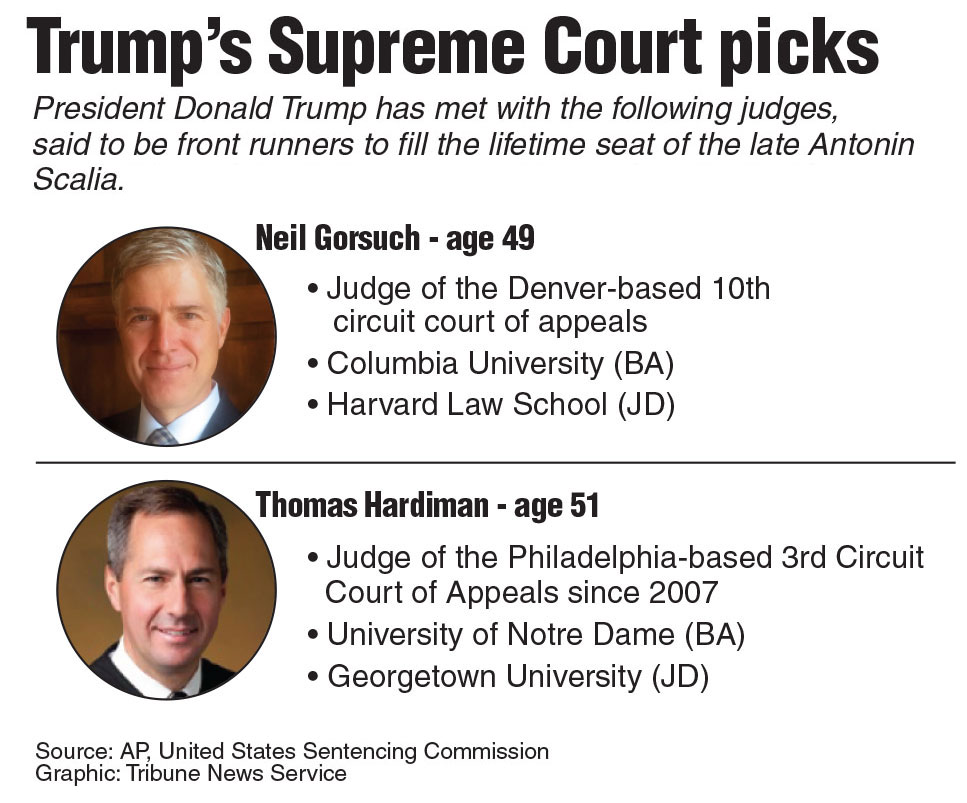
Donald Trump Releases List of Judges He Will Choose From to Put on Supreme Court

Donald Trump on Wednesday released a list of 11 judges he would consider nominating to the Supreme Court, a step intended to reassure Republicans of his conservative bona fides.

The list includes several judges often found on conservative wish lists, including Diane Sykes, William Pryor and Joan Larsen. Several of the judges were appointed by President George W. Bush, and many serve on state supreme courts.

In what some interpreted as a snub, the list does not include Sen. Ted Cruz (R-Texas), Trump’s bitter foe during the presidential primary race, or Sen. Mike Lee (R-Utah), who endorsed Cruz. Both lawmakers had been floated in Washington as potential nominees . . .

Appellate judges Sykes and Pryor, two names previously floated by Trump as model jurists, are both on the list. So is Utah Supreme Court Judge Thomas Lee, the brother of Sen. Mike Lee and the son of Rex Lee, a former U.S. solicitor general during the Reagan administration.

Other judges mentioned include Raymond Kethledge of Michigan, David Stras of Minnesota, Steven Colloton of Iowa, Allison Eid of Colorado and Raymond Gruender of Missouri. (Read more from “Donald Trump Releases List of Judges He Will Choose From to Put on Supreme Court” HERE)

Follow Joe Miller on Twitter HERE and Facebook HERE.

Judges Continue to Steal Our Sovereignty

OLYMPUS DIGITAL CAMERAAs the Supreme Court hears oral arguments in the case of Obama’s executive amnesty today, it’s important to remember that even if there is enough remaining sanity on that bench to uphold the 5th Circuit Court’s injunction against the illegal action, in the long run the courts are a much bigger liability than asset. And the 5th Circuit also happens to be the only remaining originalist panel on the federal appeals level.

Our states, and even the federal government, have been rendered impotent in defending against illegal immigration and violent drug cartels. The legal profession across the board has crowned itself king of our sovereignty and has been empowered to litigate every single deportation. Whether it’s ICE or state law enforcement, they have to spend endless hours and resources defending every last deportation in court. Even in the best case scenario (for conservatives), law enforcement gets a hearing before a judge that still upholds the law, but are deterred from further pursuing enforcement because of the endless judicial trench warfare. In the worst case scenario, the judges “overturn” the laws.

Here are two more examples from this past week:

States Cannot Punish Those Who Harbor Illegal Alien Gang Members

In 2015, confronted with the massive surge in Central Americans at the southeastern corner of the state, Texas officials passed House Bill 11. This bill was designed to combat human trafficking by slapping criminal penalties on those who encourage illegal aliens to enter the country or harbor immigrants as members of a street gang. But the George Soros-funded Mexican American Legal Defense and Educational Fund (MALDEF) filed a lawsuit on grounds that the Texas law is preempted by federal law, even though Texas was upholding federal law.

Last Thursday, Judge David Allan Ezra of the Western District of Texas issued an injunction on three sections of the state’s law. He based his decision, in part, on the specious “preemption” argument posited by the six liberals on the Supreme Court in the 2011 case involving the Arizona law. But as Scalia so clearly articulated in his dissent, states have full authority to restrict illegal immigration so long as that action is not expressly prohibited by federal statutes. In all of these cases, such action either complements or adds to federal laws. “The State has the sovereign power to protect its orders more rigorously if it wishes, absent any valid federal prohibition,” wrote Justice Scalia in 2012. “The Executive’s policy choice of lax federal enforcement does not constitute such a prohibition.”

Scalia further noted that immigration laws were never designed to hamper the states. “The naturalization power was given to Congress not to abrogate States’ power to exclude those they did not want, but to vindicate it,” wrote Scalia in that same dissent. His voice will surely be missed in today’s fight between Texas and the Obama administration over whether the state has standing to fight executive amnesty.

ACLU Sues to Release Thousands of Illegals into Our Communities

As radical as the Obama administration is with regard to suspending deportations, the legal profession is working to invalidate the few remaining enforcement measures ICE has retained. Last Tuesday, the ACLU filed a class action lawsuit in Minnesota against ICE, claiming they are detaining thousands of illegal aliens for too long. In a disturbing trend of abusing our asylum laws, thousands of them are claiming fear of persecution under the Convention Against Torture protection if they are returned home. Ironically, the only reason they are being detained and not deported is precisely because our system is clogged with so many aliens gratuitously offered a day in court to overturn their deportation. Again, our own generosity is used against us and our nation’s sovereignty.

According to Law360, the ACLU also filed a class action suit in California “to force the federal government to consider a detainee’s ability to pay when setting bond in immigration cases.” Illegal immigrants have no right to remain in the country, yet courts are increasingly granting them a right to bail, even though they represent the consummate flight risk. The ACLU is now feasting off of years of lawless court decisions to further steal our sovereignty. Even if the federal courts decline to side with the ACLU this time, they will easily make the jump within a few years to invalidate all of the detentions. There is a voracious army of immigration lawyers prepared to litigate every last illegal alien into citizenship.

Irrespective of how the Supreme Court rules in the DAPA case, conservatives would be wise to declare war on judicial amnesty, which will make executive amnesty look like child’s play. (For more from the author of “Judges Continue to Steal Our Sovereignty” please click HERE)

Watch a recent interview with the author below:

Follow Joe Miller on Twitter HERE and Facebook HERE.
Senate Judiciary Chairman: We Won’t Consider Obama Supreme Court Nominee

Senate Judiciary Chairman Chuck Grassley (R-Iowa) said on the Senate floor Thursday that he will not bow to pressure from Democrats to consider President Barack Obama’s Supreme Court pick, D.C. Circuit Court of Appeals Judge Merrick Garland.

Grassley argued that the American people should decide the direction of the high court when they vote for the next president.

“It is no secret that the White House strategy is to put pressure on this chairman of the Judiciary Committee and other Republicans in the hopes that we can be worn down and ultimately agree to hold hearings on the nominee,” said Grassley.

“This pressure campaign, which is targeted at me and a handful of my colleagues, is based on the supposition that I and they will crack and move forward on the consideration of President Obama’s pick. This strategy has failed to recognize that I am no stranger to political pressure and to strong-arm tactics – not necessarily from more Democratic presidents, probably from more Republican presidents,” he said.

Grassley said the American people should weigh on the direction of the U.S. Supreme Court through their vote for the next president. (Read more from “Senate Judiciary Chairman: We Won’t Consider Obama Supreme Court Nominee” HERE)

Follow Joe Miller on Twitter HERE and Facebook HERE.

Controversy About Obama Supreme Court Nominee’s College Years Could Change Everything

Following the unexpected death of U.S. Supreme Court justice Antonin Scalia earlier this year, Republican legislators have repeatedly insisted they will not hold a hearing for any nominee picked by President Barack Obama to replace the conservative jurist. Nevertheless, Obama subsequently selected Merrick Garland, the 63-year-old chief judge of the D.C. Circuit U.S. Court of Appeals, to join the bench of America’s highest court.

Since the nomination, Garland has faced some criticism from conservatives for his record on Second Amendment rights. In recent days, another aspect of the Harvard-educated legal scholar’s past has surfaced, leading some Americans to believe he might harbor resentment toward the U.S. military.

During his time in college, Garland served on the Harvard Committee on Housing and Undergraduate Life, a position that allowed him some influence in campus culture. It was in this capacity, reports indicate, that he agreed to hold a controversial vote to continue an existing ban on Reserve Officers’ Training Corps programs at Harvard.

The ban, enacted during the U.S. military’s involvement in the Vietnam War, was about to be rescinded in 1973 at the request of the university’s then-president. When a group of socialist students approached the CHUL to float a referendum that would continue the ROTC injunction, Garland was reportedly interested conducting a vote on the issue. (Read more from “Controversy About Obama Supreme Court Nominee’s College Years Could Change Everything” HERE)

Follow Joe Miller on Twitter HERE and Facebook HERE.

Liberals Told Senators ‘Do Your Job’ on Court Nominee. What the Constitution Says. [+video]

Following President Barack Obama’s nomination of Chief Judge Merrick Garland of the D.C. Circuit to fill the vacancy left by sudden passing of Justice Antonin Scalia, there has been an intense clamor from the left for the Senate to “do your job!”

By this, they mean that the Senate has a constitutional obligation to give Garland a hearing and an up-or-down vote, which Senate Republicans have announced they are not going to do. But is the Senate obligated under the Constitution to do so?

The answer is clearly “no.”

The president “shall nominate, and by and with the Advice and Consent of the Senate, shall appoint … Judges of the supreme Court ….” That’s all Article II, Section 2 of the Constitution says about the confirmation process for justices to the Supreme Court of the United States.

The Senate can, if it so chooses, “do its job” by withholding its consent and advising the president that it will not consider any nominee to fill this vacancy until after the forthcoming election.

Then Sen. Joe Biden, D-Del., had no doubt that the Senate could “do its job” by refusing to consider a nominee for the Supreme Court.

He made that point crystal-clear in 1992 when President George H.W. Bush was in office when he said:

The Senate … must consider how it would respond to a Supreme Court vacancy that would occur in the full throes of an election year. It is my view that if the president goes the way of Presidents Fillmore and Johnson and presses an election-year nomination, the Senate Judiciary Committee should seriously consider not scheduling confirmation hearings on the nomination until after the political campaign season is over.

Sen. Chuck Schumer, D-N.Y., clearly had this same understanding when he announced a year and a half before the end of the George W. Bush administration that the Senate should not confirm any nominee to the Supreme Court should a vacancy occur until after the next election.

In 2005, Sen. Harry Reid, D-Nev., also reminded us:

The duties of the Senate are set forth in the U.S. Constitution. Nowhere in that document does it say the Senate has a duty to give presidential nominees a vote. It says appointments shall be made with the advice and consent of the Senate. That is very different than saying every nominee receives a vote.

And, of course, then Sen. Barack Obama D-Ill., certainly felt he was doing his job when he helped to lead a filibuster against the nomination of Samuel Alito—in other words, an effort to deny him an up-or-down vote—to the Supreme Court, something he now says he regrets.

According to the non-partisan Congressional Research Service, out of the 160 men and women whose names have been submitted by presidents to the Senate for consideration for positions on the Supreme Court, 36 were not confirmed, and 25 of those did not receive a vote.

You would have to go all the way back to 1888 for the last time an election-year nominee was confirmed under divided government, as we have now.

In that year, Democratic President Grover Cleveland nominated Melville W. Fuller to be chief justice, who was confirmed by a Senate in which the Republicans had a two-vote majority. Suffice it to say that, in marked contrast to earlier times, today, two facts are obvious: The Supreme Court plays a far more active role in deciding issues that were formerly resolved by the people through the democratic process, and the confirmation process is far more politicized—both developments Scalia decried.

What the Senate chooses to do is, of course, up to the Senate. But those who are now saying that by choosing not to schedule a hearing for Garland, the Senate is not “doing its job” or is otherwise failing to carry out a constitutional obligation are dead wrong. (For more from the author of “Liberals Told Senators ‘Do Your Job’ on Court Nominee. What the Constitution Says.” please click HERE)

Follow Joe Miller on Twitter HERE and Facebook HERE.
GOP Will Confirm Obama’s SCOTUS Pick

By Cheryl Chumley. Senate Minority Leader Harry Reid tapped into tea party-type fears about the Republican leadership’s ability to stand fast in the face of President Obama’s storm of demands, and put out a Twitter message saying bluntly: Yes indeed, the GOP is already on its way to caving on Merrick Garland.

Garland was announced as Obama’s pick for the Supreme Court seat left vacant by Justice Antonin Scalia’s sudden death.

He wrote: “Republicans are backing down so quickly that they’re already bargaining about what month they will fully cave and confirm Obama’s nominee,” Mediaite found.

And in another tweet just four minutes later, Reid wrote: “No question in my mind that Sen. McConnell will cave, and President Obama will fill this vacancy this year” . . .

On an MSNBC appearance with host Chris Matthews, Reid called the Republican Party’s attempt to hold off hearings on any Obama nomination to the court a “hurtful” move for the country. (Read more from “Harry Reid: GOP Will Confirm Obama’s SCOTUS Pick” HERE)

____________________________________

Prediction: Garland Will Be Confirmed

By Allahpundit. Crafty of O to wait until the morning after Trump’s backbreaking wins last night to stick McConnell with this. Now Senate Republicans will face maximum pressure from both sides.

If they cave and decide to give Garland a hearing after all, Republican voters who are still cool to Trump might decide to vote for him in a burst of “burn it all down” rage. A betrayal here hands Trump the nomination — assuming there’s any doubt that he’s already on track to win it. If, on the other hand, McConnell stands firm, he’s blowing an opportunity to confirm a nominee who’s likely to be more “moderate” than what President Hillary will offer next year. The conventional wisdom on Trump right now is that he’s a dead duck in the general election barring some sort of national crisis. I don’t agree with it, but it’s not out of left field: His favorable rating, for instance, is toxic and it’s an open question whether he could organize a national campaign capable of matching Hillary’s. If McConnell agrees with that CW, that Hillary’s a prohibitive favorite to win and that the backlash to Trump will hand Democrats the Senate, then refusing to confirm Garland now clears the path for Democrats to nominate and confirm a young hyper-liberal justice next year. Garland is already in his 60s and is no far-lefty; if Hillary wins big, liberals will insist that she exploit her mandate by engineering a new Warren Court. (Garland, ironically, clerked for the most liberal member of the Warren Court but he hasn’t followed the same trajectory as a judge.) So what do you do if you’re Mitch the Knife? Accept a quarter-loaf here by confirming a guy whose centrist credentials will be used to show just how unreasonable and obstructionist the GOP is in blocking him? Or risk having no loaf at all when Democrats win this fall and ram through whoever they want? (Read more from this story HERE)

Follow Joe Miller on Twitter HERE and Facebook HERE.