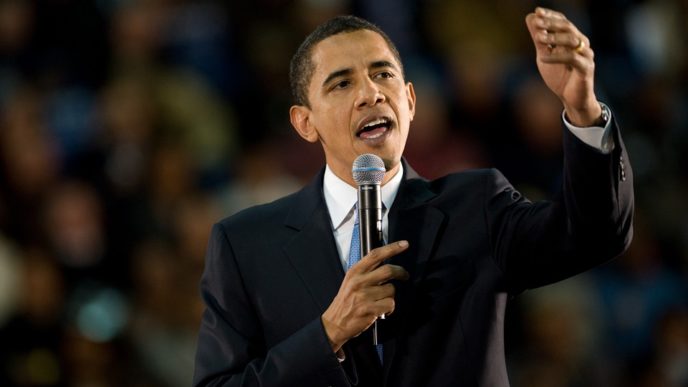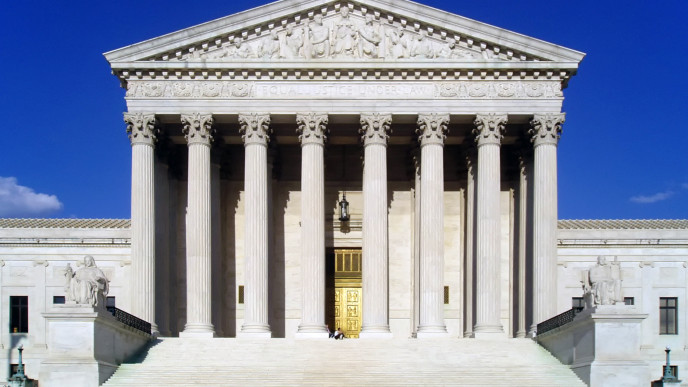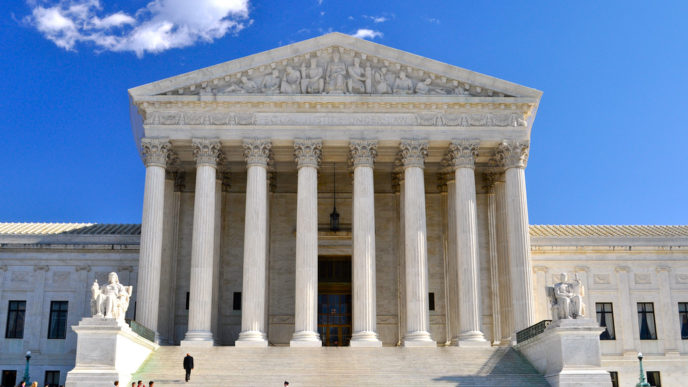
By Stephen Conway. President Obama has named Merrick Garland as his nominee to succeed Antonin Scalia on the U.S. Supreme Court.
Garland, a federal appeals judge for the District of Columbia, came out on top of a short list of potential nominees devised by the president.
“It’s not a responsibility I take lightly,” Obama said of his choice during a Rose Garden ceremony Wednesday.
Judge Andrew Napolitano, senior judiciary analyst for Fox News, said during an appearance on the network this morning that the nomination is a “lose-lose” for the President.
“It’s dangerous to appoint somebody to the court with a 19-year track record,” said Napolitano, pointing out that such a long record gives opponents plenty of rulings to criticize. “This is not a win for President Obama.”
Napolitano went on to say that Garland is the most conservative appointee a Democrat president has nominated. That could frustrate Senate Republicans, who must pledge to block the nominee of someone who is relatively conservative in nature. (Read more from “When Judge Napolitano Saw Obama’s Supreme Court Pick, He Dropped a BOMBSHELL Obama Will Hate” HERE)
_____________________________________
Democrats Plan Push to Force Hearings on Supreme Court Nomination
By Mike DeBonis and Juliet Eilperin. Democrats began laying out an aggressive strategy Thursday to get Judge Merrick Garland considered by the Senate and seated on the Supreme Court, over what appears to be implacable Republican opposition.
The approach, which is being implemented in part by a well-organized group led by former aides to President Obama, involves targeting vulnerable GOP Senate incumbents for defeat by portraying them as unwilling to fulfill the basic duties of their office. The idea is to so threaten the Republicans’ Senate majority that party leaders will reconsider blocking hearings on Garland’s nomination.
“You’re going to be surprised at how hard we’re going to work to make sure this is on the front pages of all the papers,” Senate Minority Leader Harry M. Reid (D-Nev.) told reporters after meeting with Garland on Thursday.
At the White House, Obama held a conference call with thousands of supporters across the country while senior adviser Valerie Jarrett met on Capitol Hill with members of the Congressional Black Caucus. White House press secretary Josh Earnest told reporters he had no details of a specific request Obama was making on the call. “But I think the president sent a pretty clear signal, though, that this a high priority of his, and he hoped that this would be a priority that people all across the country would share,” he said. (Read more from “Democrats Plan Push to Force Hearings on Supreme Court Nomination” HERE)
00Joe Millerhttps://joemiller.us/wp-content/uploads/logotext.pngJoe Miller2016-03-18 00:35:352016-04-11 10:51:24When Judge Napolitano Saw Obama’s Supreme Court Pick, He Dropped a BOMBSHELL Obama Will Hate
Da Noive! President Barack Obama has chosen to nominate United States Appeals Court Judge Merrick Garland to the Supreme Court.
We are told he is a “moderate,” but we know how that works. The other “moderates” on the high court somehow manage to march their way in lockstep to the officially designated liberal position on every single major case. Can anyone name an exception?
But that is the least of my objections. Whatever his merits, Garland served as Deputy Attorney General Jamie Gorelick’s “principal deputy” during the two most corrupt years in American political history – the years leading up to Bill Clinton’s reelection in 1996 – and that service alone should kill his candidacy . ..
My newest book on the subject, “TWA 800: The Crash, The Cover-up, And the Conspiracy,” spells out Gorelick’s role in all its unseemly detail. The book will be published before the crash’s 20th anniversary in July, but I would be happy to share an advanced copy with any U.S. senator who wants to know the truth.
In sum, Gorelick and the Clintons pulled off the most successful cover-up in American peacetime history. As a reward, the otherwise unqualified Gorelick was named vice-president of Fannie Mae in 1997, in which job she made more than $25 million during the next six years. (Read more from “Obama’s Supreme Pick Tied to TWA 800, OKC Bombing” HERE)
A small group of U.S. senators say they will meet with President Barack Obama’s nominee to the Supreme Court, Merrick Garland.
Sen. Kelly Ayotte, Sen. Jeff Flake, and Sen. Susan Collins all have agreed to have a meeting with Garland, reports Politico.
Ayotte – who is running in a tight re-election race against incumbent New Hampshire Gov. Maggie Hassan – said that she would meet with Garland to explain to him that she opposes any nomination during the 2016 presidential race. Prior to Obama actually naming his choice to take the seat of recently deceased Justice Antonin Scalia, Ayotte said she would not meet with the president’s nominee.
“He’s a current appeals court judge and out of courtesy and respect we will certainly meet with him if he would like to meet with me,” Ayotte said. “I would want to explain my position to the nominee…I would want to give him that courtesy.” (Read more from “GOP Senators Say They Will Meet With Obama SCOTUS Pick” HERE)
00Joe Millerhttps://joemiller.us/wp-content/uploads/logotext.pngJoe Miller2016-03-17 01:27:162016-04-11 10:51:27GOP Senators Say They Will Meet With Obama SCOTUS Pick
One of President Obama’s potential candidates for the Supreme Court has a history of defending some of Iowa’s most infamous criminals, including the “Midwest Pipe Bomber” and the child molester who murdered five-year-old Evelyn Miller.
Judge Jane Kelly, who was appointed to the 8th Circuit Court of Appeals in 2013, is reportedly on President Obama’s short list for the Supreme Court vacancy left by Justice Antonin Scalia.
Before becoming a judge, Kelly worked for years as a public defender in Iowa. In 2005, Kelly was the appointed attorney for a 26-year-old man named Casey Frederiksen, who was charged with possession of child pornography.
Although Frederiksen had previously been convicted of sexual assault involving a minor, Kelly urged the judge to grant him leniency, arguing that he was not a danger to others and should be released and allowed to live with his father. Frederiksen was sentenced to 14 years in prison in the case.
A decade later, Frederiksen was convicted of murder and sexual assault in the 2005 cold case killing of 5-year-old Evelyn Celeste Miller. Evelyn, the daughter of Frederiksen’s live-in girlfriend, was reported missing from her northern Iowa home on July 1, 2005. Over 1,500 people joined police to help search for the young girl. Her body was found with stab wounds on a nearby river bank two days later, and there was evidence she had been sexually assaulted. (Read more from “Potential Supreme Court Candidate Defended Pipe Bomber, Child Murderer” HERE)
A Senate Judiciary Committee hearing turned into a slugfest Thursday as Republicans and Democrats traded jabs over the GOP’s blockade of President Obama’s nominee for the Supreme Court.
Judiciary Chairman Chuck Grassley, R-Iowa, accused Senate Democrats of allowing “raw politics to infect the process” by stirring up a frivolous partisan fight.
“Everybody knows any nominee submitted in the middle of this presidential campaign isn’t getting confirmed. Everyone knows that. Why the charade?” Grassley asked.
“It’s because the other side is committed to using this process to score as many political points as possible. That’s it, plain and simple,” Grassley answered.
The White House has floated several potential nominees in the past few weeks, and Obama is expected to announce his final pick soon. But that doesn’t change much for Senate Republicans.
Since Justice Antonin Scalia died unexpectedly Feb. 13, the GOP has remained adamant that his seat on the bench remain open until after the November election, for the next president to fill.
If Republicans succeed, “the work of the committee and this Congress will be shamefully incomplete,” Sen. Chuck Schumer, D-N.Y., said.
Democrats continue to blast Republicans for dereliction of their constitutional duty to offer advice and consent on judicial nominees. They want Obama to nominate and the Senate to consider a nominee as soon as possible.
Republicans have been quick to counter that they’re only following a precedent established by Vice President Joe Biden. While a senator, Biden urged the Senate to block any of President George H.W. Bush’s Supreme Court picks before the 1992 general election.
Schumer characterized that back-and-forth as “he said, she said” dribble.
“On both sides, everyone’s said a bunch of things,” Schumer said. “But let me repeat: Not once since this committee began holding hearings on Supreme Court nominees a century ago has the committee refused to report a nominee to the floor for consideration.”
To make his point, Schumer goaded Sen. Thom Tillis, R-N.C., who also sits on the Judiciary Committee, for saying he enjoys a “good scrap” in a Senate floor speech last week.
“After the president makes a nomination,” Schumer said, “let’s have the kind of serious, long, detailed, thorough debate—call it a scrap if you will—that we’ve had in the past.”
Past remarks of the third-ranking Democrat have provided Republicans with plenty of ammunition. In July 2007, Schumer called on the Senate to block any of President George W. Bush’s Supreme Court nominees. Democrats controlled the chamber at that time, and 18 months remained in Bush’s term.
Sen. Lindsey Graham, R-S.C., predicted that the current fight will generate a permanent standard, one “that will stand the test of time.”
“We are setting a precedent here today, Republicans are,” Graham said. In the last year of a president’s term, he said, “you’re not going to fill the vacancy of the Supreme Court based on what we’re doing here today. That’s going to be the new rule.”
Graham, who voted to confirm both of Obama’s previous nominees, Elena Kagan and Sonia Sotomayor, encouraged Democrats to hold Republicans to that standard in the future.
“You could use my words against me, and you’d be absolutely right,” he said.
Bipartisan criticism swiftly poured in after the committee meeting ended.
Carrie Severino, chief counsel of the conservative Judicial Crisis Network, praised Grassley for letting “the people decide the next justice through their votes for president.”
Wade Henderson, president of the liberal Leadership Conference on Civil and Human Rights, said it would “be refreshing to see the Senate Judiciary Committee embrace its constitutional duty to advise and consent on judicial nominees.” (For more from the author of “Judiciary Chairman Accuses Democrats of ‘Charade’ on Supreme Court” please click HERE)
Chief Justice John G. Roberts Jr. said late Wednesday that partisan extremism is damaging the public’s perception of the role of the Supreme Court, recasting the justices as players in the political process rather than its referees.
Divisive battles over confirmations and mischaracterization of the merits of the court’s decisions worry him, Roberts told a ballroom crowd of about 1,000 people at a celebration of Law Day at New England Law-Boston, a private law school.
Criticism of the court “doesn’t bother me at all,” Roberts said, as long as it is not based on a misunderstanding of how the court differs from the political branches . . .
The court is under heavy criticism from all sides in the presidential campaigns, with Republican Donald Trump suggesting he would appoint justices who would overturn the court’s 5-to-4 decision saying gay couples have a constitutional right to marry and Democrats Hillary Clinton and Bernie Sanders making a rejection of the court’s Citizen United campaign finance decision a litmus test for their potential nominees. (Read more from “The Political Wars Damage Public Perception of Supreme Court, Chief Justice Roberts Says” HERE)
https://joemiller.us/wp-content/uploads/hqdefault-16.jpg360480Joe Millerhttps://joemiller.us/wp-content/uploads/logotext.pngJoe Miller2016-02-05 00:12:332016-04-11 10:53:04The Political Wars Damage Public Perception of Supreme Court, Chief Justice Roberts Says
We are either a representative republic or we are ruled by a judicial oligarchy. It’s time to choose once and for all.
Once again, we mark another grim anniversary of the Roe v. Wade decision, which paved the road for over 58 million abortions since 1973. This year, in particular, marks a poignant milestone in the fight for the unborn, as the agenda of the abortionist movement has been exposed as one that, far from limiting the practice to being “safe and rare,” champions butchery in the mold of the ancient Moloch. The entire panoply of perverted liberal intellectualism on other issues stems from the moral decadence rooted in the death cult of abortion.
However, aside from the 58 million souls that were deemed unfit for protection in the few dozen pages of that court opinion, our constitutional republic and entire system of governance became threatened as well. From that point onward, the courts have been legitimized as the final arbiter of the most important political and societal questions of a given generation, the very decisions that were supposed to be left to the people’s representatives. It was from that decision that the courts not only became the supreme authority of the land, but completely countermanded the Constitution as was originally written and intended: to be used as a guide for acting as the supreme authority. As William Brennan used to tell his law clerks, “With five votes you can do anything around here.”
From Roe onward, the courts have been able to concoct “fundamental rights” that are not only omitted from the Constitution, they are antithetical to our founding values. At the same time, they infringe upon our unalienable rights or green light the other branches of government to do so. Thus, our Constitution was ruled unconstitutional.
It was through the Roe decision (among other Warren-era decisions) that the 14th Amendment, which was intended to do nothing more than guarantee freed black citizens the life, liberty, and property rights of every other citizen, was perverted into a mandate for “rights” that would have shocked the consciousness of the Reconstruction-era Congress.
At the time of the adoption of the 14th Amendment in 1868, 36 states and territories had laws on the books banning abortions. Yet, we are told that the Constitution, and even the 14th Amendment as originally conceived, is unconstitutional and preempted by the evolving interpretation of the 14th Amendment, which is rooted in nothing but the political imagination of the judges. And unlike politicians who must stand for reelection, these judges now get to engage in political issues, serve as the final authority, and never stand before the people for reelection.
That we tolerated this coup d’etat for even one year is astounding, yet we’ve sat passively for over 40 years watching the courts build precedent upon precedent of anti-constitutional legal fog to destroy our Constitution even further. It represents a colossal failure of the professional “conservative movement.” It has led to the pro-live issue being used as ceremonial window dressing to elect more Republicans whose modus operandi has saddled us with the judicial tyranny we have today.
For quite some time, a number of legal theorists on the right figured that we’d benefit from a strong judiciary at least when we needed them to strike down liberal laws passed by Congress or state legislatures when they are legitimately unconstitutional. Yet, as witnessed by Obamacare, state gun laws, and many of Obama’s immigration acts, these strong judges are nowhere to be found.
The core job of the judiciary is to interpret the statutes passed by Congress, yet they refused to hear a case against Obama’s DACA, which flagrantly violates immigration statues. Just yesterday they refused to hear a case against Obama’s lawless EPA carbon emissions rule, which violates executive authority under the Clean Air Act. And while judicial review of laws passed by legislatures is controversial, if we are going to abide by an all-powerful judiciary that invalidates state marriage laws dealing with the building blocks of civilization, how could they not toss out state gun laws violating the plain language of the Constitution?
The answer, of course, is that the Constitution the courts use is the Democratic Party playbook or the pagan gospel of the legal profession that has roped in a number of Republican judges as well. As such, property rights, gun rights, and religious liberty are stripped out of the Constitution and abortion, gay marriage, affirmative action, and immigration are inserted in.
There is no greater threat to our democratic republic than the court system as it is currently and illegally constituted. Part of my upcoming book will be dedicated to the imperative of stripping the courts down to size and how that can be accomplished. There are endless reasons why this is among the most important priorities of our time. But for now, on this 43rd anniversary of Roe v. Wade, let’s remember there are also 58 million other reasons to reclaim our system of governance from the courts. (For more from the author of “58 Million Reasons to Reclaim America From the Courts” please click HERE)
https://joemiller.us/wp-content/uploads/logotext.png00Joe Millerhttps://joemiller.us/wp-content/uploads/logotext.pngJoe Miller2016-01-22 23:42:372016-04-11 10:53:3158 Million Reasons to Reclaim America From the Courts
The Supreme Court sounded ready Monday to deal a severe blow to public employee unions by striking down laws that require all workers to help pay for collective bargaining.
In its tone and questioning, the argument resembled more of a congressional hearing at which Republicans took one position, Democrats argued the opposite, and there appeared little chance to sway either side.
The court’s five Republican appointees strongly suggested they believe it is unconstitutional to force an objecting teacher from Orange County and millions like her to pay for union activities they do not support. Justice Anthony M. Kennedy described the mandatory fees as “coerced speech” that violates the 1st Amendment.
Under a 1977 Supreme Court ruling that may now be reversed, public employees can be required to pay a “fair share” fee to reflect the benefits all workers receive from collective bargaining. But at the same time, employees who object cannot be forced to pay for a union’s political activities.
In California, for example, that means teachers are required to pay $650 a year for collective bargaining, but not the roughly $350 more that goes toward the union’s political spending and lobbying. (Read more from “Supreme Court Appears Skeptical of Union Fees — a Potentially Major Loss for Labor Groups” HERE)
https://joemiller.us/wp-content/uploads/logotext.png00Joe Millerhttps://joemiller.us/wp-content/uploads/logotext.pngJoe Miller2016-01-11 23:56:452016-04-11 10:53:57Supreme Court Appears Skeptical of Union Fees — a Potentially Major Loss for Labor Groups
Hispanic “voting rights” advocates are nervous over the recent decision by the Supreme Court to hear Evenwel v. Abbott, the “biggest voting law case in 60 years” according to experts. Plaintiffs in the case are asking the court to consider a fundamental question about our representative democracy: does drawing legislative districts around “residents” instead of eligible voters give too much weight to voters in immigrant-heavy districts and thus violate the Constitution’s “one-person, one-vote” principle? As the two plaintiffs show in court filings, their respective senate districts in Texas have almost twice the amount of eligible voters than do other more Hispanic urban districts. If the voter population of Texas’s districts was equalized, it would have huge implications on how political power’s distributed not only in that state, but likely elsewhere.
In a friend-of-the-court brief filed in support of the plaintiffs, the Immigration Reform Law Institute argues that, in the case of illegal aliens at least, it was never intended by the framers to include them in the apportionment base from which we distribute our representatives. Counting them, we argue, is unconstitutional.
There was concern about the distortive effects of total population-based apportionment when the Reconstruction Congress debated the changes to the Census Clause later enshrined in Section 2 of the Fourteenth Amendment. Senator John Sherman of Ohio, for instance, could not see why a state that has “a very large element of unnaturalized foreigners” should be given political power at the expense of other states. For Sherman, the correct proposition was the one that “puts a citizen in one State on a footing of precise equality with a citizen in every other State.” Ultimately, however, it was deemed that a person’s alienage was not to prevent them from being included in the decennial census.
As for illegal immigrants, however, historical evidence shows granting them representation and apportionment “rights” was never contemplated by drafters of either the Census Clause or the Apportionment Amendment. Legal historian and former analyst with the Immigration Reform Law Institute, Patrick J. Charles, has written extensively about the topic with particular focus on the so-called “doctrine of allegiance.” Embodied in Congress’s plenary power over naturalization, the doctrine sets out that an alien must submit to the nation’s laws and declare his or her intention to lawfully settle in order to be subject to those laws. According to Charles, “when aliens only partially submit to the laws of their host nation they violate the first rule of the law of nations concerning emigration—the doctrine of allegiance and submission of the government.” The drafters understood that political privileges, such as apportionment and representation, were “subject to allegiance and subjecting one’s self fully to the laws” and that without such submission that person would still be subject to the laws of their foreign jurisdiction.
During the Fourteenth Amendment debates, Senator Luke Poland of Vermont stated that legal aliens should be apportioned observing that they are “subject to [the State’s] laws….They must all share in its burdens, and they are all interested in its legislation and government.” This does not apply to illegal aliens. As Charles argues it is “outside the bounds of constitutional logic for a class of foreigners to be entitled to the full protection of the Constitution, especially the political privilege of apportionment, if they do not subject themselves fully to the laws” (emphasis added). Illegal aliens, by their very existence in the United States, are not subjecting themselves “fully to the laws.” Their very presence flouts the law. Just one example is the failure to register their presence with immigration authorities once they have been in the country for 30 days or longer. (Read more from “‘One Person, One Vote’ Principle on Line at the Supreme Court” HERE)
https://joemiller.us/wp-content/uploads/logotext.png00Joe Millerhttps://joemiller.us/wp-content/uploads/logotext.pngJoe Miller2015-08-11 00:27:232015-08-11 00:27:23‘One Person, One Vote’ Principle on Line at the Supreme Court
The flagrant duplicity of Justice Anthony Kennedy’s Supreme Court decisions this term should render his opinions as lawfully binding as a sermon from Barney Frank. In other words: they are bloviating examples of politics before the rule of law. He has exhibited a complete disregard for the fundamental rights Americans possess, or that are protected under a simple reading of the Constitution, because he lacks any coherent jurisprudence. His hypocrisy on federalism reveals a naked political motivation for specific, and often diametrically opposed, outcomes.
In 1997, there was a case before the Supreme Court, Washington v. Glucksberg, regarding physician-assisted suicide that mirrored the arguments proponents of homosexual marriage have asserted. Despite the fact that proponents of the right to assisted suicide offered stronger arguments than those recently seeking to overturn state marriage laws and redefine the institution from the federal bench, the Court still ruled in favor of the state 9-0. Three of the justices – Kennedy, Breyer, and Ginsburg – completely contradicted themselves with the ruling on marriage.
The respondents in Glucksberg, led by Washington physician Harold Glucksberg, asserted a “liberty interest” and fundamental right to assist terminally ill patients in committing suicide. They contended that state law banning assisted suicide violated their “substantive” due process under the 14th Amendment.
Interestingly, the word substantive is never mentioned in the Constitution, but has been created by usurpation of power and revisionist history, and has now become the porta potty of post-constitutional jurisprudence for those too cowardly to pursue their societal transformation through the democratic process. It is a legal fiction meant as a means to an end – that is, societal transformation via ‘judicial legislation.’ (See, U.S. v. Carlton, J. Scalia concurring.)
On paper, the respondents in Glucksberg had a much better case than those who sought to invalidate state marriage laws. They were asserting the right of self-sovereignty and were simply asking the state to not interfere with their act. In the Obergefell case, they were asking the court to redefine an institution that has been defined by natural law and all of history until just a few years ago. They were also asking for a state benefit and recognition, the opposite of the relief the respondents sought in the assisted suicide case.
Yet, in Glucksberg, the court completely shredded the idea that there is a fundamental right under the 14th amendment to assisted suicide. The litmus test the court used, based on decades of past precedent, in determining whether the Due Process clause of the 14th amendment protects a specific act is whether the asserted right is “deeply rooted in this Nation’s history and tradition,” and “implicit in the concept of ordered liberty,” such that “neither liberty nor justice would exist if they were sacrificed.”
Chief Justice Rehnquist, writing the unanimous opinion (although the four liberals disagreed slightly in a concurring opinion), noted that bans on suicide were a part of Anglo-American common law for 700 years and that “by the time the Fourteenth Amendment was ratified, it was a crime in most States to assist a suicide.” So, rather than the asserted right having deep roots in history and tradition, Rehnquist observed that the state laws were rooted in history and tradition. This was similar to Scalia’s point in his dissent in Obergefell when he observed that every state defined marriage as between one man and one woman at the time the 14th amendment was ratified.
The second requirement the court established in Glucksberg was that those asserting the new right provide a “careful description.” This is especially important because, as Rehnquist noted, “by extending constitutional protection to an asserted right or liberty interest, we, to a great extent, place the matter outside the arena of public debate and legislative action.”
Much like in the marriage case, Rehnquist observed that despite the centuries of iron-clad opposition to suicide for terminally ill, attitudes were changing. But it has no bearings on the Constitution, because those are political decisions and need to be dealt with in the states through the political process. That’s why in upholding the state ban on assisted suicide, Rehnquist made a point of declaring the following in conclusion: “Throughout the Nation, Americans are engaged in an earnest and profound debate about the morality, legality, and practicality of physician assisted suicide. Our holding permits this debate to continue, as it should in a democratic society.”
Now step back for a moment and ponder, in light of this court’s unanimous decision – including the votes of Kennedy, Breyer, and Ginsburg – to uphold the ban on assisted suicide, how irrational it is to overturn state laws defining marriage the way it has been defined for all of civilization? The notion that such a fundamental societal question – which was decided by 32 states directly by the people – could be overturned and all debate be shut off, based upon an asserted right stemming from an idea that never existed prior to this generation, is outrageous. Rehnquist observed that “most states” in 1868 banned assisted suicide. Well, all states, as Scalia noted in his Obergefell dissent, defined marriage as between one man and one woman.
But what is even more outrageous about Kennedy’s violation of the Glucksberg precedent is that the marriage case involves coercing states to provide the parties with benefits, not merely preventing the states from prohibiting homosexual acts, which was permitted nationwide in Lawrence v. Texas (2003) [in itself a reversal of precedent]. As Clarence Thomas asserts in his Obergefell dissent, “since well before 1787, liberty has been understood as freedom from government action, not entitlement to government benefits.” [emphasis added]
The fact that Kennedy signed onto Glucksberg, yet blithely overrules it in Obergefell, plus makes a huge jump from his own decision in the Lawrence anti-sodomy case, exposes a shameless policy preference that is pre-empted not just by our constitutional system of law but by the very liberal deities of stare decisis (court precedent) that Kennedy so fervently embraces. The only substantive due process that is being violated is the due process of the millions of citizens who voted to define marriage and are now being denied that democratic process through what Scalia aptly called “societal transformation without representation.”
Why are homosexuals given extra rights?
Kennedy’s transparently cloddish replacement of legal jurisprudence for perceived public opinion and personal social preference is even more apparent by, as Justice Roberts notes, his insertion of the adjective “two” into his edict redefining marriage as between any two individuals of the same or opposite sex. Once the premise is made that 5 black robes can redefine marriage like redefining gravity and bestow a constitutional right that is antithetical to the intent of the framers, it is indefensible to exclude polygamist marriages. Polygamists can procreate, and unlike homosexuals who didn’t even recognize their relationships as marriages until this generation, polygamy is “deeply rooted in history” and in some traditions.
Moreover, so much of Kennedy’s ruling is rooted in his fabrication of new constitutional rights; namely, the right to “dignity,” “nobility,” protect against stigmas, and “the right to define and express their identity.” If Kennedy believes it is his responsibility and prerogative to bestow those new post-constitutional rights on, perhaps, the most powerful and trendy class of people in the country, how much more so for a group that is still scorned, stigmatized, and denied their dignity to express their identity.
But again, Kennedy’s opinion is 100% politics, and the inclusion of a relationship that is not in vogue would undermine the acceptance of his political polemic.
Kennedy overrules himself on states’ rights
Nowhere is Kennedy’s modus operandi of ‘choose a political outcome first, backfill the legal rationale later’ – even when it is self-contradictory – more palpable than with his reversal of his decision in Windsor just two years ago. When writing the majority opinion in striking down the federal Defense of Marriage Act (DOMA), Kennedy dedicated seven pages to the importance of state control over marriage dating back to the founding of the country. “[R]egulation of domestic relations is an area that has long been regarded as a virtually exclusive province of the States.” “[T]he Federal Government, through our history, has deferred to state-law policy decisions with respect to domestic relations.”
Let’s put aside the fact that DOMA never interfered with the states that adopted gay marriage; it was merely a protection for the states that chose not to redefine marriage, in addition to defining marriage for federal purposes, such as immigration law. But how can Kennedy say that the federal government cannot define marriage for its own purposes because states have exclusive power and then, just two years later, create a federal constitutional right precluding states from defining marriage as it has always been defined by those very states he so recently observed had marriage laws since the nation’s founding? How can he say that state laws with regard to marriage are supreme and then force every state to redefine its very essence?
Answer: naked politics and lawlessness.
For far too long, we have casually sat back and accepted opinions of the Court to be the law of the land, even when they clearly violate the basic tenants of our Constitution.
Appalling hypocrisy on popular sovereignty
Just a few days after rewriting the Constitution and countermanding the preamble of the Declaration, Kennedy signed onto a majority opinion in a seemingly unrelated case (Arizona State Legislature v. Arizona Independent Redistricting) that reveals even more hypocritical legal analysis designed to net the opposite result when it suits his personal politics. This case involved the Arizona state legislature suing for control over the redistricting process in their state after voters handed over the power of redistricting to an unelected commission. Writing for the majority, Ginsburg ruled that when Article 1 Section 4 grants the “Legislature” control over the manner in which federal elections are conducted in the state, it really also means the people of the state through ballot initiatives. This, despite the fact that the Constitution mentions the word Legislature 17 times, and in most cases, it’s impossible to be describing anything but its plain textural meaning.
As Thomas observed in his dissent in Arizona State Legislature v. Arizona Independent Redistricting, the majority (of which Kennedy was a co-signer) extolls the virtues of ballot initiatives and allowing the people of the state to decide redistricting, even though this is one of the few things preempted by the plain language of the federal Constitution. Yet, these same justices, during the same term, gaily overturned ballot initiatives of 32 states dealing with one of the most foundational and contentious societal issues of our time – all for highbrow concepts that are never mentioned anywhere in the Constitution and are indeed an anathema to the 10th Amendment and to the concept of fundamental rights – rights that were solely based on nature’s God.
For far too long, we have casually sat back and accepted opinions of the Court to be the law of the land, even when they clearly violate the basic tenants of our Constitution. But what we have seen in recent years is such a naked pursuit of politics from the bench that the political justices won’t even remain consistent in their own legal analysis precisely because they are solely focused on preferred outcomes. What has occurred this term in general, and in the marriage case in particular, has crossed a line.
Based on the tradition of all civilization, the founding principles of liberty expressed in the Declaration, the system of government established in the Constitution, and precedents of the court established by some of these very same political hacks – this opinion is null and void and should carry no weight among the states.
This fight is far from over. (“Justice Kennedy’s Naked Politics and the Hypocrisy of the Court”, originally posted HERE)
https://joemiller.us/wp-content/uploads/logotext.png00Joe Millerhttps://joemiller.us/wp-content/uploads/logotext.pngJoe Miller2015-07-07 03:35:032016-04-11 10:59:12Justice Kennedy’s Naked Politics and the Hypocrisy of the Court