Posts

CIA Director Pompeo Admits Convincing Trump Over ‘Disproven’ Chem Weapons Attack in Syria

Ever since the tragic launch of 59 Tomahawk missiles into Syria by the United States took place in April, the entire incident has been represented as a one-man show by the corporate and even by the alternative media. The corporate press, which virtually never gives Trump a break on any issue real or imagined, was strangely approving of The Donald after his war crime while his detractors in the alternative media were presenting the act as that of a madman who is frighteningly close to the red button.

On June 25, veteran journalist Seymour Hersh released a bombshell article revealing a number of facets regarding the alleged chemical attack in Khan Sheikhoun, Syria and the resulting volley of Tomahawk missiles fired by the United States at the al-Sha’aryat airbase in response. Hersh’s article provides the reader with what many of us already knew and wrote about at the time; i.e. that the Syrian military did not conduct a chemical weapons attack and that the United States was fully aware of that fact. Still, the U.S. government opted to use the attack as a justification for launching 59 Tomahawk missiles at a Syrian airbase that resulted in the deaths of Syrian soldiers, civilians, and children from the nearby village.

Hersh’s article shows that not all key personnel were on board with the decision to launch Tomahawk missiles at al-Sha’aryat or even of the whole Syria/Iraq mission. The article reveals real concerns amongst knowledgeable personnel that the Russians will not continue to act as the cooler heads and that Russia has long wanted peace in the region. Most notably, it reveals the fact that there is a “secret agenda” moving forward in regards to Syria, Iraq, and Russia. Hersh’s article also points to the President as the individual who made the decision to launch attacks in Syria, against the advice of the military and intelligence community. In fact, Hersh’s article makes the entire incident appear as if it were the Trump show from beginning to end.

While Hersh’s article provides valuable information, it is becoming more and more evident that what Hersh came across was either an intentional leak or, perhaps even more accurate, only part of the story.

I wrote at the time that what is most likely here is not the situation that Hersh presents. It is more likely that the U.S. military and intelligence apparatus colluded with their corporate media department and capitalized on this incident and Trump’s narcissism and perceived political necessity. It is more likely that “advisors” like Trump’s rabid Zionist son-in-law who has been given frightening levels of access to the President and the government in an official capacity as Trump’s senior advisor, simply told the President that launching missiles was what he was expected to do by the Deep State and Trump complied. Trump could also have been told by advisors that the story was already out and the narrative already accepted and therefore he had to do something to appease the pro-war leftists, Democrats, and Republicans.

In this regard, Hersh’s article is possibly a limited hangout operation, not on the part of Hersh, but on the part of the intelligence community who wish to do more damage to the President’s public support and his ability to act independently of the “deep state.” It is their ability to announce the tragic massive fraud of Khan Sheikhoun while looking like the level heads and the good guys of the situation. Trump, of course, comes off looking like the lone assassin, the lone madman so eaten up with narcissism that he is putting the country at risk. But while Trump is undeniably a narcissist and he is undeniably putting the country at risk, it is the fact that he is listening to and obeying the deep state apparatus that is the danger, not that he is ignoring them.

While most of the above is informed speculation, it is also put into proper historical context, not only in the Trump administration but also in the history of other administrations over the past several decades, most notably that of Kennedy and Nixon, neither of which point to a promising end for Trump.

Backing up my own suspicions is the current Director of the CIA, Mike Pompeo. In a recent speech to the INSA Leadership Dinner on July 11, Pompeo was giving a typical dinner speech about the harrowing world of the intelligence community, how tough it is to have his position, the importance of it, etc. During the course of the speech, however, Pompeo let a very interesting tidbit slip. Pompeo said:

I got a call from the President one afternoon back in April. He wanted to talk about some disturbing images that were coming in from Syria. I’m sure you saw many of them yourselves—scenes of innocent civilians writhing in agony, the apparent victims of a chemical weapons attack.

The President had a very direct message for me: Find out what happened. So we immediately assembled a crack team of Agency experts. They began piecing together the evidence, working closely with some outstanding partners from across the Intelligence Community.

The next day the President called his cabinet together. As we sat down, he turned to me and asked what we had learned. I told him that the IC had concluded that a chemical weapon had indeed been used in the attack, and that it had been launched by the Syrian regime.

The President paused a moment and said: Pompeo, are you sure? I’ll admit that the question took my breath away. But I knew how solid the evidence was, and I was able to look him in the eye and say, Mr. President, we have high confidence in our assessment.

The President never looked back. Based on the Intelligence Community’s judgment, he made one of the most consequential decisions of his young administration, launching a strike against the very airfield where the attack originated.

So I can assure you that when it comes to having the confidence of the Commander in Chief, CIA and the Intelligence Community are in great shape.

In other words, Pompeo is directly contradicting Hersh’s sources, saying it was not Trump who led the show but the intelligence community. Of course, Trump, being President is ultimately responsible for making the wrong decision but notice that, according to Pompeo himself, Trump demanded answers as to whom committed the attack. It was the intelligence community that came back to the President with assurances Assad was responsible.

Obviously, given all of the evidence surrounding Khan Sheikhoun, the idea that Assad committed a chemical weapons attack is ludicrous. It simply did not happen. The United States has no evidence that the incident was what it claims and all of the evidence produced by the Syrians, Russians, and independent researchers points to the contrary, even toward the fact that the entire incident may have been planned to set up the Syrian government so as to provide justification for an attack on Syria by the United States.

So what Pompeo is admitting to is, at best, providing the President with faulty intelligence. However, we know from the Hersh leaks that the intelligence community was already well aware of the fact that the Syrian government did not commit a chemical weapons attack. With that in mind, it appears that Pompeo has admitted to lying to Trump regarding the guilty party in Khan Sheikhoun and the existence of chemical weapons. At the very least, he managed to create a paper trail that leads right to the door of the CIA.

Is anyone surprised? (For more from the author of “CIA Director Pompeo Admits Convincing Trump Over Disproven Chem Weapons Attack in Syria” please click HERE)

Follow Joe Miller on Twitter HERE and Facebook HERE.
Will the Next Strike on Syria Target Its WMD Production Facility?

If the Assad regime carries out another chemical weapons attack on Syrian civilians, where should the United States target for its next retaliatory strike?

On Monday night, the White House released a statement declaring that Assad would face major repercussions for going forward with another WMD attack on innocents.

“The United States has identified potential preparations for another chemical weapons attack by the Assad regime that would likely result in the mass murder of civilians, including innocent children,” the statement read. “If … Mr. Assad conducts another mass murder attack using chemical weapons, he and his military will pay a heavy price.”

Unlike the Obama administration, the Trump White House has shown that they enforce their red lines with action. In early April of this year, U.S. forces fired 59 Tomahawk missiles at a Syrian regime air base, in retaliation to a chemical weapons attack on civilians in Khan Sheikhoun.

The Syrian Scientific Studies and Research Centre (SSRC) could serve as a potential high-risk, high-reward target for U.S. forces. The SSRC is “responsible not only for the development, production, and munitions integration of chemical agents, but also the means of their battlefield and theatre delivery,” according to IHS Jane’s Defence Weekly.

Since its founding in 1971, the SSRC has been used to advanced Syria’s weapons program. Hafez al-Assad, current dictator Bashar al-Assad’s founder, set up the facility under the cover of a supposed civilian scientific research center.

Syrian regime leaders reportedly utilize the SSRC to mass-produce extremely deadly chemical agents, such as mustard gas, the VX nerve agent, and Sarin (the compound allegedly used in the Khan Sheikhoun attack). Because the facility is also used for missile development, those very chemical agents can seamlessly be transferred onto warheads. French intelligence officials have pinpointed the Syrian regime’s “Branch 450” as responsible for loading munitions with chemical agents.

The SSRC was reportedly utilized to produce the “Volcano” missiles used for a 2013 regime chemical attack on Ghouta, Syria, that resulted in the death of hundreds of innocents.

The White House appears to recognize that the SSRC serves as the chief producer of Syria’s chemical stockpile. In late April, the U.S. sanctioned 271 SSRC employees in response to the Syrian chemical attack in Khan Sheikhoun.

Treasury Secretary Steven T. Mnuchin explained at the time:

“These sweeping sanctions target the scientific support center for Syrian dictator Bashar al-Assad’s horrific chemical weapons attack on innocent civilian men, women, and children. The United States is sending a strong message with this action that we will hold the entire Assad regime accountable for these blatant human rights violations in order to deter the spread of these types of barbaric chemical weapons. We take Syria’s disregard for innocent human life very seriously, and will relentlessly pursue and shut down the financial networks of all individuals involved with the production of chemical weapons used to commit these atrocities.”

So what exactly is stopping the United States from striking the SSRC?

At issue is the possible exposure a missile blast could perhaps have on the surrounding populations. Targeting the facility could result in the release of extremely deadly material, which could then spread into the surrounding Damascus area where the SSRC is located.

Regardless of whether or not the U.S. is willing to strike the compound, the SSRC serves as the main procurement center for Syria’s WMD program. Until coalition forces can somehow either choke off or destroy the facility, the regime will be free to continue to develop weapons that threaten U.S. and global security. (For more from the author of “Will the Next Strike on Syria Target Its WMD Production Facility?” please click HERE)

Follow Joe Miller on Twitter HERE and Facebook HERE.

TRUMP WARNS ASSAD: White House Says Syria Potentially Prepping Another Chemical Attack

The Trump administration said late Monday that it had discovered evidence that the regime of Syrian President Bashar Assad could be planning another chemical weapons attack.

Press Secretary Sean Spicer said in a statement that “The United States has identified potential preparations for another chemical weapons attack by the Assad regime that would likely result in the mass murder of civilians, including innocent children.”

Spicer added that the activities resembled preparations for an April chemical weapons attack that was blamed on Damascus.

“As we have previously stated, the United States is in Syria to eliminate the Islamic State of Iraq and Syria,” Spicer concluded. “If, however, Mr. Assad conducts another mass murder attack using chemical weapons, he and his military will pay a heavy price.”

The White House did not detail what prompted the warning. Several State Department officials typically involved in coordinating such announcements told the Associated Press they were caught completely off guard by the warning, which didn’t appear to be discussed in advance with other national security agencies. (Read more from “TRUMP WARNS ASSAD: White House Says Syria Potentially Prepping Another Chemical Attack” HERE)

Follow Joe Miller on Twitter HERE and Facebook HERE.

Why Russia Might Shoot Down American Planes in Syria

On the afternoon of June 18, the world changed. The U.S. Air Force shot down a bomber of the Syrian air force controlled by Bashir Assad. The reason for this action was plain and simple. This bomber attacked American allies in Syria: the Syrian Democratic Forces (SDF)—an alliance of Kurds, Christians, and non-jihadist Arabs. The U.S. did what every good ally should do and tried to stop the attack. First the Americans demanded withdrawal. When no response came, this bomber was shot down in order to stop any senseless killing of SDF forces. In response Russia now threatens to shoot down U.S. jets that happen to enter the Russian sphere of influence over Syria.

This is happening while the SDF is taking the first ring of quarters of Raqqa, the ‘capital’ of ISIS. The liberation of Raqqa started June 6 and is progressing. It is quite obvious that attacking the SDF at the end of the day only helps ISIS.

The U.S. and Russia Fight for Dominance of Post-ISIS Syria

At first sight the downing of this Syrian jet is a very simple situation: The US defends its ally on the ground. If that is true, why then is Russia threatening to shoot down U.S. fighting jets? That is because something else is equally true: All players involved are now starting to look to a new map of post-ISIS Syria. And the U.S. wants to stop Iran from dominating either Syria or Iraq.

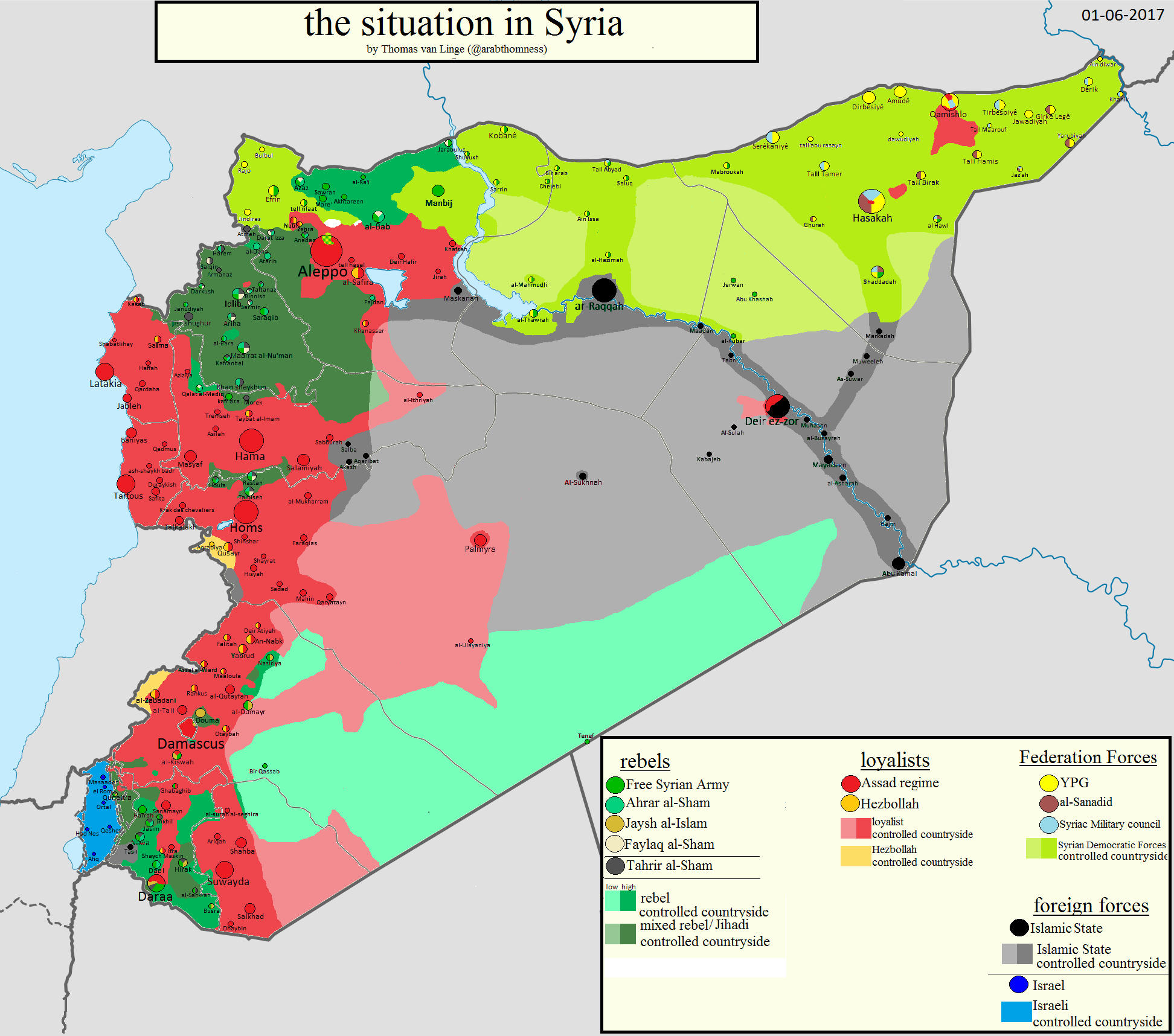
Look at the battle map that accompanies this column. (The map has not been updated yet, but there is a change in the area southwest of Raqqa.)

Iran Could Threaten Israel Through Syria

We can see that the Syrian army has (finally) made some serious progress against ISIS. Assad’s goal is probably not to defeat ISIS as such. More likely he wants to capture oilfields try to block the U.S-backed SDF. Assad wants to distract the SDF and keep its forces busy. Why? Because Assad wants his forces to beat them to the strategic site called Deir Ezzor.

The strategic importance of Deir Ezzor has totally been ignored until now. This ISIS stronghold controls the road from Teheran, Iran, across Iraq and Syria to the Mediterranean Sea and Iran’s enemy, Israel. Iran wants to control this road, so it can funnel weapons to its terrorist allies in Lebanon and the West Bank, which target Israel. The U.S. wants to prevent that, for obvious reasons.

The race to Deir Ezzor has suddenly become a high-stakes game. None of the players is at this point ready to take that area from ISIS. The Assad forces are stretched out and still a long way away. Iranian proxies are on the Iraqi side of the Iraq/Syria border, but this is a relative small force with a lot of other forces around it. The SDF meanwhile is busy in Raqqa and has no spare forces left to march to Deir Ezzor.

How Can We Block Iran?

The big question is what the US can do to block Iran. The answer is actually quite simple. The US has to deepen its commitment to the whole SDF. It must offer weapons to every element in that army. The sad truth is that the US still does not provide the Syriac Military Council (the Christian wing of SDF) any arms or ammo. These brave Christians are fighting ISIS in Raqqa as you read this. But they have to scrape their equipment together and ask others for help. Even the Arab and Kurdish parts of the SDF, which the U.S. does supply, are still under-equipped.

The U.S. still does not tap into the full potential of the SDF. although it is standing ready. For example the Syriac Military Council has more men and women trained than they can arm and this is also true for Kurdish and Arab forces in the SDF. More and better equipment can help to build an army that will act much faster in Raqqa and stand ready much sooner to win the race to Deir Ezzor. That would protect Israel and Iraq from Iran’s terrorist allies. To stabilize northern Syria, the U.S. would be wise to much more humanitarian aid and support rebuilding.

Arm Syria’s Christians

Much is at stake and President Trump can once more make a major difference. This time not only for the peoples in the Federation of Northern Syria but also for Israel.

One thing is clear. We are now definitively looking at a new map of Syria. Turkey is no longer able to block America’s policies. The U.S. has a clear, democratic, religiously tolerant ally: The SDF. America needs to build its ally up. There are now several small US military airbases in northern Syria, built to last rather years than months. The U.S. has realized that the SDF and the Federation of Northern Syria are there to stay. A return to the old, centralized and dictatorial Syria is out of the question. A new decentralized or even divided Syria is in the cards.

Don’t mourn the end of a brutal, centralized Syria. Its demise means that freedom has come to the heart of the Middle East. The task of the U.S. should be to make sure that all religious minorities, including Christians, are treated fairly. (For more from the author of “Why Russia Might Shoot Down American Planes in Syria” please click HERE)

Follow Joe Miller on Twitter HERE and Facebook HERE.
After US Shoots Down Russian-Made Fighter, Russia Threatens to Shoot Down US Jets

By MICHAEL R. GORDON and IVAN NECHEPURENKO. Long-running tensions between the United States and Russia erupted publicly on Monday as Moscow condemned the American military’s downing of a Syrian warplane and threatened to target aircraft flown by the United States and its allies west of the Euphrates.

The Russians also said they had suspended their use of a hotline that the American and Russian militaries used to avoid collisions of their aircraft in Syrian airspace. . .

The latest escalation comes as competing forces converge on ungoverned swaths of Syria amid the country’s six-year civil war. Syrian forces and Iranian-backed militias that support them are extending their reach east closer to American-backed fighters, including forces that the Pentagon hopes will pursue the militants into the Euphrates River valley after they take the Islamic State’s self-declared capital of Raqqa. The collision of the disparate forces has, in effect, created a war within a war. (Read more about Russia’s saber-rattling after the US shoots down a Syrian SU-22 HERE).

_______________________________

Pentagon: US Shoots Down Syrian Fighter Jet for First Time

By Robert Burns. The U.S. military on Sunday shot down a Syrian Air Force fighter jet that bombed local forces aligned with the Americans in the fight against Islamic State militants, an action that appeared to mark a new escalation of the conflict.

The U.S. had not shot down a Syrian regime aircraft before Sunday’s confrontation, said Navy Capt. Jeff Davis, a Pentagon spokesman. While the U.S. has said since it began recruiting, training and advising what it calls moderate Syrian opposition forces to fight IS that it would protect them from potential Syrian government retribution, this was the first time it resorted to engaging in air-to-air combat to make good on that promise.

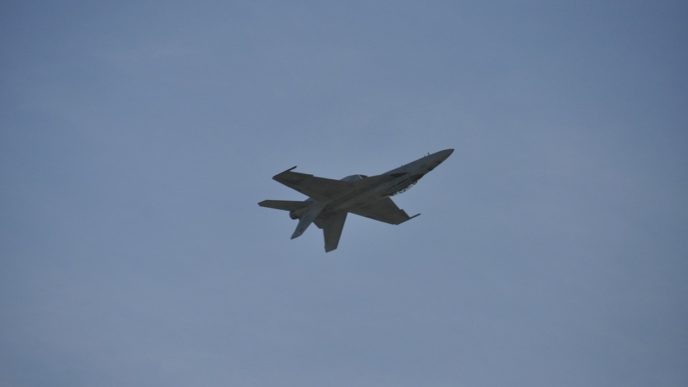
The U.S.-led coalition headquarters in Iraq said in a written statement that a U.S. F-18 Super Hornet shot down a Syrian government SU-22 after it dropped bombs near the U.S. partner forces, known as the Syrian Democratic Forces. (Read more from “Pentagon: US Shoots Down Syrian Fighter Jet for First Time” HERE)

Follow Joe Miller on Twitter HERE and Facebook HERE.

Syrian Christians Help Kurds to Liberate ISIS Capital

Today I received a call which I’ve dreaded. The battle for Raqqa has started. Starting today, thousands of brave fighters of the Syrian Democratic Forces (SDF) will fight from house to house against ISIS: an entrenched enemy that will give away absolutely nothing. Some of my dear friends will be dodging bullets and dismantling IEDs. I can only pray that they make it out alive.

This is an immensely important moment in the war against ISIS. After three years of endless fighting the SDF is about to take the capital of the “Caliphate.” There is no doubt about the final outcome: ISIS will be defeated. For the democratic, pluralist Federation of Northern Syria this is a highly symbolic moment. ISIS made the Federation its prime target.

David Kills Goliath

Nobody back in 2014 could have believed that the Federation would crush ISIS, instead of the other way around. That religious liberty and equality for women would triumph over savagery. That the brave people of Syria would free themselves. But they did. Shouldn’t that give us hope?

The upcoming victory only became possible thanks to a remarkable and unique cooperation of Kurds, Arabs and Syrian Christians. They created the most unusual alliance in the modern Middle East.

This alliance is unique because it is not a simple ‘anti-ISIS’ coalition of convenience. No, in a region where Syrian government authority had vanished, people targeted by ISIS came together. In these extraordinary circumstances these groups created their own government, starting with local and regional councils. They ensured that men and women had equal representation at all levels. They introduced the same freedom of religion as we enjoy in the West — which is rare in the Middle East. Federation residents can choose their own religion, change it, or hold to none at all. They can practice or preach it freely.

These Syrian freedom fighters started out with three small regions and very few weapons. Nobody would have believed back then that this movement would grow into the force that would conquer ISIS: A self-starter army with home-made “tanks” and little or no help from the outside world. But they resisted ISIS in Kobane and in the Khabour Valley against all odds — and won. And now they’re moving into Raqqa to finish off ISIS in its capital. It’s perhaps the most stirring story of self-sacrifice and heroism in our times.

President Trump made the bold move to arm the Kurds in the SDF, reversing the Obama administration policy of dribbling out meager aid, and only to Arab groups. Sadly, the U.S. is still honoring Obama’s decision not to arm the Christians — though they’re a full part of the SDF, and have bravely fought ISIS for years. American Christians should let the White House and Congress know that this policy is unjust and foolish. It leaves Christians uniquely vulnerable and dependent. It tells the rest of the region (where Turkey and Saudi Arabia back Sunni Islamists) that Syrian Christians are friendless and forgotten.

What Happens Next?

To answer this question we need to take a look at a very recent ‘political’ map of Syria. (It’s the main image for this column.) It shows the territory held by every single faction in Syria.

It is pretty obvious that the Assad regime and allies are strongest in the richly populated west of Syria. However their armies are exhausted due to a long, protracted war. All the areas controlled by ‘rebel forces’ are scattered across the west and south of Syria, and small by comparison. Only the rebel areas in the far south (Daraa) and north (Idlib) can receive supplies from the outside. All other rebel enclaves are pockets in regime territory.

A bit of an oddity is the southern desert, which is very sparsely populated. For some time it has been in the hands of U.S.-supported Syrian opposition forces, which have fought against ISIS and also clashed with Assad’s troops. This force is playing an increasingly important role in blocking Iranian influence.

In the desert center of Syria we see ISIS. Also it’s in the east along the Euphrates towards Iraq. However it is clear that they lost a lot of territory to the Federation and a bit to Assad’s regime.

The Federation has expanded its area almost solely at the expense of ISIS. The Federation now is the major force in all of North-East Syria and a large part of the northwest.

The Next Step in Ending ISIS

What will happen after Raqqa? The SDF have made clear that the Deir-Ezzor area east of the Euphrates is the next goal. Only after they liberate that region can we say that ISIS has been defeated in Syria. For the SDF this will be very important, as it will ensure that they will have a very significant role in post-ISIS Syria. Furthermore it will open all supply routes between the Federation and Iraq. Finally it will ensure that Iran will not be able to move freely forces from Teheran to Damascus. This prospect would otherwise become reality: Iranian proxies in Iraq have just reached the Iraqi-Syrian border.

When SDF has expanded the Federation to all of eastern Syria, there will be calm and stability in eastern and northern Syria but a protracted civil war in the west.

The West Can’t End the War

It is highly unlikely that there will be a final solution for the civil war in western Syria any time soon. At this moment there is no sign of any peace deal. The Astana and U.N. Geneva talks have unsurprisingly been mostly window-dressing. The jihadist forces in the north and the rebel forces in the south show no signs of giving up. The Assad regime forces are exhausted and have been bleeding for years now with no end in sight. The victories of Assad in Aleppo and some areas around Damascus are small in comparison to the whole territory that is still in hands of anti-regime forces.

There is a steady movement to a step by step federalization of Syria. And as The Stream has written, that would be the best possible outcome. In western Syria, the highly heterogenous population groups are gradually being homogenized — as anti-Assad people flee his regions, and his supporters flock to them. It’s sad that this is happening thanks to military pressure. In the Federation of Northern Syria, there has been no ethnic cleansing or group removals. It is still a complex mosaic, but one that functions well, with power decentralized and the rights of minorities protected.

The U.S. and the E.U. Can Help Build Peace
What can the U.S. and the E.U. do about Syria? Let’s start with what they can’t do. They cannot change the situation in the western part of the country. That’s because:

They have no allies on the ground to work with.

They won’t go to war with Russia.

The U.S. doesn’t want a repeat of its Iraq occupation in Syria.

Based on these realities the E.U. and the U.S. should focus on cooperation with the Federation of Northern Syria. It should help rebuild (where needed) war-torn towns and facilities. This will bring stability to a very significant part of Syria. Moreover the new culture of freedom that the Federation offers will exert a magnetic attraction. People in neighboring regions will want that for themselves, too. This is how freedom usually grows — organically, from the ground up. That’s how it emerged in the U.S., and in England and Switzerland before it.

And it’s happening now in the Federation. Arab women from strict Muslim towns like Shaddadi are now joining the Federation’s police forces. An increasing number of Kurds are converting to Christianity — as they are free to do in the Federation (or vice versa). Muslims who do the same in Saudi Arabia and many other Muslim countries face the death penalty.

My heart breaks when I think of all the (mostly) young people who will die in liberating Raqqa. But they need not die in vain. The West has the chance to help the Syrian people nurture the seeds of freedom. If it grows, it will change the Middle East. That will change the world. (For more from the author of “Syrian Christians Help Kurds to Liberate ISIS Capital” please click HERE)

Follow Joe Miller on Twitter HERE and Facebook HERE.

Officials: US Strike Hits Pro-Assad Forces in Syria

U.S. officials say an American airstrike has hit pro-Syrian government forces in southern Syria as they were setting up fighting positions in a protected area.

The officials say the strike near Tanf hit a tank and a bulldozer and forces there, but it was not clear if they were Syrian army troops or other pro-government allies.

One official says the pro-regime forces had entered a so-called “de-confliction” zone without authorization and were perceived as a threat to U.S.-allied troops there. The officials say the strike was a defensive move to protect the U.S. allies. It wasn’t clear if U.S. forces were there. (Read more from “Officials: US Strike Hits Pro-Assad Forces in Syria” HERE)

Follow Joe Miller on Twitter HERE and Facebook HERE.

Trump OKs Arms for Syrian Kurds, Despite Turkish Objections

The Trump administration announced Tuesday it will arm Syria’s Kurdish fighters “as necessary” to recapture the key Islamic State stronghold of Raqqa, despite intense opposition from NATO ally Turkey, which sees the Kurds as terrorists.

The decision is meant to accelerate the Raqqa operation but undermines the Turkish government’s view that the Syrian Kurdish group known as the YPG is an extension of a Kurdish terrorist organization that operates in Turkey. Washington is eager to retake Raqqa, arguing that it is a haven for IS operatives to plan attacks on the West.

Dana W. White, the Pentagon’s chief spokeswoman, said in a written statement that President Donald Trump authorized the arms Monday. His approval gives the Pentagon the go-ahead to “equip Kurdish elements of the Syrian Democratic Forces as necessary to ensure a clear victory over ISIS” in Raqqa, said White, who was traveling with Defense Secretary Jim Mattis in Europe. (Read more from “Trump OKs Arms for Syrian Kurds, Despite Turkish Objections” HERE)

Follow Joe Miller on Twitter HERE and Facebook HERE.
Will Trump and Putin Bring Peace to Syria? Not if Turkey Attacks American Troops.

A recent headline from The Hill offers a rare piece of good news about Syria: The U.S. and Russia are talking. They’ve agreed on a basic first step toward resolving this bloody and ruthless conflict: “Safe zones” should be established where civilians can live in peace, apart from the forces in combat. This is crucial for saving lives in the short run. So bravo, presidents Trump and Putin! Please make sure this happens yesterday. Thousands of lives of helpless old men, women, and children are at stake.

What the two superpowers need to do next is to build on this foundation. They must do so with an intelligible goal in sight: a decentralized Syria that allows ethnic and religious minorities to live in peace. The Stream laid out the broad sketch of such a plan last month. In fact, there’s a plan like this languishing on the negotiating table: the Astana talks, which looked toward devolving power to Syrian regions.

The alternatives are too ugly and futile to contemplate:

Let Assad’s vicious but anti-Islamist regime try a bloody reconquest of the country, with Russian help.

Allow al Qaeda allies and other Islamists backed by the Saudis and Turks to ethnically cleanse all the Christians, Alawites and Yazidis from the country.

Let Turkey use its massive, American-armed NATO military to obliterate the Kurdish/Christian alliance that the U.S. has backed so far in its war against ISIS and resistance to Assad. This would expel all American influence from the country and make it a Turkish colony.

There is no happy fourth option, where “moderate rebels” steeped in the U.S. Constitution install a liberal democracy in Syria via New England town meetings. At the urging of neoconservatives like John McCain and Lindsey Graham, we tried that in Iraq and Afghanistan. Trillions of dollars and thousands of dead or disabled U.S. soldiers later, we learned: You can’t grow that orchid in the desert.

A Decent Outcome in Syria Is Possible

But there is a non-horrible option — which isn’t always true in the Middle East. Thanks to the courage and hard work of Christians and Kurds, moderate Sunni Arabs and brave Yazidis, there already is a potential safe zone in Syria. In fact, it’s larger than Lebanon. It’s called the Federation of Northern Syria, and The Stream has reported on it extensively. Its soldiers work with American advisors, and it already gets some (not enough) U.S. military aid.

It’s organized in Swiss-style cantons, with decentralized power and complete religious freedom. Women serve in its parliament. Its leaders have pleaded with President Trump to designate it the first “safe zone” in Syria. It deserves the title, since within its borders Sunni Arabs, Kurds, Christians and Yazidis live side-by-side in peace. They cooperate. Nowhere in that tortured country, or in most of the Middle East, can you say the same.

This mini-state should be the model for a Syria reborn. The Russians can pressure Assad to step aside and go into exile, allowing another Alawite to take control of the region now held by Syria’s government. The Islamist rebels would probably keep the region they already run. The regions reconquered from ISIS should be divided along religious and ethnic lines, and granted local governance. Slowly, in fits and starts, a Swiss-style decentralized Syria could emerge from the smoking rubble.

Turkey Threatens American Troops With Missile Attacks

Who threatens such a solution? The Turks. Tayyip Erdogan, their president, has just managed a massive constitutional putsch, granting himself sweeping new powers. He has imprisoned thousands of journalists. Erdogan blackmails the European Union for concessions with the threat of dumping two million more Syrian migrants across its border. He bullies European governments like Holland’s, trying to exert control over Turkish émigrés living there. Most recently he has called on all Turks in Europe to have five or more children per family, to outbreed the Christian natives.

And Erdogan is obsessed with crushing any hope of Kurdish autonomy, even in Syria. He fears it will stoke the hopes of the Kurds he represses in Turkey. Last week he even attacked the U.S.-allied Federation of Northern Syria. It took the U.S. moving its troops to the border to protect the Syrian Christians and Kurds whom Turkey was threatening.

What’s Turkey’s response? To threaten America. Erdogan’s close aide İlnur Çevik has warned the U.S. that Turkey might fire missiles at U.S. troops. So Turkey is contemplating an act of war against the United States of America. A civil war within NATO. That’s what we’re dealing with in this regime.

Turkey Is the Spoiler in Syria

The U.S. must see that Turkey, not Russia, is the spoiler in Syria. It is Turkish hunger for conquest and control of Kurds in Syria that is the biggest obstacle to peace. The Trump administration, along with Russia, should rebuke Turkey’s threats. It should designate the Federation of Northern Syria as the first “safe zone” where civilians will be protected. A no-fly zone that keeps out both Erdogan’s and Assad’s air force would be an excellent start.

But it can’t end there. The tortured people of Syria deserve an alternative to failed socialist nationalism and totalitarian Islamist regimes. Localism and liberty saved Switzerland from tearing itself apart, and allowed the fledgling United States to grow and thrive. They could do the same in Syria. Let’s pray that the U.S. and Russia give peace a chance. (For more from the author of “Will Trump and Putin Bring Peace to Syria? Not If Turkey Attacks American Troops.” please click HERE)

Follow Joe Miller on Twitter HERE and Facebook HERE.

Turkey Bombs Syrian Christians. Will Trump Act to Protect Them?

Yesterday I woke up early, checked my phone and immediately all indicators went red (so to speak). I got the news that Turkey had bombed the area around a Christian town in North-East Syria and hit Bara, a Yazidi town in Sinjar, Iraq. All of this happened under the pretext of “fighting terrorists.”

Today I heard even more unsettling news: Turkey has launched ground attacks against the U.S.-allied Kurdish fighters who man the front lines against ISIS, alongside Syrian Christians. Those courageous Christians defending their families are hoping that the Trump administration halts these attacks. They are a blatant attempt to rebuke U.S. influence in the region. Emboldened by his win in a power-grabbing referendum, Turkish President Tayyip Erdoğan has decided to slap Uncle Sam in the face.

What Syrian Christians fear most is a Turkish ground attack on their heartland, the Khabour Valley. If that happens, they will pull back from fighting ISIS to defend themselves against Turkey, a member of NATO.

A Slap in the Face for America

I quickly got confirmation from both Syrian Christians and Yazidis that the air attack had indeed occurred. In total, 26 airstrikes were carried out. The Turks hit many civilians and SDF defense forces — allies of the United States. There was a total of 20 casualties near Derik. A media center and small headquarters of the Kurdish YPG were hit. The Kurdish YPG is part of the U.S.-backed Syrian Democratic Forces, along with the Christian Syriac Military Council, Arabs and others.

In Iraq, the airstrikes hit the Yazidi defense forces (YBŞ), who lost two fighters, while three civilians were wounded. Five Kurdish Peshmerga were killed as well. All these groups have been cooperating with the U.S. in fighting ISIS and protecting religious freedom.

Of course this is a nerve-wracking experience for the people of Derik. This Christian town is a nice place that had so far escaped the damage of war. When you stand on the roof of one of these houses you can see the Turkish mountains looming over the flat countryside of North-East Syria. There is a very nice hotel that kept going despite the war. Derik is an example of Christian resilience in the face of civil war and ISIS.

Turkey bombed it.

ISIS is far away from Derik. It never even got close to it. There was no legitimate reason whatsoever for such an aggressive act against these people.

Bombing the Hunted Yazidis

Even worse is the attack on the persecuted Yazidis. I have read reports today that these displaced people, who lost everything due to ISIS, could see the bomb blasts from their tents. A harrowing experience for a people that just survived a genocide.

Both the Syrian Christians and the Yazidis quickly released their statements this morning. The media already picked up what happened and reported the Kurdish casualties. Lost in the media reports was a crucial fact: This was a direct attack by a NATO member on a Christian town in Syria.

How will the U.S. respond? Feeling betrayed, members of the Syrian Christian, Kurdish and Yazidi communities wondered if the U.S. had sold them out. Was Trump eager to please the Turkish government? My personal take is that the U.S. was at first not aware of the intentions of the Turkish jets. The Americans were caught by surprise. This seems the most logical explanation: These strikes also posed a direct threat to U.S. forces in Northern Syria.

Punishing Trump for Mentioning the Armenian Genocide

One explanation swirling around is that these strikes were an attack in response to President Trump’s commemoration on April 24th of the Armenian/Assyrian genocide committed by the Ottoman empire and its “Young Turks.” If so, Turkey proved that it wants to continue that genocide.

On the same day as the attack, commanders of the U.S. forces based in Northern Syria inspected the consequences of the airstrikes together with SDF commanders. Furthermore, the State Department and Pentagon both described the United States as “deeply concerned” by the strikes. They said that their objections were raised directly with the Turkish government. They warned that Turkey’s targeting of Kurdish groups could distract from the common campaign to defeat ISIS.

However the core question is: What solid assurances will President Trump give to the victims of this bombing? Will he make it starkly clear to Turkey that it may not bomb Christian towns in Syria and Yazidi villages in Iraq? That this is really over?

The U.S. Must Arm the Victims, Its Natural Allies

One crucial way to end the suffering of these peoples is to arm them properly and to empower them politically. The Yazidis of Sinjar want all Kurdish forces to leave Sinjar. They wish to run their own defense forces and to achieve autonomy within Iraq and the Iraqi Constitution. This would also clear the way for autonomy for the Syriac-Assyrian Christians of Nineveh Plain in Iraq. That would take away any pretext for Turkey to attack the Yazidis ever again.

In Syria, the Trump Administration should make the logical choice to arm the Syrian Christians. Their Syriac Military Council is a real force fighting ISIS — independent of Assad. As I’ve written here before, there is no good reason why Christian forces are singled out and denied the weapons the U.S. gives to their Arab allies. Giving the Christians weapons for self-defense would send a powerful signal to Turkey that attacks on helpless religious minorities are a “red line” the U.S. won’t let Turkey cross.

Finally, President Trump should give much more attention to the Federation of Northern Syria, where religious freedom prevails. Indeed, as John Zmirak and Jason Jones wrote, the Federation should serve as the model for a new, federated Syria. To this end, the Trump Administration should declare publicly that no force will be allowed to attack SDF-controlled areas. He should declare it a “no-fly zone,” off limits to Turkey or Assad’s air force. Russia would raise no objections.

President Trump needs the cooperation of Syria’s Christians and Yazidis to end this war the right way: leaving behind religious freedom for all. He should not allow Turkey to blast that opportunity into rubble. (For more from the author of “Turkey Bombs Syrian Christians. Will Trump Act to Protect Them?” please click HERE)

Follow Joe Miller on Twitter HERE and Facebook HERE.