Posts

Cruz Makes Announcement After Meeting With Trump

Sen. Ted Cruz, R-Texas, announced on Thursday that he has accepted presumptive GOP nominee Donald Trump’s invitation to speak at the Republican National Convention later this month.

“We had a positive and productive meeting this morning with Donald Trump. Donald asked me to speak at the Republican convention and I told him I’d be happy to do so,” Cruz told reporters.

The Texas senator added that there was no discussion of an endorsement during that meeting.

Asked by a reporter what he would speak about at the convention, Cruz responded, “I’m going to urge Americans to get back to the Constitution to change the path we’re on: eight failed years of the Obama/Clinton economy; eight failed years of a presidency disregarding the Constitution and Bill of Rights; eight failed years of a commander-in-chief not protecting American and keeping us safe from radical Islamic terrorism. It’s time for that to end.”

Cruz spokeswoman Catherine Frazier said of the meeting, “There was no discussion of any endorsement. Mr. Trump asked Sen. Cruz to speak at the Republican convention, and Sen. Cruz said he would be happy to do so. Mr. Trump also asked Sen. Cruz for his counsel on future judicial nominations, and Cruz responded he would continue to do everything he can to help ensure principled constitutionalists on the courts.”

RNC chairman Reince Priebus, who was in attendance when the two met, told Fox News, “I’ll just say they had a good conversation, and it was very polite and cordial and normal. I know they’re working on details.”

As the two became the last viable Republican presidential candidates standing in the spring, the rivalry between them became particularly personal, with Trump referring to Cruz as “Lying Ted” and Cruz describing his foe as a “sniveling coward.”

In March, following Trump re-tweeting an unflattering picture of Cruz’s wife, Heidi, and threatening to “spill the beans” about her, the Texas senator indicated that he was not likely to endorse Trump. “I don’t make a habit of supporting people who attack my wife and my family,” he said.

CNN contributor and former Cruz communications staffer Amanda Carpenter tweeted regarding the Thursday meeting:

Trump also met with some 200 Republican members of Congress on Thursday. House Speaker Paul Ryan tweeted a statement following the meeting, which reads, in part, “It’s clear that our party is committed to defeating Hillary Clinton and Democrats this fall. We had a great meeting, and I appreciate Donald Trump taking the time to speak with House Republicans…”

(For more from the author of “Cruz Makes Announcement After Meeting With Trump” please click HERE)

Follow Joe Miller on Twitter HERE and Facebook HERE.

Ted Cruz’s Fight to Protect the Internet From Authoritarian Regimes

The Obama administration’s decision to give up U.S. control of regulating the internet is likely illegal, Sen. Ted Cruz, R-Texas, said.

“The Obama administration does not have the authorization from Congress,” Cruz said Thursday, speaking at a Heritage Foundation event on internet freedom. “And yet they are endeavoring to give away this valuable, critical property. To give it away with no authorization at all. That ought to trouble all of us.”

The Texas Republican added:

We built the internet and America maintains it as free for all. We don’t use it in an imperialist manner to impose our views on others. We maintain it as an oasis of freedom.

Time is running out for Cruz, however, in what he considers his fight to keep the internet free from censorship by less-open foreign countries.

In June, Cruz introduced a bill that would keep the U.S. Commerce Department in an oversight role of the body that assigns internet names and addresses. That body, the Internet Corporation for Assigned Names and Numbers, or ICANN, is a nonprofit organization that gives out domain names and numbers for the internet.

A domain name is the address of a person or an organization online. So when someone types dailysignal.com, he or she is brought to The Daily Signal website and not an imposter. One of ICANN’s responsibilities is to ensure that a specific domain name is not assigned to multiple organizations.

At issue is whether the U.S. should give up its role in overseeing ICANN. Supporters of the move say it is symbolic and that no single government or organization should have that much power over the internet. Cruz and other opponents say the move is too risky and that authoritarian regimes could gain influence over how the internet works.

Since ICANN’s creation in 1998, it has operated under a contract with a Commerce Department entity called the National Telecommunications and Information Administration.

With the department’s advice, ICANN has carried out so-called Internet Assigned Names Authority functions under the zero-cost contract. These functions include assigning domain names. Prior to 1998, one University of California computer scientist carried out these functions.

From the beginning, the United States has planned to transition oversight of ICANN from the Commerce Department to some sort of international body.

The contract between the Commerce Department and ICANN was set to expire in 2015, but the department delayed the move. That transition is now scheduled to begin in September.

Cruz wants to stop that transition altogether. In the event at The Heritage Foundation, he made the case for his bill.

“When it comes to basic principles of freedom, letting people speak online without being censored—that ought to bring everyone together,” he said.

Cruz addressed young Americans specifically, saying this issue is of critical importance:

But young people, we’re talking about the ability of the next generation and generations to come to speak your mind without the government giving prior approval.

The Protecting Internet Freedom Act, co-sponsored by Sens. Mike Lee, R-Utah, and James Lankford, R-Okla., would prevent the U.S. from giving up oversight of ICANN unless Congress passes legislation specifically authorizing the transition. A companion bill in the House was introduced by Rep. Sean Duffy, R-Wis.

The Cruz bill cites Article IV, Section 3 of the Constitution, which gives Congress the exclusive power to makes rules concerning the territory and property of the United States. The domain names .gov and .mil are property of the United States, and Cruz says they should remain under the control of the U.S. government.

Brett Schaefer, The Heritage Foundation’s Jay Kingham fellow in international regulatory affairs, testified on this issue in May before the Senate Committee on Commerce, Science, and Transportation.

Schaefer discussed the uncertainty surrounding the new ICANN structure. Schaefer said the U.S. should retain some oversight until ICANN can prove the new plan will work smoothly. He testified:

To that end, I recommend a ‘soft extension’ of the existing contractual relationship—one that allows ICANN two years to demonstrate that the new procedures it is putting in place actually work to hold the corporation accountable. The transition to a multistakeholder global system is too important to get wrong and too important to rush.

Schaefer took part in a panel discussion following Cruz’s remarks at Heritage, joined by Berin Szoka, president of TechFreedom; tech lawyers Paul McGrady and Philip Corwin; and Jonathan Zuck, president of the App Association.

A 2-year-old fact sheet on the ICANN website answers basic questions about the transition.

“This announcement does not affect internet users and their use of the internet,” it says. “However, all internet users have a stake in how the internet is run, and it is therefore important to get involved.”

Supporters of the transition say it is mostly symbolic. The U.S. government needs to cut its ties to ICANN, the Los Angeles Times said in an editorial:

But keeping the Commerce Department’s nominal role in domain names would only encourage other governments to remake the internet to their liking, either through technological barriers or through intergovernmental organizations such as the United Nations. If it truly loves the open internet, Congress will let it go.

Cruz’s bill was referred June 8 to the Senate Committee on Commerce, Science, and Transportation. Unless it or similar legislation passes and is signed by President Obama, the transition will begin Sept. 30. (For more from the author of “Ted Cruz’s Fight to Protect the Internet From Authoritarian Regimes” please click HERE)

Follow Joe Miller on Twitter HERE and Facebook HERE.

Cruz: Scrubbing Documents Threatens Homeland Security

Texas Sen. Ted Cruz was on the attack Thursday as he took Department of Homeland Security Secretary Jeh Johnson to task for laundering intelligence and counterterrosim documents to ensure words such as “Jihad,” “Muslim,” and “Islam” never appear.

Johnson tried to argue with Cruz and denied there was an effort to “purge” the Obama administration’s documents of the words Cruz cited. He lectured Cruz that saying ISIS was connected to Islam works to the advantage of the terrorist group.

“You’re entitled to give speeches other times,” Cruz said. “My question was if you were aware that the information has been scrubbed.”

Cruz also refused to quietly tolerate Johnson’s contention that the scrubbing of documents to avoid words such as “radical Islam” was, as Johson said, a “semantic difference.”

“When you erase references to radical jihad, it impacts the behavior of law enforcement and national security to respond to red flags and prevent terrorist attacks before they occur,” Cruz said.

The two then locked horns over the Fort Hood shooting of 2009, in which 13 people were killed and more than 30 wounded. .

Cruz asked Johnson if it had been a “mistake” not to respond to the “red flags” about shooter Nidal Hasan,

“In one minute, I couldn’t begin to answer your question,” Johnson said.

“Pick anything,” Cruz replied. “Pick one thing, sir.”

“You’re assuming that the federal government in advance of the attack on Fort Hood saw all these different red flags. That’s not correct,” Johnson said.

“Is it true or false that the Obama administration knew before the attack that Nidal Hasan was communicating with Anwar al-Awlaki?” Cruz asked.

“How are you defining the ‘Obama administration,’ sir?” Johnson said.

“The Federal Bureau of Investigation,” Cruz responded.

“The entire Federal Bureau of Investigation? I can’t answer that question sitting here,” Johnson answered.

“The answer is ‘yes’ and it’s public record, sir,” Cruz said, ending the discussion.

“Johnson can deny it all he wants, but it seems pretty clear the Obama administration has bent over backwards to ensure the Muslim community is spared any hurt feelings by their refusal to acknowledge radical Islamic terrorism as the main threat facing our nation right now,” wrote Michael Cantrell on Allen B. West.

“The fact that official documents would be scrubbed of such references due to our culture’s obsession with political correctness is a sad commentary on the times we inhabit,” he added. “Until we as a nation are ready to admit radical Islam is a true threat to our national security, the proper measures will not be taken to dismantle terror groups who want to wipe out our way of life.” (For more from the author of “Cruz: Scrubbing Documents Threatens Homeland Security” please click HERE)

Follow Joe Miller on Twitter HERE and Facebook HERE.

As Turkey Attack Unfolds, Cruz Faults Obama for How He Talks About Terrorism

As Sen. Ted Cruz convened a hearing intended as a platform to criticize how President Barack Obama talks about Islamist extremism, news broke of suicide bombers attacking an airport in the capital of America’s NATO ally, Turkey.

While families of the 41 people murdered in Turkey mourned, and world leaders and politicians expressed condolences, there was also a rush to try to define the event, which bore the hallmarks of an operation carried out by the Islamic State terrorist group.

With the Islamic State, also known as ISIS or ISIL, expanding its influence outside the territory it controls in Syria and Iraq, and inspiring attacks throughout the world, the debate over how to talk about terrorism has become more complex and intense.

To the Obama administration, the Cruz-led hearing in Washington was an example of what it views as a counterproductive focus on semantics that distracts from the mission of defeating terrorism.

But for Cruz, R-Texas, among other critics, the administration’s policy of not using the term “radical Islamic terrorism” underemphasizes the seriousness of the threat and showcases a weak counterterrorism strategy that isn’t stopping massacres like the one in Turkey.

“We cannot combat and defeat radical Islamic terrorism without acknowledging it exists and directing our resources to stopping it,” Cruz said at his Senate Judiciary oversight subcommittee hearing Tuesday.

“And an Orwellian doublethink that seeks to excerpt any reference to it, as the administration did to the president of France, or erase pledges of allegiance to ISIS, as the administration did with the Orlando terrorist, is counterproductive to keeping this country safe.”

Cruz was referring to the FBI’s original decision to issue a transcript of a 911 call from the Orlando nightclub attacker, Omar Mateen, that removed references to ISIS and the group’s leader, Abu Bakr al-Baghdadi.

The Texas Republican also referenced how the Obama administration handled its communication of remarks by French President Francois Hollande after the Paris terrorist attacks in November.

Though the FBI reversed itself in the Orlando case, and eventually released a complete transcript that included Mateen’s mentions of ISIS, Cruz accuses the Obama administration of making a deliberate effort to “purge” law enforcement and intelligence material to remove references to Islamist terrorism.

Cruz has made the point repeatedly for more than a year. What he views as an overt attempt at political correctness, however, the administration considers to be smart policy intended to not overgeneralize the ISIS threat and legitimize the terrorist group’s extreme interpretation of Islam.

“What exactly would using this label accomplish? What exactly would it change?” Obama said shortly after the Orlando attack. “Would it make ISIL less committed to trying to kill Americans? Would it bring in more allies? Is there a military strategy that is served by this? The answer, is none of the above. Calling a threat by a different name does not make it go away. This is a political distraction.”

Two top Justice Department counterterrorism officials declined invitations to Cruz’s hearing, so Democrats such as Sen. Chris Coons of Delaware were left to speak for them.

“I utterly reject the notion that there is some sort of political correctness preventing us from fighting our enemies,” Coons said.

He noted that the U.S.-led military campaign against ISIS has included more than 13,000 airstrikes and resulted in the recapture of more than half the terrorist group’s territory in Iraq, and nearly a quarter of it in Syria.

“The president has condemned the threat of ISIS and taken decisive action,” Coons said, adding:

We can and must defeat terrorism without sacrificing our constitutional principles. [To] blame over a billion Muslims for the twisted actions of an extremist few only serves to divide Americans, alienate the Muslim world, and legitimize the murderous groups who falsely claim to speak for Islam. This makes us less safe.

Muslim Americans who spoke at Cruz’s hearing were split on how to talk about the Islamist terrorist threat.

Zuhdi Jasser, president of the Arizona-based American Islamic Forum for Democracy, argues his fellow moderate Muslims need to actively define what their faith stands for.

“I would tell you as a Muslim, we demonize Muslims by letting Islamists speak for the religion,” Jasser said:

It is foolhardy to refuse to acknowledge the role of political Islam. A national security policy of refusing to say Islam has a problem is dangerous. Treat us [Muslims] with tough love, hold us accountable, and bigotry will melt away because [critics] will see us as essential in this fight.

Farhana Khera, president and executive director of Muslim Advocates in Oakland, California, countered that the process of radicalization in the age of ISIS is nuanced. She pointed out that the profiles of recent terrorists do not fit a neat category.

“We don’t believe there is somehow a pathway to radicalization,” said Khera, who is Muslim, adding:

We know extremist violence takes many forms, and national security experts say the common threat is vulnerable individuals seeking a sense of purpose. There are some people where ideology is a part of it, but it is not the causation for what causes people to engage in terrorism.

(For more from the author of “As Turkey Attack Unfolds, Cruz Faults Obama for How He Talks About Terrorism” please click HERE)

Follow Joe Miller on Twitter HERE and Facebook HERE.

TED CRUZ: Our Nation Is at War

Madam President, our Nation is at war. Five days ago, we saw a horrific terror attack in Orlando, FL. From September 11 to the Boston Marathon, from Fort Hood to Chattanooga, from San Bernardino to this attack in Orlando, radical Islamic terrorism has declared jihad on America. As the facts have unfolded, they now indicate that the Orlando terrorist had pledged his allegiance to ISIS in the process of murdering 49 and wounding more than 50 at a nightclub.

All of our hearts go out to those who were murdered. To the families of those who were victims and who are grieving, we stand in solidarity, we lift them up in prayer at this horrific act of terrorism. But it is also a time for action. We need a Commander in Chief who will speak the truth, who will address the enemy we face, who will unleash the full force and fury of the American military on defeating ISIS and defeating radical Islamic terrorists.

In the wake of the attack, many of us predicted what would unfold, and it was, sadly, the same political tale we have seen over and over again. Many of us predicted that Democrats would, as a matter of rigid partisan ideology, refuse even to say the words “radical Islamic terrorist”; that they would suggest this attack was yet another isolated incident, one lone criminal, not connected to any global ideology, not connected to any global jihad; and that, even worse, they would try to use it as an excuse to go after the Second Amendment rights of law-abiding citizens. I wish, when we predicted that, that we had been proven incorrect. But this week played out all too predictably.

Yesterday we saw a political show on the Senate floor, with Democrat after Democrat standing for hours, incensed not at ISIS, incensed not at radical Islamic terrorism, but incensed that Americans have a right to keep and bear arms. This is political distraction. This is political gamesmanship. I think the American people find it ridiculous that in response to an ISIS terror attack, the Democrats go on high dudgeon that we have to restrict the Second Amendment rights of law-abiding citizens. This is not a gun control issue. This is a terrorism issue. And it is nothing less than political gamesmanship for them to try to shift to their favorite hobbyhorse of taking away the Bill of Rights from law-abiding citizens.

I have spent years defending the Second Amendment–the right to keep and bear arms–the Constitution, and the Bill of Rights, and I, along with the Presiding Officer, along with a great many Members of this Chamber, am committed to defending the constitutional rights of every American. You don’t defeat terrorism by taking away our guns; you defeat terrorism by using our guns. This body should not be engaged in a political circus trying to restrict the Second Amendment. Instead, we should be focusing on the problem at hand.

Why did we see yesterday’s series of speeches? Because Senate Democrats have an election coming up in November, and they don’t want to talk about the real issue. Let’s talk about ISIS. Let’s talk about radical Islamic terrorism. Let’s talk about the failures of the last 7 years of this administration to keep this country safe.

In response to my criticism and that of many others, President Obama gave a press conference where he said, echoing the words of Hillary Clinton: What difference does it make if we call it radical Islamic terrorism? Well, Mr. President, it makes a world of difference because the failure to address the enemy impacts every action taken to fight that enemy.

I want to talk in particular about three areas where this administration and the Senate Democrats’ refusal to confront radical Islamic terrorism has made America less safe and what we need to do about it. Let’s start with prevention. Over and over again we have seen the Obama administration having ample information to stop a terrorist attack. Yet, because of the political correctness, because of the ideology of this administration that will not even say the word “jihad,” will not even say the words “radical Islamic terrorism,” they look the other way, and the attacks go forward.

In my home State of Texas, Fort Hood, Nidal Hasan–the Obama administration knew that Nidal Hasan had been in communication with the radical Islamic cleric Anwar al-Awlaki. The Obama administration knew that Nidal Hasan had asked al-Awlaki about the permissibility of waging jihad against his fellow soldiers. All of that was known beforehand, yet they did nothing. They did nothing. And on that fateful day, Nidal Hasan murdered 14 innocent souls, yelling “Allahu Akbar” as he pulled the trigger. Yet, just to underscore the blindness of this administration even after the terror attack, the administration insisted on characterizing that terror attack as “workplace violence.” That is nothing short of delusion, and it is a delusion that cost 14 lives.

If we know of a U.S. serv ice mem ber who is communicating with a radical Islamic cleric and asking about waging jihad against his fellow soldiers, MPs should show up at that individual’s door within minutes. And if we didn’t have an administration that plunged its head in the sand like an ostrich and refused to acknowledge radical Islamic terrorism, Nidal Hasan would have been stopped before he carried out that horrific act of terrorism.

Likewise, with the Boston bombing and the Tsarnaev brothers, Russia had informed the Obama administration they were connected with radical Islamic terrorism. We knew that. The FBI had gone and interviewed them. Yet, once again, they dropped the ball. They stopped monitoring them. They didn’t even note when the elder Tsarnaev brother posted on YouTube a public call to jihad. Mind you, this did not require complicated surveillance. This was YouTube. Anyone with a computer who could type in “Google” could see this. Yet, because the administration will not acknowledge that we are fighting radical Islamic terrorism, they were not watching and monitoring the Tsarnaev brothers. So they called for public jihad and then carried out that public jihad with pressure cookers at the Boston Marathon–yet another example where we knew about the individual beforehand, and if we had focused prevention on the problem, we could have stopped it.

A third example was San Bernardino, that horrific terror attack. Once again, we had ample information about the individuals in question. The female terrorist who came to San Bernardino had given the administration a fake address in Pakistan. Yet the so-called vetting that this administration tells us they do had failed to discover that it was a fake address. She had made calls for jihad; yet the administration failed to discover that. In San Bernardino, we saw yet another horrific terror attack.

And how about Orlando? Let’s talk about what the facts are in Orlando. Now, we are only 5 days in. The facts will develop further as they are more fully developed, but here is what has been publicly reported.

What has been publicly reported is that Omar Mateen was interviewed not once, not twice, but three times by the FBI in 2013 and 2014. One of the reasons he was interviewed by the FBI was that he was talking in his place of employment, which, ironically and shockingly enough, was a contractor to the Department of Homeland Security, and he was talking about being connected to terrorist organizations, including the Boston bombers. To any rational person, that is a big red flag. Yet it has also been reported that his coworkers were so afraid to say anything because they didn’t want to be labeled as somehow anti-Muslim by speaking out about someone claiming to be connected to radical Islamic terrorists.

We also know that when he was questioned by the FBI in 2004, according to public reports, it was because he was believed to have been connected to and knew Moner Mohammad Abusalha, who traveled to Syria to join the terrorist organization al-Nusra Front and who became the first known American suicide bomber in the Syrian conflict. That is yet another big red flag. If you are palling around with al-Nusra suicide bombers, that ought to be a real flag. If the administration is focused on radical Islamic terrorism, this is an individual we ought to be watching.

We know that Mateen, as it has been reported, traveled to Mecca in Saudi Arabia for 10 days on March 2011 and for 8 days in March 2012. And we also have indications that the FBI may have been aware that he was a follower of the Islamist educational Web site run by radical Imams. Not only that, but his father has posted online videos expressing not only sympathy but arguably support for the Taliban. All of that is what the Obama administration knew. Yet by Sunday morning they were no longer watching Omar Mateen. They were no longer watching Omar Mateen. They were not monitoring him, and he was able to go in and commit a horrific act of murder.

The question that every Member of this body should be asking is, Why is the ball being dropped over and over and over again? It is not once. It is not twice. It is a pattern. It is a pattern of failing to connect the dots. I would suggest it is directly connected to President Obama and this administration’s refusal to acknowledge what it is we are fighting. If you direct the prevention efforts to stopping radical Islamic terrorism–we had all the information we had on Mateen to keep a very close eye on him. Yet if that is not what you are fighting, then you close the investigation and yet another attack goes forward.

I would suggest that this willful blindness is one of the reasons we saw the circus yesterday on the Senate floor. Senate Democrats should be asking these questions, yet we don’t hear them asking those questions. Instead, they want to shift this to gun control. They want to shift this to putting the Federal Government in charge of approving every firearms transaction between law-abiding citizens in America. Mind you, that would not have prevented this attack. Mind you, it was not directed at the evil of this attack. Mind you, it ignores the global jihad we are facing, but it is a convenient political dodge. We need serious leadership focused on keeping this country safe.

A second component of keeping this country safe is defeating ISIS–utterly and completely defeating ISIS.

In yesterday’s circus, when calling for taking away your and my constitutional rights, how often did Senate Democrats say: Let’s utterly destroy ISIS. Not with the pinprick attacks we are seeing, not with the photo-op foreign policy of this administration–a failed effort that leaves the terrorists laughing at us–but instead, using overwhelming airpower; instead, using the concerted power of the U.S. military, with rules of engagement that allow us to fight and win. Right now, sending our service men and women into combat with rules of engagement tying their hands behind their backs is wrong, it is immoral, and it is not accomplishing the task.

Do you want a response to the Orlando attacks? President Obama and Vice President Biden are going down. They will no doubt give a self-righteous speech about gun control, trying to strip away the rights of law-abiding Americans. How about they stand up and have the President pledge that ISIS will be driven from the face of the Earth? Do you want to see a response to murdering innocent Americans? If you declare war on America, you are signing your death warrant. That is the response of a Commander in Chief. That is the seriousness we need.

A third component of focusing on the enemy is that we should focus on keeping us safe–in particular, passing two pieces of legislation, both of which I introduced, the first of which is the Expatriate Terrorist Act. This is legislation which provides that if any American citizen goes and takes up arms and joins ISIS, joins a radical Islamic terrorist group, that he or she forfeits their U.S. citizenship. So you do not have American citizens coming back to America with U.S. passports to wage jihad on America. We have seen Americans such as Jose Padilla, Anwar al-Awlaki, and Faisal Shahzad, just to name a few, who have abandoned their country and joined with the terrorists in waging war against us. Just this week, the CIA Director testified to the Senate that more are coming; ISIS intends to send individuals back here to wage jihad.

Rather than engaging in political showmanship, trying to gain partisan advantage in the November election, how about we come together and say: If you join ISIS, you are not using a U.S. passport to come back here and murder American citizens. That ought to be a unanimous agreement if we were focused on keeping this country safe.

Likewise, let’s talk about the problem of refugees. What are the consequences of the willful blindness of this administration that President Obama, in the face of this terror attack, says that he will admit some 10,000 Syrian Muslim refugees, despite the fact that the FBI Director has told Congress he cannot possibly vet them to determine if they are terrorists?

Here is what FBI Director Comey said:

We can only query against that which we have collected. And so if someone has never made a ripple in the pond in Syria in a way that would get their identity or their interest reflected in our database, we can query our database until the cows come home, but there will be nothing to show up because we have no record of them.

This is an FBI Director who was appointed by President Obama who is telling the administration they cannot vet these refugees. Yet what does the administration say? What does Hillary Clinton say? What do the Senate Democrats say? Let the refugees in, even though ISIS is telling us they are going to use those refugees to send terrorists here to come and murder us. This transcends mere partisan disagreement; this is lunacy.

We know the Paris attack was carried out in part by people who came in using the refugee program, taking advantage of the refugee program. Indeed, earlier this year, on January 6, 2016, Omar Faraj Saeed Al Hardan, a Palestinian born in Iraq who entered the United States as a refugee in 2009, was charged with attempting to provide support to ISIS. He wanted to set off bombs using cell phone detonators at two malls in my hometown of Houston, TX. This is a refugee who came from Iraq. Yet, do you hear the administration saying: This is a dangerous world. Jihadists are attempting to kill us. We have to keep us safe. They don’t say that.

The legislation I have introduced, which I would urge this body to take up, would impose a 3-year moratorium on refugees coming from any nation where ISIS or Al Qaeda or radical Islamic terrorists control a substantial portion of the territory. We can help with humanitarian efforts. We can help resettling refugees in majority Muslim countries in the Middle East. America is a compassionate country that has given more than 10 times as much money as any country on Earth to caring for refugees. But being compassionate doesn’t mean we are suicidal. It doesn’t mean we invite to America, we invite to our homes people who the FBI cannot tell us if they are terrorists or not.

What should this Senate be doing? We shouldn’t be engaging in a sideshow of gun control. By the way, I will say on behalf of a lot of American citizens, in the wake of this terror attack, it is offensive. I sat in that chair and presided yesterday over some of the show. It was offensive to see Democrat after Democrat prattling on about the NRA. It wasn’t the NRA that murdered 49 people in Orlando. It wasn’t the NRA that set up pressure cookers in the Boston bombing. It wasn’t the NRA that murdered 14 innocent souls at Fort Hood. It is offensive to play political games with the constitutional rights of American citizens instead of getting serious about keeping this country safe.

I would urge this body to take up both pieces of legislation–the Expatriate Terrorist Act to prevent terrorists from using U.S. passports to come back to America and TRIPA to prevent refugees from countries with majority control, major control from ISIS or Al Qaeda from coming in, ISIS terrorists as refugees. Those would be commonsense steps. The overwhelming majority of Americans would agree. Yet, in this politicized environment, that is not what our friends on the other side of the aisle want to talk about. Until we get serious about defeating radical Islamic terrorists, we will continue to lose innocents.

I would note one aspect of the attack on Sunday morning. It was widely reported that it was at a gay bar. There are a great many Democrats who are fond of calling themselves champions of the LGBT community. I would suggest there is no more important issue to champion in that regard than protecting Americans from murder by a vicious ideology that systematically murders homosexuals, that throws them off buildings, that buries them under rocks. The regime in Iran, now supported by billions of dollars of American taxpayer dollars at the behest of President Obama, murders homosexuals regularly.

I will confess, some in the press pool were a little bit puzzled: Well, how can a Republican be speaking out against this? Let me be very clear. I am against murder. I am against murder of any American. Nobody has a right to murder anybody because they differ in faith, because they differ in sexual orientation, because they differ in any respect. We are a nation founded on protecting the rights of everyone to live according to their conscience, according to their faith. This murder in Orlando was not random; it was part of a global jihad, an ideology, an Islamist ideology that commands its adherents to murder or forcibly convert the infidel, by whom they mean every one of us.

This body should not be engaged in political games. We should be focused on the threat and keeping America safe and defeating radical Islamic terrorists.

As we remember the victims of this latest terror attack, the greatest memorial we can give to them is to redouble ourselves to a seriousness of purpose to prevent the next terror attack from taking innocent American lives. I hope that is what this body does. I hope we do so in a bipartisan manner.

I yield the floor. (For more from the author of “TED CRUZ: Our Nation Is at War” please click HERE)

Follow Joe Miller on Twitter HERE and Facebook HERE.

Will Ted Cruz Run for President in 2020? Leading Conservatives Already Thinking About It

Texas senator Ted Cruz was able to win 559 delegates in the Republican primaries before suspending his campaign on May 3, 2016. After Cruz’s supporters mourned the end of his campaign they started to ask the question: “What next?”

Nearly a month and a half later the answer is emerging. On Tuesday, June 14, The Hill reports, Cruz attended a private, confidential dinner with more than 20 top conservatives at the Virginia home of conservative activist L. Brent Bozell III, founder of the Media Research Center. Several other powerful conservative leaders were in attendance, including the Heritage Foundation’s president Jim DeMint, David McIntosh, the president of the Club for Growth, direct mail guru Richard Viguerie, Ken Blackwell, the former Republican mayor of Cincinnati and candidate for governor of Ohio, and the Susan B. Anthony List’s president Marjorie Dannenfelser.

The dinner was held to discuss Cruz’s future as well as the future of the conservative movement. The main topic of the night was how to position Cruz for the presidency in 2020 as he continues to champion the conservative movement as a senator.

Bozell downplayed the dinner, telling The Hill that “There was just discussion of the future of the movement and the future of Ted Cruz as the leader of the movement.” The newspaper also claimed that many of the leaders in attendance want Cruz to run for president again in 2020, comparing his campaign to that of Ronald Reagan’s first attempt at the presidency in 1976 when he lost the Republican nomination to Gerald Ford. Reagan continued to advocate for conservatism and came back to win the presidency in 1980,.

“I think [Cruz] earned the position of being the leader of the conservative movement in terms of an elected official,” Club For Growth’s McIntosh said. “Talking to him… I think he’s thinking about how to do that and ready to step into that leadership role.”

Cruz has not endorsed presumptive Republican nominee Donald Trump, and after this dinner suggests that he is focused on the future of the conservative movement as well as the possibility of a 2020 run for president. (For more from the author of “Will Ted Cruz Run for President in 2020? Leading Conservatives Already Thinking About It” please click HERE)

Follow Joe Miller on Twitter HERE and Facebook HERE.
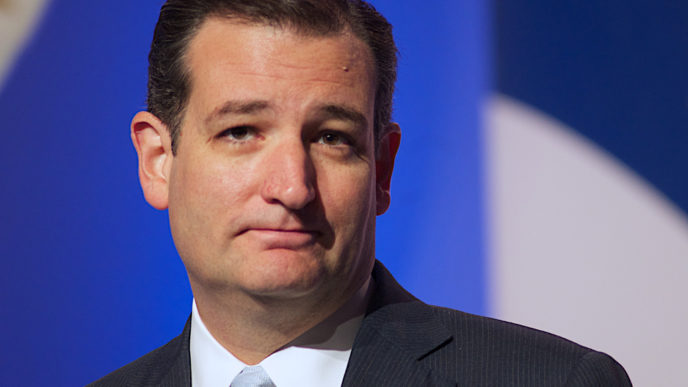
Seven Reasons Cruz’s Tough Call on Trump Really Isn’t a Tough Call at All

Now that the crowded 2016 field of mostly GOP beta males is tripping all over themselves to genuflect to their vanquisher Donald Trump – and what an embarrassment to the cause of manhood they are – all eyes are on Ted Cruz.

Will he, too, bend at the knee to Trump’s chocolate bunny?

Or will Cruz continue on the righteously ornery path that has taken him from political nobody to conservative superstar in only four years?

For now, Cruz is playing it smart. There’s no point in showing your hand if you’re Cruz, because right now there is no pressure on you. You’re no longer a candidate, and it is always the candidate’s obligation to woo the voters, not the voters’ task to contort their souls into pretzels on behalf of the candidate. That means the onus is on Trump, not Cruz, to unify.

If you’re gonna play the game, boy, you gotta learn to play it right. You gotta know when to hold em and know when to fold em.

But at some point in the coming weeks and months there will be a cash call, and I hope the man I’m proud to call a friend, and whose courage of conviction I admire, has the political savvy to realize that what may seem like a tough call for him really isn’t a tough call at all. Once you remove the peer pressure and group think, which Cruz has already made a career out of defying, and plan out the long-term consequences.

If I was in Cruz’s inner circle at this moment, here are the seven things I’d be telling him:

1. There is more at stake for you in this decision than anyone else.

With the possible exception of Scott Walker, who will rightfully be given a chance to resurrect himself because of his record in Wisconsin, none of the 16 GOP candidates not named Trump have a guaranteed political future except Cruz and Fiorina. For they are the only two non-Trump candidates who definitely ended the race with more political capital than what they started with.

Furthermore, this election cycle painfully revealed the paucity of principled conservative leaders to rally and inspire us. Therefore, Cruz owes it to both the people who gave him his political capital, as well as conservatism, to not be pennywise and pound foolish here. The list of people waiting in the wings should he sell his birthright tomorrow for a pot of stew today isn’t long or credible, thus Cruz blowing his political capital has far-reaching implications for millions of patriots in desperate need of leadership.

2. This is not 1976, and you’re not Reagan.

As a first-born son of the Reagan Revolution, Cruz was fond of comparing 2016 to 1980. Clearly that’s not the case—2016 turned out to be 1789 instead. Now he should resist the temptation to cast this as 1976 and himself in the Reagan role. See that as giving an impassioned speech at the convention that sets him up for the future, all the while claiming to be the loyal soldier for the good of the party in the meantime.

The reality is the only people who care about the good of the party are the folks Trump conquered, and don’t forget that before Trump arrived they hated Cruz the most. Once Trump is gone, Cruz will return as public enemy number one to these people. Cruz should learn from what happened with Trump in this campaign: you don’t endear yourself to foes you’ll have to destroy later. Besides, anyone who would consider voting for Cruz four years from now is more interested in a fighter than a unifier anyway.

3. Remember one of the 10 Commandments of Political Warfare: Don’t ever betray your base.

The only Republican with a future, whose base is likely to be disappointed if he kneels before Zod, is Cruz, for obvious reasons. Many of those people consider themselves “principle before party voters,” and they took Trump’s dirt bag attacks on Cruz’s family almost as personally as Cruz did. Cruz voters will be among the last to hold the line on #NeverTrump, and a chunk of them will never give up the ship. If Cruz endorses Trump he risks splitting his future base like no one else does. The dumbest thing to do when you have the biggest base heading into the future is to split it.

4. This is a rare opportunity in politics when the morally righteous thing to do is also the most politically expedient.

It’s rare in politics to be politically rewarded for doing the most principled thing, but that is the case here for Cruz. And it will be much easier for him to win over people mad at him for not “unifying” later than it would be to reunify his base if he were to endorse. Look at all the voters who don’t care Trump is a progressive and a Hillary donor. Look at all the other candidates groveling before the same Trump they once insulted. These are soulless people that will come to your beck and call in the future if you’re winning. But Cruz’s odds of winning diminish if he splits his base.

5. You will tarnish your brand, at least to some degree, because all the reasons to endorse Trump tarnish it.

How do you credibly endorse someone you called a “pathological liar” for the highest office in all the land after writing a book called “A Time for Truth”? How do you endorse a guy for president who dishonored your wife, called you a whoremonger, and claimed your dad was a presidential assassin? That’s pretty much the most beta thing ever. I’m going to point this out now as a friend, in the hopes that our enemies in the D.C. Cartel and media may not have to do it later.

6. You will open the door to being out-flanked as the insurgent once again in your next presidential run, as you were in this one.

The biggest reason Cruz could not beat Trump is that Trump out-flanked him as the insurgent candidate (and yes, the media had a lot to do with that but not everything). If Cruz endorses Trump, he risks this happening to him again in the future. Except in 2020 it won’t be another megalomaniac celebrity candidacy if Trump loses, but a new hotness like fellow Senator Ben Sasse.

Sasse has been AWOL near as I can tell on pretty much every major fight since he got to the Senate, but he clearly sees an opportunity with #NeverTrump and is wisely exploiting it. By the way, that’s not a criticism but a compliment. The GOP needs more politicians who see morally righteous causes as political opportunities, not fewer. Sasse also comes from a neighboring state to first-in-the-nation Iowa, and has already given a major political speech here in my backyard, so you can see him working.

In 2020, Sasse will have even more Senate experience than Cruz ran with in 2016, and he won’t have the stench of Trump on him. Freeing him up to go after a sizable bloc of primary voters that should be Cruz’s, unless he opens the door for a Sasse type later by endorsing Trump now. If Cruz does, someone like a Sasse could turn around and do to Cruz in Iowa four years from now what Cruz did to past caucus champions Mike Huckabee and Rick Santorum in 2016.

7. You literally gain nothing from this politically and it’s a one-sided waste of political capital.

Look at all the others who have assumed the position for Trump, and what have they gained politically for it? Answer: zilch. And at the cost of their integrities to boot. They now owe all their futures to Trump winning in November, and won’t have one if he loses.

Don’t be that guy.

Whatever you may think Trump will promise or hint at now, you know he won’t deliver later, but just mount Cruz’s scalp on the wall as another trophy. Like President Trump is going to spend one day fighting tooth-and-nail to confirm “Lyin Ted” to the U.S. Supreme Court. Come on, man.

On the other hand, the fertile political ground is the yet politically untapped #NeverTrump real estate. Cruz can have that all too himself, and it’s got long-term prospects. If Trump loses in November, Cruz becomes the immediate frontrunner in 2020. And if Trump wins, Cruz becomes the face of the principled opposition to what would likely be the most feckless presidency in the history of the republic.

Cruz learned early on there is hefty ROI potential on remaining principled in an era of cowards and charlatans. Now is the time for him to stay that course. (For more from the author of “Seven Reasons Cruz’s Tough Call on Trump Really Isn’t a Tough Call at All” please click HERE)

Follow Joe Miller on Twitter HERE and Facebook HERE.
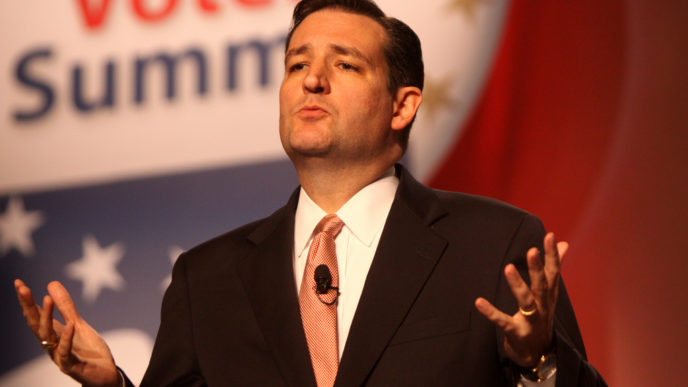
What the Wall Street Journal Got Wrong About Cruz’s Postmortem

Let’s be honest.

It hurts. To run for President of the United States, to get to the final round of primaries, and lose both a key primary and the hope of winning period? To be out there and have your family out there and lose? Yes, it stings.

But a word about Senator Ted Cruz.

Yes, yes, I know he is a conservative’s conservative. That is precisely why I have repeatedly suggested him for the second half of a Trump ticket, something that seems highly unlikely at this point. (Although Trump himself told Fox’s Bill O’Reilly the other night on the subject of Cruz for Vice President: “He really competed hard and tough, so I respect Ted. He’s certainly a capable guy, so it’s something we can think about.”) Here here!

But let’s be candid. Here is a Breitbart headline and part of a story that reflects the problem.

Poll: 70 Percent of Ted Cruz Supporters Now Dislike Donald Trump

Almost 7-out-of-10 of Sen. Ted Cruz’s supporters have an unfavorable opinion of Donald Trump, and fewer than 30 percent have a favorable view of the New Yorker, according to survey data from Morning Consult.

As the Breitbart story also points out, this wasn’t always the case.

This wasn’t always the case. At the end of 2015, of all his challengers, Trump’s favorable numbers were highest among Cruz supporters. More than half of Cruz’s backers, 53 percent, had a favorable view of the real estate developer. Just 39 percent of Cruz supporters had an unfavorable view of Trump.

By comparison, 60 percent of Sen. Marco Rubio’s supporters had an unfavorable view of Trump and just 38 percent had a positive opinion.

The positive feelings between Trump and Cruz supporters were even more reciprocal in the other direction. Among Trump’s backers, 61 percent had a positive view of Cruz, while only 21 percent had a negative view.

Among Trump’s supporters, in fact, Ted Cruz had a higher favorable rating than any other rival for the nomination.

Each were the top second choice of the other’s supporters.

One minute Trump and Cruz supporters were buds. Then not. Houston, we have a problem.

So let me start discussing this problem here, from the Trump side.

Certainly I am not in agreement with most of the Wall Street Journal’s “Cruz Postmortem” editorial. The WSJ says that Cruz had a “ruin-to-rule campaign strategy” and that it “crashed”. Said the WSJ:

The reasons for this crash go back to Mr. Cruz’s strategy to run for President that began from his earliest days in the Senate in 2013. He calculated he couldn’t stand out in the presidential pack if he merely attacked President Obama and Hillary Clinton. So he and his allies at the Heritage Foundation and the Mark Levin talk-radio right put together a strategy to inflame populist resentment against the GOP Congress and catapult Mr. Cruz to the White House.

In the narrative they contrived, true conservatives are forever betrayed by the corrupt leaders of what Mr. Cruz called “the Washington cartel.”

Thus they set up impossible feats of strength like the ObamaCare government shutdown, or phony tests of political purity on drones and gun control. Mr. Cruz also saw immigration as a wedge for the base and made it his signature.

What is incredulous here is the assignment of Cruz’s actions in the Senate as a cynical strategy to get elected president. Long before Ted Cruz appeared in the Senate there were plenty of people like me who agreed with, to quote the WSJ, “the Heritage Foundation and the Mark Levin talk-radio right” on the subject of a Washington Establishment gone off the rails. It took absolutely zero calculation for Ted Cruz to understand what was — and remains — a serious problem in American government. In the last few weeks I have had many, many conversations with Trump supporters. To a person they agree with some variation of what the WSJ scorns as the Heritage and Mark Levin talk-radio right.

I have repeatedly reiterated my support for Cruz as Trump’s VP. Why? Precisely because I believe as a conservative’s conservative he would add immeasurably to a Trump ticket and, critically, be the “conservative in the room” when it came time to decide about Supreme Court appointments and for that matter the entire appointments to the entire federal judiciary.

But this begs the obvious question. Why wasn’t I there for Ted Cruz for the top job?

Well aside from my support of Donald Trump – I was pro-Trump, decidedly not anti-Cruz — it appeared to me that — at least at this point — Senator Cruz was unable to reignite the fabled “Reagan coalition” in its modern incarnation. Which is to say a massive coming together of Americans from all walks of life — ages, income, gender, geography, race, and religion, not to mention Democrats and Independents as well as Republicans — around the core tenets of conservatism. And in doing so, move that coalition into the American future as the dominant force in American political life.

As the campaign launched, I confess I was uncertain of just how Cruz would play in my neck of the woods — the Northeastern, Mid-Atlantic states that range roughly from Maryland to Maine. And to confirm my suspicions, there were eventually the actual primary results. Yes, Cruz did carry Maine through its Republican State Convention. But alas, that was it. In fact, everywhere else in the Northeast and Mid-Atlantic states Senator Cruz got absolutely trounced in Republican primaries, some of them “open” and some of them not. Here in my home state of Pennsylvania, Trump carried all 67 counties, something that has never been done before by any presidential, senatorial or gubernatorial candidate in an open primary — in either party. There was no question in my mind that Donald Trump could carry Ted Cruz’s home state of Texas. There was considerable question whether Ted Cruz could carry Donald Trump’s home state of New York.

This cannot — must not — be ignored. In fact, this is an opportunity for Cruz moving forward.

Senator Cruz is frequently described in awed tones as a great Princeton debater, the star of Harvard Law and so forth. All to the good. But every single person who runs for the Presidency of the United States is humbled somewhere along the line by their political and human shortcomings as candidate or chief executive. Their success in either category comes because they reach inside themselves to acknowledge their problem, confront it — and move on.

If I may, again respectfully? I winced when I heard the Cruz presser early on in the day of the Indiana primary. Where he suddenly let loose in an emotional tirade with a vituperative frustration about Trump, Rupert Murdoch and Roger Ailes. In truth, it reminded me of this moment — which, I acknowledge one has to be old enough to recall. As preserved here in its original grainy black and white, this was known as “Nixon’s last press conference.” After losing a tight presidential race to JFK, Richard Nixon ran for governor of California two years later in 1962. He lost. Humiliated, exhausted and bitter, against the advice of his aides, he descended into the ballroom of a Los Angeles hotel the morning after the election and proceeded to launch an emotional tirade against the press. Among his lines, he said this was his “last press conference” and sarcastically said the press should think about how much they will miss him because “you won’t have Nixon to kick around anymore.” Suffice to say, it was mistake. A Grade-A political disaster that was used to haunt him for years to come. His enemies had an absolute field day. Within days ABC News was airing a show called “The Political Obituary of Richard Nixon” in which they gloated at his presumed political demise. In the White House, a dictaphone captured his old rival JFK talking with California Governor Pat Brown who had just defeated Nixon. Nixon was called “psychotic” a “nut” and “paranoid”. Not good.

The “last press conference” may have made Nixon feel better, but he finally came to his political senses. After quietly retreating awhile, moving to New York to start anew, by 1966 he was re-emerging as a much refreshed, solid, very polished and professional candidate. He had made his mistakes – and he had learned from them. Among other things he hired a young media savvy guy named Roger Ailes to do his media work in 1968. If nothing else, the success of Nixon in 1968 was a classic case of the candidate who confronted his problems directly, corrected them (never in 1968 was he not facing the spotlight without being rested and on his smiling professional game) and as a result finally winning the prize.

There is nothing wrong with losing a race for president. When Ted Cruz stood at that podium the other day surrounded by his family, notably his mother and wife Heidi — the latter whom I know and who is one of the world’s classiest human beings — he and they had every right in the world to be proud of his accomplishments as a candidate. In this corner, there is the distinct belief not just that he will be back. I believe he should be back.

But to come back implies the hope that after a time of well deserved rest, Senator Cruz will in his methodical, data-driven fashion sit down and try and figure out not just where he went wrong but what he did right and what he needs to do to make sure that the next time – or the next (it took Reagan three tries) – he can finally hit the political bullseye and be elected president.

The thought here is that the WSJ did in fact get one thing right in that editorial. This:

The Texan’s lost opportunity was to expand his appeal beyond his most conservative base of support and coalesce mainstream Republicans. He never tried to break out of his factional ghetto, as if excoriating the establishment and transgender bathroom laws could motivate a majority to defeat Mr. Trump’s plurality.

Inelegantly put, perhaps, but from here it would seem to be all too true. The other week I attended my first Trump rally. It was here in Central Pennsylvania. The Farm Show Complex, the largest venue in the capital city of Harrisburg, was almost filled literally to the rafters. An informal survey showed these folks numbering almost 10,000 in number to be a virtual conservative dream. Middle class, blue collar, lots of well-to-do and well-educated folk all rubbing shoulders with the less so. All passionate about The Donald. And yes, there were lots of talk radio fans in the crowd. Fans of Rush, Sean, Mark, Glenn and Laura.

There is no reason in a future American politics that all those Donald fans can’t be passionate about Ted Cruz. But they are not to be scorned, much less condescended to. In point of fact it is a huge mistake for Ted Cruz or his supporters to suddenly adapt the GOP Establishment elitist attitude and look down their noses at these Trumpians when in fact they have so much in common.

The Trump supporters I met at that rally are good, solid, decent Americans. They have responded to Donald Trump for a whole host of reasons. One Trump supporter stopped me in the local grocery store to relate that he had had a stroke and although recovered his dealings with Obamacare were a nightmare. He was decidedly unhappy. What he saw in Donald Trump was someone with a record of getting things done — a man of action. Ted Cruz was, notably, never mentioned. That’s not a diss, either. It is simply revealing of exactly why this one Trump supporter was supporting Trump.

Again, it is important as we move along here to face the hard reality that Donald Trump is where he is today because millions of people affirmatively set out to quite deliberately vote for him. Deriding his supporters, berating and condescending them is a guarantee that they will be permanently turned off — to Ted Cruz or any other conservative who thinks that at a later date they can approach these people and win their votes in a future campaign.

And Trump supporters? This is no time to gloat. Winning brings with it the responsibility of leadership. The obligation to listen, to respectfully consider honest dissent, to sit down and discuss. The fact of the matter here is that lots of very good, very honest and very conservative Americans voted for someone other than Donald Trump. A lot of them voted for Ted Cruz, and it is likewise critical to understand why. There is much, much common ground here in the Trump-Cruz dynamic, as that Breitbart story above noted when it said:

At the end of 2015, of all his challengers, Trump’s favorable numbers were highest among Cruz supporters. More than half of Cruz’s backers, 53 percent, had a favorable view of the real estate developer. Just 39 percent of Cruz supporters had an unfavorable view of Trump.

The only thing that has changed since the end of 2015 was the inevitable. To wit, a hard campaign that produced a Trump victory rather than a Cruz victory. And most assuredly, if Ted Cruz had won, I certainly would have been supporting him and it would correctly have been expected that other Trump supporters get on board as well.

This is an ongoing discussion. But for now?

No, it is not a good idea to elect Hillary Clinton by default. It is time to keep building the conservative movement. To understand just why it’s that a lot of genuine conservatives went out of their way to vote for Donald Trump, without the slightest animus towards Ted Cruz. And it is decidedly a moment for Ted Cruz and his supporters, past, present and future – to take an unblinking look at just what went wrong in this initial Cruz presidential campaign and how to correct it.

The future beckons for Ted Cruz. As with a defeated FDR in 1920 or Nixon in 1960 or Reagan in 1968 and 1976 or George H.W. Bush in 1980, the first defeat most assuredly does not mean eternal defeat. Far from it.

Here’s to wishing Ted Cruz well. That he may pull up his socks and get on with it. Because there is much getting on to do. (For more from the author of “What the Wall Street Journal Got Wrong About Cruz’s Postmortem” please click HERE)

Follow Joe Miller on Twitter HERE and Facebook HERE.

Radio Host Asks Cruz If He’d ‘Consider’ Serving on Supreme Court — and Gets This Answer Back

Sen. Ted Cruz (R-Texas) said he was not interested in serving as a justice on the Supreme Court Friday, telling a radio host that he had opportunities in the past “to go to the bench,” but that it was “not a desire of my heart.”

The comments came during an interview with WBAP-AM host Chris Salcedo.

“Everybody mentions your name, a lot of people do, and the Supreme Court,” Salcedo told Cruz. ”Frankly, all the times I’ve interviewed you, I’ve never asked if you have any aspirations or felt called if asked to serve on the Supreme Court.”

The host asked, “I mean, I know you have the sharp intelligence to handle the job. But is it even something you even consider?”

“You know, Chris, I’ll tell you. That is not a desire of my heart,” Cruz replied. (Read more from “Radio Host Asks Cruz If He’d ‘Consider’ Serving on Supreme Court — and Gets This Answer Back” HERE)

Follow Joe Miller on Twitter HERE and Facebook HERE.

Libertarian Presidential Candidate Says He Saw ‘Surge of Support’ After Cruz’s Departure

Could dissatisfaction with the choice between Republican presidential Candidate Donald Trump and Democratic presidential candidate Hillary Clinton set the stage for a third party to be successful in November? Libertarian presidential candidate Austin Petersen thinks so.

“I decided to run because I was frustrated with Donald Trump,” Petersen told TheBlaze in an interview Friday, arguing that Trump has not displayed an understanding of the constitutional limits of the executive branch’s power.

Petersen said his Libertarian campaign saw “a surge of support” after Sen. Ted Cruz suspended his bid for the Republican nomination particularly “from the #NeverTrump crowd.”

Following Cruz’s departure, Petersen said he is “the last constitutional candidate standing.”

Petersen said he hopes to “build a coalition” between libertarians and conservatives seeking an alternative to Trump in spite of their “real differences” over their shared respect for the Constitution. (Read more from “Libertarian Presidential Candidate Says He Saw ‘Surge of Support’ After Cruz’s Departure” HERE)

Follow Joe Miller on Twitter HERE and Facebook HERE.