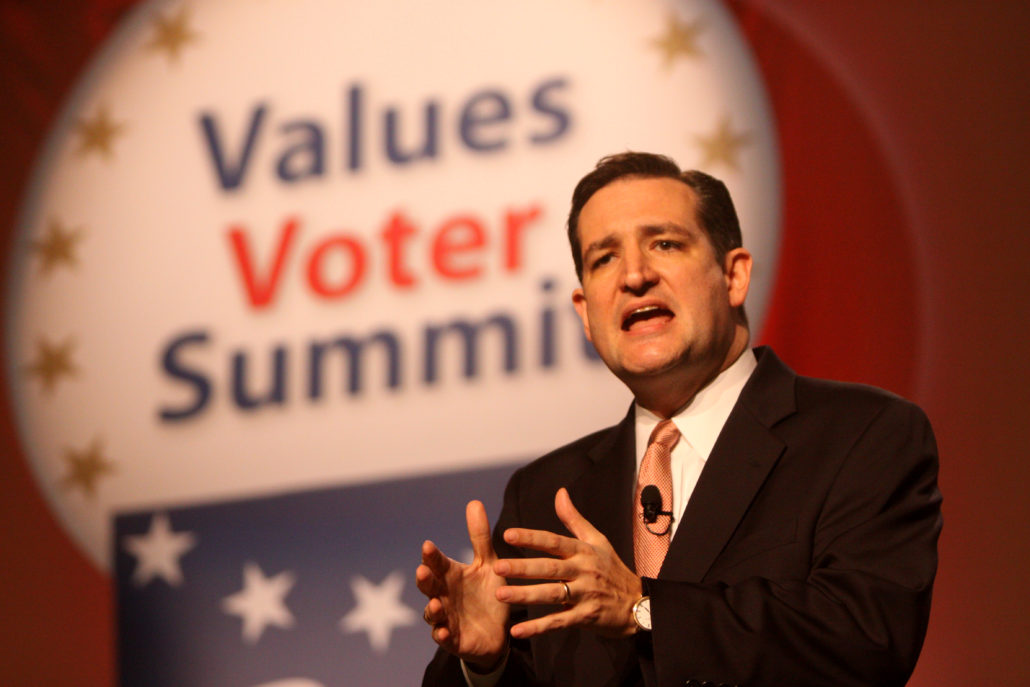
What the Wall Street Journal Got Wrong About Cruz’s Postmortem
Let’s be honest.
It hurts. To run for President of the United States, to get to the final round of primaries, and lose both a key primary and the hope of winning period? To be out there and have your family out there and lose? Yes, it stings.
But a word about Senator Ted Cruz.
Yes, yes, I know he is a conservative’s conservative. That is precisely why I have repeatedly suggested him for the second half of a Trump ticket, something that seems highly unlikely at this point. (Although Trump himself told Fox’s Bill O’Reilly the other night on the subject of Cruz for Vice President: “He really competed hard and tough, so I respect Ted. He’s certainly a capable guy, so it’s something we can think about.”) Here here!
But let’s be candid. Here is a Breitbart headline and part of a story that reflects the problem.
Poll: 70 Percent of Ted Cruz Supporters Now Dislike Donald Trump
Almost 7-out-of-10 of Sen. Ted Cruz’s supporters have an unfavorable opinion of Donald Trump, and fewer than 30 percent have a favorable view of the New Yorker, according to survey data from Morning Consult.
As the Breitbart story also points out, this wasn’t always the case.
This wasn’t always the case. At the end of 2015, of all his challengers, Trump’s favorable numbers were highest among Cruz supporters. More than half of Cruz’s backers, 53 percent, had a favorable view of the real estate developer. Just 39 percent of Cruz supporters had an unfavorable view of Trump.
By comparison, 60 percent of Sen. Marco Rubio’s supporters had an unfavorable view of Trump and just 38 percent had a positive opinion.
The positive feelings between Trump and Cruz supporters were even more reciprocal in the other direction. Among Trump’s backers, 61 percent had a positive view of Cruz, while only 21 percent had a negative view.
Among Trump’s supporters, in fact, Ted Cruz had a higher favorable rating than any other rival for the nomination.
Each were the top second choice of the other’s supporters.
One minute Trump and Cruz supporters were buds. Then not. Houston, we have a problem.
So let me start discussing this problem here, from the Trump side.
Certainly I am not in agreement with most of the Wall Street Journal’s “Cruz Postmortem” editorial. The WSJ says that Cruz had a “ruin-to-rule campaign strategy” and that it “crashed”. Said the WSJ:
The reasons for this crash go back to Mr. Cruz’s strategy to run for President that began from his earliest days in the Senate in 2013. He calculated he couldn’t stand out in the presidential pack if he merely attacked President Obama and Hillary Clinton. So he and his allies at the Heritage Foundation and the Mark Levin talk-radio right put together a strategy to inflame populist resentment against the GOP Congress and catapult Mr. Cruz to the White House.
In the narrative they contrived, true conservatives are forever betrayed by the corrupt leaders of what Mr. Cruz called “the Washington cartel.”
Thus they set up impossible feats of strength like the ObamaCare government shutdown, or phony tests of political purity on drones and gun control. Mr. Cruz also saw immigration as a wedge for the base and made it his signature.
What is incredulous here is the assignment of Cruz’s actions in the Senate as a cynical strategy to get elected president. Long before Ted Cruz appeared in the Senate there were plenty of people like me who agreed with, to quote the WSJ, “the Heritage Foundation and the Mark Levin talk-radio right” on the subject of a Washington Establishment gone off the rails. It took absolutely zero calculation for Ted Cruz to understand what was — and remains — a serious problem in American government. In the last few weeks I have had many, many conversations with Trump supporters. To a person they agree with some variation of what the WSJ scorns as the Heritage and Mark Levin talk-radio right.
I have repeatedly reiterated my support for Cruz as Trump’s VP. Why? Precisely because I believe as a conservative’s conservative he would add immeasurably to a Trump ticket and, critically, be the “conservative in the room” when it came time to decide about Supreme Court appointments and for that matter the entire appointments to the entire federal judiciary.
But this begs the obvious question. Why wasn’t I there for Ted Cruz for the top job?
Well aside from my support of Donald Trump – I was pro-Trump, decidedly not anti-Cruz — it appeared to me that — at least at this point — Senator Cruz was unable to reignite the fabled “Reagan coalition” in its modern incarnation. Which is to say a massive coming together of Americans from all walks of life — ages, income, gender, geography, race, and religion, not to mention Democrats and Independents as well as Republicans — around the core tenets of conservatism. And in doing so, move that coalition into the American future as the dominant force in American political life.
As the campaign launched, I confess I was uncertain of just how Cruz would play in my neck of the woods — the Northeastern, Mid-Atlantic states that range roughly from Maryland to Maine. And to confirm my suspicions, there were eventually the actual primary results. Yes, Cruz did carry Maine through its Republican State Convention. But alas, that was it. In fact, everywhere else in the Northeast and Mid-Atlantic states Senator Cruz got absolutely trounced in Republican primaries, some of them “open” and some of them not. Here in my home state of Pennsylvania, Trump carried all 67 counties, something that has never been done before by any presidential, senatorial or gubernatorial candidate in an open primary — in either party. There was no question in my mind that Donald Trump could carry Ted Cruz’s home state of Texas. There was considerable question whether Ted Cruz could carry Donald Trump’s home state of New York.
This cannot — must not — be ignored. In fact, this is an opportunity for Cruz moving forward.
Senator Cruz is frequently described in awed tones as a great Princeton debater, the star of Harvard Law and so forth. All to the good. But every single person who runs for the Presidency of the United States is humbled somewhere along the line by their political and human shortcomings as candidate or chief executive. Their success in either category comes because they reach inside themselves to acknowledge their problem, confront it — and move on.
If I may, again respectfully? I winced when I heard the Cruz presser early on in the day of the Indiana primary. Where he suddenly let loose in an emotional tirade with a vituperative frustration about Trump, Rupert Murdoch and Roger Ailes. In truth, it reminded me of this moment — which, I acknowledge one has to be old enough to recall. As preserved here in its original grainy black and white, this was known as “Nixon’s last press conference.” After losing a tight presidential race to JFK, Richard Nixon ran for governor of California two years later in 1962. He lost. Humiliated, exhausted and bitter, against the advice of his aides, he descended into the ballroom of a Los Angeles hotel the morning after the election and proceeded to launch an emotional tirade against the press. Among his lines, he said this was his “last press conference” and sarcastically said the press should think about how much they will miss him because “you won’t have Nixon to kick around anymore.” Suffice to say, it was mistake. A Grade-A political disaster that was used to haunt him for years to come. His enemies had an absolute field day. Within days ABC News was airing a show called “The Political Obituary of Richard Nixon” in which they gloated at his presumed political demise. In the White House, a dictaphone captured his old rival JFK talking with California Governor Pat Brown who had just defeated Nixon. Nixon was called “psychotic” a “nut” and “paranoid”. Not good.
The “last press conference” may have made Nixon feel better, but he finally came to his political senses. After quietly retreating awhile, moving to New York to start anew, by 1966 he was re-emerging as a much refreshed, solid, very polished and professional candidate. He had made his mistakes – and he had learned from them. Among other things he hired a young media savvy guy named Roger Ailes to do his media work in 1968. If nothing else, the success of Nixon in 1968 was a classic case of the candidate who confronted his problems directly, corrected them (never in 1968 was he not facing the spotlight without being rested and on his smiling professional game) and as a result finally winning the prize.
There is nothing wrong with losing a race for president. When Ted Cruz stood at that podium the other day surrounded by his family, notably his mother and wife Heidi — the latter whom I know and who is one of the world’s classiest human beings — he and they had every right in the world to be proud of his accomplishments as a candidate. In this corner, there is the distinct belief not just that he will be back. I believe he should be back.
But to come back implies the hope that after a time of well deserved rest, Senator Cruz will in his methodical, data-driven fashion sit down and try and figure out not just where he went wrong but what he did right and what he needs to do to make sure that the next time – or the next (it took Reagan three tries) – he can finally hit the political bullseye and be elected president.
The thought here is that the WSJ did in fact get one thing right in that editorial. This:
The Texan’s lost opportunity was to expand his appeal beyond his most conservative base of support and coalesce mainstream Republicans. He never tried to break out of his factional ghetto, as if excoriating the establishment and transgender bathroom laws could motivate a majority to defeat Mr. Trump’s plurality.
Inelegantly put, perhaps, but from here it would seem to be all too true. The other week I attended my first Trump rally. It was here in Central Pennsylvania. The Farm Show Complex, the largest venue in the capital city of Harrisburg, was almost filled literally to the rafters. An informal survey showed these folks numbering almost 10,000 in number to be a virtual conservative dream. Middle class, blue collar, lots of well-to-do and well-educated folk all rubbing shoulders with the less so. All passionate about The Donald. And yes, there were lots of talk radio fans in the crowd. Fans of Rush, Sean, Mark, Glenn and Laura.
There is no reason in a future American politics that all those Donald fans can’t be passionate about Ted Cruz. But they are not to be scorned, much less condescended to. In point of fact it is a huge mistake for Ted Cruz or his supporters to suddenly adapt the GOP Establishment elitist attitude and look down their noses at these Trumpians when in fact they have so much in common.
The Trump supporters I met at that rally are good, solid, decent Americans. They have responded to Donald Trump for a whole host of reasons. One Trump supporter stopped me in the local grocery store to relate that he had had a stroke and although recovered his dealings with Obamacare were a nightmare. He was decidedly unhappy. What he saw in Donald Trump was someone with a record of getting things done — a man of action. Ted Cruz was, notably, never mentioned. That’s not a diss, either. It is simply revealing of exactly why this one Trump supporter was supporting Trump.
Again, it is important as we move along here to face the hard reality that Donald Trump is where he is today because millions of people affirmatively set out to quite deliberately vote for him. Deriding his supporters, berating and condescending them is a guarantee that they will be permanently turned off — to Ted Cruz or any other conservative who thinks that at a later date they can approach these people and win their votes in a future campaign.
And Trump supporters? This is no time to gloat. Winning brings with it the responsibility of leadership. The obligation to listen, to respectfully consider honest dissent, to sit down and discuss. The fact of the matter here is that lots of very good, very honest and very conservative Americans voted for someone other than Donald Trump. A lot of them voted for Ted Cruz, and it is likewise critical to understand why. There is much, much common ground here in the Trump-Cruz dynamic, as that Breitbart story above noted when it said:
At the end of 2015, of all his challengers, Trump’s favorable numbers were highest among Cruz supporters. More than half of Cruz’s backers, 53 percent, had a favorable view of the real estate developer. Just 39 percent of Cruz supporters had an unfavorable view of Trump.
The only thing that has changed since the end of 2015 was the inevitable. To wit, a hard campaign that produced a Trump victory rather than a Cruz victory. And most assuredly, if Ted Cruz had won, I certainly would have been supporting him and it would correctly have been expected that other Trump supporters get on board as well.
This is an ongoing discussion. But for now?
No, it is not a good idea to elect Hillary Clinton by default. It is time to keep building the conservative movement. To understand just why it’s that a lot of genuine conservatives went out of their way to vote for Donald Trump, without the slightest animus towards Ted Cruz. And it is decidedly a moment for Ted Cruz and his supporters, past, present and future – to take an unblinking look at just what went wrong in this initial Cruz presidential campaign and how to correct it.
The future beckons for Ted Cruz. As with a defeated FDR in 1920 or Nixon in 1960 or Reagan in 1968 and 1976 or George H.W. Bush in 1980, the first defeat most assuredly does not mean eternal defeat. Far from it.
Here’s to wishing Ted Cruz well. That he may pull up his socks and get on with it. Because there is much getting on to do. (For more from the author of “What the Wall Street Journal Got Wrong About Cruz’s Postmortem” please click HERE)
Follow Joe Miller on Twitter HERE and Facebook HERE.