A Transportation Security Administration agent in Seattle was arrested after allegedly being spotted using a phone to take video up a woman’s skirt at the city’s airport, according to authorities.
Nicholas Fernandez, 29, was arrested on a charge of voyeurism Tuesday, Seattle police said in an arrest report. The incident occurred on an escalator, and not in a security line . . .
“When such conduct is alleged, TSA investigates it thoroughly. When appropriate, TSA requests that it be investigated by a law enforcement authority. When an investigation finds that misconduct has occurred, the appropriate action is taken.”
Fernandez has been removed from screening duties and he has been suspended without pay, the agency said.
According to an arrest report, the TSA was investigating information it received that Fernandez, who works at Seattle Tacoma International Airport, might have taken inappropriate photos of women. (Read more from “Seattle TSA Worker Arrested on Voyeurism Charge” HERE)
Hannah Cohen, 19, and her family are suing the TSA after a head injury suffered as the result of a TSA officer tackling her onto the floor. Hannah is a St. Jude’s cancer patient, who is partially deaf and blind in one eye. She is a patient at St. Jude’s, in treatment for a brain tumor discovered 17 years ago.
The horrible incident occurred as she was on a trip home to Chattanooga with her mom Sarah Cohen, after a series of treatments for the tumor at St. Jude’s Hospital.
The family has made the trip for 17 years since the tumor was discovered, and have never experienced any troubles at the airport. This time however, as Hannah and her mom were progressing through a TSA checkpoint at Memphis International Airport, she set off the metal detector.
Hannah, young and in a disabled state, was understandably confused by the TSA agents who suddenly approached her. She tried to avoid them, and moved away confused by the sudden approach of the officers.
Prior to approaching Hannah, the TSA agents told her mother they wanted to do additional screening after the alarms went off.
What was originally intended to be “additional screening” turned into a physical and bloody scuffle.
As Hannah tried to escape what she perceived to be a threat, one of the agents tackled her to the ground, ramming her head into the floor in the process.
“She’s trying to get away from them but in the next instant, one of them had her down on the ground and hit her head on the floor. There was blood everywhere,” recalled her mother.
During the incident, her mother tried to tell the officers multiple times that Hannah had various medical issues and that she was just confused, but was forced back as the agents took her daughter away in handcuffs.
After the misunderstanding-turned-spectacle subsided, Hannah was arrested and booked in the airport’s jail, apart from her mother.
The Cohen family unexpectedly spent the night in the airport, with Hannah isolated, and no access to their luggage.
“Here we were with nowhere to go, not even a toothbrush, our bags had gone to Chattanooga,” Hannah’s mom recounted.
The charges were later thrown out by authorities and Hannah was finally released.
“She’s 19 but she’ll always be my baby. We’ve been through so much.”
The TSA would not comment directly to the incident, but released a statement in the aftermath saying, “Passengers can call ahead of time to learn more about the screening process for their particular needs or medical situation.”
Upset with how things were handled, the Cohen family is planning to bring a lawsuit against the Memphis Airport, Airport Police and the TSA for negligent conduct and injuries suffered by Hannah. (For more from the author of “Family of Disabled 19-Year-Old Girl Suing TSA for Mistreatment” please click HERE)
We’ve all had to awkwardly stand in line at airport security as the Transportation Security Administration (TSA) herds hundreds of passengers to departure gates. Long lines only add to the already stressful event of flying.
Our current airport security process has become a running joke (along with long waits at the DMV or the “simplicity” of doing taxes).
Here are a few measures that could increase security at airports while shortening the wait time:
1. Expand the Screening Partnership Program
TSA’s current budget isn’t allowing it to meet the demand at airports but throwing more money at TSA won’t solve any long term inadequacies. As my colleague David Inserra has previously written:
Almost all European countries and Canada use private airport screeners. In the United States, airports have the right to opt out of TSA-administered screening through the Screening Partnership Program, which swaps out TSA screeners in favor of private contractors with TSA oversight.
The Screening Partnership Program’s ability to take advantage of private security companies is one way the TSA can meet high passenger demand without sacrificing security.
However, the Screening Partnership Program isn’t being used to its full potential. Burdensome regulations mandating the TSA hand-pick Screening Partnership Program contractors are limiting and slowing airports’ access to security vendors.
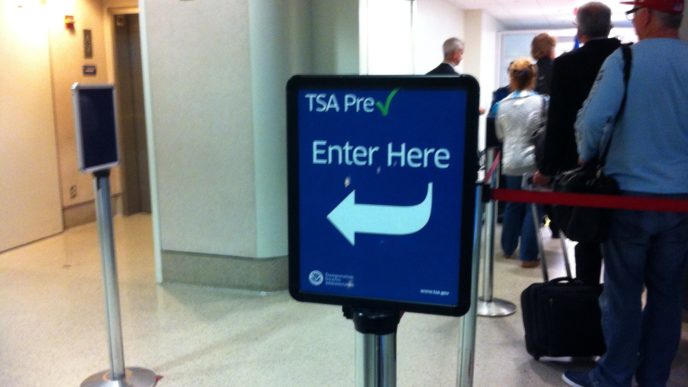
2. Enlarge and Strengthen TSA PreCheck
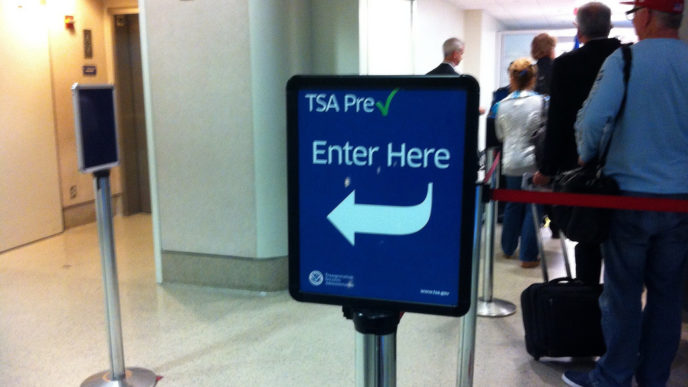
TSA PreCheck is a trusted traveler program that allows members to expedite the security process after going through a background check and vetting process.
The program allows TSA to move its resources towards a more risk-based approach by focusing less time on low-risk travelers. Congress and the TSA should be looking for ways to expand enrollment in TSA PreCheck.
3. Ensure Airports Screening is Subject to Risk Assessments and Red Team Tests
Waiting in TSA lines is partially alleviated because the TSA is supposedly providing extra security. That’s why it’s important to continue assessing the effectiveness of the TSA’s security measures. Red Teams, or undercover agents are one way to test that TSA security measures are working.
In the meantime, it’s up to passengers to also take personal responsibility in preparing themselves for security check points.
Checking wait times at the local airport before flying and making sure not to carry-through any prohibited items will help the TSA maintain order and alleviate waiting time—though this is no panacea.
It will ultimately be up to Congress to improve the TSA and better our airport security waiting times and security. (For more from the author of “3 Ways TSA Could Improve Wait Times” please click HERE)
Homeland Security Secretary Jeh Johnson warns air travelers to prepare for much longer than usual airport security lines, but a Transportation Security Administration watchdog says this mess is simply a matter of the government failing to manage its resources responsibly.
On Monday, Johnson stood at Ronald Reagan National Airport just outside Washington and told passengers to expect longer than expected wait times as the Transportation Security Administration, or TSA, expedites hundreds of new personnel into service to speed up the security process. In Chicago, passengers were told to arrive three hours prior to departure.
The TSA claims congressional action has led to the elimination of some 4,500 personnel over the past few years and the agency simply doesn’t have the manpower to keep up, but that’s just spin according to Chris Edwards, director of tax policy studies at the Cato Institute. He also run Cato’s Downsizing Government blog.
Edwards told WND and Radio America the TSA is littered with problems, starting with its existing personnel.
“Annual surveys of federal government employees find that the TSA and the broader Homeland Security Department have some of the poorest morale in the federal government,” Edwards said. “The TSA has a high turnover rate for their screeners, which is not good for morale and is not good for security.” (Read more from “TSA Watchdog Spills Secret Behind Long Airport Lines” HERE)
A Capri Sun juice pouch mistakenly left in a 10-year-old San Diego girl’s carry-on handbag led a TSA agent to subject the girl to almost two minutes of frisking and extra screening that lasted about an hour, her father said.
Liquids exceeding 3 ounces are not allowed in carry-on bags, for fear they might contain explosives, but the girl’s father said the resulting search was an over-reaction and an inappropriate intrusion.
Kevin Payne of Pacific Beach and his daughter, Vendela, were passing through the Raleigh-Durham International Airport on Dec. 30, 2015, headed home to San Diego, when U.S. Transportation Security Administration agents discovered the liquid.
Authorities followed up with a swab of the bag and a false-positive test for explosives, then a nearly 2-minute-long full-body pat-down in which a female TSA agent touched the girl’s buttocks and groin repeatedly. (Read more from “Veteran’s 10-Year Old Daughter Repeatedly Groped by TSA – and It’s Caught on Tape” HERE)
https://joemiller.us/wp-content/uploads/logotext.png00Joe Millerhttps://joemiller.us/wp-content/uploads/logotext.pngJoe Miller2016-01-07 00:08:072016-04-11 10:54:08Veteran’s 10-Year Old Daughter Repeatedly Groped by TSA – and It’s Caught on Tape
Your next flight might include a mandatory trip through the body scanner, with the US government quietly changing the opt-out rules for searches. In a document published earlier this month, the Department of Homeland Security outlined an update to the Advanced Imagery Technology protocols used by the TSA at US airports, adding a clause which allows officers to insist travelers go through the controversial machines.
Previously, though the body scanners were present at many airports across the country, travelers were free to opt-out of the process. Billed as a privacy consideration, it meant a physical screening was mandatory, but alleviated concerns held by some that the technology could “see them naked” and store photographs of that.
Now, though, that option is being diluted, though not completely retired.
“TSA is updating the AIT PIA to reflect a change to the operating protocol regarding the ability of individuals to opt opt-out of AIT screening in favor of physical screening,” the DHS writes. “While passengers may generally decline AIT screening in favor of physical screening, TSA may direct mandatory AIT screening for some passengers.”
No more detailed explanation for the change is given. However, it seems likely that the scanners’ ability to single out metallic objects hidden around the body – and that might have been missed by a physical search from a TSA agent – is seen as invaluable for whoever security services believe presents a greater-than-normal risk. (Read more from “Now the TSA Can Force You to Go Through the Body Scanner” HERE)
https://joemiller.us/wp-content/uploads/logotext.png00Joe Millerhttps://joemiller.us/wp-content/uploads/logotext.pngJoe Miller2015-12-24 00:49:112016-04-11 10:54:42Now the TSA Can Force You to Go Through the Body Scanner
By Philip Messing. A uniformed TSA agent lured a college student into a La Guardia Airport men’s room under the pretense she needed more screening — and then he molested the woman, sources told The Post on Friday.
Shortly after the attack, suspect Maxi Oquendo allegedly pretended to pore over surveillance video looking for the perp, but he was identified by witnesses and arrested . . .
The sick attack happened right after the 22-year-old victim, from South Korea, got off a Southwest Airlines flight from Salt Lake City at about 8 p.m. Tuesday in Terminal B and was allegedly approached by Oquendo, 40 . . .
Oquendo was working as a TSA evening supervisor that night. After learning that a sex complaint had been filed, he went through the motions of reviewing video surveillance footage, sources said.
But two female witnesses who work at the airport were able to help provide a description that matched the heavyset Oquendo, sources said. (Read more from “Student Molested by TSA Agent in New Work Airport” HERE)
_____________________________________________
TSA Screener Accused of Molesting College Student in LaGuardia Airport Bathroom
By Carolina Leid. A TSA screener is accused of sexually assaulting a woman at LaGuardia Airport in New York City after telling her she needed to be searched in the bathroom.
The suspect did not post $3,000 bail and was moved to jail late Friday night.
Defense attorneys argued two witnesses said they saw another man, but prosecutors say the victim picked Maxie Oquendo out in a lineup.
The TSA screener is accused of using his job to lure a passenger into a bathroom at LaGuardia Airport under the guise that he needed to search her for weapons.
Maxie Oquendo allegedly sexually assaulted a 22-year-old student from South Korea after her Salt Lake City flight landed Tuesday afternoon. (Read more from this story HERE)
https://joemiller.us/wp-content/uploads/logotext.png00Joe Millerhttps://joemiller.us/wp-content/uploads/logotext.pngJoe Miller2015-08-29 00:41:572015-08-29 00:41:57Student Molested by TSA Agent in New York Airport
The Transportation Security Administration spent $160 million on body scanners that have largely failed to detect airport security threats.
Politico reported that the government agency paid $120 million for the body scanners currently in place at airport checkpoints across the country in addition to another $40 million on the “naked” X-ray scanners removed from airports two years ago amid health and privacy concerns.
The TSA, which recently disclosed the costs to members of Congress probing the agency, on average spent over $150,000 per unit of body imaging technology since it first began purchasing the scanners in 2008.
The acting TSA head was reassigned in June after a security audit revealed that the agency’s devices failed to detect fake weapons and explosives 96 percent of the time in secret tests . . .
Senate Homeland Security Chairman Ron Johnson (R., Wis.) said that the scanners are so unsuccessful–“These things weren’t even catching metal,” he warned–that they should be preceded by metal detectors. (Read more from “TSA Spent $160 Million on Failed Body Scanners, ‘Naked’ X-Rays” HERE)
https://joemiller.us/wp-content/uploads/logotext.png00Joe Millerhttps://joemiller.us/wp-content/uploads/logotext.pngJoe Miller2015-08-18 01:29:232015-08-18 01:29:23TSA Spent $160 Million on Failed Body Scanners, ‘Naked’ X-Rays
On the heels of a revealing report demonstrating its ineptitude at catching would-be bombers, the Transportation Security Administration (TSA) has been targeted with a second damning report — this time for failing to properly vet new employees, several of whom turned out to be linked with the very terror groups agencies like TSA take pride in thwarting.
An Inspector General’s (IG) report Monday revealed the beleaguered agency “did not identify 73 individuals with terrorism-related category codes because TSA is not authorized to receive all terrorism-related information under current interagency watchlisting policy.”
While the review found the agency’s performance in using available employee-vetting practices to be “generally effective,” it also noted that TSA’s limited ability to cross-reference potential hires with all available watchlist information allowed more than six dozen applicants with possible terror ties to be hired and receive security clearance.
The report also notes that TSA left much of the vetting process to airports, which themselves did not uniformly apply the same set of standards to weeding through the agency’s pool of job applicants . . .
TSA took a beating in the public eye last week, with even mainstream media picking up an IG report explaining how auditors from the Department of Homeland Security were able to sneak weapons and bomb materials past TSA screeners 95 percent of the time. (Read more from “TSA Hired Dozens With Links to Terror Groups” HERE)
https://joemiller.us/wp-content/uploads/logotext.png00Joe Millerhttps://joemiller.us/wp-content/uploads/logotext.pngJoe Miller2015-06-15 03:42:092016-04-11 11:00:00TSA Hired Dozens With Links to Terror Groups
Whistleblowers on Tuesday portrayed the beleaguered Transportation Security Administration as an agency mired in a culture of “fear and distrust” while raising security concerns over several programs — including TSA PreCheck, in which passes for expedited screening allegedly are passed out “like Halloween candy.”
The TSA employees leveled their criticism during a Senate hearing that follows recent bombshell inspector general reports. One showed undercover agents were able to sneak fake explosives and banned weapons through airport checkpoints about 96 percent of the time; the findings led to the acting TSA secretary being reassigned last week. A second report released Monday showed the agency failed to flag 73 commercial airport workers “linked to terrorism.”
The hearing was cut short by a bomb threat, though investigators did not find anything hazardous.
Before the hearing was broken up, Rebecca Roering, an assistant TSA federal security director at the Minneapolis-St. Paul International Airport, told the Senate Homeland Security and Governmental Affairs Committee that the agency suffers from low morale. She said this is in part the result of agency leadership, composed of too many former commercial airline executives “placing more emphasis on customer service and passenger wait times than on security and detection rates.”
As part of this, she argued, TSA significantly expanded its PreCheck program. It now boasts more than 1 million enrollees who enjoy expedited security screening at airports. However, roughly 7 million are allowed to use it, according to whistleblowers. (Read more from “TSA Whistleblowers Describe Security Concerns, Culture of ‘Fear and Distrust'” HERE)