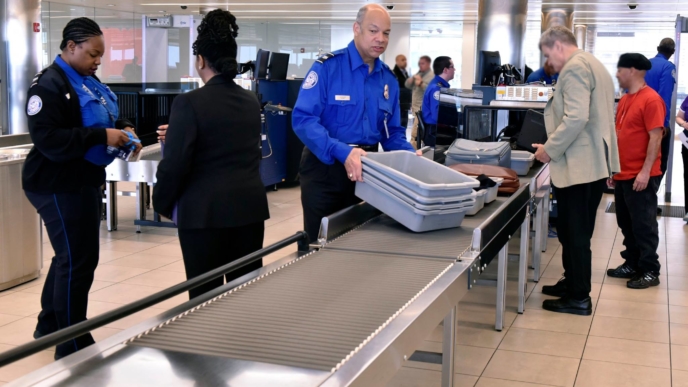
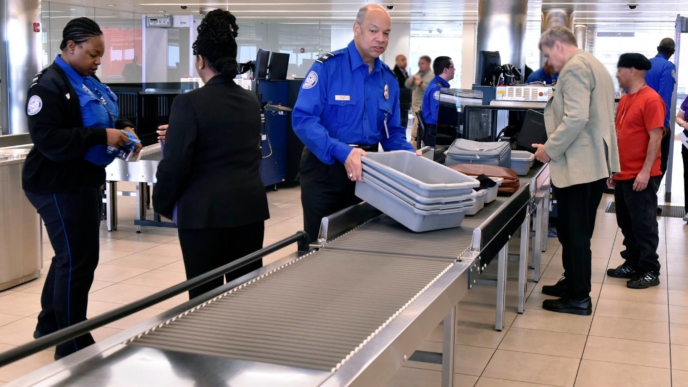
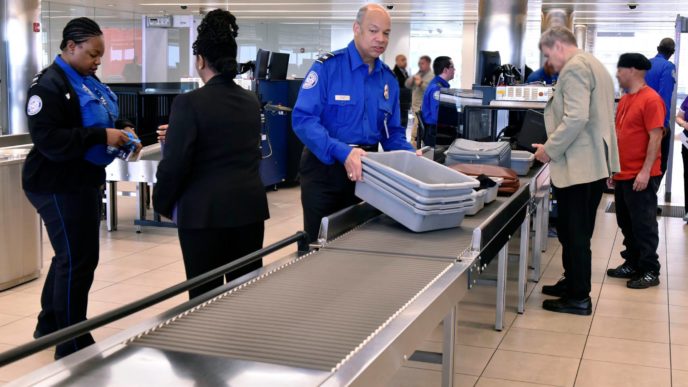
The Department of Homeland Security is proposing a rule that would allow the government to use facial recognition data to identify everyone traveling to and from the country, including U.S. citizens.
Non-citizens traveling through U.S. airports have been required to get their fingerprints scanned and have their picture taken since the mid-noughties. American citizens have enjoyed the choice of opting out of this requirement. However, in a recent regulatory filing, DHS is pushing to require all international travelers — including U.S. citizens — have their photograph taken. . .
“To facilitate the implementation of a seamless biometric entry-exit system that uses facial recognition and to help prevent persons attempting to fraudulently use U.S. travel documents and identify criminals and known or suspected terrorists, DHS is proposing to amend the regulations to provide that all travelers, including U.S. citizens, may be required to be photographed upon entry and/or departure,” the filing continues.
Facial recognition technology, which has become increasingly popular at airports across the country, matches an image taken of a traveler to a still image of them stored in a database.
Not only is the tech able to catch criminals and prevent fraudulent activity, it also can dramatically speed up processing times for travelers. The verification process can take less than two seconds and touts a 99% match rate, according to Customs and Border Protection. (Read more from “Trump Admin Proposes Using Facial Recognition on All Airport Travelers – Including Americans” HERE)
https://joemiller.us/wp-content/uploads/Thank_you_TSA_25958200086-3.jpg13652048Joe Millerhttps://joemiller.us/wp-content/uploads/logotext.pngJoe Miller2019-12-03 16:20:252019-12-03 16:18:06Trump Admin Proposes Using Facial Recognition on All Airport Travelers – Including Americans
U.S. Customs and Border Protection’s computers systems shut down nationwide on Friday, prompting widespread delays at airports across the country.
New York City’s John F. Kennedy Airport confirmed the computers were down and said officials were moving quickly to get its system up and running.
LAX also confirmed its CBP computers were offline, writing on Twitter: “.@CBP systems are experiencing an issue which appears to be impacting multiple airports including LAX. Officers are processing passengers manually so please check with your airline for the latest status of any flight impacts. More details as they become available.”
.@CBP systems are experiencing an issue which appears to be impacting multiple airports including LAX. Officers are processing passengers manually so please check with your airline for the latest status of any flight impacts. More details as they become available.
Here’s a better perspective of the customs line at JFK. People are growing frustrated. Nothing like landing after a 10 hour flight to this. pic.twitter.com/WrEUsoJhbH
https://joemiller.us/wp-content/uploads/1455388018_a2af1b18fd_b-2-1.jpg6141024Joe Millerhttps://joemiller.us/wp-content/uploads/logotext.pngJoe Miller2019-08-16 23:46:552019-08-16 23:44:22WATCH: Customs Computers Systems Down, Major Delays at Airports across Country
. . .A passenger flying through Seattle-Tacoma International Airport last month was stopped when a knife was found hiding in flower stems the traveler was trying to bring in their carry-on.
The traveler was stopped during the routine screening of carry-on luggage on July 23, the Transportation Security Administration (TSA) shared. . .
On Tuesday morning, a man was recorded charging Transportation Security Administration (TSA) officers at the Phoenix Sky Harbor International Airport.
The newly-released video shows 19-year-old Tyrese Garner rushing a TSA security checkpoint at Terminal 4, around 9:45 a.m. on June 18th. Garner, reportedly unprovoked, pushed past other passengers and through the metal detector and injuring at least five TSA employees in his assault. . .
Arizona police arrested him on charges of criminal trespassing, assault, and resisting arrest. Local ABC affiliate Channel 15 reported that Garner attempted to “resist arrest, kicking and writhing while refusing to be taken out of the terminal.”
“Got done putting my shoes on and was walking down the hallway part there and all of a sudden I heard screaming and hollering,” witness Donnie Jones recalled.
“When he was coming over that counter… He was, like, jumping at somebody, and you could just see a bunch of swinging, and that, and you couldn’t really tell what was going on,” he continued. “I don’t know what his deal was. It was just an unhappy guy rushing through there.” (Read more from “Released Surveillance Video Shows TSA Attacker at Airport” HERE)
On Tuesday night, President Donald Trump flagged a disturbing video of a TSA agent aggressively and excessively patting down a young boy with a disability at the Dallas/Fort Worth Airport.
Absolutely ridiculous! How many times do you have to feel a kid up to figure out he’s not a threat? This is infuriating and hard to watch. RT @RealJamesWoods: Uh… pic.twitter.com/UK7RNGKU02
The video first surfaced online in 2017. The boy’s mother, Jennifer Williamson, explained on public radio that her family was traveling from Texas to San Diego on a family vacation when her 13-year-old son Aaron, who suffers from Sensory Processing Disorder (SPD), was pulled aside for the invasive search by TSA.
According to radio station WIBX 950, Williamson posted the disturbing video to Facebook, where it quickly went viral, garnering tens of thousands of messages from social media users upset over the “creepy” interaction.
“We were told in no uncertain terms that either we comply immediately without question or we be escorted from the airport,” Williamson explained during an appearance on “First News with Keeler in the Morning” in the wake of the ordeal.
The mother agreed with the host that her son was “groped” by the agent. “There was no question it was excessive and way beyond what needs to be necessary,” she said. (Read more from “Disturbing Video of TSA Agent Patting Down Boy With Disability Flagged by Trump” HERE)
https://joemiller.us/wp-content/uploads/1455388018_a2af1b18fd_b-3.jpg6141024Joe Millerhttps://joemiller.us/wp-content/uploads/logotext.pngJoe Miller2019-03-20 19:03:122019-03-20 19:00:35Disturbing Video of TSA Agent Patting Down Boy With Disability Flagged by Trump
The other day, after slogging through a check-in line at one of the nation’s busiest airports, dutifully removing my shoes and belt and checking my bag and pockets for other potentially dangerous items (water and loose change), I was pulled aside by a crack Transportation Security Administration (TSA) agent so he could further investigate the contents of my carry-on. While waiting, I took this picture of what looked to be a ten-year-old boy being molested by a 250-pound man.
Now, normally I would have reported this incident to the proper authorities. Inappropriate contact with a child, inside or outside his clothing, is a criminal act. But, in this case, the proper authorities were the ones feeling up the kid and the father had already protested the frisking—although, like all of us, he probably understood that no matter how vociferously he objected to this bit of state-sanctioned criminality it wasn’t going to change anything.
Who knows? Maybe the kid had earned the attention of TSA by sporting that Minecraft hoodie? Or maybe his laptop had set off the explosive trace detection machine? Or maybe he was randomly picked. The boy looked innocent enough to me—which might be exactly what the little would-be villain had in mind. When the father inquired, the agent told him, right before touching his son’s crotch, that this sort of thing had become necessary due to drug mules using children.
If you don’t think the terrorists have won, you probably haven’t visited an airport in a while. Not only do these places needlessly gobble up hours of our day and billions of our dollars, but here that we collectively lose all dignity and act like a bunch of automatons just so they’ll let us out of the place. Though sometimes it seems like we might never escape. If we really wanted to slow the caravan from Central American down, we would make them enter through a TSA checkpoint.
It is at those checkpoints that we suspend our disbelief and pretend that (often) disheveled and (very often) rotund government agents who separate us from our water bottles possess the expertise to ferret out terrorist plots. (By the way, is there not a single physical requirement needed to hold this allegedly vital security job? There are many good reasons I’m not a pro-basketball player or a male model. If you’re not in relatively good physical shape, maybe law enforcement isn’t the profession for you. The only way these agents are the “the last line of defense against terrorism” is if the terrorists are unable to squeeze by them to get on the airplanes.) (Read more from “Dear TSA, Please Stop Molesting Kids at the Airport” HERE)
Talk about an invasion of privacy. Millions of people have watched TSA agents pat-down, search, and creep upon a 96-year-old wheelchair bound mother. While public safety and airport security is important, many are saying this was over the line and completely unnecessary. Still, others assert the TSA agents were doing their duty.
Jeanne Clarkson was traveling with her mother, Evelyn Labrier who happens to be in a wheel chair when TSA agents decided that her mother might some how pose a security threat and needed an invasive pat-down.
“I was just shocked. I’ve traveled with her before, I’ve been in a wheelchair myself unable to walk through the machines and I’ve never had that kind of a pat-down ever. I was just shocked. I couldn’t believe they were doing this to my 96-year-old mother,” Jeanne Clarkson told CBS News transportation correspondent Kris Van Cleave. “It was just shock, and frustration because they would not talk to me. I felt helpless.”
Clarkson says she, her fiancé and Evelyn LaBrier were traveling back home to Anderson, Indiana after visiting her son in Maryland. The TSA screener was polite and explained what was happening during the search which included a pat-down of LaBrier’s chest and pelvis region.
. . .
Commenters on Facebook have offered a mix bag of reactions. Some say “This poor lady! Her shoulder was stiff and she needed that arm rest so badly! She was so patient! She may have needed to use the restroom after all that prodding! Bless her!” and “Wow,sorry your mother had to go through that,like she has something to hide.where do they get these ingorant (sic) people?”
(Read more from “Good Grief: TSA Searches 96-Year-Old Wheelchair Bound Woman, Sparks Debate” HERE)
A former police officer had her tiny gun necklace confiscated at airport security because it was “too dangerous” and passengers might think it was real.
Claire Sharp, who used to work for special branch, had the piece of jewellery taken off her as she was travelling to Perugia in Italy from London Stansted Airport on Friday.
The charm had sentimental value as it was a present from her husband Nigel Greenwood, who died suddenly in 2001, aged just 32 from a heart attack, because of their shared love of shooting and membership of a gundog club.
It is around an inch long and Sharp wears it everyday in memory of her late husband who she described at the time as her “best friend.”
Sharp was travelling with her current husband, Lee, who is also a sergeant in the Met Police, and their 12-year-old daughter, Faye, when airport security staff told her she would not be able to take the necklace on the plane. (Read more from “Woman Claims Airport Security Confiscated Her Gun Necklace Because It Was ‘Potentially Dangerous'” HERE)
https://joemiller.us/wp-content/uploads/Thank_you_TSA_25958200086-1.jpg8531280Joe Millerhttps://joemiller.us/wp-content/uploads/logotext.pngJoe Miller2018-03-06 18:15:522018-03-06 18:15:52Woman Claims Airport Security Confiscated Her Gun Necklace Because It Was ‘Potentially Dangerous’
I cannot believe what I am writing, the TSA has officially invaded auto manufacturing.
According to a Lincoln Motor Company media release, their 2018 Lincoln’s will offer ‘complimentary’ CLEAR biometric memberships to new car owners.
Working with CLEAR, Lincoln takes effortless travel to the next level, offering complimentary memberships for new Lincoln owners. (Source)
Lincoln owners and their passengers wishing to travel to the airport or sports arenas will have the ‘complimentary’ pleasure of being spied on by DHS!
To help make airport travel easier, Lincoln is collaborating with CLEAR – which offers the fastest, most predictable way through security – to provide new Lincoln owners with a complimentary CLEAR membership, allowing them to speed through security at participating airports and major arenas nationwide. (Source)
Last year, I warned everyone that auto manufactures were working to put iris and fingerprint scanners in new cars. And now it appears that my worst fears have become a reality.
Lincoln’s spying vehicles are much worse than you can imagine.
Cars will scan drivers irises and fingerprints
CLEAR is a DHS-approved platform that stores people’s biometrics for the government. Currently, CLEAR is being used to spy on people in over 30 airports and arenas in the U.S.
CLEAR delivers secure and easy travel to more than 30 airports and arenas nationwide. At participating venues, members go to a dedicated CLEAR lane where they are greeted by a CLEAR team member. After a simple finger tap or blink of an eye, members are escorted straight to security screening, bypassing the usual long lines. According to CLEAR, members walk through security in minutes every time. (Source)
And who wouldn’t want a ‘complimentary’ government approved vehicle surveillance system, that pre-checks drivers and passengers into airports and sports arenas?
Sports leagues like the NHL have also begun installing facial biometric cameras. Pretty soon no one will be able to watch a sporting event without DHS knowing who you are. FYI, sports arenas are also secretly spying on everyone’s instant messages and Tweets.
CLEAR claims, they are thrilled to make travel simpler. But what they are really doing is making government spying simpler.
“We are thrilled to be part of Lincoln’s vision to enhance its clients’ lives in new and exciting ways,” said CLEAR CEO Caryn Seidman-Becker. “There is a natural fit between our shared focus on making travel simpler at every step along the customer journey.” (Source)
As if things couldn’t get any worse, CLEAR and the TSA want to install facial biometrics at every airport and you know what that means. That new Lincoln you purchased will be recalled and fitted with a TSA-approved facial biometric scanner.
Cars will send your biometrics to the TSA
An article in The Points Guy, warns that Lincoln’s new cars will scan and send your biometrics to the TSA and sports arenas.
…The biometric scan that took place earlier verified your identity, and all you need to do is hand your boarding pass to the TSA agent. (Source)
This is a hacker’s dream come true.
Soon no one will be able to travel in America without government approval.
The future of driving in a police state
Want to purchase a new car in 2018 and beyond? Then head on over to your friendly DHS-run car dealership. Want to test drive a new car? Sorry you will have to be CLEARed by the TSA first.
Interested in purchasing a used car in the future? Do you want a detailed history of where the vehicle has been?
Not to worry, DHS knows who owned it, where they live and have a detailed report of the vehicle’s daily travels.
In the not-too-distant future, used car buyers could go online and check out DHSfax, sorry I meant Carfax, and get a complete history of the driver’s and passengers’ biometrics.
If you think I am exaggerating, check out this list.
Fifty-four ways Big Brother spies on motorists
SiriusXM and in-car 911 services
Car infotainment (surveillance) systems
Car GPS surveillance
Rental car surveillance
Police Phone Trackers and cellphone towers
Digital drivers licenses
Real-ID licenses
Bluetooth readers
E-ZPass surveillance
License plate readers track our every movement and can identify the make and model of vehicles
Pay-By-Plate nationwide ‘hotlists’ tracking system
Red light camera surveillance
Stop sign surveillance cameras
School bus surveillance cameras
Garbage truck surveillance
V2V surveillance (Click here to find out more.)
DOT surveillance
DOT surveillance drones
DHS surveillance drones
Police surveillance drones (Click here to find out more.)
DEA surveillance
DEA, DHS, FBI, etc., combined surveillance
DEA license plate reader program
Border Patrol surveillance
Smart billboards
Police FaceVacs system
Police facial recognition cameras, (Click here to find out about cop run facial biometric cameras.)
DUI interlock devices
Intelligent street lights or SmartNodes
ShotSpotter streetlights
Police X-ray surveillance vehicles
Police handheld X-ray scanners
Police handheld radar scanners
DOJ facial recognition cameras
Police Stingrays
National Guard DRT boxes
Police Virtual Block Watch and POD cameras
Event data recorders or black boxes
Speed limiters
Insurance company surveillance
DUI Checkpoints
Super Bowl Checkpoints
Drivers License Checkpoints
Safety Belt Checkpoints
DNA Checkpoints
Heroin Checkpoints
Pot Breathalyzer Checkpoints
Drug Testing Checkpoints
Police ‘Fake’ Drug Checkpoints
Bus Checkpoints
Escaped Fugitive Checkpoints
Firewood Checkpoints
Hunting Checkpoints
Fishing Checkpoints
And it gets worse…
TSA’s facial biometric scanners are being installed at train stations and transit police are secretly spying on commuters. Public transportation buses across the country are being equipped with as many as TEN DHS video cameras that spy on commuters. Last year, DHS was caught secretly listening to commuters conversations; law enforcement and DHS also use CCTV cameras to spy on commuters billions of times every year.
Two months ago I warned everyone that DHS and law enforcement are using Real-ID to control ‘fundamental aspects of our daily lives’. But I never thought DHS would unabashedly infiltrate auto manufacturing.
CLEARly we are headed in the wrong direction.
Equipping vehicles with TSA technology is abhorrent, misguided and a step backwards. Americans need more privacy not less.
How long will it be before Americans have to seek law enforcement’s permission just to travel? (For more from the author of “New Cars to Be Equipped With “Complimentary” TSA PreCheck Biometric Scanners” please click HERE)
https://joemiller.us/wp-content/uploads/Thank_you_TSA_25958200086-2.jpg13652048Joe Millerhttps://joemiller.us/wp-content/uploads/logotext.pngJoe Miller2017-12-12 22:12:132017-12-13 00:18:55New Cars to Be Equipped With “Complimentary” TSA PreCheck Biometric Scanners
The federal government plans to use a TSA program advertised as a way to avoid lines at airport security checkpoints to harvest photos and other biometric information that will ultimately end up in multiple federal databases.
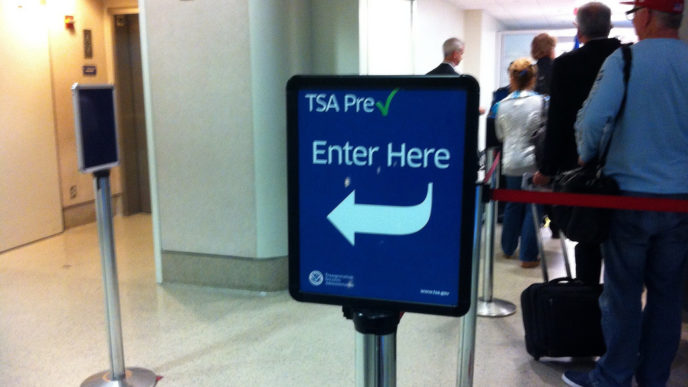
The TSA touts its PreCheck program as a way to avoid the hassle of security screening. Members of the program do not have to remove shoes, laptops, liquids, belts and light jackets. But according to a report by the Electronic Frontier Foundation (EFF), the Department of Homeland Security has developed this program with a broader purpose in mind. PreCheck will facilitate the collection of face images and iris scans on a nationwide scale. Once that happens, this biometric data will almost certainly be widely shared with other federal agencies and even private corporations.
DHS’s programs will become a massive violation of privacy that could serve as a gateway to the collection of biometric data to identify and track every traveler at every airport and border crossing in the country.
The TSA currently collects fingerprints during the PreCheck application process. Over the summer, the agency ran a pilot program at the Atlanta Airport using fingerprints to verify passengers’ identities. According to the EFF, the TSA wants to roll out the program to airports across the country and expand it to include facial recognition, iris scans, and other biometric data.
This TSA will almost certainly share this information with other federal agencies, including the FBI.
In 2014, the FBI rolled out a nationwide facial recognition program. According to information obtained by Georgetown Law last year, the Next Generation Identification Interstate Photo System (NGI-IPS), already contains some 25 million state and federal criminal photos, mostly mugshots shared by state and local law enforcement agencies. Photos remain in the system even if a court never convicts the individual of a crime. It remains unclear what other types of photos end up in NGI-IPS, but it seems almost certain TSA pre-check photos will end up in that database.
According to the EFF, “private partners” will also have access to biometric information gathered by the TSA.
For example, TSA’s PreCheck program has already expanded outside the airport context. The vendor for PreCheck, a company called Idemia (formerly MorphoTrust), now offers expedited entry for PreCheck-approved travelers at concerts and stadiums across the country. Idemia says it will equip stadiums with biometric-based technology, not just for security, but also “to assist in fan experience.” Adding face recognition would allow Idemia to track fans as they move throughout the stadium, just as another company, NEC, is already doing at a professional soccer stadium in Medellin, Columbia and at an LPGA championship event in California earlier this year.
These biometric systems create the potential for the federal government to track people all over the United States for virtually any reason.
Customs and Border Protection began rolling out facial recognition last year. The agency demonstrates how these programs expand over time.
In pilot programs in Georgia and Arizona last year, Customs and Border Protection (CBP) used face recognition to capture pictures of travelers boarding a flight out of the country and walking across a U.S. land border and compared those pictures to previously recorded photos from passports, visas, and ‘other DHS encounters.’ In the Privacy Impact Assessments (PIAs) for those pilot programs, CBP said that, although it would collect face recognition images of all travelers, it would delete any data associated with U.S. citizens. But what began as DHS’s biometric travel screening of foreign citizens morphed, without congressional authorization, into screening of U.S. citizens, too. Now the agency plans to roll out the program to other border crossings, and it says it will retain photos of U.S. citizens and lawful permanent residents for two weeks and information about their travel for 15 years. It retains data on ‘non-immigrant aliens’ for 75 years.
The federal government is in the process of creating an integrated biometric database that will ultimately have the capability to track people virtually anywhere they go. State and local law enforcement agencies also feed into this system. According to the Georgetown Law Perpetual Lineup report, the Department of Defense, the Drug Enforcement Administration, Immigration and Customs Enforcement, the Internal Revenue Service, the Social Security Administration, the U.S. Air Force Office of Special Investigations and the U.S. Marshals Service have all had access to one or more state or local facial recognition systems.
Perpetuallineup.org describes the shocking breadth of FBI facial search capabilities.
Over 185 million of these photos are drawn from 12 states that let the FBI to search their driver’s license and other ID photos; another 50 million are from four additional states that let the FBI to search both driver’s license photos and mug shots. While we do not know the total number of individuals that those photos implicate, there are close to 64 million licensed drivers in those 16 states. In 2015, the FBI launched a pilot program to search the passport database. It remains unclear if the system can access the entire 125 million passport database or just a subset.
In a May 2016 report, the Government Accountability Office reported that the FBI was negotiating with 18 additional states and the District of Columbia to access their driver’s license photos. In August, the GAO re-released the report, deleting all references to the 18 states and stating that there were “no negotiations underway.” The FBI now suggests that FBI agents had only conducted outreach to those states to explore the possibility of their joining the FACE Services network.
If you value your privacy, you should avoid submitting any kind of biometric data to federal agencies if at all possible – including the TSA.
State and local action can also help limit the scope of these federal biometric databases. They can limit the information they collect and prohibit sharing that information with federal agencies. The feds depend on state and local cooperation, particularly from law enforcement. Prohibiting help would hamper federal action. (For more from the author of “Warning: TSA Facial Recognition Plan Likely to Become Part of Growing Biometric Surveillance System” please click HERE)
https://joemiller.us/wp-content/uploads/7417151634_e76998f46d_b-2.jpg7651024Joe Millerhttps://joemiller.us/wp-content/uploads/logotext.pngJoe Miller2017-12-07 00:27:032017-12-07 00:27:03Warning: TSA Facial Recognition Plan Likely to Become Part of Growing Biometric Surveillance System