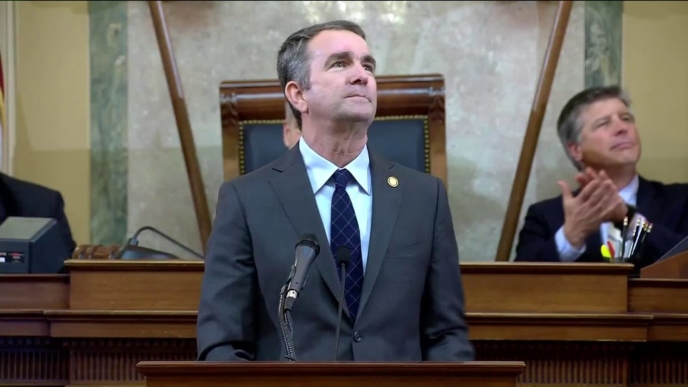
Virginia Attorney General (“AG”) Mark Herring was asked to issue a formal legal opinion regarding Second Amendment Sanctuary Resolutions being adopted by counties, cities, and towns across Virginia. AG Herring’s official advisory opinion (“Herring AO”) was issued on December 20, 2019. In it, AG Herring argues that Second Amendment sanctuary resolutions (i) have “no legal effect,” (ii) local government officials “must comply with gun violence prevention measures that the General Assembly may enact,” and (iii) “neither local governments nor local constitutional officers have the authority to declare state statutes unconstitutional or decline to follow them on that basis.” Each of these contentions is untrue.
Based on the Herring AO, and various statements reported in the press, it is apparent that AG Herring and Governor Ralph Northam believe that Virginia localities have a duty to actively assist the Commonwealth in the enforcement of any law enacted by the General Assembly. These officials appear to believe that such blind obedience is required irrespective of whether a law violates the U.S. Constitution, the Virginia Constitution, or is manifestly destructive of the pre-existing rights of the People of Virginia. This radical view is demonstrably false, and ignores the significance of the fact that local officials are required by law to take an oath to support the federal and state constitutions above the laws enacted by the General Assembly.
Moreover, neither Attorney General Herring nor Governor Northam can credibly demand that local governments must implement every Act of the General Assembly, because that view directly contradicts the positions they have taken in the past. Indeed, on three recent occasions, AG Herring and Governor Northam have taken exactly the opposite legal position, with respect to: (i) the defense of the Virginia Marriage Amendment to the Virginia Constitution; (ii) the General Assembly’s refusal to assist the federal government with the arrest and detention of civilians as authorized by the National Defense Appropriations Act of 2012; and (iii) the right of localities in Virginia to become sanctuary cities with respect to the enforcement of federal immigration laws.
Finally, the assertion that lesser magistrates owe slavish obedience to abusive higher authorities was never the view of the Founding Fathers, particularly those from the Commonwealth of Virginia. Had the English barons embraced this view, there might never have been a confrontation with King John at Runnymede, leading to the protections provided by Magna Carta. Had our nation’s founders embraced this view, Virginia might still be a colony of England. Truly, this view is contrary to the most basic principles which underlay our form of government, is anti-Biblical, and is profoundly abusive of the pre-existing and inalienable rights of the People of Virginia.
On December 2, 2019, Delegate Jerrauld C. “Jay” Jones (D-89) requested that Attorney General Mark Herring (D) issue a formal opinion under Code of Virginia § 2.2-505, addressing Second Amendment Sanctuary Resolutions. At the time of his request, such resolutions had been passed by “more than twenty localities across the Commonwealth.” Since then, the movement has spread across the Commonwealth with remarkable speed, and as of the date of this letter, 114 counties, cities, and towns have adopted Second Amendment Sanctuary Resolutions, with more still expected to add to this list. Sheriffs have joined in this effort as well.
On December 5, 2019, Delegate Lee J. Carter (D-50) pre-filed HB 67, seeking to remove law enforcement personnel from office who decline to enforce firearms laws, regardless of their constitutionality.
Virginia General Assembly to enact into law a cornucopia of the nation’s most extreme anti-gun bills. The Governor’s threat to enact radical gun control must be taken seriously, as complete one-party control of the General Assembly will occur on January 8, 2020, and the offices of the Governor, Lieutenant Governor (Justin Fairfax (D)), and Attorney General all will be filled by persons of the same political party, and sharing the same anti-gun sentiments.
In response to Delegate Jones’ request, AG Herring’s office issued a media statement on December 6, 2019, stating that the Second Amendment Sanctuary Resolutions appear to be “just symbolic.” In another newspaper article, on December 9, 2019, AG Herring was quoted as saying that “Second Amendment sanctuary” resolutions will have “no legal effect whatsoever.” On December 11, 2019, it was reported that Governor Northam stated that localities “can continue to have their meetings. They can continue to make sanctuary counties,” but they will not stop the Governor from pursuing anti-gun legislation. Now, AG Herring has issued his Advisory Opinion, formalizing that view.
The legal claims in AG Herring’s AO are invalid, and on the contrary, there are established precedents for non-cooperation efforts such as Second Amendment Sanctuary Resolutions. In fact, both AG Herring and Governor Northam participated in establishing and reinforcing those precedents.
I. Second Amendment Sanctuary Resolutions Have Significant “Legal Effect.”
It is certainly true, as the Herring AO notes, that Second Amendment Sanctuary Resolutions generally assert only the “intent” of Virginia’s counties, rather than making concrete directives to address a future situation which is not yet known. And, as the AO points out, it is certainly true that the “measures that the General Assembly may enact,” and the scope of resistance to those measures, is “entirely speculative.” But those facts hardly lead to the Attorney General’s conclusion that Second Amendment Sanctuary Resolutions have “no legal effect.”
On the contrary, events in the Commonwealth are still at the stage whereby law-abiding Virginians are sincerely petitioning their state government officials not to enact unauthorized, unconstitutional laws. The Second Amendment Sanctuary Resolutions, passed in November and December of 2019, are not unlike the petitions of an earlier time, when both the citizens of Virginia and their elected officials implored their Royal Governor, King George, and Parliament to hear their petitions and grant them relief. In this sense, the Second Amendment Sanctuary Resolutions should be considered an exercise of the ancient right to petition government for redress of grievances. They can be understood as a supplication to the Commonwealth’s rulers not to abuse their power nor do the great evil that is being considered.
At the same time, however, these petitions and supplications are not being expressed as mere preferences, but as Constitutional necessities. The vast majority of Virginia localities have made it clear that any attempt by the General Assembly to forcibly disarm Virginians, to register their weapons (in preparation for their eventual later forcible seizure), or otherwise to turn law-abiding Virginians into felons, would be ultra vires acts, void, and thus not law at all. See Federalist No. 78.
These concerted actions by the Commonwealth’s counties, cities, and towns are highly unusual and of great significance. Sadly, the Attorney General’s letter wholly ignores the fact that the Second Amendment Sanctuary Resolutions are crafted as an appeal to the government. The resolutions do not indicate any desire to provoke a fight (legal or otherwise) with the ruling government in Richmond. Rather, the resolutions indicate a most sincere desire to avoid conflict with the General Assembly, the Governor, the Lieutenant Governor, and the Attorney General. However, Second Amendment Sanctuary Resolutions announce that, should the government in Richmond act lawlessly, then local officials and the People they represent will not cooperate and may take steps to actively resist.
Indeed, the degree to which these localities may find it necessary to withhold compliance, or even actively to resist legislation, is entirely in the hands of the General Assembly and the Governor. The Attorney General was profoundly wrong in his attempt to minimize and demean this historic effort, asserting it as being of no “legal effect.”
II. No Constitutional or Statutory Provision Requires Compliance with an Unconstitutional State Law.
The Herring AO conflates several constitutional principles to arrive at the desired result. First, the AO notes that the General Assembly has the power to create (and uncreate) counties, and to designate the scope of their powers. From that, the AO reaches the far broader conclusion that “all local authority is subject to the control of the General Assembly.” (emphasis added). That is a non sequitur. On the contrary, there are certain constitutional requirements, such as the form of county government, with which the General Assembly cannot dispense. Article VII, Sections 4 and 5 establish county boards and county sheriffs as elected constitutional offices, and thus beholden to the People — not to Richmond. Indeed, Article I, Section 2 notes that “power is vested in, and consequently derived from, the people, that magistrates are their trustees and servants, and at all times amenable to them.” In other words, through the enactment of Second Amendment Sanctuary Resolutions, county boards, and sheriffs, are acting “subject to the control” of the People as expressed in the Constitution, not the General Assembly. Likewise, Article I, Section 7 explains that “all power of … the execution of laws, by any authority, without consent of the representatives of the people, is injurious to their rights, and ought not to be exercised.” It is to protect the People’s rights that Second Amendment Sanctuary Resolutions have been adopted by county boards, acting to protect the People who consented to be governed under a Constitution which contains limits on the powers of the General Assembly and the Governor.
Second, the Herring AO conflates the text of Virginia Code Section 1-248, that “the Constitution and laws of the United States and of the Commonwealth shall be supreme,” with the concept of “supremacy of state law over local ordinances and policies” and the idea that “local authority is subordinate to state law.” The Herring AO asserts that “when a statute and an ordinance conflict, the statute must prevail.” But what happens when a statute and the Constitution conflict? Indeed, Virginia Code Section 1-248 contemplates supremacy in a situation where a statute is in harmony with constitutional provisions. Here, where the General Assembly is considering passing a litany of unconstitutional gun control laws, state law would come into conflict with the Virginia and U.S. Constitutions. In such a case, county boards owe no obeisance to an unconstitutional state statute, but rather to the higher law of the Virginia and United States Constitutions, and to the People — the authorities from which these officials derive their power. The offending laws are a nullity — void — as if they were never enacted.
Finally, the Herring AO asserts that all laws enacted by the General Assembly must be complied with “unless and until those laws are repealed by the legislature or invalidated by the judiciary.” Thus, the Herring AO adopts the Doctrine of Judicial Supremacy: that the courts are the only branch of government which has a duty to interpret and apply the Constitution. If that were true, there would be no reason for all office holders to swear an oath to the Constitution — just a duty to obey the view of the courts. Indeed, this has never been the law of the land, in Virginia or the United States. Rather, as St. George Tucker observed, even after a constitution has been ratified by the people, the people retain “the censorial power [which] may be immediately exercised upon their representative or agent who forgets his responsibility….” St. George Tucker, View of the Constitution of the United States 48 (Liberty Fund: 1999). It simply is not, nor has it ever been, the case that a constitution means whatever a current majority of judges decide it should mean. As Blackstone put it, “the law, and the opinion of the judge are not always convertible terms, or one and the same thing; since it sometimes may happen that the judge may mistake the law.” W. Blackstone, Commentaries on the Laws of England at 71 (Univ. of Chi. facsimile ed. 1765).
III. AG Herring and Governor Northam Have Established the Principle that It Is the Duty of All Elected Officials to Defend the U.S. and Virginia Constitutions.
Paradoxically, one of the most recent Virginia precedents for elected officials declining to enforce provisions of state law was established by AG Herring himself, immediately after being inaugurated as Attorney General in 2014. Indeed, AG Herring not only refused to enforce a statute, he refused to enforce the Constitution of Virginia itself. AG Herring then went even further, attacking and helping undermine state constitutional provisions and statutes that he believed to be unconstitutional, based on his personal view that the U.S. Constitution superceded the Virginia Constitution, even though his opinion was wholly unsupported by any decision of the U.S. Supreme Court as of that time. If AG Herring truly believed the claim in his AO, that state officials must defend and enforce the law until a court declares it invalid, he would not have acted in this way.
On November 7, 2006, the People of the Commonwealth of Virginia ratified their State Constitution by adopting the “Virginia Marriage Amendment” with over 57 percent of the vote. In order to become part of the Virginia Constitution, as Article I, Section 15, it was necessary that the Amendment was passed by two different sessions of the General Assembly, separated by a general election. The amendment declared, inter alia, that “[o]nly a union between one man and one woman may be a marriage valid in or recognized by this Commonwealth and its political subdivisions.”
On July 18, 2013, the Virginia Marriage Amendment was challenged in a case filed in the U.S. District Court for the Eastern District of Virginia (Norfolk Div.) known as Bostic v. Rainey, 970 F.Supp.2d 456 (E.D. Va. 2014). The case was defended by then-Attorney General of Virginia Ken Cuccinelli (R). After a hotly contested election which required a recount, AG Herring was sworn into office, succeeding Ken Cuccinelli, on January 11, 2014.
On January 23, 2014, on no authority but his own, AG Herring filed a “Notice of Change of Position” with the district court, based on his personal decision to refuse to defend the Constitutional Amendment voted by the People of Virginia. AG Herring declared that, irrespective of the action of the People in amending their Constitution, that as “an exercise of” his “independent judgment,” he had concluded that when a provision of the Virginia Constitution or Statute “violates the federal constitution, he is not duty bound to defend it.” (Emphasis added.)
In an interview with NPR, reported January 23, 2014, AG Herring asserted: “As attorney general, I cannot and will not defend laws that violate Virginians’ rights.” (Emphasis added.) He added that “his job is to defend laws that are constitutional. This one, he said, isn’t.” As AG Herring put it in a January 23, 2014 opinion article in USAToday:
An attorney general who concludes that a law is unconstitutional is duty bound not to defend it. There are those who argue that attorneys general should operate on automatic pilot, defending laws regardless of their constitutional merit. An uncritical allegiance to that notion is not only wrong, it allows the critic in this instance to mask his opposition to marriage equality. [Emphasis added.]
In support of his assertion of the authority not to enforce a law thought to be unconstitutional, AG Herring relied on a position taken by Justice Scalia, stating that “the President’s powers to resist legislative encroachment by Congress include the power to ‘disregard them when they are unconstitutional.’ Freytag v. Commissioner, 501 U.S. 868, 906 (1991) (Scalia, J. concurring in part).” AG Herring also relied on an amicus curiae brief filed in the U.S. Supreme Court in Astroline Communications Co. v. Shurberg (Mar. 6, 1990), by then-Acting Solicitor General John A. Roberts (now Chief Justice of the United States), refusing to defend a federal statute in court and expressing, as AG Herring put it, “the view of the United States that the [federal] statute in question was unconstitutional.” Notice at 4.
In conclusion, AG Herring’s actions, supported by Governor Northam, with regard to the Virginia Marriage Amendment, establish the following precedents for Virginia:
First, an elected official who reaches the “independent judgment” that a state statute is in violation of the U.S. Constitution is at liberty to decline to enforce that statute.
This principle is at the very core of the Second Amendment Sanctuary Resolutions.
Second, an elected official has the power to take affirmative steps to block enforcement of an unconstitutional statute.
By these actions and the precedents they establish, AG Herring and Governor Northam have completely undermined their recently expressed opinions that Second Amendment Sanctuary Resolutions are not authorized.
On New Year’s Eve in 2011, President Obama signed the National Defense Authorization Act of 2012 (“NDAA”). Sections 1021 and 1022 of the NDAA allow the military the power to undertake an indefinite detention of anyone the federal government declares to be an enemy, including civilians not under the authority of the Department of Defense. These powers apply even if the person is a U.S. citizen, allowing him to be held without charges, without access to counsel, and without trial.
Immediately after the public became aware of the NDAA law, there were efforts across the country to resist this unlawful suspension of the right of habeas corpus and other constitutional violations. Opposition arose to this unjust, immoral, and unconstitutional law came from across the political spectrum, even among Democrats who, even though perhaps trusting President Obama with such powers, understood that a future administration could use it against its political opponents.
Thus, with broad bipartisan support, and only one dissenting vote in the Senate and seven dissenting votes in the House, Virginia enacted HB 1160 in 2012, prohibiting Virginia from assisting the federal government in the unlawful detention of U.S. citizens pursuant to the NDAA. With a narrow exception designed to exclude information sharing through joint task forces, the law stated:
no agency of the Commonwealth [including any] political subdivision of the Commonwealth … [or] employee of either acting in his official capacity, or member of the Virginia National Guard or Virginia Defense Force, when such a member is serving in the Virginia National Guard or the Virginia Defense Force on official state duty, shall knowingly aid an agency of the armed forces of the United States in the detention of any citizen pursuant to 50 U.S.C. § 1541 as provided by the National Defense Authorization Act for Fiscal Year 2012 (P.L. 11281, § 1021) if such aid would knowingly place any state agency, political subdivision, employee of such state agency or political subdivision, or aforementioned member of the Virginia National Guard or the Virginia Defense Force in violation of the United States Constitution, the Constitution of Virginia, any provision of the Code of Virginia, any act of the General Assembly, or any regulation of the Virginia Administrative Code. [Emphasis added.]
Notable among the legislators voting for HB 1160 were both Attorney General Herring and Governor Northam, on February 28, 2012 and again on April 18, 2012.
Thus, through HB 1160, the Virginia General Assembly established the principle that:
A subordinate level of government has the authority and, indeed, the responsibility, to refuse to cooperate with a higher level of government when the higher government enacts a law which violates the Constitution of the United States.
This same principle of Non-Cooperation applies when local governments are faced with unconstitutional statutes enacted by the General Assembly.
On March 9, 2018, the General Assembly passed a bill introduced by then-Delegate, now-Congressman, Ben Cline, HB 1257, which would have added a one sentence provision to the Code of Virginia:
No locality shall adopt any ordinance, procedure, or policy that restricts the enforcement of federal immigration laws.
On April 9, 2018, Governor Northam vetoed this bill. A story published on April 9, 2018 in the Washington Post stated that Delegate Cline had explained that his bill would only “ban localities from interfering [with] federal immigration actions, not press them into service.” However, Governor Northam explained that preventing localities from declaring themselves immigration sanctuaries would send “a chilling message to the communities across Virginia that could have negative impacts on public safety.” Governor Northam called the measure “unnecessary and divisive.” The House attempted to override the Governor’s veto, but it failed on a vote of 51-48.
On February 23, 2019, the General Assembly passed a bill introduced by Senator Dick Black, SB 1156, which had the same wording as the HB 1257. This bill too was vetoed by Governor Northam, who explained to the Richmond Times Dispatch on March 19, 2019, “The safety of our communities requires that all people, whether they are documented or not, feel comfortable, supported and protected by our public safety agencies….” This story mentioned that, in 2017, Governor Northam had opposed legislation (HB 2000, introduced by Delegate Charles D. Poindexter) to restrict localities from becoming sanctuary localities, and the Governor told voters that he had voted against such a measure in order to break a tie while presiding over the Senate as lieutenant governor.
Thus, three times in three consecutive years (2017, 2018, and 2019), Governor Northam used his office to support the right of Virginia’s localities to declare themselves sanctuary cities and counties, refusing to help with the enforcement of federal immigration laws, based on mere policy differences with those federal laws. These consistent and clear actions establish yet another powerful Virginia precedent supporting the right of localities to decline to enforce a state law that violates the express federal and state constitutional protections for firearms.
IV. The Virginia Founding Fathers Established the Principle that Certain Statutes were Unlawful and thus Void.
Among the authorities cited by AG Herring in his Notice of Change of Position, when he refused to defend the Virginia Constitution’s marriage amendment, were statements by certain of the Founding Fathers. Thus, it is useful to examine how the Founding Fathers viewed the enactment of laws which exceeded a government’s power.
When the Federalist Party used its power in Congress to enact the Alien and Sedition Acts in 1798, it was Virginia’s own Thomas Jefferson who anonymously drafted the Kentucky Resolves, also known as the Kentucky Resolutions of 1798 (approximately October 4, 1798) which were adopted by the Kentucky legislature. The Jefferson draft begins:
Resolved that the several states composing the US. of America are not united on the principle of unlimited submission to their general government; but that, by a compact under the style & title of a Constitution for the US. and of Amendments thereto, they constituted a general government for special purposes, delegated to that government certain definite powers, reserving, each state to itself, the residuary mass of right to their own selfgovernment; and that whensoever the general government assumes undelegated powers, it’s acts are unauthoritative, void, & of no force. [Emphasis added.]
Virginia’s James Madison drafted a similar resolution, adopted by the Virginia General Assembly on December 24, 1798. The Virginia Resolution claimed that the states may “interpose” when the federal government acts unconstitutionally:
in case of a deliberate, palpable, and dangerous exercise of other powers, not granted by the said compact, the states, who are parties thereto, have the right, and are in duty bound, to interpose, for arresting the progress of the evil, and for maintaining, within their respective limits, the authorities, rights and liberties, appertaining to them. [Emphasis added.]
Thus, from the time of this nation’s infancy, Virginians clearly envisioned the principle of resistance to abuses of power not unlike that which is taking place with the enactment of Virginia’s Second Amendment Sanctuary Resolutions. When a higher government overreaches, it is the duty of the lesser governments to interpose themselves, to protect the People from the abusive power to give meaning to the protections of the U.S. and Virginia Constitutions.
Our Founding Fathers knew well the dangers of the unauthorized accumulation of, and abuse of, power. As students of history, they knew it had not been uncommon for those holding high civil office to abuse the power with which they were entrusted. When serious abuse occurs, the role of the People and those holding lower civil office is not simply to suffer that abuse without remedy. This principle, which is long established in Virginia, and recently affirmed with the assistance of AG Herring and Governor Northam, is now being relied upon and asserted by counties and cities with respect to proposed unconstitutional gun laws.
Resistance to illegal and unauthorized government acts is not new — it is an ancient doctrine, historically known as “The Doctrine of the Lesser Magistrate.” Under this doctrine, when a superior or higher civil authority makes an unjust, immoral, or unconstitutional law or decree, the lesser or lower ranking civil authority has both the right and the duty to refuse obedience to that superior authority. The act of the lesser or lower authority is deemed an act of “interposition” — using the term chosen by Madison — choosing to stand between the higher authority and the People, thereby protecting the People under its charge. If necessary, the lower authority may even actively resist the superior authority, since the higher authority is acting illegitimately and unconstitutionally, and without legal authority.
This doctrine is, in fact, foundational to our form of government. Indeed, the Declaration of Independence is a document of interposition, between the American colonists and a tyrannical King George III. Its signatories — the People’s representatives — pledged to one another “our Lives, our Fortunes and our sacred Honor,” believing that they most likely would be tried and executed for treason against the crown.
This ancient doctrine is reflected in the words of Roman Emperor Trajan to a subordinate: “Use this sword against my enemies, if I give righteous commands; but if I give unrighteous commands, use it against me.” This doctrine equips the American People with a way to address the abuse of power by higher civil authorities (here, potentially, the Commonwealth of Virginia) — in a measured and peaceful manner — by making an appeal to and through lower civil authorities (here, the governing bodies and sheriffs of the localities of Virginia).
The application of the principles set out above to Second Amendment Sanctuary Resolutions is clear. The U.S. Constitution and the Virginia Constitution are the statements of the will of the People themselves, and the compacts from which the Virginia legislature draws its authority. Should the Virginia General Assembly, along with the Virginia Governor or Attorney General, enact and attempt to enforce a law which is prohibited by Second Amendment to the U.S. Constitution, or Article I, Section 13 of the Virginia Constitution, and the pre-existing, inalienable rights of the People, then such law is of no legitimacy — and void. In response, local government officials who have sworn an Oath to uphold the federal and state constitutions unquestionably have the inherent power — and the duty — to refuse to enforce such unconstitutional laws, and even to protect the People against enforcement.
Follow Joe Miller on Twitter HERE and Facebook HERE