Promise Broken? Trump DOJ Continues Suit Against Religious Groups

The most absurd example of progressive pathology during Obama’s reign was arguably the legal assault on the Little Sisters of the Poor. “Jumping the shark” called, and it thinks making criminals out of chaste women because they won’t pay for other women to have recreational sex is just begging for some karmic justice.

But sadly, it may be the nuns’ turn to get kicked in the teeth once more. Because elections have consequences, or something.

According to LifeSiteNews, the Trump administration has asked the Fifth Circuit Court of Appeals for 60 more days to continue the Obama administration’s bullying of religious institutions. This is after several of them, including the Little Sister of the Poor, had found at least temporary relief in multiple courts from fascism masquerading as feminism.

During the campaign, though, Trump assured such groups that to force them into providing abortifacients is “a hostility to religious liberty you will never see in a Trump administration … I will defend your religious liberties and the right to fully and freely practice your religion, as individuals, business owners and academic institutions.”

That’s the exact moral clarity the oath of office calls for, but it was lacking in federal court this week. Trump could simply have declined to enforce the illegitimate and unethical penalties leveled against acts of Christian conscience, even if it turns out he doesn’t have the energy or conviction to engage in a crusade on behalf of religious liberty. But he didn’t.

And what was the excuse, err, reason given?

Wait for it … Wait for it …

We need more bureaucracy!

Yes, this “returning the government to the people” thing from Trump’s inaugural has taken a very weird turn indeed. The Department of Justice actually said the Trump White House, which is nearing its first 100 days in office, still hasn’t had enough to time to assemble the staff necessary to determine whether or not it’s cool to force nuns to defy God.

Good grief. How many more lawyers do you need to have sufficient confidence that the Founding Fathers weren’t just spitballing when they came up with that whole First Amendment thing? Might I suggest that when the ACLU is currently suing a hospital on behalf of a man who thinks he’s a woman and is upset the hospital won’t perform a hysterectomy on him, the answer might be “zero”?

In response to this, I know some of you will find comfort in telling yourself that all this is better than Hillary, or that Trump has done some good things. Those are two things that are true, but also irrelevant to this discussion.

There are also a lot of parents who do obvious and undeniably good things for their children, like feed, clothe, and shelter them. Yet they are so derelict at providing for their spiritual needs that as soon as they go off to college, subsidized pagan brainwashing is all but assured. Proportionally speaking, providing for your children’s material needs is a necessity. But doing so at the expense of their eternal souls is an existential failure.

That’s what we are dealing with here. Trump has deregulated some things. He has had some foreign policy successes. All of which I appreciate and have noted and complimented. But he hasn’t come close to indicating that he can be, or really even wants to be, transformational in the way that Obama was. And this is what is needed to truly undo the damage Obama did. Anything short of that will be a failure for a culture on the brink, as ours is.

Perhaps no group is more responsible for Trump’s election than the devout. He owes them, well, bigly. Payback shouldn’t take 100 days, let alone another 60. That assumes Planned Parenthood apologist Ivanka, who is all but acting as First Lady, hasn’t been persuading Daddy on this issue. That could be the real reason for the delay.

How much bureaucracy does it take to stop suing nuns? If your workload is too overbearing for an under-staffed Justice Department, why not kick some feckless litigation like this to the curb and lighten the workload? How much more work does it require to file a withdrawal than to file a delay? (For more from the author of “Promise Broken? Trump DOJ Continues Suit Against Religious Groups” please click HERE)

Follow Joe Miller on Twitter HERE and Facebook HERE.

‘We Were Lied To’: Levin Torches Obama’s Climate BS Artists

Thursday evening on the radio, Conservative Review Editor-in-Chief Mark Levin discussed a report from The Daily Caller illustrating how the Obama administration lied to promote its environmental agenda.

The administration allegedly manipulated climate stats and reports to influence public opinion. From the article:

Former Energy Department Undersecretary Steven Koonin told The Wall Street Journal Monday that bureaucrats within former President Barack Obama’s administration spun scientific data to manipulate public opinion.

“What you saw coming out of the press releases about climate data, climate analysis, was, I’d say, misleading, sometimes just wrong,” Koonin said, referring to elements within the Obama administration he said were responsible for manipulating climate data.

“We were lied to,” Levin said. “We were lied to in order to advance an ideology.”

And why? Why else — Big Government insatiable greed and lust for power.

Listen:

“It’s an attack on capitalism,” Levin explained. “This is just the latest effort by the Left — the socialist Left, the Marxist Left — to nationalize economic decision making.”

Climate change is a greater national security threat than terrorism, many on the Left tell us. And some on the Right buy into their “myth,” Levin points out.

At the end of the day, this is utopian statism. (For more from the author of “‘We Were Lied To’: Levin Torches Obama’s Climate BS Artists” please click HERE)

Follow Joe Miller on Twitter HERE and Facebook HERE.

Green Freaks and Government Abandoned THESE Native Americans

Starting late last year, environmentalists gathered in the state of North Dakota to protest and block the construction of the Dakota Access pipeline.

Thousands of people from all over descended on the Peace Garden State and set up makeshift camps that would eventually become highly publicized symbols of opposition against the pipeline. The alleged grievance: that the pipeline infringed on Standing Rock Sioux land rights – even though the construction area in question wasn’t on Sioux land – and might hypothetically contaminate the tribe’s water supply.

The display would soon become a dividing point between those who cheered the camped-out protesters, and those who saw the effort as little more than a farce garnering national news coverage.

Eventually, the camps were cleared out, with even the tribe asking the demonstrators to pack up and get out.

Late last month, oil began to flow through the pipeline, but the debate over its impact still lingers, with opponents’ latest setback coming in the form of a federal court ruling that the U.S. Army Corps of Engineers could withhold the results of environmental impact reports out of public safety concerns.

Whether or not the campers’ concerns of impending calamity from the project will come to fruition remains a mystery. One thing is certain, however: The impact from the protesters themselves had a far greater apparent impact on the local environment than the construction of the pipeline itself.

But, once the dust settled and the encampments on the Standing Rock Sioux reservation cleared out, the cleanup crews took over. All in all, according to government reports in March, the cost of restoring the local camps clocked in at over $1 million, as the U.S. Army Corps of Engineers had to haul away over 800 dumpsters full of refuse left behind by so-called “environmentalists.”

In addition to garbage, reports revealed that a number of pets were also left behind, forcing local animal rescue groups to scramble last minute.

But one wonders: with all this drama over an environmental disaster that hasn’t even happened yet, and all the concerns for the wellbeing of the local Native American population all over the mere possibility of pollution, where were the eco-campers when a massive environmental disaster actually happened just under two years ago out west?

In a recent episode of “Michelle Malkin Investigates,” CRTV delves into the impact of the Gold King Mine spill, the results of which were disastrous for the Navajo Nation.

The August 2015 disaster in Silverton, Colorado, which was caused by a combination of outdated environmental laws and EPA-overseen malpractice, sent millions of gallons of an orange, heavy-metal cocktail into the watershed of multiple western states. And oh … it also had a devastating impact on the Navajo Nation – which is now suing the federal government for damages.

In “EPA Run A-Muck,” Conservative Review Senior Editor Michelle Malkin takes a hard, investigative look at the details of the spill, the victims, and why it never received the attention it deserves.

One thing you won’t see in the episode (or any of the news reports surrounding the plight of the Navajo) is anything like the environmentalist shantytowns or mass media coverage of Standing Rock. (For more from the author of “Green Freaks and Government Abandoned THESE Native Americans” please click HERE)

Follow Joe Miller on Twitter HERE and Facebook HERE.

Ann Coulter Cancels Speech After Losing Her Backing Over Violence Fears

Conservative author Ann Coulter announced Wednesday she will not be giving her speech at the University of California, Berkeley following the Young America’s Foundation (YAF) backing out of the event.

Coulter alleges that YAF “ordered the lawyer not [to] file for [a] court order,” which would have compelled the school to reserve a room for the speaker, and that the Berkeley College Republicans, one of the parties sponsoring the author, were bound to follow YAF’s lead, according to Fox News.

The College Republicans and YAF sued UC Berkeley on Monday for canceling the author’s speech. But YAF had second thoughts, according to Coulter.

“I looked over my shoulder and my allies had joined the other team,” Coulter said in an email, according to Fox News. “I think I’m still going to Berkeley, but there will be no speech.”

“I thought I might just stroll around the graveyard of free speech in America,” Coulter wrote in an email to The Daily Caller News Foundation. (Read more from “Ann Coulter Cancels Speech After Losing Her Backing Over Violence Fears” HERE)

Follow Joe Miller on Twitter HERE and Facebook HERE.

How Trump’s Tax Plan Would Affect High-Tax States Like California, New York

High-income earners in high-tax states would see a federal tax rate cut. But they still may pay more in the end if they’re unable to deduct state and local taxes under President Donald Trump’s tax reform proposal announced Wednesday.

The White House released the contours of his tax reform proposal that would lower tax rates and reduce the number of tax brackets. However, the plan would also reduce the number of tax deductions.

When a reporter asked if deducting taxes on state and local income taxes would also be eliminated, Treasury Secretary Steven Mnuchin answered, “Yes.”

“We are going to eliminate on the personal side all tax deductions other than mortgage interests and charitable deductions,” Mnuchin said at a White House press conference Wednesday.

House Republicans were already reportedly considering eliminating the deduction on state and local taxes, which could disproportionately affect wealthy people in high-tax blue states such as New York and California.

This federal deduction basically encouraged states to hike taxes, said Jonathan Williams, the chief economist for the American Legislative Exchange Commission, a state-centric public policy organization.

“The current policy subsidizes high-tax states,” Williams told The Daily Signal in a phone interview. “Using that revenue to pay for cutting rates across the board is a step in the right direction.”

The Trump tax plan would reduce the number of tax brackets from seven to three brackets of 10 percent, 25 percent, and 35 percent. The plan would not tax the first $24,000 in income for a couple, which is double the current standard deduction.

The Trump plan would repeal the alternative minimum tax, phaseout the death tax, and repeal the 3.8 percent surtax on investment income used to fund Obamacare.

On the business side, the corporate tax rate will be cut to 15 percent, from 35 percent. Also, the government would only tax a business’s income from inside the United States, not income from abroad. This is common in other countries and is known as a “territorial tax system.”

Gary Cohn, director of the National Economic Council and Trump’s chief economic adviser, told reporters tax reform is a “once-in-a-generation opportunity to do something really big.”

The last sweeping reform came in 1986.

“This isn’t going to be easy. Doing big things never is. We’ll be attacked from the left. We’ll be attacked from the right,” Cohn said. “But one thing is certain. I would never, ever bet against this president.”

Cohn added:

In 2017, we are still stuck with a 1988 corporate tax system. That’s why we are one of the least competitive countries in the developed world when it comes to taxes. So tax reform is long overdue.

House Minority Leader Nancy Pelosi, D-Calif., said the plan is the “same trickle-down economics that undermined the middle class,” and said the president should work on a fiscally responsible bipartisan plan with Democrats.

“Instead of focusing on hardworking families as he promised, President Trump’s tax outline is a wish list for billionaires,” Pelosi said in a public statement. “What few details are here overwhelmingly cut taxes for the richest and do little for middle-class Americans and those trying to get there. Besides which, nowhere does President Trump indicate how his deficit-exploding tax plan will actually be paid for.”

Adam Michel, a tax policy analyst with The Heritage Foundation, said he believes the proposal shows Trump is serious about reform:

For too long, America’s out-of-date and overbearing tax system has put a damper on economic growth while punishing savings and investment. The president’s plan is a great starting point. Now, the president and Congress must work together to finally update our broken tax system. True reform should apply the most efficient and least economically destructive forms of taxation, have low rates on a broad base, and be as transparent, predictable, and simple as possible.

Grover Norquist, president of Americans for Tax Reform, praised Trump’s proposal.

“President Trump has re-energized the drive for fundamental tax reform that creates growth and jobs,” Norquist said in a public statement. “The plan cuts taxes for businesses and individuals and simplifies the code so Americans can file on a postcard. Reducing taxes on all businesses down to 15 percent will turbocharge the economy.”

Mnuchin called the current 35 percent corporate rate “perhaps the most complicated and uncompetitive business rate in the world.”

He said he anticipates the proposal would return the U.S. to greater than 3 percent growth without an adverse impact on the debt or revenue. Throughout most of the Obama administration, economic growth didn’t surpass 3 percent in a single year.

“This plan will lower the ratio of debt to [gross domestic product]. The economic plan under Trump would grow the economy, will create massive amounts of revenues,” Mnuchin said.

The plan is a net tax reduction, Williams said, and fundamental reform takes cronyism out of the tax code, which could help Trump keep another promise.

“Draining the tax code swamp is a good way to go about getting rid of all those special interest loopholes,” Williams said. (For more from the author of “How Trump’s Tax Plan Would Affect High-Tax States Like California, New York” please click HERE)

Follow Joe Miller on Twitter HERE and Facebook HERE.

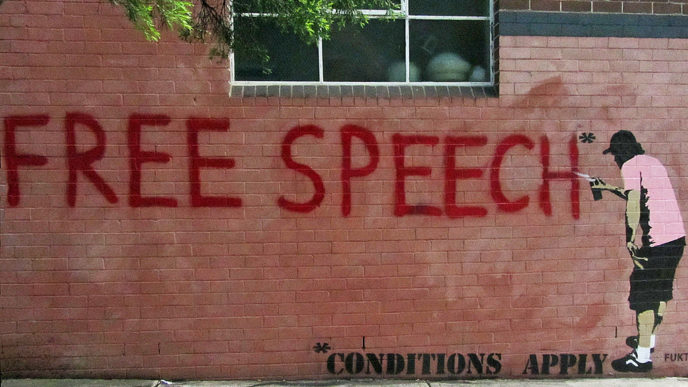
Berkeley Didn’t Birth ‘Free Speech’ but Seems Intent to Bury It

Demosthenes, the Athenian rhetorician and champion of liberty, pointed out around 355 B.C. that residents of Athens were free to praise Sparta’s regime, but Spartans were banned from praising Athens.

In 1689, the British passed a law guaranteeing freedom of speech in Parliament. A century later, French revolutionaries incorporated into law the Declaration of the Rights of Man, which established free speech as a universal right. Two years later, the Americans ratified the First Amendment, which guarantees that the state shall not infringe on the right to free speech. Roughly a century and half later, in 1948, the United Nations adopted the Universal Declaration of Human Rights which says, “Everyone has the right to freedom of opinion and expression….”

I mention all of this because every time I read or hear about the pathetic state of affairs at the University of California, Berkeley — where conservative speakers and rabble-rousers alike are banned from speaking lest they be assaulted by a mob — journalists and other commentators insist on pointing out the irony that this is all happening “where the Free Speech Movement was born.”

Yes, I know there was a thing called the Free Speech Movement. And, yes, its members and leaders talked a good deal about free speech.

But the movement for free speech is thousands of years old and runs like a deep river across the landscape of Western Civilization. (Read more from “Berkeley Didn’t Birth ‘Free Speech’ but Seems Intent to Bury It” HERE)

Follow Joe Miller on Twitter HERE and Facebook HERE.

Tillerson Says China Asked North Korea to Stop Nuclear Tests

U.S. Secretary of State Rex Tillerson said Thursday that China has threatened to impose sanctions on North Korea if it conducts further nuclear tests.

“We know that China is in communications with the regime in Pyongyang,” Tillerson said on Fox News Channel. “They confirmed to us that they had requested the regime conduct no further nuclear test.”

Tillerson said China also told the U.S. that it had informed North Korea “that if they did conduct further nuclear tests, China would be taking sanctions actions on their own.” (Read more from “Tillerson Says China Asked North Korea to Stop Nuclear Tests” HERE)

Follow Joe Miller on Twitter HERE and Facebook HERE.

These Regulations Could Incriminate Your Business Without You Knowing It. How Congress Can Bring Reform.

It’s nearly 100 days into the presidency of Donald Trump, and so far he has begun to make good on his campaign promise to curtail overregulation.

That should continue for regulations of the harshest variety: arcane rules whose violation is a federal crime.

The president’s efforts began in January, when he issued his first executive order designed to control regulatory costs and stem the seemingly endless flow of regulations being pumped out by federal bureaucrats.

A month later, he signed another executive order to create a regulatory reform task force within each agency.

The president has since taken further targeted actions to lessen the regulatory yoke borne by Americans.

In continuing this effort, the administration should be intentional in eliminating some of the most menacing rules that carry criminal penalties for regulatory infractions where civil fines or administrative remedies would be sufficient to redress harm and deter noncompliance.

Trump has already targeted two such regulations: the Waters of the United States rule (or WOTUS), and the Overtime rule.

WOTUS

The Clean Water Act, originally passed in 1972, has long determined what constitute “navigable waters”—that is, the waters subject to federal regulation.

Under President Barack Obama, the Waters of the United States rule expanded the reach of this act by redefining the scope of “navigable waters.”

According to the rule, “navigable waters” protected under federal law (33 U.S.C. § 1362) are not limited to major lakes and rivers, but include streams, ponds, and even shallow or dry ditches.

The rule represents a fundamental violation of private property rights, and is particularly menacing toward small businesses.

According to the National Federation of Independent Business, the regulation “require[s] small businesses and other property owners to spend tens of thousands of dollars to obtain federal permits before doing things as simple as landscaping or dredging soil if the land (or land near it) collects water for any significant period of time throughout the year.”

For example, after a rancher built a stock pond from a stream on his private land, the Environmental Protection Agency claimed jurisdiction over his backyard oasis and threatened his family with fines totaling $37,500 per day.

The agency also extracted a guilty plea from a building engineer who diverted sewage system overflow at a military retirement home into a storm drain because, unbeknownst to him, it led into a protected creek that eventually flowed into a river.

These penalties are not chump change. Individuals who negligently violate the Clean Water Act are subject to a maximum fine of $25,000 per day that the violation occurs and one year in prison.

The rule’s validity is currently bound up in litigation, enjoining its enforcement. Not content to wait for the courts to opine upon the constitutionality of the rule, Trump has directed the Environmental Protection Agency to review and, if warranted, revise it.

>>> What You Need to Know About Trump’s Executive Order on the Water Rule

Overtime Rule

Second, the Obama Department of Labor’s Overtime rule endeavored to double the maximum salary that an employee must receive to be exempt from overtime pay rules to $47,476 a year.

Ensuring that salaried employees receive additional compensation for working over 40 hours in a week may sound beneficial to workers on its face.

But, as Heritage Foundation scholars have written elsewhere, the rule would turn over 4 million salaried employees into hourly workers, restrict employee flexibility by forcing more workers to punch a timecard, and “cost businesses $6.9 billion in [estimated] compliance costs.”

If there were nothing more to it, this alone could be particularly devastating for small businesses.

Under the Fair Labor Standards Act (29 U.SC. § 216), business owners who fail to comply with overtime regulations, willfully or otherwise, face a fine of up to $10,000 and up to six month’s imprisonment.

The market should set wage rates, but civil remedies exist to make an employee whole if an employer undercompensates him in relation to regulatory or contractual requirements.

This rule too is tied up in litigation after a federal judge in Texas halted its implementation last November.

More Action Needed

On Inauguration Day, Trump issued a memorandum freezing the implementation of a host of rules, including the Obama overtime standard before it became effective. The rule is now ripe for review, and ultimately withdrawal, by the Department of Labor.

These actions are a hopeful start to the Trump administration’s regulatory reform agenda, but there is much more work to be done. Many additional rules unnecessarily use the threat of criminal penalties to compel compliance with regulatory objectives, and are in need of modification or repeal.

Take for instance the Food and Drug Administration’s food labeling provisions (79 F.R. 71155). The FDA is responsible for enforcing a myriad of food labeling regulations promulgated under the Federal Food, Drug, and Cosmetic Act.

New regulations written by the FDA under an Obamacare provision require restaurants with over 20 locations to display calorie counts for all food items sold.

Under the law, anyone who mislabels a commercial food product in violation of FDA regulatory standards could be offering a “misbranded” product, which is a federal crime (21 U.S.C. § 333) punishable by imprisonment up to one year and a fine of up to $1,000.

As executive vice president of Domino’s Pizza, Tim McIntyre, explained: “If people are heavy handed with cheese or pepperoni, and a pizza doesn’t meet standards and is outside of the range of the nutritional labeling, then that could be a store manager liable for a criminal penalty.”

The government has a role in protecting public health and safety, but reliance on criminal law to do so is often misguided. Just stop into your nearest mom and pop or Domino’s pizzeria and ask how regulatory compliance burdens affect their business.

This is just one of the over 300,000 federal regulations that make a federal crime out of acts ranging from selling “pre-war strength” malt liquor to installing a toilet that uses too much water.

It is impossible for any one person to know them all, yet they are looming over all manner of activity in the marketplace.

The Supreme Court long ago, in United States v. Grimaud (1911), provided that Congress may establish criminal penalties “for violations of regulations” made by administrative agencies.

Congress has had a heavy hand in contributing to the problem of overcriminalization by liberally taking advantage of this delegation authority.

Now, Congress can help fix it by working with the Trump administration to rein in administrative rule-making that has run amok for too long. This is the most significant opportunity America has had for meaningful regulatory rollback in years. (For more from the author of “These Regulations Could Incriminate Your Business Without You Knowing It. How Congress Can Bring Reform.” please click HERE)

Follow Joe Miller on Twitter HERE and Facebook HERE.

Promises Kept, and Not yet Kept, in Trump’s First 100 Days

President Donald Trump has scoffed at the measurement even as the White House heralded the successes of his first 100 days in office.

In the final week before this key presidential marker, Trump made progress on several promises such as unveiling a tax reform proposal and talking with leaders of Canada and Mexico about renegotiating the North American Free Trade Agreement.

Trump’s budget proposal addressed a slew of the promises from his first 100-day plan.

Trump is also the first president since 1881 to gain a Supreme Court confirmation in the first 100 days, White House chief of staff Reince Priebus boasted during an NBC News interview.

A new president’s first 100 days became a barometer for success beginning with Franklin D. Roosevelt, who aggressively signed numerous bills and executive actions after taking office.

Trump issued more than 30 executive orders, the most in five decades during a president’s first 100 days, according to the White House. Among these orders: authorizing construction of a border wall, requiring that for every new regulation that two others be undone, and imposing a federal hiring freeze.

He also signed executive orders approving the Keystone XL and Dakota oil pipelines and lifting restrictions on energy production, including reversing Obama administration regulations on coal.

“Increasing American energy independence is important to national security and it is something the president has done, with deregulation,” White House spokesman Michael Short told The Daily Signal. “Approving the Keystone and Dakota pipelines will help us toward the goal of getting off Middle East oil.”

Courts have stalled some of Trump’s agenda on immigration reform, regarding “extreme vetting” of certain would-be travelers to America and the administration’s effort to withhold federal funds from sanctuary cities.

Though his legislative achievements seem thin on the surface, Trump has signed 28 pieces of legislation into law, technically more than any president since Harry Truman, the White House says.

The bulk of that legislation has come from the use of the Congressional Review Act, which allows Congress to roll back regulations promulgated by the Obama administration. Under that law, Congress has 60 legislative days to disapprove a rule and get the president’s signature on that joint resolution.

Notably, the administration had a significant legislative setback when conservatives and centrists of Trump’s own party in the House didn’t support the Trump-backed health care bill pushed by the chamber’s Republican leadership to repeal and replace Obamacare.

Trump’s two predecessors, Barack Obama and George W. Bush, both managed major legislative accomplishments in their first 100 days.

Bush signed a tax cut bill, while Obama signed a massive economic stimulus bill, said Martha Kumar, director of the White House Transition Project, an organization that provides information to new White House staffers to help streamline the change from one administration to the next.

“In both cases, there were a substantial number of bills these presidents pushed in Congress,” Kumar told The Daily Signal. “In Trump’s case, the 28 bills he signed were mostly reversing what Obama had done.”

Jenny Beth Martin, president of Tea Party Patriots, said she would give Trump an A grade for his first 100 days for keeping most of his promises.

“He has worked to secure the border and has done as much as he can through executive action,” Martin told The Daily Signal. “One of the reasons he hasn’t been able to get as many major legislative items has been Senate Democrats. The Obamacare replacement from House Republican leadership was also disappointing.”

Perhaps the biggest Trump initiatives of the first 100 days weren’t expected.

These came on the national security front: The U.S. struck a Syrian air base used to carry out dictator Bashar Assad’s chemical weapons attack on his own civilians. A week later, the U.S. dropped the so-called “mother of all bombs” on an Islamic State hideout in Afghanistan.

As a candidate, Trump made a series of promises during a campaign speech in Gettysburg, Pennsylvania, where he laid out his plan for the first 100 days. Here’s a look at promises kept and not kept:

‘Clean Up the Corruption and Special Interest Collusion’

Part of Trump’s plan to “drain the swamp” was taking on both lobbyists and Capitol Hill, and he had a six-point plan.

The first item was to “propose a constitutional amendment to impose term limits on all members of Congress.” As president, Trump hasn’t advocated this yet, nor has he thrown the weight of his office behind an existing term limits proposal in Congress.

He did immediately keep the second promise, however, with a hiring freeze on all federal employees to reduce the federal workforce through attrition. He exempted military, public safety, and public health employees.

Trump promptly kept his promise to sign an executive order requiring two regulations to be eliminated for every new one created.

He imposed a five-year ban on White House officials becoming lobbyists after they leave government service. He put in place a lifetime ban on White House officials’ lobbying on behalf of a foreign government.

However, the president didn’t impose a complete ban on foreign lobbyists raising money for American elections, or on congressional staff from becoming lobbyists—both measures requiring an act of Congress.

‘Protect American Workers’

The first action listed under this category was Trump’s plan to renegotiate the North American Free Trade Agreement, the trade deal among the United States, Mexico, and Canada.

After reports the Trump White House drafted an order to pull out of NAFTA, Trump talked to Mexican President Enrique Peña Nieto and Canadian Prime Minister Justin Trudeau by phone on Wednesday.

“I decided rather than terminating NAFTA, which would be a pretty big, you know, shock to the system, we will renegotiate,” Trump told reporters Thursday. “If I’m unable to make a fair deal for the United States, meaning a fair deal for our workers and our companies, I will terminate NAFTA. But we’re going to give renegotiation a good, strong shot.”

Trump already acted on his second promise in this category, withdrawing the United States from the Trans-Pacific Partnership, a trade deal with 11 countries that the Obama administration signed but Congress never ratified.

Trump the candidate also vowed that he would direct his Treasury secretary to label China a currency manipulator. However, after meeting recently with Chinese President Xi Jinping at his Mar-a-Lago resort, Trump put a hold on this idea because, he said, he believes China will help pressure North Korea to scale back its nuclear ambitions.

Trump also vowed that he would direct the Commerce Department and the U.S. trade representative “to identify all foreign trading abuses that unfairly impact American workers and direct them to use every tool under American and international law to end those abuses immediately.”

In March, he followed through with an executive order directing a country-by-country and product-by-product review. Just last week, Trump announced the administration was launching an investigation into steel dumping.

Dumping is a form of price manipulation in which a manufacturer of a product—in this case, steel—floods a country with the product, pricing it below market value and sometimes below the cost of production to increase market share and harm competition in a foreign market.

Trump rolled out an energy plan almost identical to his campaign proposal to “lift the restrictions on the production of $50 trillion worth of job-producing American energy reserves, including shale, oil, natural gas, and clean coal.”

Trump has moved, both by signing legislation and taking executive actions, to roll back Obama-era energy regulations.

Trump also signed an executive order to remove barriers to the Keystone and Dakota pipelines. The Keystone pipeline was specifically part of the 100-day plan.

The final vow in this category was to “cancel billions in payments to U.N. climate change programs and use the money to fix America’s water and environmental infrastructure.”

The White House’s fiscal year 2018 budget proposal would “cease payments to the United Nations’ climate change programs.”

‘Restore Security and the Constitutional Rule of Law’

Trump said he would “cancel every unconstitutional executive action, memorandum, and order issued by President Obama.” He has reversed some, but others are still in place, such as the Deferred Action for Childhood Arrivals, or DACA, which shields children of illegal immigrants from deportation.

The second pledge in this category was to nominate a Supreme Court justice to replace Justice Antonin Scalia, who died last February. The Senate confirmed Neil Gorsuch to the Supreme Court last month in perhaps the biggest victory for Trump so far.

Trump also followed through on his pledge to cancel unspecified federal funding to sanctuary cities. This matter was recently blocked by a court, but the administration will appeal.

With increased enforcement for the border and the interior, the administration has already begun to deport criminal illegal immigrants. Trump pledged to remove 2 million illegal immigrants in his 100-day pledge, which is in progress.

He signed an executive order that prioritized removal of criminal illegal immigrants. Illegal immigration is down 61 percent since Trump came into office, according to the White House, and at a 17-year low.

In perhaps the most controversial move, the Trump administration followed through on a promise to “suspend immigration from terror-prone regions where vetting cannot safely occur.”

Trump also called this “extreme vetting.” However, this matter is also stuck in litigation and under a judge’s temporary restraining order. Critics of the policy call it a “Muslim ban.”

Legislative Agenda

Trump announced a tax reform proposal Wednesday, the first legislative item listed on his 100-day plan. Trump’s plan would cut the corporate tax rate to 15 percent from 35 percent, and reduce the number of individual tax brackets from seven to three: 10 percent, 25 percent, and 35 percent.

Trump’s legislative list also included the “Repeal and Replace Obamacare Act.” This turned out to be the House Republican leadership’s American Health Care Act.

While the initial bill failed, Republicans in Congress are putting forward a new proposal that has the support of most members of the conservative House Freedom Caucus as well as centrist Republicans who balked at the earlier version. A slim chance exists of a vote before the end of the week.

Trump the candidate promoted a “School Choice and Education Opportunity Act.” His budget addressed the issue by advocating a $1.4 billion boost to cover charter schools, permitting public dollars to follow children to other public schools, and a federal voucher system for parents to pay for private schools.

However, the administration hasn’t directly addressed other legislative proposals that were part of the 100-day plan, such as a major infrastructure initiative, tariffs, new ethics laws, and a child and elder care tax credit.

Candidate Trump promoted an “End Illegal Immigration Act,” which included funding construction of a wall on the U.S.-Mexico border. An initial payment for the wall of $1.5 billion was part of the Trump budget proposal.

However, the administration reportedly isn’t willing to risk a government shutdown over the issue, which Senate Democrats have threatened to do, to achieve the funding in a short-term spending bill to keep the government operating through Sept. 30.

Trump did establish a law enforcement task force to help local police combat violent crime and determine how federal law enforcement agencies and federal prosecutors can dismantle criminal gangs. However, he did this through an executive order rather than through the proposed “Restoring Community Safety Act.”

The 100-day plan also included proposing a “Restoring National Security Act.” The provisions have been spread across several proposals and presidential actions.

Trump’s budget proposal would increase the military budget by $54 billion to $603 billion, offset by cuts to foreign aid.

This same campaign proposal would provide veterans more choices of private health care providers paid for by the Department of Veterans Affairs. Last week, Trump signed a bill extending the health care voucher system for veterans.

The measure improves on a 2014 system that was about to expire, which was put in place as a response to the veterans’ waiting list scandal exposed in 2013. (For more from the author of “Promises Kept, and Not yet Kept, in Trump’s First 100 Days” please click HERE)

Follow Joe Miller on Twitter HERE and Facebook HERE.

Bringing Accountability to ‘Zombie’ Appropriations, a Key Driver of Federal Waste

A key driver of wasteful spending in Washington is what some call “zombie” appropriations.

This refers to spending on programs that either have never been authorized, or are operating under an expired authorization. According to the Congressional Budget Office, these programs accounted for nearly one-third of all discretionary spending in fiscal year 2016, receiving more than $310 billion.

Under both House and Senate rules, a program that does not have an up-to-date authorization is not supposed to be able to receive an appropriation. Unfortunately, these rules are almost always ignored, and “zombie” programs continue to receive funding.

Some may wonder, why does it matter if zombie programs continue to receive funding?

One of Congress’ core constitutional authorities is to maintain the power of the purse. Authorization legislation, budget resolutions, and appropriations bills (collectively known as regular order) are key components of Congress’ oversight function.

By authorizing agencies and programs on a regular basis, Congress is able to examine the activities that receive taxpayer dollars. This also allows Congress to consider the usefulness of government programs and make sometimes tough decisions about what the nation’s spending priorities should be. With the gross federal debt now approaching $20 trillion, it is clear that Congress has a spending problem.

Lack of oversight has at least in part contributed to this problem. Congress should be working toward reducing wasteful spending and finding ways to put spending and debt on a sustainable path.

Yet at the very least, it should perform its oversight function and fully account for exactly how scarce taxpayer resources are being spent.

This week, Rep. Cathy McMorris Rodgers, R-Wash., introduced the Unauthorized Spending Accountability (USA) Act of 2017.

Rodgers’ bill makes a strong push to begin the return to regular order, forcing Congress to do its job and regularly authorize agencies and programs. Under her USA Act, programs would be put on a three-year track to being sunset if they are not reauthorized.

The first year after their expiration, appropriations would be reduced by 10 percent of the total value of their unauthorized spending. In the remaining two years, this cut would deepen to 15 percent.

The Heritage Foundation’s “Blueprint for Balance” calls for a similar penalty to be applied to unauthorized accounts, but would withhold any funding until after reauthorization.

Spending reductions would be enforced by an automatic sequester each year, and the only way for Congress to avoid these reductions for unauthorized activities would be to enact offsetting reductions in mandatory spending.

Enforcement through sequestration gives Congress a strong incentive to either authorize programs or make targeted cuts to other parts of the budget and avoid arbitrary across-the-board cuts.

The USA Act would also create a commission to establish a three-year schedule by which all discretionary programs would be authorized. This commission would also review all mandatory spending programs and identify mandatory offsets that could be used to restore budget authority to unauthorized accounts.

Hopefully, the bill would also bolster Congress’ oversight ability and provide an opportunity to identify programs and activities that could be consolidated or eliminated entirely, saving taxpayers billions of dollars.

Zombie appropriations continue to be a major problem and threaten the nation’s fiscal health. It is going to require backbone and decisive action from Congress to stop this practice and return accountability to the budget process.

This bill is a first step in the right direction. (For more from the author of “Bringing Accountability to ‘Zombie’ Appropriations, a Key Driver of Federal Waste” please click HERE)

Follow Joe Miller on Twitter HERE and Facebook HERE.