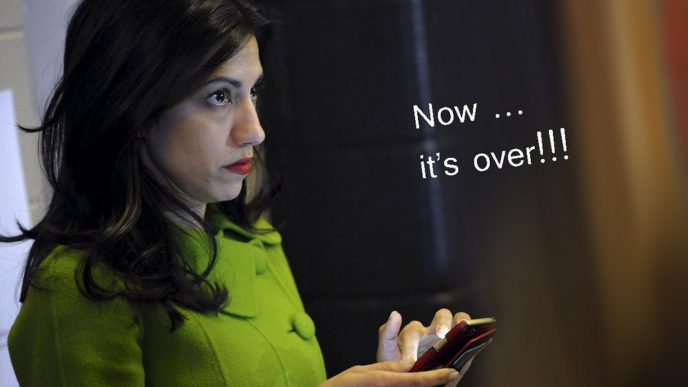
What We Talk About When We Talk About Huma Abedin

The following exchange, or something very like it, is taking place all across the country via email, social media, or cryptic series of texted memes, between patriotic citizens who are scared pantless by the prospect of Hillary Clinton and her team taking absolute executive power come January — and their friends or family members who simply can’t or won’t see what they’re so worried about. Initially, I thought of presenting it entirely in Tweets using social media jargon, but why punish the reader?

CASSANDRA: Did you see that Stream article I sent you on the lifelong ties Hillary’s closest aide, Huma Abedin, has to radical Islamist movements and governments — and their links to terrorist groups that have attacked America?

POLLYANNA: Yeah, I’m really sick of all this racist Muslim-bashing, you know.

CASSANDRA: You know Islam isn’t a race, right? Some of the worst Islamists are blond-haired, blue-eyed losers from the U.S. and Britain who convert to radical Islam as a means of raising their low testosterone count or finding a man who will marry them despite all those extra “fish-and-chips pounds.”

And the majority of Arabs in the U.S. are Christians, who fled the godforsaken hellholes that intolerant Islam made of once-prosperous countries. Of course, the Democrats’ immigration policies are trying to change that, spending millions to fly Muslims from safe camps in Turkey to dump them in Minnesota and Maine, where they can cash nice checks from the U.S. taxpayers — while real refugees (Christians, Yezidis) get beaten at the gates of U.N. camps by highly organized Sunni Muslim bigots.

POLLYANNA: You say that you object to radical Islam. Fine, I can see problems with that, just as I have problems with radical Christianity. You’ve heard of the Westboro Baptist Church, right?

CASSANDRA: Which has maybe 50 members. Remind me, which presidential candidate has an advisor that belongs to Westboro? Is there some oil-rich country pouring millions of dollars each year into turning all Christians into Westboro-style bigots? Building churches and staffing them with Westboro preachers, running journals that explain how to spread Westboro’s ideas to mainstream, peaceful Christians? Because that’s what Saudi Arabia does, and Huma Abedin joined her entire family’s effort to help them, with Saudi money, from people whose other donations went to al Qaeda.

POLLYANNA: The problem with you conservatives is that you read some wild conspiracy theory on the Internet, you don’t bother to fact check it, but if it supports your prejudice you just start forwarding it around. Have you ever heard of Snopes.com?

CASSANDRA: Yes. It’s two pasty-faced Democrats sitting on their couch with a laptop and Doritos. Why should I trust them any more than you should trust Alex Jones?

POLLYANNA: Well you don’t have to. Real publications with real journalists have looked into the wild allegations you people are throwing to try to smear Huma Abedin.

CASSANDRA: You mean like Vanity Fair, which is the source of most of the facts tying Abedin to radical Islamist propaganda organizations that support terrorism, jihad, and sharia?

POLLYANNA: How about Glenn Kessler’s Washington Post “Fact-Checker” column? It completely devastates stories like the one you sent me.

CASSANDRA: Does it now? Are you willing to go through with me, fact by fact, the claims that the WaPo piece challenges, and what it offers in evidence against those claims? Or do you just want to wave it off, and pretend that the matter is settled because a left-leaning newspaper exuded some spin that helps you feel better about voting for Clinton? Let me know now — my time is precious. Those episodes of Dr. Who on Amazon Prime aren’t going to watch themselves.

POLLYANNA: Sure. Go ahead.

CASSANDRA: Great. Keep in mind that many of the claims put forward by Paul Sperry in the New York Post and in that Stream article I sent you aren’t even addressed here.

Was Huma Abedin an editor at a sharia newspaper, as Rep. Sean Duffy (R-Wis.) told CNN?

Kessler points out triumphantly that, contrary to the charge of Rep. Duffy, the Journal of Minority Muslim Affairs is not a newspaper — but a “journal.” He asserts that it is “staid,” and “peer-reviewed,” nice reassuring words for Washington Post readers, but irrelevant to its contents. There’s a Holocaust-denial journal out there that claims to be peer-reviewed too. You just pick the right set of “peers.” Kessler doesn’t dispute the fact that the journal itself openly supports sharia (the core of Duffy’s claim). But Kessler asserts that calling the journal “radical” is “ridiculous, according to experts on Islam and members of the advisory board.”

He does not address the misogynist and anti-American positions taken by Abedin’s mother in the journal, except to call them “cherry-picked” and “mischaracterized,” based on his own review. Kessler makes no argument to defend these claims, but expects us to trust him — and the opinion of one scholar of Israel, and several people who serve on the magazine’s board (hence, interested parties). So is Kessler saying that it isn’t “radical” by contemporary Muslim standards to blame domestic violence on women, claim that sharia law is more empowering for women than legal equality, and blame the 9/11 attacks on U.S. foreign policy? Kessler might be right about that, tragically.

Did Huma Abedin work at this sharia-advocacy journal?

Kessler waves off the indisputable fact that her name was on the masthead for 12 long years, even as she worked for the Clinton White House and Clinton’s Senate campaign. That’s old news, he suggests, so it doesn’t matter. Did she approve of and agree with the misogynist, theocratic, and anti-American articles that appeared with her name on the masthead? Here Kessler is satisfied with an answer from … the Clinton campaign itself: “The Clinton campaign says Abedin played no role in editing articles.” Well, that settles things, doesn’t it? What journalist would ever question a claim from a political campaign just before a presidential election? Not Kessler.

Here’s a question Kessler didn’t bestir himself to ask: Assuming the (completely unproven) claim that Abedin played no role whatsoever in the journal (and so she was essentially committing career fraud): Was she aware of the journal’s contents? If she disagreed with the views expressed there (something she has never publicly said), why didn’t she resign? It helped to sink Ron Paul’s 2008 run when it came out that bigoted newsletters were put out under his name, though he claimed he’d never seen them. You’d think a political reporter like Kessler could remember a major story like that from just eight years ago.

Was the founder of the journal, Huma’s father, Syed Abedin, a supporter of Saudi Wahabi Islam?
Wahhabism is one of the most puritanical religions in the world. It forbids women to drive cars, flogs and executes adulterers, and demands the death penalty for Muslims who join other faiths. Kessler doesn’t address Abedin’s actual views or statements, but relies on the word of Harvard professor Ali Asani, who vouches that Abedin was a model of a “moderate Muslim.” Had Kessler troubled to look into Syed Abedin’s stated positions, he might have found an interview such as this one, where Abedin endorses Saudi-style theocratic control over the lives of citizens:

The state has to take over. The state is stepping in in many countries … where the state is now overseeing that human relationships are carried on on the basis of Islam. The state also under Islam has a right to interfere in some of these rights given to the individual by the Sharia.

Is the Abedin family tied to the Muslim Brotherhood and terrorist financiers?

Kessler goes deep into the weeds here, counting on readers’ confusion and weariness with foreign names. Essentially, he argues that all the connections between the people who funded the Abedins’ sharia journal and also funded organizations that engaged in terrorism pre-date those groups’ proven involvement in terrorism. Essentially, these organizations seemed entirely innocent when the Abedins worked with them, and only later emerged as radical Islamist groups willing to train, equip, and dispatch terrorist attacks against the West.

Kessler ignores the most significant Muslim Brotherhood link of all, Abedin’s service for three years (while she was in college) on the board of the George Washington University branch of the Muslim Students Association — a group which the Muslim Brotherhood itself named in 1991 as a like-minded allied organization. Remember, as the original Stream piece pointed out, that it was Abedin’s own local branch of the MSA that (just two years after she graduated) hired as its chaplain the al Qaeda operative Anwar al Awlaki, later killed by a U.S. drone strike.

POLLYANNA: This is boring. What’s your point?

CASSANDRA: That the same woman with all these shadowy ties to terrorist financiers and radical organizations, who was raised a puritanical Muslim in a country where women live as serfs, who has never condemned the views she once helped propagate, helped Hillary Clinton create a secret private server where she could hide how the $30 million dollar payoffs the Clinton Foundation was taking from the Saudi government had influenced U.S. policy via the State Department. But probably now you want to talk about how some Alt-Right online trolls are using Pepe the Frog to Tweet about Donald Trump. (For more from the author of “What We Talk About When We Talk About Huma Abedin” please click HERE)

Follow Joe Miller on Twitter HERE and Facebook HERE.
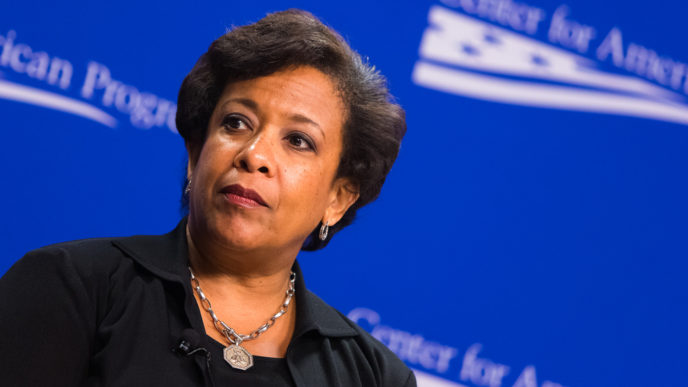
‘Total Political Hack’ Loretta Lynch Denies Grand Jury Request From FBI Clinton Investigators

Loretta Lynch’s Department of Justice is unquestionably playing defense for Hillary Clinton.

Thursday night on the “The Mark Levin Show,” former U.S. Attorney for D.C Joseph diGenova appeared on the program to discuss the potential fallout of electing Hillary Clinton president of the United States. The Democratic nominee, of course, is amidst an FBI investigation into her private email server and Clinton Foundation practices.

With extensive experience on Capitol Hill, diGenova informed Conservative Review Editor-in-Chief Mark Levin that senior FBI officials had approached the criminal and national security divisions of the Justice Department, asking for a grand jury in the Clinton investigation. Lynch’s DOJ denied that request.

Listen:

“I think it’s pretty clear that Loretta Lynch is a total political hack,” diGenova said. “She has demeaned the department, she has abused her authority, and I think she is headed for quite an outrageous ending between the election and the inauguration.”

Discontentment within the FBI over the conduct and perceived obstruction of these investigations into Hillary Clinton is approaching a boiling point.

“There’s going to be an explosion after the election,” diGenova said. “No matter who wins.” (For more from the author of “‘Total Political Hack’ Loretta Lynch Denies Grand Jury Request From FBI Clinton Investigators” please click HERE)

Follow Joe Miller on Twitter HERE and Facebook HERE.

Obamacare Revealed as Masterpiece of Government’s Failed Central Planning

Obamacare, a veritable fountain of unintended consequences, is a 21st century showcase of government central planning. Let’s be clear. This is what President Barack Obama wanted.

Liberals in Congress meticulously designed the Affordable Care Act’s insurance exchanges as powerful regulatory bodies. They defined the kinds of insurance plans, benefits, and medical treatments and procedures the plans must offer; set all of the insurance rules; determined the permissible premium and deductible levels; and organized the most complex and confusing premium subsidy program imaginable.

So, federal government control was, and is, comprehensive. They planned it all.

Obama’s most high-profile promises, reinforced by “progressive” propaganda, have yielded the following: Americans have less consumer choice, less market competition, exploding insurance premiums, ridiculous deductibles, fewer doctors, a narrowing of provider networks—no, you can’t necessarily “keep” your doctor—and the looming prospect of ever bigger burdens on taxpayers.

Through it all, the Obama administration’s academic and media allies have remained fiercely loyal.

Last year, New York Times columnist Paul Krugman hailed the health care law as “a portrait of policy triumph.” This year, New York Magazine’s Jonathan Chait opined: “The policy rationale for repealing the Affordable Care Act continues to disintegrate, while the political conditions to replace it with an alternative have collapsed entirely.”

Let’s also be clear about something else: What “progressive” politicians want, and their academic and media cheerleaders like, most Americans don’t want or like.

Regardless of the outcome of the presidential election, Obamacare, heading into year seven, remains persistently unpopular—with more and more people saying the law is hurting them.

Moreover, the law is not working as officially anticipated. The proof is in the data.

For 2016, the Congressional Budget Office initially projected 21 million people would enroll in the exchanges. The reality: Only about 11 million enrolled.

For 2017, the Obama administration is projecting 13.8 million will sign up for coverage in the exchanges. You can bet, however, that the actual number who remain will be significantly less.

According to the Kaiser Family Foundation, 17 million more people have health insurance in 2016 compared to 2013. But the so-called “market” is churning rapidly.

Examining complete enrollment data for the 2014 to 2015 period, a Heritage Foundation analysis shows that enrollment in individual insurance (mostly exchange enrollment) increased by 5.8 million, while total private employer market enrollment fell by almost 3.6 million.

This means that total private market coverage over that two-year period increased by almost 2.3 million. On the other hand, Medicaid coverage jumped by almost 11.8 million.

So, Obamacare is mostly a major Medicaid expansion. The law is not encouraging Americans’ enrollment in a robust, well-functioning private insurance market; it’s discouraging it.

Consider insurer supply. Obama promised health insurance market competition would blossom. In 2014, Urban Institute analysts, examining the impact of the law in 10 states, concluded: “The Affordable Care Act has resulted in considerable competition.”

A Heritage analysis in 2014, however, examining insurers’ participation in all 50 states, came to a different conclusion; it found a 21.5 percent reduction in the number of insurers nationwide, reflecting the transition from 2013 to 2014.

During that big transition, millions lost their health insurance plans whether they liked them or not. Liberal commentators dismissed these losses as the elimination of “junk plans” or “substandard plans,” meaning they imposed excessive out-of-pocket costs or provided insufficient coverage.

But today enrollees on the Obamacare exchanges face standard “silver” plan deductibles that average $3,572 for single coverage and $7,474 for family coverage. For the lowest-cost “bronze” plans, deductibles amount to roughly $6,000 for single coverage and $12,393 for family coverage.

Taxpayers subsidize the vast majority of exchange enrollees, more or less heavily, depending on their income. Eligibility for insurance premium subsidies ranges from 100 percent to 400 percent of the federal poverty level, and the lowest-income enrollees benefit the most.

Even so, the Kaiser Family Foundation finds that 40 percent are dissatisfied with their premiums and 46 percent are unhappy with their deductibles.

For any person making in excess of $47,080 per year—a large chunk of America’s middle class—there are no Obamacare taxpayer subsidies for either premiums or deductibles for individual insurance. Unless he or she is self-employed, there is not even any tax relief.

These folks, of course, can buy outside the Obamacare exchanges, where they are likely to secure broader provider networks in the standard health plans, but they pay even higher premiums and deductibles. But they can’t just buy health plans tailored to their personal wants and needs.

Meanwhile, the meltdown of health insurance competition intensifies. In 2017, 15 new insurers will enter the exchanges, but 83 insurers are dropping out. Moreover, according to the latest Heritage review of the data, one-third of all U.S. counties (32.8 percent) will have only one insurer and another third (35.9 percent) will have only two insurers.

So, private insurance plans fail, fewer doctors are in the exchanges, Americans have less choice and face less competition. To keep supply up, the administration and its congressional allies want to bail out insurance companies—with more subsidies. To keep demand from falling through the floor, several “progressive” proposals would increase taxpayer subsidies to alleviate the law’s ugly impact on enrollees’ cost sharing.

The most far-reaching proposal would offset all out-of-pocket costs in all private insurance, both in and out of the exchanges. That would be enormously costly for taxpayers, and explode the nation’s deficit by as much as $90 billion in 2018.

No surprises here. The tacit premise of Washington’s central planners is that anything they screw up can be fixed. Just add more government micromanagement and more taxpayers’ dollars. (For more from the author of “Obamacare Revealed as Masterpiece of Government’s Failed Central Planning” please click HERE” HERE)

Follow Joe Miller on Twitter HERE and Facebook HERE.
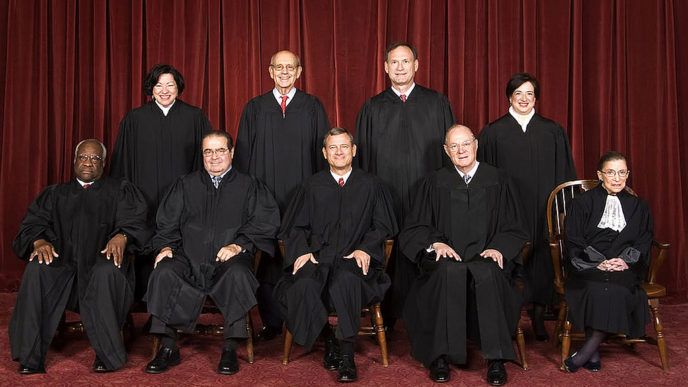
Congress Demands Explanation for Clarence Thomas’ Exclusion From Black History Smithsonian

Seventeen members of Congress sent a letter to the secretary of the Smithsonian Thursday, inquiring why U.S. Supreme Court Justice Clarence Thomas was excluded from the National Museum of African American History and Culture.

The Daily Caller News Foundation reported in October that Thomas is only referenced in the new Smithsonian in connection with an exhibit on Anita Hill, the government employee turned law professor who accused him of sexual harassment during his confirmation hearings. Hill is giving prominent billing in a gallery on blacks in the 1990s.

“The background and accomplishments of Justice Thomas are worthy of inclusion in the museum on their own merits,” the letter reads. “Justice Thomas’ contributions to the judicial system through his appointment to the highest court in the country cannot be discounted. It is a disservice to his legacy and to the history of this nation to mention his name in a single caption, but provide no other exhibit showcasing his story.”

“With this in mind, we insist that you provide an explanation about the conspicuous absence of Supreme Court Justice Clarence Thomas from the new museum, and of any future plans to feature him in a permanent exhibit,” the letter adds.

The lead signatory on the letter is GOP Rep. Earl “Buddy” Carter, who represents Savannah, Georgia, Thomas’ hometown. Sixteen other Republicans signed the letter.

For its part, the Smithsonian has denied it applied any ideological litmus test in preparing its exhibits.

“There are many compelling personal stories about African-Americans who have become successful in various fields, and obviously, Associate Justice Thomas is one of them,” a spokesman said. “However, we cannot tell every story in our inaugural exhibitions.”

“We will continue to collect and interpret the breadth of the African-American experience,” the spokesman added. (For more from the author of “Congress Demands Explanation for Clarence Thomas’ Exclusion From Black History Smithsonian” please click HERE” HERE)

Follow Joe Miller on Twitter HERE and Facebook HERE.

Amnesty Would Cost Taxpayers Trillions, National Academy of Sciences Report Indicates

The long-term costs to taxpayers of immigrants and their descendants are detailed in a new report from the National Academy of Sciences.

The findings in the report indicate that if amnesty for illegal immigrants were enacted, the government would have to raise taxes immediately by $1.29 trillion and put that sum into a high-yield bank account to cover future fiscal losses generated by the amnesty recipients and their children.

To cover the future cost, each U.S. household currently paying federal income tax would have to pay, on average, an immediate lump sum of over $15,000.

The National Academy of Sciences report, “The Economic and Fiscal Consequences of Immigration,” provides fiscal balance projections for immigrants and their descendants over 75 years.

The fiscal balance of an individual equals all government taxes paid minus all benefits received. Federal, state, and local benefits and taxes are included in the estimates.

The NAS report, released a few weeks ago, shows that the fiscal balances of immigrants vary greatly according to education level: Immigrants with low education levels impose substantial fiscal costs that extend far into the future. The government benefits they will receive greatly exceed the taxes they will pay.

This is critical because current illegal immigrants have very low education levels.

Around 10 million adult illegal immigrants currently are in the U.S. Nearly half don’t have a high school diploma. Overall, adult illegal immigrants are six times more likely to lack that diploma than are U.S.-born residents.

Illegal immigrants currently receive routine government services such as roads, sewers, and police and fire protection. The children of illegal immigrants currently receive heavily subsidized public education at an average cost of $12,000 per child per year.

Children of illegal immigrants born in the U.S. are eligible for the same welfare benefits (such as food stamps, Medicaid, Obamacare, and Temporary Assistance for Needy Families) as children born to U.S citizens.

Because illegal immigrant families already receive many government benefits and services, they currently impose a fiscal cost on taxpayers. The benefits they receive exceed taxes paid.

Amnesty or “earned citizenship” would provide current illegal immigrants access to an additional level of expensive government entitlements and benefits.

All of the major “comprehensive” immigration reform or “earned citizenship” bills debated in Congress since 2006 would have granted nearly all current illegal immigrants eligibility for future Social Security and Medicare benefits after 10 years of work. These bills also would have given amnesty recipients access to almost the entire U.S. welfare system, after modest delays.

In effect, amnesty would give current illegal immigrants access to the same government benefits as immigrants who are here legally. Thus, as a general rule of thumb, the long-term fiscal balance of an illegal immigrant, after amnesty, would be roughly equal to the cost of a current legal immigrant with the same age and education level.

The NAS report does not distinguish between legal and illegal immigrants. But, as noted, the report does provide fiscal projections for immigrants at different education levels. Because the education level of adult illegal immigrants is approximately known, the NAS projections enable us to project the future fiscal costs of illegal immigrants if they were granted amnesty or “earned citizenship” as a group.

Based on the education level of illegal immigrants, the NAS figures project that the net fiscal cost (benefits minus taxes) for 10 million adult illegal immigrants after receiving amnesty would have a net present value of negative $1.29 trillion.

The concept of “net present value” is complex; it places a much lower value on future expenditures than on current expenditures. One way to grasp net present value is that it represents that total amount of money that would have to be raised today and put in a bank account earning 3 percent interest above the inflation rate in order to cover future costs.

As noted above, this means that if amnesty were enacted, government would have to immediately raise taxes by $1.29 trillion and put that sum into a high-yield bank account to cover the future fiscal losses that will be generated by the amnesty recipients and their children.

And to cover the future cost, each U.S. household currently paying federal income tax would have to pay, on average, an immediate lump sum of over $15,000.

Of course, if the federal government were to grant amnesty, it would not actually raise current taxes by $1.29 trillion and put the money in a high-yield bank to cover the future costs. Instead, in the government’s normal pattern, the costs would be unfunded and passed on to future years.

Converting a net present value figure into future outlays requires information on the exact distribution of costs over time; unfortunately, that data is not provided by the National Academy of Sciences. However, a rough estimate of future net outlays to be paid by taxpayers (in constant 2012 dollars) for illegal immigrants after amnesty is around $3.6 trillion over 75 years.

Advocates of amnesty have suggested that low-skill immigrants generate large-scale positive economic results that benefit U.S. workers. The NAS report finds no evidence of such effects.

On the other hand, the report clearly shows that the continuing inflow of low-skill immigrants into the U.S. creates large fiscal burdens for taxpayers in the present and the future.

Moreover, granting amnesty is likely to generate even greater flows of illegal immigrants into the United States, adding even more costs. (For more from the author of “Amnesty Would Cost Taxpayers Trillions, National Academy of Sciences Report Indicates” please click HERE)

Follow Joe Miller on Twitter HERE and Facebook HERE.
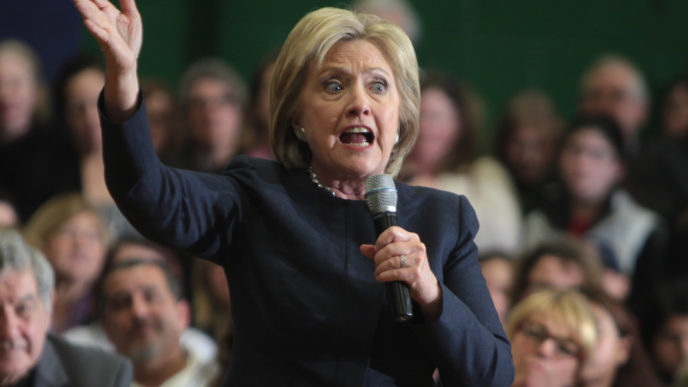
The Media Knew Hillary’s Server Was Hacked Months Ago yet Remained Deafeningly Silent

Hillary’s server being hacked is old news. The story you’re not hearing about is the media’s willful blindness.

The next president of the United States could be an individual — Hillary Clinton — who allowed classified information to fall into the hands of not one, not two, but as many as five foreign intelligence agencies due to her negligence and illegal use of an unsecured private email server.

And the mainstream media’s malfeasance is helping her get elected commander in chief.

Fox News’ Bret Baier rocked the political world Wednesday with an explosive report, as he cited FBI sources indicating the following:

That the investigation into the Clinton Foundation for pay-to-play schemes was more in depth than anyone previously thought.

That an indictment is “likely.”

And, most shockingly, that the FBI believes with “99 percent” certainty that Hillary Clinton’s private server had been hacked by at least five foreign intelligence agencies, and that information was stolen from the former secretary of state.

Again, to recap: As secretary of state for the United States of America, the Democratic nominee allowed classified information to be placed on a private email server — built at her request — and then failed to make sure that server was secure. As a result, foreign intelligence agencies were able to steal information from that Secretary of State.

This virtually never came up during the Democratic primary; Clinton was never really pressed about her email server’s potential threat to national security. But the media cannot pretend they had no reason to suspect that the security of Clinton’s server was compromised.

Why?

Because Conservative Review’s Dan Bongino broke that story in January — definitively stating that Hillary Clinton’s server was hacked, and that Clinton’s team knew about it.

As Bongino, a former Secret Service agent, wrote (emphasis mine):

The growing divide between government rules that are good for the ruling-goose and government rules that are good for the citizen-gander is a source of friction for Americans tired of being dumped on by the DC ruling class. One of the most disturbing examples of this is the growing scandal surrounding Hillary Clinton’s use of a personal email system to share U.S. national security secrets, a potential crime which would have, unquestionably, sent me to prison had I done it as a Secret Service agent on assignment to protect her. And as I state in my book, and as was relayed to me by an unimpeachable source, Mrs. Clinton’s private server WAS HACKED, and Mrs. Clinton’s team knew about it. Combine this with recent revelations that Mrs. Clinton ordered subordinates to remove classified markings from emails before sending them to her over her private, non-government server, and more salt has been poured in this gaping wound.

As Bongino exlplained in the most recent episode of his “Renegade Republican” podcast, “I don’t do tinfoil-cap stuff. I found out from an … as I said in the piece … unimpeachable source who was there!”

Listen:

“I put this stuff out there … media people ignored the story,” Bongino said.

Why didn’t the mainstream media run with the story at any point dating back to January? Why didn’t they press candidate Clinton in the midst of the Democratic primary?

For two reasons. First, Dan Bongino is a conservative, a member of the alternative media liberals scoff at. Therefore, anything he says is null and void.

Secondly, because the liberal media is and always has been in the tank for Hillary Clinton. And everybody knows it. (For more from the author of “The Media Knew Hillary’s Server Was Hacked Months Ago yet Remained Deafeningly Silent” please click HERE)

Follow Joe Miller on Twitter HERE and Facebook HERE.

Abedin Admitted Email Problem Near Time of Reported Hacking Attempt

In August 2010, Huma Abedin admitted she had a problem.

“Sorry. My email is acting up,” the top Clinton aide wrote in response to an email from then-Secretary of State Hillary Clinton.

The email was among 1,250 pages of emails between Abedin and Clinton released Thursday.

That email carries an unusual significance when set alongside an email chain dated Aug. 16, 2010, that was shown to Abedin by the FBI during its investigation into Clinton’s use of a private email server.

The Aug. 16, 2010, email contained the subject line, “Re: your yahoo acct.” The contents of the message appeared to be a warning to Abedin that her personal Yahoo account had been hacked.

“Abedin did not recall the email and provided that despite the content of the email she was not sure that her email account had ever been compromised,” the FBI report on its investigation said.

The disclosure comes the same day Fox News reported that two separate sources close to the FBI investigation into Clinton’s email server believe that up to five foreign intelligence agencies were successful in hacking into the server.

Abedin held a top-secret security clearance during her time at the State Department, and was able to access two systems — the State Department’s classified system and a nonclassified computer where she could access both her clintonmail.com and Yahoo accounts, the FBI has reported.

The longtime Clinton aide said printing difficulties on the classified network led her to ship emails to her non-State Department accounts for printing. She has also said that she rarely, if ever, cleaned out her inbox of old emails.

Abedin told investigators she “lost most of her old emails” when the clintonemail.com server was transitioned to a different server after Clinton left the State Department.

“Abedin did not know if the system administrator had archived the mailboxes before the system was taken down,” the FBI report said.

As the FBI moves forward with its investigation, the probe could further shed light on President Barack Obama, according to one news report

Obama may also have a “vested interest in the outcome” of the race, said Catherine Herridge of Fox News, who reported Thursday that Abedin told the FBI she “had to tell the White House” every time Clinton changed her email address to make sure that the electronic device used by the president would accept it.

Obama’s cellphone only accepts communications from “whitelisted” sources, Herridge said.

The development may be “another admission that the White House understood [Clinton] was using this private server for government business, and that the president was OK with it … because they were allowing updates to the email [address] to be made,” Herridge said. (For more from the author of “Abedin Admitted Email Problem Near Time of Reported Hacking Attempt” please click HERE)

Follow Joe Miller on Twitter HERE and Facebook HERE.

These 8 Supreme Court Elections Could Have Huge Implications for Conservatives

Election Day is Tuesday, which means that in addition to voting for president, congressmen, senators, local officials, and ballot initiatives from sea to shining sea, voters in most states will also be deciding on who sits on their state and local courts.

According to Ballotpedia, 34 states are currently holding elections for their respective state supreme courts and lower appellate courts across the country.

What’s more, 2016 promises to be a record-setting cycle for these races. According to the Brennan Center for Justice, a record $14 million of outside money has been spent on media buys for state supreme court seats this election. This already breaks the previous $13.5 million record for independent expenditure during the 2011-12 cycle.

Here is a quick breakdown of some of the most important races to watch.

North Carolina:

Possibly the highest-profile state high court race is going to be in the Tar Heel State, where Republican incumbent Bob Edmunds faces off against Democrat challenger Mike Morgan, who currently serves on the N.C. superior court.

The seven-member court is currently split between four Republicans and three Democrats, meaning that the election could tip the balance in a state that has become a battleground for several crucial issues.

Though officially a nonpartisan election, Edmunds remarked to the Salisbury Post that the current contest is “the first time I’ve had a race that’s gotten on the front page of newspapers.” The 67-year-old jurist went on to implore voters to weigh a candidate’s “respect for the rule of law” with regard to their state’s highest court. Mike Morgan, meanwhile, has been endorsed by President Obama.

Current estimates of outside spending on the race — an eight-year term — top $2 million, reports Josh Bergeron and the Salisbury Post.

Alabama:

The Yellowhammer State has partisan elections, and Republican justices are currently in control of the Alabama bench. The three Republican incumbents are currently running unopposed, meaning there is no chance of an election-night shift for the bench. But the election is worth keeping an eye on for the extra-electoral buzz surrounding it.

Alabama’s nine-member supreme court has fallen into controversy in recent months due to the extrajudicial suspension of Chief Justice Roy Moore in September. As a result of an administrative order issued earlier this year, Alabama became the first state high court to challenge the federal Supreme Court since before the Civil War, when states like Wisconsin clashed with Justice Taney’s decision in Dred Scott v. Sanford.

Furthermore, a federal lawsuit filed in early September alleges that, under the Voting Rights Act, the state’s current election system somehow “unlawfully dilutes the voting strength of African Americans.”

Louisiana:

Louisiana currently has one contested supreme court race (one incumbent on the seven-member court is running unopposed), in which Jimmy Genovese and Marilyn Castle (both Republicans) are vying for the open seat of the retiring Janet Knoll. Justices are elected to 10-year terms on the Louisiana Supreme Court.

Recent reports show that the appeals court judge Genovese has raised about twice as much as Castle — roughly $1 million — and has a very dim view of judicial activism, recently remarking, “If the law needs to be changed, it is not our job on the bench to change those laws. It is the function of the legislative branch to make it right.”

“It is necessary that those separation of powers be kept in place and be honored,” Genovese told the Louisiana Record.

Castle, a district court chief justice, is the reported favorite of corporate interests in the state, LINK especially those in the energy sector concerned about “legacy lawsuits” that might result from environmental damage.

Kansas:

Kansas’ supreme court election could be a big win for conservatives — especially when it comes to abortion issues and the death penalty. But according to polling, the race is up in the air right now.

Currently, five of the Sunflower State’s top jurists are up for retention in the state’s nonpartisan election (held every six years). Four of the five were appointed by either Democratic or establishment Republican governors. If the jurists are not retained, Governor Sam Brownback would be able to fill the majority of seats on the court after having four slates presented to him under Kansas’ truly bizarre selection process.

However, with the death penalty, abortion legislation, and school choice in the mix, Kansans are split on the issue.

According to polling conducted by KSN News through SurveyUSA:

Twenty percent said none should be retained, and that all five on the bench should be gone. Fifteen percent said only one should be retained, while 16 percent said that two to four justices should stay. Twenty six percent said that want all justices to stay. Twenty-two percent were undecided.

It’s also worth noting that a judge has never lost his seat through a retention election, so this could also throw the court into uncharted territory. Former Kansas governor and Health and Human Services Secretary Kathleen Sebelius has been on the road in recent weeks campaigning for the retention of all five jurists.

Texas:

Republicans currently hold a 9-0 majority on the Lone Star State’s high court, but three of them are currently facing reelection challenges from Democrats. The challengers are undoubtedly hoping that Donald Trump’s effect on disenfranchised Republican voters planning on staying home on Election Day might aid their long-shot bids. State justices are elected to six-year terms.

According to a profile at the Texas Tribune, the Democratic challengers include Mike Westergren, who is trying to “out-Bernie Bernie Sanders” with his small-donor fundraising model; Dori Contreras Garza, who is running on the “diversity” platform of making the high court “more representative” of the state’s demographics; and Savannah Robinson, a first-time, 60-year-old candidate with no campaign website, and no fundraising apparatus.

Texas hasn’t elected a Democrat to its supreme court since Bill Clinton’s days in the Oval Office.

Iowa:

Chief Justice Mark Cady and Justices Brent Appel and Daryl Hecht are facing reelection for the first time since the state’s high court unanimously redefined marriage seven years ago, well ahead of last summer’s Obergefell decision. Just a year after the Hawkeye court’s decision, three of the other concurring in the decision failed their bid for retention following a massive grassroots response from social conservatives unhappy with the justices’ votes to legalize gay marriage.

“I think it will send a message across the country that the power resides with the people,” Bob Vander Plaats, a leading campaign activist in the election, said at the time. “It’s we the people, not we the courts.”

According to the AP, Cady, Appel, and Hecht have opted against campaigning for retention, citing their belief that the court should be above politics.

Ohio:

Ohio currently has 30 judgeships up for grabs on Tuesday in a nonpartisan election. Three of these are on the state supreme court. One of those seats is uncontested, with the other two being cases in which the current justices have reached the Buckeye State’s mandatory retirement age.

Ohio’s supreme court justices run for six-year terms. Currently featuring a 6-1 Republican bend, this means that the two contested elections could create a narrow 4-3 split on the swing state’s bench.

According to an Associated Press report:

Cincinnati appeals court judge Pat DeWine, a Republican, has booked almost $644,000 in TV ads, according to an analysis by the Brennan Center. DeWine’s opponent, Warren Democratic appeals court judge Cynthia Rice, released her first TV ad Monday, but no spending figure was immediately available.

Democrats say DeWine will face a monumental conflict of interest if elected because his father is Attorney General Mike DeWine. DeWine says he has been assured through legal opinions that he would have to step aside only if his father personally argued a case.

Meanwhile, in the other contested race, Republican Pat Fischer squares off against Democrat John O’Donnell.

According to a recent profile by Angela Hatcher and the Cincinnati Enquirer, Fischer worked as a janitor and referee to help pay for his undergraduate and law school degrees at Harvard University and serves on the Ohio Constitutional Modernization Commission. John O’Donnell, meanwhile, previously worked as a claims adjustor and graduated from Cleveland-Marshall Law School. He has presided over hundreds of criminal cases as a county court of common pleas judge.

Both Fischer and O’Donnell have voiced their law-over-party philosophy in this nonpartisan election.

Washington:

The makeup of Washington state’s nine-justice supreme court — to which justices are elected to six-year terms — could be fundamentally altered over an anti-school choice decision from last year.

The race for incumbent Charlie Wiggins’ seat has drawn the attention of tech industry moguls like Microsoft co-founder Bill Gates and former Microsoft CEO Steve Ballmer, who are looking to oust Wiggins in favor of municipal court judge Dave Larson.

According to Geekwire, Gates and others’ contributions are going into a PAC called Citizens for Working Courts Enterprise Washington, with innovation in education being a top priority for the campaign:

The PAC throwing its weight behind Larson is likely due to his background with the landmark McCleary lawsuit, which called on the state to fully fund public schools. When he was president of the Federal Way School Board, Larson spearheaded an education-funding lawsuit. It was unsuccessful, but it laid the groundwork for the state Supreme Court McCleary ruling.

The Washington State Supreme Court declared public charter schools unconstitutional in 2015, three years after Gates and company dumped millions into a public charter school initiative.

Wealthy individuals on the pro-school choice side have also contributed large donations to unseat state chief justice Barbara Madsen, who wrote the McCleary decision last year, in favor of prosecutor Greg Zempel.

For the third contested seat, incumbent Justice Mary Yu is running to hold her position against David DeWolf, a professor at Gonzaga law school for the past 25 years.

So what makes these cases so important?

These are the judicial bodies that were originally meant to handle most issues of state law — before widespread federal overreach took that away. Nonetheless, state supreme courts still have a tremendous impact on how their respective states function, as elections have a tremendous effect on how judges rule in hot-button cases, a recent study shows.

The 2016 election’s focus on Justice Scalia’s empty Supreme Court seat has left many Americans feeling helpless about the judicial direction of the country. But lower judicial elections are where voters can have a direct impact on how policies that affect them most often are decided.

Just as far more emphasis should be placed on electing local officials that share the concerns and values of voters, the same can be said for lower court elections. Regardless of the outcome, America may still end up with a more liberal court at the national level after Tuesday, but that doesn’t have to be the case at the state level. (For more from the author of “These 8 Supreme Court Elections Could Have Huge Implications for Conservatives” please click HERE)

Follow Joe Miller on Twitter HERE and Facebook HERE.

Refugees Are Getting Obamacare Subsidies While Your Premiums Skyrocket

There’s been a lot of talk about how many refugees we’re letting into our country; in fiscal year 2016 alone, the Obama administration let in 85,000 refugees into the United States. Almost half of them were Muslim refugees, according to Pew Research. In 2017, the plan is to let in at least 110,000 total refugees.

But, on top of the countless other concerns that come with refugees (assimilation, terrorism, taxpayer dollars, etc.), did you know that these refugees are also eligible for Obamacare?

Well, they are. You don’t need to be a citizen to be eligible to buy Obamacare through a marketplace exchange or to receive tax credits and subsidies. Rather, you just need to be “lawfully present.”

What does that mean? According to a recent Congressional Research Service report, the term “lawfully present” generally includes refugees and foreign nationals. But because the ambiguous term means different things to different government agencies, the Department of Health and Human Services had to create a program to determine which “lawfully present” people are eligible for the Affordable Care Act when the health care law took effect.

None of the information the federal government discovers in the course of determining a person’s eligibility is used in any immigration enforcement either. So if someone is illegally in the United States and applies for Obamacare, and the federal government then discovers their illegal status in the process, the government will take no action to deport that person.

Here’s where it gets downright unfair: A lawfully present noncitizen who isn’t eligible for Medicaid can be eligible for Obamacare tax credits and subsidies, while “[s]imilarly situated U.S. citizens and lawfully present noncitizen who are eligible for Medicaid could technically participate in an [Obamacare] exchange, but they would be ineligible for the premium credits and cost-sharing subsidies.”

This means that there are struggling citizens who may not get help with the ever-more expensive health care costs, but certain non-U.S. citizens — in a comparable financial situation — are getting extra help from the federal government to purchase Obamacare.

As Obamacare gets more and more expensive (premiums are shooting through the roof) and refugees come flooding into this country, it would be prudent for policymakers to close this unfair loophole. It’s not right that non-citizens are given preferential treatment, when so many struggling, tax-paying Americans are closed off from the same help.

While we don’t have any numbers yet on how many refugees are on Obamacare, we do know that some cities and states will be disproportionally affected. As The New York Times reported recently, Detroit, Chicago, San Diego, Dallas, Houston, Atlanta, Baltimore, New York, and Philadelphia, among other cities, have each received a few hundred Syrian refugees since 2012. Some smaller cities are also feeling the brunt of the Obama administration’s refugee policies. For example, Boise, Idaho, has accepted more refugees than Los Angeles and New York combined, according to the Times.

In addition to thousands and thousands of refugees becoming eligible for government health care, California recently became the first state to apply for a waiver from the federal government to allow illegal aliens to get ACA coverage. If the waiver is granted, nearly 400,000 illegal aliens in California would be covered through Obamacare — despite President Obama’s 2009 promise that illegal aliens would not be eligible.

Premiums are up, enrollment is down, thousands of refugees are being put on Obamacare, and Obama’s promise to keep illegal aliens off Obamacare looks like another broken promise.

In other words, we’re getting closer and closer to the cliff. (For more from the author of “Refugees Are Getting Obamacare Subsidies While Your Premiums Skyrocket” please click HERE)

Follow Joe Miller on Twitter HERE and Facebook HERE.
Why Kansas Conservatives Are Pushing Voters to Reshape the State’s Highest Court

It’s typically a no-drama affair. Every six years, Kansans vote whether to retain the state’s sitting Supreme Court justices.

The question is the last item on the ballot. In Kansas history, voters never have voted out a justice on the state’s highest court.

But this year, the judicial elections in Kansas—known as retention elections—are especially contentious and political, mirroring shifts in other states as the public reckons with what the role of the court should be.

“It is political in Kansas right now, but I believe the court brought this environment upon themselves,” state Senate President Susan Wagle, a Republican, said in an interview with The Daily Signal. “The information you want to get from a court ruling is whether a law fits within the [state] constitution, and by all appearances, we have a number of justices making decisions based on personal convictions rather than state law and the state constitution.”

Kansas Gov. Sam Brownback and other conservative Republicans in the Legislature have not been shy about wanting to reshape the state’s Supreme Court.

Conservatives have accused justices of overstepping their authority, and have expressed outrage over rulings that overturned death penalty verdicts and struck down abortion restrictions. In another controversial ruling, the court determined the Republican-led Legislature has not adequately and equitably funded public schools.

In response, the Kansas Legislature has proposed bills to change the way justices are selected in the state, giving the governor more power in appointing them. That effort so far has failed.

In 2014, the Legislature passed and Brownback signed an appropriations bill that weakened the state Supreme Court’s administrative authority over local courts. Last year, the state Supreme Court ruled that measure unconstitutional.

The criticism of the seven-member court by conservative politicians has elevated the judicial elections into the public discourse. Outside groups are campaigning—and spending heavily on the election. And the Kansas Republican Party for the first time took a formal position on judicial retention.

“The Republican base in Kansas is not comfortable with a lot of decisions the court makes,” Clayton Barker, executive director of the state Republican Party, told The Daily Signal. “The state party is more involved this year because the court is going beyond judicial power and these justices don’t seem to have the wisdom of self-control.”

Chief Justice Lawton Nuss and four other justices face a retention vote: Marla J. Luckert, Carol A. Beier, Dan Biles, and Caleb Stegall.

Groups opposing retention specifically aim to oust four of the five—all but Stegall, the only one appointed by Brownback. The others were appointed by Democratic and Republican governors who preceded him.

These anti-retention groups include Kansans for Life—the state’s most vocal organization opposing abortion—and Kansans for Justice.

The latter group was created by family and friends of the victims in a notorious multiple-murder case. Brothers Jonathan and Reginald Carr were sentenced to death in 2002 after being convicted of robbing, raping, kidnapping, and shooting five people—four of whom died—in Wichita in 2000.

The Kansas Supreme Court vacated the Carrs’ death sentences in 2014, and required new trials. The U.S. Supreme Court overruled the state court’s decision, and reinstated the death sentences.

Two prominent groups, meanwhile, support retention of the justices targeted by conservatives. Kansans for Fair Courts says it represents “thousands” who believe conservative politicians unfairly have rebuked the court and unethically politicized the judicial process.

Four former Kansas governors—Republicans Bill Graves and Mike Hayden and Democrats Kathleen Sebelius and John Carlin—also urge voters to keep the justices in their seats.

“As former governors we understand the unique roles of the three branches of government,” Graves said during a media tour on the topic in September. “We may not have always agreed with them but we respected that the judicial branch is a nonpolitical branch accountable to the constitution. The courts provide a critical check and balance on the other two branches and we want to keep this constitutional balance.”

Alicia Bannon, who monitors state courts at the Brennan Center for Justice at New York University School of Law, says outside groups advocating on the subject of retention elections are not subject to financial disclosure requirements under Kansas law.

But in one measurement of the scale of spending, she said, she has reviewed television contracts filed with the Federal Communications Commission that show outside groups on both sides have spent roughly $600,000 combined on ads related to the judicial elections.

In 2010, Bannon says, she began noticing increasing outside interest and spending related to retention elections in the 18 states that use such a method as part of their judicial systems.

“We are seeing a number of retention elections attracting a lot of spending, and generally becoming more politicized—sometimes linked to a particular decision on the bench and sometimes linked more to a general interest in shifting the ideological position of the court,” Bannon told The Daily Signal in an interview.

Bannon named Iowa, Florida, Tennessee, and Illinois as states that had contentious Supreme Court retention elections in recent years.

Bannon says she worries that the politics surrounding such races affect how judges make decisions, and undermine the faith in courts as a nonpartisan arbiter.

“One of the troubling aspects of this whole development is that because judges are focusing on their re-election while sitting on the bench, their decisions are up for criticism,” Bannon said, adding:

There is a lot of evidence that job security concerns are bearing on decisions. More generally, if judges start to see themselves as simply politicians, than it becomes harder for them to approach cases putting all politics aside. And ultimately, that’s their job.

The Kansas judicial system is conditioned so as not to be vulnerable to political winds, supporters say.

As authorized by the state constitution, justices of the Supreme Court are selected by a nonpartisan nominating commission and appointed by the governor.

“The Kansas Constitution is set up to keep these type of politicized things from happening,” Kerry Gooch, executive director of the Kansas Democratic Party, said in an interview with The Daily Signal, adding:

We as Kansas Democrats like our judges to not be political, and we hate the fact that Governor Brownback and conservative lawmakers have tried to change that. That makes it hard for the court to do its basic job, which is to follow and enforce the law, and not take into account public opinion, feeling, and emotions.

The Kansas Democratic Party has not taken a formal position on the retention elections, Gooch said, because party leaders don’t think it’s appropriate for a political body to influence the judiciary.

Conservatives, however, argue that the current system for selecting judges isn’t fair.

Lawyers who belong to the Kansas Bar Association select five of the nine members of the nominating commission. The other four members must be nonlawyers selected by the governor.

The Republican-led state Senate has twice voted for a constitutional amendment that would change the judicial selection system to be like the one at the federal level, so that the governor appoints justices and the Senate confirms them. Those measures failed in the House.

Jeff King, a Republican who is Senate vice president, contends that unless the selection system changes, politicians like himself are not wrong to involve themselves proactively in judicial elections and to make the public more aware of court decisions.

“It’s healthy that the public has more information about the influence that the Supreme Court has on their daily lives,” King, who is retiring, told The Daily Signal in an interview. He added:

I would rather have something else than the politicized retention elections we see now, but our system doesn’t allow for anything else to allow the broader voice of 2.9 million Kansans to be heard. This is not about one justice. It’s about taking the system we have in Kansas and making sure it works vibrantly and is representative of the people’s will.

(For more from the author of “Why Kansas Conservatives Are Pushing Voters to Reshape the State’s Highest Court” please click HERE)

Follow Joe Miller on Twitter HERE and Facebook HERE.