National Debt Will Hit $20 Trillion After Next President Is Sworn In

The next president will face a nation debt of $20 trillion, nearly double what it was when President Barack Obama took office.

The national debt likely will reach the staggering $20 trillion figure in 2017, according to the Bipartisan Policy Center, a Washington think tank.

On March 16, the new president and Congress will have to reach an agreement on the debt limit—which will likely be $20.1 trillion, according to the center’s projection. That will last until mid-summer, before another negotiation will ensue on borrowing more to pay the government’s bills.

“There are a number of uncertainties between now and then and we don’t know exactly what the revenues and outlays will be, but we project the total gross debt will hit $20 trillion sometime in February,” Shai Akabas, director of fiscal policy for the Bipartisan Policy Center, told The Daily Signal in a phone interview.

“February is typically a bad month for the national debt because a lot of tax refunds go out then.”

The national debt currently stands at $19.8 trillion. When Obama came into office in January 2009, the national debt was $10.6 trillion. The spending agreement Obama reached with Congress in late 2015 allowed the Treasury Department to borrow another $1.5 trillion before he leaves office in January 2017.

To put the $20 trillion figure in perspective, MarketWatch reported in September the combined valued of all 500 major corporations in the S&P 500 were valued at $19.1 trillion as of the summer of 2016. These companies include Apple Inc., Exxon Mobil Corp., Facebook, and other giants.

Further, the U.S. national debt is more than all of the world’s physical currency, gold, silver, and bitcoin, according to MarketWatch. The combined value of every dollar, euro, yen, pound, and other physical currency is $5 trillion. The world’s physical gold is worth $7.7 trillion and the world’s physical silver is valued at $20 billion.

The Congressional Budget Office projects that gross debt in 2017 will reach $20.16 trillion, but did not have a month-by-month breakdown as of deadline. The budget office’s 10-year debt projection estimates the national debt will reach $28.19 trillion in 2016. The amount of debt held by the public will be 77.2 percent of the gross domestic product in 2017.

By 2026 the publicly held debt will be 85.5 percent of the economy, according to the budget office.

Treasury Department spokesman Rob Runyan told The Daily Signal that the department does not have a projection to share.

For the next president and Congress, the challenge will be to slow the rate of debt’s growth. This is because a cut in the national debt won’t come unless there is a budget surplus, which no one projects, Akabas said.

Akabas thinks a deal for bipartisan entitlement and tax reform is possible over the next two or four years, while both parties will have areas where they want to spend more.

“Health care is the biggest driver of government spending with Medicare and Medicaid,” Akabas said. “But, Republicans are concerned about defense and Democrats are worried about domestic [spending]. There will be some dialogue about giving back in those areas.”

While divided government can lead to gridlock, Akabas also has some optimism.

Congress and the new president could reach a bipartisan plan to tackle the debt in a way that wouldn’t cause one party to be blamed. Further, he said he anticipates such a debt plan—that would require some unpopular actions—could be offset with popular items such as more infrastructure spending.

There are actions that Congress and the next president can take to rein in the debt, but the problem might be what realistically will be done, said Romina Boccia, deputy director of the Thomas A. Roe Institute for Economic Policy Studies at The Heritage Foundation.

“A lot can be done in the next administration’s budget proposal and with Congress’s follow up,” Boccia told The Daily Signal. “Neither candidate for president has a strong plan for addressing the debt.”

She said there is still potential to control the debt.

“The House Budget Committee has presented a plan that can make a real difference,” Boccia said. “Any plan will have to include entitlement reforms, health care spending reforms, and Social Security reform.” (For more from the author of “National Debt Will Hit $20 Trillion After Next President Is Sworn In” please click HERE)

Follow Joe Miller on Twitter HERE and Facebook HERE.

Did Wikileaks Just Uncover Hillary’s Mole Within the DOJ?

Today’s 25th installment of the WikiLeaks emails contained a blockbuster. The assistant attorney general for congressional relations, Peter Kadzik, used his Gmail account to inform John Podesta of next steps in the DOJ Clinton email investigation. Kadzik is now reportedly heading up the “review” of documents and emails seized from Anthony Weiner’s computer.

Here’s what the May 19, 2015 email from Kadzik said:

There is a HJC oversight hearing today where the head of our Civil Division will testify. Likely to get questions on State Department emails. Another filing in the FOIA case went in last night or will go in this am that indicates it will be awhile (2016) before the State Department posts the emails.

kadzik-email

There you have it. An assistant attorney general gave the campaign chair of a presidential candidate under investigation by the FBI a heads up on next steps related to that investigation.

On top of that, Kadzik is the one who sent a letter to Democratic congressmen saying that the Department of Justice was adding additional resources to the Weiner computer investigation.

Who is Kadzik? We have learned in WikiLeaks emails that he is a very good friend of Clinton campaign chair Podesta. Here’s how the Daily Caller reported their relationship last month.

The day after Hillary Clinton testified in front of the House Select Committee on Benghazi last October, John Podesta, the Democrat’s campaign chairman, met for dinner with a small group of well-connected friends, including Peter Kadzik, a top official at the Justice Department.

The dinner arrangement, revealed in hacked Podesta emails released by WikiLeaks, is just the latest example of an apparent conflict of interest between the Clinton campaign and the federal agency charged with investigating the former secretary of state’s email practices.

According to the Washington Free Beacon, Kadzik has previously donated to several Clinton initiatives, including Hillary’s 2008 campaign.

Up until now, Wikileaks emails between Podesta and Kadzik only showed a friendship. And the fact that Podesta claims Kadzik, “kept me out of jail.” Today’s dump by Wikileaks shows that Kadzik was, in fact, providing the Clinton inner circle with information regarding the email investigation.

Not only was Kadzik providing this information, but he did it through his personal, not governmental email address —likely to hide it from the National Archives.

Kadzik should immediately be taken out of his role in this investigation. The American people deserve an impartial Department of Justice. (For more from the author of “Did Wikileaks Just Uncover Hillary’s Mole Within the DOJ?” please click HERE)

Follow Joe Miller on Twitter HERE and Facebook HERE.

Families Struggling With Socialism: Obamacare Tripled My Costs for Much Less Coverage

Obamacare is ubiquitously regarded as an utter failure. However, when viewed through the lens of its supporters, it is a smashing success. The goal of Obamacare was to ensure that no average-income family (or even upper-middle income family) could live in dignity without government subsidies for health insurance. By that measure, the leviathan has achieved its goal. Will we the people let them get away with it?

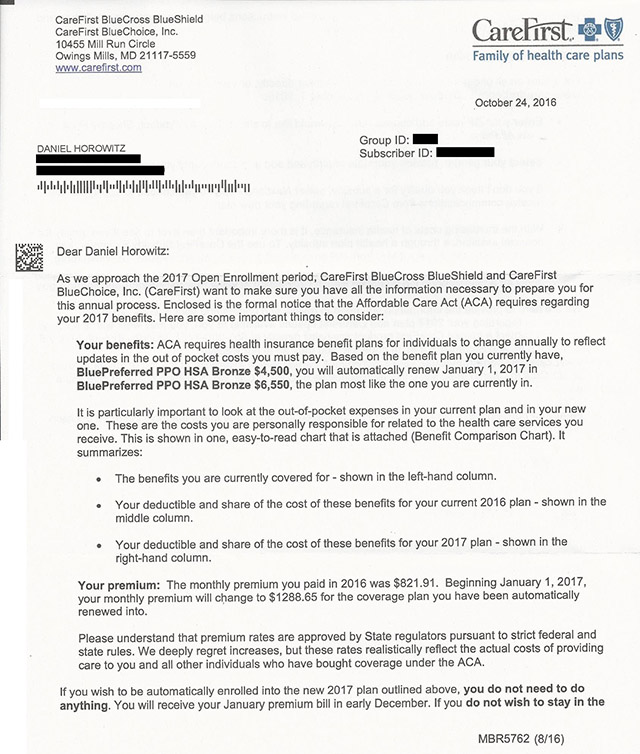
Like millions of other Americans, my wife and I just got the dreaded Obamacare letter in the mail, and it ain’t pretty:

obamacare-letter

My monthly premium for the HSA Bronze plan under CareFirst Blue Cross Blue Shield of Maryland will be going up from the already astronomical $821.91 a month to $1288.65. Worse, the deductible, which was already high, is going up to $13,100. It is an incredible testament to our broken political system the fact that the Republican Party has barely made this an issue during the past two presidential elections. The Obamacare crisis is a once-in-a-generation opportunity for conservatives to win the fight over government intervention once and for all.

To begin with, the price of health care and health insurance was always distorted and inflated thanks to a myriad of government regulations, the employer-based tax exemption (what I refer to as fourth party coverage), and other cultural trends of over-utilizing and over-insuring health care. Nonetheless, there was enough choice and competition in the market for most Americans to find a tailor-made plan that more or less worked for the family at a price that would not place a crushing burden on the family budget.

My Pre-Obamacare Plan

Prior to enactment of Obamacare regulations, my family of five had a plan with a monthly premium of $425. The “Healthy Blue” plan from CareFirst of Maryland had a $5,000 deductible, but it covered most of the basic necessities for absolutely free, even before meeting the deductible. All sick and well visits to the primary care physician were covered 100% without copay, as were generic prescription drugs. Specialists were covered with just a $40 co-pay before meeting the deductible. For a healthy family with three young kids in which ear infections are the most common ailment, this plan worked out perfectly because sick PCP visits and generic drugs account for most of the expenses.

Even under this relatively high deductible plan, I was able to have surgery to remove two Lipomas from my abdomen for just $40 because it was done in the office of the surgeon. Hospitalization was obviously not covered, but that was a worthwhile calculated risk given the money we saved on the premiums. Plus, the deductible, although relatively high (now we’d die for it!), would be met by the time potential extended health costs would surpass the sum we were saving from the cheaper premiums. Those are the decisions that smart families make every day on an array of goods and services when there are actually market-based forces allowing competing offers from which to choose.

The crushing increase in costs in just a few years

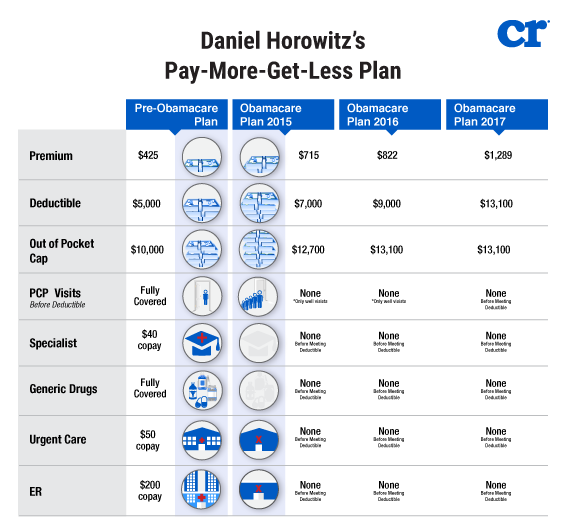
Now, take a look at this graphic for a vivid demonstration of what Obamacare has done to our budget:

pay-more-get-less-chart

Our premium has tripled to a crushing cost of $1,288 per month, over $15,000 a year. Just this year’s increase alone will be $467 a month, $5,600 a year. Remember, my entire premium was less than $5,000 before Obamacare. And what do we get for the crushing cost? We pay money in order to pay money. The deductible has gone from $5,000 to $13,100, and unlike with our previous plan, nothing but the dubious “annual well visits” are covered prior to meeting the deductible. That means one must shell out roughly $28,000 in a given year before one red cent of routine or emergency medical care is even partially covered.

Thanks to the overutilization and no market forces in healthcare, even a perfectly healthy year for a family of five — with no costs beyond typical sick visits and basic antibiotics for standard ailments (no hospitalizations or ER visits) — we must shell out $3,000-$5,000 in out-of-pocket-costs. Add that to the $10,000 increase in premiums from Obamacare and my family must pay a minimum of $13,000 more a year in health expenses thanks to the stupidity of those who voted for Obama and the perfidy of the Republicans who have no plans to fight it.

Once you let that sink in, take note of the fact that this is just the third year of implementation. What does the price tag look like 3-4 years from now?

This issue is potent enough for a true opposition party to win

A party that was actually committed to sound conservative policy would utilize this as a teachable moment, irrespective of who becomes president. My story is undoubtedly the story of so many families. Whereas most prior big government interventions took longer to inflate the cost of the private sector, and the deleterious effects were not apparent enough to the public, everyone recognizes that Obamacare is the culprit for the health crisis and they know who is to blame. This is one case where families unambiguously feel the cost of regulation and government intervention.

$13,000 is real money. That is a lot more than what we spend on food a year for a family of five. The $467 increase in monthly premiums just from last year’s increase is more than my monthly car payment for our Toyota Sienna. I could by a new minivan for that cost. Recently, we replaced our heating and air conditioning with a top-of-the-line system and I’m only paying about $260 a month for a zero-interest loan. Heck, it’s a lot more than what we pay for our son’s playgroup.

This issue alone could sink the entire Democrat Party in the long run. Yet, the Chamber of Commerce has already made it their official policy to “fix Obamacare” instead of ending it. Watch for Hillary (if elected) to call for single-payer and Republicans to use that as the new baseline to define the contours of their opposition. They will oppose single-payer but offer nothing more than what the Chamber and insurance companies are looking for — a bailout and a preservation of the coverage mandates, such as pre-existing conditions and community rating — the very mandates that have made insurance actuarially insolvent. That has already been the official policy of GOP leaders for years, even though they run on repealing the law.

Rarely do conservatives have an opportunity to demonstrate why unconstitutional government interventions are not just costly for the federal budget (most people don’t understand how the debt affects them) but also for the family budget. This is an opportunity for a new movement to rise up and pledge to fight this law until the bitter end. This issue was responsible for two landslides in midterm elections that were not overpowered by personality issues, as was the case in 2012 and this election.

Republicans will still have control of the House and very possibly the Senate after next week’s election. If every elected Republican — not just Ted Cruz, R-Texas (A, 97%) shouting from the wilderness — would use the power of the purse to put an end to this problem, even a Democrat president could not overcome the pain crying out from the family budget of millions of Americans. And in fact, Hillary Clinton, who will likely enter the presidency as the most illegitimate and unpopular persona since John Quincy Adams, is the most beatable opponent on this issue. If only we had a real second party ..

Democrats better be careful what they wish for. The people are not with them on a single major issue, Obamacare first and foremost. This issue will only deteriorate for them in the coming months and Hillary is the polar opposite of Obama’s likable “Teflon” personality. The only thing saving them is a fake Republican Party committed to “governing” with them instead of exposing and defeating them. That will not always be the case. It will change one day. The fight will continue, irrespective of what happens next week. Remember, our republic will not rise or fall on your vote for president alone, but whether you acquiesce to this corrupt system or take your own destiny into your hands. (For more from the author of “Families Struggling With Socialism: Obamacare Tripled My Costs for Much Less Coverage” please click HERE)

Follow Joe Miller on Twitter HERE and Facebook HERE.

8 Instances of Voter Fraud in 2016, and It’s Not Even Election Day Yet

In just the last week, prosecutors pursued three voter fraud-related charges in three major battleground states—Florida, Iowa, and Virginia.

Numerous other election irregularities such as voting beyond the grave, voting more than once, voting without citizenship, and registrations by nonexistent people have occurred throughout 2016. While some cases have been prosecuted, others were discovered through various news reports.

Here’s a sampling of election irregularities that have already taken place well in advance of Nov. 8.

1. ‘Fictitious’ Voter Registration

On Oct. 28, Vafalay Massaquoi, 30, of Alexandria, Virginia, was arraigned on two felony charges of voter registration fraud and two felony counts of forging a public record, according to the Alexandria Commonwealth’s Attorney’s Office.

Massaquoi worked for New Virginia Majority, a progressive community organizing group, earlier this year when he allegedly fabricated names on voter registration forms. The Alexandria Office of the General Registrar, which oversees elections in the city, flagged the matter and reported it to prosecutors in June.

“Given the recent public attention to claims of election fraud, I think it is important to note that there is no allegation that any illegal vote was actually cast in this case,” Bryan L. Porter, Alexandria Commonwealth’s attorney, said in a public statement, adding:

Furthermore, since the fraudulent applications involved fictitious people, had the fraud not been uncovered, the risk of actual fraudulent votes being cast was low. However, any such offense is extremely serious and can degrade the confidence we as citizens justly have in our system of elections.

Massaquoi left Alexandria before police could make an arrest in July, authorities said. After what Porter called a “lengthy search,” police arrested him near Philadelphia in early October and extradited him to Alexandria on Oct. 27 to face arraignment the next day.

2. Double Trumper

In another battleground state, Terri Lynn Rote, 55, of Des Moines, Iowa, was arrested on charges of voting twice for Republican presidential candidate Donald Trump.

Rote was charged with first-degree election misconduct, a Class D, or less serious, felony in Iowa. She reportedly was booked in the Polk County Jail Oct. 27 and released the next day.

The Des Moines Register reported that Rote cast an early ballot at the Polk County Election Office and another at a county satellite office in Des Moines.

Rote was among three suspects reported to police by Polk County Auditor Jamie Fitzgerald. Others were accused of casting mail-in votes, then early voting in-person, but neither was charged, according to the Des Moines Register.

Rote’s court appearance is set for Nov. 7, one day before the election.

3. Florida Busts Two for Election Fraud

Miami-Dade State Attorney Katherine Fernandez Rundle announced Oct. 28 that two women were charged with election violations. One was charged with registering phony or dead voters, the other with changing votes on mail-in ballots.

Tomika Curgil, 33, was a canvasser for People United for Medical Marijuana, where she was hired to register voters. However, the Miami-Dade Elections Department couldn’t verify much of the voter information, or whether the names submitted were of people eligible to vote.

Authorities said they believe Curgil never left her home before returning completed and falsified voter registration forms. They said discrepancies include registering dead voters, according to the Miami-Dade prosecutor’s office.

Curgil was charged with five counts of submitting false voter registration information, which is a third-degree felony in Florida.

In the other Florida case, Gladys Coego, 74, was hired as a temporary election worker for the Miami-Dade Elections Department to open absentee ballots. A co-worker reported that Coego marked some of the ballots.

According to the prosecutor’s office, Coego admitted to investigators she marked several absentee ballots for mayoral candidate Raquel Regalado when that race was left blank.

Coego was charged with two counts of marking or designating on the ballot of another person, a third-degree felony.

“Anyone who attempts to undermine the democratic process should recognize that there is an enforcement partnership between the [Miami-Dade] Elections Department and our Prosecution Task Force in place to thwart such efforts and arrest those involved,” Rundle said in a written statement. “Now we need to move forward with the election.”

4. Dead and Double Voting in Colorado

CBS4, a TV station in Denver, conducted a broad voter fraud investigation that found numerous cases of dead voters and people voting more than once. The report aired in September.

The station cross-referenced databases to find a particular problem in El Paso County and Jefferson County, and the findings triggered a criminal investigation, CBS4 reported.

In one case, the station noted a woman who died in 2009 apparently managed to vote in 2010, 2011, 2012, and 2013. In another case, a man who died in 2009 was recorded to have voted in an election nine months later. A man who died in 2004 had a recorded vote in the 2006 election.

CBS4 aired a follow-up piece Oct. 25 noting six cases in which records show people voting twice in Colorado elections during the same election cycle, while six others voted in Colorado and another state’s elections. Five of the cross-state votes cast a vote in Kansas as well as Colorado, the station reported.

5. 19 Dead Re-Registered to Vote in Virginia

In another Virginia case, the FBI and Virginia law enforcement found in late September that at least 19 dead people were re-registered to vote in the state. All 19 were registered in the city of Harrisonburg, The Washington Post reported.

The investigation commenced after family members of some of the deceased received voter registration notifications. The forms reportedly were filled out by a group trying to sign up voters on the James Madison University campus in Harrisonburg.

Not all of the alleged fraud is taking place in swing states. New York and California have had problems as well.

6. Dead Registered Voter From New York

In at least one case, a dead person is being encouraged to vote by the state of New York. Unlike elsewhere, a lack of pulse kept one individual from casting a ballot.

Michelle Dimino, of Queens, doesn’t want her father to be registered to vote any longer. That’s because he died in 2012. Yet, the New York Board of Elections keeps sending Anthony Baldomir absentee ballots.

Dimino informed the board numerous times that her father died and was no longer eligible to vote, but the ballots keep coming.

So she went public with the complaint, the New York Post reported in October.

Baldomir was a registered Democrat.

“In 2013, 2014, 2015, and again this year, I received absentee ballots for my father. I could have fraudulently voted with those ballots, but I shredded them instead,” Dimino told the Post.

Baldomir was ill in 2012 and was receiving medical care when he requested an absentee ballot, the Post reported.

New York Board of Elections spokeswoman Valerie Vazquez confirmed to the newspaper that Baldomir was still on its “permanent absentee ballot list.”

7. Switching Voter Registration

In July, Riverside County, California, District Attorney Mike Hestrin announced that online tampering with voter registration information resulted in the switching of voters’ party affiliations.

Complaints reportedly came primarily from Republicans, but voters in both parties were affected, Hestrin said. Party affiliation mattered for the June 7 primary, where numerous Republicans cast provisional ballots. Any impact on the Nov. 8 election remains to be seen.

The incident exposes security problems, since someone was able to access voter information and change it in at least one California county. But it wasn’t the only issue in California.

8. Voting Dead in L.A.

In May, another TV station affiliated with CBS found hundreds of dead voters in Southern California, most of them from Los Angeles County.

CBS2 compared millions of voting records from the California secretary of state’s office with death records from the U.S. Social Security Administration. Based on this, the station determined that 265 people voted from beyond the grave. At least one individual who died in 2003 is recorded to have voted in 2004, 2005, 2006, 2008, and 2010. (For more from the author of “8 Instances of Voter Fraud in 2016, and It’s Not Even Election Day Yet” please click HERE)

Follow Joe Miller on Twitter HERE and Facebook HERE.
THE EPIC #NEVERTRUMP FAIL: Drudge, Breitbart See Massive Traffic Surges as NRO, Weekly Standard Melt Down

Whatever you might think of Donald Trump as a candidate, it’s clear there’s a significant chunk of the American population with whom his message resonates.

For ostensibly conservative- and/or Republican-leaning sites like National Review and Weekly Standard to utterly reject Mr. Trump is curious, to be sure. For the pro-life constituency, embracing the #NeverTrump position is to, in effect, support partial-birth abortions. That is because rejecting Trump is tacit support for the ultra-progressive Obama/Clinton doctrine that states a baby can be ripped to pieces in the womb one second before birth.

Aside from being completely illogical, championing #NeverTrump also appears to be a very, very bad business decision.

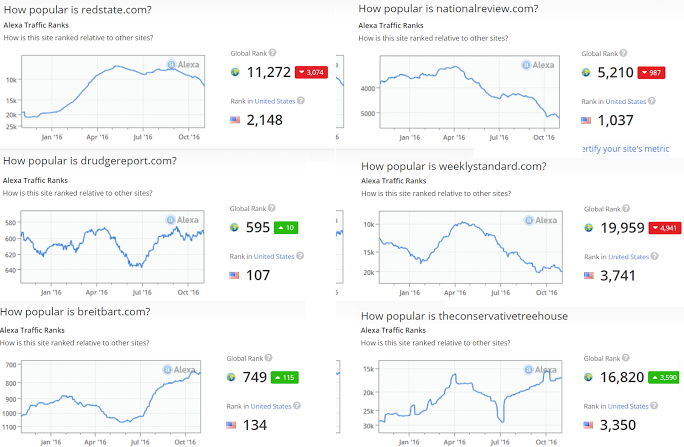
According to the Alexa traffic analysis service, the leading #NeverTrump websites are hemoragging visitors and, by extension, ad revenue. For digital properties focusing on politics, this meltdown is especially damaging because the last few months should have been advertising bonanzas.

Instead, the last few months have been catastrophes.

Meanwhile, pro-GOP/pro-Trump sites like Drudge Report, Breitbart, Gateway Pundit and The Conservative Treehosue are seeing — in some cases — astonishing traffic spikes.

161102-never-trump-fail

It’s clear that the #NeverTrump position isn’t just illogical, it’s also bad business. (For more from the author of “THE EPIC #NEVERTRUMP FAIL: Drudge, Breitbart See Massive Traffic Surges as NRO, Weekly Standard Melt Down” please click HERE)

Follow Joe Miller on Twitter HERE and Facebook HERE.
Insurers Lobby for Changes to Obamacare ‘Bailouts’

Insurance companies continue to put pressure on members of Congress over two Obamacare programs set to expire at the end of the year.

Lawmakers and outside groups expect a fight over the risk corridor and reinsurance programs—referred to as insurer “bailouts” by conservatives—during the lame-duck session, the period after the Nov. 8 election and before the start of the next Congress.

Members of the House and the Senate have spent the past few weeks back in their districts ahead of the election. But insurance companies and trade groups representing insurers have not stopped pressing Congress on the two programs, according to the latest lobbying disclosures filed with both chambers.

From July 1 to Sept. 30, insurers and associated groups spent nearly $10.5 million on lobbying efforts for the risk corridor and reinsurance programs, among other issues related to health care.

America’s Health Insurance Plans (AHIP), a trade group representing insurers, spent more than $1.8 million on lobbying efforts related to the risk corridor and reinsurance programs.

So far this year, the organization has spent $5.6 million on lobbying, according to the Center for Responsive Politics. Not all of that money was related to efforts involving the Obamacare provisions.

The trade group hasn’t shied away from publicly advocating for tweaks to the risk corridor and reinsurance programs.

In an interview with Morning Consult last month, Marilyn Tavenner, America’s Health Insurance Plans CEO and former head of the Centers for Medicare and Medicaid Services, which oversees Obamacare, said changes need to be made to the two programs.

“I know ‘risk corridors’ is a bad word. ‘Reinsurance’ is a bad word. But the fact of the matter is, it’s probably taking longer than three years to stabilize,” Tavenner said. “So I think Congress, after the election, is going to have to take a look at this and decide, ‘How do you stabilize this market?’”

Only the Blue Cross and Blue Shield Association, a trade group representing 36 plans nationwide, outspent America’s Health Insurance Plans on lobbying efforts for the risk corridor and reinsurance programs from July 1 to Sept. 30.

The organization spent $4.6 million on efforts involving the two Obamacare provisions, according to lobbying disclosures.

So far this year, the Blue Cross and Blue Shield Association spent $19 million on lobbying, though not all of it was devoted to the risk corridor and reinsurance programs, according to the Center for Responsive Politics.

A combined $1 million on lobbying was spent from July 1 to Sept. 30 by insurance companies such as Anthem, Moda Health, Highmark Blue Cross and Blue Shield, Centene, and Blue Cross and Blue Shield plans in Michigan, Florida, Kansas, Tennessee, Arizona, and Minnesota.

Though not all of the money went toward lobbying for the risk corridor and reinsurance programs, insurance companies have been pressing Congress to make changes to them over the past few months.

In filings with state regulators, insurers attributed rising premiums, in part, to the end of the reinsurance program.

The risk corridor and reinsurance programs, written into the Affordable Care Act, are set to expire at the end of the year.

The two programs, along with a third, the permanent risk adjustment program, were designed to help mitigate insurers’ risks in enrolling populations that potentially were sicker and costlier than in previous years.

In 2014 and 2015, Republican lawmakers included language in government spending bills requiring the Department of Health and Human Services to use only money it received from insurance companies with lower-than-expected costs through the risk corridor program to pay out insurers with higher-than-expected costs.

As a result, insurance companies received 12.6 percent of the money they requested from the risk corridor program.

Now, several insurance companies including Moda Health and Blue Cross and Blue Shield of North Carolina are suing the Obama administration for the rest of the money.

Republicans in Congress worry that, in order to settle with insurers, the Justice Department will tap into the Judgment Fund, an indefinite appropriation created by Congress and administered by the Treasury Department.

Doing so would provide the White House with a way to pay the full risk corridor payments to insurers, effectively circumventing Congress, they warn.

But in motions to dismiss filed by the Justice Department in response to the lawsuits, the government argued insurers weren’t entitled to the full payments under the risk corridor program.

According to lobbying disclosures, insurance companies want Congress to appropriate more money for the program and combat Republican-led efforts to limit the money available through it.

As with the risk corridor program, insurance companies and related organizations have pushed lawmakers to extend the lifespan of the reinsurance program.

Under the reinsurance program, the Obama administration diverted $5 billion intended for the Treasury to insurers. A legal decision from the Government Accountability Office issued in September found that the Department of Health and Human Services acted illegally in prioritizing giving this money to insurers over the Treasury.

Still, that hasn’t stopped Obamacare’s supporters from encouraging Congress to extend the reinsurance program.

Sen. Ben Sasse, R-Neb., and Rep. Mark Walker, R-N.C., introduced legislation earlier this year requiring the Obama administration to repay the $5 billion owed to the Treasury, or face steep cuts to the Health and Human Services management fund this year and next year. Both House and Senate versions of this legislation have been referred to their respective committees.

It is called the Taxpayers Before Insurers Act, and insurers and groups such as America’s Health Insurance Plans are lobbying members to oppose it.

Conservative groups have issued warnings that health insurance industry giants would look to the lame-duck session as the time to push for changes to the program.

And they, too, lobbied members to oppose any changes.

According to lobbying disclosures, Heritage Action for America, the sister organization of The Heritage Foundation, spent $110,000 from July 1 to Sept. 30 lobbying, in part, for Sasse and Walker’s bill. (For more from the author of “Insurers Lobby for Changes to Obamacare ‘Bailouts'” please click HERE)

Follow Joe Miller on Twitter HERE and Facebook HERE.
Black Leaders Warn of Clinton Threat to Religious Liberty in Blistering Letter

Black leaders slammed Hillary Clinton’s position toward the poor in a letter delivered to her campaign Monday, saying her economic ideas won’t help black communities in crisis and that her social views pose a threat to their religious liberty.

“Today in the United States more than ten million people of African descent face a crisis of catastrophic proportions,” the letter begins. “Life in our major post-industrial centers can be poor, nasty, brutish and short.”

More than 20 black leaders of the popular Pentecostal-Charismatic wing of the black church signed onto the letter, requesting a meeting with Clinton to discuss their concerns about her views on the economy, abortion and other issues. “We know that you will not make the political mistake of taking the 69,000 black churches in the US for granted,” they write.

First on economics, the signers outline their concern about Clinton’s motivations and policy ideas, all but accusing her of pandering for black votes. Federal programs have often “failed” the poor black communities they’re intended to help, they note. “It is not enough to make obligatory appearances at black churches, we need you to articulate a coherent policy for the black poor.”

The leaders then turn to the subject of abortion. “Abortion in the black community has had a catastrophic impact,” they write, saying they are “very concerned” about Clinton’s position on unborn children, particularly as it relates to religious liberty. (Read more from “Black Leaders Warn of Clinton Threat to Religious Liberty in Blistering Letter” HERE)

Follow Joe Miller on Twitter HERE and Facebook HERE.
The Ultimate Lame-Duck Move? How President Obama Could Actually Pardon Hillary Clinton

The American people have a right to know if President Barack Obama will pardon Hillary Clinton after Election Day, and before the next president is inaugurated.

On Friday, the Clinton campaign melted down when Federal Bureau of Investigation (FBI) Director James B. Comey sent a very short letter to the chairmen of the relevant committees in Congress explaining a supplement to his testimony in which he’d said that the FBI had completed an investigation into former Secretary of State Hillary Clinton’s personal email server. Comey wrote: “In connection with an unrelated case, the FBI has learned of the existence of emails that appear to be pertinent to the investigation.” This letter has caused advocates of Hillary Clinton to attack the character of Comey.

News broke over the weekend that the Justice Department has obtained a warrant to review Clinton aide Huma Abedin’s newly discovered emails. Team Clinton has pulled out all the stops and is saturating the news with disparaging statements and implications about James Comey’s competence and motives. Former Attorney General Eric Holder even penned a piece this week in the Washington Post arguing that Comey has made a “serious mistake.”

The most fascinating debate, however, is whether President Barack Obama can wipe the slate clean by pardoning Hillary Clinton.

Law Newz published a piece on October 28, 2016, titled, “If Hillary Is Indicted, President Clinton Could Pardon Herself and Congress Might be Helpless.”

While Comey didn’t indicate how long the investigation could take, it’s pretty safe to bet investigators won’t come to any kind of decision before November 8th. It may even take months for the FBI to wrap up round two of this. So what happens if Clinton is elected, takes office, and then finds her self under indictment? It might not be likely, but it is worth exploring the legal possibilities.

It is Friday, January 20, 2017 and Hillary Clinton has just been sworn in as the 45th President of the United States after narrowly defeating Donald Trump in November. Republicans managed to hold both the House of Representatives and the Senate. A few weeks after winning the election, however, the Department of Justice handed down a multi-count indictment against Clinton over her handling of classified information and her involvement in an alleged pay for play scandal with the Clinton Foundation during her time as Secretary of State. It is a scenario that several of our commentators, and twitter followers have asked us to analyze.

Under Article II, Section Two, the president’s power to issue a pardon for a federal offense is nearly limitless. The Law NewZ site analyzed whether President Hillary Clinton has the power to pardon herself, but a more likely hypothetical is whether President Obama will pardon Clinton regardless of the result of the election.

The power of the president to pardon before a person has not even been charged with a crime has been established by the Supreme Court. This issue came up at the end of the presidency of George W. Bush when the question was raised as to whether Bush could pre-emptively pardon government employees involved in counter-terrorism programs who had not been charged.

As reported by Slate on July 21, 2008:

In 1866, the Supreme Court ruled in Ex parte Garland that the pardon power “extends to every offence known to the law, and may be exercised at any time after its commission, either before legal proceedings are taken, or during their pendency, or after conviction and judgment.” (In that case, a former Confederate senator successfully petitioned the court to uphold a pardon that prevented him from being disbarred.) Generally speaking, once an act has been committed, the president can issue a pardon at any time — regardless of whether charges have even been filed.

The power of President Obama to pre-emptively pardon Hillary Clinton has been established, and under the two likely election scenarios presented below there are reasons to believe that he will.

If Hillary wins the election, it would seem like something Obama might do because he has publicly stated that he didn’t think Hillary’s mishandling of classified information “posed a national security problem.” Remember that Obama reportedly used a pseudonym in emails with Clinton, too. For those two reasons, it seems reasonable to believe that President Obama would issue a pardon to clean the slate and let Hillary take office without the possibility of this legal question clouding her tenure as president of the United States. It would be ethically wrong, but perfectly within the power of a president under the Constitution.

If Trump wins the election, it would also seem like something President Obama might do to protect an elongated prosecution of a former presidential candidate. Again, President Obama would not want this litigated under a Republican administration, therefore it seems like he has a strong motive to pardon under either circumstance.

A reporter needs to ask President Obama right now if he will take a pardon off the table. (For more from the author of “The Ultimate Lame-Duck Move? How President Obama Could Actually Pardon Hillary Clinton” please click HERE)

Follow Joe Miller on Twitter HERE and Facebook HERE.
Republican Rep. Receives Death Threats for Tweeting About FBI’s Hillary Investigation

Democrat overreaction to the FBI’s reopening of the Hillary Clinton investigation has reached peak bizarre. Rep. Jason Chaffetz, R-Utah (C, 76%) has become a target of the Left all because of a tweet.

The House Committee on Government Oversight and Reform chairman is facing an ethics complaint and has even received death threats over a tweet he sent Friday. The congressman’s offense? Announcing he received new information from FBI Director James Comey concerning the investigation into Clinton and her private email server.

Apparently serious enough in nature, Rep. Chaffetz told Lisa Riley Roche of the Deseret News Monday night that he’s required increased security protection due to the death threats.

Roche reports that Chaffetz is not backing down, however:

“I thought I would put it out there. People have a right to know. It was newsworthy. It caught me by surprise,” the 3rd District congressman said, calling it “a totally accurate statement” to say the case has been reopened.

“It is absolutely correct. They are spending time, money and resources investigating,” he said, after the case was closed in July. “Nobody knows where it’s going to lead, but the reality is, it is reopened.”

Meanwhile, The Democratic Coalition Against Trump has filed an ethics complaint against the Utah congressman for what they described as “an ill-planned partisan attempt […] that compromised the integrity of the FBI when he irresponsibly tweeted.”

The grassroots organization has also filed a complaint against Comey with the Department of Justice, seeking an investigation into whether the FBI director’s letter to Congress violated the federal Hatch Act, which prohibits federal employees’ influencing of elections.

Chaffetz has dismissed the ethics complaint against him as “silly.”

Democrats can kick and scream all they like, but the fact of the matter is there would be no FBI investigation at all had their party’s presidential nominee not been a lying, corrupt crook.

This ill-placed rage against Congressman Chaffetz would be better directed at candidate Hillary Clinton for putting the Democrats in a position where support for Republican Donald Trump is surging just one week before the election.

But “accountability” and “objectivity” aren’t words in the Left’s dictionary, are they? (For more from the author of “Republican Rep. Receives Death Threats for Tweeting About FBI’s Hillary Investigation” please click HERE)

Follow Joe Miller on Twitter HERE and Facebook HERE.

Tackling the Claims of ‘Right to Die’

Five states have legalized physician-assisted suicide—California, Oregon, Vermont, Washington, and Massachusetts. If Colorado votes “yes” on Proposition 106 next week, it will become the sixth. The District of Columbia is looking to adopt similar legislation.

End of life care is deeply personal. Watching a loved one suffer is something no one ever wants to do. And if you’ve been in the position to care for someone as they lay dying, you know that you’d give anything to relieve their pain.

Needless to say, this issue is emotional. This means the common ground you find, the examples you cite, and the words you use matter a lot. Your goal isn’t to present a dry, emotionless argument, but to tread lightly with the right emotion.

Here is how to do just that and call out the “death with dignity” and “right to die” movements for what they are.

Common Ground

The common ground in this argument seems obvious—no one wants to suffer, and no one wants to watch other people suffer.

You see a toddler fall and scrape his knee and you immediately want to comfort him.

You watch a friend care for her dying husband and you want to alleviate both her pain as the caretaker and his pain as the terminally ill.

Though it seems obvious that suffering is never anyone’s goal, it’s important to state it. If you start rattling off statistics without first establishing your motivation, you risk allowing the person on the other end of your conversation to assume the worst.

Instead, reiterate that suffering is painful, and messy, and hard, both for the one experiencing it and their loved ones. We should be looking to innovative medical care and better hospice treatment to manage pain at all price points.

It’s the working out of this desire to its logical conclusion that calls for discussion.

Examples

The best way to communicate your position on a sensitive issue is to use examples and anecdotes, and highlight the consequences not widely reported in the mainstream media.

A terminally ill patient in a state with physician-assisted suicide says she received a letter from her insurance company explaining that it’s cheaper to cover the medication to end her life than purchasing the medication to ease symptoms.

In other words, your chemotherapy is more expensive than this pill to end your life, so we can no longer cover your chemotherapy treatment. This is a scary reality, especially as the government becomes more involved.

If you want to use the power of a story, it’s worth citing J.J. Hanson’s experience (as covered by The Daily Signal a few weeks ago).

Hanson is a veteran and brain cancer survivor. He was initially told he had only four months to live, which made him eligible for physician-assisted suicide. But Hanson, who sought additional medical opinions, is still alive more than two years after that diagnosis and speaks out against physician-assisted suicide.

Physician-assisted suicide is also an issue for the most vulnerable among us. Think the elderly and disabled.

The Daily Signal reported on Friday that “evidence from the Netherlands, where physician-assisted suicide has been legal for years, suggests that many instances of physician-assisted suicide there were nonvoluntary. It is the marginalized who are most vulnerable to being pressured, tricked, or coerced into killing themselves.”

Physician-assisted suicide allows a medical professional you don’t know (and who doesn’t know you) to decide if your life is worth living. Advocates will argue that there are rules in place—18 years old, mentally fit, less than six months to live—to prevent coercion. But the possibility remains, and studies show otherwise.

Last, it may be helpful to note the implication for doctors and religious liberty. If you’re practicing medicine in a state with physician-assisted suicide and your faith instructs you not to take a life, is your job in jeopardy if you refuse a patient their right to die? Possibly.

Words

There are a lot of euphemisms thrown around when people discuss physician-assisted suicide—“death with dignity,” “aid in dying,” “right to die.”

These phrases make it seem impossible for anyone to disagree with legislation that seeks to promote an end to suffering via “death with dignity.” But talk about the disabled as people who “live with dignity” and explain that those suffering with a terminal illness still have the “right to live.”

Remember: There is a lot of emotion on either side of this argument, so find that common ground and use it to your benefit before launching into examples and statistics.

Don’t shy away from reclaiming the words and phrases the other side likes to use. They may cite “death with dignity” as void of suffering, but there is a case to be made to the contrary. (For more from the author “Tackling the Claims of ‘Right to Die'” please click HERE)

Follow Joe Miller on Twitter HERE and Facebook HERE.