DC City Council Votes to Allow Physician-Assisted Suicide. That’ll Change Us All, for the Worse.

Ultimately, it will change how society views the weak and the marginalized and affect our family relationships—how we view our elders and our duties toward them.

No one is perpetually self-sufficient. We enter life entirely dependent on our parents, and many of us exit life dependent on our children. Along the way, through life’s ups and downs, we’ll rely on neighbors, friends, and family. A healthy society will help shoulder the burdens of life, recognize everyone’s intrinsic worth and dignity, and thus respect human equality.

But assisted suicide denies this. It says that some lives are unworthy of legal protection. That if you’re sick enough or disabled enough, you’re better off dead—and that doctors can give deadly drugs to you, but not to people with allegedly greater social value.

Diane Coleman of the Center for Disability Rights puts it like this:

Assisted suicide sets up a double standard for how health care providers, government authorities, and others respond to an individual’s stated wish to die. Some people get suicide prevention while others get suicide assistance, and the difference between the two groups is the health status of the individual.

Once you start down the road of making some lives eligible for assisted suicide, the lethal logic is clear. Baroness Mary Warnock, a leading ethicist in the United Kingdom, has argued, “If you’re demented, you’re wasting people’s lives—your family’s lives—and you’re wasting the resources of the National Health Service.” Such people, she suggests, have a “duty to die.”

Dr. Paul McHugh of Johns Hopkins Hospital explains what happens when this boundary is crossed:

Once doctors agree to assist a person’s suicide, ultimately they find it difficult to reject anyone who seeks their services. The killing of patients by doctors spreads to encompass many treatable but mentally troubled individuals, as seen today in the Netherlands, Belgium, and Switzerland.

D.C.’s proposed assisted suicide law is ripe for abuse. As I explain in the Heritage report, a family member or friend who might benefit financially from the death of a patient may act as a witness that the patient is voluntarily requesting the lethal prescription, and doctors who support the ideology of death can judge patients to be “qualified” under the law—even if they’ve never before met the patient (or the patient’s family). Finally, it sets no safeguards whatsoever to ensure voluntariness or competence—or to guard against coercion—at the time the deadly drug is administered.

The lack of legal protections at the time the lethal choice is made has led Judge Neil Gorsuch to ask: “How does it serve the putative goal of autonomous patient decision making to set up a regime that allows people to commit suicide without considering whether they are, in fact, acting freely, competently, and autonomously at the time of suicide?”

Instead of changing our entire ecosystem of medicine and family relations, we should respond to suffering with true compassion and solidarity. People seeking assisted suicide typically suffer from depression or other mental illnesses, as well as simply from loneliness. Rather than help them kill themselves, we should offer them appropriate psychological and psychiatric care as well as human presence.

For those in physical pain, pain management and other palliative medicine can manage their symptoms effectively. For those for whom death is imminent, hospice care and fellowship can accompany them in their last days. Anything less falls short of what human dignity requires. The real challenge facing society isn’t to legalize assisted suicide, but to make quality end-of-life care available to all.

Doctors should help their patients to die a dignified death of natural causes, not assist in killing. They are to eliminate illness and disease but never eliminate their patients. Not every medical means must be used. Patients can refuse or doctors can withhold particular treatments that are useless or causing more harm than good. But in deciding that a treatment is useless, we must not decide that a patient is worthless. Physicians are always to care, never to kill. (For more from the author of “DC City Council Votes to Allow Physician-Assisted Suicide. That’ll Change Us All, for the Worse.” please click HERE)

Follow Joe Miller on Twitter HERE and Facebook HERE.

New Clinton Emails: The Latest on the FBI’s Reopened Investigation

It was around midday last Friday when FBI Director James Comey unveiled the October surprise no one expected — a letter to Congress announcing that the FBI was reopening its investigation into Hillary Clinton’s use of a personal email server during her time as secretary of state. The FBI discovered more relevant emails — over 650,000 — during an investigation that was “unrelated.”

Later that afternoon, officials said the “unrelated” investigation was of Anthony Weiner — former congressman, estranged husband to longtime Clinton aide Huma Abedin, and currently undergoing investigation for allegedly sexting a 15-year-old girl. They found the new emails on his laptop.

The bombshell ignited bipartisan backlash against Comey, whom Democrats formerly praised for recommending no criminal charges against Clinton in July. It also revealed rifts between the FBI and the Department of Justice (DOJ), sparking speculation about Comey’s motivations and whether his letter would ultimately harm Clinton’s bid for the White House (a recent poll shows Trump and Clinton now virtually tied.)

Here’s the latest.

FBI Obtains Warrant to Search Newly Discovered Emails

The Wall Street Journal reported that the new emails were discovered weeks ago at the beginning of October while FBI investigators searched Weiner’s device for child pornography. Investigators couldn’t search the emails further without a warrant, since their current warrant only extended to materials relevant to the Weiner investigation. When it became clear that the emails were from Abedin’s accounts and sent to or from Clinton’s private server, investigators were given permission to dig deeper.

But last week, sources told the Journal, when officials asked for an update on the “Weiner laptop,” they “realized that no one had acted to obtain a warrant.” Investigators then allegedly confirmed that the emails could be relevant to the Clinton investigation and updated Comey, who sent the controversial letter to Congress on Friday.

Comey stated in the letter that investigators would be searching the new emails for classified information, though he did not know yet whether the emails contained anything “significant” (they could be duplicates of emails already reviewed by the FBI).

The FBI officially obtained a warrant to search the newly discovered emails late Sunday.

Comey Draws Criticism from Democrats and Some Republicans

From Clinton herself to GOP vice presidential pick Mike Pence, people across the aisle are calling on the FBI to release more information immediately.

On Sunday, a bipartisan group of nearly 100 Justice Department officials and former federal prosecutors wrote an open letter calling Comey’s judgment into question, stating that his announcement just 11 days before Election Day undermined the nonpartisanship that makes the U.S. justice system “exceptional throughout the world.”

The letter writers note that Comey’s decision — while not a breach of law — defies “prevailing Department policy.”

The letter ended with a call for more information:

[W]e believe the American people deserve all the facts, and fairness dictates releasing information that provides a full and complete picture regarding the material at issue.

Clinton’s Fault?

Since Friday, Abedin — who has worked closely with Clinton since she was 19 — and her estranged husband have come under scrutiny, with commentators wondering what role, if any, Abedin will have if Clinton is elected.

Others have noted that earlier this year, Abedin swore under oath that all her devices containing documents relevant to the FBI’s investigation of Clinton had been turned over — a claim that now seems questionable. Abedin now claims she does not know how her emails got on Weiner’s laptop.

While some have postulated how awkward it must be for Abedin to be involved in a political scandal so potentially detrimental to Clinton’s campaign given their longtime working relationship, others have asserted that the responsibility falls on none other than Clinton herself.

“The reason they’re in this fix is because Hillary Clinton inexplicably chose to have a private email server as secretary of state,” Susan Page, Washington Bureau Chief for USA Today, told CBS’s Face the Nation on Sunday. She also said Bill Clinton’s private meeting with Attorney General Loretta Lynch earlier this year has proved problematic.

The Clintons and Lynch were criticized in June after Mr. Clinton and Lynch met on Lynch’s plane in Phoenix. Though Lynch claimed their conversation consisted of “grandchildren” and other “social” topics, it looked suspicious when the House Benghazi Committee’s report on the 2012 attack was released just days later. The FBI’s initial investigation into Clinton’s private email server was also ongoing at the time.

Lynch later admitted that the meeting had appeared questionable and recused herself from that investigation, saying that she would follow Comey’s recommendations regarding the outcome. Comey announced in early July that the FBI recommended the DOJ bring no criminal charges against Clinton.

Page said on Sunday that Mr. Clinton’s meeting with Lynch “made it impossible” for Lynch to stop Comey from going public with the reopening of the investigation, even though “we know from news reports that she was opposed.”

FBI vs. DOJ

Lynch wasn’t the only one who advised against Comey’s actions. According to sources cited by The Wall Street Journal, the DOJ and the FBI have long been at odds when it comes to investigating the Clintons.

Before Comey alerted Congress of the reopened investigation, senior DOJ officials warned that it would “violate policies against overt actions that could affect an election,” the Journal reported Sunday, adding that DOJ officials previously clashed with Comey over his public statements regarding the FBI’s Clinton investigation.

Sources also told the Journal that there was conflict between the DOJ and the FBI regarding how to investigate the Clinton Foundation.

Is Comey Getting Political?

Thought some of have accused Comey of playing politics, in a press conference on Monday, White House Press Secretary Josh Earnest claimed that President Barack Obama considers Comey to be a man of “integrity” and “doesn’t believe that he’s secretly strategizing to benefit one candidate or one political party.”

Why did Comey make the renewed investigation public? John Podhoretz, editor of Commentary Magazine hypothesizes that the alleged disagreements between the DOJ and the FBI could have contributed to Comey’s decision. Perhaps, Podhoretz speculates, Comey wanted to cover all his bases lest he be “accused of complicity in a cover-up by the Republicans in Congress,” should the newly-discovered emails prove truly incriminating for Clinton.

Whatever Comey’s intentions, and regardless of whether the new emails contain anything “significant,” the ramifications of Comey’s letter to Congress are proving significant. With only eight days to go until November 8, the reopened investigation of the Democratic presidential nominee is dominating election coverage. (For more from the author of “New Clinton Emails: The Latest on the FBI’s Reopened Investigation” please click HERE)

Follow Joe Miller on Twitter HERE and Facebook HERE.

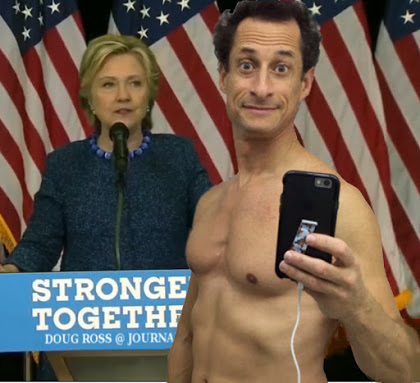
BREAKING, EXCLUSIVE: Intruder Spotted at Hillary Press Conference

So reports our summer intern Biff Spackle:

161030-weiner-at-hrc-fbi-press-conference2

Someone alert the Secret Service. (For more from the author of “BREAKING, EXCLUSIVE: Intruder Spotted at Hillary Press Conference” please click HERE)

Follow Joe Miller on Twitter HERE and Facebook HERE.
Hillary Clinton Breaks Her Silence on FBI Announcement

Democratic presidential nominee Hillary Clinton finally spoke out Monday about the FBI’s announcement Friday that it is revisiting the investigation into her use of a private email server when she was secretary of state because of newly discovered emails.

“There is no case here,” she said at a rally in Kent Ohio.

“I’m sure a lot of you may be asking what this new email story is about and why in the world the FBI would decide to jump into an election with no evidence of any wrongdoing with just days to go,” Clinton said to her supporters. “That’s a good question.”

The new emails emerged from the FBI’s investigation into allegations that former Rep. Anthony Weiner (D-N.Y.) sent illicit text messages to a 15-year-old girl in North Carolina. Weiner is the estranged husband of longtime Clinton aide Huma Abedin, and the two shared a computer.

Although Abedin served as Clinton’s deputy chief of staff in the State Department and is vice chairwoman of her presidential campaign, Clinton referred to her as “one of my staffers” Monday.

“Now they apparently want to look at emails of one of my staffers, and by all means, they should look at them,” she said.

Clinton continued, “And I am sure they will reach the same conclusion they did when they looked at my emails for the last year. There is no case here.”

Her campaign released a video seeking to downplay the FBI announcement, and it quickly went viral, reaching more than 1.4 million views on Facebook.

Brian Fallon, Clinton’s press secretary, tried to persuade voters not to be swayed by the FBI announcement. “The more information that has come out, the more overblown this all seems,” he said. “You’re probably just as puzzled and outraged as we are.”

Clinton’s running mate, Virginia Sen. Tim Kaine, attempted to put a positive spin on the FBI investigation.

“It has kind of revved up some enthusiasm, a little bit of righteous indignation and righteous anger. It’s revved it up a bit,” Kaine said Sunday in Michigan.

On Sunday, Republican nominee Donald Trump tried to make the most of the situation at an event in Las Vegas.

“Huma. They just found a lot of them. We never thought we were going to say thank you to Anthony Weiner,” he said.

John Podesta, Clinton’s campaign chairman, has confirmed that there will be no changes to Abedin’s duties.

“She’s played a central and vital role in this campaign and she continues to do that,” he said. (For more from the author of “Hillary Clinton Breaks Her Silence on FBI Announcement” please click HERE)

Follow Joe Miller on Twitter HERE and Facebook HERE.

Romney Making Campaign Stop in Arizona for GOP Candidate

Former Republican presidential nominee Mitt Romney will make a rare campaign appearance in Mesa, Ariz., on Thursday in support of another former GOP nominee, Sen. John McCain, R-Ariz.

Romney, who lost to President Obama in 2012, will try to help McCain win a sixth term in the Senate.

The GOP’s 2008 presidential nominee is being opposed by Rep. Ann Kirkpatrick, D-Ariz.

A recent Monmouth University poll found McCain leading Kirkpatrick by 10 points.

The poll showed McCain with 50 percent support against 40 percent for Kirkpatrick and 4 percent for Green Party candidate Gary Swing.

“McCain is sitting on a decent lead, but it’s worth noting that he has won all five of his previous Senate races by more than 20 points,” said Patrick Murray, director of the independent Monmouth University Polling Institute.

The poll showed McCain leads Kirkpatrick 56 percent to 34 percent among white voters, but trails her 53 percent to 39 percent among non-white voters.

Despite the fact that the senator has kept his distance from GOP presidential nominee Donald Trump, the Monmouth poll found Trump supporters favoring McCain with 79 percent to 9 percent for Kirkpatrick. Supporters of Democratic nominee Hillary Clinton favor Kirkpatrick, 77 percent to 19 percent.

The poll also noted that 53 percent of respondents approve of the job McCain has done in Washington, while 39 percent disapprove.

The most recent YouGov/CBS News poll showed McCain leading Kirkpatrick 43 percent to 38 percent, with 11 percent of the voters undecided and 8 percent preferring another candidate.

Romney, who has largely avoided the campaign trail this year after his much-publicized antipathy toward Trump, went to Arizona in December on behalf of McCain.

“John McCain has been a strong leader in the United States Senate and a dedicated representative for the state of Arizona, making important contributions to our service members, veterans and families,” Romney said at the time.

“John’s deep knowledge of national security issues and experience helping American veterans is unmatched. We need advocates like John to fight against President Obama’s failed policies and get this country back on track,” he said then. (For more from the author of “Romney Making Campaign Stop in Arizona for GOP Candidate” please click HERE)

Follow Joe Miller on Twitter HERE and Facebook HERE.

New Report Suggests Massive Turnout for Hillary… Among Zombies

The Clinton camp is expecting a huge boost in voting after tonight, as 1.8 million zombies are getting ready to scratch their way out of their tombs in a get-out-the-vote effort truly befitting the greater of two evils running for office.

“What the ACLU and the violent mobs couldn’t do, the zombies are taking care of,” one campaign operative quipped, “I used to have to actually go down to the cemetery and copy down the names from the tombstones. This is way easier.”

Even though the fun of Halloween is over for many areas, as they have already held weekend trick-or-treating events for efficiency’s sake over tonight there will be plenty of action out there if you know where to look. Digger Flanagan, groundskeeper for my hometown’s Red Oak Cemetery, says he dreads tonight more than any other night.

“On the one hand, I appreciate how the zombies pretty much put a stop to pranksters who have been toppling gravestones. But on the other hand, zombies aren’t real neat about how they come up. Nobody really cares about all the work I have to do to keep this place nice for the dead, especially the undead.”

Skeptics claim that zombies don’t have a prayer in turning this election for Hillary, since investigation after investigation seems to suggest that human error is the cause of millions of voters remaining on the rolls after death. But that claim is hardly in line with the progressive push for equality that zombies have been banging their caskets about for decades. One surprisingly articulate zombie told this reporter that he’s being oppressed simply because of the technicality that he is undead.

“If the UN’s Universal Declaration of Human Rights were properly followed, equality for zombies would be a no-brainer,” he said, shuddering at the thought. “Look at this newspaper, voter discrimination is rampant against zombies, felons and illegals, but no group suffers prejudicial social, and economic discrimination more than us zombies. Look at it!”

His insistence was compelling but off-putting, so I shot him with a pea-shooter which just ticked him off. Luckily, I had a potato mine back up.

There are some progressives who clearly are paving the way for zombie acceptance, and there is work being done to compensate loyal zombie voters. Equal wages are, of course, a difficult thing to manage, since zombies don’t want walking around money, just brains. But fraudsters are finding that a massive bank of unused brains is out there still watching and buying into the mainstream media’s lies. Once progressives figure out who’s still watching, they’ll be able to thank the zombies properly.

Happy Halloween. (For more from the author of “New Report Suggests Massive Turnout for Hillary… Among Zombies” please click HERE)

Follow Joe Miller on Twitter HERE and Facebook HERE.

The ‘Untold Threat’ Responsible for 40% of Illegal Aliens

While the debate over illegal immigration tends to focus on how to control and treat those who make it across our nation’s borders, a more enduring challenge for the U.S. government has been what to do to stop legal entrants from overstaying their allotted time here.

The problem of so-called visa “overstays”—which make up about 40 percent of the 11 million people living illegally in the U.S.—will continue on past the Obama administration and follow the next president.

That’s partially because the government has not yet delivered on its long-promised—and congressionally mandated—plan to create a better checkout system to track who has left the country on time, and who hasn’t.

“It [visa overstays] is the most overlooked issue when it comes to immigration,” Rep. Michael McCaul, R-Texas, who chairs the House Homeland Security Committee, said in an interview with The Daily Signal.

“It’s an untold threat,” McCaul added. “We are allowing millions of people to overstay visas and remain in this country who could potentially pose a threat to homeland security.”

The uncertainty around the scope of the problem comes at a time when a growing percentage of the illegal immigrant population is made up of visa overstays as opposed to people being apprehended at the border.

For more than 20 years, the U.S. government had struggled to quantify just how many people entered the country legally with a visa and stayed too long, making it impossible to prescribe policy fixes.

That finally changed in January, when the Department of Homeland Security released a first-of-its-kind study reporting that 527,127 people who traveled legally to the U.S. for business or leisure and were supposed to leave the country in fiscal year 2015 in fact overstayed their visas.

This figure is larger than the 337,117 people caught crossing the border illegally last year.

The long-awaited data from 2015 was not all-encompassing. It counted only visa holders who entered the U.S. by air and sea, not by land, and it did not include those who came as students or temporary workers.

Still, immigration and security experts as well as policymakers welcomed the new information because they thought it would force the government to move faster on methods to improve, most importantly in trying to assemble a system to obtain biometric data—such as fingerprints, facial recognition images, and eye scans—on those leaving the country.

‘A Top Issue’

The 9/11 Commission recommended the Department of Homeland Security complete an entry and exit system “as soon as possible,” viewing it as an important national security tool because two of the hijackers on Sept. 11, 2001, had overstayed their visas.

Plagued by financial and logistical challenges, the government has introduced various pilot projects at some airports and land borders, but is still a few years off from implementing a biometric exit system on a large scale.

Homeland Security Secretary Jeh Johnson has pledged to have biometric checks at major airports in 2018, and Congress in last year’s omnibus spending bill authorized $1 billion in visa fee increases over 10 years to pay for an exit system.

The struggle to install a biometric exit tracking system is well known.

Foreigners who apply to enter the U.S. on a visa are interviewed and photographed and have their fingerprints taken at a consulate overseas before arriving here. But collecting biometric data on those exiting the country is not as easy.

That’s because U.S. airports do not have exclusive terminals for domestic and international flights, which makes it hard for officers from Homeland Security’s Customs and Border Patrol to screen overseas travelers and get their information.

“Most countries have a designated checkout system built in airports,” Stewart Verdery, a senior Homeland Security official during George W. Bush’s administration, said in an interview with The Daily Signal. Verdery added:

We just didn’t build our airports this way. So the question is where do you collect the information in a way that doesn’t inconvenience travelers and is actually effective in making sure someone has left? None of the options are particularly great. And though the biometric equipment is very mature, there is also a manpower issue over who maintains the machines.

To satisfy these limitations, Verdery expects the government to pursue a facial recognition exit system that automatically would snap a traveler’s photograph—likely at the gate.

‘It Doesn’t Matter’

Even if the U.S. were to settle on a workable exit tracking method, some national security experts doubt that such a system would be an effective counterterrorism tool, especially when considering its cost.

David Inserra, a homeland security expert at The Heritage Foundation, says the government could just as well use already collected biographical information, such as a traveler’s name and date of birth, to track exits and collect overstay data. But other experts say bad actors could use fake passports and aliases to bypass a system that did not require biometrics such as fingerprints and facial recognition.

No matter the method used, Inserra and other experts note that an exit system simply reveals who has departed—and remained—in the country. It would not help discover where those that stayed are living, and whether they present a security risk.

“Even if you have the greatest biometric exit system, if someone doesn’t leave, it doesn’t matter,” Inserra said, adding:

You are now left with the problem of every other police officer looking for someone. They are a missing person who doesn’t want to be found. If you want to stop visa overstays, the solution isn’t to spend money on an exit system.

Inserra argues that policymakers instead should give more money to intelligence agencies such as Homeland Security’s Immigration and Customs Enforcement so they can go into communities and try to locate—and deport—people who overstayed their visas.

Yet other experts are doubtful that would happen. They say the government does not prioritize enforcing immigration law against those who’ve stayed past their visa expiration date because those travelers were screened before coming here.

“In terms of removing a garden variety illegal migrant, you aren’t going to search for somebody on that basis,” Edward Alden, an immigration and visa policy expert at the Council on Foreign Relations, said in an interview with The Daily Signal. “The notion we will have some special dedicated effort to go find overstays I find completely implausible.”

Alden says the government can take simpler steps to deter visa overstays, by emailing reminders to foreigners of their expected departure date, specifying the consequences of not leaving on time.

Many who overstay their visas don’t intend to settle in America, Alden contends.

The Homeland Security report from earlier this year found that as of Jan. 4, a total of 416,500 of the 527,127 overstays in 2015 remained in the U.S. More have left the country since then, the government says.

The government also has taken diplomatic steps to better track foreign visitors, especially by improving information sharing with Canada, the country that had the most overstays in the U.S.

The U.S. and Canada exchange names and biographical information of those from third countries who enter on their shared border. Mexico, the second-largest source of visa overstays in the U.S., generally does not yet have the capacity to exchange information like that, Alden says.

‘Serious About Enforcement’

Despite these improvements, Congress is not backing off its demand for a biometric exit system.

McCaul, the chairman of the House Homeland Security Committee, says he hopes for a vote next year on a broad border security bill he sponsored last year. It includes a provision requiring the government to establish an exit system at the 15 largest airports, seaports, and land ports within two years.

The legislation, which President Barack Obama promised to veto, would impose financial and other penalties on Department of Homeland Security political appointees if the government fails to meet the timeline.

Having the best data possible, supporters of the exit system say, will give the government incentive to more aggressively enforce the law against those who’ve overstayed visas.

“I think once the government gets an exit system up and running, they’ll be serious about enforcement,” Verdery said, adding:

We will never have a system where we will go out and find someone who overstays and just wants to do nothing on their buddy’s couch. But we will go out and find them when they try to get a job, draw the attention of law enforcement, or illegally try to claim benefits.

(For more from the author of “The ‘Untold Threat’ Responsible for 40% of Illegal Aliens” please click HERE)

Follow Joe Miller on Twitter HERE and Facebook HERE.

Americans Face Fewer Obamacare Choices, Higher Premiums in 2017

As open season begins Tuesday for enrollment in Obamacare next year, most customers for health insurance in the individual market will face both fewer choices and higher premiums under President Barack Obama’s signature health care law.

More than three-fifths of the states, 33 of them, will have fewer insurers offering coverage on the Obamacare exchanges than they did in 2016.

Arizona and Texas are each losing six insurers, while two other states—Kentucky and Ohio—are losing four each. Only one state, Virginia, will have more exchange insurers next year than this year.

Five states—Alabama, Alaska, Oklahoma, South Carolina, and Wyoming—will have only one insurer offering exchange coverage in 2017, while another 13 states will have only two.

Because many of the remaining insurers offer coverage only in part of a state, the reduction in choice is even more pronounced at the county level. One-third of all U.S. counties (32.8 percent) will have only one insurer offering exchange coverage in 2017, and another one-third (35.9 percent) will have only two competing insurers.

So exchange customers in two-thirds (68.7 percent) of U.S. counties will be faced with either a monopoly or a duopoly in health insurance.

At the same time, insurers also have increased premiums significantly. The Department of Health and Human Services, which oversees Obamacare, had to admit that premiums are increasing by an average of 25 percent in the 39 states using the federally run insurance exchange.

Indeed, residents of 10 states using the federal exchange face average premium increases of 40 percent or more: Alabama (58 percent), Arizona (116 percent), Illinois (43 percent), Kansas (42 percent), Montana (44 percent), North Carolina (40 percent), Nebraska (51 percent), Oklahoma (69 percent), Pennsylvania (53 percent), and Tennessee (63 percent). In at least one state running its own exchange (Minnesota) premiums are increasing by a similar rate (56 percent).

The Obama administration has tried to spin this news by repeatedly stating that 85 percent of customers on one of the state insurance exchanges receive taxpayer-funded subsidies for their coverage, which will soften the blow to their wallets.

While that is technically true, it offers an incomplete and misleading picture.

The most recent comprehensive enrollment data show that 17.7 million Americans had health coverage from the individual market as of the end of 2015. Of that number, 7.4 million (42 percent) had coverage subsidized by taxpayers, while the remaining 10.3 million (58 percent) paid the full cost on their own.

Because the Affordable Care Act bars insurers from charging off-exchange customers a different premium than on-exchange customers for the same plan, nearly 60 percent of those with individual market coverage will face the full cost of any premium increases.

Want to understand why Obamacare remains persistently unpopular?

Consider the likely reactions of those 10 million Americans as they open letters from their insurers informing them of their premium increases—or, worse, that their health care coverage is being discontinued. (For more from the author of “Americans Face Fewer Obamacare Choices, Higher Premiums in 2017” please click HERE)

Follow Joe Miller on Twitter HERE and Facebook HERE.

After This State Blocked Online Eye Exams, a Health Care Startup Is Fighting Back

A Chicago-based health care startup that allows customers to conduct eye exams from their homes and obtain a prescription is fighting back against a South Carolina law that prohibits the company from operating in the state.

Opternative, an online eye exam company, and the Institute for Justice, a public interest law firm, filed a lawsuit in South Carolina civil court last week arguing that a law passed in May violates the state constitution.

“Opternative wasn’t banned in South Carolina because there was anything wrong with their technology or because there was any public health or safety problem with their technology,” Robert McNamara, a lawyer with the Institute for Justice, told The Daily Signal. “They were banned because their technology interferes with the business model of established optometrists.”

Opternative, which was founded in 2012 and launched to the public in 2015, developed technology that allows customers to obtain a prescription for glasses and contacts without ever stepping foot in a doctor’s office.

Using Opternative’s technology, customers self-perform their own vision test for $40 using a smartphone and computer. The results of the exam, along with answers to a list of questions about the patient’s medical history, are then compiled and sent through Opternative’s platform to a state-licensed ophthalmologist, who reviews the information and writes a prescription.

Opternative currently operates in 39 states, but the company has been effectively banned in South Carolina.

There, state lawmakers passed the Eye Care Consumer Protection Law this year, which states that vision assessments “must not be based solely on objective refractive data or information generated by an automated testing device, including an autorefractor or other electronic refractive-only testing device, to provide a medical diagnosis or to establish a refractive error for a patient as part of an eye examination.”

The American Optometric Association pushed for the legislation, but Gov. Nikki Haley, a Republican, ultimately vetoed the bill and criticized it for using “health practice mandates to stifle competition for the benefit of a single industry.”

“If [the bill were] allowed to become law, South Carolina would become the eighth state to impose such a ban, putting us on the leading edge of protectionism, not innovation,” Haley continued.

The Republican-led state Legislature ultimately voted to override Haley’s veto, with the Senate voting 39-3 and the House voting 98-1.

“This bill is protectionist legislation at its worst,” Aaron Dallek, Opternative’s CEO, told The Daily Signal. “It protected the economic interest of one group of people over the interest of the citizens of the great state of South Carolina.”

According to a complaint filed with the state court, the lawsuit argues that the law keeps Opternative from exercising its right to “pursue an honest living free from arbitrary, irrational, and protectionist regulation.”

“The South Carolina Constitution protects people’s right to be free from arbitrary and unreasonable economic regulations, and it’s part of an ongoing trend we’ve seen in state courts of announcing that their state constitutions are going to give people stronger protections against this kind of arbitrary or protectionist economic regulation than you might see under the federal constitution,” McNamara said.

In response to the lawsuit, Barbara Horn, secretary-treasurer of the American Optometric Association and an optometrist in Conway, South Carolina, said Opternative and the Institute for Justice “are not concerned about the health care needs” of South Carolinians.

The American Optometric Association also filed a complaint with the Food and Drug Administration in April urging the agency to take action against Opternative.

“Having lost decisively in our state capital and still lacking any credible research or federal medical device approvals, they’ve come back to try to impose their profit-driven approach to health care on South Carolina,” Horn said on behalf of the organization regarding the lawsuit. “Their questionable legal tactics will cost the citizens of our state time and money—resources better invested in protecting the health of our patients.”

McNamara, meanwhile, said the South Carolina Legislature has carved out specific regulations and restrictions for eye care and optometrists, specifically.

In June—one month after the Legislature voted to override Haley’s veto of the Eye Care Consumer Protection Law—state lawmakers passed the South Carolina Telemedicine Act, which legalized telemedicine across the state.

The two laws, McNamara said, conflict with each other.

“That’s part of what makes the ban on Opternative’s technology unconstitutional,” he said. “What the state has essentially said is, ‘We don’t have a problem with telemedicine, and we trust doctors, as long as they’re meeting the standard of care, to choose what technology they want to use and choose how they want to incorporate the internet into their practice, except for ophthalmologists.’”

In addition to South Carolina, lawmakers in Georgia and Indiana passed bills this year prohibiting Opternative from operating in those states.

Dallek said the company “doesn’t make threats” regarding the potential for legal challenges to laws in those two states. However, he didn’t rule it out completely.

“We do believe that we have the right to defend our doctors’ right to offer affordable and convenient eye care services to their patients, and we’ll work with those states to try to correct any legislative restrictions on our services,” Dallek said. “If we have to, we’ll use the judicial system to defend our doctors’ constitutional right to their economic freedom.”

Challenges to Opternative’s technology underscore debates taking place in state legislatures nationwide and in the courts following the rise of technology companies like Uber and Airbnb.

In response to these new technologies, government officials at the local and state level have passed ordinances and laws regulating companies like Opternative.

McNamara said that no matter what the company or service is—be it eye care, ride-sharing, or mobile vending—the core issue remains the same.

“When you look at these fights, it’s always the same underlying phenomenon. Whatever the specific facts of the case are, it is always a legislature kowtowing to a powerful, private interest group at the expense of some new entrant, some entrepreneur, some innovator,” he said.

“I think a big solution to the problem is to persuade the courts to continue the growing trend of taking a serious look at regulations like this and standing up to the protectionists for protectionists sake,” McNamara continued. (For more from the author of “After This State Blocked Online Eye Exams, a Health Care Startup Is Fighting Back” please click HERE)

Follow Joe Miller on Twitter HERE and Facebook HERE.

Wall Street Journal: New FBI Investigation Could Include 650K Emails

New information is coming out about the FBI’s new examination of emails that relate to Democratic presidential nominee Hillary Clinton’s email practices as U.S. Secretary of State. The Wall Street Journal reports that 650,000 emails may have been discovered in a computer previously unknown to investigators, and USA TODAY reports that investigators are negotiating with “representatives” of senior Clinton aide Huma Abedin for access to her computer.

FBI Director James Comey’s letter about a newly discovered trove of e-mails on a computer shared by Abedin and husband former Rep. Anthony Weiner has been slammed as partisan by Democrats and as an issue of transparency by Republicans. Comey’s letter came despite a DOJ recommendation that he not reveal the new information publicly, as it could affect the election. Weiner is reportedly cooperating with authorities.

The DOJ’s decision-making on the Clinton investigation has been under fire since Comey decided not to recommend charges against Clinton for her illegal practices. The July decision was predated by a meeting between U.S. Attorney General Loretta Lynch and Clinton’s husband, former President Bill Clinton.

On Sunday morning, Fox News‘ Chris Wallace grilled Clinton campaign manager Robby Mook on the campaign’s false claim that Comey’s letter was sent solely to Republicans. Likewise, CNN’s Jake Tapper asked campaign chairman John Podesta if Clinton was to blame for the email controversies that have arisen thanks to Clinton’s use of a private server instead of a State Department server.

While criticism of Comey has mostly come from the left and the Clinton campaign, some voices on the right have also denounced Comey’s decision. GOP presidential nominee Donald Trump supporter and former prosecutor Jeanine Pirro said that “Comey’s actions violate” DOJ policy and “the most fundamental rules of fairness and impartiality.” Washington Post columnist and noted Trump opponent George Will called the letter a “contentless October surprise.”

Comey’s letter was publicized on Friday; it was later reported that the emails are on Weiner’s computer. Weiner used the computer as part of his effort to exchange sexually explicit messages with women, including a minor. The emails were discovered by accident as the FBI investigated Weiner. (For more from the author of “Wall Street Journal: New FBI Investigation Could Include 650K Emails” please click HERE)

Follow Joe Miller on Twitter HERE and Facebook HERE.