Back Again: This Time Obama Administration Wants a Taxpayer Bailout for Puerto Rico

Less than two months after Congress passed a package aimed to provide financial relief for Puerto Rico, the Obama administration is already at it again—this time seeking an outright taxpayer bailout for the U.S. territory through additional Medicaid funds and access to the earned income tax credit.

Why does Puerto Rico need help? After decades of failed economic policies and rising debt, Puerto Rico began defaulting on some of its debt payments in 2015. Faced with substantial government spending (including massive pension costs), a declining economy, and rising interest rates, Puerto Rico was on track to default on multiple other debt payments.

Under Congress’ attempted relief, most debtors still won’t receive full payment. After all, it wouldn’t be relief for Puerto Rico if it actually had to pay all its bills. Instead, the island will have access to bankruptcy-like proceedings that will allow it to write off a large portion of its debt.

This is precisely what the administration wanted. The island now has access to so-called “Super Chapter 9” bankruptcy that will allow Puerto Rico to write down not only its municipal debts (in the same way that states can choose to do), but also its constitutionally protected territorial debt.

In addition, Puerto Rico has been afforded an unprecedented stay on litigation that will allow the island’s government to operate free of legal challenges for months.

But apparently allowing the island to renege on its constitutional obligations and stripping creditors of their right to access the courts wasn’t enough. Now the administration is back at it again, seeking an outright taxpayer bailout for the island.

In a letter to the recently appointed Congressional Task Force on Economic Growth in Puerto Rico, the administration called for granting Puerto Rico the same access as states to Medicaid funds and the earned income tax credit.

But Puerto Rico is not a state and its residents are not subject to federal income taxes. So why should U.S. citizens who do pay federal income taxes have to fork over an extra $36.2 billion over the next 10 years to provide benefits to people who do not pay those taxes?

Puerto Rico and other U.S. territories already receive a disproportionate share of federal welfare spending, and they get these benefits without their residents paying federal income taxes.

Providing additional Medicaid funds to Puerto Rico is not really any different than a pure cash bailout. Money is fungible, and what Puerto Rico doesn’t have to spend from its own resources to provide Medicaid, it can use on whatever else it wants.

The same is true for the earned income tax credit, except that the bailout would go directly to Puerto Rican residents as opposed to its government. But Puerto Ricans aren’t subject to federal income taxes, so why should they receive federal income tax credits?

The administration argues that the earned income tax credit is “one of the most powerful policy tools” to stimulate and encourage work. Stimulating work is an important objective in Puerto Rico where only 38 percent of the island’s working-age population has a job in the formal economy.

But the tax credit would have little impact in Puerto Rico and would be ripe for fraud and abuse.

For starters, the federal minimum wage in Puerto Rico is as large an impediment to job creation as a $20 per hour minimum wage would be on the mainland. Employers who can’t afford to pay workers the minimum wage will still not be able to pay the minimum wage with an earned income tax credit. Instead, the benefits will primarily flow to Puerto Rico’s more fortunate residents—those with a formal job.

Moreover, taxpayers can expect to foot the bill for unlawful earned income tax credit payments. Even when implemented by the IRS, which has access to taxpayers’ federal income tax returns, this tax credit has an excessively high improper payment rate of about 25 percent.

Just imagine how high the improper payment rate would be in Puerto Rico where residents don’t file federal taxes. Puerto Rico’s Treasury, which would presumably administer the tax credit, would have no incentive to prevent improper payments. After all, mainland taxpayers would be funding the subsidy.

Puerto Rico has the authority to enact and fund its own version of an earned income tax credit. Instead, the territory’s politicians have prioritized maintaining a bloated public sector with much higher pay than the island’s private sector workers.

Congress has already intervened more than it should have in Puerto Rico’s financial crisis. Federal taxpayers shouldn’t be forced to foot the bill for Puerto Rico’s poor economic and fiscal policies.

If Congress does cave in to the bailout demands, states and localities will be encouraged to engage in the same reckless policies so that they too can receive a federal bailout. (For more from the author of “Back Again: This Time Obama Administration Wants a Taxpayer Bailout for Puerto Rico” please click HERE)

Follow Joe Miller on Twitter HERE and Facebook HERE.
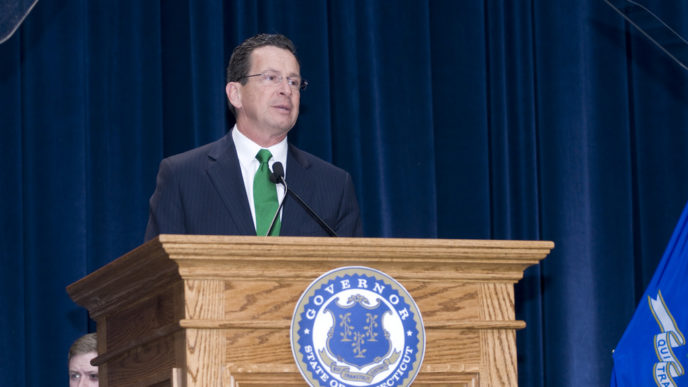
Connecticut Limits Free Speech Using Campaign Finance Rules

The clash over free speech and campaign finance has erupted in Connecticut, as two Republican state legislators have refused to settle a case with the State Elections Enforcement Commission.

Connecticut is one of at least three states that have a “clean campaign” system, in which a candidate collects very small donations of $5 from a large pool of people to qualify for a near fully-funded campaign by the taxpayer. In all, 13 states have some form of public financing for state elections, according to the National Conference of State Legislatures.

However, the enforcement action taken by the Connecticut State Elections Enforcement Commission, or SEEC, against 16 Republican candidates—including state Sen. Joe Markley and state Rep. Rob Sampson—could be unprecedented, some national observers said.

The state’s sanction against the legislative candidates was for mentioning Connecticut Gov. Dan Malloy, a Democrat, by name in mailings that referenced “Malloy’s bad policies” and “Malloy’s tax hike” for their own races in 2014, when Malloy was also on the ballot. The lawmakers used similar reference in campaign literature this year and in 2012, but face no sanction because Malloy appeared on the 2014 ballot.

“I don’t know how you can be a sitting state legislator and not mention the governor’s name,” Markley told The Daily Signal in a phone interview. “This is not in the statute; this is an interpretation by the [State Elections Enforcement Commission].”

The State Elections Enforcement Commission will have a hearing on the matter in September, Markley said. He said he will challenge in state court if necessary on constitutional grounds. As a matter of being competitive in the state, he said candidates must take public funding. But, he believes putting the government in charge of financing campaigns is the problem.

“If it weren’t for the state funding campaigns, this wouldn’t have arisen as an issue,” Markley said. “It is frustrating for liberals to see government funds used to criticize them for a change.”

It’s hard to find a similar case nationally, said David Keating, president of the Center for Competitive Politics, which opposes most campaign finance restrictions.

“What Connecticut is trying to do is both ridiculous and likely unconstitutional,” Keating told The Daily Signal in an email.

Still, Keating added that politicizing a program was likely inevitable once the state has the purse strings to campaign funding.

“A government that funds speech will seek to control that speech,” Keating said. “Bureaucrats who control the funding will try to penalize candidates for trivial violations.”

Keating said such a case has less to do with the Citizens United precedent on campaign finance than it would have to do with legal precedent barring government agencies from placing unconstitutional restrictions on receiving government money.

However, this matter typically comes up in the areas of welfare or in government contracting and not campaign funding, Keating said. Thus, he said there is almost no precedent for the Connecticut controversy.

State Elections Enforcement Commission spokesman Josh Foley said the agency doesn’t comment on ongoing cases.

Connecticut House Speaker Brendan Sharkey, a Democrat, defended the commission’s actions in a letter to the editor responding to a Hartford Courant columnist’s criticism of the sanctions.

“When candidates voluntarily sign up to receive taxpayer dollars to run their campaigns, they swear to abide by the law,” Sharkey wrote. “Instead, state Republicans in 2014 coordinated to violate the rules—including the protagonist in Mr. [Kevin] Rennie’s column—and most of them have already admitted their violations and settled their cases.”

Connecticut adopted a bipartisan public financing law in 2005 following a major corruption scandal. The law was passed by a Democratic-controlled legislature and signed by a Republican governor. In October 2014, the state election agency issued an advisory opinion warning candidates for the legislature to avoid referring to candidates in the governor’s race.

The state agency asserted that referring to candidates would have been permissible if the cost of the campaign had been shared by either the state Republican Party or the 2014 campaign of Republican gubernatorial candidate Tom Foley.

The state election agency brought a case against 16 Republican candidates who mentioned Malloy by name during their 2014 campaigns. Most of those Republicans signed a settlement agreement, admitting an election violation in exchange for dodging a civil penalty. However, Markley and Sampson refused to sign, asserting that empowering the agency would violate the First Amendment.

“For me, this is a clear violation of my First Amendment rights, and an overt restriction on free speech,” Sampson wrote in an op-ed in The Southington Observer newspaper. “The government should not be able to restrict the issues we campaign about in a free election.”

Two other states that provide near-full state funding for all state offices, including the legislature, are Maine and Arizona.

Hawaii also provides a matching funds program for its legislative candidates, which provides tax dollars to candidates who cap their spending. Minnesota defunded its program in its last state budget, according to the Center for Competitive Politics.

Keating, president of the center, said candidates in most of the states do not use the public funding program any longer, largely because it inhibits their ability to campaign. So, he said, it’s doubtful a dispute similar to what is happening in Connecticut has occurred elsewhere.

The states of Florida, Maryland, Massachusetts, Michigan, Rhode Island, and Vermont all provide some form of public financing to candidates for governor and lieutenant governor. Elections to the state Supreme Court are publicly funded in New Mexico and West Virginia.

The Connecticut public finance system could be on shaky legal footing because of this case, said Hans von Spakovsky, senior legal fellow at The Heritage Foundation.

“If providing public funding for candidates is being used as grounds to prevent criticism of candidates in other elections or of the governor then that would be a horrendous infringement on the First Amendment and probably the Supreme Court would throw that public financing system out,” von Spakovsky told The Daily Signal.

He referred to part of the Arizona public financing law that was tossed by the court. In June 2011, the U.S. Supreme Court struck down a provision of the Arizona public financing law that allocated more taxpayer money to candidates if a political action committee or independent group spoke against the candidate in ads. (For more from the author of “Connecticut Limits Free Speech Using Campaign Finance Rules” please click HERE)

Follow Joe Miller on Twitter HERE and Facebook HERE.

Congress Must Close New $10 Billion Gap in Government Spending, Report Says

To meet current obligations, the government will need $10 billion more next year, forcing Congress to make new cuts, according to lawmakers’ nonpartisan budget office.

The Congressional Budget Office’s preliminary new projections, obtained by The Daily Signal, show current government operations without changes would cost nearly $1.08 trillion, up from $1.07 trillion.

Lawmakers returning to Washington after Labor Day are in for a rude awakening, because the new report means hard decisions ahead.

Put another way, last year’s budget deal between President Barack Obama and House Republican leadership mandated spending levels that were $10 billion less than the CBO’s new projections.

The Congressional Budget Office, or CBO, is the nonpartisan agency charged with providing economic and fiscal information to lawmakers. And the gap identified in its new analysis makes the already arduous political task of funding the government even harder.

With government spending authority set to expire Oct. 1, Congress was expected to pass a makeshift spending measure known as a continuing resolution.

To avoid breaking the $1.07 trillion spending caps established in the budget agreement of October 2015, negotiated by the president and then-House Speaker John Boehner, Congress now must find $10 billion to trim or endure a round of automatic, politically painful spending cuts called the sequester.

That task of identifying the cuts under the Obama-Boehner caps will fall to members of the House and Senate appropriations committees.

GOP aides told The Daily Signal that Congress has found itself in similar situations before, but rarely of this severity.

In the past, appropriators applied across-the-board spending cuts to reduce any funding shortfalls. But following that precedent, a senior House aide told The Daily Signal, could lead to severe defense cuts because of the way Boehner and Obama negotiated last year’s deal.

“Funding for our national defense would be cut significantly below the spending limits signed into law,” the aide said, “and non-defense spending would be allowed well above those spending limits.”

While defense hawks will balk at those reductions, another senior Republican aide said they’re not inevitable. Appropriators will “utilize whatever tools they have in their toolbox” to close the funding gap, the staffer said.

“This is just a preliminary CBO analysis,” the staffer said. “It’s a carbon copy of what this year’s bill would look like based off of last year before any policy decisions are made, changes are built in, and before any final decisions are made about right spending levels.”

The funding gap throws gas on a long-burning debate in Congress.

And now leverage wrests with appropriators. They could turn to budget gimmicks such as offsets, anomalies, and “changes in mandatory programs,” which they call CHIMPS.

House conservatives have traded barbs with leadership over top-line government spending levels all year. The conflict already derailed a proposed $1.07 trillion budget pushed by Boehner’s successor, House Speaker Paul Ryan, R-Wis.

Two caucuses of GOP members in the House, the Freedom Caucus and the Republican Study Committee, have spearheaded the opposition. They called for $30 billion worth of cuts and a return to the $1.04 trillion spending level established by the Budget Control Act of 2011.

Fear over the possibility of a lame-duck spending bill, one passed between the Nov. 8 election and the swearing-in of the new Congress in January, has persuaded many conservatives to reconsider.

Several members of the Freedom Caucus say they could swallow a continuing resolution for $1.07 trillion if it extended government funding until next year. That way, outgoing lawmakers wouldn’t be making spending decisions after they’ve been booted from office. (For more from the author of “Congress Must Close New $10 Billion Gap in Government Spending, Report Says” please click HERE)

Follow Joe Miller on Twitter HERE and Facebook HERE.
SHOCKED FACE: Under Obama, National Deficit Skyrockets to Ludicrous Levels, Again

The nonpartisan Congressional Budget Office (CBO) just revealed that this year’s federal budget deficit will rise to $590 billion, a depressing 35% increase over last year’s already-high $438 billion:

CBO now estimates that the 2016 deficit will total $590 billion, or 3.2 percent of GDP, exceeding last year’s deficit by $152 billion… The deficit is growing in 2016 because revenues are up only slightly, by less than 1 percent ($26 billion), whereas outlays are projected to rise by 5 percent ($178 billion).

As Barack Obama staggers toward the end of his failed presidency, that marks just the latest milestone in what is perhaps his worst legacy, one that remains grotesquely underreported by the “watchdog” mainstream media.

Namely, he possesses what is by far the worst deficit record in U.S. history.

The primary culprit, the CBO explains, is “weaker-than-expected economic growth” that also characterizes the Obama era:

The growth in GDP that CBO now projects is slower throughout the 2016-2026 period than the agency projected in January. Weaker-than-expected economic growth indicated by data released since January, recent developments in the global economy, and a reexamination of projected productivity growth contributed to that downward revision.

Not that you’ll hear any of this from Obama or his willing accomplices, of course.

The most you’ll hear from any of them on the subject is the preposterous claim that Obama has somehow reduced deficits throughout his tenure. That amounts to bragging that he halved annual deficits after first quadrupling them.

Before Obama entered the White House, after all, the largest deficit the nation had ever endured was the record $458 billion in 2008.

But then Obama proceeded to run deficits of $1.4 trillion in 2009, $1.3 trillion in 2010, another $1.3 trillion in 2011, then $1.1 trillion as he ran for reelection in 2012. In 2013 we finally dipped back below the trillion-dollar mark, but it was still a $680 billion total that dwarfed the largest deficit of George W. Bush’s tenure. We then suffered historically enormous deficits of $492 billion in 2014 and $438 billion last year. And now the CBO reports that Obama’s trajectory is upward once again.

Let’s compare Obama’s deficit record to that of the man he so viciously maligned, George W. Bush.

In 2001, Bush posted a surplus of $127 billion, then deficits of $158 billion in 2002, $378 billion in 2003, $413 billion in 2004, $318 billion in 2005, $248 billion in 2006, $161 billion in 2007 and $458 billion in 2008.

Over an eight-year period, that amounts to an accumulated $2 trillion under Bush, or an average of approximately $260 billion. Obama, in contrast, has run up an accumulated $7.3 trillion in deficits, for an average of $913 billion.

Even if one attributes the entire 2009 deficit to Bush (thereby disregarding Obama’s trillion-dollar 2009 “stimulus” and other wasteful spending) and subtracting his 2001 surplus, he still averages just $444 billion for the years 2002 through 2009.

With those comparative averages in mind, it’s only fair to recall July 3, 2008, when Obama labeled Bush “unpatriotic” at a time when the deficit was just $161 billion:

“The problem is, that the way Bush has done it over the last eight years is to take out a credit card from the Bank of China in the name of our children, driving up our national debt from $5 trillion for the first 42 presidents, number 43 added $4 trillion by his lonesome, so that we now have over $9 trillion of debt that we are going to have to pay back – $30,000 for every man, woman and child. That’s irresponsible. It’s unpatriotic.”

So if Bush was “unpatriotic” for averaging $260 billion deficits, what label applies to Obama for averaging $913 billion deficits?

When confronted with these inescapable facts, Obama apologists often rationalize by scapegoating the Bush tax cuts, combined with war spending in Iraq and Afghanistan.

But those rationalizations simply aren’t accurate. War spending in Iraq and Afghanistan reached its peak in 2007, which was also several years after the Bush tax cuts of 2001 and 2003 took effect. But as noted above, the deficit that year was just $161 billion.

The simple fact is that Obama’s deficit record is the worst in U.S. history, and it’s not even close. Long after he exits the White House, we’ll all still be left paying his bill. (For more from the author of “SHOCKED FACE: Under Obama, National Deficit Skyrockets to Ludicrous Levels, Again” please click HERE)

Follow Joe Miller on Twitter HERE and Facebook HERE.
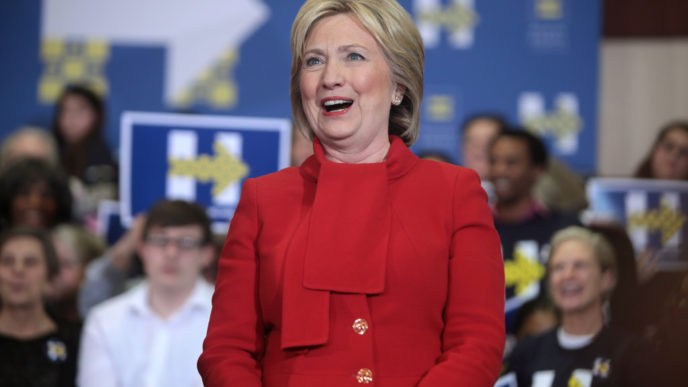
Hiding Hillary: 272 Days Since Last Clinton Press Conference

ABC News reported late last night that come Labor Day, Hillary Clinton will be upgrading her campaign jet to accommodate reporters as she travels across the country to campaign events.

By finally allowing reporters onto her campaign jet, Clinton is following in the footsteps of other presidential nominees — albeit very late in the game. As the New York Times pointed out this week, the press have been traveling with presidential candidates on their planes since the early 1960’s. So far this election cycle, Donald Trump’s vice presidential candidate Mike Pence is the only person out of the two presidential tickets to invite press on his plane.

In addition to keeping press off of her campaign plane, Clinton has not held a formal press conference for 272 days, since December 2015. When CNN’s Jake Tapper asked her why she hadn’t held a press conference this year, she said: “I had my team check. I have done nearly 300 interviews just in 2016 and I believe it’s important to continue to, you know, speak to the press as I’m doing right now.”

Right. In a controlled environment … to one reporter. There’s a difference between granting an interview to a reporter where the candidate has a lot of control, and an open press conference where the candidate will have to take questions on a host of topics. And if this is the way Clinton is conducting her campaign, how secretive will she be if she becomes president? (For more from the author of “Hiding Hillary: 272 Days Since Last Clinton Press Conference” please click HERE)

Follow Joe Miller on Twitter HERE and Facebook HERE.

Melania Trump Files $150 Million Libel Lawsuit Over ‘Lies’ About Her Past

Donald Trump is not the only member of his family who knows how to counterpunch.

Melania Trump, the wife of the Republican presidential candidate, on Thursday followed up on previously made threats and filed a libel lawsuit over a story claiming she had been an escort in the 1990s.

Trump is suing Mail Media, parent company of the British newspaper the Daily Mail, as well as a Maryland blogger named Webster Griffin Tarpley.

After the lawsuit was filed, the Daily Mail offered a retraction.

Trump is seeking $150 million in damages, according to a statement released by Charles Harder, her attorney. Harder was Hulk Hogan’s lawyer in the pro wrestler’s successful lawsuit against Gawker that netted Hogan $140 billion and bankrupted the gossip site.

“Defendants broadcast their lies to millions of people throughout the U.S. and the world — without any justification,” Harder said. “Their many lies include, among others, that Mrs. Trump supposedly was an ‘escort’ in the 1990s before she met her husband. Defendants’ actions are so egregious, malicious and harmful to Mrs. Trump that her damages are estimated at $150 million.”

The complaint was filed in Maryland Circuit Court. In the lawsuit, Melania Trump addresses an Aug. 19 Daily Mail article headlined “Naked photoshoots, and troubling questions about visas that won’t go away: The VERY racy past of Donald Trump’s Slovenian wife.”

The article was based upon the work of a Slovenian journalist who helped write an unauthorized biography of Melania Trump and claims by a Slovenian magazine that connected the operator of her modeling agency to an escort agency.

Trump’s lawsuit says the article was not true.

“The statements of fact in the Daily Mail Article are false. Plaintiff did legitimate and legal modeling work for legitimate business entities and did not work for any ‘gentleman’s club’ or ‘escort’ agencies. Plaintiff was not a sex worker, escort or prostitute in any way, shape or form, nor did she ever have a composite or presentation card for the sex business,” the lawsuit said.

“Plaintiff did not come to the United States until 1996. Thus, Plaintiff did not, and could not have participated in a photo shoot in the United States or met her current husband in the United States prior to that time,” the lawsuit also said.

Prior to its publication, British news organizations had been warned not to publish the allegations.

Although several news organizations have questioned Trump’s immigration status when she came to the United States, she has been clear that she never broke immigration laws.

Tarpley, who often writes about conspiracy theories, published a blog post headlined “Where Is Melania Trump.” The post included multiple allegations about her mental state and repeated the claim about her status as an escort.

Tarpley has removed the post and published a retraction.

The Daily Mail’s retraction highlighted some of the allegations made in the initial article but said the article “did not intend to state or suggest that these allegations are true, nor did it intend to state or suggest that Mrs. Trump ever worked as an ‘escort’ or in the ‘sex business.’”

The newspaper went on to defend itself.

“The point of the article was that these allegations could impact the U.S. presidential election even if they are untrue,” the retraction read.

“To the extent that anything in the Daily Mail’s article was interpreted as stating or suggesting that Mrs. Trump worked as an ‘escort’ or in the ‘sex business,’ that she had a ‘composite or presentation card for the sex business,’ or that either of the modeling agencies referenced in the article were engaged in these businesses, it is hereby retracted, and the Daily Mail newspaper regrets any such misinterpretation,” the newspaper said.

Harder told CNN that Trump would proceed with the lawsuit despite the retraction. (For more from the author of “Melania Trump Files $150 Million Libel Lawsuit Over ‘Lies’ About Her Past” please click HERE)

Follow Joe Miller on Twitter HERE and Facebook HERE.
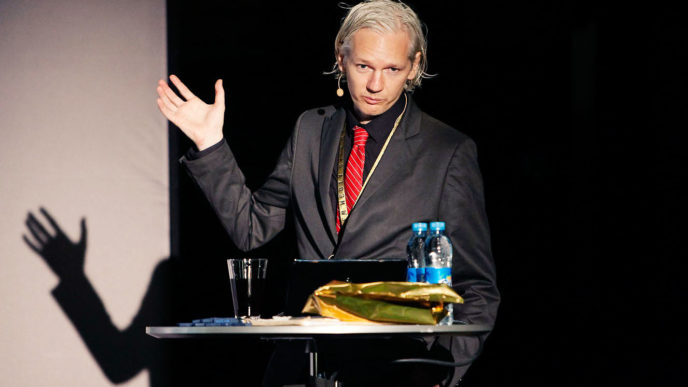
Assange: There’s ‘Demon’ at Work in America

WikiLeaks already has assumed a co-equal role in America’s 2016 election to many of those players who consider themselves significant, the network, daily and station editorialists and more.

It has released Democratic Party emails, resulting in the resignation of top party officials. It has publicly promised that those who supply insider information probably will be happy with the results, and it has made no secret of the fact that Americans likely will be getting access to a lot more heretofore “secret” details before the November election.

Now founder Julian Assange is making it clear that he’ll not take anything less than full and accurate representations by the mainstream outlets.

Following an interview he granted to the New York Times, there were a number of headlines based on the interview and resulting story about alleged links to the Russian government, about how he called Hillary Clinton a “demon,” and more . . .

On Twitter, he posted, “What we were drawing attention [to] is the amazing transformation that Hillary Clinton and the Democratic Party are by becoming the national security party and the national security candidate by whipping up a neo-McCarthyist hysteria about Russia. (Read more from “Assange: There’s ‘Demon’ at Work in America” HERE)

Follow Joe Miller on Twitter HERE and Facebook HERE.

New Polling Shows Shakeup in Presidential Race

Republican presidential candidate Donald Trump now tops Democratic rival Hillary Clinton nationally, according to a new poll.

The Rasmussen survey released Thursday has the GOP nominee taking 40 percent of the vote to Clinton’s 39 percent, a 5-point swing since last week.

Meanwhile, Libertarian Gary Johnson garners 7 percent and Green Party nominee Jill Stein takes 3 percent.

The same poll last week showed Clinton ahead 42 to 38 percent, The Hill reported.

The poll’s results mirror several recent ones that have had Trump gaining ground and in some cases overtaking his rival.

A Reuters/Ipsos poll released on Wednesday had the two candidates in a virtual tie: 39.7 to 39.1 percent.

That same polling outfit had Clinton up by 12 points in a survey released on Aug. 22.

The change of fortunes can likely be traced to new revelations about the former secretary of state’s email server and the Clinton Foundation, as well as a pivot in the Trump campaign.

Americans learned last week that Clinton never turned over nearly 15,000 work-related emails, despite claiming multiple times during the past year that she had returned them all.

This week the public found out that some of those emails address Benghazi, Libya. All of Clinton’s emails regarding that topic have been subject to congressional subpoena since 2013.

Other emails released last week from Clinton aide Huma Abedin show instances of top donors to the Clinton Foundation obtaining favors or preferential treatment from the State Department.

An ABC News/Washington Post poll published on Thursday found Clinton’s unfavorability rating among registered voters reaching an all-time high of 59 percent.

“Notably, Clinton’s popularity among women has flipped from 54-43 percent favorable-unfavorable last month to 45-52 percent now; it’s the first time in a year that most women have viewed her unfavorably,” according to ABC News.

“[A]mong nonwhites she’s fallen from 73 to 62 percent favorable, largely due to a 16-point drop, to 55 percent, among Hispanics,” the outlet added.

Trump also remains unpopular, with 60 percent of registered voters disapproving. He has slipped 6 percent with men, but gained 7 points with women. That perhaps can be traced to his more measured rhetoric and minority outreach, which he has adopted since naming Kellyanne Conway as his campaign manager in mid-August. (For more from the author of “New Polling Shows Shakeup in Presidential Race” please click HERE)

Follow Joe Miller on Twitter HERE and Facebook HERE.

Email Reveals Clinton Foundation Execs Demanding Diplomatic Passports From Top Hillary Aide

When a Clinton Foundation executive wanted diplomatic passports for himself and an associate back in July 2009, all it took was one email to get a reply from top Hillary Clinton aide Huma Abedin saying, “Ok will figure it out.”

The email was among 510 pages of new State Department documents that were released by Judicial Watch as it continues its investigation into the Hillary Clinton-era State Department, its links to the Clinton Foundation, and the use of a private email server by Clinton while she was secretary of state.

“The idea that the State Department would even consider a diplomatic passport for Clinton Foundation executives is beyond belief,” stated Judicial Watch President Tom Fitton.

“These emails show various violations of national security laws and ethics rules and further confirm that Hillary and Bill Clinton are personally implicated in the Clinton Foundation pay to play scandal,” he said.

According to a press release issued by Judicial Watch, the request by Clinton Foundation executive Doug Band was for a special diplomatic passport for himself and his associates – an unidentified “JD” and apparently Justin Cooper, who Judicial Watch described as “formerly a key member of Bill Clinton’s personal office.”

The exchange of emails, as released by Judicial Watch, went like this:

From Band to Abedin:

Need get me/ justy and jd dip passports.

We had them years ago but they lapsed and we didn’t bother getting them.

Six minutes later, Abedin replied:

Ok will figure it out

Judicial Watch’s release notes, “The U.S. Code of Federal Regulations strictly limits the granting of diplomatic passports to members of the Foreign Service, their family members, or those working on U.S. government contracts.”

The Clinton campaign said in response that the diplomatic passports were needed as part of an effort to free American journalists held by North Korea.

The Judicial Watch press release also said that among the emails it found are some in which Hillary Clinton forwarded classified information to Abedin’s unsecured, non-state.gov account.

“The emails also show Bill Clinton sought a meeting with Mrs. Clinton for a major Clinton donor with State Department officials and Hillary Clinton herself pushed for a joint event with the Clinton Global Initiative,” the release stated, adding that Band received special help from Abedin for Clinton Foundation donor Chris Ruddy.

Another of the newly released emails finds the Clinton State Department granting special favors to Andrew Liveris, CEO of Dow Chemical, which donated between $1 million and $5 million to the Clinton Foundation.

The July 2009 exchange began with Abedin advising Clinton scheduler Lona Valmoro that “wjc” (William Jefferson Clinton) wanted special treatment for Liveris:

Wjc wants to be sure hrc sees Andrew Liveris, ceo of dow tomorrow night. Apparently he is head of us china business council. Is he definitely going to be there?

The email string ended with Clinton aide Paul Narain responding to Valmoro:

Lona, I have arranged this pull aside for on the arrival in the Hold Room across the hall from the ballroom, immediately prior to the Secretary’s entrance and remarks.

Judicial Watch said the new documents include 37 Clinton email exchanges not previously handed over to the State Department, bringing the total to 228.

“These records further appear to contradict statements by Clinton that, ‘as far as she knew,’ all of her government emails were turned over to the State Department,” Judicial watch said. (For more from the author of “Email Reveals Clinton Foundation Execs Demanding Diplomatic Passports From Top Hillary Aide” please click HERE)

Follow Joe Miller on Twitter HERE and Facebook HERE.
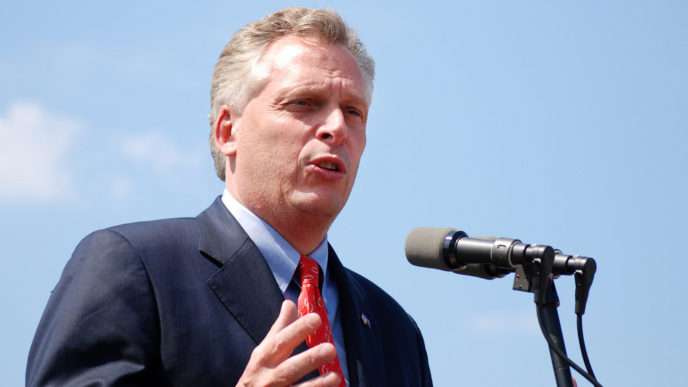
In Historic Move, Virginia Legislators File Contempt Motion Against McAuliffe Over Felon Voting

Virginia state legislators have filed a motion with the Virginia Supreme Court asking for an order requiring Gov. Terry McAuliffe to “show cause” why he should not be held in contempt for violating the court’s July 22 order that vacated McAuliffe’s executive orders restoring the voting rights of 206,000 felons.

The court ruled that the governor’s clemency and pardon power could only be exercised on an individual, case-by-case basis and that the voter registrations of felons who had registered as a result of McAuliffe’s orders had to be canceled.

Being held in contempt by a court can occur if a party to a lawsuit deliberately disobeys a prior order of the court. A governor being held in contempt by a state supreme court for such behavior is rare and would be a history-making event in Virginia.

McAuliffe’s Persistence to Let Felons Vote

This motion for contempt follows McAuliffe’s Aug. 22 press conference in which he announced that he had again restored the voting rights of 13,000 felons who had registered to vote after he issued three blanket restoration orders earlier in the summer. His press announcement said that “individual restoration orders were printed with the Governor’s signature.”

How much of an individualized review could be given by McAuliffe to these 13,000 felons in the four weeks between the Supreme Court’s July 22 decision and his press conference on Aug. 22 was certainly in question. And that is what the contempt motion focuses on—the lack of any real individualized review of these felons’ cases. In fact, the motion cites a spokesman for the governor who said that the only review of the record would be to confirm completion of the felon’s sentence and any supervised release.

The motion points out that McAuliffe “denounced” the Virginia Supreme Court’s order, “vowing to accomplish precisely the same result simply by issuing individual restoration orders for precisely the same class of approximately 206,000 felons, again without any regard for their individual circumstances and without any specific request by individuals seeking such relief.” Thus, McAuliffe “reads this Court’s decision as permitting him to suspend the Constitution’s general rule disenfranchising felons so long as he does so with 206,000 restoration orders rather than three. He is wrong.”

According to the motion, the court did not reduce the relevant provisions of the Virginia Constitution “to a printing requirement.” The protections of Virginia’s Constitution “do not depend upon how many reams of paper and autopen machines the Governor deploys to work his will.” As the legislators say, there “is no substantive difference between the Governor’s current actions and his three executive orders … that the court invalidated.” This is an open declaration by McAuliffe of “his resolve to evade the Court’s order.”

The motion uses McAuliffe’s own words against him, citing McAuliffe’s proclamation that “the Virginia Supreme Court has placed Virginia as an outlier in the struggle for civil and human rights” and that he “cannot accept” the court’s ruling. That kind of contemptuous, unfair criticism of the court is certainly not the smartest thing that a party to a lawsuit can do.

McAuliffe’s Lack of Respect for Virginia Government

It also demonstrates a level of disrespect and lack of understanding of Virginia’s constitutional provisions and governmental structure that is inappropriate and unseemly in the executive officer of the state.

McAuliffe added to that, as the legislators point out, when he showed his “disdain” for the court and claimed that the court acted not in accordance with the Constitution but because of “the way things have always been done in the Old Dominion.”

He even suggested, according to the motion, “that the Court’s ruling was comparable to requiring children to attend segregated schools, assigning seats on buses on the basis of race, prohibiting interracial marriage, and imposing a poll tax.” McAuliffe expressed his determination to act notwithstanding the court’s order because he would “not stand down and allow discriminatory state laws to destroy the lives and families and destabilize our communities.”

As the legislators say, the governor is certainly entitled to disagree with the state’s constitution or the court’s interpretation of it, but he cannot set himself above the law. They cite an old Virginia case in which the state Supreme Court said that a government official cannot “go his own way because he deems the law’s requirements to be unwise or its restraint vexatious. In such manner does a government of laws become a government of men.”

What’s Next for McAuliffe

The motion asks for an order from the Virginia Supreme Court that would require the governor to show cause why he “should not be held in contempt.” In the alternative, the court should enter an order enforcing its prior judgment and prohibiting the registration of the felons “whose rights were purportedly restored by the orders issued, without application from the felon.” At a “bare minimum,” the court should authorize the legislators to “conduct discovery to determine in detail the purpose, scope, and effect” of McAuliffe’s conduct in response to the court’s July 22 order.

I’ve been a lawyer for a long time and I can’t ever remember seeing a motion filed to hold a governor in contempt. It is going to be very interesting to see whether McAuliffe finally tempers his public statements as a result of this motion or whether he continues to criticize and defy the state’s highest court.

One thing’s for sure—I would not want to be the state assistant attorney general who has to show up before the Virginia Supreme Court to explain the inflammatory and offensive statements made by the governor about the court and to defend his defiance of the court’s prior order. (For more from the author of “In Historic Move, Virginia Legislators File Contempt Motion Against McAuliffe Over Felon Voting” please click HERE)

Follow Joe Miller on Twitter HERE and Facebook HERE.