The Force Is Not With You: Government Rules Could Land Star Wars Drone Pilots in Prison

What kid hasn’t watched “Star Wars” and imagined skimming the Death Star trench in an X-Wing, tangling with TIE Fighters to save the Rebel cause?

For a long time, playing out these flights of fancy was restricted to video games. But thanks to drone technology—not quite anti-gravity, but close—the Force may be coming to a neighborhood near you. A company known as Propel is marketing “Star Wars Battle Quads”—faithful miniatures of some of the most iconic craft from that galaxy far, far away—that can dogfight one another above your backyard.

When the models are released, enthusiasts will be able to blast out of their backyard spaceport in the Millennium Falcon, tangle with Darth Vader’s TIE Fighter, or dodge trees on Imperial speeders.

But, kids (and let’s be honest, adults, too), before you get too excited, keep this in mind: While most people will see these as harmless toys, regulators at the Federal Aviation Administration claim these palm-sized drones are “aircraft” no different than a passenger-laden 747 jet. That means that drones are subject to a host of federal laws and regulations that were originally written for manned aircraft, and carry severe civil and criminal penalties that are disproportionate in this context.

Here are just a few of the absurd crimes the FAA could accuse you of committing:

Destroying an aircraft—According to 18 U.S.C. § 32, anybody who willfully “damages, destroys, disables, or wrecks any aircraft in the special aircraft jurisdiction of the United States” has committed a felony punishable by up to 20 years’ imprisonment. Amazingly, the FAA has confirmed that this statute applies to drones, even though it is abundantly clear that Congress wrote the statute to criminalize takedowns of traditional, manned aircraft by terrorists and criminals. So, dogfight at your own risk—and don’t even think about recreating the speeder bike chase on Endor.

Aiming a laser pointer at an aircraft—18 U.S.C § 39(A) criminalizes “knowingly aim[ing] the beam of a laser pointer at an aircraft” or “at the flight path of such an aircraft.” Doing so can land you in prison for up to five years. Again, criminalizing this behavior only makes sense in the context of manned aviation, where a laser point can—and has—blinded pilots behind the controls of actual aircraft. What damage, however, is done by aiming a laser pointer at a drone? The jury is still out on that question, but violating this law is almost guaranteed given that these battle quads feature laser pointers intended to mimic Rebel blasters.

Failing to register as a drone owner—Last December, just days before Christmas, the FAA released a rule mandating that all drone owners register themselves with the FAA if the drone they are flying is used for hobby or recreational purposes, and weighs more than 0.55 pounds—the equivalent of two sticks of butter. Failure to register before your first flight constitutes a felony punishable by up to $277,500 in fines and three years’ imprisonment, a penalty scheme that the FAA’s own drone registry task force noted was utterly disproportionate in the drone context.

As if this is not bad enough, hapless drone operators flying purely for fun could find themselves fined for failing to comply with commercial drone regulations. For years, the FAA has divided drone activities into “recreational” and “commercial” categories along largely arbitrary and ill-defined lines. The result: Someone may think that he is flying purely for fun, but the FAA might think otherwise, and proceed to fine him for failing to comply with rules he did not know applied to him.

In fact, in one case, the FAA targeted a drone operator in Florida in precisely this fashion, determining that since he posted videos of his drone joyrides on YouTube, a site that had advertisements, his activity was, in fact, commercial. Another man, Mical Caterina, used a drone to photograph an event protesting the killing of Cecil the Lion. He did this as a favor to a friend, and for his troubles the FAA is now fining him $55,000 for failing to comply with commercial drone rules.

Thanks to draconian rules likes these, arbitrarily enforced by FAA bureaucrats without concern for the costs of unpredictable regulatory enforcement, yours may be the drones they’re looking for. It’s no wonder that some might yearn to become a Rebel and take out their frustrations on the Empire’s finest.

But future X-Wing pilots should probably restrict themselves to bull’s-eyeing womp rats instead of other drones, because if you actually take down Darth Vader’s toy TIE, you could find yourself hauled before a judge on federal felony charges. And no, “restoring peace and justice to the Galaxy” is not likely to be a winning defense. (For more from the author of “The Force Is Not With You: Government Rules Could Land Star Wars Drone Pilots in Prison” please click HERE)

Follow Joe Miller on Twitter HERE and Facebook HERE.

What Pokémon Go Teaches Us About Job Creation

The zombie apocalypse has arrived. Just look around. Our streets and neighborhoods appear as though we are living a scene from the Walking Dead. People everywhere are aimlessly limbering around without any clear destination.

But fear not. Those people are not zombies—just addicted to a new Nintendo game called Pokémon Go. It’s a game that is played only your smartphone by downloading an app. After you’ve downloaded the app, you’ll find yourself on an endless quest to hunt virtual creatures that appear in your actual surroundings.

Having been blessed with a serious case of FOMO (Fear of Missing Out), I recently decided to see what everyone was raving about. I downloaded the app on my iPhone, and before long I was in a zombie-like trance chasing after cartoon creatures that leapt, hopped and flew down sidewalks, alleys and parks. In short order, I had bagged a Squirtle.

I may be a new devotee of the game, but I’m not alone – the game has more than 65 million users worldwide.

While the game’s success has captured the news, perhaps the more fascinating aspect of this new game is the impact it’s having on small businesses.

Unlike other Nintendo games, this game requires a lot of walking. You have to walk to catch Pokémon, but told you also want to hatch eggs (some of which require 10 kilometers – 6 miles – of walking to incubate) and collect Pokéballs (used to catch Pokémon), which are found at various locations. It’s these Pokéstops that have caught the attention of small businesses.

As Fortune writes, “Many shops are attracting customers by advertising themselves as ‘Pokestops,’ a place where gamers can grab new Pokémon balls and increase their level of power within the app.”

The in-app purchases are also catnip for business. “Lures,” which can be purchased within the game, allow a business to set themselves up as a stop that attracts Pokémon to its location. Take for example the now-viral story of Tom Blaze, founder of L’Inizio Pizza Bar in New York City, who purchased a “lure” from Pokémon Go for $10. The result has been a swell of new customers. As Blaze says, “[business has been] unbelievable.” Since he began to use Pokémon Go to attract customers, his bar has seen more than a 75 percent increase in business over the past few days.

Pokémon Go is perhaps the most positive news resonating from the small business community in a while. Small businesses are the pillar of the U.S. economy. The 28 million small businesses in America make up more than 50 percent of all sales, they employ 55 percent of workers; and have created 66 percent of all new jobs since the 1970s.

The birth of small businesses in America is on the rise after a slump during the Great Recession. Yet, as the engine of the U.S. economy, they are not growing fast enough. One culprit for this malaise is the Obama administration’s desire to make doing business harder than ever. Consider how Obamacare unleashed a myriad of unaffordable healthcare mandates—on top of 674 federal regulations that businesses must comply with today.

According to the Competitive Enterprise Institute, it costs small businesses (50 employees or less), $11,724 to comply with federal regulations – per employee. Of that amount, 30 percent of that costs results from environmental regulations.

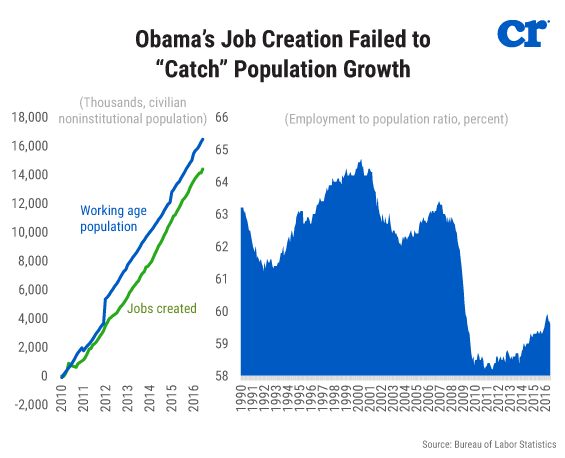
Since small businesses are the most prolific job creator, their growth is instrumental in a healthy economy. But while Obama’s small business numbers appear on the rise, they are falling well behind a level needed to create jobs that keeps up with the growth in the population.

The population has grown at a far quicker pace, particularly for those entering the workforce. As you can see from the chart, the job market has left millions without the opportunity to find work since Obama has been in office. Those figures are reflected in the employment to population ratio, which today is at its lowest levels compared to recent history.

Obamas Job Creation Failed to Catch Population Growth

It’s telling that the most recent surge in small business growth hasn’t come from the government, but is instead the result of innovation and creativity in the private sector. It’s also a sad commentary on the state of small business in America that we’re excited about the recent economic prospects that comes from virtual creatures named Pidgeotto, Diglett and Poliwag. Here’s hoping the next president powers up in the name of small business. (For more from the author of “What Pokémon Go Teaches Us About Job Creation” please click HERE)

Follow Joe Miller on Twitter HERE and Facebook HERE.

Real or Fake? Ghostly Photo Mesmerizes Social Media

Real or fake? That’s the big question surrounding the latest social media buzz – a photograph posted by a man who says he witnessed the scene of a fatal motorcycle accident from afar, snapped a quick picture, and noticed, while looking at it and posting on Facebook, a shadowy whitish figure hovering above an emergency response official’s head.

Saul Vazquez of Mount Sterling, Kentucky, posted this to his Facebook page, alongside the photo: “I took this picture just few minutes ago from the cab of my truck it was an accident between Campton and Stanton on the service road just off of the mountain parkway, zoom in and pay attention to the shadow just off the top of the state trooper hat. All I say is I hope everyone involved is okay!!”

The crash victim was taken to the hospital, but later died, the Palm Beach Post reported.

Vazquez told LEX 18 he snapped the photo from the bed of his truck, while driving past the scene, and assures the photograph’s not been tampered with in any way.

His post has been shared more than 8,700 times. And most comments show individuals appear to believe the photo is genuine. (Read more from “Real or Fake? Ghostly Photo Mesmerizes Social Media” HERE)

Follow Joe Miller on Twitter HERE and Facebook HERE.

House Committee OKs Bill Letting the FBI Use Rapid DNA Profiling

A DNA evidence bill that would let police in the field, not just technicians in an accredited lab, quickly test the genetic material of suspects has advanced to the House floor.

The measure centers around a relatively new screening instrument the size of a printer, called Rapid DNA.

The idea behind the technology is to swiftly clear innocents, detain criminals and free up technicians to clear rape kit backlogs, among other things, say Judiciary Committee members who advanced the bill.

Currently, only DNA swabs analyzed in a crime lab, a process that can take many weeks, are permitted to be run against the FBI’s central DNA database for matches.

The bipartisan House Rapid DNA Act, which the Senate unanimously approved in June, would authorize a cheek swab processed by the automated tool to be uploaded into the database, named CODIS. (Read more from “House Committee OKs Bill Letting the FBI Use Rapid DNA Profiling” HERE)

Follow Joe Miller on Twitter HERE and Facebook HERE.

Why You Should Read ‘Out-Of-Date’ History Books

Over the long Independence Day weekend, the Washington Free Beacon published an essay by Waller Newell calling for renewed attention for what he calls the Next Best Books. These are works of history or literature that, while you wouldn’t file them away in the canon with books by Plato or Shakespeare or Hegel, nevertheless ought to have some claim on our lasting attention. Books by authors like Solzhenitsyn or Tuchman or Ortega y Gasset can help readers, especially younger readers, develop their political and psychological instincts, educating them about human nature, about greatness and great evil, and about what is required for a free society to endure.

Concluding that the universities have fallen down on this job, among so many others, Newell provided a provocative list of 15 history books “to get the ball rolling.” The earliest among them, Gibbon’s Decline and Fall, was published beginning in 1776; the most recent, Bernard Lewis’s Crisis of Islam, appeared in 2003. Most of the volumes are products of the mid-twentieth century, with books by Churchill, Robert Conquest, and Karl Polyani among them.

Given that these are histories rather than, say, novels, an obvious objection arises: aren’t most of these books a little, well, out of date? If we really want young people to understand why the Roman Empire fell apart, is a book written during the decade America fought for its independence really the best place to look? If Rome’s transition from self-governing republic to monarchic empire seems important for students to understand, what utility could be found in Ronald Syme’s The Roman Revolution, originally published in in 1939?

The same objection could be applied to most of the books on this list, or any similar list. In the years since these volumes have been published, hasn’t there been important new research that later authors have usefully synthesized? And even if the books have certain superficial charms that haven’t been improved upon—the rich skill of Barbara Tuchman’s prose, for example—a now half-century-old account of the start of World War One by definition cannot include the latest developments in the scholarship pertaining to that period of history, right? Not to mention the latest developments in our understanding of history or politics or human nature in a broader way! So, superficial appeal or antiquarian affectations aside … why bother?

Here’s why. The strongest point that can be made in favor of systematically preferring more recent histories to their predecessors is that later writers have access to more and better data. That later writers know more facts is generally true—though not universally, and certainly not before the era of modern western scholarship. (An interesting feature of medieval Arabic histories of the origins of Islam is that the later histories indeed tend to be longer than the earlier ones—chock full of inventions and fabrications that were passed off as discoveries.) But the flaw in this argument is the assumption that the main reason to read history is to determine the facts of the period in question to the greatest degree possible—to learn what really happened, or what von Ranke called wie es eigentlich gewesen (which sounds much more impressive). (Read more from “Why You Should Read ‘Out-Of-Date’ History Books” HERE)

Follow Joe Miller on Twitter HERE and Facebook HERE.

Shops Set to Spy on Us by Tracking Our Smartphones: Scanners Will Collect Information on How Many People Pass

Scanners are to be placed outside stores from Pret a Manger to Aldi to track people through their smartphones’ wifi signals.

One thousand of the sensors will be used to measure the numbers passing or entering, known as footfall.

The idea is that the information could help revive dying high streets threatened by the rise of internet shopping.

It could lead to changes in bus timetables to make shopping visits easier, or identify times of the day when free parking would help retailers. In theory, it could even be used to decide that some town centres are beyond saving.

But the idea that shoppers will be tracked through their phones’ wifi signals is controversial. Many balk at the rise of the surveillance society through CCTV cameras, automatic number plate recognition and smartphones. (Read more from “Shops Set to Spy on Us by Tracking Our Smartphones: Scanners Will Collect Information on How Many People Pass” HERE)

Follow Joe Miller on Twitter HERE and Facebook HERE.

Why Extremely Rare Events Keep Happening All the Time

Something weird seems to be happening in the heavens. This week marks a coincidence of the full moon and the summer solstice. Some astronomers are calling this combination of maximum moonlight and the Northern Hemisphere’s longest day a rare event.

It comes close on the heels of last month’s rare passage of Mercury in front of the sun, September’s rare pairing of a lunar eclipse with a so-called supermoon, the rare 2014 “tetrad” of lunar eclipses, the rare 2012 transit of Venus, and a plethora of once-in-a-lifetime planetary alignments, one earlier this year, one in 2014 and one in the summer of 2013. Next year there will be a rare total eclipse of the sun.

If these sorts of events are so rare, why do they happen so often?

Ask a statistician. David Hand, a professor at Imperial College London makes sense of world’s abundance of rare events in his 2014 book, “The Improbability Principle: Why Coincidences, Miracles and Rare Events Happen Every Day” . . .

The fact that astronomers could present either the event or its absence as noteworthy makes some sense in light of what Hand calls “the close-enough effect.” This effect comes into play in news stories about people who win the lottery more than once, he said. Often one “win” is really a more commonplace second and third prize. The more you relax the definition of winning, the greater the odds it will happen twice. (Read more from “Why Extremely Rare Events Keep Happening All the Time” HERE)

Follow Joe Miller on Twitter HERE and Facebook HERE.

Large-Scale Motion Detected Near San Andreas Fault System

Analysis of GPS data has revealed new areas of motion around the San Andreas Fault System.

Using data collected by the EarthScope Plate Boundary Observatory’s GPS array, researchers identified 125-mile-wide “lobes” of uplift and subsidence. Over the last several years, the lobes, which straddle the fault line, have hosted a few millimeters of annual movement . . .

Researchers used advanced statistical modeling to identify the movement among the inevitable statistical noise that comes with monitoring minute movements in the Earth’s crust.

“While the San Andreas GPS data has been publicly available for more than a decade, the vertical component of the measurements had largely been ignored in tectonic investigations because of difficulties in interpreting the noisy data,” lead author Samuel Howell, a researcher at the University of Hawaii at Manoa, explained in a news release. “Using this technique, we were able to break down the noisy signals to isolate a simple vertical motion pattern that curiously straddled the San Andreas fault.” (Read more from “Large-Scale Motion Detected Near San Andreas Fault System” HERE)

Follow Joe Miller on Twitter HERE and Facebook HERE.

Scientists Have Discovered How to Implant False Memories

MIT researchers Steve Ramirez and Xu Liu recently made history when they successfully implanted a false memory into the mind of a mouse. The proof was a simple reaction from the rodent, but the implications are vast. They placed the furry little creature inside a metal box, and it froze, displaying a distinct fear response. The mouse was reacting as if it had received an electrical shock there, when it hadn’t at all.

What makes it more riveting is that their success was considered a long-shot. The hypothesis was that not only could they identify those neurons associated with encoding memory, but could essentially rewrite one. Experts say that this an impressive feat which helps uncover more of the mystery of how memory operates. Though neuroscientists have considered such a possibility for years, they never thought this kind of experiment could actually work.

This breakthrough was possible due to research out of Oxford which discovered exactly how short-term memories are transferred into long term memory. But the MIT researchers took it into an entirely new direction. Memories are actually stored in not one area, but certain groups of neurons known as engrams. Ramirez and Liu came together in 2010 and designed a new method for exploring live brains, to identify specific engrams. The neuroscientists used a newly minted technique called optogenetics, which employs lasers to stimulate genetically engineered cells designed to react to them. (Read more from “Scientists Have Discovered How to Implant False Memories” HERE)

Follow Joe Miller on Twitter HERE and Facebook HERE.

FedEx Is in Court for Allegedly Being the World’s Most Efficient Drug Dealer

Shipping company FedEx is up against the U.S. government in court Monday for allegedly trafficking all sorts of prescription drugs to addicts through online pharmacies.

The Tennessee-based shipping firm is accused of knowingly doling out prescription drugs to users without prescriptions since 2000. FedEx shipped Valium and Xanax to sketchy public addresses like parking lots and abandoned homes.

A San Francisco grand jury indicted FedEx for its alleged drug trafficking back in July 2014. The delivery services company is said to have teamed up with Superior Drugs and Chhabra Smoley Organization, two online pharmacies, to sell drugs to desperate people.

At the time of the indictment, U.S. Attorney Melinda Haag said, “The advent of Internet pharmacies allowed the cheap and easy distribution of massive amounts of illegal prescription drugs to every corner of the United States, while allowing perpetrators to conceal their identities through the anonymity the Internet provides.” Haag went on to state, “This indictment highlights the importance of holding corporations that knowingly enable illegal activity responsible for their role in aiding criminal behavior.”

The judge presiding over the trial is Senior District Judge Charles R. Breyer of the U.S. District Court for the Northern District of California. Breyer is the brother of Associate Supreme Court Justice Stephen Breyer.

Breyer has made his doubts clear with the case and questioned why prosecutors have not gone after the U.S. Postal Service for the same kind of illegally drug deliveries. The “essential ingredient,” to the prosecution’s case, or a smoking gun proving FedEx knew about its shady customers, seems to be lacking according Breyer.

If found guilty of money laundering and conspiracy, FedEx could be fined up to $1.6 billion. FedEx claims that the government should let them know if they are dealing with illegal retailers. It has been decided by both the prosecution and the defense that the trial will be decided by the judge’s ruling rather than a jury.

FedEx has stated since the indictment that the firm will gladly stop dealing with illegal businesses if the DEA would just give them a list of illegitimate recipients. Despite the firm’s willingness to stop any inadvertent illegal activity, the DEA has not told FedEx which of its clients is involved in illegal activities.

Top FedEx competitor UPS settled charges in a case much like this one back in 2013 to the tune of $40 million. Some of the lawyers representing FedEx, gave their legal counsel to retired baseball player Barry Bonds regarding steroids. (For more from the author of “FedEx Is in Court for Allegedly Being the World’s Most Efficient Drug Dealer” please click HERE)

Follow Joe Miller on Twitter HERE and Facebook HERE.