Posts

JD Vance Expects Iran, Israel to ‘Keep Shooting at Each Other’ Until Cease-Fire Goes Into Effect

President Trump does not plan to take further action against Iran following its “failed retaliation” strike on a US base in Qatar Monday night, a military official told The Post.

“As long as it stands, Trump has no intention of retaliating for the ‘failed retaliation,'” the source said, suggesting that tensions in the Middle East will soon de-escalate following Saturday’s US strike on three Iranian nuclear facilities. . .

President Trump announced a cease-fire between Iran and Israel just seconds before Vice President JD Vance’s live interview with Fox News “Special Report” host Bret Baier on Monday.

This was the veep’s reaction.

“Well, we were actually working on that just as I left the White House to come over here. So that’s good news, that the president was able to get that across the finish line,” Vance told Baier when informed about Trump’s Truth Social post.

“What that means, I think, is we have to talk to Iran and, of course, to Israel, about what the future holds,” the vice president said, noting that Trump “is really trying to figure out” how to “build a long term settlement here to where we can have peace in the region. (Read more from “JD Vance Expects Iran, Israel to ‘Keep Shooting at Each Other’ Until Cease-Fire Goes Into Effect” HERE)

Whatever Happens Next, Iran Doesn’t Need To Be Made Safe For Democracy

Now that President Donald Trump has decided to bring the United State into the Iran-Israel war by striking Tehran’s major nuclear facilities, our goal should be to ensure Iran remains a non-nuclear power that’s unable to threaten the United States or its allies anywhere in the world.

What that goal doesn’t require, however, is a regime-change war with the aim of toppling the ayatollahs and imposing democracy in Iran. The American interest is not served by toppling regimes and nation-building — especially not in the Middle East. Whatever the wisdom of striking Iran’s nuclear facilities at this particular time, on the heels of Israeli strikes on Iran, President Trump’s aim now should be to limit escalation and avoid plunging the U.S. into a years-long quagmire in Iran.

Unfortunately, many people in Washington were hoping that Trump would strike Iran precisely because it might make room for the kind of escalation that would lead to a regime-change war. We still don’t know what Iran’s response will be to these strikes, and it might well lead to unavoidable escalation on our part. But that escalation should serve the purpose of rendering Iran harmless — not free, or democratic, or even stable. The internal politics of Iran are of no concern to us.

One hopes the president understands that, even as he acts to ensure that Iran cannot acquire nuclear weapons or carry out a major retaliatory attack on the U.S. Initially, there was reason to think he did understand. “Our objective was the destruction of Iran’s nuclear enrichment capacity and a stop to the nuclear threat posed by the world’s No. 1 state sponsor of terror,” Trump said Saturday night from the White House.

But on Sunday, Trump posted a disturbing comment about how it’s not politically correct to use the term “regime change,” “but if the current Iranian Regime is unable to MAKE IRAN GREAT AGAIN, why wouldn’t there be a Regime change??? MIGA!!!” (Read more from “Whatever Happens Next, Iran Doesn’t Need To Be Made Safe For Democracy” HERE)

Trump Announces Ceasefire in Iran-Israel ’12 Day War’

President Donald Trump announced on Monday that Israel and Iran had agreed to a “complete and total ceasefire,” after 12 days of ongoing war between the two countries.

“CONGRATULATIONS TO EVERYONE! It has been fully agreed by and between Israel and Iran that there will be a Complete and Total CEASEFIRE (in approximately 6 hours from now, when Israel and Iran have wound down and completed their in progress, final mission!), for 12 hours, at which point the War will be considered, ENDED!” Trump wrote in a post on Truth Social.

“Officially, Iran will start the CEASEFIRE and, upon the 12th Hour, Israel will start the CEASEFIRE and, upon the 24th Hour, an Official END to THE 12 DAY WAR will be saluted by the World. During each CEASEFIRE, the other side will remain PEACEFUL and RESPECTFUL,” Trump added.

Trump continued to offer his congratulations to Israel and Iran for having agreed to a ceasefire “on the assumption that everything works as it should.”

(Read more from “Trump Announces Ceasefire in Iran-Israel ’12 Day War’” HERE)

Photo credit: Flickr

DOD Reveals Stunning New Details Following Trump’s Attack on Iran

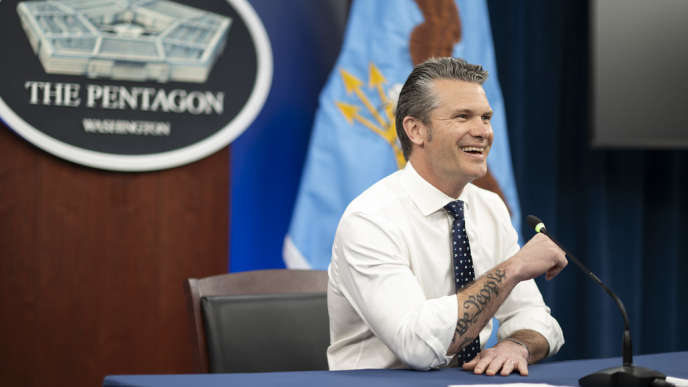
Defense Secretary Pete Hegseth and Chairman of the Joint Chiefs of Staff Gen. Dan Caine revealed stunning new details following President Donald Trump’s historic strikes against Iranian nuclear sites on Saturday.

Hegseth and Caine confirmed that deception was involved to execute “Operation Midnight Hammer,” commending the American military, who “performed flawlessly” during the mission. Part of the fleet of B-2 bombers flew west over the Pacific as a decoy, while the “main strike package” headed east before striking Iran at about “6:40 p.m. Eastern Standard Time.”

Hegseth also clarified that only the Iranian nuclear targets were “devastated” and that civilians were not targeted.

“Many presidents have dreamed of delivering the final blow to Iran’s nuclear program, and none could, until President Trump,” Hegseth told reporters during a press conference Sunday. “The operation President Trump planned was bold, and it was brilliant, showing the world that American deterrence is back. When this president speaks, the world should listen.”

“No other country on planet Earth could have conducted the operation that the chairman is going to outline this morning, not even close,” Hegseth added.

(Read more from “DOD Reveals Stunning New Details Following Trump’s Attack on Iran” HERE)

How Likely Is An Iranian Sleeper Cell Attack On US Soil?

The U.S. strike against Iran on Saturday night has ignited fears that Iran may choose to orchestrate attacks against Americans with undercover agents.

Iran threatened to activate sleeper cells in the U.S. days before President Donald Trump decided to strike Iran’s nuclear facilities Saturday night, two U.S. officials told NBC News. In the wake of the U.S. attacks against the Iranian nuclear program, the Department of Homeland Security (DHS) issued a memo Sunday warning of a “heightened threat environment” in light of the attacks, warning that Iranian government affiliates could launch terrorist attacks.

“The likelihood of violent extremists in the Homeland independently mobilizing to violence in response to the conflict would likely increase if Iranian leadership issued a religious ruling calling for retaliatory violence against targets in the Homeland,” the memo read. “Multiple recent Homeland terrorist attacks have been motivated by anti-Semitic or anti-Israel sentiment, and the ongoing Israel-Iran conflict could contribute to U.S.-based individuals plotting additional attacks.”

Trump announced a ceasefire agreement on Truth Social Monday evening between Iran and Israel, set to go into effect at approximately 12:00 a.m. EST, which would mark an end to the ongoing twelve day conflict assuming it holds. While Iran may have indicated it is no longer interested in continuing the war in the short-term with the agreement, the regime has a considerable history of pursuing violent plots on American soil.

In 2011, two men linked to the Iranian government were charged in a plot to assassinate the Saudi Arabian Ambassador on American soil. One co-conspirator, Gholam Shakuri, was involved in the Iranian Revolutionary Guard Corps (IRGC) Qods Force, a key cog of Tehran’s state-sponsored terror machine. (Read more from “How Likely Is An Iranian Sleeper Cell Attack On US Soil?” HERE)

Trump Hits Iran, Left Explodes — Even One Republican Says It’s ‘Unconstitutional’

Leading members of Congress and progressive activists erupted on social media following President Donald Trump’s announcement that the United States had launched airstrikes against Iran.

Rep. Rashida Tlaib (D-MI) stated, “Dear colleagues: Don’t make another mistake in dragging our country into another war,” Tlaib tweeted. “You can stop the President and the war mongers in Congress by signing on to our War Powers Resolution.”

“Trump struck Iran without any authorization of Congress,” Ro Khanna (D-CA) posted. “We need to immediately return to DC and vote on @RepThomasMassie and my War Powers Resolution to prevent America from being dragged into another endless Middle East war.”

Massie, a libertarian-leaning Republican, joined Democrats in blasting the strikes, writing, “This is not Constitutional,” in response to Trump’s post.

Former DNC Vice Chair David Hogg also weighed in,“What happened to no new wars?” Hogg asked. “Also how are we paying for this? If we can’t afford to spend trillions on healthcare we sure as hell can’t afford to spend trillions on another endless war.” (Read more from “Trump Hits Iran, Left Explodes — Even One Republican Says It’s ‘Unconstitutional’” HERE)

Did Trump Violate Constitution With Strike on Iran? Republicans in Congress at Odds

In the wake of President Donald Trump’s military strike on Iran’s nuclear facilities Saturday, Republicans in Congress are at odds over the constitutionality of the military action without congressional approval.

House Speaker Mike Johnson said: “The President made the right call, and did what he needed to do. . .

But a fellow Republican, U.S. Rep. Thomas Massie of Kentucky, said the dropping of 12 bunker buster bombs in a precision strike on three nuclear sites was “not constitutional.”

Massie responded directly to Johnson’s opinion, saying: “Why didn’t you call us back from vacation to vote on military action if there was a serious threat to our country?” . . .

Numerous presidents of both major political parties have taken military action against countries without congressional approval in recent years, including Democrat Barack Obama launching strikes in Afghanistan, Iraq, Syria, Libya, Yemen, Somalia and Pakistan.

(Read more from “Did Trump Violate Constitution With Strike on Iran? Republicans in Congress at Odds” HERE)

Photo credit: Gage Skidmore via Flickr

If Iran Blocks Strait of Hormuz, What Will Happen to U.S. Energy Costs?

Iran is reportedly weighing blocking a key commercial choke point known as the Strait of Hormuz, a move that could drive up energy costs in the U.S. and across the globe, according to energy sector experts who spoke with the Daily Caller News Foundation.

Israel began to bombard Iran to eliminate the Islamic Republic’s ability to build a nuclear weapon on June 13, and the U.S. carried out “Operation Midnight Hammer” on Saturday night, bombing three of Iran’s nuclear facilities. While Iran’s parliament has reportedly voted to close the Strait of Hormuz in a retaliatory move to choke the world’s oil supply in response to the American strikes, the U.S. is well-positioned to combat the inevitable energy cost spike that would follow if Iran succeeds, sector experts told the DCNF.

“The escalating conflict between Iran and Israel is already putting upward pressure on oil and natural gas prices—and that pressure will intensify if the Strait of Hormuz is blocked,” Trisha Curtis, an economist at the American Energy Institute, told the DCNF. “This kind of disruption would send global prices higher and tighten supply chains. Fortunately, the U.S. is well-positioned to respond — our domestic production strength and growing export infrastructure make American oil and natural gas increasingly indispensable to global markets.”

Iran does not have the legal authority to halt traffic through the strait, meaning it would need to usurp control through force or the threat of force, according to legal scholars and multiple reports. The Iranian parliament’s reported move to block the Strait on Sunday awaits final approval by Iran’s Supreme Council, according to Iran’s Press TV.

The Strait is only 35 to 60 miles wide and connects the Persian Gulf to the Indian Ocean, flowing past Iran, the United Arab Emirates and Oman. The thoroughfare is vital for global trade, as tankers carried one fifth of the world’s oil supply through the Strait of Hormuz in 2024 and the first quarter of 2025, according to data from the U.S. Energy Information Administration. (Read more from “If Iran Blocks Strait of Hormuz, What Will Happen to U.S. Energy Costs?” HERE)

Kremlin Warns That Other Nations Ready to Give Iran Nukes: ‘Dangerous Escalation Has Begun’

Moscow warned Sunday that several nations are prepared to supply Tehran with nuclear weapons, as Russia and China condemned America’s attack on Iran’s nuclear facilities.

Dmitry Medvedev, who serves as deputy head of Russian President Vladimir Putin’s Security Council, claimed Saturday’s US airstrike — the first to use 15-ton GBU-57 “bunker-buster” bombs in combat — only caused minimal damage to Tehran’s nuclear sites, including the fortified Fordow enrichment plant.

Medvedev, who did not specify which countries are ready to arm Tehran, reiterated that the attacks would not stop Russia’s ally in the Middle East from acquiring nuclear weapons.

The statement comes as Iranian Foreign Minister Abbas Araghchi said he will be traveling to Moscow to meet with Putin to discuss countermeasures.

“We enjoy a strategic partnership, and we always consult with each other and coordinate our positions,” Araghchi told Russian media.

Russia’s Foreign Ministry described the American airstrike in Iran as “a gross violation of international law, the UN Charter, and UN Security Council resolutions. (Read more from “Kremlin Warns That Other Nations Ready to Give Iran Nukes: ‘Dangerous Escalation Has Begun’” HERE)

Homeland Security Warns of Possible Terrorist Attacks in U.S. Following Strike on Iran

The Department of Homeland Security issued a terrorism alert on Sunday — warning of possible Iranian attacks against the US following the American airstrikes against Tehran’s nuclear program.

DHS warned officials to be on the lookout for Iranian-led attacks over the next three months by terror cells inspired to retaliate following Saturday night’s strike.

“The likelihood of violent extremists in the Homeland independently mobilizing to violence in response to the conflict would likely increase if Iranian leadership issued a religious ruling calling for retaliatory violence against targets in the Homeland,” DHS said in a statement. (Read more from “Homeland Security Warns of Possible Terrorist Attacks in U.S. Following Strike on Iran” HERE)