Posts

Trump Reveals the Major Holdup in Iran Nuclear Deal

President Trump disclosed Monday that Iran is pushing hard for the right to continue enriching uranium in any new nuclear deal — which the US “can’t have.”

“They’re just asking for things that you can’t do,” Trump, 78, told reporters at the White House.

“They don’t want to give up what they have to give up. You know what that is? They seek enrichment. We can’t have enrichment. We want just the opposite. And so far, they’re not there.”

The president said US officials would meet again with their Iranian counterparts later this week — but indicated that an agreement was not close.

“I hate to say that, because the alternative is a very, very dire one, but they’re not there,” he said. “They have given us their thoughts on the deal, and I said, you know, it’s just not acceptable.”

Trump has expressed hope that Washington and Tehran can reach a new agreement to replace the 2015 Joint Comprehensive Plan of Action (JCPoA), from which the 45th president removed the US in 2018. (Read more from “Trump Reveals the Major Holdup in Iran Nuclear Deal” HERE)

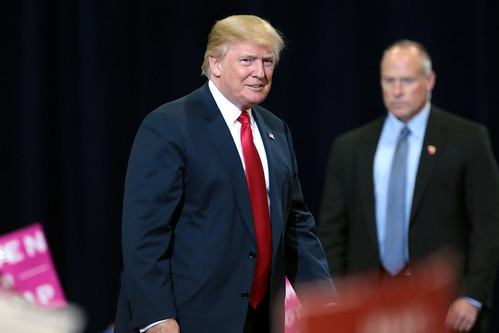
Photo credit: Gage Skidmore via Flickr

Iran’s Supreme Leader Accuses Trump of ‘Lying’ While Crowd Chants ‘Death to America’

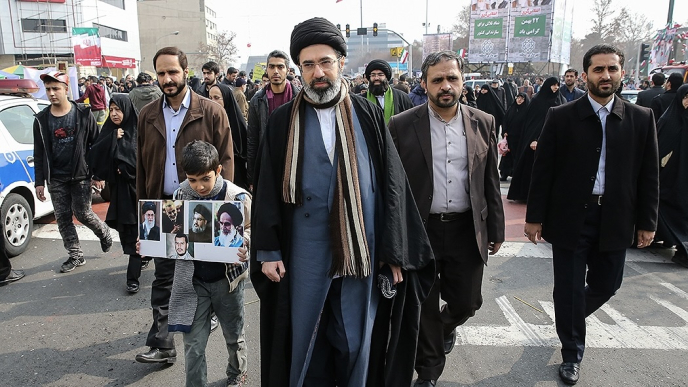
Iranian Supreme Leader Ayatollah Ali Khamenei slammed President Donald Trump in front of a crowd chanting “death to America” in recent comments as the United States tries to negotiate a new nuclear deal with Iran.

Khamenei accused Trump of lying about attempts to bring peace to the Middle East and said that the United States should leave the region. The supreme leader also referred to Israel as a “cancerous tumor” that needs to be “uprooted,” according to a translation of his comments by the Washington D.C.-based Middle East Media Research Institute.

“Some of the things the U.S. president said in his recent visit to the region are not even worthy of a response,” the supreme leader said Saturday in a video published and translated by the institute. “Trump said that he wanted to use power for peace. He is lying.”

In reaction to Khamenei’s comments throughout the roughly four-minute clip, the crowd of supporters alternately chant “death to America,” “death to England,” and “death to Israel.” The crowd also calls for “death to those who oppose the rule of the Jurisprudent,” a reference to the Islamic law that the Iranian regime is based on.
“[Trump] and other senior officials in the American administration have used power to perpetrate a massacre in Gaza, to stir up war wherever they could, and in order to support their mercenaries,” the supreme leader said. “When have they ever used power for peace?”

(Read more from “Iran’s Supreme Leader Accuses Trump of ‘Lying’ While Crowd Chants ‘Death to America’” HERE)

Iran Refuses to Close Nuclear Facilities Despite U.S. Pressure

Four rounds of talks with a team of American diplomats have done nothing to soften Iran’s position on ending its illicit nuclear weapons development, Iranian officials insisted on Thursday.

Foreign Minister Abbas Araghchi, who has led the delegation to Oman-mediated talks with Washington for the past month, eliminated the possibility on Thursday that Iran will stop enriching uranium, a core demand of the administration of President Donald Trump for any agreement to lift sanctions on the world’s premier state sponsor of terrorism. Tehran insists that it has a “right” to generate highly-enriched uranium as part of its “peaceful” nuclear program, while American officials have pointed out that no peaceful nuclear states have programs that enrich to the capacity that Iran has and that uranium of such highly enriched quality is not necessary to run nuclear power plants — its only use would be in developing a bomb.

Nonetheless, Araghchi insisted, according to the Iranian state propaganda outlet PressTV, that enrichment is a “right of the Iranian people” that the Islamist regime will not compromise on.

“Defending the rights of the Iranian people in the nuclear field, including [uranium] enrichment, is one of these principles and rights of the people that we will not compromise on,” the foreign minister declared, “neither in the media nor at the negotiation table. This is the right of the Iranian people, and no one can deny it.”

Araghchi made similar remarks last week before the latest round of negotiations with the U.S., led by Special Envoy for the Middle East Steve Witkoff. (Read more from “Iran Refuses to Close Nuclear Facilities Despite U.S. Pressure” HERE)

Photo credit: Flickr

New Secret Nuclear Site in Iran Revealed

The major Iranian opposition group known as the People’s Mojahedin Organization of Iran, or PMOI/MEK, on May 8 exposed a secret nuclear facility in Semnan Province. Known as “Ranginkaman” (Rainbow), the site operates under the guise of Diba Energy Sina, a company claiming to produce chemicals for the oil and petrochemical industries. In truth, however, it is part of the SPND – an Iranian organization tasked with building nuclear weapons.

The facility’s primary objective is to design warheads for missiles with a range exceeding 3,000 kilometers. Its use of tritium, a radioactive isotope, raises serious concerns for global security. . .

Recent reports in regime-aligned media suggest Iran and the U.S. may be exploring nuclear cooperation, including joint uranium enrichment in a third-party country. Some sources even speculate about a potential meeting between Iran’s president and U.S. President Donald Trump.

Regardless of their accuracy, these rumors must be approached with skepticism. The Islamic Republic has repeatedly violated its nuclear commitments – such as breaching the 3.67% enrichment cap set by the 2015 Joint Comprehensive Plan of Action, or JCPOA (the “Iran nuclear deal”) and enriching uranium to 60%.

The revelation of yet another hidden nuclear site serves as a clear warning: Complacency in confronting Tehran’s nuclear ambitions could once again plunge the region into crisis, as history has already shown. (Read more from “New Secret Nuclear Site in Iran Revealed” HERE)

How Striking Iran Could Sabotage Trump’s Nuclear Negotiations

A strike against Iran would torpedo the Trump administration’s attempts at peace, Middle East experts told the Daily Caller.

Israel “has not ruled out” a limited strike against Iran’s nuclear facilities, Reuters first reported in April. The report follows Trump’s meeting with Israeli Prime Minister Benjamin Netanyahu.

Israel was planning to attack Iranian nuclear facilities potentially next month but was opposed by Trump, administration officials and others familiar told the New York Times (NYT).

“I think that Iran has a chance to have a great country and to live happily without death,” Trump later told reporters, according to the NYT. “That’s my first option. If there’s a second option, I think it would be very bad for Iran, and I think Iran is wanting to talk.”

Trump told Time Magazine he is open to meeting with Iran’s leader and said a deal is likely to happen, according to an interview published Friday. (Read more from “How Striking Iran Could Sabotage Trump’s Nuclear Negotiations” HERE)

Trump’s Letter To Brutal Regime Provokes Accusations Of Causing ‘Breach Of Promises’

Iran’s president on Sunday rejected the idea of direct negotiations with the U.S. in the Islamic regime’s first public response to the letter President Donald Trump previously sent to the country’s Supreme Leader Ayatollah Ali Khamenei.

“The response by the Supreme Leader to Trump’s letter was delivered to the U.S. contact in Oman by our brother Dr. Araghchi. In that response, direct negotiations have been rejected,” President Masoud Pezeshkian said. “But, regarding indirect talks, Iran has always been involved in such talks and the Supreme Leader has emphasized that indirect talks can still continue.” (Read more from “Trump’s Letter To Brutal Regime Provokes Accusations Of Causing ‘Breach Of Promises'” HERE)

Iran Triples Military Budget, Signals End to Negotiations

Iran’s decision to triple its military budget in the 2025 fiscal plan does not necessarily indicate war preparations, an Iranian National Security Committee member in Parliament revealed on Wednesday.

In a press interview, Ahmad Bakhshayesh Ardestani noted that the significant increase in defense spending means “negotiations are no longer an option.” When asked whether the 200% rise suggested military escalation, he responded, “It cannot be said with certainty, but in any case, this significant increase means that we are not negotiating.”

His remarks come amid heightened tensions following recent threats from US President Donald Trump, who suggested that Israel could launch a strike on Iran if it does not abandon its nuclear program.

Iran’s military leadership has also issued warnings today. The commander of the Islamic Revolutionary Guard Corps’ Aerospace Force (IRGC-AF), Amir Ali Hajizadeh, hinted at the possible execution of a military operation called “True Promise 3,” saying, “If Iran’s nuclear facilities are attacked, the region will be engulfed in uncontrollable flames.”

The budget proposal for 2025 includes plans to export 1.75 million barrels of oil per day, with 420,000 barrels—approximately 24%—allocated directly to the armed forces. According to Iran International, this portion is valued at around €11 billion, up from €4 billion in the 2024 budget. (Read more from “Iran Triples Military Budget, Signals End to Negotiations” HERE)

Photo credit: Flickr

Hamas Makes an Announcement About the Freedom of Future Hostages (VIDEO)

Iranian backed terrorist organization Hamas announced Monday it will not comply with the next stage of a previously negotiated hostage deal, falsely claiming “Israeli violations” as the reason for the decision. The deal Hamas agreed to requires the release of three more hostages this week, which now isn’t happening.

The move comes less than 24 hours after President Donald Trump said he was “losing patience” with the terrorist group and that the condition of hostages Eli Sharabi, Ohad Ben Ami and Or Levy, who were released Saturday, was unacceptable.

(Read more from “Hamas Makes an Announcement About the Freedom of Future Hostages” HERE)

Trump Restores ‘Maximum Pressure’ Policy to Keep Iran From Possessing Nukes

President Donald Trump signed an executive order Tuesday that reinstates the “maximum pressure” policy on Iran that he implemented during his first term.

The “maximum pressure” executive order was part of a larger package of executive orders that included several foreign policy initiatives, such as withdrawing America from several United Nations agencies including the Human Rights Council and UNESCO. Much of the pressure will be financial, as the executive order tasks the Department of the Treasury to implement sweeping sanctions to keep money out of the pockets of the Iranian regime.

Iran is the world’s premier state sponsor of terrorism, funding and controlling a complex web of jihadist entities including Hamas, Hezbollah, a host of Iraqi Shiite militias, and the Houthi terrorists of Yemen. In 2o18, a State Department study estimated that Iran spends as much as $1 billion a year funding terrorism.

“Iran spends $700 million a year on Lebanese Hezbollah. It gives another $100 million to various Palestinian terrorist groups, including Hamas,” then-Ambassador-at-Large and Coordinator for Counterterrorism Nathan Sales told reporters. “Combined with the money that Tehran provides to other terrorists, the total bill comes close to $1 billion a year.”

During his first term as president, Trump similarly implemented onerous sanctions on Iran that significantly limited its malign influence in the Middle East. Trump also designated the Islamic Revolutionary Guard Corps (IRGC), a wing of the Iranian military, a foreign terrorist organization, and eliminated IRGC Quds Force chief Qasem Soleimani in an airstrike in 2020. Soleimani was largely responsible for coordination among several major Iranian terror proxies, leaving Tehran’s efforts to control jihadist activity hampered. (Read more from “Trump Restores ‘Maximum Pressure’ Policy to Keep Iran From Possessing Nukes” HERE)

Photo credit: Gage Skidmore via Flickr

Here Are Trump’s Options For Dealing With An Imminent Nuclear Threat That Festered Under Biden

Iran has largely been left unchecked by the Biden administration in its goal to become a nuclear power, presenting President-elect Donald Trump with a significant foreign policy challenge that has few easy solutions.

Iran, with its current stockpiles, can make a nuclear weapon with 60% enriched uranium in just one week, the International Atomic Energy Agency (IAEA) said in a November bulletin. The president-elect will have to choose a path quickly upon assuming office, such as renegotiating a deal to halt or slow Iran’s progress, military intervention or re-tooling sanctions that have so far been ineffective.

“The United States needs another Middle East war like it needs a hole in the head,” Justin Logan, director of defense and foreign policy studies at the Cato Institute, told the DCNF. “There are all kinds of angles from which escalation could happen, and Trump openly campaigned as a Peace Through Strength leader, not a warmonger. With that said, a lot turns on what Trump’s closest advisers will do to shape the president’s understanding of the options. Unfortunately, we’re heading to a fork in the road.”

The first, and perhaps most direct option, is a military strike from the U.S. on Iranian nuclear facilities. Trump advisers have reportedly expressed concern that Iran’s progress may be too far in, and a military strike may be the only option, according to Axios. Israel would be a prime candidate to assist with a strike, as it has conducted similar operations in the past.

“The Trump Administration is committed to reestablishing peace & stability in the Middle East. President Trump will keep all options on the table as it relates to the Iran Regime including Maximum Pressure,” Brian Hughes, Trump-Vance transition spokesperson, told the DCNF. (Read more from “Here Are Trump’s Options For Dealing With An Imminent Nuclear Threat That Festered Under Biden” HERE)

Photo credit: Gage Skidmore via Flickr