Posts

The Insane Strategy of Empowering Iran, Islamists Against Kurds

If you believe the Arabs living in Israel need a state but the Kurds should cede their state to the Islamic governments of Turkey, Baghdad, and Iran, you might be part of the Swamp.

We have spent several trillion dollars, lost thousands of dead, and ruined lives of our military fighting for our enemies in the Middle East or refereeing Islamic civil wars with no good outcome for America. Yet our government is now spitting on the one semi-stable, pro-Western, non-Islamic ally that could serve as a hedge against all our Middle Eastern enemies. We are dumping on the Kurds for taking a democratic vote for sovereignty — all for the purpose of allying with the Iranian-backed government in Baghdad and cozying up to Erdogan.

Iraq doesn’t exist any more and only existed for a few generations, drawn together randomly after WWI by immoral, arbitrary lines. Once we overthrew Saddam Hussein and handed Baghdad to Iran, there was no more Iraq. We’ve spent over a decade refereeing the Islamic civil war between Iranian-backed Shia militants and Sunni jihadists. Now, in order to “defeat ISIS,” we have essentially allied with Iran, handing them a Hezbollah terror corridor from Iran to the Mediterranean Sea.

Even worse, when Iran’s domination over Sunni areas reaches another boiling point and triggers the next round of the Sunni insurgency, our genius civilian and military leadership will feel obligated to “fix Iraq” again and bail out Iran, which is much more of a strategic threat than any Sunni group.

Enter the Kurds, who are the only successful fighting force against the Sunni insurgency but are also pro-American and can actually hold a growing area of northern Iraq in a stable way that serves every one of our interests. They voted overwhelmingly to become independent. And all the Kurds need are national recognition, a fraction of the military aid we give the corrupt Afghani and Baghdad governments, and the simple, helpful tools of statecraft we’d give to any allies. Rather than a bloody choice between helping Iran and helping Sunni jihadists, with the loss of tremendous blood and treasure, we can help a stable ally almost for free.

Yet not only are we not helping, we are rebuking the Kurds for taking up their sovereignty. The State Department said it was “deeply disappointed” by the democratic affirmation of sovereignty. Sen. Bob Corker, the king of the Iran deal, complained that the Kurdish vote was not in our national interests because it would weaken the Iranian-backed government. War is peace and peace is war!

This has emboldened the Baghdad government (aka Iran) to cut off all flights to Erbil airport, the Kurdish capital. Erdogan has threatened to attack the Kurds. Isn’t it amazing that while we pressured the Arab nations to back off Qatar, we are sitting idly by while they threaten the Kurds?

The Iraqi Kurdistan Regional Government (KRG) declared victory earlier this week when the population voted 93 percent in favor of Kurdish independence. The Kurds are also on the cusp of winning back even more territory than they originally lost to Sunni jihadists. After we spent tens of billions training the “Iraqi army,” it fled the minute ISIS attacked. Now that the Kurds are winning back their original land, which had been stolen by Arab Baathists for the past half-century, we are siding with Baghdad to pressure them to pull back. Our government is literally siding with Iran and Shiite militias, some of which are designated as terrorist groups, in their dispute with the Kurds over Kirkuk. We are also allowing Baghdad to hold up foreign aid for them while we refuse to cut off aid to the Lebanese Army at a time when Hezbollah is more empowered than ever before.

The Kurds are the biggest buffer against Iranian hegemony. NSC director H.R. McMaster won’t say what the administration’s strategy is to stop Iranian and Hezbollah expansion in the region, which was accelerated by our own military intervention on their behalf. Now the Kurds have the ability to undermine the Iranians. Iranian Kurds are already celebrating the move toward independence and rattling the Islamic republic.

It’s amazing to ponder the breathtaking insanity of our government’s policies in the Middle East. We will invest trillions in tying a noose around our own necks, yet we won’t invest pennies and moral support to allies who will help our interests for free. Just consider how the Special Inspector General for Afghanistan Reconstruction (SIGAR) just reported that we’ve flushed $70 billion down the tubes propping up the failed Afghani military in order to sustain their Sharia government, yet we won’t simply give the green light to those who have demonstrated they can secure their country and remain pro-West.

Finally, as we explained already this month, creating an independent Kurdistan in northern Iraq would kill two birds with one stone by serving as that regional resettlement home Trump has promised for refugees rather than resettling them in America.

It’s tragically ironic that at a time when we are struggling to defend our own sovereignty, we would disrespect the sovereignty of the Kurds. Yet, much like the backward domestic policy priorities of our political class, when it comes to foreign policy, friend is enemy and enemy is friend. The first 10 names in any telephone book would do a better job identifying the right investments, alliances, and strategic interests abroad than the current political and military leaders.

The question nobody in government is willing to ask is: How much longer are we going to continue throwing good money and lives after 16 years of failure in Iraq and Afghanistan? How many opportunities will we ignore while fighting for foreign Islamic countries that no longer exist?

(For more from the author of “The Insane Strategy of Empowering Iran, Islamists Against Kurds” please click HERE)

Follow Joe Miller on Twitter HERE and Facebook HERE.

Texas School District Will Permit Students to Kneel During Anthem

While some high schools and colleges across the U.S. are beginning to ban kneeling during the national anthem following the NFL protests from last weekend, the Frisco School District in Texas is tacitly encouraging students to protest (arguably even inviting them to do so).

In an email directive, Frisco Independent School District coaches have been told not to stop any students from kneeling. If students choose to kneel before the game, “they may do so without repercussion,” states a copy of the note provided to CR by a member of the Frisco ISD community.

While some high schools and colleges across the U.S. are beginning to ban kneeling during the national anthem following the NFL protests from last weekend, the Frisco School District in Texas is tacitly encouraging students to protest (arguably even inviting them to do so).

In an email directive, Frisco Independent School District coaches have been told not to stop any students from kneeling. If students choose to kneel before the game, “they may do so without repercussion,” states a copy of the note provided to CR by a member of the Frisco ISD community.

The point of this letter is ostensibly to provide “guidance” to school coaches, to help navigate around potential trouble. Its defenders will claim the district is in no way encouraging students to protest the national anthem.

But what is the purpose of sending this directive where there was no indication students were planning a protest? In sending this letter (which countless coaches have undoubtedly shared with their teams), the school preemptively declared there will be no consequences for a protest that wasn’t happening. By doing this, the school is actually inviting such a protest.

It’s like saying, “By the way, kids, if you want to protest during the anthem, you won’t be punished.” “We aren’t protesting.” “OK, but if you do, we won’t punish you.”

Don’t be surprised if Frisco ISD athletes start kneeling during the national anthem now that the school essentially gave them the all-clear. (For more from the author of “Texas School District Will Permit Students to Kneel During Anthem” please click HERE)

Follow Joe Miller on Twitter HERE and Facebook HERE.

Iran Threatens to Send Warships to Atlantic and Ramp up Nuclear Activities If U.S. Continues Sanctions

Amid Americans’ concerns that North Korea threatened to launch a missile at Guam, Iran is planning on building up a flotilla of warships in the Atlantic Ocean, while Iranian leader Hassan Rouhani has threatened to revitalize the country’s nuclear program if the U.S. continues “threats and sanctions.”

If Washington continues with “threats and sanctions” against Iran, Tehran could easily ramp up its nuclear activities Rouhani said in Iranian Parliament, AP reported.

In an hour and a day, Iran could return to a more advanced (nuclear) level than at the beginning of the negotiations.

“The U.S. has shown that it is neither a good partner nor a trustable negotiator,” Rouhani added. “Those who are trying to go back to the language of threats and sanctions are prisoners of their past hallucinations. They deprive themselves of the advantages of peace.”

Iranian lawmakers reportedly shouted “death to America” as they passed the bill to increase military spending.

The legislation also imposes sanctions on U.S. military officials who are in the region.

Meanwhile, after the announcement of a massive $500 million investment in war spending, Iran has planned to send flotilla of warships to the Atlantic Ocean in response to the U.S. proposed sanctions against the country.

“No military official in the world thought that we can go around Africa to the Atlantic Ocean through the Suez Canal but we did it as we had declared that we would go to the Atlantic and its Western waters,” Iranian Navy Commander Rear Admiral Habibollah Sayyari said.

This comes amid previous weeks of several tense interplays where Iranian military ships have carried out a series of dangerous drills near U.S. ships.

Just last Monday U.S. military officials reported another “unsafe” encounter with an Iranian drone that was following a U.S. carrier in the Persian Gulf that allegedly came close enough to an American F-18 jet to risk the pilot’s life.

In early August, U.S. President Donald Trump signed into law new sanctions on Iran, Russia and North Korea passed by the U.S. Congress.

Iran has maintained the new U.S. sanctions amount to a “hostile” breach of the 2015 nuclear deal.

U.S. President Donald Trump has stated several times that the Iran deal was a “bad deal” and continues looking into ways to repeal the deal.

Meanwhile, Iran has just threatened Trump saying they will “abandon its nuclear agreement with world powers within hours” if the United States imposes any more new sanctions, Reuters reported.

“If America wants to go back to the experience (of imposing sanctions), Iran would certainly return in a short time — not a week or a month but within hours — to conditions more advanced than before the start of negotiations,” Rouhani told a session of parliament broadcast live on state television.

“The world has clearly seen that under Trump, America has ignored international agreements and, in addition to undermining the (nuclear deal), has broken its word on the Paris agreement and the Cuba accord…and that the United States is not a good partner or a reliable negotiator,” Rouhani added.

Another U.S. president and just more geopolitical wars mounting up. Nothing ever seems to change even though all presidents seem to campaign on ending wars. (For more from the author of “Iran Threatens to Send Warships to Atlantic and Ramp up Nuclear Activities If U.S. Continues Sanctions” please click HERE)

Follow Joe Miller on Twitter HERE and Facebook HERE.

Busted Iran Front Group Loaded Clinton Foundation With Cash

An Iranian foundation recently convicted as a front organization for the theocratic regime in Tehran donated five-figure sums to the infamous Clinton Foundation.

Last week, a New York grand jury ruled that the government can seize a building majority-owned by the Alavi Foundation, agreeing with prosecutors that it is a front group for the mullahs in Tehran. The foundation used the Manhattan skyscraper to garner hundreds of millions in revenue so it could supply cash for its “charitable” endeavors inside the United States.

The Alavi Foundation rarely donated to non-Islamic or non-academic institutions. Alavi spent most of its funds on building Shiite institutions — such as mosques and cultural centers — and installing Iran-friendly professors at prominent American universities.

So its regular donations to the Clinton Foundation — now estimated at around $100,000 — particularly stood out. From 1985 to 2014, the Alavi Foundation — which last year listed its assets at over $100 million — donated to only 13 non-Islamic organizations.

In addition to its direct donations to the Clinton Foundation, the Alavi Foundation has also sent money to organizations associated with the non-profit. Alavi has given funds to the Clinton Foundation through its supposed humanitarian programs (the “Child Foundation”) in Louisiana and Haiti.

Prominent legislators have labeled the Clinton Foundation as something resembling a money-laundering and influence-peddling operation. Its critics argue that the foundation was primarily utilized to curry favor with the power Clinton family. They point to instances like the foundation’s disaster-relief fundraising efforts in Haiti, which ended up enriching the Clinton Foundation and not doing anything substantive to relieve the suffering of the people on the ground.

When first confronted with the possibility that the Alavi Foundation was an Iranian front group, the Clinton Foundation refused to return its donations.

At the time, in 2015, New York U.S. Attorney Preet Bharara said: “For two decades, the Alavi Foundation’s affairs have been directed by various Iranian officials, including Iranian ambassadors at the United Nations, in violation of a series of U.S. laws.”

It remains unclear if the conviction of the Alavi Foundation will change whether the Clinton Foundation will dispose of the terror-linked funds they have regularly received from the Iranian front group. If the Clinton Foundation continues to take funds from Alavi, the Clintons will be enabling a country determined — by bipartisan consensus — in U.S. government circles as the world’s foremost state sponsor of terrorism. (For more from the author of “Busted Iran Front Group Loaded Clinton Foundation With Cash” please click HERE)

Follow Joe Miller on Twitter HERE and Facebook HERE.

Iran Re-Elects Rouhani as President

Iranian President Hassan Rouhani won a second term in office on Friday, securing about 57 percent of the votes cast in Iran’s carefully vetted and stage-managed presidential election.

Rouhani, a pragmatic hardliner often mistakenly described as a “moderate” by western media, outpolled a field of rival candidates that included Ebrahim Raisi, an ultra-hardline protégé of Ayatollah Ali Khamenei, Iran’s Supreme Leader.

The election will change little in Iran. In Iran’s theocratic political system, elections advance the interests of mullahcracy, not democracy.

Iran’s clerical rulers claim legitimacy by purporting to be carrying out the will of God, not the will of the people.

Unlike in the U.S., Iran’s president is a political figurehead with very limited powers and responsibilities.

Iran’s Supreme leader is the ultimate arbiter of the important issues, particularly those the United States is most concerned about: Iran’s nuclear program, its ballistic missile force, its export of terrorism, and its efforts to export its revolution to Bahrain, Iraq, Lebanon, Saudi Arabia, Yemen and other places.

As the leader of Iran’s Islamic revolution, the Supreme Leader controls the Islamic Revolutionary Guard Corps?the cutting edge of the regime?which suppresses political opposition, protects the regime at home and abroad, controls Iran’s ballistic missile force as well as covert nuclear efforts, and orchestrates Iran’s support for terrorist groups.

Iran’s theocratic dictatorship has constructed a façade of democracy to mask the fact that real power always has been wielded by unelected clerical leaders. It is the ayatollahs, after all, who approve which candidates are allowed to run for president.

This year, more than 1,600 male candidates announced plans to run for the presidency (women cannot run), but only six were approved by the Guardian Council, an Orwellian body that certifies that candidates reliably support the radical goals of Iran’s Islamic revolution.

The political process amounts to more of a selection than an election. The political campaign provides something of a barometer for measuring popular opinion, but it is still a small, self-perpetuating clerical elite that makes the critical decisions.

This year’s campaign focused primarily on economic issues. Many Iranians were disappointed when the lifting of economic sanctions as part of the 2015 nuclear deal did not trickle down to improve their lives—something Rouhani had promised.

This didn’t happen, in part was because Iran’s biggest trade deals were designed to benefit state-controlled industries and firms affiliated with the Revolutionary Guards, who control a large chunk of the Iranian economy.

Moreover, low oil prices have depressed Iran’s oil export revenues, which are the backbone of its economy.

The regime has exacerbated the situation by funneling many of the economic dividends provided by sanctions relief into a military buildup and an increasingly costly military intervention in Syria to prop up the brutal Assad regime.

Rouhani has little control over those decisions, which are made by Ayatollah Khamenei.

In reality, Iran’s election on Friday was a charade. All it did was re-select Rouhani as president—a president in name only.

Under Iran’s revolutionary political system, Ayatollah Khamenei, the leader of the revolution, greatly outranks the leader of the Iranian state.

Khamenei, who has ruled Iran since 1989, reportedly has suffered from prostate cancer in recent years. The selection of his successor will have a greater impact on Iran’s future than the selection of any president. (For more from the author of “Iran Re-Elects Rouhani as President” please click HERE)

Follow Joe Miller on Twitter HERE and Facebook HERE.

Meet the Men Vying to Become Iran’s Next President

Around 1,600 people filed to run for president of Iran and challenge Hassan Rouhani, who is seeking a second four-year term. Only six of them have been allowed on the ballot for election day.

The role of president of Iran varies. Some see him as no more than a figurehead, while others see him as the bridge between the supreme leader (Ayatollah Ali Khamenei) and the people living under his rule.

In post-1979 Islamist Iran, the supreme leader maintains unchecked veto power over all of the nation’s affairs, and dominates foreign policy matters. Still, the president has considerable influence over domestic affairs.

It also must be noted that Iranians who seek the nation’s highest elected office must first be vetted by the 12-man, unelected Guardian Council, which is primarily made up of individuals appointed by the supreme leader. This year, the Guardian Council has granted only six individuals (denying requests from about 1,600 other aspiring candidates) clearance to run for president. All 137 women who registered to run were disqualified (the council has never cleared a woman to run for president)

The mainstream media in America often position some of these individuals as “reformists” and others as “hardliners,” but this distinction is misleading at best. All of the candidates not only have to be personally approved by the nation’s theocratic body, they are also positioning their platform as the best way to advance the interests of a caliphatist regime hell-bent on disrupting global order. With that in mind, here’s a look at the six candidates in Iran’s presidential “election.”

HASSAN ROUHANI:

Hailed as a “moderate” by The New York Times, the incumbent president helped Iran set the prestigious world record for most executions per capita.

Rouhani is known to use more pragmatic language than his predecessor Mahmoud Ahmadinejad, who infamously promised to “wipe Israel off the map.” Still, Rouhani is a Holocaust-denier who encourages terrorist groups like Hamas and Hezbollah to export Iran’s brand of Islamic totalitarianism throughout the region.

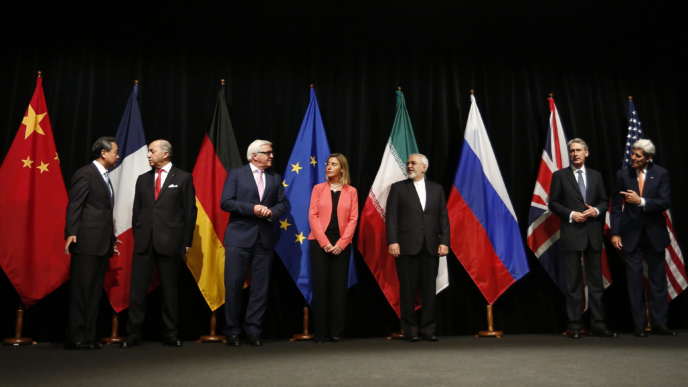
Rouhani played a key role in garnering international support for the Iran nuclear deal between Tehran and the P5+1 world powers (United States, United Kingdom, China, France, Germany, Russia). The deal gave Iran a major cash windfall and allowed for the regime to continue to finance its terrorist proxies in the Middle East.

Several analysts believe Rouhani has a good chance at reelection, as polls indicate that a large percentage of Iranians view him somewhat favorably.

EBRAHIM RAISI:

Portrayed in international media as the hardline option to Rouhani, Raisi is the main threat to unseat Rouhani. Raisi is also rumored as a potential successor to Supreme Leader Ali Khamenei (who is in his late 70s and suffering from several ailments). A Shiite cleric, Raisi wears a black turban, indicating that he is a descendant of Islam’s founder, Muhammad.

As part of his foreign policy platform, Raisi said he would consider engaging in diplomatic relations with every country “except the occupying regime of Israel.”

Raisi’s radicalism is exemplified by his views on the 2009 “Green Movement” protests that saw thousands of Iranians march into the streets to demand reform. The regime viciously cracked down on the protests, killing dozens of innocents (with estimates as high as 150), wounding hundreds more, and arresting thousands of dissenters.

Describing the protests as “sedition,” Raisi commented in 2014: “The Islamic System has treated the heads of the sedition with mercy. Those who sympathize with the heads of sedition must know that the great nation of Iran will never forgive this great injustice.”

Additionally, Raisi served on Iran’s 1988 “Death Commission,” which was responsible for exterminating thousands of political prisoners.

Khamenei recently appointed him to serve as the leader of Iran’s largest foundation. It is an extremely prominent post given that the endowment has an estimated value of around $15 billion, according to the Washington Post.

MOHAMMAD BAGHER GHALIBAF:

The current mayor of Tehran, Ghalibaf is the former commander of Iran’s Islamic Revolutionary Guard Corps’ (IRGC) Air Force. He was a distant runner-up to Rouhani in the 2013 election.

Ghalibaf, who has spearheaded efforts to revitalize and modernize Tehran infrastructure, is known for his iron-fisted methods.

He has boasted about personally engaging in violence to repress student protests. Ghalibaf once said of one such student protest that occurred in 1999:

“Photographs of me are available showing me on back of a motor bike … beating them [the protestors] with wooden stick … I was among those carrying out beatings on the street level and I am proud of that. I didn’t care I was a high ranking commander.”

MOSTAFA MIRSALIM:

The 70-year-old is Iran’s former minister of culture and Islamic guidance. Mirsalim has criticized the Iran nuclear deal as an objection to Rouhani’s leadership, saying the deal did not do enough to boost the Iranian economy. His statement comes as recent polls show that economic woes remain the most important issue to Iranians. One such poll showed 42 percent of respondents stating unemployment is the most pressing matter in Iran.
From 1981 to 1989, Mirsalim served as an advisor to the supreme leader.

ESHAQ JAHANGIRI:

Rouhani’s vice president has made it clear that he is not a serious contender. He initially registered to run for election as concerns floated around regarding whether Rouhani would be disqualified by the Guardian Council. Jahangiri is running to “stand by Rouhani and complement him.” He is almost certainly going to drop out of the race so as not to split votes with the man he serves under.

MOSTAFA HASHEMI TABA:

Like Jahangiri, he is expected to soon throw his full weight behind Rouhani’s candidacy. Hashemi Taba once served as Iran’s vice president and also headed the country’s Olympic committee. He ran for president in 2001, but came in dead last of the 10 approved candidates, accumulating only 0.1 percent of the vote.

WHAT’S NEXT?

Iranians will head to the ballots on May 19. Local elections will occur on the same day to decide members of city and town councils. Parliamentary elections, however, do not happen on the same day as the presidential election. Iran’s last parliamentary elections were in early 2016 and are held every four years.

Depending on the year, reported turnout varies from around 51 percent to 85 percent, according to the BBC.

On numerous occasions, watchdog groups have called into question Iran’s elections as free and fair. In 2009, the regime allegedly rigged ballots in favor of former President Mahmoud Ahmadinejad. (For more from the author of “Meet the Men Vying to Become Iran’s Next President” please click HERE)

Follow Joe Miller on Twitter HERE and Facebook HERE.

Cause for Alarm? China Put in Charge of Iranian Nuclear Site

China and Iran have signed a deal to modify an integral part of the latter’s nuclear program at the Arak heavy water nuclear site. The news comes just one day after the Trump administration certified that Iran has committed to its responsibilities under the nuclear agreement signed by the former Obama administration and the Iranian regime in 2015. On the same day that President Trump verified Iran’s compliance in the agreement, the Iranian Supreme Leader declared the United States an “enemy” nation.

A heavy water plant is an essential element in producing the material needed to developing a nuclear weapons program. Iran insists that the Arak reactor is purposed with producing “isotopes for cancer and other medical treatments.” However, heavy water reactors are needed to cool down reactors that churn out plutonium, which can be used to create a nuclear bomb.

The Arak plant was uncovered thanks to 2002 satellite images from the Institute for Science and International Security.

As part of the Joint Comprehensive Plan of Action (JCPOA) agreed to by Iran and world powers, Iran is supposed to modify the heavy water reactor so it could not produce weapons-grade plutonium.

Whether the United States can trust China to lead the project is a matter of concern. Most geopolitical observer recognize that China views Iran as an ally and the United States as an adversary.

Moreover, China has previously helped supply the Iranian regime with nuclear material and advanced missile technology that would have been otherwise likely impossible to produce internally. Since the early 80s, the Chinese government has clandestinely and overtly helped the Mullahs develop their nuclear program.

International agencies such as the United Nations have been tasked with verifying compliance. No American inspectors are allowed on any of the Iranian nuclear sites, thanks to terms agreed to by the Obama administration. Therefore, whether or not Iran is cheating on the nuke deal is left completely to foreign bodies.

Iran has already breached the material limits used by the nuclear reactor that were imposed under the JCPOA. The IAEA, the U.N.’s nuclear watchdog, said Tehran exceeded the limit twice last year.

Beijing is looking forward to beginning the project. “The signing of this contract will create good conditions for substantively starting the redesign project,” said China Foreign Ministry spokesman Lu Kang. (For more from the author of “Cause for Alarm? China Put in Charge of Iranian Nuclear Site” please click HERE)

Follow Joe Miller on Twitter HERE and Facebook HERE.

Trump Lets Iran off the Hook … For Now

By certifying Tehran’s compliance in the Iran nuclear deal for at least the next 90 days, President Trump is sending mixed messages about an agreement he famously called the “worst deal ever.”

Secretary of State Rex Tillerson sent a letter to Speaker of the House Paul Ryan, R-Wisc., Tuesday confirming that the Trump administration will continue to abide by the agreement made by the Obama administration with the world’s foremost state sponsor of terror.

“The U.S. Department of State certified to U.S. House Speaker Paul Ryan today that Iran is compliant through April 18th with its commitments under the Joint Comprehensive Plan of Action,” the letter read.

Tillerson also “raised concerns about Iran’s role as a state sponsor of terrorism and alerted Congress to an effort directed by the President to evaluate whether continuing to lift sanctions would be in U.S. national security interests,” a press statement said.

Additionally, President Trump has directed the National Security Council to review whether the deal is “vital to the national security interests of the United States.”

Dealing with Iran comes with its downsides. The country remains a vital threat to global security.

Iran’s worldwide terror scheme involves arming and support of Palestinian terrorist outfits such as Palestinian Islamic Jihad and Hamas. The regime also utilizes its proxy terror group Hezbollah to disrupt order and kill innocents in Syria, Iraq, and Lebanon. Hezbollah also participates in the global drug trade in order to boost relationships with western drug cartels and help fund the caliphatist endeavors of Tehran. Iran also funds and arms countless militias and jihadist outfits in Syria, Iraq, Yemen, and elsewhere.

Additionally, the Institute for Science and International Security, which has been very skeptical about the Iran deal, has urged caution on moving forward with judgement on the president’s decision. They say that certification should be seen as a “tactical decision” to buy more time for a further review.

During his campaign for the presidency, Trump described the deal as the “worst deal ever negotiated.” He has used strong language in speaking out against the deal.

The president has the authority to unilaterally end the Iran deal, but he has instead chosen to give the Mullahs 90 more days. The Iran deal is not legally binding and can be dismissed immediately. Why the president has so radically changed from his initial anti-Iran deal platform remains a mystery unsolved, as the president has consistently spoken out publicly against the deal.

It remains unclear how the Trump administration will be able to wholly certify Iran’s compliance. A similar process failed to reveal that Syria kept stockpiles of chemical weapons. Much of the review process relies upon outside agencies, such as the United Nations and Russia, to confirm compliance. (For more from the author of “Trump Lets Iran off the Hook … For Now” please click HERE)

Follow Joe Miller on Twitter HERE and Facebook HERE.

Saber-Rattling: Russia and Iran Express Rage at US Strikes in Syria

The Russian and Iranian regimes are furious with America’s retaliatory strike against Syrian dictator Bashar al-Assad following his use of weapons of mass destruction.

Last week, President Trump ordered a missile strike on the Syrian base that was reportedly used to launch a chemical weapons attack against an opposition stronghold in the city of Idlib. On Thursday, Trump launched 60 Tomahawk missiles at the base to retaliate against Assad killing of dozen of innocents men, women, and children earlier that week.

Russia and Iran, which are allied with Assad, condemned the military action, and threatened to retaliate if the U.S. “crosses the red lines” again.

Iranian dictator Ali Khamenei slammed the strikes, pushing the conspiracy that the U.S. apparently created the Islamic State terror group.

Iranian President Hassan Rouhani, who presides over the world’s foremost state-sponsor of terrorism, condemned what he called “flagrant U.S. aggression,” and said the strike on the airbase in Syria “benefitted terrorism.” Rouhani also alleged that the Syrian opposition was behind the chemical attacks, not the Assad dictatorship.

“Previous US officials created ISIS, and the current ones are strengthening ISIS or groups like them; however, the danger these terrorist groups present will backfire on Americans,” he said.

Russian autocrat Vladimir Putin teamed up with Rouhani for an additional memo that claimed the strike was “a violation of international law.”

Another statement sent by the “joint command” of Russia and Iran threatened military action against the United States.

“The United States crossed red lines by attacking Syria, from now on we will respond to anyone, including America if it attacks Syria and crosses the red lines,” the statement said. “America knows very well our ability and capabilities to respond well to them … we will respond without taking into consideration any reaction and consequences.”

Russia and Iran have long sided with the Assad regime over opposition forces. Both countries have ground troops in the country fending off threats to Assad. Iran’s Hezbollah proxy is also heavily militarily engaged in the country on the side of the Syrian dictatorship.

Russia and Iran are largely responsible for escalating the complete devastation and chaos in Syria. The two nations have propped up a man who has been responsible for the vast majority of the hundreds of thousands of deaths during the Syrian civil war. Without their help, there’s likely no possibility that Assad would have been able to stay in power.

Russia and Iran’s tough talk should be taken with a grain of salt. The two countries combined have a military that is vastly inferior to that of the United States. It is certainly not in their interests to use kinetic action against America. To attack the United States military, even if framed as a “retaliatory” strike, would draw the two U.S. adversaries into a conflict that would undoubtedly threaten the stability of both authoritarian regimes. (For more from the author of “Saber-Rattling: Russia and Iran Express Rage at US Strikes in Syria” please click HERE)

Follow Joe Miller on Twitter HERE and Facebook HERE.

GOP-Led Congress Looks to Protect Israel and Check Iranian Power

Aiming to prove their commitment to Israel, senior U.S. lawmakers are backing bipartisan legislation that would slap Iran with new sanctions while maintaining rigorous enforcement of the landmark nuclear deal.

The measures, unveiled at the opening of the annual American Israel Public Affairs Committee conference, seek to build consensus among Republicans and Democrats who are so often bitterly at odds on domestic issues. The AIPAC meeting continues Tuesday with appearances by Senate Majority Leader Mitch McConnell and Senate Minority Leader Chuck Schumer.

During Monday’s session, House Speaker Paul Ryan declared the U.S. commitment to Israel “sacrosanct.” Ryan also derided the nuclear deal an “unmitigated disaster” that gives Iran “a patient pathway to a nuclear weapons capability.” (Read more from “GOP-Led Congress Looks to Protect Israel and Check Iranian Power” HERE)

Follow Joe Miller on Twitter HERE and Facebook HERE.