Posts

Past Is Prologue: America Is More Like Soviet Russia Than You Might Expect

Could America have its own version of a Russian Revolution? With Vladimir Putin’s modern-day authoritarian intelligence state inserting itself into the 2016 American presidential election, the question is more timely than you might think. More unsettling — putting aside Russia’s meddling in American affairs — is the argument that such an ideological revolution is already well underway.

A recent essay in The New Criterion by Gary Saul Morson illuminates this chilling thesis. As a professor of (among other weighty subjects) Russian literature and the history of ideas at Northwestern University, Morson is uniquely qualified to comment on the parallels between the two nations that previously represented opposing poles of political philosophy. In his piece titled “The house is on fire!” Morson explains how the Soviet Union’s bloody communist past has great bearing on America’s present and future.

Morson, that perhaps rare, intellectually honest professor at a major American university, surveys communism’s past and reasonably suggests — with its millions of victims from the Soviet Union, China, and Ethiopia — that communism ought to be considered on par with Nazism in terms of its barbarism and our revulsion to it.

Yet curiously, Prof. Morson writes, likely alluding to his peers in the academy,

In intellectual circles … such comparisons taint not Communists, but the person who makes them.

This in spite of the ghoulish revelations from the Soviet archives – from Mitrokhin to Stalin – hiding in plain sight. Morson gives an example:

Our knowledge of Bolshevik horrors expanded dramatically when, after the fall of the Soviet Union, its archives were opened. Jonathan Brent and Yale University Press brought out volume after volume of chilling documents, but public opinion did not noticeably change. How many readers of The New York Times know about its role in covering up the worst of Stalin’s crimes and earning a Pulitzer Prize (still unreturned) for doing so?

I understand being so carried away by Communist ideals that one denies or justifies millions of deaths. What amazes me is that people and publications who have done so still feel entitled to criticize others from a position of moral superiority.

More on that Pulitzer story here and here.

The refusal to acknowledge communism’s history of genocide — and for the “lucky” ones starvation, misery, and the constant need to look over one’s shoulder — in particular among the nation’s progressive elite, has real consequences. As does the inability of said progressives to acknowledge a link between collectivist ideology and its dire consequences. To many such people, it is the intent of the ideas — using the state to “help others” and thus create a utopia — that matters, even if the ends prove cataclysmic.

Look no further than the viability of a Bernie Sanders presidency in the same country that several decades ago had supposedly vanquished communism for the corrosive effect of such an ethos. No, Bernie is not a communist in the sense of being a Bolshevik or Menshevik. But his ideas are based on the same socialist principles underlying those movements, and they are geared toward similarly disastrous ends. His ideological and political differences with the communists of yesteryear are a matter of degree, not kind.

The idea that wealth redistribution is moral, and that the provision of goods and services by the state is a legitimate function have tremendous sway in America.

And the pervasiveness of political correctness powerfully attests to the idea that the roots of communist ideology have insinuated themselves in the American mind, manifesting themselves in every aspect of our culture.

If there is an underlying subtext to Prof. Morson’s piece, that is the harrowing reality.

Consider several of the communist bigwigs that Prof. Morson quotes, and the relevance of their positions to our nation at present:

Delivering a toast on the twentieth anniversary of the Bolshevik seizure of power, Stalin declared: “We will destroy each and every enemy, even if he was an old Bolshevik; we will destroy all his kin, his family. We will mercilessly destroy anyone who, by his deeds or his thoughts — yes, his thoughts! — threatens the unity of the socialist state. To the complete destruction of all enemies, themselves and their kin!” … Georgy Arbatov, adviser to five general secretaries of the Soviet Communist Party, observed that “the main code of behavior” was “to be afraid of your own thoughts.”

In America we do not destroy political enemies by sending them to the gulag or grave by way of mysterious “accidents,” but we do so in more subtle, nuanced ways: Think of the IRS Scandal, selective enforcement of laws, harassment at the hands of federal agencies, etc.

But thought control — a.k.a., political correctness — is a much more powerful tool. It calls to mind a certain former secretary of state’s comment in front of the Organization of Islamic Conference on “combatting religious intolerance.” Then-Secretary Clinton spoke to a group of Sharia supremacists about the need for Western nations to use “some old-fashioned techniques of peer pressure and shaming” to counter language offensive to Muslims.

A direct government threat may be happily distant for most Americans, but fear of social ostracism for holding beliefs conflicting with the prevailing progressive orthodoxy is ever-present. Who needs a formal, state-controlled cultural police force when people will self-censor lest they draw the ire of friends and colleagues?

Prof. Morson quotes Felix Dzerzhinsky, founder of the Cheka, a secret police force and precursor to the KGB used to purge (read: assassinate thousands of people) Russia of “enemies of the state” during the so-called Red Terror.

Dzerzhinsky wrote in a journal aptly titled, “Red Terror”:

We are not waging war against individual persons. We are exterminating the bourgeoisie as a class. During the investigation, do not look for evidence that the accused acted in deed or word against Soviet power. The first questions that you ought to put are: To what class does he belong? What is his origin? What is his education or profession? And it is these questions that ought to determine the fate of the accused.

True, the scale of violence in American class warfare is incomparable to that of the Soviet Union and China — rooted though it may be in the same Marxian philosophy and ethics and geared toward consolidating all manner of power in the hands of the state. Different cultures are different. But Dzerzhinsky’s questions are telling.

From railing against “millionaires and billionaires” of America’s most prominent political figures to the pervasive social justice warrior rhetoric on white privilege and the patriarchy, Dzerzhinsky’s premises are more apparent in American society than anyone might care to admit. And perhaps most stunning of all, we as a nation cannot see it and do not know it. This blindness, ignorance, or combination of both speaks to the effectiveness of a communism that we may have “vanquished” in a conventional sense – the Soviet Union fell, albeit without its murderous leaders ever being put on trial and punished for their crimes – but the ideas of which are powerful as ever.

Prof. Morson quotes Lenin, who said “Morality is entirely subordinated to the class struggle of the proletariat.” The means are what matters. Ends are irrelevant. The struggle is inherently moral. Get on the “right side of history.” This is how you get the Affordable Care Act the effects of which are diametrically opposed to its name.

Prof. Morson quotes Trotsky on the Communist Party:

Comrades, none of us wishes or is able to be right against his Party. The Party in the last analysis is always right, because the Party is the sole historical instrument given the proletariat for the solution of its basic problems … I know that one cannot be right against the party. It is only possible to be right with the Party and through the Party for history has not created other ways for the realization of what is right.

The progressivism that pervades our government, our media, and our schools — as well as the consequence of not adhering to such an ideology — testify to the power of The Party.

Prof. Morson continues:

Is it any wonder that those who reject human rights, treat people in terms of friendly or enemy groups, place no moral limit on action, and are certain that whatever they do is right should wind up committing colossal evil?

Although the Left in America would take issue with the idea that the violation of individual liberty represents a rejection of human rights, does any statement better describe the party of class warfare, Clintonian notions of right and wrong, and all manner of disasters from Obamacare to open borders and suicidal “Countering Violent Extremism”?

Prof. Morson concludes his piece on a sobering but well-taken note:

Perhaps my training as a Russian specialist distorts my judgment, but as I contemplate the ideas spreading from the academy through society, I fear, a century after the Russian Revolution, a tyranny greater than Stalin’s. Comrades, the house is on fire.

Bad ideas have bad consequences. (For more from the author of “Past Is Prologue: America Is More Like Soviet Russia Than You Might Expect” please click HERE)

Follow Joe Miller on Twitter HERE and Facebook HERE.

Journalists Caught in the Crossfire of the Ukraine-Russia Conflict

There is a memorial to murdered Ukrainian journalists on Khreshchatyk, Kyiv’s central boulevard.

It’s a simple, nondescript metal plaque flanked by flowers on the side of a building. Some of the names are faded now, worn down by the years and the elements.

The names date from 1992, the first year after Ukraine gained its independence from the Soviet Union, underscoring how the fall of communism 25 years ago did not portend a new era of vibrant democratic culture in Ukraine.

Ukraine has spent much of the past quarter century under oligarchic thug rule, in which free and objective journalism was often seen as a nuisance to be controlled and manipulated—and sometimes a threat worth eliminating—by those in power.

And this summer, more than two years after Ukrainians took to the streets to overthrow the regime of former pro-Russian President Viktor Yanukovych, a string of violent incidents against journalists and media outlets has rocked Ukraine’s capital.

Journalists are caught in the crossfire of those wishing to control the country (both in Kyiv and in Moscow), as well as targets of simmering anti-Russian sentiments due to the ongoing war in the east.

Journalists of all leanings have been targeted this summer, including government corruption watchdogs and those accused of maintaining a pro-Russian bias.

On July 20, Pavlo Sheremet, a well-known journalist in Ukraine for the news agency Ukrainska Pravda, was killed in a brazen car bomb attack in central Kyiv. Ukrainian officials requested the assistance of U.S. FBI investigators, but a motive has not yet been determined and officials have not named any suspects.

“I think the final aim was to scare or to intimidate Ukrainian journalists apart from or simultaneously trying to further destabilize the situation in the country,” said Andriy Kulykov, chairman of Hromadske Radio, during a broadcast interview for the independent Ukrainian radio news outlet.

“I don’t see that Ukrainian investigative journalists are limited in their duties or became scared and abandoned their jobs after Sheremet’s murder,” said Viktor Kovalenko, a Ukrainian journalist and former journalism professor.

“On the contrary, I see that now they are turning their eyes inside media society to find out how deeply Kremlin’s manipulators infiltrated and rule it according to their infowar against Ukraine,” Kovalenko added. “This attention to ourselves will help in cleaning, rethinking of journalism standards, and with actual rebirth of Ukrainian journalism.”

On the same day as Sheremet’s assassination, a knife-wielding man attacked Maria Rydvan, 25, an editor for Forbes Ukraine, as she was walking in a central Kyiv park.

“In park for no apparent reason a man ran to me and stabbed me three times… It’s all very strange,” Rydvan wrote on her Facebook page.

On Aug. 28, Russian journalist Alexander Shchetinin was found dead on the balcony of his Kyiv apartment. He died due to what police said was a self-inflicted gunshot wound to the head, according to Ukrainian news reports, and was discovered by friends who had come to celebrate his birthday.

Shchetinin renounced his Russian citizenship to be a Ukrainian citizen and founded the Kyiv-based New Region news agency.

Ukrainian officials are investigating Shchetinin’s death as a suicide. The Organization for Security and Cooperation in Europe, or OSCE, is pushing for his death to be “swiftly and thoroughly investigated.”

Without directly alleging that Shchetinin’s death was the result of foul play, Dunja Mijatovic, OSCE representative on freedom of the media, said Ukrainian officials should “improve the fragile situation regarding the safety of journalists and fully and effectively address the issue of impunity.”

Information Wars

On Sunday, the Kyiv offices of the TV news station Inter were set ablaze in an arson attack. Protesters had gathered outside the building to rally against the channel’s alleged pro-Russian bias, setting tires on fire and spray painting graffiti on the side of the building and on a fence hastily put up to keep them back.

One message read: “Inter—get out!” Another said: “Inter agents of Moscow.”

There were reports of minor injuries, but no deaths. Protesters barricaded Inter’s offices until Tuesday, when a deal was allegedly reached with the news agency, in which unspecified changes to Inter’s editorial policy were agreed upon.

“If the channel fails to observe the deal, the blockade will be resumed in a more radical way,” said Oleksiy Serdiuk, a protest leader, according to the Ukrainian news site Ukraine Today.

Many Ukrainians took to social media for a polarizing debate about the Inter incident.

Inter is commonly known among Ukrainians to harbor a pro-Russian bias, and after more than two years of war against pro-Russian separatists and Russian regulars in eastern Ukraine, and the murder of more than 100 protesters by the Yanukovych regime during the 2014 revolution, there is no love lost in Ukraine for those who promote Russian propaganda.

The arson attack against Inter on Sept. 4 was preceded by a Facebook post on Aug. 31 by Ukrainian Interior Minister Arsen Avakov, in which he pushed for the National Television and Radio Broadcasting Council and the Security Service of Ukraine, or SBU (Ukraine’s equivalent of the FBI), to investigate Inter for “anti-Ukrainian” and “anti-state” propaganda.

Most Ukrainian officials condemned the Inter incident. Some also expressed concern about the perceived damage to Ukraine’s ongoing efforts to showcase the country’s progress toward a stable democracy worthy of deeper ties to the European Union and NATO.

“It’s clear that those who want to show a turbulent Ukraine suffering from destabilization and alike benefit from this,” Ukrainian Prime Minister Volodymyr Groysman told Ukrainian media. “But it is important that the law enforcement system gives an adequate answer: who has done this, what was the aim, and, most important, those people should be punished.”

Kovalenko noted that the Kremlin exploits incidents like the Inter arson attack as part of an ongoing effort to destabilize Ukraine to undercut support from the U.S. and the EU.

“I treat an attack on Inter TV as another element of Kremlin’s infowar … and at the same time damage the reputation of the Ukrainian government abroad to force the West to weaken support in times of military aggression,” Kovalenko said. “Freedom of the press is a very sensitive value for Europe and the U.S., therefore, Moscow propagandists love to speculate on this to get the maximal level of media noise.”

The patience and resolve of the EU to maintain punitive economic sanctions on Moscow for its aggression in Ukraine will likely wear thin if Ukraine is perceived as slipping back into old authoritarian habits. And U.S. support for Ukraine—including military training programs and the delivery of limited nonlethal military hardware—could also dry up if Kyiv fails to show adequate progress in shoring up its democratic institutions.

“The whole world is watching you. That’s a fact,” U.S. Vice President Joe Biden said in an address to Ukraine’s parliament on Dec. 9. “They’re watching you because their hopes for your success as you fight both the unrelenting aggression of the Kremlin and the cancer of corruption will impact on them.”

Biden continued:

Ukraine’s moment. It may be your last moment. Please for the sake of the rest of us, selfishly on my part, don’t waste it. Seize the opportunity. Build a better future for the people of Ukraine.

(For more from the author of “Journalists Caught in the Crossfire of the Ukraine-Russia Conflict” please click HERE)

Follow Joe Miller on Twitter HERE and Facebook HERE.

Threats of a Russian Election Hack a Mere Smoke Screen by Democrats for Power Grab

The Democrats are now playing the Russia card. As Donald Trump rises in the polls against an increasingly unpopular Hillary Clinton, Democrats are raising the specter of the nefarious Vladimir Putin. Then-Secretary of State Hillary Clinton’s famous Russian relations reset was a bust, but we are supposed to trust her to handle Putin in the future. More important, the Democrats are sowing grounds to challenge the election, relying on their unnatural ability to squeeze, as if by magic, extra votes from the courtroom.

There may be an even more insidious objective, Outgoing Nevada Sen. Harry Reid — never a fan of election fair play — warned of Russian tampering and called for an FBI investigation. This followed warnings by Jeh Johnson, Secretary of the Department of Homeland Security, of potential cyber-attacks come November. He indicated he was considering designating the election system “critical infrastructure.”

Why is that significant? This would be followed by a Washington campaign to “assist” and “protect” balloting, which inevitably would turn into control. The Heritage Foundation’s Hans von Spakovsky warned that Johnson’s action “may be a way for the administration to get Justice Department lawyers, the FBI and DHS staff into polling places they would otherwise have no legal right to access, which would enable them to interfere with election administration procedures around the country.” That would dramatically, and permanently, transform the constitutional balance between the national and state governments.

Despite scare-mongering by Reid and Johnson, there is no evidence of any impending cyber-attack on the American electoral system. Even Johnson apparently admitted that he could point to no indications of such a threat. A far greater danger to the integrity of U.S. democracy is voter fraud, yet the courts seem determined to block any effort to even require identification to cast a ballot. This undermines the great strength of America’s elections, state control.

As von Spakovsky pointed out, “we have the most decentralized election system of any Western democracy.” This approach protects America from having Russia (or China or anyone else) manipulate electoral outcomes. Nationalizing the process actually would make U.S. elections far more vulnerable to outside attack.

Which demonstrates the continuing wisdom of the nation’s Founders in creating a system that kept most important public policies and activities at the state level. The national government was established to deal with national problems, not to elevate to the national level controversies which belonged closer to the people.

The Founders’ idea, called “federalism,” naturally grew out of Americans’ commitment to self-government. The people, not a king or emperor, were sovereign. They were to solve their own problems and chart their own futures. That required decision-makers to be close to each other and the challenges facing them.

In this way federalism had a lot in common with the Catholic doctrine of subsidiarity. Whenever possible, higher, more distant institutions should leave undisturbed authorities below. Each government had a specific role and should not encroach upon the responsibilities of others.

Early Americans well understood the meaning of federalism: creating two distinct levels (local authorities being subsumed within states) of government with separate and defined duties. Unfortunately, however, the founding generations allowed ambiguity to creep in by calling the national government the “federal” government.

The very concept of federalism requires protecting the vibrancy of state (and local) institutions. The federal system meant dual authority rather than the unitary system prevalent in Europe, including in Great Britain. Although the Civil War established the ultimate supremacy of the national government, the conflict did not wipe out state sovereignty. The so-called federal government remained small, without much day-to-day impact on most people’s lives. Even enthusiastic nationalists at the time could not have imagined the wholesale federal takeover of education, health care, and welfare.

Of course, to speak of “federal” action now means to nationalize an issue. Thus, supporting the founding principle of “federalism” risks communicating the opposite of the truth to people, suggesting that the Constitution turned most problems over to the “federal,” that is, national government. And that continuing islands of state authority, such as running elections, are anomalies which should be wiped out.

Federalism in the original sense of the word always set American democracy apart from that of other nations. Power was separated and balanced; responsibility was accorded to institutions best able to confront problems. The people retained ultimate sovereignty and remained close enough to their officials to hold the latter accountable.

Unfortunately, these principles are under sustained attack. Attempts to tie Trump to Russia are just another attempt to expand federal, as in national, authority. With so many of their leaders AWOL, only the American people are left to stand up for their country’s founding principles. Only We the People. (For more from the author of “Threats of a Russian Election Hack a Mere Smoke Screen by Democrats for Power Grab” please click HERE)

Follow Joe Miller on Twitter HERE and Facebook HERE.
Russia Will Deploy a Division of Troops About 50 Miles From the US

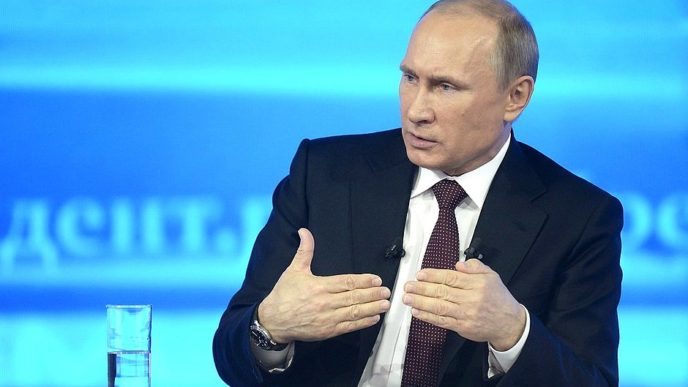
At a recent event, Russian Defense Minister Sergei Shoigu said that a division of troops would be stationed in Chukotka, Russia’s far-east region, just slightly more than 50 miles from Alaska.

“There are plans to form a coastal defense division in 2018 on the Chukotka operational direction,” said Shoigu.

He said that the deployment was “to ensure control of the closed sea zones of the Kuril Islands and the Bering Strait, cover the routes of Pacific Fleet forces’ deployment in the Far Eastern and Northern sea zones, and increase the combat viability of naval strategic nuclear forces.”

Japan and Russia dispute ownership of the northern Kuril Islands, where Russia plans to deploy missile-defense batteries. The Bering Strait is the narrow waterway that separates Alaska from Russia. (Read more from “Russia Will Deploy a Division of Troops About 50 Miles From the US” HERE)

Follow Joe Miller on Twitter HERE and Facebook HERE.

Russia’s Military Exercises Fuel Fears of Continued Aggression

As the late summer weather begins to cool, Russian military exercises have kept the tensions hot in Ukraine and across Eastern Europe.

Periodic flare-ups in the ongoing war in Ukraine’s embattled Donbas region this summer have renewed fears of a full-on Russian invasion and spurred an unprecedented post-Cold War redeployment of NATO military forces toward the alliance’s eastern flank to deter further Russian aggression in the region.

The latest headache for Kyiv and NATO: Russian military exercises scheduled for Eastern Europe and the Black Sea region in September in addition to Russian snap military exercises launched Aug. 25 in military districts near Ukraine and the Baltic countries.

“If there is an interest in Moscow in stability and predictability, then these exercises are not the way to go,” NATO Deputy Secretary-General Alexander Vershbow said Monday.

Russia has staged about a dozen snap military exercises in the past two years, while NATO member countries have not held any since the end of the Cold War, according to news reports.

In September, Russia has plans for a large-scale strategic military exercise called Kavkaz-2016. The exercise, which is an annual event, will include units deployed near the borders of Ukraine, Georgia, and Azerbaijan—including two Russian military districts in the Southern and Northern Caucasus, the Russian Black Sea Fleet (headquartered in occupied Crimea), and the Caspian Flotilla.

It is not immediately clear the exact size of this year’s exercise, but last year it comprised 95,000 troops, 7,000 vehicles, and 150 aircraft, according to a report by IHS Markit, a U.K.-based intelligence and analysis firm.

“It is important to assess our capabilities for protecting national interests in the southwestern strategic direction amid the uneasy international military and political situation,” Russian Defense Minister Sergei Shoigu said in January while commenting on plans for Kavkaz-2016, according to the Russian news agency RIA Novosti.

Some military experts say the combination of snap military drills with the planned Kavkaz-2016 exercise have the hallmarks of Russian military maneuvers that served as smoke screens for the invasion of Georgia in 2008 and the hybrid warfare invasion of Ukraine’s Crimean Peninsula in 2014.

Yet, others argue Russia’s strategic military objectives have more to do with diplomatic leverage than military outcomes.

Alex Kokcharov, IHS Markit’s principal analyst for Europe and the Commonwealth of Independent States, said the Kremlin is probably maneuvering to destabilize the post-revolution government in Kyiv, and consequently gain leverage for negotiating sanctions relief at the G20 summit to be held in Hangzhou, China, from Sept. 4 to 5.

“War is a continuation of policy,” Kokcharov told The Daily Signal. “And the Kremlin’s policy is to keep Ukraine sufficiently destabilized to stall the implementation of its reform agenda and economic recovery, and thus to engineer a fall of the current pro-Western government in Kiev.”

Fighting Seasons

A combined force of pro-Russian separatists and Russian regulars has been fighting a limited war against Ukraine’s military in the southeastern Donbas region of the country since spring 2014.

One year ago, the war’s intensity dropped precipitously as both sides to the conflict renewed their commitment to the terms of the ineffectual second cease-fire, called Minsk II.

In theory, the war in Ukraine was supposed to end in September 2015. But it didn’t.

On Tuesday, the Ukrainian military announced that during the previous 24 hours combined Russian-separatist forces had attacked Ukrainian positions with more than 690 mortars and 250 artillery shells, including a Grad rocket attack near the southern port city of Mariupol.

One Ukrainian soldier was killed, Ukrainian military spokesman Col. Andriy Lysenko told reporters Tuesday in Kyiv.

Attacks on Ukrainian forces have spiked several times this summer, most notably around the time of the NATO summit in Warsaw (during which NATO members proclaimed their support for Ukraine), and after the Aug. 10 skirmish on the border of Russian-occupied Crimea and Ukraine.

The Crimean border incident was serious enough to prompt Ukrainian President Petro Poroshenko to place Ukraine’s military on its “highest level of alert,” and for Western media outlets to momentarily divert their attention back to the only ongoing land war in Europe.

In an Aug. 24 interview with CNN’s Christiane Amanpour, Poroshenko compared Russia’s support for separatists in eastern Ukraine with the Russian bombing campaign on Aleppo, Syria.

Poroshenko claimed Russia’s overall objective was to “destabilize the global security situation” and for Ukraine to be “part of the Russian empire.”

Status Quo

The war’s escalations this summer have not resulted so far in any significant change in territory or military offensives. The war in Ukraine remains locked in a static artillery back-and-forth fought from within trenches and the artillery-blasted ruins of towns scattered along the front lines.

And domestic troubles inside Ukraine, such as the July 20 car bomb assassination of a journalist in downtown Kyiv, also highlight the steep road ahead for Ukraine’s ongoing transition to a democratic society free of the vestiges of communism and the follow-on decades of corrupt oligarchic thug rule.

The next potential inflection point for the Ukraine war is September’s G20 summit in China. Russian President Vladimir Putin will likely use the sidelines of the summit to discuss the Ukraine crisis with other world leaders and press for the lifting of sanctions put on Russia for its 2014 Crimean land grab.

“Russia certainly has the military capability to invade Ukraine but the benefits of grabbing new land in Ukraine would be much smaller than the costs, both direct, and indirect, such as potential new economic sanctions,” Kokcharov said.

He added:

I still continue to hold the view that Putin aims to use intimidation to raise the stakes in the diplomatic game in order to push for negotiations on Donbas settlement that excludes Ukrainian government from the negotiating table, by branding them illegitimate and terrorists.

(For more from the author of “Russia’s Military Exercises Fuel Fears of Continued Aggression” please click HERE)

Follow Joe Miller on Twitter HERE and Facebook HERE.

The Trump-Russia Link: Notable. The Hillary-Russia Web: Huge.

Obama’s Justice Department is investigating both the Hillary Clinton campaign and the Donald Trump campaign for possible ties to corrupt funding traceable back to Russian Vladimir Putin’s regime. While Trump’s alleged involvement through his campaign manager has been extensively covered by the media, forcing that campaign manager to resign, far less ink has been spilled over Clinton’s extensive connections.

Skolkovo, a research facility known as Russia’s version of Silicon Valley and partially funded by the Russian government, contributed tens of millions of dollars to the Clinton Foundation while Hillary Clinton was secretary of state. The Obama administration’s plan was to help Russia create its own version of Silicon Valley. Obama claimed he wanted to “reset” U.S. relations with Russia. Clinton Cash author Peter Schweizer revealed that Clinton was behind it, asserting that “no cabinet official in the Obama Administration was more intimately and directly involved in the Russian reset than Hillary Clinton.”

Schweizer published a report in June with the details, entitled From Russia With Money. He found that 17 of the 28 American, European and Russian companies that participated in the Skolkovo initiative were Clinton Foundation donors such as Google and Intel, or sponsored speeches for former President Bill Clinton. Some on the Russian side of the Skolkovo initiative also contributed to the Clinton Foundation.

ClintonTrump-Russian-Funding-Chart-1-900

Clinton’s Campaign Manager, John Podesta, Also Did Quite Well With Russian Money

The FBI warned technology companies to avoid the Skolkovo initiative due to concerns that Russian companies backed by Putin’s government wanted to gain access to “classified, sensitive, and emerging technology” from U.S. tech companies. But undeterred by the warning, Clinton’s campaign manager, John Podesta, went ahead and served on the Skolkovo board representing Joule Energy, a solar company based in the Netherlands.

Two months after Podesta joined the foreign firm (which included senior Russian officials), a $35 million transfer came in from Rusnano, an investment firm founded by Putin. One of the investors in Joule was Hans-Jorg Wyss, a major Clinton Foundation donor. Podesta consulted for a foundation run by him.

Podesta, who formerly served as chief of staff to Bill Clinton, failed to disclose his position on the board of this offshore company in federal financial reports, as appears to be clearly required by law, prompting the FBI investigation. Additionally, while serving in that position he headed the left-wing think tank Center for American Progress, which wrote favorably about the Russian government, apparently in exchange for money secretly funneled to the organization by Russians, according to Schweizer. The organizations in the trail of money have ties to Russian oil and gas companies, which opposed U.S. efforts to explore fracking and natural gas.

ClintonTrump-Russian-Funding-Chart-2-900

How Many Pay-to-Play Schemes are Connected to the Clinton Foundation and the Putin Government?

Schweizer’s report alludes to numerous apparent quid pro quos like this one. “The other senior State Department official involved in the Skolkovo process was Lorraine Hariton,” he writes, “the State Department’s Special Representative for Commercial and Business Affairs. (Hariton served on Hillary Clinton’s National Finance Committee during the 2008 campaign.)”

I have previously covered other similar pay-to-play operations involving Clinton’s revolving door between the state department and the Clinton Foundation. Congressional members are now demanding an investigation into a large transfer of money to the Clinton Foundation made by the Russian owner of Uranium One, which was timed when Clinton gave authorization as secretary of state for him to buy the company.

Trump’s Campaign Manager was Demoted and Resigned After His Russian Ties Were Exposed

Trump has also been criticized for hiring a presidential campaign manager, Paul Manafort, who has ties to funding from the Russian government, specifically, by way of his connection to a former pro-Russian Ukrainian regime. However, Manafort was only in that position for four months, and resigned Friday from the campaign due to the controversy.

In 2012, Manafort and one of his associates helped the Ukrainian organization European Centre for a Modern Ukraine, which included members of then-president Viktor Yanukovych’s ruling party, direct money to Washington firms to lobby Congress for the benefit of Yanukovych. (Yanukovych was eventually forced out due to corruption and fled to Russia.) Like Podesta, Manafort was criticized for failing to notify the Department of Justice as a lobbyist about ties to foreign parties and leaders. Regardless, the FBI has said Manafort is not the target of their investigation.

ClintonTrump-Russian-Funding-Chart-3-900

Podesta Blames the Client

The Podesta Group also represented Centre for a Modern Ukraine. The lobbying firm is now threatening to turn on its own client, issuing this statement,

The firm has retained Caplin & Drysdale as independent, outside legal counsel to determine if we were misled by the Centre for a Modern Ukraine or any other individuals with regard to the Centre’s potential ties to foreign governments or political parties. When the Centre became a client, it certified in writing that “none of the activities of the Centre are directly or indirectly supervised, directed, controlled, financed or subsidized in whole or in part by a government of a foreign country or a foreign political party.” We relied on that certification and advice from counsel in registering and reporting under the Lobbying Disclosure Act rather than the Foreign Agents Registration Act. We will take whatever measures are necessary to address this situation based on Caplin & Drysdale’s review, including possible legal action against the Centre.

It remains to be seen whether Podesta will resign as Clinton’s campaign chair. Unlike Trump, Clinton doesn’t seem to have a problem with her campaign manager’s deals, perhaps because she was heavily involved with the same type of activity herself. Tellingly, Trump replaced Manafort with Breitbart News chief Steve Bannon, who made Schweizer’s Clinton Cash into a documentary. It sends a strong message as to how Trump will treat covert funding from Putin’s government. (For more from the author of “The Trump-Russia Link: Notable. The Hillary-Russia Web: Huge.” please click HERE)

Watch a recent interview with the author below:

Follow Joe Miller on Twitter HERE and Facebook HERE.
‘The War Won’t Be Over Soon’: Ukraine’s Long Fight Against Russia for Freedom

For more than two years, Ukraine’s military has been fighting a ground war against a combined force of pro-Russian separatists and Russian regulars in the Donbas, Ukraine’s embattled southeastern territory.

As Ukraine prepares for the 25th anniversary of its independence from the Soviet Union this Wednesday, the ongoing war in the Donbas highlights how the post-Soviet country is still fighting to establish its freedom from Russian vassalage.

“The dream of Ukrainian independence existed in the USSR, but we couldn’t talk about it,” Kovbel Vasyl Vasyliyovych, a 62-year-old Ukrainian soldier, told The Daily Signal. “The environment was one in which you only tried to survive. You didn’t express yourself. I feel like now I can finally express sentiments that I’ve had bottled up inside me my whole life.”

The war in Ukraine is a bizarre, paradoxical fusion of antiquated fighting methods with modern technology. It is a trench warfare battle, where heavy artillery is fired every day and drones orbit overhead. Small units engage each other in no man’s land, but there are no serious attempts to take new ground. The war is static, governed in its intensity by the terms of the Minsk II cease-fire. It’s like two boxers sparring at half speed, sparing themselves for the main event.

It has been nearly 100 years since the Russian Civil War began, sparking events that led to the consolidation of Ukraine into the Soviet Union—a loss of independence that lasted until Aug. 24, 1991. Today, many Ukrainian soldiers say they are still fighting for Ukraine’s independence from Moscow.

“The separatists are the weapons of the Russians,” Borys Antonovich Melnyk, a 75-year-old Ukrainian volunteer soldier and Red Army veteran, said in an interview.

“They were turned by Russian propaganda against Ukraine,” Melnyk said. “They are Russia’s weapons. They are the weapons, not the reasons. This is not only a war against the separatists, this is a war against Russia.”

It has also been about 100 years since combat airpower made its debut over the trenches in World War I. Today, Ukraine’s air force now sits on the ground while its soldiers dodge artillery and tank shots.

And despite the front lines ending on the Sea of Azov, there is no naval component to the war, either.

The last major offensive in the war was in February 2015. In the days after the signing of the second cease-fire, known as Minsk II, combined Russian-separatist forces sacked the strategic rail hub town of Debaltseve, seizing it from Ukrainian government control.

Since the Debaltseve battle, periodic upticks in violence predictably spur flurries of media speculation about whether a major Russian offensive is looming. Yet, the war has not changed in any meaningful way in more than a year and a half. No significant territory has changed hands, and the opposing camps have made scant progress toward achieving a diplomatic solution to the conflict.

And periodic spats between Kyiv and Moscow, such as the Aug. 10 border skirmishes in Crimea, underscore how the conflict retains the potential to quickly spiral into something much worse.

>>>After Crimea ‘Incursions,’ Russia and Ukraine Step Back From All-Out War

Today, U.S. and Ukrainian intelligence sources estimate the combined Russian-separatist army has about 45,000 troops inside Ukrainian territory, with about 45,000 more Russian soldiers staged in Russia along the western border with Ukraine. Russia also has about 45,000 military personnel stationed inside occupied Crimea. Ukraine has deployed about 100,000 soldiers to its eastern territories.

“The Russian people are not the enemy,” Vasyliyovych said. “Half of my relatives and friends live in Russia. It’s a political war. The Soviet propaganda is still there. And [Russian President Vladimir] Putin still uses it the same way as they did in the USSR.”

Ad Hoc War

The Ukrainian army’s 92nd Brigade is hunkered down in trenches and in the basements of abandoned homes scattered throughout the artillery-blasted ruins of the village of Pisky, on the outskirts of the separatist-controlled Donetsk airport in eastern Ukraine.

Squads of Ukrainian soldiers on patrol carry at least one radio among them. The radio, usually an off-the-shelf Motorola, is their advance warning system for incoming artillery.

Spotters posted in front-line trenches continuously peer across no man’s land through binoculars and telescopes. When they observe artillery fired in the Ukrainians’ direction, they have a few precious instants to radio a warning—the word “hole”—on a common frequency. That’s the cue for all who hear it to take cover or to lay down flat on the ground if caught in the open.

The radios the Ukrainian soldiers use are not encrypted. Therefore, they share the airwaves with their enemies. Due to the lack of encrypted radios and how frequently Ukrainians change their positions, which precludes setting up hardline communications, the Ukrainians sometimes use runners to carry handwritten messages scribbled on sheets of torn paper among various front-line posts.

In calm periods of bemusement, the Ukrainian troops listen to radio chatter transmitted from the opposite side of no man’s land; they pick out Russian accents from Moscow, or St. Petersburg. The Ukrainians often chime in on the radio, employing the full breadth of the Russian language’s copious lexicon of curse words to taunt and mock their enemies.

At night, the dark sky is cut by the streaking red lights of tracer fire. And there is the frequent whirring sound from the motors of Russian drones orbiting overhead. The Ukrainian soldiers call them “sputniks.”

During downtime, the soldiers scroll through their Facebook pages on their smartphones. They listen to music or watch movies on their laptops. They try not to cluster together when on their cellphones, however, due to reports of Russian signals technology that can pick out clusters of cell signals as a way to target artillery.

The soldiers use an app, loaded onto a tablet and developed by university students in Kyiv, for plotting enemy artillery positions on a Google Earth map of the battlespace.

Without the possibility of airborne medevac, ground evacuation is the only hope for survival if a soldier is wounded. Understanding the long odds against survival if wounded severely, many Ukrainian soldiers carry a grenade under their body armor as a means to commit suicide if they are ever mortally wounded.

During the day, tanks on both sides periodically come out from their camouflaged hiding spots to lob a few artillery rounds across no man’s land. Snipers take frequent potshots, and other weapons like automatic grenade launchers are often used.

In 2012, Ukraine was the world’s fourth largest arms exporter, selling more than $1.344 billion worth of conventional arms, according to a report from the Stockholm International Peace Research Institute.

Yet, apart from weapons and ammunition, almost all of the Ukrainian soldiers’ kits, food, and clothing are brought to the front lines by civilian volunteers. Many Ukrainian soldiers have used their own money to buy uniforms and body armor off the internet. One soldier said his wife gave him a body armor vest for his birthday.

Civilian volunteer groups raise money from internet campaigns to purchase items like individual first aid kits, sleeping bags, boots, and food for soldiers deployed to the front lines. Volunteers, usually with no military training, deliver these supplies, exposing themselves to the same risks of artillery and sniper fire as the soldiers they are supporting.

One Dimensional Fight

The southern terminus of the front lines is in the seaside town of Shyrokyne, on the Sea of Azov.

In the industrial city of Mariupol, about 20 minutes by car west of the front, the beaches are lined with troop barricades, barbed wire, and mines. It is a scene reminiscent of fortifications in Normandy during World War II.

Separatist territory comprises about 20 miles of shoreline on the Sea of Azov (running from Shyrokyne to the Russian border), but there is currently no naval dimension to the conflict.

Air power is also almost nonexistent. The Ukrainian air force was grounded as a condition of the first cease-fire signed in September 2014. The Donbas is now among the most heavily defended airspaces on Earth. The area is replete with modern Russian surface-to-air missile systems, posing a grave threat to Ukraine’s Cold War-era warplanes.

The July 17, 2014, downing of Malaysia Airlines Flight 17 over separatist-held territory by a Russian BUK surface-to-air missile, killing all 288 people aboard, highlighted the threat to aircraft in the region.

Three days prior to the downing of MH17, a Ukrainian An-26 transport plane flying at more than 21,000 feet over eastern Ukraine was brought down by a surface-to-air missile—the crew survived. A month earlier, on June 14, 2014, a Ukrainian IL-76 transport plane was shot down near the Luhansk airport in separatist-controlled territory, killing 49 soldiers and crew.

According to news reports, combined Russian-separatist forces shot down seven Ukrainian fighter and attack aircraft, three transport aircraft, and at least nine helicopters over eastern Ukraine prior to the first cease-fire.

Ukraine has not lost any aircraft to enemy fire after September 2014 due to the halt in air operations. Yet, according to the Ukrainian military, Russian air defense forces are still moving into eastern Ukraine.

On Saturday, the Ukrainian Defense Ministry’s Main Intelligence Directorate reported that Russia had deployed a mobile air defense division to the Donbas, comprising 12 TOR-M2U short-range air defense missile systems and 170 personnel.

Additionally, combined Russian-separatist forces in eastern Ukraine currently have more tanks than the arsenals of France and the United Kingdom put together, according to Ukrainian defense officials.

Life Goes On

In Ukraine’s capital of Kyiv one would hardly know there was a land war going on within a day’s drive from the city’s bustling cafés and restaurants. There are new art spaces popping up across town, live music in the bars, festivals in the streets. It feels like a carefree summer in any European capital.

Kyiv’s main thoroughfare, Khreshchatyk, will be closed for a military parade on Wednesday as part of Independence Day celebrations.

Many Ukrainian soldiers admit they don’t want civilian life to grind to a halt because of the war. They say it is a testament to their military service and the promise of the 2014 revolution that normal life carries on despite the war.

Kyiv’s ubiquitous hipsters, the new coffee shops, the packed arena concerts featuring bands like the Red Hot Chili Peppers and Muse make it feel like the revolution’s promise of a more Western European way of life is inching toward reality. Ukrainian millennials wishfully describe Kyiv as the “New Berlin.”

Yet, beneath the surface, life is harder in Ukraine than it was prior to the 2014 revolution. The country’s economy is struggling. Wages have remained stagnant despite the fact that the hryvnia, Ukraine’s national currency, has plummeted to less than a third of its pre-revolution value against the dollar.

Corruption is still rampant, from government halls to the minutia of daily life, like getting in to see a doctor. And the war is no closer to a long-term solution today than when the second cease-fire was signed on Feb. 12, 2015, more than a year and a half ago.

The conflict is quarantined to the Donbas region, which comprises less than 15 percent of Ukraine’s total landmass. And for many Ukrainians, the day-to-day hardships of the economic downturn trump concerns about the conflict, which has little tangible impact on daily life outside of the war zone. News reports from the front lines have consequently faded from Ukraine’s domestic headlines.

Waning public attention to the war has left many returning veterans feeling isolated and frustrated when they return home. There is a feeling among many veterans and active-duty soldiers that they are fighting in a forgotten war. Not only forgotten by the world’s media, but by Ukrainians themselves.

“The war won’t be over soon,” Melnyk, the 75-year-old Ukrainian soldier, said. “I don’t know when. Maybe Putin knows. Maybe [Ukrainian President Petro] Poroshenko knows. But I don’t think it will be over soon.” (For more from the author of “‘The War Won’t Be Over Soon’: Ukraine’s Long Fight Against Russia for Freedom” please click HERE)

Follow Joe Miller on Twitter HERE and Facebook HERE.

Russia Preparing For Nuclear War, Building Many New Underground Command Posts

Russia is building large numbers of underground nuclear command bunkers in the latest sign Moscow is moving ahead with a major strategic forces modernization program.

U.S. intelligence officials said construction has been underway for several years on “dozens” of underground bunkers in Moscow and around the country.

Disclosure of the underground command bunkers comes as Army Gen. Curtis Scaparrotti, commander of U.S. European Command, warned recently that Russia has adopted a nuclear use doctrine he called “alarming” . . .

“Russian doctrine states that tactical nuclear weapons may be used in a conventional response scenario,” Scaparrotti said on July 27. “This is alarming and it underscores why our country’s nuclear forces and NATO’s continues to be a vital component of our deterrence.”

Mark Schneider, a former Pentagon nuclear policy official, said Russia’s new national security strategy, which was made public in December, discusses increasing civil defenses against nuclear attack, an indication Moscow is preparing for nuclear war. (Read more from “Russia Building New Underground Command Posts” HERE)

Follow Joe Miller on Twitter HERE and Facebook HERE.

Russia Caught Red Handed With Hundreds of Ground Mercenaries in Syria

A recent Sky News investigation reveals Russia is hiring hundreds of private military contractors to fight on the ground in Syria, catching the government in a lie that it only assists Syria from the air.

Russia has repeatedly stressed its military operations are low cost, highly limited and focused on helping the Assad regime defeat jihadist groups. Sky New’s investigation reveals hundreds of Russian private military contractors are fighting side by side with the Syrian regime. Russia’s use of private military contractors is only the latest lie about its campaign inside Syria.

Independent analyses of Russian airstrikes in Syria reveal they almost exclusively focus on groups that threaten territory valuable to the Syrian regime. Russia also broke several internationally brokered ceasefires in March 2016.

Russia is likely hiding the extent of its intervention in Syria to not inflame domestic tensions. Direct Russian military intervention in the Middle East harkens many Russians back to the Soviet Union’s military intervention in Afghanistan. Thousands of Russians were killed in Afghanistan, and many Russians blame the Afghan war for the collapse of the Soviet Union.

Russia has a history of guising the scope its intervention with “unofficially” affiliated troops in active war zones. In Ukraine, Russia deployed thousands of non-uniformed Russian fighters to fight against the Ukrainian military. These fighters became infamously known as “little green men” and have been demonstrably linked back to the Kremlin. (Read more from “Russia Caught Red Handed With Hundreds of Ground Mercenaries in Syria” HERE)

Follow Joe Miller on Twitter HERE and Facebook HERE.

Russian Olympics Cheating Is Emblematic of the Nature of Putin’s Regime

The Games of the XXXI Olympiad [Friday] in Rio de Janeiro, Brazil. As you watch the parade of nations, you may notice Russia’s contingent of Olympians is noticeably smaller. That’s because well over 100 Russian athletes have been banned from competing in the Olympics for their use of performance-enhancing drugs.

In December 2014, the World Anti-Doping Agency began looking into allegations that Russia was running a state sanctioned doping operation for its Olympic athletes. The anti-doping agency’s investigations found that Russia had indeed operated a state-sponsored doping operation for athletes competing at the 2012 Summer Olympics in London and the 2014 Winter Olympics that Russia hosted in Sochi.

One of the investigative reports, released on July 18, stated that Russia’s “Ministry of Sport directed, controlled, and oversaw the manipulation of athlete’s analytical results or sample swapping … ” The report also cites the active engagement of the Centre of Sports Preparation in Russia and the Russian Federal Security Service.

The head of the International Olympic Committee described Russia’s actions as a “shocking and unprecedented attack” on the integrity of the sport and on the Olympic games.

Nothing about Russia’s doping program should be shocking; rather, it is yet another example of the brutal nature of the Russian regime. As The Heritage Foundation has described, the regime is “an autocracy that justifies and sustains its hold on political power by force, fraud, and a thorough and strongly ideological assault on the West in general, and the U.S. in particular.”

Russian President Vladimir Putin’s regime defines itself against the United States. Putin sees Russia as a great power and undoubtedly sees Olympic medal counts as another means to solidify his country’s great power status.

At the 2010 Vancouver Winter Olympics, Russia came in 11th in the overall medal count, winning only three gold, five silver, and seven bronze medals. In Sochi, however, at the apex of the state-sponsored doping operation, Russia won 13 gold medals, 11 silver, and nine bronze, coming in first in the overall medal count.

Russia also seeks to make a mockery of international norms, values, and standards of conduct. The doping scandal shows a complete lack of respect for the integrity of sport as well as for the international organizations that organize the Olympic Games and the countries and athletes that participate from across the globe.

In July, the International Olympic Committee decided against issuing a blanket ban for Russian athletes at the Olympics, instead largely leaving the decision to the international federations of each sport to decide whether Russian athletes would be individually banned from participating.

The World Anti-Doping Agency criticized the International Olympic Committee’s decision not to issue a blanket ban, saying that the investigations “exposed, beyond a reasonable doubt, a state-run doping program in Russia that seriously undermines the principles of clean sport embodied within the World Anti-Doping Code.”

While some Russian athletes will be able to compete at the Olympics in Rio, the doping scandal has once again highlighted the criminal nature of the Russian regime, a nature that is at the very heart of the country’s actions at home and abroad.

The next president must come into office approaching Russia as it actually is, not as the U.S. wishes it might be. Russia is not a fit international partner, the size and scope of the doping operation, as well as the government’s involvement in directing it, once again drive this point home. (For more from the author of “Russian Olympics Cheating Is Emblematic of the Nature of Putin’s Regime” please click HERE)

Follow Joe Miller on Twitter HERE and Facebook HERE.