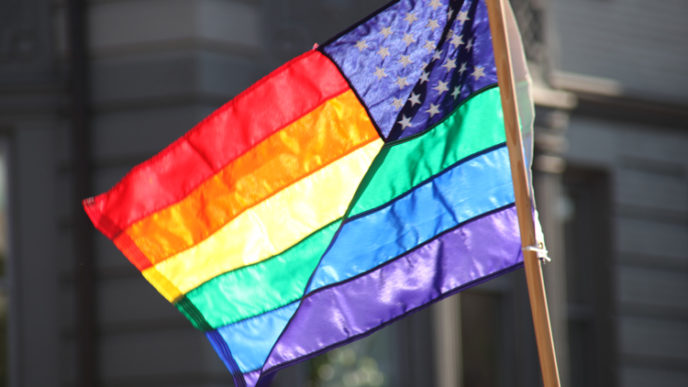
Taiwan might be the first Asian country to fall to the Great Gay Juggernaut. Its government might follow the same path as many post-Christian Western governments and force its citizens to declare or pretend two men (or two women) may marry each other.
On 26 December, a second large rally in as many weeks supporting government-defined “marriage,” or gmarriage, was held in the capital city of Taipei. The rally coincided with a meeting of the country’s Legislative Yuan which was considering legislation to further the cause of gmarriage. The China Post (an English-language Taiwan-based paper) reported:
An amendment to the Civil Code was approved by a legislative committee Monday in a major step toward the legalization of same-sex marriage, as thousands-strong dueling demonstrators took place outside the Legislative Yuan.
After three hours, the Judiciary and Organic Laws and Statutes Committee approved the amendment proposed by ruling party Legislator Yu Mei-nu, which replaces “male and female parties” in the Civil Code’s marriage chapter with “two parties.”
This is not considered enough to ensconce a full-blown retreat from actual marriage. But words matter, as is understood by members of the “anti campaign.”
More than 110 demonstrators from the anti campaign were taped by the wrist by police officers after they broke through the police line and barged into the Legislative Yuan, attempting to interrupt the committee meeting.
This is interesting because these active counter-demonstrations were not often seen in the Western countries which adopted gmarriage, which is a signal that hope is not yet lost for Taiwan. Also, polls only show about 37% of Taiwanese support gmarriage, a number which has been dropping.
There is not much to be sanguine about, however. Only two weeks before the latest rally, on December 11th, another huge pro-gmarriage event was also held in Taipei. One report is as many as between 75,000 to 250,000 came.
A site called Pride Watch Taiwan keeps detailed statistics on the 113 members of the Legislative Yuan. As of this writing, 57.5% (or 65) of that body’s members have expressed support in one way or another for gmarriage. The support may have only been in public settings and not (yet) made official. Only 10.6% (or 12) of the members are openly opposed, with the rest remaining mute or supporting a version of civil partnerships.
A majority of the country’s ruling Democratic Progressive Party (DPP), 66.5% (or 46), are for gmarriage, while only 34.3% (or 12) of the opposition Kuomintang (KMT) are for gmarriage. Historically, the KMT has been the more conservative party. It was also the first party after Chiang Kai-shek decamped to the island after being chased from the Chinese homeland by the murderous Mao Zedong. There is a rich and rough history of the KMT and Taiwan, so the usual left-right party breakdowns familiar in the USA don’t apply well in Taiwan.
Pride Watch also tracks which members of the Legislative Yuan call themselves Christian, of whom there are 12. Half of these are against gmarriage, and three are neutral or support civil partnerships. And three — curiously, since gmarriage is not justifiable or compatible with Christianity — are for it. All these three are in the DPP.
The country’s president since last January is Tsai Ing-wen, a DPP member and one-time college professor. Tsai is a confirmed bachelorette and cat fancier, and has said, “In the face of love, everyone is equal. Let everyone have the freedom to love and to pursue their happiness. I am Tsai Ing-wen, and I support marriage equality.” Speaking on the same day, but not at the 11 December rally, Tsai said, “Gay people also have the right to get married.”
It’s unclear whether Tsai has the charisma or the backing to carry the gmarriage policy forward. She was elected with a wide margin, but homosexual “rights” and gmarriage were not part of the platform she ran under. And though she was very popular immediately after her election, she ran into immediate troubles for failing to uphold her campaign promises, mostly involving vacation practices and treatment of cross-straight relations with China.
Because of her inconsistencies, she has come in for no small measure of teasing. Her family name “Tsai” mimics the sound of a popular, hollow-stalk vegetable, which has given rise to the nickname Kong Xin Tsai, or “empty-hearted vegetable” (proving insults are often culturally relative).
Correspondingly, her approval rating has been plummeting, and her mirror disapproval rating rising. This could mean she has to put her focus on more pressing matters and put homosexual matters on the side.
If Taiwan falls, it will be the first predominately Buddhist nation to embrace this denial of the nature of marriage . Thus far, only post-Christian countries have adopted gmarriage. Taiwan is largely Chinese in demographics and culture, with its corresponding history of Confucianism and its intense focus on family. That this is fading is important.
Maybe of most importance, is that Taiwan has crossed a secular threshold common in those Western nations that abandoned actual marriage, with some 18-20% of its adults saying they hold to no religion. These are similar percentages in those gmarriage nations which were once openly Christian. (For more from the author of “Will Taiwan Be the First Asian Country to Adopt Same-Sex ‘Marriage?” please click HERE)
Follow Joe Miller on Twitter HERE and Facebook HERE.