Posts

A Question You Should Never Be Asked: Please Vote on Which Ethnic People Groups Should Be Discriminated Against in State Law?

This was the question put before the Alaska House of Representatives for a vote last Friday. Of course, the question wasn’t phrased quite so candidly as that. Instead, it took the form “shouldn’t veterans from these two ethnic groups be given a special veteran designation on Alaska state drivers licenses?”

And with this simple question we watch the pernicious march of identity politics creep ever so slowly and innocently into our state laws. At the outset, it is never about treating individuals of one race or ethnicity poorly—it is rarely about that—instead, it’s about treating individuals of another race or ethnicity better.

There are ample noble justifications for creating and giving special legal status to members of one ethnic group over another. I won’t list them because the possible justifications are literally limitless.

The question yesterday (House Bill 125) was whether two specific ethnic groups should be given veteran status, and veterans from all other ethnicities should be excluded. In reply to that question, I offered an amendment.

My amendment removed the ethnic qualifier, and returned to what should have been the real question all along, “does this individual’s military service merit veteran status in Alaska state law?”

You see, once you identify the real issue—military service—there is no longer a need to limit veteran status to a particular set of individuals based on race or their ethnic heritage.

And why is that important?

It is critical for every state legislator to recognize that you cannot draw lines based on ethnicity without including some individuals, and excluding others.

In the amendment I put forward, veterans of any racial background would be eligible for veteran status, as the original bill already declared, if they “served in military operations in support of the United States” between “February 28, 1961 and May 15, 1975.”

I didn’t choose those specific dates, they were chosen by the author of the original bill. But in reading the bill, I looked for examples of who was being discriminated against in the bill. I then asked why we would be discriminating against these veterans in state law?

I could find no good reason. I still can’t. And I believe that our politicized legislative system is a terrible process for trying to figure out which race or ethnicity should be accorded special benefits and privileges. Our political process rewards groups with political power; namely, votes, money and lobbyists. Can you think of a worse process for deciding which groups will be looked on more favorably by the government?

As I said to my colleagues in the House, this is a question that governments have no business answering. No matter how clear the answer may seem to a group of politicians, there is no good answer to the question.

The Alaska Constitution declares “that all persons are equal and entitled to equal rights, opportunities, and protection under the law.” Any laws that try to assign rights, opportunities or legal protection based on race or ethnicity are a direct and unmistakable violation of our constitution.

But let us pretend for a moment that the U.S. Constitution and the Alaska State Constitution did not exist. What then? HB125 would still be a terrible law because it promotes discrimination based on a person’s ethnicity.

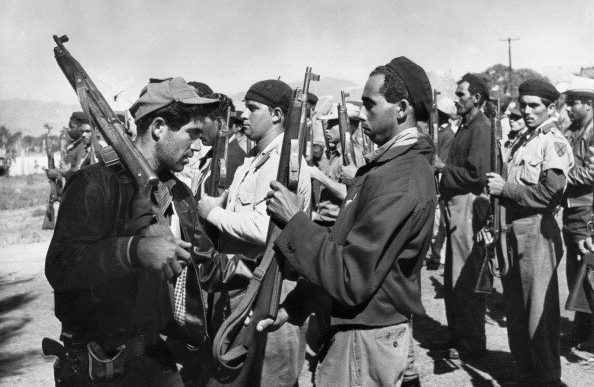
Read “Human Events: What Really Happened at the Bay of Pigs” by Humberto Fontova.

Both groups were recruited to fight for the U.S. by the CIA. Both were trained and equipped and led by the U.S. government. Both groups received their weapons and supplies from the U.S. government. Members of both groups fought alongside American servicemen, and members of both groups gave their lives in doing so. Both groups were promised support and protection by the U.S. President. And both groups had those promises broken before later emigrating to the U.S. with their families in large numbers.

With this new law, the State of Alaska declares by law that only one group will be given veteran status for their military service in support of the United States. Those who fought with the U.S. in Cuba, who were captured, tortured, and then exchanged by the U.S. government and personally welcomed to the U.S. by the President of the United States—We now declare in state law that their sacrifice was not worthy of veteran status because of their ethnicity and because we place a greater value on the military service that took place in Asia than we do the military service that took place in the Americas, even though both took place at the same time and under the orders of the very same U.S. President.

This is the evil of racism, and laws that draw lines between races and peoples can never escape it.

As another legislator observed nearly two hundred years ago, “If the natural tendencies of mankind are so bad that it is not safe to permit people to be free, how is it that the tendencies of these organizers are always good? Do not the legislators and their appointed agents also belong to the human race? Or do they believe that they themselves are made of a finer clay than the rest of mankind?” (Frederick Bastiat, The Law)

Watch the vote in the legislature here: https://goo.gl/mvvyXK

_______________________________________

Rep. David Eastman is a firefighter in Wasilla, a former military police captain on JBER, and currently represents residents of the Mat-Su (District 10) in the Alaska House of Representatives.

Why Trump’s Call to Investigate Vote Fraud Is Valid

President Donald Trump recently called for an investigation into vote fraud. His press secretary Sean Spicer added: “This isn’t just about the 2016 election. This is about the integrity of our voting system.”

And there is a problem: Liberal activists have all too often rejected and fought against bipartisan efforts to fix these critical problems.

Trump detailed some of the problems in our voting system: “You have people that are registered who are dead, who are illegals, who are in two states. You have people registered in two states. … They vote twice.”

In 2014, President Barack Obama’s bipartisan Presidential Commission on Election Administration called for voter list maintenance to improve the voter registration rolls. Yet liberals have regularly fought against efforts to clean up voter rolls.

The irony was that at the same time Obama’s lawyer, Bob Bauer, was leading the bipartisan commission, his own firm was suing the state of Virginia, calling the efforts to clean up voter rolls racist and purging.

It goes further. Obama nominated Myrna Perez to be on the Election Assistance Commission. Perez was an adamant opponent of voter list maintenance, declaring such efforts “purging.”

This is why it’s tough to even talk about vote fraud. Any efforts, even those with bipartisan support, are bitterly opposed by liberal activists.

Aside from the incendiary rhetoric, there are real challenges to maintaining clean voter registration rolls that liberals and conservatives need to work together to overcome.

Underfunded and understaffed state election offices do not have the resources to review voter registration records and remove dead people and other ineligible voters. States do not share information to identify double registrations and potential double voting.

Lists of noncitizens excused from jury duty are not shared with secretaries of state to be removed from voter registration rolls. Significant advances are being made in this area through the use of technology, but much remains to be done. Bipartisan cooperation, not political bickering, is needed.

There may be no better example than the requirement for a photo ID. Voter ID is overwhelmingly supported by the public. A 2016 Gallup poll last August found that 80 percent of Americans, including 63 percent of Democrats, support the requirement that a person show a photo ID at the polls before voting.

A primary recommendation of the 2005 bipartisan Commission on Federal Election Reform (the “Carter-Baker Commission”) was to require voter ID. This commission was led by Jimmy Carter, former president and noted liberal, and James Baker, secretary of state under President George H.W. Bush.

Yet, liberals oppose any efforts to enact commonsense voter ID laws, opposing them in legislatures and in the courts. Voter ID laws, which protect the integrity of the vote and thus our democracy for all citizens, are called racist and mechanisms of voter suppression.

Liberals often make ludicrous, unsubstantiated claims about voter ID, such as claiming hundreds of thousands of voters would be disenfranchised by voter ID—claims that even sympathetic liberals and courts question as based on faulty statistics and methods.

Liberal activists unfortunately show by their actions they do not want to fix our electoral system despite strong public, bipartisan support for things like voter list maintenance and photo ID requirements.

Instead of accepting and supporting reforms that have public support, liberals open the door to more fraud by championing changes to the process like mandatory voter registration, all mail-in voting, same-day registration, no-excuse absentee voting, and not requiring proof of citizenship for voter registration.

These changes have not been shown to improve voter participation, engagement, or turnout, but instead strain local election resources and present more opportunities for ineligible people to register and cast fraudulent ballots.

Take the example of New Hampshire.

Democrat New Hampshire Secretary of State William Gardner supports a 30-day residency requirement to stop fraudulent, as he calls it, “drive-by voting,” in which people from out of state come to New Hampshire for a short period to vote on Election Day.

New Hampshire has same-day registration and no period of residency required before a person may register and vote. Yet a commonsense residency requirement has been passed for the past two years by the New Hampshire Legislature, which liberals in the Legislature opposed and then-Gov. Maggie Hassan vetoed each time.

Even Hillary Clinton recognized the problem, alleging that out-of-state voters led to her losing the 2016 New Hampshire presidential primary to Sen. Bernie Sanders, I-Vt. Gardner pledged to investigate.

One can only wonder how out-of-state voters affected the close 2016 presidential and senatorial election in New Hampshire, where Hassan defeated Sen. Kelly Ayotte by approximately 700 votes.

Significantly, data from the state election results published regarding the 2012 and 2014 general elections by the New Hampshire secretary of state demonstrate the margin of victory for the winning candidate in the races for governor, Senate, and president was less than the number of votes cast on Election Day by same-day registrants.

A few votes from out-of-state voters can literally change the winner of a race.

This begs the question: What are liberals trying to hide? Why not support Trump’s call for an investigation into vote fraud? Is it because they are concerned what would happen if they helped pass laws to protect the integrity of our elections?

It’s time to stop playing politics with election administration and start working together to fix our electoral system, which in turn protects our democracy and our republic. (For more from the author of ” Why Trump’s Call to Investigate Vote Fraud Is Valid” please click HERE)

Follow Joe Miller on Twitter HERE and Facebook HERE.

Illegal Voting by the Numbers

How many votes in the past presidential election were cast illegally or fraudulently? Some say none to few. Others, such as President Trump, say a couple of million. The mainstream press insist there is “no evidence” for systemic problems in the electoral process. Yet evidence does exist, only that evidence is disputed or ignored.

Here is the story so far. President Trump lost the popular election by more than two million votes, apparently due largely to the massive number of blue votes concentrated in California and New York. Yet shortly after the election, he said, “In addition to winning the Electoral College in a landslide, I won the popular vote if you deduct the millions of people who voted illegally.” He later estimated the fraudulent margin to be some 3 to 5 million.

He also said, “I will be asking for a major investigation into VOTER FRAUD, including those registered to vote in two states, those who are illegal and even, those registered to vote who are dead (and many for a long time). Depending on results, we will strengthen up voting procedures!”

Mr Trump’s claims launched waves of horrified apoplexy in the press (who at this early point know no other reaction). The New York Times was reduced to using the L-word, i.e. “liar.” The Washington Post said Trump’s charge “is not supported by any verifiable facts.” Even politicians in his own party, such as Senator John McCain, said, “I obviously have seen no evidence of illegal voting.”

Various rhetorical tricks then played out in the mainstream press to give the impression illegal voting was rare in the extreme, or even non-existent. An academic study which estimated there were some 800,000 illegal votes from non-citizens was excoriated. Much evidence in plain site was just plain ignored. Yet, so far, there has been no systematic attempt to estimate the illicit vote count, and such an estimate is required before dismissing or accepting Mr. Trump’s claims. The best that can now be said is nobody knows the right answer.

Sloppy “Fact” Checking

One writer at the Washington Post “combed through the news-aggregation system Nexis to find demonstrated cases of absentee or in-person voter fraud.” And since this reporter could only find four reported instances, he said, “There is simply no evidence that fraudulent ballots played any significant role in the 2016 presidential election whatsoever.”

But since the point is question is fraud that has (thus far) gone undetected, arguing that since newspaper accounts of fraud don’t exist that therefore actual fraud doesn’t exist is not unlike arguing that since Pravda didn’t print reports of arrests of political prisoners in Moscow under Stalin, that therefore the arrests didn’t happen.

The controversial site FactCheck.org produced, at times, a petulant report, calling Trump’s claims “bogus.” FactCheck.org relied in part on the paper “The Truth About Voter Fraud” published by the left-leaning Brennan Center for Justice. It is a remarkable document that takes great pains to suggest that fraud almost never occurs by emphasizing instances where fraud was searched for but was not found. For instance, this bullet point: “In Washington in 2005, an individual asked county offices to investigate the citizenship status of 1,668 registered voters based on their ‘foreign-sounding names.’ There are no reports of which we are aware that any individual on the submitted list was actually a noncitizen.” This is clever because it also brings with it the slight whiff of racism, for which there is no defense.

The Brennan report argues repeatedly that those who break the law to come to the USA would not likely break the law a second time to vote because the “payoff,” i.e. their one additional vote, is so small. But that same logic (as is well known) applies to the legal citizen voter deciding whether to head to the polls knowing his one vote also counts for almost nothing in a general election.

Pew and Actual Fraud

FactCheck.org admits Mr. Trump quotes accurately from the Pew Report “Inaccurate, Costly and Inefficient: Evidence That America’s Voter Registration System Needs and Upgrade“, before downplaying the report because it doesn’t specifically mention fraud. Instead, Pew says things like “Approximately 24 million — one of every eight — voter registrations in the United States are no longer valid or are significantly inaccurate,” “More than 1.8 million deceased individuals are listed as voters,” and “Approximately 2.75 million people have registrations in more than one state.” While none of these are direct indicators of fraud, all are in the direction of fraud.

FactCheck.org does bring up an instance of fraud:

After the 1982 election, in Chicago, 62 people, most of them precinct captains, were indicted by a grand jury for stuffing ballot boxes and buying votes, including a scheme in which they would identify registered voters not voting on Election Day and forge ballots in their name.

Like certain other metropolitan areas, Chicago is, as all know, a Democratic machine town with a long history of electoral shenanigans. In the linked example, the Chicago Tribune reported that a Democratic precinct worker was caught taking a straight-Democrat ballot and running it through a vote-counting machine 198 times. In that same article, “U.S. Atty. Dan Webb repeated contentions previously made by federal investigators that of the 1 million votes cast in Chicago in the Nov. 2, 1982, general election, about 100,000, or 10 percent, were fraudulent.”

Also: Webb “estimated that 80,000 illegal aliens are registered to vote here” and that by that time some had already been convicted for fraudulent voting. Several election officials were also convicted and others awaited trial.

FactCheck.org then pooh-poohs these facts by reminding the reader that “Trump urged his supporters to ‘watch your polling booths…,’” thus suggesting cheating could not have occurred under these watchful eyes, and by citing “experts” who say “the kind of voter fraud Trump is talking about — voter impersonation — is extremely rare.” Rare is might be, but did it happen in 2016?

Major Malfunctions

FactCheck.org forgot (somehow) to mention headlines like this: “Voting machines in more than one-third of all Detroit precincts registered more votes than they should have during last month’s presidential election.” The main discovery: “Detailed reports from the office of Wayne County Clerk Cathy Garrett show optical scanners at 248 of the city’s 662 precincts, or 37 percent, tabulated more ballots than the number of voters tallied by workers in the poll books.”

How many irregular votes were counted is unknown because of obscure recount rules in Michigan, but it is clearly non-zero. Even with these problems, a recent state audit said there “is no evidence of voter fraud surrounding the presidential election in Detroit.” It was admitted, however, that “87 of the 490 [Wayne County] precinct voting machines malfunctioned”, and that the poll workers were generally old and “tired.”

FactCheck.org also missed a case in Los Angeles where the County Registrar Dean Logan was presented with “more than 80 ballots for Tuesday’s [presidential] election filled out with names and the same address.” Logan has a history with difficult elections, such as in Washington State in 2000:

The Seattle Times documented 129 felons illegally voting in that election; National Review reported nearly 350 provisional ballots were counted without being verified; and The Wall Street Journal noted some 55,000 optical-scan ballots were “enhanced” so the voters’ supposed “intent” could be determined.

There are many other (easy-to-discover yet oddly ignored) instances like these, which proves one thing: that fraudulent or improper votes have been cast in past presidential elections, and that therefore it is rational to conclude fraudulent or improper votes have been cast in this most recent presidential election. The question then becomes how many votes are illicit.

Kinds of Bad Votes

Before investigating a contentious academic study of electoral fraud from non-citizen voting, it helps to list the main sources of fraudulent or improper votes in Presidential elections:

Legal non-citizens; i.e. those who are here legally who are ineligible to vote but do anyway
Law-breaking non-citizens; i.e. those who have broken laws to come here and are not in the formal immigration pipeline and who vote illegally
The dead, including legal and illegal (see below)
The fictional; i.e. names which are entirely made up
The multiple; i.e. citizens who vote more than once
Felons; i.e. citizens barred from voting

The dead requires clarification. Some citizens vote early and legally and then die before the official election date. Searches afterwards might turn some of these folks up as “dead voters.” The culprit is early voting and not fraud or ill intent. Of course, names of the deceased can also be, and have been, used by the unscrupulous.

Direction manipulation, by ballot box stuffing and, if it were possible, by hacking, would largely fit under the fictional category. The Chicago example of running the same ballot through the counting machine, and the example of malfunctioning machines fit here.

In order to come to total illicit votes, estimates are needed from each source.

The Dead and Felons

The dead whose names have been used improperly do not appear to account for a large number of bad votes. Many dead people are registered, as Pew reported, but their names have not been discovered to have been systematically misused. Still, there is substance (and here) to the many Chicago jokes like this: “My father voted Republican all his life. Since he died he votes Democrat.” No one therefore knows the best estimate of dead voters, but the Pew study does give an upper bound.

Laws vary by state whether felons can vote, with most states saying convicted felons are ineligible in some way. One estimate is that just over 6 million citizens are thus restricted. Ballotpedia cites a 2008 study which discovered “33,000 convicted felons who should not be eligible to vote” in Florida; another reports the “Wisconsin Government Accountability Board announced in September 2009 that it had identified up to 195 felons who may have illegally voted in the November 2008 presidential election.”

The total improper number of votes from felons is anybody’s guess, however. That 6 million is another upper bound, with the actual total surely far less than this.

Multiple and Fictional Votes

Pew again gives a clue about multiple voting by citizens; i.e., that 2.75 million people have multiple registrations. And then Alan Schulkin, Commissioner of the Board of Elections in New York City, was filmed by Project Veritas admitting people are “bused around” to vote multiple times, predominately in Democrat-heavy neighborhoods. In 2014, North Carolina identified “hundreds of cases of potential voter fraud,” many of which were likely multiple voters.

Fictional and incorrect names can be “on paper,” as when fraudulent registrations are entered, or virtual, as with ballot stuffing and hacking. For an on-paper example, recall the infamous Acorn voter registration drives in which the group turned in “‘massive numbers’ of duplicate registration cards,” cards for fictional characters and children and others with forged signatures. How many of these faked registrations turned into real votes nobody appears to know.

Ballotpedia quotes from a National Review article in which “undercover agents with New York City Department of Investigations ‘showed up at 63 polling places [in the fall of 2013] and pretended to be voters who should have been turned away by election officials … in 61 instances, or 97 percent of the time, the testers were allowed to vote.’” Other examples exist.

Ballot Stuffing and Hacking

The Chicago example suffices for a ballot-stuffing example, though many say newer voting machines make the practice difficult. Yet computerized machines open the possibility of hacking. The Detroit example with more votes than voters also falls into this category, regardless whether the intent was malicious or due to faulty equipment.

Hacking is more mysterious. A security researcher demonstrated to Forbes the ease which some machines can be tampered with. Others agree. There were claims from some that machines in Texas changed votes from Trump to Hillary, though some of these curious changes could be put down to voter error. But the same mysterious switches from Trump to Hillary were reported in Pennsylvania and other places, too.

“I went back, pressed Trump again. Three times I did this, so then I called one of the women that were working the polls over. And she said you must be doing it wrong. She did it three times and it defaulted to Hillary every time,” Bobbie Lee Hawranko told KDKA.
The key line to the story: “Officials recalibrated the machines and said the issue has been resolved.” Here is a video of an instance of switching.

And, as all know, there were multiple reports that Russia hacked the election, but here it is generally meant that “entities” in Russia provided the emails from the DNC and John Podesta, which is a different kind of thing.

As above, the conclusion is that nobody knows the size of the error or fraud from these categories, except to say that it is not zero. The direction of reports of vote switching is, of course, interesting.

Non-Citizen Voting

In 2014, Jesse Richman, Gulshan Chattha, and David Earnest published “Do non-citizens vote in U.S. elections?” in the journal Electoral Studies. Their study relied on data provided by the Cooperative Congressional Election Study (CCES), which is an on-going Internet survey.

The CCES includes a question asking whether the respondent is a US citizen, and others asking whether the respondent voted and for whom. Some respondents who said they were non-citizens also said they voted, which of course is illegal. In the 2008 election, Richman and Earnest calculated that “more than 80 percent” of non-citizens who illegally vote did so for Obama. So pronounced was the Democrat tilt, “we find that this participation was large enough to plausibly account for Democratic victories in a few close elections.”

If extrapolated to 2016, these findings support Mr. Trump’s claim. But Richman’s paper was not well received by Democrats and the mainstream press. How accurate are Richman’s findings?

Not so accurate, say Stephen Ansolabehere, Samantha Luks, and Brian Schaffner, who penned the rebuttal paper “The perils of cherry picking low frequency events in large sample surveys” in Electoral Studies. The gist of this article is that if there is a known error rate in answering the question on citizenship, then, given the observed data, it is possible all the people who responded they were non-citizen voters were in error, and that, in fact, no non-citizens voted.

Yet there is no known error rate, only a guess, a guess which is disputed in turn by Richman (also here). Ansolabehere and the others also fail to consider what errors in answering other questions might mean. And both Richman and Ansolabehere fail to consider the biggest source of uncertainty, which is lying.

Some non-citizens vote because they honestly believe they are allowed to, but others vote knowing of the illegality. Both categories of votes are, however, illegal. A key point of dispute in the CCES is that some people who answered they were citizens in 2010 later said in 2012 that they were non-citizens (and vice versa). This supports the measurement error theory of Ansolabehere. But it also supports the theory that some might have been lying in 2010 and later changed their mind. Even stronger, there were a very large number of folks who said they were non-citizens consistently, and Ansolabehere’s approach would be to toss all these out, a move for which he does not have a solid justification.

How many who were non-citizens who claimed to be citizens, i.e. how many lied, is not known by anybody. This was an Internet survey and people were tracked through time. It is unclear how much trust respondents had in the privacy of their data; plus, the motivation to lie about voting illegally is obvious enough.

Estimating Non-Citizen Votes

Many in the press, and even Ansolabehere, intimate Richman did not consider the effects of measurement error (of mistakenly answering the citizenship question), but this is simply false. In the original paper, Richman gathered as much evidence as they could to support their claim of non-citizen voting. Most of this evidence was indirect, as in comparing demographic and other characteristics of non-citizen voters and non-citizen non-voters. But, really, this is all that can be done short of tracking down the original respondents and investigating (not questioning) them individually.

Supposing Richman is correct, his estimate of some 834,000 votes cast illegally in 2016, and most of these for Hillary, is too precise. That number has substantial uncertainty, even accepting Richman’s analysis. And then we have to add the uncertainty due to the survey itself: how were people gathered, what biases it has, how many lied, and so forth. And even if we could do all that, the result is not observational proof of the number of illegal non-citizen votes. It will be just the number (or a range, really) from some statistical model, which would be disputed until Kingdom come. Richman himself agrees more would be needed.

Lastly, another difficulty is that the CCES data does not distinguish between legal non-citizens and those who broke the law to come here. Since the CCES was an Internet survey, and thus would require access to some kind of (expensive) device, it may be that it is biased toward legal non-citizens. Folks who break the law to come here to work washing dishes or picking crops aren’t, one surmises, as likely to participate in surveys. How likely this latter group is to vote (illegally and encouraged or bused by men like Schulkin mentioned) is unknown.

Final Numbers

It is disappointing, but the answer at this date is that there is no answer, no precise answer. There is more than sufficient evidence to confirm that some illegal votes were counted, however. Much of this evidence is circumstantial, but it is also substantial. (For more from the author of “Illegal Voting by the Numbers” please click HERE)

Follow Joe Miller on Twitter HERE and Facebook HERE.

Early Voting Is Fundamentally Unfair and Undermines Fair Elections

Ever four years, the world of politics is completely consumed with Election Day. However, election days have, ironically, become somewhat anti-climactic events because they no longer exist as they have since our Founding. We now have “election month.”

With the revelation that the FBI is re-opening its investigation into Hillary’s emails and Trump on the rise because he is keeping his mouth shut, many are wondering if Trump could pull off a major come-from-behind victory. The problem is even if his positive trajectory continues through Election Day, it might already be too late for him. Hillary might have already banked an insurmountable lead prior to the authentic Election Day set by Congress since 1845. According to the New York Times, with eight days until official Election Day, over 22 million people had already voted early. Some estimate that two-thirds of voters in critical states such as Colorado, Florida, Nevada, and North Carolina will have cast ballots before Election Day.

Irrespective of one’s view of either candidate, this dynamic is fundamentally unfair. It’s akin to having the jury begin casting its vote while the evidence in the case is still being presented and before closing arguments.

Constitution and federal law

Clearly, our Founders never envisioned protracted voting periods for as long as 4-6 weeks when ballots were cast and the results of how many registrants voted would be shaping the momentum of the election.

When discussing the election of the president, Art. II §1 cl. 4 of the Constitution states: “The Congress may determine the Time of chusing the Electors, and the Day on which they shall give their Votes; which Day shall be the same throughout the United States.”

Although states were to have control over all the administrative aspects of voting and voter eligibility (which courts are now violating), Congress was granted the authority to set the national Election Day for president. In 1845, Congress designated that day as “the first Tuesday after the first Monday in November.” In 1872, Congress enacted the same law governing elections to the U.S. House [2 U.S.C. § 7], and when the Seventeenth Amendment was ratified, Congress dictated that Senate elections should be held on the same day as well [2 U.S.C. § 1]. Congress never intended voting to begin more than a month before that day, as is practiced in many states.

Also, the spirit of the Constitution clearly dictates that Election Day should be uniform. Although the clause dictating that the “Day shall be the same throughout the United States” was referring to the day the electors choose the president, it was clearly understood as granting Congress the sole authority to set the uniform day for choosing the electors (what we regard as national Election Day).

The great constitutional historian, Justice Joseph Story, wrote that when Congress first designated the date for choosing the electors in 1792 (not just the date for the electors choosing the president), it was “[I]n pursuance of the authority given by this clause.”

When defending the election clause from those who felt it gave the federal government too much power, former North Carolina Governor Richard Dobbs Spaight gave a robust defense at the North Carolina ratification convention. From the context of his words, it is clear that the power granted to Congress and the desire for uniformity applied both to the day the people choose the electors and to the day the electors actually vote for president:

Mr. Spaight replied, that he was surprised that the gentleman objected to the power of Congress to determine the time of choosing the electors, and not to that of fixing the day of the election of the President; that the power in the one case could not possibly answer the purpose of uniformity without having it in the other; that the power, in both cases, could be exercised properly only by one general superintending power; that, if Congress had not this power, there would be no uniformity at all, and that a great deal of time would be taken up in order to agree upon the time.

While many delegates to various state conventions objected to any federal control of elections, it was very clear that the Constitution had indeed vested Congress with the power to create a single election day. Ever since the Presidential Election Day Act set that date as “the Tuesday after the first Monday in November,” it’s hard to see how a state holding multiple election days for in-person voting — without any excuse — is not a violation of this law, at least in spirit.

What is doubly ironic is that the federal courts have obliterated legitimate state control over methods and procedures of elections. Yet, when it comes to the actual date of the presidential election, which is fixed by Congress pursuant to the Constitution, the courts actually mandate that states have additional early voting. A backwards system indeed.

Rendering a Verdict before the Trial

Aside from the dubious constitutionality of early voting, the notion that, over the course of a volatile campaign, different people would vote at different times is absurd because there are so many events that could alter the public perception about a candidate. It makes sense that everyone should observe the same campaign for the same duration and render their verdict based on a uniform set of information only available once the entire campaign is completed. What if a major revelation comes to the forefront — either positive or negative — about a given candidate after ballots have already been cast?

In recent years, some states have gone as far as allowing early voting even before the presidential debates! Minnesota has been voting since September 23, prior to the first debate at Hofstra University. This is especially damaging for congressional races where challengers to incumbents are often lacking name recognition at this stage. Yet many people who would otherwise have an open mind voting for a known quantity will reflexively vote for the incumbent at this early stage.

Influencing the Outcome of Election Day

A quick glance at the congressional debates preceding passage of the election day law for presidents in 1845, and the election day for the House of Representatives in 1872, reveals that Congress clearly intended that states should have polls open only on the day prescribed in the statute. In 1871, Rep. Benjamin Butler (R-MA) spoke on the House floor about the need for a uniform voting day because otherwise “we may have a canvass going on all over the union at different times.” Butler’s concern was that it would give some states and political parties “an undue advantage.” He spoke of how the announcement of vote results in some states helped influence the momentum of the election.

While official election results are not announced to the public prior to Election Day, practically everything else — from turnout by party to demographics — is either announced or can be ascertained. It is now known who has voted on every block in every state with early voting. The New York Times has an entire blog page dedicated to influencing the momentum of this election by prejudging the results. And as Rep. Butler feared, this certainly is designed to benefit a political party, in this case, the Democrats. It’s no coincidence that the electoral map substantially shifted in favor of Democrats beginning in 2008 when early voting first became a significant factor. As has been the case over the past decade, preliminary estimates of early voting turnout show a significant advantage for Democrats. Ace reporter, Jon Ralston, predicts that based on early voting, Hillary has a near-insurmountable lead in the critical state of Nevada. And since the Democrat base is comprised of monolithic groups, they can harness their GOTV machine to completely influence the perception of an election long before Election Day. This is obviously not an excuse for Republicans lacking a decent ground game for early voting, but it doesn’t make the state laws fair or just.

In his “Commentaries on the Constitution,” Justice Story presciently observed that the need for a uniform day was “self evident”:

Every reason of public policy and convenience seems in favour of a fixed time of giving the electoral votes, and that it should be the same throughout the Union. Such a measure is calculated to repress political intrigues and speculations, by rendering a combination among the electoral colleges, as to their votes, if not utterly impracticable, at least very difficult; and thus secures the people against those ready expedients, which corruption never fails to employ to accomplish its designs.

It goes without saying that, aside from the aforementioned reasons to end early voting, holding the vote over a protracted period invites corruption and fraud. It gives “those ready expedients” (think Soros community organizing groups) ample time “to employ to accomplish its designs.”

Early Voting a killer for Insurgent Candidates in Primaries

Democrats will never agree to cede their advantage in early voting during general elections, but both parties should agree to reform the process for primaries, which affects both parties equally. Given that primaries are so heavily influenced by name recognition, new insurgent candidates — even the ones who are ultimately victorious — tend to surge in the final days of the election when there is the most intense coverage of the race. Unfortunately, states with early voting give incumbents and candidates with ubiquitous name ID an automatic advantage by allowing them to bank votes before enough voters know there is another viable candidate in the race.

Nowhere is early voting more deleterious and absurd than in presidential primaries. Unlike general elections which were designed to occur on the same date in each state, the whole point of the staggered primary process is to allow unknown candidates to gain momentum gradually instead of competing in a national primary day with few resources. Yet, with the advent of early voting, the momentum from a surprise upset win in an early state could be mitigated by the fact that so many “early” votes were already cast in the “later” states for the initial front-runner.

Moreover, in what is perhaps the inanest outcome of early voting, presidential primaries are extremely fluid with multiple candidates dropping out after performing poorly in earlier states, yet a number of voters in later states with early voting have already cast thousands of ballots for a candidate that is no longer in the race on election day. We saw this across the board in the GOP primary when Cruz was vying for a mano-a-mano fight against Trump (who had the universal name ID from day one), but for weeks after candidates dropped out so much of the anti-Trump vote was already wasted on Rubio or other candidates no longer in the race.

If nothing else, it would make sense for the parties to come together and get rid of early voting at least for the primary process. Sadly, the establishments of both parties love early voting precisely because it benefits incumbents.

The trend for early voting is only getting worse. Democrats are seeking to expand the days, hours, and locations of early voting at every turn. In the states where they are out of power, the courts have enacted their early voting agenda for them. With modern communication and transportation, it is easier than ever to register to vote and cast a ballot or request and send back an absentee ballot if one is unable to vote in person on Election Day. If a single Election Day was good enough for our first two centuries when it was harder to travel or communicate, it should certainly work for us today. (For more from the author of “Early Voting Is Fundamentally Unfair and Undermines Fair Elections” please click HERE)

Follow Joe Miller on Twitter HERE and Facebook HERE.
Fmr. DOJ Election Attorney Says 4 Million Dead People Voting – DOJ Doesn’t Care

Video Transcript:

Donald Trump has caught some flack for saying that voter fraud happens today.

TRUMP: Get out and vote. But they even want to try and rig the election at the polling booths where so many cities are corrupt and you see that. And voter fraud is all too common. Then they criticize us for saying that.

President Obama on Tuesday told Trump to stop “whining” about voter fraud.

OBAMA: So, I’d advise Mr. Trump to stop whining and go try to make his case to get votes. It happens to be based on no facts. Every expert, regardless of political party, regardless of ideology, conservative or liberal, who has examined these issues in a serious way will tell you that instances of significant voter fraud are not to be found.

Well, this “expert” and former voting section attorney at the Department of Justice argues there are 4 million dead or ineligible voters.

STEVE DOOCY: J. Christian, you’ve handled some dead people voting cases in the past haven’t you?

J. CHRISTIAN ADAMS: Yeah, I filed six in just the last year against Philadelphia. Broward Country, Florida, is pending. Places where the voter rolls are corrupted. And you know, we had one case where — in Texas, there was somebody on the voter rolls who died in 1944. Dead people are voting and it’s something that this administration isn’t doing anything about.

DOOCY: Why is that?

ADAMS: They must like it. They must like who they are voting for. Look, when I was at the Justice Department in the Bush administration, we enforced a law called Motor Voter that forced states and local election officials to clean up their voter rolls of dead people. When I was there, we shut it down after the Obama inauguration. We would not bring cases because these people are opposed to cleaning the voter rolls. Why is that? Now we have 4 million, 4 million Steve, ineligible and dead voters on American voter rolls, according to the Pew Charitable Trust. That’s too many and it’s going to affect the election.

(For more from the author of “Fmr. DOJ Election Attorney Says 4 Million Dead People Voting – DOJ Doesn’t Care” please click HERE)

Follow Joe Miller on Twitter HERE and Facebook HERE.
When Zombies, Aliens, and Felons Steal Our Votes

People may expect zombies to be wandering the streets on Halloween, but they certainly don’t expect them to start casting ballots a week later. Yet in Colorado, dead voters’ ballots are cropping up in the vote counts.

CBS4, a Denver TV station, identified multiple cases of dead men and women in the state voting, with dozens of other deceased individuals still on the rolls. Colorado Secretary of State Wayne Williams confirmed these instances and both state and county investigations have been launched.

This comes on top of a report back in May by another CBS station in Los Angeles that found a similar problem in Southern California, with some zombie voters repeatedly voting from the grave years after they died.

While Colorado isn’t the only state dealing with an influx of ineligible voters, it’s unfortunately one of the few states trying to do something about it. A recent report by the Public Interest Legal Foundation and Virginia Voters Alliance lists thousands of noncitizens who were registered to vote and cast ballots in elections in Virginia and Pennsylvania.

The report analyzed data from just eight counties within Virginia. In these eight, the legal foundation found over 1,000 aliens who registered to vote illegally, with nearly 200 ballots cast from this group before they were removed from the rolls.

What’s perhaps most shocking about this is that the alien voters were only detected because when they renewed their driver’s licenses, they told the truth the second time when they admitted to the Virginia Department of Motor Vehicles that they were not citizens. Thus, this report certainly only shows a fraction of the problem, while the true extent of ineligible noncitizen voters in Virginia has yet to be uncovered.

While this number may seem insignificant, recall that the 2013 Virginia attorney general’s race was decided by a margin of 165 votes, not to mention how the integrity of the voting process is compromised and the votes of legitimate voters are stolen when ineligible individuals are allowed to cast ballots.

While these aliens have been removed from the registration rolls, it seems no information about their illegal registration and voting has been turned over to law enforcement for investigation and prosecution.

Worse still, state election officials appointed by Gov. Terry McAuliffe, a Democrat, have refused to provide information on their voting histories and have instructed other counties contacted by the Public Interest Legal Foundation not to provide information on aliens removed from the voter rolls. This gives the appearance of a blatant cover-up.

Instead of being outraged at this illegal behavior by noncitizens or outlining what steps would be taken by the state to prosecute them, McAuliffe instead accused the Public Interest Legal Foundation of prematurely casting doubt on election results: “When you can’t talk about issues and you have nothing to say to the American public about what you will do for them, you throw up issues that have no basis in substance at all.”

No substance? McAuliffe ignored the fact that all of these individuals who illegally registered and voted were removed from the voter rolls because election officials had all the “substance” they needed to prove they were ineligible noncitizens. The governor is ignoring instance after instance of possible felony voter fraud.

Unfortunately, this problem is not unique to Virginia. A similar report released by the legal foundation on Philadelphia shows that thousands of ineligible voters, both noncitizens and felons, registered to vote, stayed on the rolls, and cast ballots in the City of Brotherly Love.

Again, these instances were only found through individuals self-reporting their ineligibility or by chance, meaning they only cover a fraction of the problem, and again, Philadelphia election officials have done nothing to identify these ineligible voters.

Despite the fact that incarcerated felons are barred from voting, Philadelphia election officials refuse to remove felons from the voter rolls or even notate their records. They don’t even know who the felons are because they didn’t ask.

As the legal foundation’s report says, “City of Philadelphia election officials behave as if Pennsylvania law prohibiting certain felons from voting doesn’t even exist. This is rank lawlessness.” They also take no proactive steps to detect aliens who are illegally registered or voting.

The fact that there are so many felons and potential felons from Philadelphia in the state Legislature today or formerly might have something to do with Philadelphia’s lawless attitude. This was demonstrated at a hearing on Oct. 3 at the state Capitol where J. Christian Adams, president and general counsel of the Public Interest Legal Foundation, testified before the Pennsylvania House State Government Committee on the findings in the Philadelphia report.

One of the members of the committee is Vanessa Lowery Brown, D-Philadelphia, who is under indictment for taking bribes to vote against voter ID legislation. According to state grand jury testimony, she admitted her guilt and told undercover officers that she preferred her bribes to be delivered by check, not in cash.

Despite this admission to the grand jury and the fact that four other defendants facing similar charges have all pleaded guilty and a fifth pleaded no contest (all state legislators, too), Brown is claiming she was racially targeted by law enforcement. This claim has been vehemently denied by all of the law enforcement officials involved in the prosecution.

According to a source present at the hearing, Brown spent much of the Oct. 3 hearing disputing that prohibiting incarcerated felons from voting should be a concern even though it is the law of Pennsylvania. She complained that talking about the issue would deter felons from voting once they got out of prison. She said encouraging felons to vote when they leave prison should be more important than worrying about ballots being cast for or by them when they are in prison.

This caused state Rep. Jerry Knowles, R-Tamaqua, to explode even though he was sitting next to Brown on the dais: “My constituents don’t give a rip about whether a felon is discouraged from voting, I can tell you that much, they care about their vote not being canceled by an illegal vote. “

Another convicted felon (we are not making this up) who is a member of the House committee was also present at the hearing, although she got up at one point and left the hearing room. State Rep. Leslie Acosta, D-Philadelphia, pleaded guilty in March to a felony count of conspiring to commit money laundering, although that has not stopped her from running for re-election (or potentially voting in November). Only in Philadelphia.

Virginia, Philadelphia, and Colorado all highlight the security problems we have in our voter registration system that allow fraudulent and illegal votes to poison the integrity of the election process. They emphasize the need for officials to investigate, charge, and remove ineligible voters from the rolls, not ignore the problem and refuse to enforce the law against wrongdoers.

No matter how small the number, ineligible and zombie voters have no place in our voting rolls or ballot boxes. Until we take steps to improve the security and integrity of our election process, the problem will only grow. (For more from the author of “When Zombies, Aliens, and Felons Steal Our Votes” please click HERE)

Follow Joe Miller on Twitter HERE and Facebook HERE.
Strangers in Our Own Land: The Non-Citizen Voter Fraud Disaster

Several weeks after a court ordered Ohio to stop cleaning its voter rolls from dead voters, likely raising the specter of voter fraud in the key battleground state, a new report reveals how Virginia and Pennsylvania — two other critical states — have seen hundreds of cases of non-citizens voting. That raises the question: Is the foundation of our democratic republic and national sovereignty no longer secure?

Earlier this week, the Public Interest Legal Foundation (PILF), headed by former Justice Department Attorney J. Christian Adams, released a pair of damning reports showing how the voting rolls in parts of Virginia and Pennsylvania are compromised with ineligible voters and that some of those voters have actually cast ballots in recent elections. What is more disquieting about this analysis is that it covered only a handful of counties via public record requests made through the National Voter Registration Act. Thanks to stonewalling from local election officials, a story Conservative Review first broke, PILF could not obtain comprehensive data on these two battleground states, which makes it all the more likely the number of registered voters who are non-citizens or otherwise ineligible to vote is much higher.

Virginia

The Virginia report, which was the first to be released this week, found 1,046 non-citizens registered to vote in eight counties, who “cast a total of 186 votes between 2005 and 2015.” But here’s the kicker: This was a mere sample from 133 election jurisdictions in the state. And as PILF’s Adams noted in an article at PJ Media, this report does not cover “the behemoths of Arlington and Fairfax Counties.”

Moreover, Adams made it clear that this sample only covered self-reported aliens. “These are just the aliens who were accidentally caught because when they renewed their driver’s license, they told the truth that they were a non-citizen,” wrote Adams in the PJ Media article [emphasis in original quote]. Thanks to the Motor-Voter laws there is no way to require that states and localities use the federal SAVE (Systematic Alien Verification for Entitlements) database to check for non-citizens voting. Thus, most of the illegal votes actually reported are by those who legitimately didn’t realize they were ineligible to vote and checked off the box indicating they were not citizens when renewing their driver’s licenses. That is how easy it is for non-citizens to vote and debase the entire value of citizenship and the sovereignty of our people.

Now imagine the total number of non-citizens registered in theses eight counties. Then, add another 125 localities, including the largest population centers in Northern Virginia with huge numbers of non-citizens. Consider the following reality: Virginia is home to a large and fast-growing immigrant population. According to Pew, there were over 1 million immigrants in Virginia as of 2014. In 2013, according to the Census, the number of non-citizens in the state was 427,535, but given the fast pace of new immigration to the region, that number has likely grown. If a random sampling from just eight counties showed over 1,000 non-citizens registered to vote, one can easily speculate that thousands more are registered statewide.

This random sampling on non-citizens voting dovetails well with a 2014 study from three prominent political scientists who found that up to 6.4% of all non-citizens participated in the 2008 elections and up to 14.7% voted. Given the population of non-citizens in the state, that is potentially a very impactful number for any close election.

Worse, unlike fraudulent voters, non-citizen voters cannot be stopped with voter ID requirements. As Adams notes, once states fail to screen out citizenship verification on the application, “the aliens are getting registered to vote when they are getting their photo ID cards!” Making matters worse, the D.C. Circuit Court of Appeals prevented a number of states from verifying citizenship on the federal voter registration forms used through the Motor-Voter process. This is on top of court rulings barring states from requesting a photo ID to vote.

Pennsylvania

Another must-win state for Republicans this fall is Pennsylvania. In a separate report released Tuesday, PILF discovered 86 registrants in Philadelphia who had their voter registration terminated between 2013 and 2015 due to non-citizen status. Among those illegally registered to vote, 40 ballots were cast. Again, these were only registrants who voluntarily asked to be stricken from the voter rolls. “That means the aliens who don’t want to admit they committed a federal felony when they registered to vote remain on the rolls because Philadelphia election officials do nothing to detect them,” said Adams in an email correspondence. I can only speculate that this is an infinitesimal percentage of the total number of non-citizens registered to vote.

What is so sad here is that preserving the franchise for citizens and eligible voters should not be a partisan issue. In a sane world, a discovery of this magnitude from such a tiny sample of registration lists should spark an immediate bipartisan push to verify every name in every country to ensure non-citizens are not voting. The absence of such an urgent response can lead to no other conclusion than a willingness on the part of Democrats to steal the sovereignty of the citizenry.

As Adams observed, most of the counties in Virginia took active steps to prevent PILF from examining the voter rolls. In a world without ubiquitous malfeasance in government, public officials would welcome every opportunity to ensure that not a single non-citizen is registered to vote, especially after so many discoveries were made.

To be clear, if Donald Trump continues down the current path, the margin of victory for the Democrats will be large enough to overshadow voter fraud. But so many down-the-ballot races in recent years have been decided by tiny margins. Moreover, any path to 270 electoral votes for Republicans this year, or in future elections, will likely encounter slim margins of victory in states like Florida, Ohio, Virginia, and Pennsylvania.

As Professors Richman, Chattha, and Earnest concluded in the 2014 study, “non-citizen votes have also led to Democratic victories in congressional races including a critical 2008 Senate race that delivered for Democrats a 60-vote filibuster-proof majority in the Senate.”

The consequences of inaction are unconscionable. Here is an observation I made in “Stolen Sovereignty”:

Consider the following agonizing thought for conservatives. Obamacare is the seminal issue and the most consequential legislative victory of the Left this past decade. The bill passed the House 220-210 and garnered sixty votes in the Senate, the bare minimum needed to overcome a filibuster. During the 2008 elections, Democrats won two Senate seats by less than 2 percent. In 2006, they won three Senate seats by 2 percent or less. Some of these elections were decided by a few thousand votes. It is hard to imagine that there were not more than enough noncitizens to account for the entirety of the margin of victory in at least one of these races, thereby rendering Obamacare null and void.

Now, couple non-citizens voting with general voter fraud and the number of House seats Democrats gain thanks to illegal aliens being counted in the Census (states like California gain an extra five seats), and we are strangers in our own land! The average American citizen who wants to continue following our own system of governance, history, and traditions is left helpless while federal and state executives refuse to follow the statutes passed by legislatures to preserve the franchise. Meanwhile, the courts are preventing the people from reclaiming their sovereignty. We are suffering from a collective social transformation without representation.

Those like Judge Roy Moore in Alabama who adhere to existing state law are punished for upholding state powers regarding marriage, the most foundational tradition of all civilization. At the same time, public officials who do nothing about voter fraud and disenfranchise the citizens are free to do what they want while the courts stop the few patriots actually engaging in public service and protecting the integrity of our elections.

Fundamental transformation, indeed! (For more from the author of “Strangers in Our Own Land: The Non-Citizen Voter Fraud Disaster” please click HERE)

Follow Joe Miller on Twitter HERE and Facebook HERE.

Virginia Hasn’t Stopped Noncitizens From Voting, Watchdog Finds

More than 1,000 noncitizens registered to vote in Virginia and cast nearly 200 ballots in elections before being purged from voter rolls, according to a government watchdog group.

The Public Interest Legal Foundation released its findings Tuesday from only eight of Virginia’s 133 voting jurisdictions. So, the group suggested, the problem of noncitizen voting could be more widespread.

Virginia is making no effort to prosecute offenders, said J. Christian Adams, a former Justice Department lawyer who now is president of the Public Interest Legal Foundation.

“Virginia election officials don’t seem to care that thousands of ineligible aliens have corrupted their voter rolls by illegally registering to vote,” Adams said in a written statement. “Even worse than doing nothing about it, they are trying to cover it up.”

A total of 31 of the 1,046 registered voters who were noncitizens voted between 2005 and 2015, casting 186 ballots, the organization found.

Virginia has been a battleground state in recent elections. Two races for state attorney general—in 2005 and 2013—were determined by fewer than 1,000 votes statewide. So, voter fraud opponents argue, even a few illegal votes can carry a lot of weight.

It is a federal crime and a violation of Virginia law for noncitizens to vote. The federal penalty for an ineligible voter found to have cast a vote could be a fine or imprisonment for no more than one year. Under Virginia law, it is a Class 6 felony for an ineligible voter to vote, punishable by not less than one year of imprisonment and not more than five years.

The foundation’s report says:

In our small sample of just eight Virginia counties who responded to our public inspection requests, we found 1,046 aliens who registered to vote illegally.

The problem is most certainly exponentially worse because we have no data regarding aliens on the registration rolls for the other 125 Virginia localities. Even in this small sample, when the voting history of this small sample of alien registrants is examined, nearly 200 verified ballots were cast before they were removed from the rolls. Each one of them is likely a felony.

The report asserts that the Virginia State Board of Elections, the panel that oversees the state’s Department of Elections, directed local election officials not to provide information to the legal foundation.

The Department of Elections did not respond to phone messages and email inquiries Tuesday from The Daily Signal.

The Public Interest Legal Foundation sought information from 19 cities and counties in the state, but got the data from only eight.

Prince William County had the largest number, 433, of noncitizens purged from the rolls by election officials. Loudoun County was next at 310, followed by Stafford County with 128, the city of Alexandria with 70, Bedford County with 35, Hanover County with 28, the city of Roanoke with 22, and the city of Fairfax with 20.

The report says:

In the eight jurisdictions that provided us with lists of aliens recently removed from their voter rolls, we discovered that 31 noncitizens had cast a total of 186 votes between 2005 and 2015. The most alien votes were cast in 2012 followed by 2008, the year President Obama was elected to his first term.

The report goes on to criticize the state’s lack of verification for citizenship in voter registration:

There is plenty of blame to go around. One culprit, however, is glaringly obvious—federal and state voter registration forms, which ask registrants to affirm their citizenship with nothing more than the check of a box. No documentary proof of citizenship must be shown. It is nothing more than an honor system, one that is unquestionably failing to keep noncitizens from voting.

Alexandria General Registrar Anna Leider, who is in charge of elections and voter registration in the city, previously told The Daily Signal that the city provided the Public Interest Legal Foundation with all the information required by law.

After it cleans the voter rolls, Leider said, a jurisdiction is not required to check for past voting activity—whether the name removed is a noncitizen, someone who died, or someone who moved outside the jurisdiction. (For more from the author of “Virginia Hasn’t Stopped Noncitizens From Voting, Watchdog Finds” please click HERE)

Follow Joe Miller on Twitter HERE and Facebook HERE.
Hundreds of Noncitizens on Voting Rolls in Swing State of Virginia

The 2012 presidential race in Virginia was decided by just 3 percentage points, as was the next year’s race for governor. In both 2005 and 2013, fewer than 1,000 votes decided contests for Virginia attorney general.

Against this backdrop, watchdog groups have pushed local election officials in seven Virginia jurisdictions to reveal hundreds of noncitizens who are registered to vote. So far, they have found more than 550.

Potentially more could be found on the voters rolls, as the Public Interest Legal Foundation pursues a total of 20 counties and cities in the Old Dominion—a sampling of its 95 counties and 38 independent cities.

However, leaders of the group say the Virginia State Board of Elections has resisted release of information on ineligible voters.

The Public Interest Legal Foundation represents the Virginia Voters Alliance in a lawsuit filed earlier this year against the city of Alexandria. The city prompted its suspicion after the alliance determined that more people were registered to vote in the city than eligible voters who lived there, said Noel Johnson, litigation counsel for the legal foundation.

“These records that we are trying to get should all be available through the National Voter Registration Act,” Johnson told The Daily Signal in a phone interview. “Every ineligible voter on the rolls could end up being an eligible vote that cancels out the vote of other, eligible voters. So these are high stakes.”

In most cases, Johnson said, counties respond by saying the Virginia State Board of Elections informed them not to provide information about noncitizens who are registered to vote.

Alexandria General Registrar Anna Leider, who is in charge of elections and voter registration there, said the city’s reading of Census Bureau information showed the number of voting-age adults surpassed the number of registered voters. So, city officials disagreed with the Virginia Voters Alliance on that point, she said.

“We provided them with all of the information they have requested,” Leider told The Daily Signal in a phone interview, referring to the alliance.

In Alexandria, election officials have removed 70 noncitizens from the voter rolls since January 2012, Leider said.

Separate from the Alexandria lawsuit, the legal foundation obtained voter information from seven of the 20 counties it is investigating.

Of the data available, the largest number of noncitizens registered to vote was in Prince William County, about 400 since 2011, before officials removed them from the rolls, Johnson said.

Other jurisdictions providing information to the Public Interest Legal Foundation were the city of Fairfax and the counties of Bedford, Hanover, Roanoke, and Stafford, which combined had about 150 noncitizens registered to vote.

Virginia has moved from being a reliably Republican state in presidential elections to twice voting for President Barack Obama. This shift has prompted Democrats and Republicans to contest it as a swing state.

In June, U.S. District Judge Leonie M. Brinkema of the Eastern District of Virginia, who was appointed by resident Bill Clinton, dismissed the Virginia Voters Alliance lawsuit against Alexandria.

The lawsuit argued that Leider, the registrar, violated the National Voter Registration Act by not releasing records about city procedures for maintaining voter rolls, which the group said should be available for public inspection under the federal voter registration law. The alliance also asked that the rolls be cleaned up, in compliance with that law.

Martin Mash, spokesman for the Virginia Department of Elections, the agency supervised by the Board of Elections, at first told The Daily Signal that the department wouldn’t comment on pending litigation.

When The Daily Signal noted that the lawsuit had been dismissed, Mash again declined to comment. He referred questions on the matter to the office of Virginia Attorney General Mark Herring, which did not respond to phone and email inquiries. Herring is a Democrat.

The Public Interest Legal Foundation also has sought to know if these noncitizens voted in past elections, but said local governments haven’t provided the information.

“That is not done for any canceled voter registration, not for deceased [voters], not for people who have moved out of the state,” Leider said. “Past activity is not something we routinely check.”

It is a federal crime and a violation of Virginia law for noncitizens to vote.

The federal penalty for an ineligible voter found to have cast a vote could be a fine or imprisonment for no more than one year. Under Virginia law, it is a Class 6 felony for an ineligible voter to vote, punishable by not less than one year of imprisonment and not more than five years

“We have had conversations with the [Alexandria] commonwealth’s attorney, but those conversations are between us and the commonwealth’s attorney,” Leider said.

In Virginia, a commonwealth’s attorney is equivalent to a district attorney or local prosecutor.

The federal voter registration law requires state and local election officials to “make available for public inspection and, where available, photocopying at a reasonable cost, all records concerning the implementation of programs and activities conducted for the purpose of ensuring the accuracy and currency of official lists of eligible voters.”

Hans von Spakovsky, a senior legal fellow with The Heritage Foundation, is a former member of both the election board in Fairfax County, Virginia, and the Federal Election Commission.

“Not a single one of those noncitizens, who committed a felony under federal law, has been prosecuted,” von Spakovsky said at a forum on voter fraud at The Heritage Foundation, referring to the findings of the legal foundation. “In fact, there is no indication that any of this information was ever turned over to law enforcement officials for investigation or prosecution.”

Von Spakovsky recently wrote that the Virginia State Board of Elections was engaged in a “cover-up”:

Numerous other Virginia counties have refused to provide this information to the Public Interest Legal Foundation, apparently based on instructions from the State Board of Elections and individuals working for the state Department of Elections, which the board supervises. This is what a cover-up directed by state election officials looks like. They are trying to hide hundreds, if not thousands, of instances of voter fraud that occurred on their watch.

If thousands of aliens are registered or actually voting, it would obviously undermine the national narrative that voter fraud is a myth. This would be particularly disturbing in a state like Virginia, in which statewide elections for attorney general have been decided by fewer than 1,000 votes in the last decade.

(For more from the author of “Hundreds of Noncitizens on Voting Rolls in Swing State of Virginia” please click HERE)

Follow Joe Miller on Twitter HERE and Facebook HERE.

California Could Let Felons Behind Bars Vote, Despite What the State Constitution Says

California Gov. Jerry Brown is considering whether to sign a bill that would allow tens of thousands of incarcerated felons to vote, while continuing to deny the vote to others.

The Legislature sent a bill to Brown’s desk that would restore voting rights to an estimated 50,000 convicted felons who are behind bars in county jails, but not to felons who are serving their sentence in prisons.

The legislation is a means to get around the language of the state constitution, which specifies:

The Legislature shall prohibit improper practices that affect elections and shall provide for the disqualification of electors while mentally incompetent or imprisoned or on parole for the conviction of a felony.

In 1976, California voters approved an amendment to the constitution to restore voting rights to felons so long as they are not still “imprisoned or on parole.”

In 2011, Brown, a Democrat, signed the Realignment Act, which empowered officials to move low-level offenders to county jails as a way to address overcrowding in the state’s prisons.

The stated goal of the legislation on Brown’s desk was to clarify the distinction between voting rights for felons in prison and those serving in county jails, something left murky by a 2014 court ruling.

Supporters contend that the word “imprisoned” in the California Constitution refers to a state prison, but not a county jail.

If Brown signs the bill, he would add 50,000 felons to the voter rolls, according to the American Civil Liberties Union of California. The state has 123 county jails.

The governor’s office would not say whether Brown will sign the bill.

“Generally, we do not comment on pending legislation. The governor has until September 30 to act on the legislation and when he does so we will issue a news release and post on our website,” Brown spokesman Gareth Lacy told The Daily Signal in an email.

If the bill becomes law, it would create an odd circumstance in which inmates out of prison on parole are prohibited from voting, but felons behind bars in county jails could vote, said Cory Salzillo, legislative director for the California State Sheriffs’ Association, which represents 58 county sheriffs.

“We think that it’s appropriate to keep felons from voting while they are incarcerated,” Salzillo told The Daily Signal in a phone interview. “Our notion is that it’s a consequence of being incarcerated. Society has said for a certain period of time you are precluded from participating in certain aspects of civic life.”

The bill passed by a vote of 23-13 in in the state Senate in August and by a vote of 41-37 in the state Assembly in June.

Assemblywoman Shirley Weber, D-San Diego, sponsored the legislation, saying it addressed voting rights questions gaining attention in other states.

“While national attention is focused on a few states, many fail to realize that in California voters of color have suffered new restrictions on their right to vote in recent years,” Weber said in prepared remarks. “I wrote AB 2466 because I want to send a message to the nation that California will not stand for discrimination in voting.”

California Attorney General Kamala Harris asserted her support, saying in a formal statement: “The right to vote is fundamental to our democracy and society, and yet for too long we have stripped certain individuals of that right.”

If Brown signs it into law, the measure also would guarantee that juvenile offenders retain their right to vote when they turn 18 if they committed a delinquent felony offense, according to a “fact sheet” from Weber’s office. It also would clarify information that courts send to election offices, to ensure eligible voters aren’t denied the right to vote by mistake.

But the controversy is over what Weber’s office describes as the provision of the bill that “defines the term ‘imprisoned’ for purposes of voting as a state-prison or federal-prison sentence.”

To differentiate prisons and jails regarding voting rights would be splitting hairs, said Hans von Spakovsky, a senior legal fellow at The Heritage Foundation who specializes in election-related issues.

“If you look at the state constitution, you would have a hard time believing that jails and prisons aren’t the same intent,” he told The Daily Signal. “If the governor signs the bill, any voter in the state will have a cause of action [to sue the state]. If the state is taking action in diluting an individual’s vote, it is easy to get standing.”

Earlier this year, Virginia Gov. Terry McAuliffe, a Democrat, took executive action to restore voting rights to felons after they are released.

“Social science shows that felons overwhelmingly vote Democrat,” von Spakovsky said.

Only Maine and Vermont allow felons to vote even while serving their sentence in state prisons. If Brown signs the measure, California would not be going as far as those New England states in granting inmates the right to vote.

In a formal statement, Lori Shellenberger, director of the ACLU of California’s Voting Rights Project, said:

The Legislature’s vote demonstrates that our elected officials want to be on the right side of history and end this insidious form of voter discrimination. It’s also a vote for public safety. When we allow people to exercise their civic duty to participate in our elections we reduce their chances of re-offending and make our communities safer.

Massachusetts used to allow felons to vote from behind bars, von Spakovsky said. However, after inmates formed a political action committee to influence legislators, voters overwhelmingly approved a constitutional amendment to ban felons from voting while incarcerated.

Nationally, 38 states and the District of Columbia allow most ex-felons to regain voting rights after completing their sentence, according to the National Conference of State Legislatures. Some of these states restore rights automatically, others either require felons to wait or apply to have their rights restored. (For more from the author of “California Could Let Felons Behind Bars Vote, Despite What the State Constitution Says” please click HERE)

Follow Joe Miller on Twitter HERE and Facebook HERE.