Posts

Head of University Calls to Give 6 Year Olds Voting Rights

Children as young as six should be able to vote in general elections to tackle age bias in society, Cambridge University’s head of politics has said.

Professor David Runciman said the British voting system was weighted against the young because older people yield far more votes, a problem made worse by an ageing population. . .

‘I would lower the voting age to six, not 16, and I’m serious about that,’ he said. ‘I would want people who vote to be able to read, so I would exclude reception. . .

‘It is never going to happen in a million years but as a way of capturing just how structurally unbalanced our democracies have become, seriously, why not? Why not six-year-olds?’ he asked. . .

‘If you are in your 20s, you are not represented in your parliament, you keep losing elections and you are expected to care about the future, the environment, the unborn… it is your job as a young person to somehow take up causes that old people are a little bit long in the tooth to worry about.’ (Read more from “Head of University Calls to Give 6 Year Olds Voting Rights” HERE)

Follow Joe Miller on Twitter HERE and Facebook HERE.

Arizona GOP Accuses County Recorder of Destroying Evidence as Votes Counted in Tight Senate Race

The chairman of the Arizona Republican party Jonathan Lines accused Maricopa County Recorder Adrian Fontes of destroying evidence Friday by not separating ballots from “emergency voting centers” which state Republicans are challenging as the vote count is ongoing in the tight Senate race between Rep. Martha McSally (R) and Democratic candidate Rep. Kyrsten Sinema.

In a Sunday letter, the GOP wrote to all of the recorders that “state law does not allow recorders to offer early voting after the Friday prior to Election Day except in specifically-defined emergency situations.”

However, “the Maricopa County Recorder’s Office offered ’emergency voting’ from 8 a.m. to 5 p.m. Saturday and Monday for voters who could not make it to the polls on Election Day,” according to the Arizona Republic. “The Recorder’s Office said it allowed voters to determine what constitutes an emergency.”

Fontes would not say whether ballots from the emergency vote centers were “segregated” but told the Republic that it would be “nearly impossible” for him to do so, claiming the ballots cast on Saturday are “likely already combined with other ballots cast at early voting locations.”

Republicans also filed a lawsuit Wednesday against county recorders over the way in which they’re counting mail-in ballots. The lawsuit, filed by Republican parties in four counties, challenged the manner in which counties verify signatures on the mail-in ballots. (Read more from “Arizona GOP Accuses County Recorder of Destroying Evidence as Votes Counted in Tight Senate Race” HERE)

Follow Joe Miller on Twitter HERE and Facebook HERE.

Historic: Arizona Newspaper Endorses a Republican for This Seat for the First Time in Two Decades

Arizona Governor Doug Ducey (R) is touting a new endorsement one day before the 2018 midterm elections. The Arizona Daily Star, Tucson’s main newspaper, endorsed Ducey in his reelection bid for governor.

While this seems like a fairly standard endorsement, especially in a red state, it’s not. Ducey’s endorsement is the first time the Tucson-based paper has endorsed a Republican for Governor of Arizona in two decades.

The main reason the paper endorsed Ducey is because of his work on education. While the paper recognizes Democratic candidate David Garcia’s stance education, the editorial board seems to think it’s the only policy position he’s been clear on. . .

Interestingly enough, the paper also gives Ducey credit for understanding that Tucson’s economy is directly tied to Mexico and applauds him for his efforts to mend broken relationships.

(Read more from “Historic: Arizona Newspaper Endorses a Republican for This Seat for the First Time in Two Decades” HERE)

Follow Joe Miller on Twitter HERE and Facebook HERE.

Millennials Explain Their Ridiculous Reasons for Not Voting

When the Intelligencer set out to find out why Millennials aren’t voting in the 2018 midterm elections, they probably expected to learn that the Democratic and Republican Parties are equally unappealing, or that not everyone is lucky enough to be able to vote for Alexandria Ocasio-Cortez.

What they probably didn’t expect to discover was that Millennials are equal parts lazy and apathetic, and will take any excuse to avoid doing their civic duty.

In an article published Tuesday, apparently the culmination of months of interviews with select Millennials who don’t plan on voting in the midterms, 12 “young people” described the hassle of voting, the difficulty of mailing envelopes, the problems inherent in online voter registration, and, of course, the violence inherent in the “system.”

Samantha, age 22, isn’t voting because “2016 was such a disillusioning experience,” she’s crushed and can’t bring herself to believe her vote counts because her chosen candidate lost. She’s waiting for a “full progressive candidate.” She has a ballot sitting at home because she asked for absentee ballots the last time she voted, but she’s not mailing it in. She calls herself an “informed nonvoter.” . . .

Tim, age 27, does not understand how the post office works. “I tried to register for the 2016 election, but it was beyond the deadline by the time I tried to do it. I hate mailing stuff; it gives me anxiety.” He also has “ADHD” which he says makes it impossible to vote because the “payoff is far off in the future or abstract.” His friends have told him that’s “irresponsible,” but he does not care. (Read more from “Millennials Explain Their Ridiculous Reasons for Not Voting” HERE)

Follow Joe Miller on Twitter HERE and Facebook HERE.
Transgender Man Elected as Governor in Vermont

Primary season continued its steady march toward November Tuesday night as voters in Connecticut, Minnesota, Vermont and Wisconsin took to the polls to choose candidates for a number of competitive general election contests. . .

Christine Hallquist, the former chief executive of the Vermont Electric Cooperative, won the Democratic gubernatorial primary Tuesday evening, The Associated Press projected. The AP also has projected that incumbent Gov. Phil Scott will win the Republican gubernatorial primary to face Hallquist in November.

Scott faced a primary challenge from first-time candidate Keith Stern, who mounted a serious challenge to the incumbent by running to Scott’s right. The Republican Governor’s Association invested more than $1 million in a PAC supporting Scott’s re-election, according to FiveThirtyEight. Scott infuriated pro-gun factions of his base by supporting gun-control measures, the AP reported.

The AP also projects that Wisconsin Superintendent of Public Instruction Tony Evers will win the Democratic nomination for governor in Wisconsin’s primary election. Evers was one of eight Democrats competing to challenge Scott Walker. A recent NBC News/Marist poll showed Walker trailing Evers by 13 points in the general election.

Facing Wisconsin Sen. Tammy Baldwin in November is Leah Vukmir, who the AP projects to win the Republican nomination for U.S. Senate. (Read more from “Transgender Man Elected as Governor in Vermont” HERE)

Follow Joe Miller on Twitter HERE and Facebook HERE.

The One Question You Must Ask This Election Season

When you get passed all the pomp and circumstance, there is just one principal difference between you and the legislators in Juneau. Of the 20,000 or so Alaskans in your legislative district, only one has a vote in Juneau. Therefore, only one person is in a position to sell your community’s vote to the bipartisan caucus.

If you are new to Alaska, or new to the way business is being conducted in Juneau today, Legislators decided to create a loophole for themselves when it comes to state ethics Laws. While it is illegal for a politician to sell their vote to you, a voter, it is completely legal for them to sell that vote to the caucus in Juneau. In fact, even before they travel to Juneau, they can literally sell all of their votes to the bipartisan caucus without risk of penalty.

Let that sink in for a moment. Your legislator can sign away every single one of their votes for the next two years to the special interests in Juneau, without any penalty whatsoever. In fact, quite the opposite; in exchange for selling out voters, Juneau will lavishly reward them for “being a team player”.

And if a legislator is feeling particularly detached from voters, he may even make a speech about how selling his vote to the caucus ahead of time is a more “efficient” way of doing government and will help shorten the legislative session.

The rewards a legislator receives for pledging votes to the caucus are substantial and often immediate: A guarantee of additional staff employees, a bigger travel budget, a bigger office in the capitol building, chairmanship of a committee, maybe of two committees, additional assignments on other committees, invitations to closed-door policy meetings, a better parking space at the capitol. You name it; the caucus can be very generous in exchange for a legislator’s votes.

Of course, what the caucus gives it can take away. We saw that last year. Perhaps the single most important vote a legislator casts in any given year, is to endorse the state budget (which this year topped $10 Billion). Last year, Senator Mike Dunleavy and Senator Shelley Hughes voted with their constituents to reject a truly terrible budget proposal. For that vote, their fellow legislators in the bipartisan caucus turned on them. Legislative employees who served the Mat-Su were fired, and out looking for work as soon as their bosses’ vote was cast. Their former bosses were kicked off committees, even committees they had been in charge of only the day before. Their budgets were reduced, they were forced to clear out their offices, and immediately disinvited from policy meetings. You get the picture.

I cannot overstate the effect of this arrangement on legislators. Even legislators on good terms with the caucus know that they are only one vote away from receiving the same treatment that Dunleavy and Hughes received. This year, the newest member of the senate, Senator Mike Shower, refused to give his vote to the caucus from the outset. For refusing to give their vote to the caucus, each of these senators were denied the easy life Juneau.

Your legislator is the only member of your community who can vote in Juneau. The one question they must be asked this election cycle, is what they are going to do with that vote. Ask them: “Will you pledge loyalty to the caucus, in exchange for the good life, or will you reserve that loyalty exclusively for your constituents, even if it means forfeiting the good life in Juneau?

Some elected officials, especially those who’ve been in office a few years, or those for whom politics is a family tradition, over time can come to think of their vote as a personal possession or a family heirloom; part of their inheritance, to be used to enlarge their own standing in Juneau or among the political class.

Once a legislator has gotten to that point, it can be very difficult to find their way home again. Regardless, it is incumbent on each of us, as Alaskans, to ask this question before we give our support to a candidate on Election Day. Whose vote is it? Is it the vote of the people, on loan to their elected legislators, to be cast on their behalf? Or is it the politician’s personal property to be bartered or sold in whatever way makes their life better and easier?

Before you decide to vote for someone, ask them if they are going to sell their vote to the caucus. Their answer will tell you a lot about the kind of legislator they are likely to become in Juneau.

Rep. David Eastman has served in the Alaska State House representing the Mat-Su since 2017; He ran on a platform of fighting for genuine conservative reform, fiscally and socially, and remains committed to delivering on that promise.

PA Election Recount Likely — Reports of Bizarre Voting Machine Behavior

The Pennsylvania special election for congressional district 18 may be heading to a recount, with just hundreds of votes separating the Republican and Democrat candidates and irregularities alleged in Democrat heavy Allegheny County.

As of Wednesday, 627 votes (0.2 percent) separate Republican Rick Saccone and Democrat Conor Lamb, the New York Times reported.

With hundreds of absentee ballots and an undetermined number of military and provisional ballots yet to be counted, the race is still too close to call.

Lamb claimed victory early Wednesday morning, while Saccone stated, “We are still fighting the fight. It is not over.”

The Republican state representative noted many of his previous wins were by narrow margins, so he is prepared to go the distance until all the ballots are counted.

Fox News reported that Republican attorneys are planning to go to court on Wednesday to demand an impounding of all the ballots and voting machines used in the race, in preparation for a potential recount.

The lawyers plan to make multiple complaints that could form the basis of their recount.

One involves allegations that touch screen machines used in heavily Democrat Allegheny County, bordering Pittsburgh, were not calibrated correctly, registering votes for Lamb that were meant for Saccone. Lamb carried the county, but not the other three counties found in the district, which trend moderate to conservative.

The GOP also claims that their representatives were blocked from observing the absentee ballot count in Allegheny County.

Pennsylvania law makes provision for a recount, but it requires three voters in each precinct who can attest to error or fraud in the election.

Trump won the congressional district by 20 points in 2016; however, the blue collar coalition that supported the outsider candidate was split by Lamb.

Labor unions, including the United Steelworkers and the United Mine Workers, campaigned heavily for the Democrat and against Saccone who has expressed support for right to work laws, according to CNN.

“The labor unions were very energized and were doing their best to organize the rank and file,” Pennsylvania-based Republican strategist Charlie Gerow told The Western Journal.

He added, “How much of the rank and file fell in behind labor unions remains to be seen, but certainly organized labor played an important role in that special election because they were providing the energy and the organizational base for Conor Lamb.”

Lamb aligned himself with Trump on several issues including the Second Amendment, trade, and opposition to the Washington Democrat establishment.

“If the Conor Lamb lead holds up, it’s proof that all politics is local, because here was a Democratic candidate that tailored himself to that district, making himself sound much more like Donald Trump than Nancy Pelosi,” said Gerow. “And in fact saying, he won’t vote for Nancy Pelosi when he gets to Washington.”

Republican National Committee spokesperson Kayleigh McEnany shares this assessment of Lamb’s candidacy.

“He’s pro-gun. He says he’s personally pro-life. He says he’s pro-coal, he’s pro-tariff. He says he’s anti-Nancy Pelosi,” she told ABC News ahead of the election results Tuesday.

“Imagine that, a Democratic candidate who’s against Nancy Pelosi, the minority leader,” she said. “He has made himself into essentially a Republican. So you have a Republican in name and a Republican in truth running against one another.” (For more from the author of “PA Election Recount Likely — Reports of Bizarre Voting Machine Behavior” please click HERE)

Follow Joe Miller on Twitter HERE and Facebook HERE.

Illegals Charged for Voting in Presidential Election

Three illegal aliens in Illinois were indicted on felony charges for voting in the 2016 election.

The clerk’s office of Lake County, north of Chicago, discovered the alleged crimes, charging three illegal aliens with perjury for misrepresenting their citizenship. Two other local residents were charged with voting twice, the Chicago Tribune reported.

The charges against the five local residents began with information uncovered by the Lake County clerk’s office, and then the cases were developed through an investigation by the Lake County state’s attorney’s office.

Marcelo Villaruz and his wife, Gina Villaruz of Beach Park, Illinois, and Yvette Yust of Waukegan were charged with 3 felonies, which carry a potential sentence of probation or two to five years in prison upon conviction.

WND reported in June a study concluded that as many as 5.7 million noncitizens may have voted in the 2008 election won by Barack Obama, giving credence to Trump’s much-maligned claim that more than 3 million illegal-alien voters cost him the nationwide popular vote last November. (Read more from “Illegals Charged for Voting in Presidential Election” HERE)

Follow Joe Miller on Twitter HERE and Facebook HERE.
U.S. State to Drop Electronic Voting System

A unique effort is underway in Georgia to safeguard elections by taking voting machines back to the future.

“The most secure elections in the world are conducted with a piece of paper and a pencil,” said Georgia State Rep. Scot Turner. “It allows you to continue into the future to verify the result.”

Turner has proposed a bill that would retire Georgia’s electronic touch-screen voting machines and switch to paper ballots that voters would fill out and then be counted by optical scan machines. The technology has been in use for decades to score standardized tests for grade-school students.

“You can try and hack these machines all day long,” Turner said. “But that piece of paper that you can touch and feel and look at is going to give the voter the confidence that the election is actually being recorded the way it should have been.”

But Georgia’s top election official, Secretary of State Brian Kemp, also a Republican, said the electronic voting machines currently in use in Georgia are accurate and efficient and replacing them with paper would be a step backward. (Read more from “U.S. State to Drop Electronic Voting System” HERE)

Follow Joe Miller on Twitter HERE and Facebook HERE.

A 2016 Election Battleground State Is Investigating Potential Voter Fraud

New Hampshire’s U.S. Senate race was decided by little more than 1,000 votes in November, while the spread between the top two presidential candidates was fewer than 3,000 votes.

While 458 potentially fraudulent votes aren’t enough to have changed the outcome of either race, the questionable votes prompted an investigation by the New Hampshire Attorney General’s Office and legislation to reform the state’s same-day voter registration.

“It’s not enough to change the result of the national level races, but it could impact state or local races that are often decided by just one vote,” New Hampshire Deputy Secretary of State David Scanlan told The Daily Signal.

Though New Hampshire is a small state, its House of Representatives has 400 members—the largest state legislative body in the United States.

While President Donald Trump and some other Republicans have said voter fraud occurred in last year’s elections, it wasn’t a conservative outlet that turned up inconsistencies in New Hampshire.

A public records request by New Hampshire Public Radio determined that 5,903 New Hampshire voters registered on Election Day using an out-of-state ID under the state’s same-day voter registration law.

To register to vote with an out-of-state ID, a person must show documented evidence of living in New Hampshire. In lieu of that, voters may sign a legal document affirming their address, under penalty of prosecution if they lie. For confirmation, election officials send a letter to that address after the election.

The New Hampshire Secretary of State’s Office sent out a total of 6,033 letters to people who voted in New Hampshire without proof of a domicile in the state (including but not limited to same-day registrants), according to a follow-up report by NH1 News Network.

Of those, 458 letters came back as undeliverable. This is the evidence of potential voter fraud. New Hampshire has 984,920 registered voters.

In a phone interview with The Daily Signal, Scanlan said that after the letters came back as undeliverable, the office sent the matter to the state Attorney General’s Office for investigation as required by law.

“Just because these were undeliverable doesn’t mean they were illegal votes. We’re seeking further investigation to find out,” Scanlan said.

No update is available, New Hampshire Assistant Attorney General Brian Buonamano told The Daily Signal, and the office continues to review the information.

Attorney General Joseph Foster and Secretary of State William Gardner both are Democrats.

The Republican-controlled state Senate passed a measure 14-9 on March 30 reforming the same-day voter registration system.

The legislation would require a same-day registrant to provide a document showing he or she lives or plans to live in New Hampshire for more than 30 days.

Documentation could include real estate contracts, leases, school enrollment forms, or utility service agreements. A false statement could lead to a fine of up to $5,000.

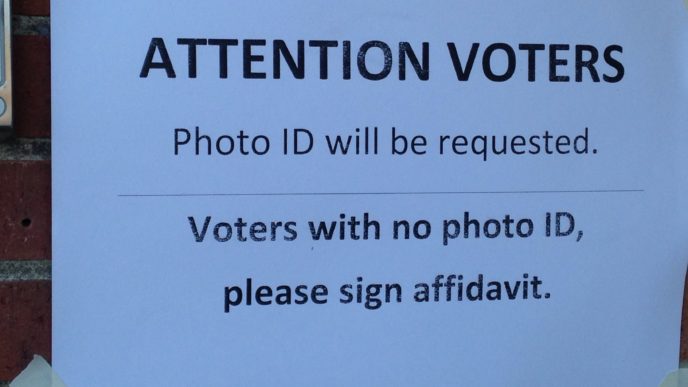
If passed, the bill would continue to allow people to vote without proof, but they would have to fill out an affidavit promising to provide proof within 10 days. This shifts some of the burden to the voter who lacked necessary ID, rather than local election officials who currently have to send the confirmation letter within 90 days of the election.

“The thrust of this bill does not change same-day voter registration,” state Sen. James Gray, R-Rochester, vice chairman of the Election Law and Internal Affairs Committee, told The Daily Signal. “This is about making sure folks who vote here do live here.”

Under the legislation, the local election supervisor would seek to verify a voter’s address. The official would first use available public documents. If the official is unable to verify the voter’s location, the official will remove the name from the voter rolls and send the matter for review by the Secretary of State’s Office.

Republicans control the state’s House of Representatives, and Gov. Chris Sununu also is a Republican, so the political climate favors the legislation. However, the bill faces opposition from national groups.

Amy Busefink, a national voter registration director for Project Vote, an organization opposing voter ID laws, wrote that the bill “will make registering to vote more difficult for students and low-income people.”

Busefink said the bill “proposes steep penalties and issues the threat of criminal investigations that can deter or intimidate voters—especially those who may not have physical proof of domicile because they recently moved—from registering and voting.”

The legislation clearly is needed given what’s known about New Hampshire elections, argued Logan Churchwell, spokesman for the Public Interest Legal Foundation, an organization that advocates stronger voter integrity measures.

“Those votes were cast and still count. That 458 [questionable votes] only reflects the addresses that were undeliverable, it doesn’t reflect the potential fake names that might have been provided,” Churchwell told The Daily Signal. “There could be more who gave a good address and name, it just wasn’t theirs. How many voters might have come from Massachusetts? We don’t know.” (For more from the author of “A 2016 Election Battleground State Is Investigating Potential Voter Fraud” please click HERE)

Follow Joe Miller on Twitter HERE and Facebook HERE.