Posts

Think You Need Proof of Citizenship to Register to Vote? DC Circuit Court Says Not a Chance

Non-citizens voting in our elections poses one of the most foundational threats to our republic. As I detail in chapter eight of my book, Stolen Sovereignty, a record high level of immigration, in conjunction with Motor-Voter laws, has resulted in so many non-citizens voting that elections are actually swayed, especially in close House and Senate elections. In fact, non-citizen voting likely gave Democrats the margin of victory needed to pass Obamacare back in 2010. Now, the federal courts are stealing the sovereignty of the states and disenfranchising the citizenry by preventing them from guarding the benefits of citizenship.

On Friday, the D.C. Circuit Court of Appeals, which has been overrun by leftists, ruled that Kansas, Alabama, and Georgia could not ask for proof of citizenship on mail-in federal voter registration forms — pending the outcome of litigation. In addition to mandating that individuals be allowed to vote without presenting any form of identification, courts have been forcing states to allow individuals to register to vote without even demonstrating that they are citizens. The 2-1 decision overturned a district judge’s denial of an injunction against the federal voter forms requested by Kansas Secretary of State Kris Kobach, noting that the plaintiffs were likely to succeed on the merits of the case. The two majority judges were Judith W. Rogers (a Clinton appointee) and Stephen F. Williams (a Reagan appointee).

As we’ve dissected many times throughout the litigation against basic election integrity laws, Article I, Section 4 of the Constitution clearly grants states the power to determine eligibility for voter registration: “The times, places, and manner of holding elections for senators and representatives, shall be prescribed in each state by the legislature thereof.” The dissenting judge, senior Judge Raymond Randolph, one of the few originalists left on that court, raised this same point and noted that it would “raise serious constitutional doubts” if the federal government prevented states from enforcing its voter qualification laws.

The Tenth Circuit Court of Appeals already “struck down” laws in Arizona and Kansas in November 2014 requiring those who register to vote with federal forms to show proof of citizenship in order to vote. Overturning a district judge’s opinion, the appeals court denied requests from those states that the federal government alter their forms to require the additional proof and protect the integrity of state elections. [1] The Supreme Court, in a growing pattern of letting the lower courts run roughshod over the states, refused to hear the case.

The following year, however, Brian Newby, the Executive Director of the U.S. Election Assistance Commission (EAC) — the agency responsible for drafting the federal voter registration forms — accommodated those states and provided for space on the form to require proof of citizenship. When liberal groups brought the lawsuit against Newby’s decision in the District Court of the District of Columbia, Obama’s DOJ took the unprecedented step in February of consenting to the injunction against the EAC instead of defending the government agency. Kansas got lucky and the case was heard by Judge Richard Leon, perhaps the only originalist left on the D.C. District Court (11 of 12 active judges are Democrat-appointed). Judge Leon summarily blocked the request for an injunction.

But alas, the D.C. Circuit Court of Appeals, which is likely gone forever thanks to a slew of Obama appointees on top of existing judicial activists, granted the request for an injunction.

[As an aside, the destruction of the most important circuit by the Left is another reason why I believe we can never fix the judiciary through conventional means.]

Disenfranchising the citizenry and a permanent Democrat majority

It is serious business when a state cannot even prevent non-citizens from voting and must spend years and millions of dollars to merely have a shot at extracting a few concessions from the feds. As I lament in Stolen Sovereignty, “[T]hat states are prevented from even upholding the integrity of their elections from illegal voters of foreign invaders violates the very essence of popular sovereignty, the social contract, and the social compact expressed in the preamble of the Declaration.”

Motor-Voter laws, unless states have the ability to protect themselves against non-citizens voting, will create a permanent Democrat majority. In 2015 alone, 605,000 drivers’ licenses were handed out to illegal aliens in California, accounting for half of all licenses issued in the state that year! How many of them are now registered to vote?

But the problem is not just with illegal aliens. As the flood of legal immigration continues, the growth in non-citizens voting will only continue to skyrocket. While we don’t want illegal immigrants obtaining driver’s licenses, we certainly want legal immigrants to have all the privileges of residents, albeit not the citizen right to vote. But with near-automatic voter registration of those applying for driver’s licenses — without the ability to check for citizenship status — how many legal immigrants are registered to vote and don’t even realize there is something wrong with it?

As the Center for Immigration Studies reports today, “[I]n 1990, immigrants were at least 20 percent of the adult population (18-plus) in just 44 counties; by 2014 they were at least 20 percent of the adult population in 152 counties.” They further note that “the immigrant share of adults has more than quadrupled in 232 counties.” Putting the broader immigration debate aside for a moment, even those who favor mass immigration must admit that the unprecedented growth in immigration poses a foundational risk unless states are able to ensure that non-citizens are not registering to vote through Motor-Voter forms.

If nothing is done about the federal judiciary, unelected judges will not only render elections moot by their self-declared status as the final arbiter of every political and social issue; they will prevent Republicans from winning elections in the first place by stealing the sovereignty of the citizen. (For more from the author of “Think You Need Proof of Citizenship to Register to Vote? DC Circuit Court Says Not a Chance” please click HERE)

Follow Joe Miller on Twitter HERE and Facebook HERE.

Hacking of Election Data Raises Concerns for States Without Voter ID

Hacking incidents at voter registration systems in Arizona and Illinois could demonstrate the need for stronger voter identification laws and the flaw with pushing for online voting and registration, experts said.

“We can’t afford this vulnerability in our election systems,” Mark Meckler, president of Citizens for Self-Governance and a former internet technology lawyer, told The Daily Signal in a phone interview.

“We know it can disrupt the integrity of an election,” Meckler said. “There are so many states with no voter ID laws, that hacking into voter registration is a danger.”

The FBI is investigating the hacking of 200,000 voter records in Illinois and a hacking that forced Arizona to take its statewide voter registration system offline.

Illinois officials told news agencies that no information was changed. The Arizona hacking was perpetrated by Russian actors, according to news reports—although investigators have not said whether they believed it to be the work of Moscow or a private criminal enterprise.

As of June, 31 states and the District of Columbia allowed voter registration online, according to the National Conference of State Legislatures. A total of 34 states had some form of voter ID laws in place. However, some states only request that voters present ID, rather than require it.

“It’s not just foreign hackers, but domestic hackers as well,” Meckler said. “All of us are vulnerable to hacking. No matter how good we get at preventing hacking, the hackers will always get better.”

The Obama administration is taking the threat seriously, but believes Americans should not lose confidence in the system, White House press secretary Josh Earnest said.

“People can have a lot of confidence in the election system in part because it’s not centralized,” Earnest told reporters during Tuesday’s press briefing, adding:

Elections are administered and conducted by state and local authorities, which means you have a patchwork of systems across the country that maintain the records of elections. Sometimes the consequences for that kind of that very system means that it’s hard to make reforms across the board. That also makes it harder to hack the system.

As The Daily Signal previously reported, Homeland Security Secretary Jeh Johnson last week had a conference call with election officials from across the country in which they discussed the possible protection of state election systems as “critical infrastructure.”

“The response from DHS is a pretty good indication of how seriously we take this,” Earnest told reporters. “There is an active discussion on the president’s national security team of designating election administration systems in the United States as critical infrastructure. If so, that would qualify those systems for enhanced protections and resources from the federal government.”

Election experts—including Hans von Spakovsky, a senior legal fellow at The Heritage Foundation—agree it’s highly improbable a national election could be hacked, because of the decentralized system.

However, von Spakovsky contends that a targeted hacking of certain states has the potential to shift an election.

“If it’s an organized effort, and someone hacks into a system and falsely registers bogus voters, you could hire a crew of people to vote multiple times under different names,” von Spakovsky told The Daily Signal. “That’s a problem for states with no voter ID laws. There is no way to prevent that.”

This should be a further lesson to states and localities to avoid online voter registration and especially online voting, which could be particularly vulnerable to hackers, he said.

Von Spakovsky, a former member of the Federal Election Commission, noted that the Republican Party of Utah “stupidly” allowed online voting for its presidential primary in March. That resulted in numerous problems, primarily with voters accessing the system.

Voting machines are not on a network, thus any tampering would have to take place with the individual machine using an available device that allows someone to reset the voting machine, then vote more than once.

Conversely, voter registration information typically is on a network at either the state or local level—making it available for hackers. If citizens can register to vote online, the information would become even more vulnerable, von Spakovsky said.

“Online voter registration would give hackers another point to access information online,” he said. (For more from the author of “Hacking of Election Data Raises Concerns for States Without Voter ID” please click HERE)

Follow Joe Miller on Twitter HERE and Facebook HERE.
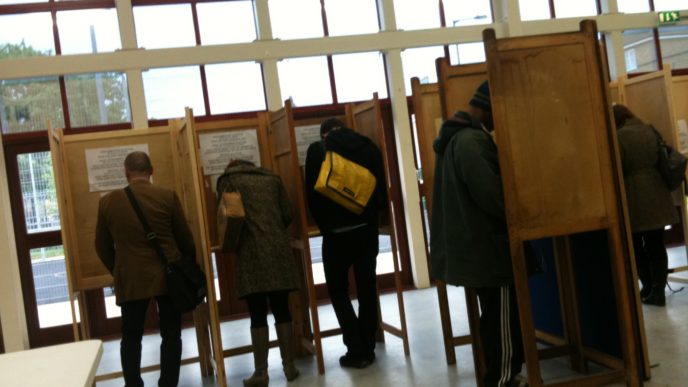
Security Officials Consider National Hacking of Voting Machines Extremely Unlikely. Here’s Why.

(Editor’s note: although presented with incontrovertible evidence, one of the so-called experts quoted in this article ignored the wide-spread fraud in Alaska’s 2010 Senate election where thousands of ballots were fraudulently submitted to the state’s Division of Elections. With the news today of even more Alaskan fraud, we should read the below conclusions with a very skeptical eye.)

Successful computer hacks at major federal agencies, large corporations, and the Democratic National Committee have sparked concern that clever infiltrators from outside the country might attempt to tinker with the 2016 election results.

The Department of Homeland Security asserts there is no credible cyberthreat to the 2016 election results, and state election officials and other experts concur that a grand scale hack is extremely unlikely—at least on a national level.

“Recent high-profile hackings and concerns about the integrity of the vote have been on the front page more than once,” Connecticut Secretary of the State Denise Merrill said in a press conference Wednesday.

Merrill, also president of the National Association of Secretaries of State, added:

It’s highly improbable at best that a national election could be hacked. First of all, there is no national system of elections. Our election system is extremely decentralized, It is run [individually] by all 50 states and within those states, the counties are really responsible.

There was a strong push for internet voting, Merrill said, but that’s not something elections officials around the country found prudent.

“We had pressure to do internet voting, then something happens like Target getting hacked, and people say that’s not such a good idea.”

The absence of a national hack threat doesn’t mean zero risk. CBS News reported on a $15 magnetic device, available online, that can be used on individual electronic voting machines. Someone who is knowledgeable could insert the card, reset the machine, and vote more than once.

Hans von Spakovsky, a senior legal fellow at The Heritage Foundation who studies election issues, noted that even at a single polling place, none of the machines are networked. Thus, the scale of the threat is likely less than other voting fraud activities.

“The threat of hacking is greatly exaggerated,” von Spakovsky told The Daily Signal in an interview. “It could be a problem with individual voting machines, but individual electronic voting machines are not part of any national network.”

Nevertheless, lawmakers and commentators raise the possibility, particularly after allegations that the Russian Federal Security Service was behind the hacking of the Democratic National Committee and the Democratic Congressional Campaign Committee in what Sen. Tom Carper, D-Del., said might be an attempt to try to manipulate the U.S. election.

“If these reports are accurate, such an intrusion raises concerns about the ability of foreign actors to interfere in the American political process during the upcoming election, including through cyber attacks targeting electronic voting machines or the information technology of state and local election officials,” Carper, ranking member of the Senate Homeland Security and Governmental Affairs Committee, said in an Aug. 8 letter to Homeland Security Secretary Jeh Johnson.

Carper’s letter noted that in 2004 the U.S. Computer Emergency Readiness Team identified vulnerabilities in voting machines that “would allow malicious actors to modify vote totals.”

And, he wrote, the Argonne National Laboratory in Illinois in 2011 and the Virginia State Board of Elections in 2015 issued reports that “identified issues that left certain electronic voting machines vulnerable to physical or wireless intrusion without detection.”

Carper also said the CIA found that bad actors were attempting to manipulate election outcomes in other countries.

Johnson hosted a conference call Monday with the National Association of Secretaries of State, offering assistance from his department as well as from the Justice Department and the Commerce Department’s National Institute for Standards and Technology (NIST).

In a readout of the call, homeland security officials said:

While DHS is not aware of any specific or credible cybersecurity threats relating to the upcoming general election systems, Secretary Johnson reiterated that DHS, the Election Assistance Commission, NIST, and DOJ are available to offer support and assistance in protecting against cyberattacks.

Johnson told the state election officials that homeland security officials would consider designating voting machines as “critical infrastructure,” a national protection category given to 16 sectors including energy, emergency services, and food supply that the nation depends on to function. The readout added:

As part of the ongoing effort, the secretary also announced that DHS is convening a Voting Infrastructure Cybersecurity Action Campaign with experts from all levels of government and the private sector to raise awareness of cybersecurity risks potentially affecting voting infrastructure and promote the security and resilience of the electoral process.

In a statement Aug. 5, the National Association of Secretaries of State insisted a major hacking effort is extremely unlikely, but that officials should make other efforts to protect the aging electronic machines.

“A national hacking of the election is highly improbable due to our unique, decentralized process,” a statement by the association said. “Each state and locality conducts its own system of voting, complete with standards and security requirements for equipment and software. Most states publicly conduct logic and accuracy testing of their machines prior to the election to ensure that they are working and tabulating properly, then they are sealed until Election Day to prevent tampering. Furthermore, electronic voting machines are not internet-based and do not connect to each other online.”

Still, voices on both the right and the left raised concerns.

The conservative editorial board of Investor’s Business Daily called hacking “a very realistic concern, one that has been raised for years, and if it were to happen, it could have a huge impact, since around 4 in 10 voters will be casting ballots using electronic voting machines this year.”

The editorial added: “The real risk isn’t that Russians or some other foreign government will hack our elections. It’s that homegrown partisan hackers will do so to affect the results in key districts or states.”

Changing results isn’t the only goal for a cyberattack, Lawrence Norden, deputy director of the democracy program at the left-leaning Brennan Center for Justice, wrote in an op-ed for NBC News:

The threats to the integrity of our elections go beyond potential hacks to change the vote count on polling place machines. Attackers could attempt a ‘denial of service’ attack, where machines simply crash more often. In those cases, voters could be forced to wait in line for hours while technicians work to fix machines or replace them. Many would give up and never vote. Alternatively, the systems could be attacked after voting is complete, when results from individual machines are tallied at a central location.

(For more from the author of “Security Officials Consider National Hacking of Voting Machines Extremely Unlikely. Here’s Why.” please click HERE)

Follow Joe Miller on Twitter HERE and Facebook HERE.

INSANE Court Nixes NC Voter ID Law, Smears Every Thinking Person as Racist

Here we go again: I sound like a broken record by now, but yet another court has thrown out a voter ID law. Last week, the Fifth Circuit gutted Texas’s voter ID law under the ludicrous notion that it discriminates against minorities. Today, the Fourth Circuit overturned North Carolina’s voter ID law and went a step further than the Fifth Circuit, asserting that the law was “passed with racially discriminatory intent.” In addition, they tossed out state laws limiting early voting, same-day registration, out-of-precinct voting, and preregistration—all Democrat election “innovations” that are fraught with fraud and manifestly against our founding concept of Election Day.

As I noted last week, states have full authority over the methods and processes of conducting elections, while the federal courts have no power in that realm.

This ruling comes on the heels of the Fourth Circuit mandating transgender bathrooms and remaking North Carolina’s election maps in middle of the campaign season after millions of dollars and hours logged by volunteers had been spent campaigning in the districts drawn by the duly elected state legislature.

In N.C. State Conference of the NAACP v. Patrick McCrory, Judges Diana Motz, James Wynn, and Henry Floyd invalidated the laws clamping down on non-traditional methods of voting, while the latter two (over the dissent of Motz) agreed to strike down the revised photo ID law as well. We have reached a point in time when all the circuits have codified the entire Democrat Party racial agenda into the Fourteenth Amendment, Civil Rights Act, and Voting Right Act, to the extent that even the most basic laws protecting the franchise of the entire citizenry are thrown out by the courts. The judges openly said that because these laws would result in less Democrat votes, and because most African-Americans vote Democrat, these laws are discriminatory. This ruling comes just a week after a federal judge in Michigan mandated that the state must offer a box on the ballot for straight-ticket voting denoting the Democratic candidates so African-Americans can identify them. This is insane!

This ruling overturns a 485-page district judge’s opinion, which upheld the state laws with unassailable facts and impressive scholarship. The Left will always find a judge at any level willing to enshrine their policies. Conservatives have to win every case, they only have to win once and the law is permanently changed.

As a result of this ruling, one week of early voting and preregistration for 16 and 17-year-olds will be forced upon North Carolina. Practices that our founders would likely have ruled unconstitutional are now being mandated by the courts. The Constitution is unconstitutional.

It has gotten so bad that we can’t even get a circuit split on most issues to even afford the eminent tribunal – the Supreme Court – to render its edict on society. Remember, even the most sacred conscience rights of the Little Sisters of the Poor and similar religious institutions just barely got one circuit to uphold the most foundational of inalienable rights after over a dozen circuits ruled against them. The Supreme Court couldn’t even agree to uphold this sacred right and remanded it back to the lower courts.

There is simply no point to winning elections anymore – on a state or federal level – unless Congress strips the courts of their illegal power grab, and to a certain extent, states begin saying no. The unelected judges are essentially ruling our Constitution and the preamble of the Declaration’s dictate for popular sovereignty – unconstitutional. Disenfranchising the citizenry is something that even King George never did to the colonies in their respective state legislative elections. It makes no sense that the unelected judiciary, especially the lower courts – which themselves are a complete creation of Congress – have such authority.

As Conservative Review’s very own Editor in Chief, Mark Levin, observed over a decade ago in his book, Men in Black, “judges are appointed for life because they are not politicians. And because they’re not politicians, they’re not directly accountable to the people and are not subject to elections.”

Not only will court interference render elections meaningless in terms of pursuing conservative policies, we won’t even have the ability to win elections anymore thanks to the Judiciary’s block and tackle strategy in securing the Democrat voter fraud scheme.

Once again, I urge everyone to pick up a copy of Stolen Sovereignty: How to Stop Unelected Judges from Transforming America. We can’t afford another 50 years of wringing our hands over the courts and merely hoping to change the irremediably broken profession by “appointing better judges.” It will take years before we could even make a dent in the circuits, and as I plan to demonstrate next week, there are a dozen other reasons why this won’t work in the short term and long term.

The legal profession has declared war on the very foundation of our democratic republic and state sovereignty. It’s time to respond in kind. (For more from the author of “INSANE Court Nixes NC Voter ID Law, Smears Every Thinking Person as Racist” please click HERE)

Watch a recent interview with the author below:

Follow Joe Miller on Twitter HERE and Facebook HERE.

Politics or Principles? Virginia Gov. Defies High Court, Will Give Felons Right to Vote

Virginia Governor Terry McAuliffe has vowed to individually sign 13,000 clemency orders allowing ex-cons to vote, after the Virginia Supreme Court invalidated his executive order restoring voting rights to nearly 200,000 Virginia convicts.

“The men and women whose voting rights were restored by my executive action should not be alarmed,” the governor said in a statement. “I will expeditiously sign nearly 13,000 individual orders to restore the fundamental rights of the citizens who have had their rights restored and registered to vote. And I will continue to sign orders until I have completed restoration for all 200,000 Virginians.”

The move could have a significant impact on the 2016 presidential election. McAuliffe’s action extends ballot access to a largely Democratic constituency in a key swing state. The governor is a long time friend of presumptive Democrat presidential nominee Hillary Clinton.

The governor and other Virginia Democrats allege the state’s blanket ban on ex-felon voting is the strongest remaining vestige of Jim Crow-era disenfranchisement. Fully one in five black Virginians are forbidden from voting because of the ban.

The governor issued a sweeping executive order restoring voting rights to 200,000 convicted felons in April. The order also restored the right to serve on a jury or stand for public office. The Virginia Supreme Court struck down the law on Friday, ruling that such a broad and indiscriminate extension of clemency was not imagined by the clemency power in the state constitution. (Read more from “Politics or Principles? Virginia Gov. Defies High Court, Will Give Felons Right to Vote” HERE)

Follow Joe Miller on Twitter HERE and Facebook HERE.

Should Released Felons Have Their Voting Rights Restored?

Earlier this year, Virginia Gov. Terry McAuliffe, a Democrat, issued an executive order to restore voting rights to felons who have completed their prison sentences.

McAuliffe’s action is being challenged in lawsuits from Judicial Watch and Republican leaders of Virginia’s House and Senate. They say McAuliffe violated the state constitution and exceeded his authority by restoring voting rights to 206,000 released felons all at once, rather than individually through an application process.

We take a look at the debate and explain what’s at stake. So what do you think? Leave a comment below. (For more from the author of “Should Released Felons Have Their Voting Rights Restored?” please click HERE)

Follow Joe Miller on Twitter HERE and Facebook HERE.
California Refuses to Admit Its Voter Fraud Problem

Hollywood has always loved making films about the walking dead, but in Southern California it appears they have a real life problem with “zombie” voters.

An investigation by CBSLA2 and KCAL9 found that hundreds of deceased persons are still on voter registration rolls in the area, and that many of these names have been voting for years in Los Angeles.

For example, John Cenkner died in 2003 according to Social Security Administration records, yet he voted in the 2004, 2005, 2006, 2008 and 2010 elections. His daughter told the station that she was “astounded” and couldn’t “understand how anybody” could get away with this.

Another voter, Julita Abutin, died in 2006 but voted in 2008, 2010, 2012, and 2014. According to CBS, the county confirmed they have “signed vote-by-mail envelopes” from Abutin since she passed away. So either someone has been forging her signature or her ghost has quite an earthly presence.

The investigation revealed that 265 deceases persons voted in Southern California, 215 of them in Los Angeles County. Thirty-two were repeat voters, with eight posthumously-cast ballots each. One woman who died in 1988 has been voting for 26 years, including in the 2014 election.

This report comes twenty years after the contested election of Rep. Loretta Sanchez. D-Calif., from this same area. An investigation by a U.S. House committee found that hundreds of illegal ballots were cast by noncitizens and improper absentee ballots.

In that 1996 election, when she defeated incumbent Bob Dornan, a winning margin of 979 votes was whittled down to only 35 votes or fewer when that voter fraud was factored in. In cases like these, where elections are decided by only a small number of votes, the harmful effects of voter fraud are most obvious.

Yet here, two decades later, California has still not taken the necessary steps to ensure the reliability of its electoral system.

As a result of the investigation, L.A. county supervisors called for an investigation into the findings. Even if these particular zombie voters did not change the outcome of an election, each fraudulently cast ballot stole and diluted the vote of a legitimate voter.

Cases like these and many others show that voter fraud is a real phenomenon and a potential threat to the integrity of the election process.

The Los Angeles county registrar pointed to the 1200-2000 voter registrations removed every month to update records and told reporters, “There’s really no way to connect a person whose death is recorded with a person who is registered to vote unless we get some kind of notification from the family.”

But that is plain nonsense. Other states do frequent comparisons between their voter registration lists and the death databases maintained by the Social Security Administration, and other state agencies consult vital records departments in order to remove voters who have died.

The CBS investigation shows both that voter fraud exists and that this type of fraudulent voting is detectable through proper investigation.

CBS reports that California is the only state that does not comply with the Help America Vote Act of 2002, something the Obama administration has basically ignored.

The Help America Vote Act establishes mandatory minimum standards of accuracy for state voter registration lists and requires states to engage in regular maintenance and updates to remove ineligible voters who die or move away.

California is obviously not complying with these requirements. (For more from the author of “California Refuses to Admit Its Voter Fraud Problem” please click HERE)

Follow Joe Miller on Twitter HERE and Facebook HERE.

Early Voting Is Dumb and Unconstitutional

You might have missed it, but voting has already begun. No, I’m not referring to the South Carolina primary; I’m referring to the Texas primary … scheduled for March 1. You heard that right. Voting for the March 1 primary has begun two weeks early, even before the South Carolina primary. Other Super Tuesday primary states, such as Oklahoma, Tennessee, and Arkansas, have early voting as well.

Art. II §1 cl. 4 of the Constitution states: “The Congress may determine the Time of chusing the Electors, and the Day on which they shall give their Votes; which Day shall be the same throughout the United States.”

In 1845, Congress designated that day as “the first Tuesday after the first Monday in November.” For some states to allow voting on multiple days prior to the one set by Congress and have more than half their votes cast before Election Day is incontrovertibly unconstitutional.

Common sense also dictates that we should have a single national election day. The notion that, over the course of a volatile campaign, different people would vote at different times is absurd because there are so many events that could alter the public perception about a candidate. It makes sense that everyone should observe the same campaign for the same duration and render their verdict on a uniform set of information when the entire campaign is completed.

That some states hold voting open for an entire month before the general election in November is clearly against the spirit of the Constitution and the foundation of democratic elections. There is already a remedy for those who can’t show up at the polls on the designated Election Day — the absentee ballot. Now we have an entire month of early voting in some states, the turnout of which often influences the outcome of the legitimate Election Day.

Obviously, the Constitution is silent on the question of primaries because that is a party election, not a constitutionally mandated election. Political parties, in cooperation with the states, can do what they please. And clearly, primaries were designed to be staggered over the period of a few months to allow new candidates to slowly gain traction. But the notion that individual voters within the same state would vote at different times definitely violates the same spirit of free democratic elections.

In some ways early voting during the primaries is even worse than during the general election. For the most part, people voting in the same primary share similar values and priorities but are unsure as to which candidate best represents those values. This is why primaries are so volatile. We see candidates rise and tumble within a few days based on one statement, revelation, or debate performance. Who knows which candidates will be seriously competing by March 1? Who knows what will be revealed about any number of candidates. It’s simply absurd to begin voting two weeks ahead of time during a presidential primary with such a large field.

The bottom line is that we already have enough low-information voters casting ballots that will affect the future of the republic. There is no need for a protracted “election month” just for the purposes of boosting turnout. Anyone who is incapable of voting in person on Election Day or casting an absentee ballot shouldn’t participate in the process anyway. (For more from the author of “Early Voting Is Dumb and Unconstitutional” please click HERE)

Watch a recent interview with the author below:

Follow Joe Miller on Twitter HERE and Facebook HERE.

DC Council Wants to Give Non-Citizens the Right to Vote

District of Columbia council members voiced their support Wednesday for a new law that would allow non-citizens to vote in local elections.

“These are residents who are well on their paths to citizenship,” Councilman David Grosso said. “Unfortunately not all of our residents have a say in the politicians who are elected to represent them.”

The bill would allow permanent residents in the city who are not American citizens to vote in elections for mayor, city council, the attorney general and State Board of Education members, among other things.

“They are our neighbors and our friends and they want to see our city flourish, yet they have no say in how the city’s government is run,” said Councilwoman Elissa Silverman.

Silverman went on to say that nearly one in eight D.C. citizens are immigrants, but only about 30 percent of them are American citizens, and that “all long-term residents of a city should have a right to have a choice in who represents them.” (Read more from “DC Wants to Give Non-Citizens the Right to Vote” HERE)

Follow Joe Miller on Twitter HERE and Facebook HERE.

Hack the Vote: Cyber Experts Say Ballot Machines Remain Easy Targets

The recent cyber theft of millions of personnel records from the federal government was sophisticated and potentially crippling, but hackers with just rudimentary skills could easily do even more damage by targeting voting machines, according to security experts.

Voter fraud is nearly as old as elections themselves, and different states and precincts use different voting systems and machines. But in many cases, even the electronic ballots could be manipulated remotely, according to a new report by the Commonwealth Security and Risk Management for the Virginia Information Technologies Agency. That report found that the AVS WINVote machines Virginia has used since 2002 have such flimsy security that an amateur hacker could change votes from outside a polling location.

“This means anyone could have broken into the machines from the parking lot,” said Cris Thomas, a strategist with the Columbia, Md.-based Tenable Network Security, one of the nation’s leading cyber and enterprise security firms. “Our entire democracy depends on systems with minimal, easily bypassed security.”

The report was commissioned after one precinct in Virginia reported “unusual activity with some of the devices used to capture votes,” during last November’s statewide elections.

“Security deficiencies were identified in multiple areas, including physical controls, network access, operating system controls, data protection, and the voting tally process,” the report found. “The combination of critical vulnerabilities in these areas, along with the ability to remotely modify votes discretely, is considered to present a significant risk. This heightened level of risk has led VITA security staff to conclude that malicious third party could be able to alter votes on these devices. These machines should not remain in service.” (Read more from “Hack the Vote: Cyber Experts Say Ballot Machines Easy Targets” HERE)

Follow Joe Miller on Twitter HERE and Facebook HERE.