What the New York Times Got Devastatingly Wrong About the Orlando Massacre
In an editorial, The New York Times viewed the massacre in Orlando as an example of hate against the LGBT community. The liberal newspaper blamed Republican efforts such as the North Carolina law that requires individuals to use the bathroom that corresponds to their sex at birth and “more than 200 anti-L.G.B.T. bills have been introduced in 34 states,” as factors that contributed to an atmosphere of bigotry conducive for violent reactions to gays and transgender people.
Nowhere in its 630 words did the article mention the fact that Omar Mateen was a Muslim and pledged his allegiance to ISIS – the terrorist group that executes homosexuals.
Instead, the editorial stated, “the precise motivation for the rampage remains unclear…”
Sadly, it’s not just the New York Times that is jumping on the chance to blame anyone and anything BUT the real enemy. Democratic politicians, the media and progressive organizations avoided blaming the ISIS-inspired mass shooting on radical Islam. Instead, they point fingers at guns and supposed bias against the LGBT community by Republicans and Christian conservatives.
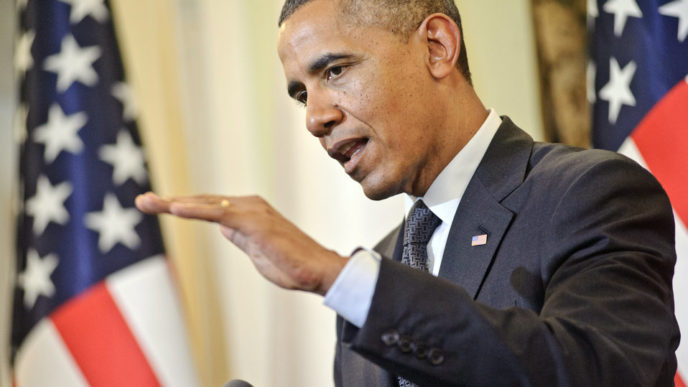
Speaking from the Oval Office about the shooting, President Obama emphasized the attack was not “part of a larger plot,” and added that the motivation behind the shooting was unknown.
And as usual, Obama then pivoted to guns saying, “We are also going to have to think about the risks we are willing to take by being so lax in how we make very powerful firearms available to the people in this country.”
Reacting to the shooting, and acting as Obama’s puppets, Senate Democrats pushed for gun control measures following the attack. Democrats launched a filibuster to force votes on preventing gun sales to individuals on a terrorist watch list and measures to tighten background checks.
In a tweet, Senator Chris Murphy (D-CT) proudly announced his filibuster accomplishment.
I am proud to announce that after 14+ hours on the floor, we will have a vote on closing the terror gap & universal background checks
— Chris Murphy (@ChrisMurphyCT) June 16, 2016
Democrat’s intense focus on guns and refusal to address ISIS drew criticism from Carl Higbie, former Navy SEAL and author of Enemies Foreign and Domestic: A SEAL’s Story. According to Higbie, Democrats are exploiting the terrorist attack to advance their progressive political agenda on guns and to protect Obama and Hillary Clinton from their foreign policy failure to defeat ISIS.
“Many on the left are jumping on this tragedy as a chance to push the same agenda they have been pushing for years. They also do not want to admit that their failed foreign policy could have in any way contributed to this,” said Higbie in an interview with Conservative Review. He added, “This is a scapegoat to not link Hillary Clinton to the influence of ISIS.”
Higbie believes the focus needs to be on the radical ideology and not the objects used in attacks noting, “No one blamed Boeing for the planes hitting the towers. We must not blame the objects, we must blame the ideology that possesses people to use them for evil.”
Amanda Marcotte, writing for Salon, criticized conservatives for citing radical Islam as the cause for the violent attack and added there isn’t a difference between Christianity and Islam regarding violence.
In tweets, ACLU attorneys added to the liberal view that avoided linking the terrorist attack to ISIS and went further by directly blaming the “Christian Right” for the attack citing the 200 anti-LGBT bills that were introduced this year.
Think Progress, a progressive policy group, said Christian views toward the LGBT community are as violent as radical Islam. Yes, you read that right.
Abraham Hamilton III, a public policy analyst for the American Family Association, a Christian and family values organization, was dismayed over the blame being assigned to Christians and believes it’s dangerous to not identify ISIS as the true cause of the attack.
“The speed with which some have turned their ire onto Christianity, as a result of this tragedy, [is] appalling and astounding. It’s sickening how quickly some are willing to politicize the death of some many,” Hamilton said in an interview with Conservative Review.
Hamilton believes there is no ambiguity regarding Mateen’s motivation since the murderer called 911 and pledged his allegiance to ISIS and its leader, Abu Bakr Al-Baghdadi, and reportedly yelled “Allahu Akbar” during the shooting.
Additionally, Hamilton noted that disagreement over an issue does not equate animus against others. He pointed out that Chick-Fil-A, the restaurant founded by Christians and normally closed on Sundays, opened last Sunday to serve food and drinks for the people waiting in line in Orlando to donate blood for the victims of the attack.
Finally, Hamilton is concerned about the failure of Obama and The New York Times to identify ISIS as an organization responsible for the attack especially science ISIS claimed responsibility for the shootings at the Pulse nightclub.
Hamilton concluded, “Failure or unwillingness to identify those who seek to destroy us puts our citizens more at risk of danger.”
Unlike the 911 attack by Al Qaeda that unified the nation against a common enemy, the response to the terrorist attack in Orlando is split between ideological lines. (For more from the author of “What the New York Times Got Devastatingly Wrong About the Orlando Massacre” please click HERE)
Follow Joe Miller on Twitter HERE and Facebook HERE.