Posts

Legendary Entertainer Is Quick to Respond to Inauguration Announcement

Shortly after the announcement that Elton John would be performing at the presidential inauguration in January, the award-winning singer and pianist refuted the claim.

In an interview Tuesday with BBC, Anthony Scaramucci, a member of President-elect Trump’s inauguration committee, said John would be performing at the event.

“Elton John is going to be doing our concert on the mall for inauguration,” Scaramucci told the BBC.

Scaramucci went on to say that having John perform “shows our committment to gay rights.”

He added, “This will be the first American president in U.S. history that enters the White House with a pro-gay rights stance.”

After hearing Scaramucci’s announcement, a spokesperson for the legendary singer was quick to set the record straight.

“Elton will not be performing at Trump’s inauguration,” the spokesman told the New York Post.

Throughout the presidential campaign, John was a supporter of Democratic candidate Hillary Clinton. “We need a humanitarian in the White House, not a barbarian,” John said. “She is, without a doubt, the only candidate supremely qualified to lead this great nation in these challenging times.”

Although Trump used several of the artist’s songs on the campaign trail, “Elton’s music has not been requested for use in any official capacity by Donald Trump,” the singer’s spokesman said. “Any use of his music should not be seen as an endorsement of Donald Trump by Elton.”

In February, John told the Guardian he didn’t want his music associated with an American election campaign because he is British.

He admitted he had met Trump and was treated nicely; however, they have different political views.

“I’m not a Republican in a million years,” said John.

In an earlier announcement based on a report from the New York Daily News, musician Vince Neil of the band Motley Crue said the band had been invited to perform at the inauguration, “no matter who won.”

But Neil later said that after the Republicans won the election, the band’s invitation was rescinded. (For more from the author of “Legendary Entertainer Is Quick to Respond to Inauguration Announcement” please click HERE)

Follow Joe Miller on Twitter HERE and Facebook HERE.

Donald Trump Shouldn’t Trust Anything Chuck Schumer Says on Supreme Court Nominees

When it comes to loathsome political figures, there isn’t a person serving at any level of government than Sen. Harry Reid, D-Nev. (F, 2%). He’s just awful, and the Senate will be a better place now that he is leaving. That said, one of those most conniving, back-stabbing Senators will be taking his place.

New York Senator Charles Schumer, D-N.Y. (F, 2%) is a career politician through and through. Schumer was elected to office in 1974, soon after graduating from Harvard Law School. Schumer passed the New York State Bar Exam but never practiced. He’s never worked a single day in the private sector. He is also fond of using the word “bipartisan” when he engages in some of the most partisan nonsense of anybody in the entire Congress.

Schumer was on Fox News Sunday this week. When asked by Chris Wallace about the Supreme Court and Donald Trump, Schumer said the following:

WALLACE: Let’s talk about an issue where you won’t agree and that is that Donald Trump intends to name a conservative, a real conservative, to the Supreme Court.

SCHUMER: Right.

WALLACE: If you think that it’s the wrong person, are you prepared — and will Democrats be prepared to filibuster that nomination, which has only happened once in the history of the Senate.

SCHUMER: I would hope first and foremost that President Trump nominates a mainstream nominee capable of getting bipartisan support.

If he does, then we’ll give it just a very, very thorough vetting, but we won’t ipso facto say no.

If it’s out of the mainstream, yes, we’re going to fight that nominee tooth and nail. And let’s remember two things. Let’s —

WALLACE: But wait. Fight — does that mean filibuster?

SCHUMER: Let me say two things.

First, we — when we had power, we changed the rules, but I argued with Harry Reid not to change it for Supreme Court, because it should get that bipartisan support.

So, it’s still 60 votes. We didn’t change the rules. If they, you know, I hope our Republicans won’t.

And second, when our Republican colleagues say, “Let’s do this quickly, without filibuster,” they don’t come here with clear, clean hands. After what they did to Merrick Garland and held him up for a whole year, a bipartisan nominee who Senator Hatch, conservative Republican, Utah, former head of Judiciary, said would be a very good nominee.

So, let’s — let’s try to get a mainstream nominee, but let’s not jump to conclusions, because what the Republicans did, past is sometimes prologue.

To get straight to the point: A “mainstream” nominee is one Schumer supports. In 2010, Schumer had the audacity to say about Sonia Sotomayor, “…no one questioned that she was out of the mainstream.” Not even Politifact bought this and rated the claim “false” showing some Republicans said she was out of the mainstream.

Schumer’s blather about bipartisanship and the treatment of Merrick Garland is ridiculous considering he gave a speech in 2007 imploring Democrats to reject any Supreme Court nominee by President George W. Bush in the wake of the confirmations of John Roberts and Samuel Alito. Schumer said:

We should reverse the presumption of confirmation. The Supreme Court is dangerously out of balance. We cannot afford to see Justice Stevens replaced by another Roberts; or Justice Ginsburg by another Alito.

Given the track record of this President and the experience of obfuscation at the hearings, with respect to the Supreme Court, at least: I will recommend to my colleagues that we should not confirm a Supreme Court nominee except in extraordinary circumstances.

There are a few things to consider. First, the Republicans did not engage in any poor treatment of Garland. When Justice Scalia died, the GOP immediately informed President Obama they would not consider a Supreme Court nominee during an election year. Obama went ahead and nominated Garland anyway, arguing the Senate had some constitutional obligation to consider him, even though no such legal edict exists.

Secondly, Schumer’s complaints about a one year wait for Garland are hypocritical given there were 543 days left in Bush’s administration when he gave this speech. Schumer was perfectly fine with filibustering a nominee for nearly 18 months.

Finally, exactly what obfuscation is Schumer talking about? He not only voted against Roberts and Alito, but he also worked with then-Senator Obama to filibuster Alito’s nomination. Is Senator Schumer arguing his Democratic colleagues are not smart enough to see they were being hoodwinked? Also, if he’s so concerned about obfuscation, where was his denouncement of Elana Kagan who ruled to affirm same-sex marriage is a constitutionally protected right when she testified to the exact opposite during her confirmation hearings?

Donald Trump submitted a list of very well qualified people to nominate to the Supreme Court. Charles Schumer will no doubt argue all of them are out of the “mainstream.” It’s going to be up to President Trump to tell Schumer he doesn’t get to make a choice. His role is to take part in the hearings and then put it to an up or down vote. (For more from the author of “Donald Trump Shouldn’t Trust Anything Chuck Schumer Says on Supreme Court Nominees” please click HERE)

Follow Joe Miller on Twitter HERE and Facebook HERE.

How Trump Can Reshape US Policy Toward Refugees

As a candidate for president, Donald Trump advocated a restrictive U.S. policy toward refugee resettlement, and other forms of legal immigration.

In his speech accepting the Republican nomination for president, Trump said he would suspend immigration from countries that are “compromised by terrorism.”

Trump, when he assumes office in January, will find that he has significant authority to fulfill his pledge.

“He can decide how many refugees we take and from what regions of the world we take them,” said Kevin Appleby, senior director of international migration policy at the Center for Migration Studies in New York, in an interview with The Daily Signal. “He has a pretty broad brush to pick and choose who he thinks is worthy of admission to the United States.”

Trump has not clarified his position on refugees since becoming president-elect.

But throughout his campaign, Trump targeted the U.S. refugee resettlement program, arguing the government’s vetting system needed to be tougher, especially for Syrians fleeing war and terrorism.

The Obama administration says the current vetting process for Syrian refugees is the most stringent screening for any category of legal immigrant. The process can take up to two years and involves in-person interviews, health tests, and other security checks with multiple government agencies, including the Department of Homeland Security and the State Department.

About 14,500 Syrians have been resettled in the U.S. since last October. There is no known case of a Syrian refugee being involved in a terror plot in the U.S. In January, the U.S. government arrested two men on terrorism-related charges who came to the U.S. as refugees from Iraq.

In September, the Obama administration announced that it wants to resettle 110,000 refugees from around the world—including a substantial number of Syrians—for the fiscal year that began Oct. 1. That’s up from 85,000 refugees last year.

The Refugee Act of 1980 gives the U.S. president unilateral power over how many refugees the country admits each fiscal year, and where they come from.

Congress is only consulted in the process and does not get an up or down vote on the numbers.

Traditionally, the refugee resettlement gets broad bipartisan support, but this year, many Republicans protested President Barack Obama’s pledge to raise the number admitted to the U.S.

“This has become a politically correct program where we are led to believe that we have to take refugees from all over the world no matter how dangerous the threat is,” said Rep. Brian Babin, R-Texas, in an interview with The Daily Signal. “We are out here trying to keep Americans safe. That is our No. 1 duty we have as elected officials.”

Babin has sponsored legislation pausing refugee resettlement from “terrorism hot spots” to the U.S.

He was among 37 Republicans who tried, but failed, to attach language to a must-pass spending bill passed in September that would have blocked federal funding to refugees from Syria, other countries in the Middle East, and North Africa until national security officials could guarantee that terrorists cannot infiltrate the screening process.

“Trump has the authority to do what we in Congress could not do, and suspend this program immediately, particularly from Islamic terrorist hot spots,” Babin said. “I urge him to follow through on his campaign promise.”

Refugee and immigration experts say Trump can indeed use his executive powers immediately to keep Obama’s 110,000 refugee target number for this fiscal year, or reduce it. He can even pause the program completely, or restrict refugees from specific countries.

“Trump has the authority to resettle 110,000 like Obama or zero refugees,” said Matthew La Corte, an immigration policy analyst at the Niskanen Center. “That is his decision with consultation with Congress and the State Department.”

Trump can also limit other forms of legal immigration to the U.S., as he and his incoming administration have hinted they may try and do.

Speaking on CNN’s “State of the Union” this weekend, Reince Priebus, the incoming White House chief of staff, said, “We’re going to temporarily suspend immigration from [certain countries or regions] until a better vetting system is put in place.”

Under U.S. law, the president has authority to use a proclamation to suspend the entry of “any aliens or of any class of aliens into the United States [who] would be detrimental to the interests of the United States.”

Over six decades ago, Congress, worried that communists would try and enter the U.S., authorized this executive authority as part of the Immigration and Nationality Act of 1952.

Obama used this power in 2011 when he issued a presidential proclamation suspending the entry of “any alien who planned, ordered, assisted, aided, and abetted, committed or otherwise participated in” war crimes or other violations of humanitarian law.

But immigration experts say the power has not been applied as broadly as Trump has proposed.

For example, early in his campaign, Trump called for “total and complete shutdown of Muslims entering the U.S.” He later removed the reference to religion and instead proposed barring people from regions of the world with a “proven history of terrorism” against the U.S. and the West.

“The statutory authority is clearly there for Trump to do what he said he would do,” said William Stock, the president of the American Immigration Lawyers Association, in an interview with The Daily Signal. “But the power under the law has usually been used in a case-by-case manner, impacting narrow classes of people. The broader the assertion of the authority, the more likely a successful court challenge against it.”

Opponents of Trump’s proposals, including refugee advocates and national security experts, say that limiting U.S. assistance to the most vulnerable of immigrants is detrimental to the fight against terrorism.

They say that such a withdrawal from the world makes the case for terrorist groups such as the Islamic State that seek to turn Muslims against the West.

“We are at a pivotal moment in our country,” Appleby said. “If we start closing our doors, pulling up the drawbridge will undermine our national interests. It gives the extremists more power to demonize us and use it as a propaganda tool. We are looked at as an humanitarian leader, and if withdraw that commitment, the rest of world will follow and then we will really have a crisis on our hands.” (For more from the author of “How Trump Can Reshape US Policy Toward Refugees” please click HERE)

Follow Joe Miller on Twitter HERE and Facebook HERE.

Trump to Follow Reagan Model in Federal Hiring Freeze

President-elect Donald Trump won’t be saying you’re fired, but he will be saying you’re froze as a one means of shrinking the bureaucracy.

Trump has pledged to reduce the federal workforce through attrition, and leaving positions unfilled through a hiring freeze.

It’s part of his first 100-day plan that he first laid out during his Oct. 22 speech in Gettysburg, Pennsylvania. He said the freeze would exempt military, public safety, and public health personnel.

The hiring freeze doesn’t offer many details, but would likely be similar to a hiring freeze by President Ronald Reagan in 1981.

“It’s smart for the Trump administration to do this in the first 100 days to let the bureaucracy know you’re there,” Donald Devine, who served as Reagan’s director of the Office of Personnel Management, told The Daily Signal. “Reagan did it and it lasted for a couple of months.”

Reagan’s first act after he was sworn in was signing a memorandum telling heads of executive departments to enforce a “strict freeze” on civilian federal employees. He reportedly was so eager, that he signed it before leaving the Capitol grounds.

“The purpose under Reagan was to reduce the workforce by 100,000 nondefense employees,” Devine said. “There were some firings, but it was 90 percent through attrition.”

President Jimmy Carter also had three hiring freezes, but were smaller in scale than Reagan’s freeze.

The hiring freeze is part of Trump’s six-point plan to reform Washington that includes initiatives to amend the Constitution to limit congressional terms, curbing regulation, and limiting the influence of lobbyists, all of which Trump said he would propose on his first day in office.

Some of these measures would require congressional action. However, a hiring freeze can be done through executive action.

The Daily Signal reached out to two federal unions, the American Federation of Government Employees and the National Federation of Federal Employees. Neither responded by the time of this posting.

Federal Managers Association President Renee Johnson expressed her opposition to the freeze in a post-election statement congratulating Trump. The organization represents 200,000 supervisors in the federal government.

“As a candidate, President-elect Trump proposed a government-wide hiring freeze on his first day on the job, as well as attrition,” Johnson said. “[Federal Managers Association] has opposed arbitrary attrition policies in the past and notes the severe negative impact that a reduction of resources has had on services at agencies across the federal government.”

A 1982 audit by the Government Accountability Office (then the General Accounting Office) asserted the Carter and Reagan hiring freezes failed to save money.

“Any potential savings produced by these freezes would be partially or completely offset by increasing overtime, contracting with private firms, or using other than full-time permanent employees,” the 1982 GAO report said. “Decreased debt and revenue collections also occurred as a result of hiring freezes.”

The Reagan hiring freeze was successful, as a package with other efforts, in reigning in the federal workforce, contends Robert Moffit, senior fellow for health policy studies at The Heritage Foundation and a former assistant director of congressional relations at OPM during the Reagan administration.

“The hiring freeze was successful under Reagan,” Moffit told The Daily Signal. “If the president’s priority is really to drain the swamp, personnel is the place to start. Inspectors general can be a tremendous asset to a new administration as they were during the Reagan administration.”

He said that after the Obama administration, there should be an investigation into personnel matters at the Department of Veterans Affairs, the Internal Revenue Service, the Justice Department, and the Department of Health and Human Services. He noted that the Reagan administration launched some department probes.

Moffit stressed an effective OPM will be key to reforming Washington.

“He will need a very strong OPM director that will hold civil service bureaucrats accountable, but will also protect the career bureaucrats from political appointees,” Moffit said.

Trump hasn’t announced an OPM director. However, he named Paul T. Conway, who worked in the George W. Bush administrations, to head up his OPM landing team as part of the transition. Conway served as chief of staff for Bush OPM Director Kay Coles James and was chief of staff to Labor Secretary Elaine L. Chao.

Moffit had no predictions or preference for the next OPM director.

“Trump needs to make sure the civil servants obey the new leaders on implementing policy. But there is a big threat to the civil service when the big thick red line is crossed,” Moffit said. “There has to be a clear division between political appointees and civil service employees.” (For more from the author of “Trump to Follow Reagan Model in Federal Hiring Freeze” please click HERE)

Follow Joe Miller on Twitter HERE and Facebook HERE.

Trump, the Alt-Right and White Racialism: A Mainstream Media Myth

There’s a national hissy fit at the moment about the threat of white racialism. D.C.-based reporters who somehow miss the 200,000-plus citizens each year that make the March for Life right past their offices have discovered … a room full of marginal losers in second-hand blazers who rented a room at a bistro and made Hitler salutes, claiming to “honor” Donald Trump. And these journos know a story when they see one!

No, none of the moral midgets in that room had anything to do with the Trump campaign. None of them wrote for Breitbart. None of them, in fact, had any national platform until these reporters gave them one, and catapulted the small-souled Richard Spencer into the highlight. (Like the producers of Springtime for Hitler, something tells me they’ll regret it.)

So what’s the proper journalistic response? For the leftwing media, it’s obvious. You need to cover this obscure gathering as if you’d infiltrated the Wannsee Conference, then demand that Donald Trump denounce these cranks (as he rightly did), and that he fire his strategist Steven Bannon (which he didn’t, shouldn’t, and won’t).

Imagine if a White Racist Organization Captured a Presidential Candidate

Like Cecile Richards of Planned Parenthood, Spencer runs a national organization founded to advance white racial dominance. Unlike Richards’ group, Spencer’s has never succeeded in killing anyone, much less 300,000 a year, focused in poor and non-white neighborhoods. Spencer has not helped to pass mandatory sterilization laws of the genetically “unfit.” He has not helped a totalitarian government (China’s) enforce a brutal policy of forced abortions. No, compared with Planned Parenthood, Spencer and all his crew are about as important as the Bronies.

Hillary Clinton campaigned with Cecile Richards on behalf of her eugenics organization. Clinton accepted the Margaret Sanger Award, named for its Nazi-linked founder. How many mainstream reporters demanded that Clinton renounce the racist legacy of that group which she openly, proudly supported? Not one. But let’s make Donald Trump answer for total strangers whom he has never heard of. That’s journalism, folks.

There are deeper issues here than brain-bleedingly obvious bias. While Spencer represents almost no one, there has been a shift inside the Republican party and the American electorate, and it is in fact important.

Jacksonian Nationalism Comes in from the Cold

There are many intellectual movements represented within the big tent that is the Republican party. Libertarians, religious conservatives, Jacksonian nationalists, and pro-business incrementalists all co-existed for decades. Back when the fear of Communism united them, these movements largely cooperated, making trade-offs where appropriate that compromised their ideological “purity.” The collapse of Communism provoked a widely noted “crack-up” within the broad conservative movement. The balance among these competing forces shifted, and major elements within this coalition began to feel less and less represented.

One of the most important “outsider” factions — and the one that Trump and Bannon speak for — is Jacksonian nationalism. This brand of politics values the interests of the nation viewed as one vast community over the promotion of abstract, intellectual projects, however appealing, such as promoting social justice, shrinking government, or spreading democracy abroad.

Jacksonians hold citizenship precious, akin to membership in a family. They view with suspicion international agreements, mass immigration from starkly different cultures, multinational coalitions, and promises that cooperation with other nations will prove as “win/win” as internationalists and libertarians insist. In fact, Jacksonians suspect that such promises are political cover for policies that benefit elites at the expense of the common man and the common good. There is nothing essentially racial about the Jacksonian worldview, so long as membership in the nation is open to all who are willing to assimilate to its culture and play by its rules.

For a fascinating (if lengthy) account of the conflict between Jacksonian nationalism and various forms of globalism, see Steve Bannon’s own essay contrasting Ted Cruz’s foreign policy with Marco Rubio’s, published at Breitbart during primary season.

We’ve Got Spam, Eggs, Sausage and Spam …

On the Jacksonian view, starting around 1992, the Republican party began to freeze out its concerns, in favor of a more ideologically coherent program that was dubbed neoconservatism. Jacksonians such as Patrick Buchanan described this newly dominant worldview concisely as “Invade the world, invite the world.” I noted in 2003 that for leading neocons, it seems that America is not actually an historic country in a fallen world, with both gifts and limits. Instead, it is a kind of ideological virus, which our military can spread around the world, and which every immigrant catches upon arrival. Jacksonians see our culture of freedom, hard work, ordered liberty and religious tolerance as the precious and fragile fruit of centuries’ struggle in England and America. For neoconservatives, that culture is the inevitable outcome of our creed, which could flourish equally among 319 million people from any other heritage. America is an abstraction.

For Jacksonians, from 1992 until the rise of Donald Trump, the GOP was like that Monty Python restaurant where, whatever you ordered, what you were actually getting was Spam. Supposedly “hardline” conservative leader Paul Ryan was working with radical left-wing Democrats to pass immigration amnesty. Republican president George W. Bush was inviting thousands of “refugees” from Central America, to compete for jobs that Bush’s big business allies were outsourcing to foreign countries, or else to subsist on American welfare. Bush also pretended that the intolerant dictates of the Quran itself were “perversions” of Islam, which in his mind was apparently Unitarianism, plus hummus. None of these policies were acceptable to Jacksonians. But none of their objections had anything to do with crank theories of race.

Are Human Beings Interchangeable Parts?

Racialism is evil, and if actually put into practice would devastate America, as tribalism shattered Yugoslavia. But globalism as practiced by leftist internationalists and blithe neoconservatives is equally destructive. It pretends that human beings are interchangeable, or instantly malleable to economic or government incentives — that they can be controlled by the kinds of levers that smart, prosperous people with prestigious college degrees learn to manipulate. The geniuses who ran the European Union decided that a million Muslim colonists would fit right in to Germany, Sweden and Denmark — and accused the terrified citizens who objected of being — you guessed it — racists!

Both racialism and globalism are toxic and destructive. Which one is more powerful in America? Which one is respectable, from the U.N., the EU, and the Vatican to every major university? Which one gets people attaboys and cushy jobs? Answer those questions, and you know which heresy is more dangerous right now.

Cheap Grace Isn’t Worth its Price

It doesn’t take much courage to read the transcripts of the Nuremburg Trials and tell the world, “I am against this!” Of course, you should be against it, along with dog-fighting and kiddie porn. But you don’t deserve any laurels for “taking a stand” on such issues. Sorry, snowflakes. You’ll have to find another way to win those merit badges.

C.S. Lewis wrote (in the voice of Screwtape) about the danger of picking up “cheap grace” by following moral fashions, instead of seeking and serving the truth:

The use of Fashions in thought is to distract the attention of men from their real dangers. We direct the fashionable outcry of each generation against those vices of which it is least in danger and fix its approval on the virtue nearest to that vice which we are trying to make endemic. The game is to have them all running about with fire extinguishers whenever there’s a flood, and all crowding to that side of the boat which is already nearly gunwale under.

It’s much tougher, and therefore more important, to ignore fashion and instead question the ideologues who are currently in power, from worldwide bureaucracies and federal agencies to posh colleges and self-serving church hierarchies. Jacksonians are right to fear the globalism which these elites are promoting, especially in the form of mass colonization of Western countries by newcomers with alien values. But to fight this globalism, you’ll pay a price. Part of that might be that you’re slandered as a racist, as Steve Bannon and Donald Trump have been. If you care for the common good, you will just have to soldier on. (For more from the author of “Trump, the Alt-Right and White Racialism: A Mainstream Media Myth” please click HERE)

Follow Joe Miller on Twitter HERE and Facebook HERE.

Who’s Funding the Rioting Against Trump?

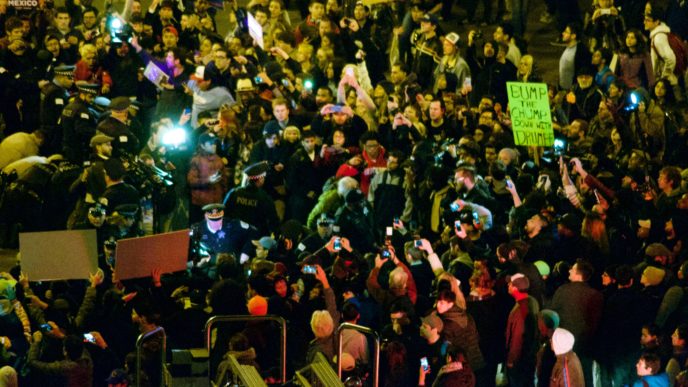
As the violent post-election riots continue, many observers are becoming aware that much of the rioting is the work of paid protesters who have been instructed to use violence. Retired Army Gen. Michael Flynn, Donald Trump’s national security advisor, told a gathering of Young America’s Foundation the demonstrators are “paid anarchists.”

Both Donald Trump and Senator Ben Sasse (R-Neb.) have publicly criticized the paid rioting. As the word is getting out, Twitter hashtags of #paidprotest and #fakeprotest have been started, identifying the operations.

The left has been paying “AstroTurf” activists for years — “astroturf” movements seem to be natural grassroots movements but were actually created and funded by others for propaganda. Project Veritas Action, the organization of conservative undercover videographer James O’Keefe, filmed Democratic operative Scott Foval discussing paying people to engage in violence at Trump campaign events. Several protesters admitted they were paid $16 an hour to demonstrate against Trump.

The Billionaire Funders

Billionaires are funding left-wing groups organizing the protests. A strategy document was uncovered in the hacked and leaked emails of Hillary Clinton’s campaign manager John Podesta. Sent from his think-tank Center for American Progress and shared with MoveOn.org, it asked leftist billionaires George and Jonathan Soros, Peter and Jonathan Lewis, Herb and Marion Sandler, Steve Bing, and John Sperling to fund “grassroots” protest efforts. Jonathan Lewis, who inherited his fortune from his father Peter Lewis, the founder of Progressive Insurance, agreed to fund the protests this year.

The lefty organizations place ads on Craigslist recruiting activists to agitate in large cities. A typical ads says, “STOP TRUMP — up to $1500/week. Hiring immediately! Call Today Start tomorrow! $15-$18 hourly rate + bonus + overtime up to 77 hours per week!”

One of the groups placing the ads is Community Outreach Group, a Planned Parenthood affiliate. Planned Parenthood received $553.7 million dollars in tax dollars last year, so taxpayers may be indirectly funding the protesters. Left-wing billionaire George Soros and his family are top contributors to Planned Parenthood. Soros himself contributed $1.5 million to the organization this election cycle.

Moveon.org placed an ad on Craigslist in New York hiring anti-Trump activists for $18 an hour. The ad said, “We only want protesters under the age of 30. … We prefer minorities.” The organization is not only funding the demonstrators but creating a fake impression of who they are. Moveon.org is also funded by Soros.

Another ad is from the Fund for the Public Interest, the largest fundraiser for progressive causes in the United States. Soros funds many of the umbrella organizations underneath it. The Progressive Unity Fund provides the financial backing for Act Now To Stop War & End Racism (ANSWER) Coalition, which started much of the rioting after the election.

What the Left Wants

The left is trying to cover its tracks. Two leftist “fake news debunking sites” are trying to distract people from investigating the paid protesters by citing a fake article about a paid protester as evidence it’s not happening. In fact, the fake article was written by a man who deliberately tried to fool Republicans into sharing incorrect news in order to help Clinton.

However, the organizations behind the rioting clearly indicate they intend to continue the demonstrations. They are planning to demonstrate at Trump’s inauguration January 20.

It is not clear what the lefty organizations seek to achieve with the protests. Trump won the election fairly and it will be extremely difficult to persuade enough electors to change their votes to Clinton. There are rumors that the left wants to generate dislike for Trump in order to start impeachment proceedings after he enters office, but with a Republican-controlled House and Senate that is equally unlikely.

Their goal must be to artificially create the appearance of a mass dislike for Trump, in order to influence others and generally undermine his administration. With the Republican advantage in the Senate so small, the left has to get only three or four senators to start opposing Trump to change the balance of power in the Senate. They may also be preparing for the mid-term elections, where Democrats hope to regain seats in Congress by capitalizing on what they hope will be Trump’s unpopularity. (For more from the author of “Who’s Funding the Rioting Against Trump?” please click HERE)

Follow Joe Miller on Twitter HERE and Facebook HERE.
Trump Dismisses Notion of Offering Senator a Spot in Cabinet – ‘No Thank You’

New Hampshire Sen. Kelly Ayotte, who has been one of the most outspoken Republicans against President-elect Donald Trump, will not have to worry about serving on Trump’s Cabinet.

When speaking with New York Times reporters Tuesday, Trump made it clear that he’s not interested.

Trump reportedly said Ayotte “would love a job in the administration.”

When asked by reporters if the senator could potentially have a spot in his Cabinet, the president-elect replied, “No thank you.”

Earlier this month, Ayotte lost her re-election bid to New Hampshire Gov. Maggie Hassan, a Democrat.

Ayotte withdrew her support for Trump in October after the release of a 2005 tape in which the New York businessman made lewd comments about women.

“I wanted to be able to support my party’s nominee, chosen by the people, because I feel strongly that we need a change in direction for our country,” she said in a statement. “However, I’m a mom and an American first, and I cannot and will not support a candidate for President who brags about degrading and assaulting women.”

Trump also had harsh words for Rep. Joe Heck, R-Nev., who also withdrew his support for Trump after the tape was released.

“I can no longer look past the pattern of behavior and comments that have been made by Donald Trump. … My wife, my daughters, my mom, my sister and all women deserve better,” Heck said in October.

Like Ayotte, Heck lost his bid for re-election, falling to Democrat Catherine Cortez Masto.

In his time with reporters Tuesday, several of whom were live tweeting highlights of the meeting, Trump said he noticed a shift among some prominent Republicans who had been critical of him before his Nov. 8 victory.

Conservative columnist George Will had suggested Trump choose Ayotte as his attorney general. (For more from the author of “Trump Dismisses Notion of Offering Senator a Spot in Cabinet – ‘No Thank You'” please click HERE)

Follow Joe Miller on Twitter HERE and Facebook HERE.

Levin: ‘Will Trump Be Nixon or Reagan?’

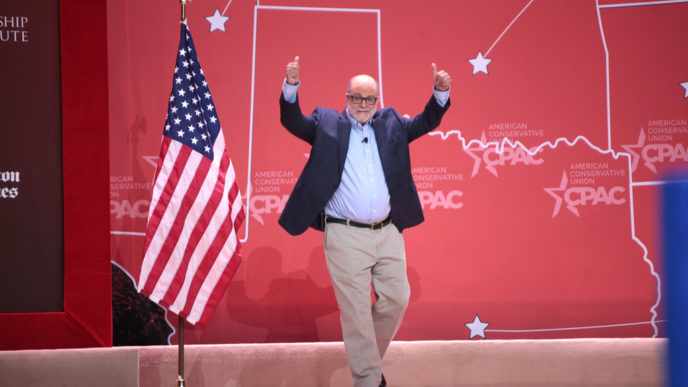
“I have a serious question,” said Mark Levin on his radio program Tuesday night. “Will Trump be more Nixon or Reagan?” His question focused on the policy positions of the two former Republican presidents.

Some of Trump’s recent comments should have conservatives wondering — perhaps not quite worrying — but wondering. The new president-elect has walked back or been silent on many major campaign promises, including the building of a border wall, cancelling the Paris climate agreement, and prosecuting Hillary Clinton.

“Of course, we are told to ignore this,” Levin said. “I want [Trump] to succeed, but I want him to do the right thing.”

Listen to the full clip below:

Now, before the inauguration, is the time to hold Trump to his word and pressure him towards conservative policies. Once he is president it will be very difficult to influence him. So, why are so many in conservative media ignoring Trump’s softer rhetoric? (For more from the author of “Levin: ‘Will Trump Be Nixon or Reagan?'” please click HERE)

Follow Joe Miller on Twitter HERE and Facebook HERE.

Clinton Critics Voice Disappointment After Trump Vows to Drop Investigation

President-elect Donald Trump asserted Tuesday his administration would not further investigate his vanquished opponent Hillary Clinton.

“I don’t want to hurt the Clintons,” Trump said in a wide-ranging interview with The New York Times.

The news came after a rough campaign where Clinton faced an FBI investigation into classified information sent and received on her private email server.

FBI Director James Comey announced in July he was not recommending a prosecution. However, 11 days before the election, he announced he was reopening the probe, only to close it two days before Election Day.

The FBI is reportedly also investigating potential ties between donors to the Clinton Foundation and actions taken by Clinton when she was the secretary of state.

“It was a premature decision [not to continue investigating Clinton] because we don’t know what evidence on the email server or Clinton Foundation will emerge,” said Peter Flaherty, president of the National Legal and Policy Center, a conservative watchdog group, told The Daily Signal.

“It shouldn’t be the call of the White House anyway, but should be left up to the new attorney general—and IRS commissioner—whether to investigate,” Flaherty continued, noting the IRS should look into the nonprofit status of the Clinton Foundation. “Prosecuting Hillary might seem like piling on from a political sense, but if she broke the law, this is a decision that should be left to law enforcement.”

Trump’s comments to The New York Times followed an interview earlier Tuesday with Trump campaign manager Kellyanne Conway in which she expressed a similar view. Trump said his administration would not pursue further investigation into the email server or the Clinton Foundation.

Trump further told the Times, “we’ll have people that do things,” which the newspaper said could mean the FBI, but Trump was clear he would not push the investigation.

Following her defeat, The Daily Signal reported that Clinton faced at least four legal probes. Regardless of Trump’s decision, she could still face scrutiny from Republican-controlled committees in the House and Senate, as well as a Federal Election Commission investigation of her presidential campaign.

During the second presidential debate, Trump told Clinton, “If I win, I am going to instruct my attorney general to get a special prosecutor to look into your situation.”

Judicial Watch President Tom Fitton expressed disappointment in Trump’s decision.

“Donald Trump must commit his administration to a serious, independent investigation of the very serious Clinton national security, email, and pay-to-play scandals,” Fitton said in a statement.

“If Mr. Trump’s appointees continue the Obama administration’s politicized spiking of a criminal investigation of Hillary Clinton, it would be a betrayal of his promise to the American people to ‘drain the swamp’ of out-of-control corruption in Washington, D.C.,” Fitton continued. “President-elect Trump should focus on healing the broken justice system, affirm the rule of law, and appoint a special prosecutor to investigate the Clinton scandals.”

The matter muddies the waters beyond what the FBI might already be investigating about Clinton, said Ilya Shapiro, senior fellow of constitutional studies at the Cato Institute, a libertarian think tank.

“It’s a little disturbing for a president to say, ‘I’m showing mercy and the fate of my political opponent is in my power,’” Shapiro told The Daily Signal. “It’s not his place to decide which political enemies to go after or not go after. The FBI and the Department of Justice should go forward without political interference.”

Shapiro added this could be politically costly.

“I think more of his supporters voted against Clinton than for him, so it would have been better to stay silent rather than act like a benevolent leader who holds the fate of his opponent at his whim,” Shapiro added.

Conway, Trump’s campaign manager and current adviser in the transition, presented the case for turning the page during an interview on MSNBC’s “Morning Joe” on Tuesday.

“I think Hillary Clinton still has to face the fact that a majority of Americans don’t find her to be honest or trustworthy,” Conway said. “If Donald Trump can help her heal, then perhaps that’s a good thing to do.”

Conway added, “I think he’s thinking of many different things as he prepares to become the president of the United States, and things that sound like the campaign are not among them.”

Trump foreshadowed that he might not pursue a special prosecutor during an interview with CBS News’ “60 Minutes” after the election.

From a political standpoint, Trump’s decision could be mixed, said Gary Rose, chairman of the political science department at Sacred Heart University.

“This does make him more statesmanlike because it probably is for the good of the country to move on, even if his base will not be all that happy,” Rose told The Daily Signal. “It does seem to turn the page and provide a way to say ‘I’m a statesman.’ But, if a crime was committed, perhaps that wasn’t his call. A line might have been crossed.” (For more from the author of “Clinton Critics Voice Disappointment After Trump Vows to Drop Investigation” please click HERE)

Follow Joe Miller on Twitter HERE and Facebook HERE.
Markets Rise to New Records — Expert Says Trump Cabinet Picks Might Send Them ‘Through the Roof’

Four days before President-elect Donald Trump was elected to the White House, there was one thing most of the economic experts agreed upon: If Trump won, the markets would lose.

Pre-election forecasts included one by Citigroup of a 5 percent drop in the Standard & Poor’s 500. Barclay’s was estimating a 13 percent drop. CMC Markets in Singapore projected the economic dismay would top that of Brexit, which led to a 5.3 percent decline in the S&P index.

As with a lot of other pre-election predictions, they got it wrong.

On Monday, for the first time in over a year, all three of the major American stock indices closed at record highs.

The Dow Jones industrial average went up 88 points, the NASDAQ rose 47 points and the S&P 500 climbed 16 points.

“So far, stock markets are betting that Trump’s fiscal polices, if implemented, would be bullish for stocks that have been waffling up until recently,” wrote Mark DeCambre on MarketWatch.

“The thinking is that a plan to increase infrastructure spending and cut corporate and personal income taxes will boost growth prospects, which is bullish for stocks,” he wrote.

Even the doom-and-gloom forecasters were coming around.

” … [P]resident-elect Trump has already left a significant imprint on financial markets. In contrast to many predictions before the election — including our own — and unlike the aftermath of the Brexit vote in the UK, the surprising outcome has generally lifted risky asset prices as well as nominal interest rates,” said a Goldman Sachs market letter cited by MarketWatch.

It may get even wilder.

“A name-brand Wall Street friendly Treasury secretary on top of tabbing [Mitt] Romney for state would send this market through the roof, that is if there even is a roof,” predicted Jim Cramer of CNBC, noting that the meeting between Trump and one of his fiercest foes in the GOP was a powerful signal that Trump could exceed expectations as president.

Wall Street investment banker Steve Mnuchin, who was a part of Trump’s campaign, and Rep. Jen, Hensarling, R-Texas, are considered two of the top candidates for the Treasury job, according to MarketWatch. (For more from the author of “Markets Rise to New Records — Expert Says Trump Cabinet Picks Might Send Them ‘Through the Roof'” please click HERE)

Follow Joe Miller on Twitter HERE and Facebook HERE.