Posts

North Korea Open To US Talks Under ‘Conditions’

A top North Korean diplomat said Saturday that Pyongyang would be willing to meet with the Trump administration for negotiations “if the conditions are set.”

Choi Sun-hee, the top North Korean diplomat who handles relations with the U.S., spoke briefly to reporters in Beijing en route to Pyongyang. She was traveling from Norway, where she led a delegation that held an informal meeting with former U.S. officials and scholars.

Choi did not elaborate on what the North’s conditions are, but her comments raise the possibility of North Korea and the U.S. returning to negotiations for the first time since 2008, when six-nation talks over Pyongyang’s nuclear weapons program fell apart. Read more from “Delaying Marriage and Parenthood: The Consequences of ‘Emerging Adulthood'” HERE)

Follow Joe Miller on Twitter HERE and Facebook HERE.

North Korea Detains Another American Over Alleged Hostile Acts

North Korea announced Sunday that it detained a fourth American citizen over unspecified hostile acts against the country and amid worsening tensions with the U.S.

North Korea’s official Korean Central News Agency said that Kim Hak Song had worked for the Pyongyang University of Science and Technology before he was held on Saturday.

North Korea on Wednesday announced the detention of an accounting instructor at the same university, Kim Sang Dok, for “acts of hostility aimed at overthrowing the country.” Kim was detained in April at the airport in Pyongyang.

The KCNA report didn’t say whether the two cases are connected.

Kim Hak Song is among at least four Americans being detained in North Korea. (Read more from “North Korea Detains Another American Over Alleged Hostile Acts” HERE)

Follow Joe Miller on Twitter HERE and Facebook HERE.

North Korea Accuses US, south Korea of Assassination Attempt

North Korea on Friday accused the U.S. and South Korean spy agencies of an unsuccessful assassination attempt on leader Kim Jong Un involving biochemical weapons.

In a statement carried on state media, North Korea’s Ministry of State Security said it will “ferret out and mercilessly destroy” the “terrorists” in the CIA and South Korean intelligence agency responsible for targeting its supreme leadership.

North Korea frequently lambasts the United States and South Korea, but its accusation Friday was unusual in its detail. (Read more from “North Korea Accuses US, south Korea of Assassination Attempt” HERE)

Follow Joe Miller on Twitter HERE and Facebook HERE.

U.S. General Confirms: Special Operations Teams Will Be Sent to Take out North Korean Nuke Sites

With China issuing a final warning to North Korea earlier today, and U.S. President Donald Trump keeping all options on the table as he prepares a response to continued North Korean military posturing and rhetoric, Army General Raymond A. Thomas confirmed in sworn testimony to a Congressional subcommittee that special operations teams will be utilized as part of any conflict with the rogue state and would likely be sent in to secure and/or destroy North Korean nuclear facilities in the event of war:

Army Gen. Raymond A. Thomas stated in testimony to a House subcommittee that Army, Navy, and Air Force commandos are based both permanently and in rotations on the Korean peninsula in case conflict breaks out.

The special operations training and preparation is a warfighting priority, Thomas said in prepared testimony. There are currently around 8,000 special operations troops deployed in more than 80 countries.

“We are actively pursuing a training path to ensure readiness for the entire range of contingency operations in which [special operations forces], to include our exquisite [countering weapons of mass destruction] capabilities, may play a critical role,” he told the subcommittee on emerging threats.

“We are looking comprehensively at our force structure and capabilities on the peninsula and across the region to maximize our support to U.S. [Pacific Command] and [U.S. Forces Korea]. This is my warfighting priority for planning and support.”

Special forces troops would be responsible for locating and destroying North Korean nuclear weapons and missile delivery systems, such as mobile missiles. They also would seek to prevent the movement of the weapons out of the country during a conflict.

Special operations missions are said by military experts to include intelligence gathering on the location of nuclear and chemical weapons sites for targeting by bombers. They also are likely to include direct action assaults on facilities to sabotage the weapons, or to prevent the weapons from being stolen, or set off at the sites by the North Koreans.

Source: Free Beacon

In earlier reports it was noted that SEALs and other commandos could be used in a first strike to decapitate North Korean leadership at the onset of any military engagement.

The President deployed high-altitude surveillance drones over North Korea earlier this week in a bid to gather intelligence about the secretive country’s nuclear and military capabilities ahead of any military action . . .

The world appears to be moving towards war at a feverish pace. (For more from the author of “U.S. General Confirms: Special Operations Teams Will Be Sent to Take out North Korean Nuke Sites” please click HERE)

Follow Joe Miller on Twitter HERE and Facebook HERE.

North Korea Just Threatened to Sink US Nuclear Submarine

North Korea, feeling pressure of encroaching American and allied vessels, has now threatened to make a ghost ship of a U.S. nuclear submarine — but the warning might not be hyperbolic rhetoric.

“The moment the USS Michigan tries to budge even a little, it will be doomed to face the miserable fate of becoming an underwater ghost without being able to come to the surface,” railed propagandistic North Korean outlet, Uriminzokkiri, quoted by the Independent.

The urgent fielding of the nuclear submarine in the waters off the Korean Peninsula, timed to coincide with the deployment of the super aircraft carrier strike group, is intended to further intensify military threats toward our republic.

Announced as a routine, scheduled training exercise with ally, South Korea, President Trump sent an ‘armada’ of U.S. vessels to the waters off the Korean peninsula, which now includes the nuclear-powered U.S.S. Michigan and the U.S.S. Carl Vinson aircraft carrier group — which, as Bloomberg reports, are also accompanied by the “destroyers USS Wayne E. Meyer and USS Michael Murphy and the Ticonderoga-class guided-missile cruiser USS Lake Champlain.”

All of this firepower, whatever the guise under which they arrived near Pyongyang’s doorstep, has been characterized by the North as “intimidation and blackmail,” particularly given Trump’s pugnacious assertions he would not allow secretive regime to develop nuclear missiles capable of striking the U.S. mainland.

Both Japan and South Korea, traditional U.S. allies in the region, continue with other allied nations to coordinate in hopes of lessening the chance Kim Jong-un would act aggressively amid stifling tensions, as Uriminzokkiri stated outright, “whether it’s a nuclear aircraft carrier or a nuclear submarine, they will be turned into a mass of scrap metal in front of our invincible military power centred on the self-defence nuclear deterrence.”

Trump recently stumped South Korea by calling for Seoul to pay up to $1 billion for its use of the THAAD missile defense system along its border with the North; but national security adviser H.R. McMaster has since insisted to his South Korean counterpart, Kim Kwan-jin, the U.S. would ensure its ally’s safety.

As the U.S. armada began arriving for exercises, Pyongyang test fired another ballistic missile, and although Washington reported that firing a failure — the missile ostensibly disintegrated just minutes after launch, its pieces landing in the Sea of Japan — the cloistered nation continued threats like the aforementioned.

China, North Korea’s strongest ally, has urged Pyongyang to employ discretion and caution in engaging the U.S., warning any sudden moves like firing upon the American fleet would bring the region into full-scale military conflict.

Asked about the latest test and for a general message on the topic of North Korea, Trump ominously stated, without elaborating further,

You’ll soon find out, won’t you?

Of course, with nationalist and military propaganda thoroughly inundating any discussion of the situation, a realistic picture of what could happen if and when rhetoric turns kinetic has been difficult to discern.

Reports such as those from the U.S. Naval Institute claim superiority in firepower, both defensive and offensive, should Pyongyang follow through with increasingly belligerent threats — but some analyses caution the Vinson group and accompanying ships might be capable of the destruction officials have championed.

Bloomberg, for instance, headlined an article, “Trump ‘Armada’ Sent to Deter Kim Can’t Shoot Down His Missiles,” on Tuesday — the same day the Michigan arrived in the South Korean port city of Busan to join the others.

Noted Bloomberg of the Vinson group and armada,

They aren’t equipped with the version of the Aegis surveillance system made by Lockheed Martin Corp. that can track long-range ballistic missiles or Raytheon Co.’s SM-3 interceptors that are capable of bringing down medium and longer-range ballistic missiles.

Nor are the modern Japanese Navy destroyers JS Samidare and JS Ashigara that joined the Vinson group for exercises equipped for missile defense detection or intercepts, a Japanese Navy spokesman confirmed. And the three South Korean ‘Sejong the Great’-class destroyers currently in operation don’t have ballistic missile defense capability, Tom Callender, a naval forces analyst with the Washington-based Heritage Foundation, said in an interview.

Further, although the Terminal High Altitude Area Defense (THAAD) system has been placed around 35 miles from the Korean demilitarized zone, its hardware is not yet fully operational — leaving South Korea vulnerable even as its neighbor to the North specifically takes issue with that defense.

Pentagon spokesman Navy Commander Gary Ross refused to answer specifics on U.S. weapons defense capabilities, he emphasized for Bloomberg, “no single capability defends against all threats. Rather it is the employment of integrated, multi-layered land and sea-based systems that provide missile defense” — for the U.S. and its allies.

“We have ballistic missile ships in the Sea of Japan, in the East Sea, that are capable of defending against ballistic missile attacks,” Navy Admiral Harry Harris, the head of U.S. forces in Korea and the Pacific, asserted Wednesday to the House Armed Services Committee.

He added of ships escorting the Vinson group that defense of the armada would not be a question, stating,

If it flies, it will die, if it’s flying against the Carl Vinson strike group.

Defense analyst David Wright with the Union of Concerned Scientists explained that, even if Aegis-equipped vessels were present in the waters near North Korea and Japan, the U.S. would not be capable of striking down another ICBM immediately after it was launched.

“There is a misconception that if it was close enough,” a U.S. Navy BMD vessel “could shoot a missile down during boost phase. But it doesn’t have that capability,” Wright said. “During boost phase the missile is an accelerating target, and Aegis doesn’t have the maneuverability to home in on such a target.

“Similarly, it would not be able to shoot down shorter-range missiles, like the Musudan, during boost phase. You might be able to shoot it down after boost phase, but by that time North Korea would be able to get information about the most critical part of the trajectory, so that strategy is unlikely to slow” Kim’s ardent quest to develop missiles.

No matter how stridently Trump feels toward quashing North Korea’s nuclear weapons hopes, any designs the U.S. might have to depose the Kim regime will not likely see success — even if physically successful.

Business Insider pointed out, the secretive nation still considers itself under the rule of ‘forever leader,’ Kim II Sung, who died in 1994 — and North Koreans vociferously support longstanding goals of nuclear aggression against the world. (For more from the author of “North Korea Just Threatened to Sink US Nuclear Submarine” please click HERE)

Follow Joe Miller on Twitter HERE and Facebook HERE.

Tillerson Says China Asked North Korea to Stop Nuclear Tests

U.S. Secretary of State Rex Tillerson said Thursday that China has threatened to impose sanctions on North Korea if it conducts further nuclear tests.

“We know that China is in communications with the regime in Pyongyang,” Tillerson said on Fox News Channel. “They confirmed to us that they had requested the regime conduct no further nuclear test.”

Tillerson said China also told the U.S. that it had informed North Korea “that if they did conduct further nuclear tests, China would be taking sanctions actions on their own.” (Read more from “Tillerson Says China Asked North Korea to Stop Nuclear Tests” HERE)

Follow Joe Miller on Twitter HERE and Facebook HERE.

What next with North Korea?

There was a moment at Press Secretary Sean Spicer’s White House briefing Monday that was significant. Asked by a reporter about North Korea’s missile launch last weekend, Spicer said the administration was aware of the launch and that “it failed.” End of story. Next question, please.

Sir Malcolm Rifkind, the former Conservative foreign secretary in Britain, might provide an explanation for Spicer’s tight-lipped response. Rifkind told the BBC Sunday that “…there is a very strong belief that the U.S. — through cyber methods — has been successful on several occasions in interrupting these sorts of tests and making them fail.”

At present, there are no direct links to a cyber attack on North Korea from the U.S., but that hasn’t stopped media outlets from reporting the possibility of one.

American Actions

Last month, the U.S. began sending the first elements of its Terminal High Altitude Area Defense (THAAD) missile defense system to South Korea, though China opposed the move. When it becomes operational will it, along with cyber attacks, be enough to deter North Korean dictator Kim Jong-Un from conducting new missile tests capable of hitting the U.S. with a nuclear warhead, which he has repeatedly threatened to do? Kim has said he will conduct missile tests “weekly” in response to U.S. threats.

On a recent visit to South Korea, Vice President Mike Pence vowed that “the era of strategic patience is over,” a strategy adopted by the Obama administration to explain its long-term view on global conflict resolution. Pence added, “North Korea would do well not to test (President Trump’s) resolve — or the strength of the armed forces of the United States in this region.”

How much of this is bluster on both sides no one can say for sure. After President Trump’s meeting with Chinese president Xi Jinping, there is some optimism that China might be able to exert sufficient pressure on its unpredictable ally to pull back from a direct confrontation with the U.S. Of greatest concern for the Trump administration, in addition to South Korean civilians who would likely suffer massive casualties should there be a North Korean invasion, are the more than 28,000 U.S. troops stationed in South Korea. Kim has threatened to attack them and flood South Korea with his ground forces.

What’s the Goal?

What is our goal with North Korea? Is it regime change? If so, who and what would follow if Kim is ousted? Kim, his father and grandfather have established such an atmosphere of complete control and cult-like obedience with North Koreans who have been cut off from all outside information that it is hard to predict how the people would react. It’s a good bet political prisoners in North Korea’s prison camps would be overjoyed if the regime fell and they were set free.

Humanrights.gov estimates between “80,000 and 120,000 political prisoners and family members are detained in these camps, where starvation, forced labor, executions, torture, rape, forced abortion and infanticide are commonplace.”

Those who wish to hold off on further challenges to North Korea must ask themselves a question. Given the erratic behavior of Kim Jong-Un and his bellicose promises to strike the U.S. with a nuclear missile, is it better to take him seriously and stop him now, or wait until he has the capability to carry out his threat?

Last week, Hawaii’s House public safety committee passed a resolution calling for the state’s defense agency to repair hundreds of fallout shelters that have not been updated since the 1980s and restock them with medical supplies, food and water.

We haven’t yet reached the tension level of the 1962 Cuban Missile Crisis, which put the United States in direct confrontation with the Soviet Union and brought the world to the brink of nuclear war, but the current tension between the U.S. and North Korea could quickly spiral downward.

Will the “peace through strength” doctrine of the Reagan administration, which suggested that military power could help preserve peace, work today? During the Reagan years, Soviet leaders were not unstable, as Kim Jong-Un appears to be, and a nuclear confrontation was avoided. Perhaps a demonstration of what the U.S can do with cyber warfare, a missile defense system and help from China will be enough.

One can only hope. (For more from the author of “What next with North Korea?” please click HERE)

Follow Joe Miller on Twitter HERE and Facebook HERE.
White House Turns up Heat, but Rejects ‘Red Lines’ for North Korea

Both the Trump administration and North Korea are ratcheting up statements about a potential conflict.

“President [Donald] Trump has changed the equation. We don’t know what he will do,” said Fred Fleitz, a senior vice president for the Center for Security Policy, a conservative national security think tank. “If there is a strike, shooting down missiles would be proportional. But I don’t think we will see a strike on missile sites.”

When visiting South Korea on Sunday, Vice President Mike Pence said “the era of strategic patience is over.” This came days after the North Korean state-run media asserted the country is “ready to react to any mode of war desired by the U.S.”

On Monday, White House press secretary Sean Spicer said the White House was unlikely to draw a “red line” on North Korea.

“Drawing red lines hasn’t worked well in the past. He holds his cards close to the vest and I think you’re not going to see him telegraphing how he’s going to respond to any military or any other situation going forth,” Spicer said. “The action he took in Syria shows, when appropriate, the president takes decisive action.”

President Barack Obama famously said that if Syrian dictator Bashar Assad used chemical weapons on his own people, it would be a “red line,” but when Assad did so in 2013, Obama took no action.

Trump’s policy marks a stark change in attitude from the Obama administration, Fleitz noted.

“North Korea will eventually have missiles pointed at U.S. bases, in Japan or elsewhere,” Fleitz said. “North Korean nuclear weapons have two purposes, deterrence and extortion. We have bought them off for years, then they break their commitments and we buy them off again for a little while, while their technology gets more and more advanced. This cycle can’t continue.”

The failed missile launch was rumored to be sabotaged by the U.S., but Fleitz said he thinks it more likely demonstrates that even while North Korean technology is advancing, it’s still inadequate.

“The failure of the missile test is a failure of their science and engineering. It’s hard to build an arsenal with stolen and borrowed parts,” Fleitz said. “Ph.D.s from MIT aren’t running to North Korea. There isn’t a lot of job security. If your project fails, you’ll be executed.”

A strike group of Navy warships was deployed toward North Korea. The USS Carl Vinson, which is part of the strike group, is capable of carrying 90 fixed-wing aircraft and helicopters.

Spicer noted that China has stopped importing North Korean coal and has signaled further economic actions after Trump met with Chinese President Xi Jinping.

“The results of [the meeting], I think, is you’ve seen China playing a much more active role in North Korea, both politically and economically, that they can continue to apply pressure to achieve results,” Spicer said. “I think we’re going to continue to urge China to continue to exert that influence to get better results.”

China shouldn’t be trusted this time around, said Bruce Klingner, senior research fellow for Northeast Asia at The Heritage Foundation.

“A succession of U.S. presidents all thought China would take action against North Korea, but after one to four months of action, China would always back off,” Klingner told The Daily Signal.

He said “giving China another chance” has too often led to not enforcing the law and existing sanctions.

Klingner said he has concerns about the new U.S. posture on North Korea. For instance, a strike could prompt North Korea to strike South Korea immediately.

“Many people believe it is useful to put pressure not only on North Korea but also on China,” he said. “Others, including myself, worry this could be unnecessary provocation. South Korea is having a presidential election now and the top debate question is how will the candidates prevent the U.S. from a pre-emptive attack on North Korea. It may be a negotiating tactic but a very high stakes one.” (For more from the author of “White House Turns up Heat, but Rejects ‘Red Lines’ for North Korea” please click HERE)

Follow Joe Miller on Twitter HERE and Facebook HERE.
Trump Warns North Korea: ‘Gotta Behave’

A day after a failed North Korean missile test, U.S. President Donald Trump had a message Monday for the North’s ruler: ‘Gotta behave.” At the same time, Vice President Mike Pence warned at the Korean Demilitarized Zone that America’s “era of strategic patience is over.”

Keeping up the verbal volleying, North Korea’s deputy U.N. ambassador accused the United States of turning the Korean peninsula into “the world’s biggest hotspot” and creating “a dangerous situation in which a thermonuclear war may break out at any moment.”

Pence’s visit to the tense DMZ dividing North and South Korea came at the start of a 10-day trip to Asia and underscored U.S. commitment. It allowed the vice president to gaze at North Korean soldiers afar and stare directly across a border marked by razor wire. (Read more from “Trump Warns North Korea: ‘Gotta Behave'” HERE)

Follow Joe Miller on Twitter HERE and Facebook HERE.
The Possible Upsides of Korea Crisis

Not only is the current showdown with North Korea unlikely to lead to a military conflict, it is likely that all the countries involved will walk away believing they have achieved something for their side. In fact, it could be the perfect storm of crisis diplomacy that’s a win-win for everybody—for now.

Pyongyang gets the world’s attention. Kim family diplomacy requires that the world see its regime as a dangerous, unpredictable menace. Otherwise, why would anybody care to deal with the world’s poorest nation at the far end of the planet?

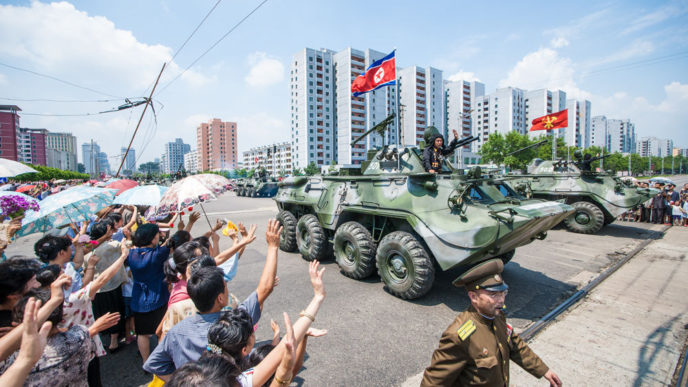
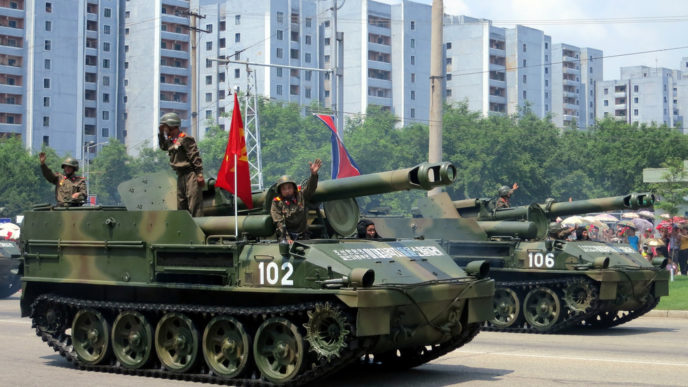
Usually the annual military parade gets no more attention than a joke on the late-night shows. This time around, Kim Jong Un’s half-serious salute got worldwide coverage. The question for Kim is how to parlay fear-mongering into some kind of strategic advantage.

Seoul and Tokyo got a big reassurance of commitment from Washington, as the U.S. rushed to show both that we’d honor our obligations to mutual defense. Nothing says we care like an armada of ships and a fleet of nuclear-capable bombers.

Beijing used the crisis to establish a rapport with the new U.S. president. Rather than stiff-arm President Donald Trump or play rope-a-dope, President Xi Jinping adopted a let’s make-a-deal attitude.

Washington got to look strong, too. In a little over a week, Trump met with top foreign leaders, including Xi, dealt with the situation in Korea, and handled a crisis in Syria. For a fledgling administration led by a president with little foreign policy chops, that was a damn decent performance.

That Trump navigated through the crisis, so far, so well is a hopeful indicator that he will deliver a mature and responsible foreign policy. Indeed, signs point in that direction.

By giving all the players involved enough space to save face, Washington helped defuse rather than escalate the crisis.

The question is: Where do we go from here?

Getting through the day without starting World War III doesn’t solve the threat of a nuclear-armed North Korea. The White House needs a sustained responsible policy. The Chinese are not going to solve the problem. Kim is never going to voluntarily give up his nukes.

Just talking will get us nowhere. What is needed is a serious long-term plan that might create future opportunities for de-escalation, something Heritage Foundation expert Bruce Klingner was pressing for even before the crisis started.

The good news is that Trump has weathered the challenge so far. The administration is following the right playbook: maximum pressure but not regime change.

But there is more to be done.

For sure, the U.S. needs to send clearer signals that it is not planning to ratchet up tensions.

While the announced part of the next-step policy seems good, the sanctions portion, including enforcing existing U.S. law, might well be put on hold pending action by China. It’s a problem that China always underperforms on its promises. Trump should not wait long for Beijing to deliver before really turning up the heat on sanctions. (For more from the author of “The Possible Upsides of Korea Crisis” please click HERE)

Follow Joe Miller on Twitter HERE and Facebook HERE.